Soci al Em
ot i onal
Lear ni ng ( SEL)
W
hat i s SEL?
SEL is the process of developing social
and emotional skills in the context of
safe, caring, well-managed, and
engaging learning environments
(CASEL, 2006).
W
her e does t hi s st uf f
com
e f r om any way?


The Collaborative for Academic and Social
Emotional Learning (CASEL), 2006
House Committee on Education and Labor;
Academic, Social, and Emotional Learning
Act (HR 4223)
W
hy Teach SEL?
 Emotions affect how and what we learn
 Schools are social places--
relationships provide foundation for
learning
 Effective as classroom
management strategy
2006, Collaborative for Academic, Social, and Emotional Learning (CASEL)
W
hy Teach SEL?





Reduces barriers to learning
SEL skills can be taught
Demanded by employers
Has positive impact on academic
performance
Required for positive citizenship
2006, Collaborative for Academic, Social, and Emotional Learning (CASEL)
The Need f or SEL
 Reduces risk taking behavior by
developing assets in students
 Complies with NCLB mandates that
schools be safe and drug free, prevent
drop out, and implement evidence
based prevention programs.
2006, Collaborative for Academic, Social, and Emotional Learning (CASEL)
The Need f or SEL
 Develops skills that employers want:
1. Learning to learn skills
2. Listening and oral communication
3. Adaptability: creative thinking and
problem solving
4. Personal management: self-esteem,
goal-setting/self-motivation
The Need f or SEL
 Develops skills that employers want:
5. Group effectiveness: interpersonal skills,
negotiation, teamwork
6. Organizational effectiveness and
leadership
7. Competence in reading,writing and
computation
U.S Department of Labor (1999)
W
hat Does t he Resear ch
Say?
 SEL leads to improvements in:
 Attitudes: Motivation and Commitment
 Behavior: Participation and Study Habits
 Performance: Grades and Subject
Mastery
Zins, J., Weissberg, R., Wang, M., and Walberg, H. (Eds.) (2004). Building Academic
Success on Social and Emotional Learning: What Does the Research Say? New
York: teachers College Press
W
hat Does t he Resear ch
Say?
 School Attitude





Stronger sense of community
Higher academic motivation and educational
aspirations
Better understanding of consequences of
behavior
Better ability to cope with school stressors
More positive attitudes toward school and
learning
Zins, J., Weissberg, R., Wang, M., and Walberg, H. (Eds.) (2004). Building Academic Success on
Social and Emotional Learning: What Does the Research Say? New York: teachers College
Press
W
hat Does t he Resear ch
Say?
 School Behavior:






Participate in class more
Demonstrate more pro-social behavior
Have fewer absences and improved attendance
Show reductions in aggression and disruptions
Are on track to graduate and are less likely to
drop out
Are more likely to work out their own way of
learning
Zins, J., Weissberg, R., Wang, M., and Walberg, H. (Eds.) (2004). Building Academic Success on Social
and Emotional Learning: What Does the Research Say? New York: teachers College Press
W
hat Does t he Resear ch
Say?
 School Performance:






Improved math, literacy, and social studies skills
Higher achievement test scores and/or grades
and no decreases in standardized test scores
Improved learning-to-learn skills
Better problem-solving and planning ability
Use of higher-level reasoning strategies
Improvements in reading comprehension
The Ul t i m
at e Goal
W
hat Does SEL Addr ess?
 Self Awareness: Knowing what we
are feeling in the moment; having
a realistic assessment of out own
abilities; and a well-grounded
sense of self confidence.
2006, Collaborative for Academic, Social, and Emotional Learning (CASEL),
Anchorage School District Standards for SEL
W
hat Does SEL Addr ess?
Examples of Self Awareness



Recognize/label emotions, distinguish
intensity,understand physical responses &
describe the situations that cause them
Aware of personal traits, “what I do well and
what I can work on”
Personal responsibility--know and
understand rules and consequences of
actions, know and understand what things
are within our control
W
hat Does SEL Addr ess?
 Social Awareness: Sensing what
others are feeling; being able to
take their perspective; appreciating
and interacting positively with
diverse groups.
2006, Collaborative for Academic, Social, and Emotional Learning (CASEL), Anchorage School
District Standards for SEL
W
hat Does SEL Addr ess?
Examples of Social Awareness






How our behavior affects others
Listening skills
Sportsmanship
Identifying cues as to how others are feeling
Demonstrate caring
Understanding how culture impacts
perspective
W
hat Does SEL Addr ess?
 Self Management: Handling our
emotions so that they facilitate rather
than interfere with the task at hand;
being conscientious and delaying
gratification to pursue goals;
persevering in the face of setbacks and
frustration.
2006, Collaborative for Academic, Social, and Emotional Learning (CASEL), Anchorage School
District Standards for SEL
W
hat Does SEL Addr ess?
Examples of Self-Management
 Identify & use calming strategies
 Understand the difference between a
truth & a lie; act with integrity
 Use a problem-solving model
 Demonstrate ability to set and achieve
goals
W
hat Does SEL Addr ess?
 Social Management: Handling
emotions in relationships effectively;
establishing and maintaining healthy
and rewarding relationships based on
cooperation; resisting inappropriate
social pressure, negotiating solutions
to conflict; and seeking help when
needed.
2006, Collaborative for Academic, Social, and Emotional Learning (CASEL), Anchorage School
District Standards for SEL
W
hat Does SEL Addr ess?
Examples of Social Management
 Give & receive compliments
 Recognize difference between positive
and negative relationships
 Understand the benefits of boundaries
in relationships
 Conflict resolution skills
The How of SEL
Within the school setting, SEL can best
be accomplished through a layered
approach of skills lessons, infusion into
the curricula and classroom practices,
and an environment of safety, respect,
and caring which models SEL values.
Anchorage District Social Emotional Learning Standards
The How of SEL
 Skills lessons:
 Stand alone curricula (i.e PATHS,
Second Step, School-Connect, Wise
Skills)
 Lessons on social skills, character
education, relaxation, conflict resolution,
self-assessments, etc.
 Teaching self-regulation through
strategies such as the Incredible 5 point
scale, How Does Your Engine Run?
The How of SEL
 Infusion into the curricula and classroom
practices (Generalization)







Anticipate the day/Reflect on the day
Standard practice for problem solving
Daily practice of relaxation
Routines
Daily goals setting
How conflict is managed in the classroom
Intentional integration in all core curriculum areas to
teach skills
The How of SEL
 Environment of safety, respect and caring
which models SEL values







Responsive classroom
Ross Green
Nurtured Heart
Love and Logic
PBIS
Health Services
School/Family/Community Partnerships
The How of SEL
What we know about Social Skills Training
 Social Skills Training for students with
disabilities needs to be more frequent and
intense
 Social Skills intervention must be linked to
the student’s social skills deficits
 The most effective social skills training
strategies are a combination of modeling,
coaching and reinforcements
W
hat Ar e W
e Doi ng
 Second Step
 Restorative Justice
 Conflict Mediation
 Transitions Curriculum
W
hat Ar e W
e Doi ng
 Restorative Practices
 Teaching Relaxation Strategies
 Social Stories
 The Incredible 5 Point Scale
 Service Learning
 Experiential Education
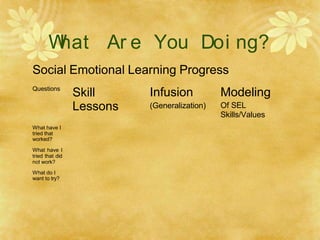
W
hat Ar e You Doi ng?
Social Emotional Learning Progress
Questions
Skill
Lessons
Infusion
(Generalization)
Modeling
Of SEL
Skills/Values
What have I
tried that
worked?
What have I
tried that did
not work?
What do I
want to try?

socialemotionallearning-130131133028-phpapp01 (1).pptx

  • 1.
    Soci al Em oti onal Lear ni ng ( SEL)
  • 2.
    W hat i sSEL? SEL is the process of developing social and emotional skills in the context of safe, caring, well-managed, and engaging learning environments (CASEL, 2006).
  • 3.
    W her e doest hi s st uf f com e f r om any way?   The Collaborative for Academic and Social Emotional Learning (CASEL), 2006 House Committee on Education and Labor; Academic, Social, and Emotional Learning Act (HR 4223)
  • 4.
    W hy Teach SEL? Emotions affect how and what we learn  Schools are social places-- relationships provide foundation for learning  Effective as classroom management strategy 2006, Collaborative for Academic, Social, and Emotional Learning (CASEL)
  • 5.
    W hy Teach SEL?      Reducesbarriers to learning SEL skills can be taught Demanded by employers Has positive impact on academic performance Required for positive citizenship 2006, Collaborative for Academic, Social, and Emotional Learning (CASEL)
  • 6.
    The Need for SEL  Reduces risk taking behavior by developing assets in students  Complies with NCLB mandates that schools be safe and drug free, prevent drop out, and implement evidence based prevention programs. 2006, Collaborative for Academic, Social, and Emotional Learning (CASEL)
  • 7.
    The Need for SEL  Develops skills that employers want: 1. Learning to learn skills 2. Listening and oral communication 3. Adaptability: creative thinking and problem solving 4. Personal management: self-esteem, goal-setting/self-motivation
  • 8.
    The Need for SEL  Develops skills that employers want: 5. Group effectiveness: interpersonal skills, negotiation, teamwork 6. Organizational effectiveness and leadership 7. Competence in reading,writing and computation U.S Department of Labor (1999)
  • 9.
    W hat Does the Resear ch Say?  SEL leads to improvements in:  Attitudes: Motivation and Commitment  Behavior: Participation and Study Habits  Performance: Grades and Subject Mastery Zins, J., Weissberg, R., Wang, M., and Walberg, H. (Eds.) (2004). Building Academic Success on Social and Emotional Learning: What Does the Research Say? New York: teachers College Press
  • 10.
    W hat Does the Resear ch Say?  School Attitude      Stronger sense of community Higher academic motivation and educational aspirations Better understanding of consequences of behavior Better ability to cope with school stressors More positive attitudes toward school and learning Zins, J., Weissberg, R., Wang, M., and Walberg, H. (Eds.) (2004). Building Academic Success on Social and Emotional Learning: What Does the Research Say? New York: teachers College Press
  • 11.
    W hat Does the Resear ch Say?  School Behavior:       Participate in class more Demonstrate more pro-social behavior Have fewer absences and improved attendance Show reductions in aggression and disruptions Are on track to graduate and are less likely to drop out Are more likely to work out their own way of learning Zins, J., Weissberg, R., Wang, M., and Walberg, H. (Eds.) (2004). Building Academic Success on Social and Emotional Learning: What Does the Research Say? New York: teachers College Press
  • 12.
    W hat Does the Resear ch Say?  School Performance:       Improved math, literacy, and social studies skills Higher achievement test scores and/or grades and no decreases in standardized test scores Improved learning-to-learn skills Better problem-solving and planning ability Use of higher-level reasoning strategies Improvements in reading comprehension
  • 13.
    The Ul ti m at e Goal
  • 14.
    W hat Does SELAddr ess?  Self Awareness: Knowing what we are feeling in the moment; having a realistic assessment of out own abilities; and a well-grounded sense of self confidence. 2006, Collaborative for Academic, Social, and Emotional Learning (CASEL), Anchorage School District Standards for SEL
  • 15.
    W hat Does SELAddr ess? Examples of Self Awareness    Recognize/label emotions, distinguish intensity,understand physical responses & describe the situations that cause them Aware of personal traits, “what I do well and what I can work on” Personal responsibility--know and understand rules and consequences of actions, know and understand what things are within our control
  • 16.
    W hat Does SELAddr ess?  Social Awareness: Sensing what others are feeling; being able to take their perspective; appreciating and interacting positively with diverse groups. 2006, Collaborative for Academic, Social, and Emotional Learning (CASEL), Anchorage School District Standards for SEL
  • 17.
    W hat Does SELAddr ess? Examples of Social Awareness       How our behavior affects others Listening skills Sportsmanship Identifying cues as to how others are feeling Demonstrate caring Understanding how culture impacts perspective
  • 18.
    W hat Does SELAddr ess?  Self Management: Handling our emotions so that they facilitate rather than interfere with the task at hand; being conscientious and delaying gratification to pursue goals; persevering in the face of setbacks and frustration. 2006, Collaborative for Academic, Social, and Emotional Learning (CASEL), Anchorage School District Standards for SEL
  • 19.
    W hat Does SELAddr ess? Examples of Self-Management  Identify & use calming strategies  Understand the difference between a truth & a lie; act with integrity  Use a problem-solving model  Demonstrate ability to set and achieve goals
  • 20.
    W hat Does SELAddr ess?  Social Management: Handling emotions in relationships effectively; establishing and maintaining healthy and rewarding relationships based on cooperation; resisting inappropriate social pressure, negotiating solutions to conflict; and seeking help when needed. 2006, Collaborative for Academic, Social, and Emotional Learning (CASEL), Anchorage School District Standards for SEL
  • 21.
    W hat Does SELAddr ess? Examples of Social Management  Give & receive compliments  Recognize difference between positive and negative relationships  Understand the benefits of boundaries in relationships  Conflict resolution skills
  • 22.
    The How ofSEL Within the school setting, SEL can best be accomplished through a layered approach of skills lessons, infusion into the curricula and classroom practices, and an environment of safety, respect, and caring which models SEL values. Anchorage District Social Emotional Learning Standards
  • 23.
    The How ofSEL  Skills lessons:  Stand alone curricula (i.e PATHS, Second Step, School-Connect, Wise Skills)  Lessons on social skills, character education, relaxation, conflict resolution, self-assessments, etc.  Teaching self-regulation through strategies such as the Incredible 5 point scale, How Does Your Engine Run?
  • 24.
    The How ofSEL  Infusion into the curricula and classroom practices (Generalization)        Anticipate the day/Reflect on the day Standard practice for problem solving Daily practice of relaxation Routines Daily goals setting How conflict is managed in the classroom Intentional integration in all core curriculum areas to teach skills
  • 25.
    The How ofSEL  Environment of safety, respect and caring which models SEL values        Responsive classroom Ross Green Nurtured Heart Love and Logic PBIS Health Services School/Family/Community Partnerships
  • 26.
    The How ofSEL What we know about Social Skills Training  Social Skills Training for students with disabilities needs to be more frequent and intense  Social Skills intervention must be linked to the student’s social skills deficits  The most effective social skills training strategies are a combination of modeling, coaching and reinforcements
  • 27.
    W hat Ar eW e Doi ng  Second Step  Restorative Justice  Conflict Mediation  Transitions Curriculum
  • 28.
    W hat Ar eW e Doi ng  Restorative Practices  Teaching Relaxation Strategies  Social Stories  The Incredible 5 Point Scale  Service Learning  Experiential Education
  • 29.
    W hat Ar eYou Doi ng? Social Emotional Learning Progress Questions Skill Lessons Infusion (Generalization) Modeling Of SEL Skills/Values What have I tried that worked? What have I tried that did not work? What do I want to try?