Cultural literacy
What is cultural literacy?
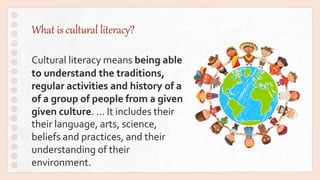
Cultural literacy means being able
to understand the traditions,
regular activities and history of a
of a group of people from a given
given culture. ... It includes their
their language, arts, science,
beliefs and practices, and their
understanding of their
environment.
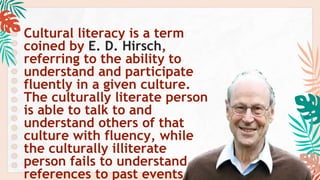
Cultural literacy is a term
coined by E. D. Hirsch,
referring to the ability to
understand and participate
fluently in a given culture.
The culturally literate person
is able to talk to and
understand others of that
culture with fluency, while
the culturally illiterate
person fails to understand
references to past events,
Why is cultural literacy
important for you?
CULTURAL LITERACY IS CULTURE-
SPECIFIC BUT IT IS NOT LIMITED TO
NATIONAL CULTURES, CONTRARY
TO WHAT MANY PEOPLE ASSUME.
THE CULTURE OF ONE WORKPLACE
CAN BE VERY DIFFERENT FROM
ANOTHERM, JUST AS THE CULTURE
OF A PARTICULAR SCHOOL CAN
DIFFER WIDELY FROM ANOTHER
CULTURAL LITERACY IN THE PHILIPPINES
• The National Commission for Culture and the Arts (NCCA) is tasked with the
documentation, preservation and dissemination of Philippine culture. Part
of how the NCCA is addressing this and related matters is through the
establishment of the Philippine Cultural Education Program (PCEP). The
PCEP held national consultative meetings, conference, workshops, art
camps, and festivals on culture-based teaching and good governance from
2003 to 2007.
• As a result of Republic Act 10066, PCEP has been designated as the body ,
together with the Department of Education (DepEd), task to “formulate the
cultural heritage education programs both local and overseas Pilipinos”
that are to be an integral part of Philippine education in all aspects.
• Cultural education- and thus cultural literacy- in the Philippines is quite a
challenge, given that Philippine culture is a complex blend of many
De Leon (2011) coins this propensity for Filipinos to
look at their culture and themselves through Western
lenses as the Dona Victorina Syndrome is a kind of
inferiority complex where anything and everything
natively Pilipino is considered as inferior, backward
and worthless in comparison to their Western
counterparts. Our low self-esteem borders on self-
contempt, the result is doubt in capacity for
achievement, perverse delight in belittling ourselves,
lack of respect and contempt for one another and
blind dependence on foreign goods, concepts,
techniques, approaches, and expertise. The biggest
challenge then is the deconstruction of the negative
self-images and notions of ourselves that we have
PHILIPPINES CULTURE EDUCATION PROGRAM
(PCEP)
PHILIPPINES CULTURE EDUCATION PROGRAM IS
THE CULTURAL EDUCATION ARM OF THE NCCA
(NATIONAL COMMISSIONS FOR CULTURE AND THE
ARTS) IT IS ENVISION AN A NATIONAL OF
CULTURALLY LITERATE AND EMPOWERED
FILIPINOS BY ENSURING THAT CULTURE IS THE
CORE AND FOUNDATION OF EDUCATION,
GOVERNANCE, AND SUSTAINABLE
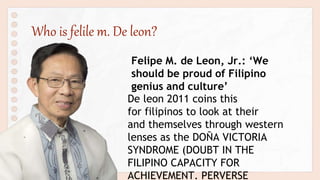
Who is felile m. De leon?
Felipe M. de Leon, Jr.: ‘We
should be proud of Filipino
genius and culture’
De leon 2011 coins this
for filipinos to look at their
and themselves through western
lenses as the DOÑA VICTORIA
SYNDROME (DOUBT IN THE
FILIPINO CAPACITY FOR
ACHIEVEMENT. PERVERSE
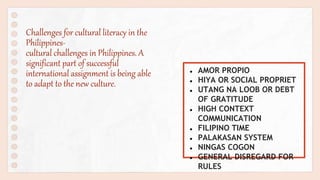
Challenges for cultural literacy in the
Philippines-
cultural challenges in Philippines. A
significant part of successful
international assignment is being able
to adapt to the new culture.
● AMOR PROPIO
● HIYA OR SOCIAL PROPRIET
● UTANG NA LOOB OR DEBT
OF GRATITUDE
● HIGH CONTEXT
COMMUNICATION
● FILIPINO TIME
● PALAKASAN SYSTEM
● NINGAS COGON
● GENERAL DISREGARD FOR
RULES
THANK YOU FOR
LISTENING AND GOD
BLESS!

PED2

  • 1.
  • 2.
    What is culturalliteracy? Cultural literacy means being able to understand the traditions, regular activities and history of a of a group of people from a given given culture. ... It includes their their language, arts, science, beliefs and practices, and their understanding of their environment.
  • 3.
    Cultural literacy isa term coined by E. D. Hirsch, referring to the ability to understand and participate fluently in a given culture. The culturally literate person is able to talk to and understand others of that culture with fluency, while the culturally illiterate person fails to understand references to past events,
  • 4.
    Why is culturalliteracy important for you?
  • 5.
    CULTURAL LITERACY ISCULTURE- SPECIFIC BUT IT IS NOT LIMITED TO NATIONAL CULTURES, CONTRARY TO WHAT MANY PEOPLE ASSUME. THE CULTURE OF ONE WORKPLACE CAN BE VERY DIFFERENT FROM ANOTHERM, JUST AS THE CULTURE OF A PARTICULAR SCHOOL CAN DIFFER WIDELY FROM ANOTHER
  • 6.
    CULTURAL LITERACY INTHE PHILIPPINES • The National Commission for Culture and the Arts (NCCA) is tasked with the documentation, preservation and dissemination of Philippine culture. Part of how the NCCA is addressing this and related matters is through the establishment of the Philippine Cultural Education Program (PCEP). The PCEP held national consultative meetings, conference, workshops, art camps, and festivals on culture-based teaching and good governance from 2003 to 2007. • As a result of Republic Act 10066, PCEP has been designated as the body , together with the Department of Education (DepEd), task to “formulate the cultural heritage education programs both local and overseas Pilipinos” that are to be an integral part of Philippine education in all aspects. • Cultural education- and thus cultural literacy- in the Philippines is quite a challenge, given that Philippine culture is a complex blend of many
  • 7.
    De Leon (2011)coins this propensity for Filipinos to look at their culture and themselves through Western lenses as the Dona Victorina Syndrome is a kind of inferiority complex where anything and everything natively Pilipino is considered as inferior, backward and worthless in comparison to their Western counterparts. Our low self-esteem borders on self- contempt, the result is doubt in capacity for achievement, perverse delight in belittling ourselves, lack of respect and contempt for one another and blind dependence on foreign goods, concepts, techniques, approaches, and expertise. The biggest challenge then is the deconstruction of the negative self-images and notions of ourselves that we have
  • 8.
    PHILIPPINES CULTURE EDUCATIONPROGRAM (PCEP) PHILIPPINES CULTURE EDUCATION PROGRAM IS THE CULTURAL EDUCATION ARM OF THE NCCA (NATIONAL COMMISSIONS FOR CULTURE AND THE ARTS) IT IS ENVISION AN A NATIONAL OF CULTURALLY LITERATE AND EMPOWERED FILIPINOS BY ENSURING THAT CULTURE IS THE CORE AND FOUNDATION OF EDUCATION, GOVERNANCE, AND SUSTAINABLE
  • 9.
    Who is felilem. De leon? Felipe M. de Leon, Jr.: ‘We should be proud of Filipino genius and culture’ De leon 2011 coins this for filipinos to look at their and themselves through western lenses as the DOÑA VICTORIA SYNDROME (DOUBT IN THE FILIPINO CAPACITY FOR ACHIEVEMENT. PERVERSE
  • 10.
    Challenges for culturalliteracy in the Philippines- cultural challenges in Philippines. A significant part of successful international assignment is being able to adapt to the new culture. ● AMOR PROPIO ● HIYA OR SOCIAL PROPRIET ● UTANG NA LOOB OR DEBT OF GRATITUDE ● HIGH CONTEXT COMMUNICATION ● FILIPINO TIME ● PALAKASAN SYSTEM ● NINGAS COGON ● GENERAL DISREGARD FOR RULES
  • 11.