Budgeting For Grant Writers

      Grant Writers Network of Greater Houston

      John F.X. Prior, LCSW, ACSW
      Harris County Protective Services
      for Children and Adults
      Houston, Texas

      March 11, 2009
Definition


     A numerical expression of an
  organization’s dreams that serves as a
     guide or measure of acceptable
          financial performance.
Benefits of a Budget
   Establishes goals to be achieved
   Identifies work to be done
   Projects resources that will be needed
    to get work done
   Establishes timetables and deadlines
   Assigns individuals responsible for
    work
Overview of Budgets
   Well-prepared, clear and accurate
    budgets allow nonprofits to:
       Adjust plans, activities, and spending
       Achieve cost effective spending
       Receive CLEAN audits
       Avoid incurring questioned or disallowed
        costs or cost overruns
Overview of Budgets
   Brings together input from Board, clients,
    management, prospective donors, and general
    public
   Anticipate operational expenses and identify
    revenue sources
   Provide financial & operational guidance to
    implement policies and use resources
   Are tools for controlling spending, avoiding deficits,
    and assessing the financial situation.
   Integrates administrative, staff, and operating
    activities
   Serves as basis for performance reviews
   Ongoing process
Roles of Staff to Create a Budget

   Agency Accountant, Treasurer, or
    Chief Financial Officer
   IF NOT:
       Someone knowledgeable about the
        project & organization
       Person who regularly handles finances
       Collaborative Effort
Budget Planning Issues
   Balancing
   Timing
   Evolution
   Accountability
   Zero Basis vs. Incremental
   Forecasting
Types of Budget
   Income & Expenses
   Revenues by Type
   Individual project, department, or program
   Service delivery costs
   Capital Additions
   Investment income
   Cash Flow
   Fund raising events
   Income generating activities
   Personnel projections
Advantages
   Enhances likelihood that organization will be
    financial successful
   Tool that translate abstract goals into determinable
    information; stipulates performance goals
   Budgeting process leads organization to look at
    itself, set priorities, and to narrow its choices
   Facilitates coordination and cooperation between
    various programs and financial department
   Periodic budget comparison to actual performance
    can identify problems and allow time for a response
    to changing conditions
   Measures financial performance in relation to
    expectations.
Disadvantages
   Presence of controls may stifle creativity
   Tendency to emphasize cost control
   Budget based on historical data only can fail
    to keep up with changing circumstances
   Budgets completed by only nonfinancial
    personnel can result in a plan without
    adequate staff input
   Not easy to implement and may require
    enthusiasm among management staff to be
    accepted as useful
Budget Elements
   Personnel
   Fringe Benefits
   Travel
   Equipment
   Supplies
   Contractual
   Indirect Charges
   Program Income
General Budget Components
   INCOME
       Donations & Memberships
       Service Delivery Fees
       Grants and Contracts
       Investment Income
Budget Components
   EXPENSES
       Personnel
       Fringe Benefits
       Travel
       Equipment
       Supplies
       Contractual
       Construction
       Indirect Charges
Budget Narrative
   Budget = Includes detailed
    calculations with estimation methods,
    quantities, unit costs, and other similar
    qualitative detail.

   Budget Narrative = Discusses
    necessity, reasonableness, and
    allocation of costs.
Indirect Charges
   Costs not readily identified with a
    particular aspect of organizational
    operation (i.e.: administration,
    fundraising, etc.)
Budgeting Do’s
   Budget for the life of the grant
       Allowable costs
       Indirect Cost Rate Agreement
       Cost of living increases
       Address matching requirements
       Seek non-Federal support
       Focus on sustainability
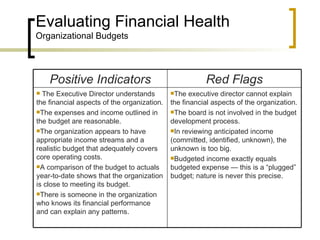
Evaluating Financial Health
Organizational Budgets


    Positive Indicators                                 Red Flags
 The Executive Director understands         The   executive director cannot explain
the financial aspects of the organization.   the financial aspects of the organization.
The expenses and income outlined in         The board is not involved in the budget
the budget are reasonable.                   development process.
The organization appears to have            In reviewing anticipated income
appropriate income streams and a             (committed, identified, unknown), the
realistic budget that adequately covers      unknown is too big.
core operating costs.                        Budgeted income exactly equals
A comparison of the budget to actuals       budgeted expense — this is a “plugged”
year-to-date shows that the organization     budget; nature is never this precise.
is close to meeting its budget.
There is someone in the organization
who knows its financial performance
and can explain any patterns.
Evaluating Financial Health
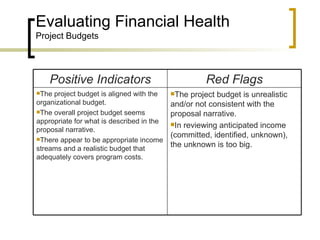
Project Budgets


    Positive Indicators                              Red Flags
The project budget is aligned with the    The  project budget is unrealistic
organizational budget.                     and/or not consistent with the
The overall project budget seems          proposal narrative.
appropriate for what is described in the   In reviewing anticipated income
proposal narrative.
There appear to be appropriate income
                                           (committed, identified, unknown),
streams and a realistic budget that
                                           the unknown is too big.
adequately covers program costs.
Evaluating Financial Health
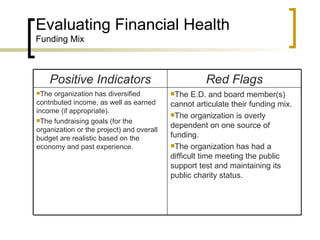
Funding Mix


    Positive Indicators                              Red Flags
The  organization has diversified         The   E.D. and board member(s)
contributed income, as well as earned      cannot articulate their funding mix.
income (if appropriate).
                                           The organization is overly
The fundraising goals (for the
                                           dependent on one source of
organization or the project) and overall
budget are realistic based on the          funding.
economy and past experience.               The organization has had a
                                           difficult time meeting the public
                                           support test and maintaining its
                                           public charity status.
Evaluating Financial Health
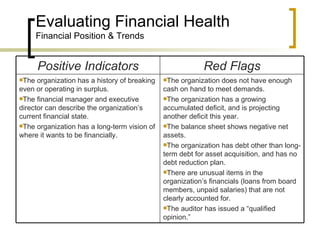
       Financial Position & Trends


       Positive Indicators                                 Red Flags
The  organization has a history of breaking   The  organization does not have enough
even or operating in surplus.                  cash on hand to meet demands.
The financial manager and executive           The organization has a growing
director can describe the organization’s       accumulated deficit, and is projecting
current financial state.                       another deficit this year.
The organization has a long-term vision of    The balance sheet shows negative net
where it wants to be financially.              assets.
                                               The organization has debt other than long-
                                               term debt for asset acquisition, and has no
                                               debt reduction plan.
                                               There are unusual items in the
                                               organization’s financials (loans from board
                                               members, unpaid salaries) that are not
                                               clearly accounted for.
                                               The auditor has issued a “qualified
                                               opinion.”
Evaluating Financial Health
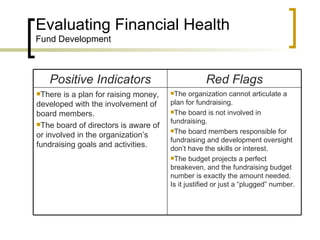
Fund Development


   Positive Indicators                             Red Flags
There  is a plan for raising money,   The    organization cannot articulate a
developed with the involvement of      plan for fundraising.
board members.                         The board is not involved in

The board of directors is aware of
                                       fundraising.
                                       The board members responsible for
or involved in the organization’s
                                       fundraising and development oversight
fundraising goals and activities.      don’t have the skills or interest.
                                       The budget projects a perfect
                                       breakeven, and the fundraising budget
                                       number is exactly the amount needed.
                                       Is it justified or just a “plugged” number.
Evaluating Financial Health
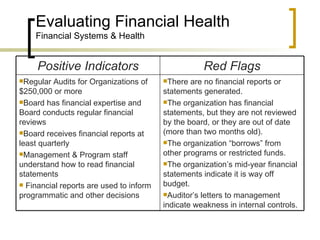
    Financial Systems & Health


     Positive Indicators                            Red Flags
Regular  Audits for Organizations of    There  are no financial reports or
$250,000 or more                         statements generated.
Board has financial expertise and       The organization has financial
Board conducts regular financial         statements, but they are not reviewed
reviews                                  by the board, or they are out of date
Board receives financial reports at     (more than two months old).
least quarterly                          The organization “borrows” from

Management & Program staff              other programs or restricted funds.
understand how to read financial         The organization’s mid-year financial
statements                               statements indicate it is way off
 Financial reports are used to inform   budget.
programmatic and other decisions         Auditor’s letters to management
                                         indicate weakness in internal controls.
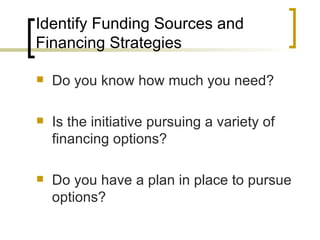
Identify Funding Sources and
Financing Strategies

   Do you know how much you need?

   Is the initiative pursuing a variety of
    financing options?

   Do you have a plan in place to pursue
    options?
Creating a Strategic Budget Plan

   Clarify What You are Budgeting For?
       Number of clients you want to serve
       Number of sites you want to operate
       Target population you want to serve
       Range of activities you want to provide,
        and
       Level of quality of services you want to
        provide.
Creating a Strategic Budget Plan

   Estimate Fiscal Needs
       Activities & strategies you want to sustain
       Over what time period do you want to
        sustain them?
       Ramp Up Assumptions:
           Scale of operations
               Start-up Costs and Timing
               Ongoing Operating Costs
               Infrastructure Costs
Creating a Strategic Budget Plan
   What funding sources currently support your
    initiative? Amounts? Type?
   What non-cash resources provide support to
    your initiative?
   Are these resources restricted to specific
    program elements or functions?
   Over what timeframe will these resources be
    available to you?
Creating a Strategic Budget Plan

   Assess Funding Gaps
       Identify Major Strategies or Activities
       Identify Total Costs
       Identify Available Resources
       Identify Gaps in Funding.
Creating a Strategic Budget Plan

   Identify Funding Sources and
    Financing Strategies
       Clarify your NEED and WHEN
       Review current funding mix
           Public Funding
           Time-limited grants of 1 to 3 years
           Longer term funding commitments of more
            than 3 years
           Any current funding sources that may be at-
            risk of reduction or termination
Creating a Strategic Budget Plan

   Identify Funding Sources and Financing
    Strategies (continued)
       How much revenue can be generated?
       What is the administrative burden?
       Does funding stream help diversify your funding
        mix?
       When can you expect to realize the revenue?
       How can the funding be used (allowable costs)?
       Does accepting funding provide opportunities to
        create new partnerships, or will it limit your
        abilities?

Budgeting For Grant Writers

  • 1.
    Budgeting For GrantWriters Grant Writers Network of Greater Houston John F.X. Prior, LCSW, ACSW Harris County Protective Services for Children and Adults Houston, Texas March 11, 2009
  • 2.
    Definition A numerical expression of an organization’s dreams that serves as a guide or measure of acceptable financial performance.
  • 3.
    Benefits of aBudget  Establishes goals to be achieved  Identifies work to be done  Projects resources that will be needed to get work done  Establishes timetables and deadlines  Assigns individuals responsible for work
  • 4.
    Overview of Budgets  Well-prepared, clear and accurate budgets allow nonprofits to:  Adjust plans, activities, and spending  Achieve cost effective spending  Receive CLEAN audits  Avoid incurring questioned or disallowed costs or cost overruns
  • 5.
    Overview of Budgets  Brings together input from Board, clients, management, prospective donors, and general public  Anticipate operational expenses and identify revenue sources  Provide financial & operational guidance to implement policies and use resources  Are tools for controlling spending, avoiding deficits, and assessing the financial situation.  Integrates administrative, staff, and operating activities  Serves as basis for performance reviews  Ongoing process
  • 6.
    Roles of Staffto Create a Budget  Agency Accountant, Treasurer, or Chief Financial Officer  IF NOT:  Someone knowledgeable about the project & organization  Person who regularly handles finances  Collaborative Effort
  • 7.
    Budget Planning Issues  Balancing  Timing  Evolution  Accountability  Zero Basis vs. Incremental  Forecasting
  • 8.
    Types of Budget  Income & Expenses  Revenues by Type  Individual project, department, or program  Service delivery costs  Capital Additions  Investment income  Cash Flow  Fund raising events  Income generating activities  Personnel projections
  • 9.
    Advantages  Enhances likelihood that organization will be financial successful  Tool that translate abstract goals into determinable information; stipulates performance goals  Budgeting process leads organization to look at itself, set priorities, and to narrow its choices  Facilitates coordination and cooperation between various programs and financial department  Periodic budget comparison to actual performance can identify problems and allow time for a response to changing conditions  Measures financial performance in relation to expectations.
  • 10.
    Disadvantages  Presence of controls may stifle creativity  Tendency to emphasize cost control  Budget based on historical data only can fail to keep up with changing circumstances  Budgets completed by only nonfinancial personnel can result in a plan without adequate staff input  Not easy to implement and may require enthusiasm among management staff to be accepted as useful
  • 11.
    Budget Elements  Personnel  Fringe Benefits  Travel  Equipment  Supplies  Contractual  Indirect Charges  Program Income
  • 12.
    General Budget Components  INCOME  Donations & Memberships  Service Delivery Fees  Grants and Contracts  Investment Income
  • 13.
    Budget Components  EXPENSES  Personnel  Fringe Benefits  Travel  Equipment  Supplies  Contractual  Construction  Indirect Charges
  • 14.
    Budget Narrative  Budget = Includes detailed calculations with estimation methods, quantities, unit costs, and other similar qualitative detail.  Budget Narrative = Discusses necessity, reasonableness, and allocation of costs.
  • 15.
    Indirect Charges  Costs not readily identified with a particular aspect of organizational operation (i.e.: administration, fundraising, etc.)
  • 16.
    Budgeting Do’s  Budget for the life of the grant  Allowable costs  Indirect Cost Rate Agreement  Cost of living increases  Address matching requirements  Seek non-Federal support  Focus on sustainability
  • 17.
    Evaluating Financial Health OrganizationalBudgets Positive Indicators Red Flags  The Executive Director understands The executive director cannot explain the financial aspects of the organization. the financial aspects of the organization. The expenses and income outlined in The board is not involved in the budget the budget are reasonable. development process. The organization appears to have In reviewing anticipated income appropriate income streams and a (committed, identified, unknown), the realistic budget that adequately covers unknown is too big. core operating costs. Budgeted income exactly equals A comparison of the budget to actuals budgeted expense — this is a “plugged” year-to-date shows that the organization budget; nature is never this precise. is close to meeting its budget. There is someone in the organization who knows its financial performance and can explain any patterns.
  • 18.
    Evaluating Financial Health ProjectBudgets Positive Indicators Red Flags The project budget is aligned with the The project budget is unrealistic organizational budget. and/or not consistent with the The overall project budget seems proposal narrative. appropriate for what is described in the In reviewing anticipated income proposal narrative. There appear to be appropriate income (committed, identified, unknown), streams and a realistic budget that the unknown is too big. adequately covers program costs.
  • 19.
    Evaluating Financial Health FundingMix Positive Indicators Red Flags The organization has diversified The E.D. and board member(s) contributed income, as well as earned cannot articulate their funding mix. income (if appropriate). The organization is overly The fundraising goals (for the dependent on one source of organization or the project) and overall budget are realistic based on the funding. economy and past experience. The organization has had a difficult time meeting the public support test and maintaining its public charity status.
  • 20.
    Evaluating Financial Health Financial Position & Trends Positive Indicators Red Flags The organization has a history of breaking The organization does not have enough even or operating in surplus. cash on hand to meet demands. The financial manager and executive The organization has a growing director can describe the organization’s accumulated deficit, and is projecting current financial state. another deficit this year. The organization has a long-term vision of The balance sheet shows negative net where it wants to be financially. assets. The organization has debt other than long- term debt for asset acquisition, and has no debt reduction plan. There are unusual items in the organization’s financials (loans from board members, unpaid salaries) that are not clearly accounted for. The auditor has issued a “qualified opinion.”
  • 21.
    Evaluating Financial Health FundDevelopment Positive Indicators Red Flags There is a plan for raising money, The organization cannot articulate a developed with the involvement of plan for fundraising. board members. The board is not involved in The board of directors is aware of fundraising. The board members responsible for or involved in the organization’s fundraising and development oversight fundraising goals and activities. don’t have the skills or interest. The budget projects a perfect breakeven, and the fundraising budget number is exactly the amount needed. Is it justified or just a “plugged” number.
  • 22.
    Evaluating Financial Health Financial Systems & Health Positive Indicators Red Flags Regular Audits for Organizations of There are no financial reports or $250,000 or more statements generated. Board has financial expertise and The organization has financial Board conducts regular financial statements, but they are not reviewed reviews by the board, or they are out of date Board receives financial reports at (more than two months old). least quarterly The organization “borrows” from Management & Program staff other programs or restricted funds. understand how to read financial The organization’s mid-year financial statements statements indicate it is way off  Financial reports are used to inform budget. programmatic and other decisions Auditor’s letters to management indicate weakness in internal controls.
  • 23.
    Identify Funding Sourcesand Financing Strategies  Do you know how much you need?  Is the initiative pursuing a variety of financing options?  Do you have a plan in place to pursue options?
  • 24.
    Creating a StrategicBudget Plan  Clarify What You are Budgeting For?  Number of clients you want to serve  Number of sites you want to operate  Target population you want to serve  Range of activities you want to provide, and  Level of quality of services you want to provide.
  • 25.
    Creating a StrategicBudget Plan  Estimate Fiscal Needs  Activities & strategies you want to sustain  Over what time period do you want to sustain them?  Ramp Up Assumptions:  Scale of operations  Start-up Costs and Timing  Ongoing Operating Costs  Infrastructure Costs
  • 26.
    Creating a StrategicBudget Plan  What funding sources currently support your initiative? Amounts? Type?  What non-cash resources provide support to your initiative?  Are these resources restricted to specific program elements or functions?  Over what timeframe will these resources be available to you?
  • 27.
    Creating a StrategicBudget Plan  Assess Funding Gaps  Identify Major Strategies or Activities  Identify Total Costs  Identify Available Resources  Identify Gaps in Funding.
  • 28.
    Creating a StrategicBudget Plan  Identify Funding Sources and Financing Strategies  Clarify your NEED and WHEN  Review current funding mix  Public Funding  Time-limited grants of 1 to 3 years  Longer term funding commitments of more than 3 years  Any current funding sources that may be at- risk of reduction or termination
  • 29.
    Creating a StrategicBudget Plan  Identify Funding Sources and Financing Strategies (continued)  How much revenue can be generated?  What is the administrative burden?  Does funding stream help diversify your funding mix?  When can you expect to realize the revenue?  How can the funding be used (allowable costs)?  Does accepting funding provide opportunities to create new partnerships, or will it limit your abilities?