GAM
E
SENSE
APPROACH
NICOLE
YANNOPOULOS, 17876126
WHAT IS GAME SENSE?
• The Game Sense (GS) Approach is a student centred approach
which allows students to develop and understand lifelong
skills
• GS focuses on the game and the rules, it’s not focused on the
explicit learning of the skills and techniques that traditional
pedagogies focus on.
• GS is fun, communicative, inclusive, challenging and player
centred (Australian Sports Commission, 2017)
WHAT DOES THE GS APPROACH INVOLVE?
• Modified games that move from simple to
complex games
• Small groups using a guided discovery and
inquiry learning approach
• Invasion games and target games
• Physical, intellectual and social learning
• GS caters for students of different ages,
sizes, abilities and motivations. This is an
inclusive pedagogy
(Curry, 2011 & Pill, 2016)
WHY GAME SENSE AND NOT THE TRADITIONAL
APPROACH?
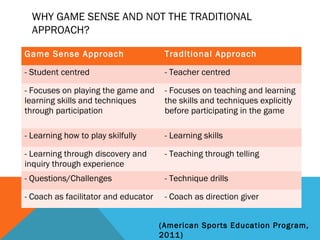
Game Sense Approach Traditional Approach
- Student centred - Teacher centred
- Focuses on playing the game and
learning skills and techniques
through participation
- Focuses on teaching and learning
the skills and techniques explicitly
before participating in the game
- Learning how to play skilfully - Learning skills
- Learning through discovery and
inquiry through experience
- Teaching through telling
- Questions/Challenges - Technique drills
- Coach as facilitator and educator - Coach as direction giver
(American Sports Education Program,
2011)
• The ‘Playing for Life’ sports cards and activities all employ a
game sense approach to teaching and learning
• One of the key features of the Game Sense Approach
includes modifying a game. Examples of this include:
- reducing or increasing the size of the playing area
- the time limit
- number of players
- adding in more complex rules
• The game sense approach uses teaching/coaching to
develop tactical and strategic thinking skills through games
• The game sense approach allows students to critically think
whilst being involved in the game before incorporating rules
and constraints. This allows for students to work
collaboratively
GAME SENSE AND THE LINKS TO THE
NSW K-6 PDHPE SYLLABUS
The Game Sense pedagogy and teaching approach will allow students to
achieve outcomes and content descriptors out of the NSW K-6 PDHPE
Syllabus. These specific outcomes are:
ALS1.6: Participates in physical activity, recognising that it can be both
enjoyable and important for health
GSS1.8: Performs fundamental movement skills with equipment in
minor games
GSS2.8: Participates and uses equipment in a variety of games and
modified sports
GSS3.8: Applies movement skills in games and sports that require
communication, cooperation, decision making and observation of rules
In conjunction to achieving these outcomes, when students participate in
PDHPE whilst the teacher utilises a Game Sense Approach, students will
be able to feel confident, secure and inclusive. Overall, these are the
feelings and experiences students will carry with them in their life.
(NSW Board of Studies, 2007)
REFERENCES
American Sports Education Program. (2011). Games approach has
advantages over traditional. human-kinetics. Retrieved 4 May 2017, from
http://www.humankinetics.com/excerpts/excerpts/games-approach-has-
advantages-over-traditional-
Australian Sports Commission. (2017). Game Sense
Approach. Sportingschools.gov.au. Retrieved 7 May 2017, from
https://www.sportingschools.gov.au/resources-and-pd/schools/playing-
for-life-resources/game-sense-approach
Curry, C. (2011). Using the Game Sense approach to deliver Quality Teaching
in Physical Education. 21st Century Learning. Retrieved from
https://learning21c.wordpress.com/2011/11/27/using-the-game-sense-
approach-to-deliver-quality-teaching-in-physical-education/
NSW Board of Studies. (2007). Personal Development, Health and Physical
Education K-6 Syllabus (1st ed.). Sydney: Board of Studies.
Pill, S. (2016). An appreciative inquiry exploring game sense teaching in
physical education. Sport, Education And Society, 21(2), 279-297.
http://dx.doi.org/10.1080/13573322.2014.912624

PDHPE PowerPoint for Weebly

  • 1.
  • 2.
    WHAT IS GAMESENSE? • The Game Sense (GS) Approach is a student centred approach which allows students to develop and understand lifelong skills • GS focuses on the game and the rules, it’s not focused on the explicit learning of the skills and techniques that traditional pedagogies focus on. • GS is fun, communicative, inclusive, challenging and player centred (Australian Sports Commission, 2017)
  • 3.
    WHAT DOES THEGS APPROACH INVOLVE? • Modified games that move from simple to complex games • Small groups using a guided discovery and inquiry learning approach • Invasion games and target games • Physical, intellectual and social learning • GS caters for students of different ages, sizes, abilities and motivations. This is an inclusive pedagogy (Curry, 2011 & Pill, 2016)
  • 4.
    WHY GAME SENSEAND NOT THE TRADITIONAL APPROACH? Game Sense Approach Traditional Approach - Student centred - Teacher centred - Focuses on playing the game and learning skills and techniques through participation - Focuses on teaching and learning the skills and techniques explicitly before participating in the game - Learning how to play skilfully - Learning skills - Learning through discovery and inquiry through experience - Teaching through telling - Questions/Challenges - Technique drills - Coach as facilitator and educator - Coach as direction giver (American Sports Education Program, 2011)
  • 5.
    • The ‘Playingfor Life’ sports cards and activities all employ a game sense approach to teaching and learning • One of the key features of the Game Sense Approach includes modifying a game. Examples of this include: - reducing or increasing the size of the playing area - the time limit - number of players - adding in more complex rules • The game sense approach uses teaching/coaching to develop tactical and strategic thinking skills through games • The game sense approach allows students to critically think whilst being involved in the game before incorporating rules and constraints. This allows for students to work collaboratively
  • 6.
    GAME SENSE ANDTHE LINKS TO THE NSW K-6 PDHPE SYLLABUS The Game Sense pedagogy and teaching approach will allow students to achieve outcomes and content descriptors out of the NSW K-6 PDHPE Syllabus. These specific outcomes are: ALS1.6: Participates in physical activity, recognising that it can be both enjoyable and important for health GSS1.8: Performs fundamental movement skills with equipment in minor games GSS2.8: Participates and uses equipment in a variety of games and modified sports GSS3.8: Applies movement skills in games and sports that require communication, cooperation, decision making and observation of rules In conjunction to achieving these outcomes, when students participate in PDHPE whilst the teacher utilises a Game Sense Approach, students will be able to feel confident, secure and inclusive. Overall, these are the feelings and experiences students will carry with them in their life. (NSW Board of Studies, 2007)
  • 7.
    REFERENCES American Sports EducationProgram. (2011). Games approach has advantages over traditional. human-kinetics. Retrieved 4 May 2017, from http://www.humankinetics.com/excerpts/excerpts/games-approach-has- advantages-over-traditional- Australian Sports Commission. (2017). Game Sense Approach. Sportingschools.gov.au. Retrieved 7 May 2017, from https://www.sportingschools.gov.au/resources-and-pd/schools/playing- for-life-resources/game-sense-approach Curry, C. (2011). Using the Game Sense approach to deliver Quality Teaching in Physical Education. 21st Century Learning. Retrieved from https://learning21c.wordpress.com/2011/11/27/using-the-game-sense- approach-to-deliver-quality-teaching-in-physical-education/ NSW Board of Studies. (2007). Personal Development, Health and Physical Education K-6 Syllabus (1st ed.). Sydney: Board of Studies. Pill, S. (2016). An appreciative inquiry exploring game sense teaching in physical education. Sport, Education And Society, 21(2), 279-297. http://dx.doi.org/10.1080/13573322.2014.912624