Game Sense Approach to Learning PE
How does it benefit your child's physical education?
Miss B’s 6B
What is Game Sense?
• Game sense adopts a different philosophy and style to traditional learning,
until recently teaching and learning PE, which has been largely teacher-
directed, highly organised and focused on developing and enhancing skill and
technique (Light, 2006)
• Game sense approaches to teaching PE are aligned with the model of
Teaching Games for Understanding (Light, 2006). This goes against the
traditional way of teaching and learning, focusing more on the interest rather
than developing skill (Pill, 2016).
Traditional vs Game sense
• Traditional approach
• Teacher centred
• Organised activities
• Focus on: skill
• Performance
• Success
• High emphasis on success (winners
and loses)
• High focus on warm ups/drills
• Playing by instruction
A game sense approach
• Student centred
• Game is the focus of the lesson
• Inclusive environment-all
participants involved
• Focuses on developing fundamental
skills
• Focus on developing confidence and
promotes a sense of belonging
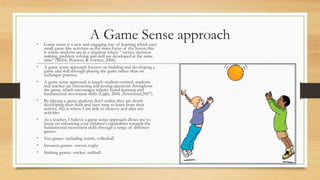
A Game Sense approach• Game sense is a new and engaging way of learning which uses
small game-like activities as the main focus of the lesson this
is where students are in a situation where “ tactics, decision
making, problem solving and skill are developed at the same
time” (Webb, Pearson, & Forrest, 2006).
• A game sense approach focuses on building and developing a
game and skill through playing the game rather than on
technique practice.
• A game sense approach is largely student-centred, students
and teacher are interacting and posing questions throughout
the game, which encourages inquiry based learning and
fundamental movement skills (Light, 2006 ;Townsend,2007).
• By playing a game students don’t realise they are slowly
developing their skills and have time to learn from their
activity, this is where I am able to observe and alter any
activities
• As a teacher, I believe a game sense approach allows me to
focus on enhancing your children's capabilities towards the
fundamental movement skills through a range of different
games:
• Net games- including tennis, volleyball
• Invasion games- soccer, rugby
• Striking games- cricket, softball
Teaching Games for
Understanding Model (TGFU)
• The game sense approach is a variation of Bunker’s and Thorpe’s Teaching
Games for Understanding Model (TGFU) (Pill, 2013).
• When using game sense, or any game it follows the model developed by Bunker
and Thorpe (1982).
• The model displays that students must first understand the form of the game,
then being aware of the problems that need to be solved in that particular game
• Through decision making, questioning, and problem solving amongst peers
students are able to achieve high performance in physical education.
• As time goes by, students should develop an understanding of the game, and
the rules that shape it.
• Students are introduced to the skill by little techniques taught gradually through
play.
• It also highlights that to acquire advanced skills and game performance,
students need to be aware of the need for a type of skill (Pill, 2013).
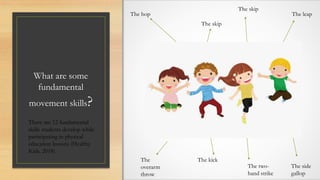
What are some
fundamental
movement skills?
The hop
The skip
The skip
The leap
The
overarm
throw
The kick
The two-
hand strike
The side
gallop
There are 12 fundamental
skills students develop while
participating in physical
education lessons (Healthy
Kids, 2018)
Strengths
as a Game
Sense as a
Teaching
Approach
• A major strengths of using the games based approach
in my PE lessons are games are able to be adapted and
modified to involve all students with different levels of
abilities, which encourages a positive sportive
environment.
• Game sense increases self-confidence and sense of
identity through positive feelings of success and
interaction with peers.
• Game sense allows students to develop skills
independently while being actively involved in a game
• It also helps in presenting physical education in an
achievable way as we are focusing on developing the
needs and slowly increasing the skill at a comfortable
pace.
• All students are participating and moving around
majority of the lesson, there is very little waiting
around listening for instructions.
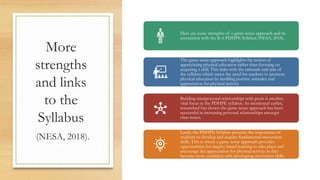
More
strengths
and links
to the
Syllabus
(NESA, 2018).
Here are some strengths of a game sense approach and its
association with the K-6 PDHPE Syllabus (NESA, 2018).
The game sense approach highlights the notion of
appreciating physical education rather than focusing on
acquiring a skill. This links with the rationale and aim of
the syllabus which states the need for teachers to promote
physical education by instilling positive attitudes and
appreciation for physical activity.
Building interpersonal relationships with peers is another
vital focus in the PDHPE syllabus. As mentioned earlier,
researched has shown the game sense approach has been
successful in increasing personal relationships amongst
class mates.
Lastly, the PDHPE Syllabus presents the importance of
students to develop and acquire fundamental movement
skills. This is where a game sense approach provides
opportunities for inquiry based learning to take place and
encourage the appreciation for physical activity as they
become more confident with developing movement skills.
References
• Board of Studies, NSW. (2007). Personal development, health and physical education K-6 syllabus. Sydney: Author. Retrieved from NESA website:
http://educationstandards.nsw.edu.au/wps/portal/nesa/k-10/ learning-areas/pdhpe/pdhpe-k-10-2018
• Healthy Kids. (2018). Live life well @ school: resources for teachers. Retrieved June 28, 2018, from https: //www.healthykids.nsw.gov.au/teachers-
childcare/live-life-well-@-school/resources-for-teachers.aspx
• Light, R.(2013). Game Sense: pedagogy for performance, participation and enjoyment. Chapter4 (pp 37-47). (Online Library Book).
• NSW Education Standards Authority. (2018). Personal development, health and physical education K-10 syllabus. Sydney: Author. Retrieved from NESA
website: http://educationstandards.nsw.edu.au/wps/portal/ nesa/k-10/learning-areas/pdhpe/pdhpe-k-10-2018
• Pearson, P., & Webb, P. (2010). The integration of tgfu into the secondary school physical education curriculum –how successful has it been? In A.
Rendimiento (Ed.), Congreso de la asociacion internacional de escuelas superios de education fisica (pp.1004-1015). Retrieved from
http://ro.uow.edu.au/cgi/viewcontent.cgi?article=1674&context=edupapers
• Pill, S. (2016). An appreciative inquiry exploring game sense teaching in physical education. Sport, Education and Society, 21(2), 279-297.
• Townsend, G. (2007). Game Sense. Rugby Football Union. Retrieved from https://vuws.westernsydney.edu.au/bbcswebdav/pid-3912527-dt-content-rid-
28958718_1/courses/102072_2019_1h/101576_2013_1h_ImportedContent_20121127041828/Games%20Sense%20by%20G%20Townsend.pdf

Game Sense Approach to Learning PE Powerpoint

  • 1.
    Game Sense Approachto Learning PE How does it benefit your child's physical education? Miss B’s 6B
  • 2.
    What is GameSense? • Game sense adopts a different philosophy and style to traditional learning, until recently teaching and learning PE, which has been largely teacher- directed, highly organised and focused on developing and enhancing skill and technique (Light, 2006) • Game sense approaches to teaching PE are aligned with the model of Teaching Games for Understanding (Light, 2006). This goes against the traditional way of teaching and learning, focusing more on the interest rather than developing skill (Pill, 2016).
  • 3.
    Traditional vs Gamesense • Traditional approach • Teacher centred • Organised activities • Focus on: skill • Performance • Success • High emphasis on success (winners and loses) • High focus on warm ups/drills • Playing by instruction A game sense approach • Student centred • Game is the focus of the lesson • Inclusive environment-all participants involved • Focuses on developing fundamental skills • Focus on developing confidence and promotes a sense of belonging
  • 4.
    A Game Senseapproach• Game sense is a new and engaging way of learning which uses small game-like activities as the main focus of the lesson this is where students are in a situation where “ tactics, decision making, problem solving and skill are developed at the same time” (Webb, Pearson, & Forrest, 2006). • A game sense approach focuses on building and developing a game and skill through playing the game rather than on technique practice. • A game sense approach is largely student-centred, students and teacher are interacting and posing questions throughout the game, which encourages inquiry based learning and fundamental movement skills (Light, 2006 ;Townsend,2007). • By playing a game students don’t realise they are slowly developing their skills and have time to learn from their activity, this is where I am able to observe and alter any activities • As a teacher, I believe a game sense approach allows me to focus on enhancing your children's capabilities towards the fundamental movement skills through a range of different games: • Net games- including tennis, volleyball • Invasion games- soccer, rugby • Striking games- cricket, softball
  • 5.
    Teaching Games for UnderstandingModel (TGFU) • The game sense approach is a variation of Bunker’s and Thorpe’s Teaching Games for Understanding Model (TGFU) (Pill, 2013). • When using game sense, or any game it follows the model developed by Bunker and Thorpe (1982). • The model displays that students must first understand the form of the game, then being aware of the problems that need to be solved in that particular game • Through decision making, questioning, and problem solving amongst peers students are able to achieve high performance in physical education. • As time goes by, students should develop an understanding of the game, and the rules that shape it. • Students are introduced to the skill by little techniques taught gradually through play. • It also highlights that to acquire advanced skills and game performance, students need to be aware of the need for a type of skill (Pill, 2013).
  • 6.
    What are some fundamental movementskills? The hop The skip The skip The leap The overarm throw The kick The two- hand strike The side gallop There are 12 fundamental skills students develop while participating in physical education lessons (Healthy Kids, 2018)
  • 7.
    Strengths as a Game Senseas a Teaching Approach • A major strengths of using the games based approach in my PE lessons are games are able to be adapted and modified to involve all students with different levels of abilities, which encourages a positive sportive environment. • Game sense increases self-confidence and sense of identity through positive feelings of success and interaction with peers. • Game sense allows students to develop skills independently while being actively involved in a game • It also helps in presenting physical education in an achievable way as we are focusing on developing the needs and slowly increasing the skill at a comfortable pace. • All students are participating and moving around majority of the lesson, there is very little waiting around listening for instructions.
  • 8.
    More strengths and links to the Syllabus (NESA,2018). Here are some strengths of a game sense approach and its association with the K-6 PDHPE Syllabus (NESA, 2018). The game sense approach highlights the notion of appreciating physical education rather than focusing on acquiring a skill. This links with the rationale and aim of the syllabus which states the need for teachers to promote physical education by instilling positive attitudes and appreciation for physical activity. Building interpersonal relationships with peers is another vital focus in the PDHPE syllabus. As mentioned earlier, researched has shown the game sense approach has been successful in increasing personal relationships amongst class mates. Lastly, the PDHPE Syllabus presents the importance of students to develop and acquire fundamental movement skills. This is where a game sense approach provides opportunities for inquiry based learning to take place and encourage the appreciation for physical activity as they become more confident with developing movement skills.
  • 9.
    References • Board ofStudies, NSW. (2007). Personal development, health and physical education K-6 syllabus. Sydney: Author. Retrieved from NESA website: http://educationstandards.nsw.edu.au/wps/portal/nesa/k-10/ learning-areas/pdhpe/pdhpe-k-10-2018 • Healthy Kids. (2018). Live life well @ school: resources for teachers. Retrieved June 28, 2018, from https: //www.healthykids.nsw.gov.au/teachers- childcare/live-life-well-@-school/resources-for-teachers.aspx • Light, R.(2013). Game Sense: pedagogy for performance, participation and enjoyment. Chapter4 (pp 37-47). (Online Library Book). • NSW Education Standards Authority. (2018). Personal development, health and physical education K-10 syllabus. Sydney: Author. Retrieved from NESA website: http://educationstandards.nsw.edu.au/wps/portal/ nesa/k-10/learning-areas/pdhpe/pdhpe-k-10-2018 • Pearson, P., & Webb, P. (2010). The integration of tgfu into the secondary school physical education curriculum –how successful has it been? In A. Rendimiento (Ed.), Congreso de la asociacion internacional de escuelas superios de education fisica (pp.1004-1015). Retrieved from http://ro.uow.edu.au/cgi/viewcontent.cgi?article=1674&context=edupapers • Pill, S. (2016). An appreciative inquiry exploring game sense teaching in physical education. Sport, Education and Society, 21(2), 279-297. • Townsend, G. (2007). Game Sense. Rugby Football Union. Retrieved from https://vuws.westernsydney.edu.au/bbcswebdav/pid-3912527-dt-content-rid- 28958718_1/courses/102072_2019_1h/101576_2013_1h_ImportedContent_20121127041828/Games%20Sense%20by%20G%20Townsend.pdf