What is a Game Sense approach?
• Games Sense (GS) is alternative teaching pedagogy to more traditional directive, and “skill and drill”
based approaches.
• As opposed to teaching fundamental skills separately from their corresponding sports, a GS approach
centres student learning around their engagement within modified games (Chen, Light, 2006, p. 51).
• These modified games emphasise students’ understanding of tactical awareness, decision-making, and
the development of skills within a contextualised environment (Chen, Light, 2006, p. 51).
• The modified games are essentially activities that are designed to limit the initial skill demands of the
base game being taught. This allows for students to focus upon the more intellectual aspects of the
game.
• The games may begin as simple activities that develop in complexity as students’ understanding and
skills develop (Chen, Light, 2006, p. 51).
• By structuring student learning around modified games, the GS approach addresses the inter-related
nature of skills, technique and overall game understanding (Pill, 2016, p. 282).
What is a Game
Sense approach?
Continued.
A GS pedagogical approach will typically
consist of:
• Small-sided and designer games
• Modified games as a representation of “full
rules”
• Student centric, inquiry based learning,
supplemented by teacher guided discovery
• A “game first” approach, rather than
“practice first”
• Categorising of games into similar principle
and objective based groups. Eg. Invasion,
Striking and Fielding, Net and Court and
Target games.
(Pill, 2016, p. 282)
Rationale Utilising a GS approach in PE brings with it a host of
advantages for students:
• The “games first” system enables students to
experience the general idea of a particular sport,
without the necessity or pressure, of possessing
specialised techniques or skillsets. This in turn
creates a highly inclusive PE environment, appealing
to students who may be low skilled, less motivated,
or have negative attitudes towards physical activity.
• Rather than separating techniques from the sport
itself, GS allows for a holistic approach to teaching a
new sport. Students engage in inquiry based
learning while they play, developing new strategies
and a better, more experience based understanding
of the core sport.
Rationale
Part 2
• A GS approach promotes the notion of a “thinking
player”. The regular intervals in which the teacher
will pose questions about the each activity/modified
game allow students the opportunity to reflect on
their participation. In these discussion periods
students are able to brainstorm tactics, techniques
and strategies that will further enhance their
understanding of the sport.
• Problem solving and decision making are
emphasised to be as important as any particular
technique or skillset.
• Participating together within teams develops
positive social and behavioural attitudes
• Through highly engaging and challenging lessons, a
GS approach fosters the development of positive
attitudes towards sport and physical activity within
and outside the school context.
Compatibility
with the
Syllabus
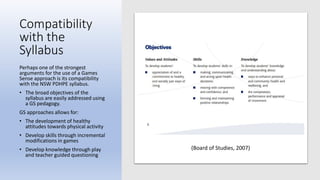
Perhaps one of the strongest
arguments for the use of a Games
Sense approach is its compatibility
with the NSW PDHPE syllabus.
• The broad objectives of the
syllabus are easily addressed using
a GS pedagogy.
GS approaches allows for:
• The development of healthy
attitudes towards physical activity
• Develop skills through incremental
modifications in games
• Develop knowledge through play
and teacher guided questioning
(Board of Studies, 2007)
References
• Chen, S., & Light, R. (2006). 'I thought I'd hate cricket but I love it!' : Year six
students' responses to Games Sense pedagogy. Change : Transformations in
Education, 9(1), 49-58. Retrieved May 9, 2017, from
http://search.informit.com.au.ezproxy.uws.edu.au/fullText;dn=165750;res=AEIPT
• Pill, S. (2016). An appreciative inquiry exploring game sense teaching in physical
education. Sport, Education and Society, 21(2), 279-297. Retrieved May 9, 2017,
from http://www-tandfonline-
com.ezproxy.uws.edu.au/doi/abs/10.1080/13573322.2014.912624
• Board of Studies, NSW. (c2007). Personal Development, Health and Physical
Education K‐6 Syllabus. Sydney: Board of Studies. Retrieved May 9, 2017, from
http://k6.boardofstudies.nsw.edu.au/wps/portal/go/personal‐development‐healt
h‐and‐physicaleducation‐pdhpe

A GAMES SENSE APPROACH

  • 2.
    What is aGame Sense approach? • Games Sense (GS) is alternative teaching pedagogy to more traditional directive, and “skill and drill” based approaches. • As opposed to teaching fundamental skills separately from their corresponding sports, a GS approach centres student learning around their engagement within modified games (Chen, Light, 2006, p. 51). • These modified games emphasise students’ understanding of tactical awareness, decision-making, and the development of skills within a contextualised environment (Chen, Light, 2006, p. 51). • The modified games are essentially activities that are designed to limit the initial skill demands of the base game being taught. This allows for students to focus upon the more intellectual aspects of the game. • The games may begin as simple activities that develop in complexity as students’ understanding and skills develop (Chen, Light, 2006, p. 51). • By structuring student learning around modified games, the GS approach addresses the inter-related nature of skills, technique and overall game understanding (Pill, 2016, p. 282).
  • 3.
    What is aGame Sense approach? Continued. A GS pedagogical approach will typically consist of: • Small-sided and designer games • Modified games as a representation of “full rules” • Student centric, inquiry based learning, supplemented by teacher guided discovery • A “game first” approach, rather than “practice first” • Categorising of games into similar principle and objective based groups. Eg. Invasion, Striking and Fielding, Net and Court and Target games. (Pill, 2016, p. 282)
  • 4.
    Rationale Utilising aGS approach in PE brings with it a host of advantages for students: • The “games first” system enables students to experience the general idea of a particular sport, without the necessity or pressure, of possessing specialised techniques or skillsets. This in turn creates a highly inclusive PE environment, appealing to students who may be low skilled, less motivated, or have negative attitudes towards physical activity. • Rather than separating techniques from the sport itself, GS allows for a holistic approach to teaching a new sport. Students engage in inquiry based learning while they play, developing new strategies and a better, more experience based understanding of the core sport.
  • 5.
    Rationale Part 2 • AGS approach promotes the notion of a “thinking player”. The regular intervals in which the teacher will pose questions about the each activity/modified game allow students the opportunity to reflect on their participation. In these discussion periods students are able to brainstorm tactics, techniques and strategies that will further enhance their understanding of the sport. • Problem solving and decision making are emphasised to be as important as any particular technique or skillset. • Participating together within teams develops positive social and behavioural attitudes • Through highly engaging and challenging lessons, a GS approach fosters the development of positive attitudes towards sport and physical activity within and outside the school context.
  • 6.
    Compatibility with the Syllabus Perhaps oneof the strongest arguments for the use of a Games Sense approach is its compatibility with the NSW PDHPE syllabus. • The broad objectives of the syllabus are easily addressed using a GS pedagogy. GS approaches allows for: • The development of healthy attitudes towards physical activity • Develop skills through incremental modifications in games • Develop knowledge through play and teacher guided questioning (Board of Studies, 2007)
  • 7.
    References • Chen, S.,& Light, R. (2006). 'I thought I'd hate cricket but I love it!' : Year six students' responses to Games Sense pedagogy. Change : Transformations in Education, 9(1), 49-58. Retrieved May 9, 2017, from http://search.informit.com.au.ezproxy.uws.edu.au/fullText;dn=165750;res=AEIPT • Pill, S. (2016). An appreciative inquiry exploring game sense teaching in physical education. Sport, Education and Society, 21(2), 279-297. Retrieved May 9, 2017, from http://www-tandfonline- com.ezproxy.uws.edu.au/doi/abs/10.1080/13573322.2014.912624 • Board of Studies, NSW. (c2007). Personal Development, Health and Physical Education K‐6 Syllabus. Sydney: Board of Studies. Retrieved May 9, 2017, from http://k6.boardofstudies.nsw.edu.au/wps/portal/go/personal‐development‐healt h‐and‐physicaleducation‐pdhpe