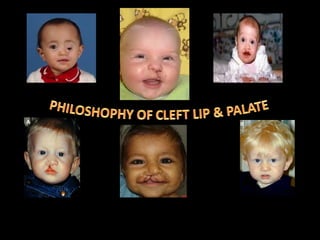
• Approximately one in 1000 children is born with a cleft palate, cleft lip,
or with both anomalies.
• Epidemiology differentiates between cleft lip with or with out cleft
palate and isolated cleft palate, the most common form of which is thepalate and isolated cleft palate, the most common form of which is the
cleft lip with cleft palate.
• Cleft lip and palate is the second most common congenital
malformation exceeded only by cardiovascular malformations.
• Unilateral clefts occur six times more often than bilateral clefts.
• The rates of oral clefts in Asian populations are high (0.79 to
3.74 per 1000 individuals); intermediate rates for Caucasians
have been reported (0.91 to 2.69 per 1000 individuals); and
Black African populations have a very low rate of cleft
malformation (0.18 to 1.67 per 1000 individuals).
In India one child in 714 birthsone child in 714 births is born with a cleft defect
35,000 children35,000 children are born with such defects in India every
malformation (0.18 to 1.67 per 1000 individuals).
• Males are more often affected with CL/P, whereas females are
more frequently afflicted with cleft palate only and with severe
forms of CL/P.
• Left sided cleft is more common, than the right side.
35,000 children35,000 children are born with such defects in India every
year (Study of Children Born with Cleft Lips And Palates in India - S Shiva Raju et al
December 2000)
• Cleft occurs alone (non-syndromic) or associated with other congenital
anomalies.
• Multifactorial etiology
– Chemical exposures, radiation, maternal hypoxia, teratogenic drugs,
nutritional deficiencies, physical obstruction,
• Genetic factors
– Recent studies - cleft malformation is associated with polymorphisms in the– Recent studies - cleft malformation is associated with polymorphisms in the
gene encoding TGF alpha, an epidermal growth factor receptor (EGFR) ligand
made by most epithelia.
– Mutations in other genes, such as cytochrome P-450, the retinoic acid
receptor or NADH dehydrogenase, have also been implicated.
• Environmental factors
• Associated with syndromes
Clefts are seen to be associated with more than 250
syndromes
• Some of them are-
• Waardenburg syndrome
• van der Woude’s syndrome
• Orofacial digital syndrome
• Treacher collin syndrome
• Pierre robin syndrome
• Klippel Feil syndrome
• Repair of the lip is generally deferreddeferred until an infant weighs approximately 12
to 14 lbs in order to have more tissue with which to work.
• Palate repair is m/c performed b/w 12-24 months of age.
• Clefts involving only the soft palate – 6-18 months.
Repair procedures for lip:
1. lip adhesion procedure.
• for very difficult & wide cleft of the lip.
• M/C used in wide cleft of the lip
2. Rose thompson operation or straight line repair.2. Rose thompson operation or straight line repair.
• Only for the repair of incomp cleft, prenatal scars &revision of a lip scar.
3. Tennison – Randall Triangular flap.
• Excellent proced, only little tissue is sacrificed.
• Require exact measurements & is mathematical
4. Millard Rotation- Advancement Flap
• M/C approach to cleft lip repair.
• Does not require the mathematics.
• Used in incomplete, complete & wide cleft repairs.
• Less precise than Tennison randall.
Controversial
• In 1921, Sir HaroldSir Harold GilliesGillies - "Close the lip early and repair the
palate prior to speech".
• Most believe - palate should be closed prior to the time that the
child begins to speak.child begins to speak.
• Main area of controversy - timing of hard palatehard palate repair
• Early repair results in scar tissue formation and limitation of
maxillary growth
• Early soft palate repair preceding hard palate closure is
recommended by some.
• But most surgeons close the hard and soft palate as early as 6-9
months of age and almost always before 18 months of age.
I) Primary Veloplsty
• Soft palate closure at early age.
• Delayed hard palate closure
• Currently rarely indicated.
 Severe speech problems.
 Requires additional procedure so tech. difficult
II)Von Langenbeck’s palatoplasty
• Bipedicle mucoperiosteal flap
• Effective only for soft palate clefts.• Effective only for soft palate clefts.
III) Oxford palatoplasty (V to Y push-back.) (Kilner 1937; Wardill 1937)
• Posteriorly & ant based unipedicle mucoperiosteal flaps.
• V-Y rerodisplacement advantages
 Lengthens palate.
 Better speech than with Von Langenback’s palatoplasty.
• V-Y rerodisplacement disadvantages
 Def. mucosal coverage of nasal surface, leading to scar contracture &
shortened palate.
 Failure to close alveolar portion of cleft.
 Fistulas occurs at hard/soft palate junction.
IV) Two flap tech.
• Only for posteriorly based unipedicle flaps.
• Advantages: Closes alveolar cleft.
• Disadvantage: no palatal lengthening.
RECONSTRUCTION OF ALVEOLAR CLEFT:RECONSTRUCTION OF ALVEOLAR CLEFT:
Surgical goals:
• Oronasal fistula closure.• Oronasal fistula closure.
• Improvement of alveolar ridge form.
• Prevention of tooth loss (primarily the cuspid) d/t lack of pdl support.
• provision of nasal alar base support.
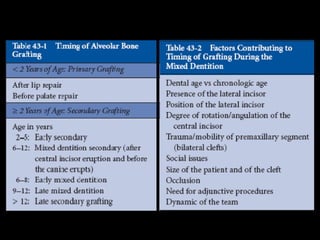
Timing of bone grafting:
1. Primary bone grafting Less than age 2
2. Early secondary grafting Ages 2 to 6
3. Secondary grafting Ages 7-12 (before time of cuspid eruption).
4. Late secondary grafting adult
1. Primary bone grafting at less than age 2 was abandoned b/c of
adverse effects noted in facial growth & arch form.
2. Early sec. grafting b/w ages 2 and 6, is done to provide support
for eruption of lateral incisor.
• If lat. Incisor is present & appears to be anatomically normal,
early secondary grafting may be indicated.
• A child at age 5 still has significant transverse & A-P growth
remaining in the maxilla, & placement of an alveolar graft at that
age may interfere with midface growth.age may interfere with midface growth.
• Mx is completed by age 8, & bone grafting performed after that
age does not interfere with mx growth in those dimensions.
3. The m/c time for alveolar cleft grafting is b/w 9 & 11, before the
time the permanent cuspid erupts & when half to 2/3rd of the
roots has formed.
• At this age, A-P & transverse mx growth is complete & only
vertical mx growth remains.
• Objectives of alveolar cleft grafting
– To fillfill the bony defectthe bony defect and to enable spontaneous canine
eruption
– To closeclose any oronasal fistulasany oronasal fistulas and eliminate mucosal
recesses
– To provide bony supportbony support for the alar base– To provide bony supportbony support for the alar base
– To improveimprove alveolar contouralveolar contour, dental, and facial
aesthetics
– To stabilizestabilize the segments
– To provideprovide bonebone for osseointegrated implants
– To aim for nonnon--prosthetic rehabilitationprosthetic rehabilitation
– To improveimprove the condition of thethe condition of the periodontiumperiodontium and soft
tissue
• The ideal patient is between the ages of 8 and
12 years with a maxillary canine root that is
one-half to two-thirds developed.
Biologic process of new bone formation b/w the surfaces of bone segments
that are gradually separated by incremental traction.
Contribution by Russian surgeon Gavrill Ilizarov.
Ilizarov’s protocol:
1. Divide 2/3rd of bony cortex with a narrow osteotome (comp. osteotomy
can be done in mandible b/c of good periosteal supply)
2. Place the distraction device.
3. Latency period: 2 days in young pts & 7 days in old pts. (adequate
duration of latency period allow development of # callus).
4. Distraction rate: 1mm/day (0.25mm in 4 increments).
• If < 0.5mm/day- premature consolidation
• If > 1.5mm/day- local ischemia & delayed ossification or pseudoartheosis
may occur.)
5. Consolidation period: 6 times the days required for distraction.
Sufficient time for consolidation & remodelling of newly formed bone before
fnal load.

Pdf clcp

  • 2.
    • Approximately onein 1000 children is born with a cleft palate, cleft lip, or with both anomalies. • Epidemiology differentiates between cleft lip with or with out cleft palate and isolated cleft palate, the most common form of which is thepalate and isolated cleft palate, the most common form of which is the cleft lip with cleft palate. • Cleft lip and palate is the second most common congenital malformation exceeded only by cardiovascular malformations. • Unilateral clefts occur six times more often than bilateral clefts.
  • 3.
    • The ratesof oral clefts in Asian populations are high (0.79 to 3.74 per 1000 individuals); intermediate rates for Caucasians have been reported (0.91 to 2.69 per 1000 individuals); and Black African populations have a very low rate of cleft malformation (0.18 to 1.67 per 1000 individuals). In India one child in 714 birthsone child in 714 births is born with a cleft defect 35,000 children35,000 children are born with such defects in India every malformation (0.18 to 1.67 per 1000 individuals). • Males are more often affected with CL/P, whereas females are more frequently afflicted with cleft palate only and with severe forms of CL/P. • Left sided cleft is more common, than the right side. 35,000 children35,000 children are born with such defects in India every year (Study of Children Born with Cleft Lips And Palates in India - S Shiva Raju et al December 2000)
  • 4.
    • Cleft occursalone (non-syndromic) or associated with other congenital anomalies. • Multifactorial etiology – Chemical exposures, radiation, maternal hypoxia, teratogenic drugs, nutritional deficiencies, physical obstruction, • Genetic factors – Recent studies - cleft malformation is associated with polymorphisms in the– Recent studies - cleft malformation is associated with polymorphisms in the gene encoding TGF alpha, an epidermal growth factor receptor (EGFR) ligand made by most epithelia. – Mutations in other genes, such as cytochrome P-450, the retinoic acid receptor or NADH dehydrogenase, have also been implicated. • Environmental factors • Associated with syndromes
  • 5.
    Clefts are seento be associated with more than 250 syndromes • Some of them are- • Waardenburg syndrome • van der Woude’s syndrome • Orofacial digital syndrome • Treacher collin syndrome • Pierre robin syndrome • Klippel Feil syndrome
  • 6.
    • Repair ofthe lip is generally deferreddeferred until an infant weighs approximately 12 to 14 lbs in order to have more tissue with which to work. • Palate repair is m/c performed b/w 12-24 months of age. • Clefts involving only the soft palate – 6-18 months. Repair procedures for lip: 1. lip adhesion procedure. • for very difficult & wide cleft of the lip. • M/C used in wide cleft of the lip 2. Rose thompson operation or straight line repair.2. Rose thompson operation or straight line repair. • Only for the repair of incomp cleft, prenatal scars &revision of a lip scar. 3. Tennison – Randall Triangular flap. • Excellent proced, only little tissue is sacrificed. • Require exact measurements & is mathematical 4. Millard Rotation- Advancement Flap • M/C approach to cleft lip repair. • Does not require the mathematics. • Used in incomplete, complete & wide cleft repairs. • Less precise than Tennison randall.
  • 8.
    Controversial • In 1921,Sir HaroldSir Harold GilliesGillies - "Close the lip early and repair the palate prior to speech". • Most believe - palate should be closed prior to the time that the child begins to speak.child begins to speak. • Main area of controversy - timing of hard palatehard palate repair • Early repair results in scar tissue formation and limitation of maxillary growth • Early soft palate repair preceding hard palate closure is recommended by some. • But most surgeons close the hard and soft palate as early as 6-9 months of age and almost always before 18 months of age.
  • 9.
    I) Primary Veloplsty •Soft palate closure at early age. • Delayed hard palate closure • Currently rarely indicated.  Severe speech problems.  Requires additional procedure so tech. difficult II)Von Langenbeck’s palatoplasty • Bipedicle mucoperiosteal flap • Effective only for soft palate clefts.• Effective only for soft palate clefts. III) Oxford palatoplasty (V to Y push-back.) (Kilner 1937; Wardill 1937) • Posteriorly & ant based unipedicle mucoperiosteal flaps. • V-Y rerodisplacement advantages  Lengthens palate.  Better speech than with Von Langenback’s palatoplasty. • V-Y rerodisplacement disadvantages  Def. mucosal coverage of nasal surface, leading to scar contracture & shortened palate.  Failure to close alveolar portion of cleft.  Fistulas occurs at hard/soft palate junction.
  • 10.
    IV) Two flaptech. • Only for posteriorly based unipedicle flaps. • Advantages: Closes alveolar cleft. • Disadvantage: no palatal lengthening. RECONSTRUCTION OF ALVEOLAR CLEFT:RECONSTRUCTION OF ALVEOLAR CLEFT: Surgical goals: • Oronasal fistula closure.• Oronasal fistula closure. • Improvement of alveolar ridge form. • Prevention of tooth loss (primarily the cuspid) d/t lack of pdl support. • provision of nasal alar base support. Timing of bone grafting: 1. Primary bone grafting Less than age 2 2. Early secondary grafting Ages 2 to 6 3. Secondary grafting Ages 7-12 (before time of cuspid eruption). 4. Late secondary grafting adult
  • 11.
    1. Primary bonegrafting at less than age 2 was abandoned b/c of adverse effects noted in facial growth & arch form. 2. Early sec. grafting b/w ages 2 and 6, is done to provide support for eruption of lateral incisor. • If lat. Incisor is present & appears to be anatomically normal, early secondary grafting may be indicated. • A child at age 5 still has significant transverse & A-P growth remaining in the maxilla, & placement of an alveolar graft at that age may interfere with midface growth.age may interfere with midface growth. • Mx is completed by age 8, & bone grafting performed after that age does not interfere with mx growth in those dimensions. 3. The m/c time for alveolar cleft grafting is b/w 9 & 11, before the time the permanent cuspid erupts & when half to 2/3rd of the roots has formed. • At this age, A-P & transverse mx growth is complete & only vertical mx growth remains.
  • 12.
    • Objectives ofalveolar cleft grafting – To fillfill the bony defectthe bony defect and to enable spontaneous canine eruption – To closeclose any oronasal fistulasany oronasal fistulas and eliminate mucosal recesses – To provide bony supportbony support for the alar base– To provide bony supportbony support for the alar base – To improveimprove alveolar contouralveolar contour, dental, and facial aesthetics – To stabilizestabilize the segments – To provideprovide bonebone for osseointegrated implants – To aim for nonnon--prosthetic rehabilitationprosthetic rehabilitation – To improveimprove the condition of thethe condition of the periodontiumperiodontium and soft tissue
  • 14.
    • The idealpatient is between the ages of 8 and 12 years with a maxillary canine root that is one-half to two-thirds developed.
  • 15.
    Biologic process ofnew bone formation b/w the surfaces of bone segments that are gradually separated by incremental traction. Contribution by Russian surgeon Gavrill Ilizarov. Ilizarov’s protocol: 1. Divide 2/3rd of bony cortex with a narrow osteotome (comp. osteotomy can be done in mandible b/c of good periosteal supply) 2. Place the distraction device. 3. Latency period: 2 days in young pts & 7 days in old pts. (adequate duration of latency period allow development of # callus). 4. Distraction rate: 1mm/day (0.25mm in 4 increments). • If < 0.5mm/day- premature consolidation • If > 1.5mm/day- local ischemia & delayed ossification or pseudoartheosis may occur.) 5. Consolidation period: 6 times the days required for distraction. Sufficient time for consolidation & remodelling of newly formed bone before fnal load.