PDE3330 Nov 2019
Referencing made easy
https://unihub.mdx.ac.uk/study/library
In this workshop we will look at..
• Basics
• Creating references
• Getting them right
• Identifying resources
• Referencing from scratch
What is referencing?
• Acknowledging other people’s work
• Link between what you write and your evidence
Adapted from: https://www.citethemrightonline.com/Basics/what-is-referencing
Why reference?
• Demonstrate that you have read widely
• Evidence of your research
• Establish the credibility and authority of your ideas and
arguments
• Reader can locate original material used
• Give credit to the author/creator
• Highlight and back-up relevant points
• Avoid plagiarism
Adapted from: https://www.citethemrightonline.com/Basics/what-is-referencing
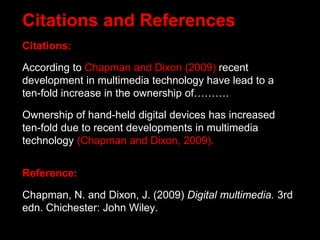
Citations and References
Citations:
According to Chapman and Dixon (2009) recent
development in multimedia technology have lead to a
ten-fold increase in the ownership of……….
Ownership of hand-held digital devices has increased
ten-fold due to recent developments in multimedia
technology (Chapman and Dixon, 2009).
Reference:
Chapman, N. and Dixon, J. (2009) Digital multimedia. 3rd
edn. Chichester: John Wiley.
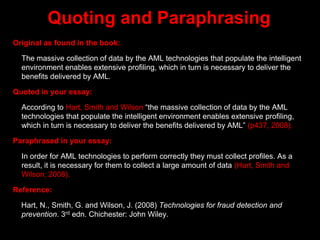
Quoting and Paraphrasing
Original as found in the book:
The massive collection of data by the AML technologies that populate the intelligent
environment enables extensive profiling, which in turn is necessary to deliver the
benefits delivered by AML.
Quoted in your essay:
According to Hart, Smith and Wilson “the massive collection of data by the AML
technologies that populate the intelligent environment enables extensive profiling,
which in turn is necessary to deliver the benefits delivered by AML” (p437, 2008).
Paraphrased in your essay:
In order for AML technologies to perform correctly they must collect profiles. As a
result, it is necessary for them to collect a large amount of data (Hart, Smith and
Wilson, 2008).
Reference:
Hart, N., Smith, G. and Wilson, J. (2008) Technologies for fraud detection and
prevention. 3rd edn. Chichester: John Wiley.
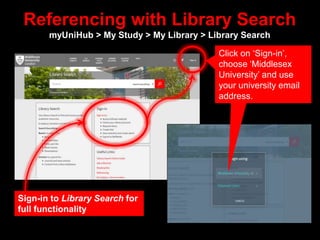
Sign-in to Library Search for
full functionality
Click on ‘Sign-in’,
choose ‘Middlesex
University’ and use
your university email
address.
Referencing with Library Search
myUniHub > My Study > My Library > Library Search
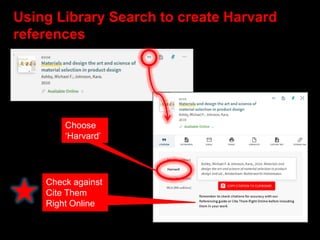
Using Library Search to create Harvard
references
Choose
‘Harvard’
Check against
Cite Them
Right Online
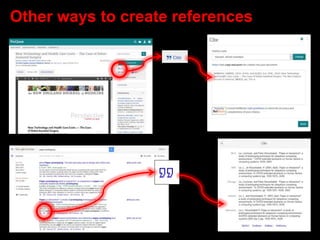
Other ways to create references
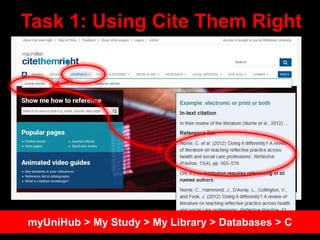
Task 1: Using Cite Them Right
myUniHub > My Study > My Library > Databases > C
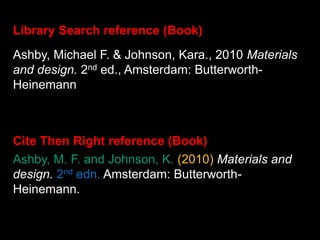
Ashby, M. F. and Johnson, K. (2010) Materials and
design. 2nd edn. Amsterdam: Butterworth-
Heinemann.
Library Search reference (Book)
Cite Then Right reference (Book)
Ashby, Michael F. & Johnson, Kara., 2010 Materials
and design. 2nd ed., Amsterdam: Butterworth-
Heinemann
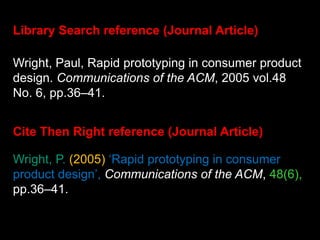
Wright, P. (2005) ‘Rapid prototyping in consumer
product design’, Communications of the ACM, 48(6),
pp.36–41.
Library Search reference (Journal Article)
Cite Then Right reference (Journal Article)
Wright, Paul, Rapid prototyping in consumer product
design. Communications of the ACM, 2005 vol.48
No. 6, pp.36–41.
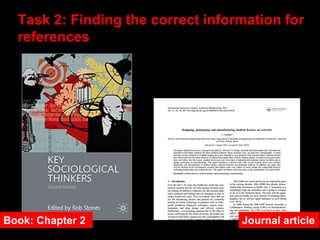
Task 2: Finding the correct information for
references
Book: Chapter 2 Journal article
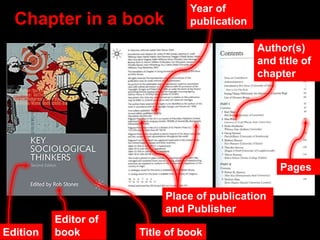
Chapter in a book
Editor of
book Title of bookEdition
Place of publication
and Publisher
Year of
publication
Author(s)
and title of
chapter
Pages
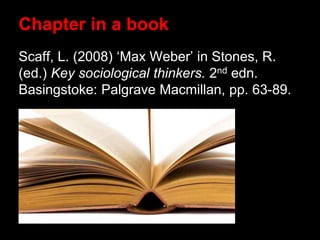
Scaff, L. (2008) ‘Max Weber’ in Stones, R.
(ed.) Key sociological thinkers. 2nd edn.
Basingstoke: Palgrave Macmillan, pp. 63-89.
Chapter in a book
Journal article
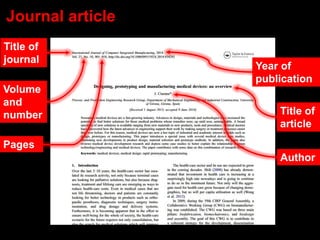
Author
Pages
Year of
publication
Title of
article
Title of
journal
Volume
and
number
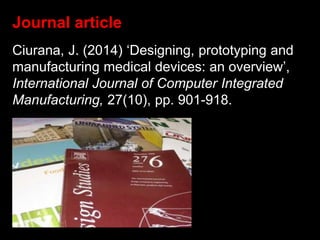
Ciurana, J. (2014) ‘Designing, prototyping and
manufacturing medical devices: an overview’,
International Journal of Computer Integrated
Manufacturing, 27(10), pp. 901-918.
Journal article
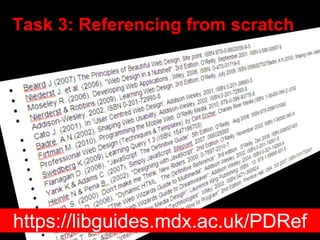
Task 3: Referencing from scratch
https://libguides.mdx.ac.uk/PDRef
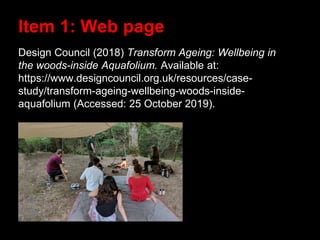
Design Council (2018) Transform Ageing: Wellbeing in
the woods-inside Aquafolium. Available at:
https://www.designcouncil.org.uk/resources/case-
study/transform-ageing-wellbeing-woods-inside-
aquafolium (Accessed: 25 October 2019).
Item 1: Web page
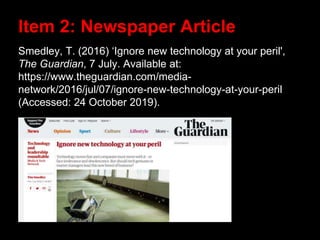
Smedley, T. (2016) ‘Ignore new technology at your peril',
The Guardian, 7 July. Available at:
https://www.theguardian.com/media-
network/2016/jul/07/ignore-new-technology-at-your-peril
(Accessed: 24 October 2019).
Item 2: Newspaper Article
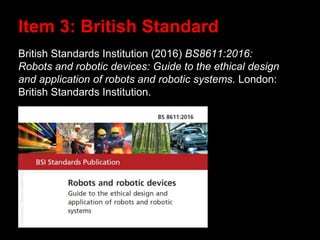
British Standards Institution (2016) BS8611:2016:
Robots and robotic devices: Guide to the ethical design
and application of robots and robotic systems. London:
British Standards Institution.
Item 3: British Standard
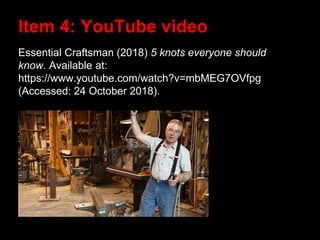
Essential Craftsman (2018) 5 knots everyone should
know. Available at:
https://www.youtube.com/watch?v=mbMEG7OVfpg
(Accessed: 24 October 2018).
Item 4: YouTube video
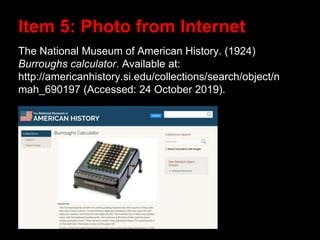
The National Museum of American History. (1924)
Burroughs calculator. Available at:
http://americanhistory.si.edu/collections/search/object/n
mah_690197 (Accessed: 24 October 2019).
Item 5: Photo from Internet
Referencing top tips
• Create references using Library Search
• Use Cite Them Right
• Be consistent
Need further help?
Your Librarian is:
Vanessa Hill v.hill@mdx.ac.uk
http://libguides.mdx.ac.uk/pdde/Help

PDE3330 3rd year Harvard Referencing workshop Nov 2019

  • 1.
    PDE3330 Nov 2019 Referencingmade easy https://unihub.mdx.ac.uk/study/library
  • 2.
    In this workshopwe will look at.. • Basics • Creating references • Getting them right • Identifying resources • Referencing from scratch
  • 3.
    What is referencing? •Acknowledging other people’s work • Link between what you write and your evidence Adapted from: https://www.citethemrightonline.com/Basics/what-is-referencing
  • 4.
    Why reference? • Demonstratethat you have read widely • Evidence of your research • Establish the credibility and authority of your ideas and arguments • Reader can locate original material used • Give credit to the author/creator • Highlight and back-up relevant points • Avoid plagiarism Adapted from: https://www.citethemrightonline.com/Basics/what-is-referencing
  • 5.
    Citations and References Citations: Accordingto Chapman and Dixon (2009) recent development in multimedia technology have lead to a ten-fold increase in the ownership of………. Ownership of hand-held digital devices has increased ten-fold due to recent developments in multimedia technology (Chapman and Dixon, 2009). Reference: Chapman, N. and Dixon, J. (2009) Digital multimedia. 3rd edn. Chichester: John Wiley.
  • 6.
    Quoting and Paraphrasing Originalas found in the book: The massive collection of data by the AML technologies that populate the intelligent environment enables extensive profiling, which in turn is necessary to deliver the benefits delivered by AML. Quoted in your essay: According to Hart, Smith and Wilson “the massive collection of data by the AML technologies that populate the intelligent environment enables extensive profiling, which in turn is necessary to deliver the benefits delivered by AML” (p437, 2008). Paraphrased in your essay: In order for AML technologies to perform correctly they must collect profiles. As a result, it is necessary for them to collect a large amount of data (Hart, Smith and Wilson, 2008). Reference: Hart, N., Smith, G. and Wilson, J. (2008) Technologies for fraud detection and prevention. 3rd edn. Chichester: John Wiley.
  • 7.
    Sign-in to LibrarySearch for full functionality Click on ‘Sign-in’, choose ‘Middlesex University’ and use your university email address. Referencing with Library Search myUniHub > My Study > My Library > Library Search
  • 8.
    Using Library Searchto create Harvard references Choose ‘Harvard’ Check against Cite Them Right Online
  • 9.
    Other ways tocreate references
  • 10.
    Task 1: UsingCite Them Right myUniHub > My Study > My Library > Databases > C
  • 11.
    Ashby, M. F.and Johnson, K. (2010) Materials and design. 2nd edn. Amsterdam: Butterworth- Heinemann. Library Search reference (Book) Cite Then Right reference (Book) Ashby, Michael F. & Johnson, Kara., 2010 Materials and design. 2nd ed., Amsterdam: Butterworth- Heinemann
  • 12.
    Wright, P. (2005)‘Rapid prototyping in consumer product design’, Communications of the ACM, 48(6), pp.36–41. Library Search reference (Journal Article) Cite Then Right reference (Journal Article) Wright, Paul, Rapid prototyping in consumer product design. Communications of the ACM, 2005 vol.48 No. 6, pp.36–41.
  • 13.
    Task 2: Findingthe correct information for references Book: Chapter 2 Journal article
  • 14.
    Chapter in abook Editor of book Title of bookEdition Place of publication and Publisher Year of publication Author(s) and title of chapter Pages
  • 15.
    Scaff, L. (2008)‘Max Weber’ in Stones, R. (ed.) Key sociological thinkers. 2nd edn. Basingstoke: Palgrave Macmillan, pp. 63-89. Chapter in a book
  • 16.
    Journal article Author Pages Year of publication Titleof article Title of journal Volume and number
  • 17.
    Ciurana, J. (2014)‘Designing, prototyping and manufacturing medical devices: an overview’, International Journal of Computer Integrated Manufacturing, 27(10), pp. 901-918. Journal article
  • 18.
    Task 3: Referencingfrom scratch https://libguides.mdx.ac.uk/PDRef
  • 19.
    Design Council (2018)Transform Ageing: Wellbeing in the woods-inside Aquafolium. Available at: https://www.designcouncil.org.uk/resources/case- study/transform-ageing-wellbeing-woods-inside- aquafolium (Accessed: 25 October 2019). Item 1: Web page
  • 20.
    Smedley, T. (2016)‘Ignore new technology at your peril', The Guardian, 7 July. Available at: https://www.theguardian.com/media- network/2016/jul/07/ignore-new-technology-at-your-peril (Accessed: 24 October 2019). Item 2: Newspaper Article
  • 21.
    British Standards Institution(2016) BS8611:2016: Robots and robotic devices: Guide to the ethical design and application of robots and robotic systems. London: British Standards Institution. Item 3: British Standard
  • 22.
    Essential Craftsman (2018)5 knots everyone should know. Available at: https://www.youtube.com/watch?v=mbMEG7OVfpg (Accessed: 24 October 2018). Item 4: YouTube video
  • 23.
    The National Museumof American History. (1924) Burroughs calculator. Available at: http://americanhistory.si.edu/collections/search/object/n mah_690197 (Accessed: 24 October 2019). Item 5: Photo from Internet
  • 24.
    Referencing top tips •Create references using Library Search • Use Cite Them Right • Be consistent
  • 25.
    Need further help? YourLibrarian is: Vanessa Hill v.hill@mdx.ac.uk http://libguides.mdx.ac.uk/pdde/Help

Editor's Notes

  • #3  Basics: quick recap on difference between refs and citations, quoting and paraphrasing . Creating references using Library Search and other resources. Getting them right – ensuring that your references comply with Harvard Cite them right Identifying resources – getting the information that you need from a source in order to create a reference Referencing from scratch
  • #4 Referencing is the process of acknowledging other people’s work when you have used it in your assignment or research. Referencing provides the link between what you write and the evidence on which it is based i.e. verifies what you claim etc You identify the sources that you have used by citing them in the text of your assignment (called citations or in-text citations) and referencing them at the end of your assignment (called the reference list or end-text citations). The reference list only includes the sources cited in your text. It is not the same thing as a bibliography, which uses the same referencing style, but also includes all material, for example background readings, used in the preparation of your work.
  • #5 Demonstrate that you have read widely on the subject and considered and evaluated the writings of others Show your tutor the evidence of your research and thereby appreciate your contribution to the topic Establish the credibility and authority of your ideas and arguments Enable the reader to locate the original material you used Give credit to the original author/creator Enable the reader to form their own views on the value of your sources and how you have interpreted them Distinguish between your own ideas and opinions and those of others Highlight and back-up relevant points by quoting, paraphrasing or summarising from the original text Achieve a better mark or grade Avoid plagiarism.
  • #7 Quoting: Use when the original wording conveys the idea perfectly Use author’s exact words Put “quotation marks” around the author’s words Refer to the author in text and include book/journal in reference list Paraphrasing: Present the author’s ideas in your own words Still need to refer to the author….the words are yours, but the idea is theirs
  • #8 An easy way to create Harvard refs is using Library search. Signing-in enables you to access full text material, check your library record, request items, create lists, save searches and create alerts and export references to RefWorks. Everyone sign-in.
  • #9 Everyone do a search and try creating some references.
  • #11 Hand out worksheet. You will see a reference created by Library Search and you need to use Cite Them Right to check what the reference should look like and correct it.
  • #12 Answers. Bits that needed changing are highlighted in colour.
  • #13 Answers. Bits that needed changing are highlighted in colour.
  • #14 Hand out worksheet, photocopies and book and ask students to note down the correct information. Answers on next slides. 301.0922 KEY
  • #15 Answers.
  • #17 Answers.
  • #19 One of the biggest problems with referencing is knowing what you’ve got, so the next task is for you to identify what sources are and create a reference for them from scratch using Cite Them Right. None of these items are on Library Search, so you can’t use that to generate references. Go to the web address and look at the 5 items.
  • #20 Answers.
  • #26 More help available at the link.