PCI DSS
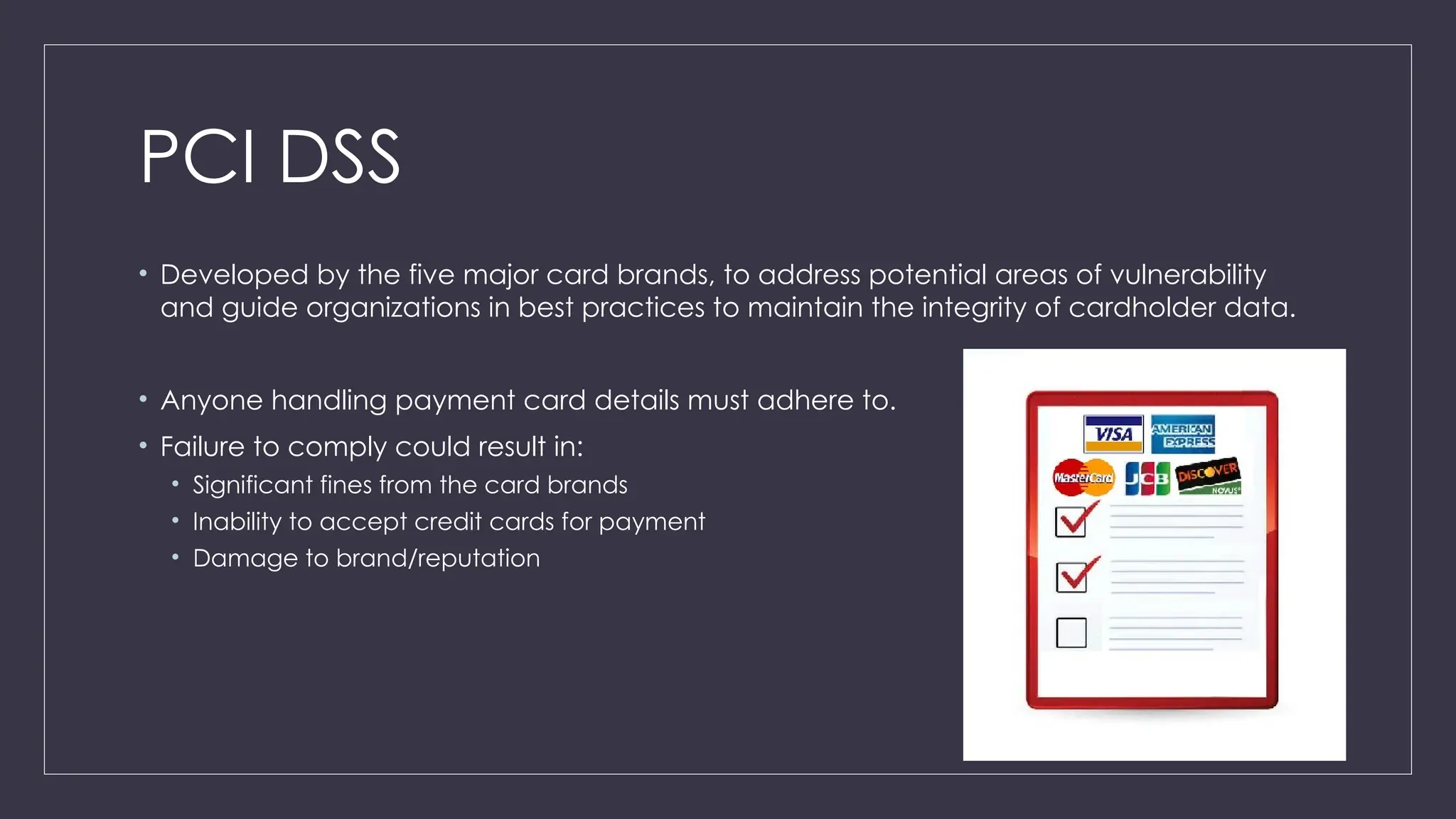
• Developedby the five major card brands, to address potential areas of vulnerability
and guide organizations in best practices to maintain the integrity of cardholder data.
• Anyone handling payment card details must adhere to.
• Failure to comply could result in:
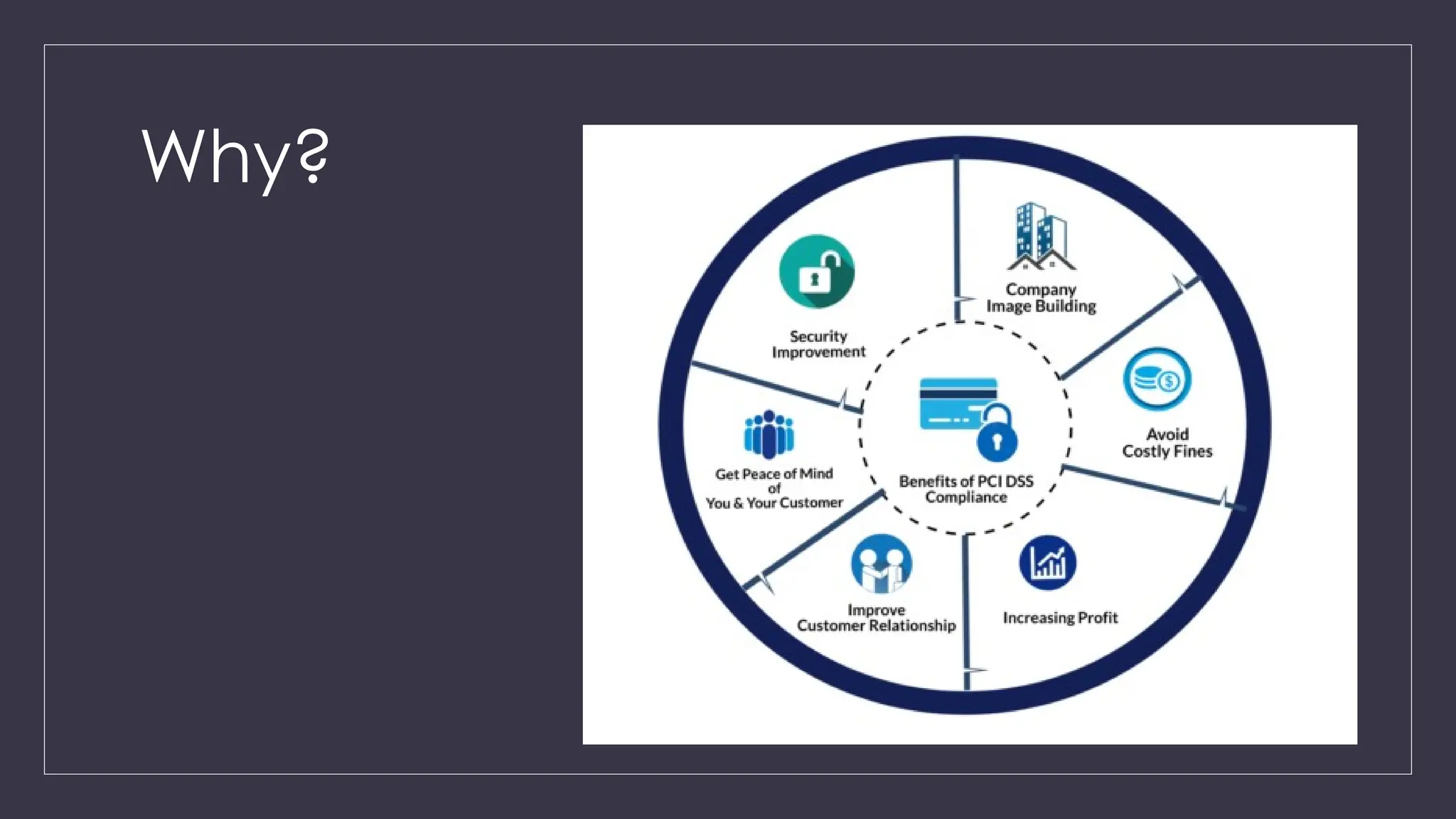
• Significant fines from the card brands
• Inability to accept credit cards for payment
• Damage to brand/reputation
4.
PCI DSS
• ThePayment Card Industry Data Security Standard (PCI DSS) is a set of
requirements intended to ensure that all companies that process, store, or
transmit credit card information maintain a secure environment.
• The PCI DSS applies to all entities that store, process, and/or transmit
cardholder data. It covers technical and operational system components
included in or connected to cardholder data. If you are a merchant who
accepts or processes payment cards, you must comply with the PCI DSS.
• All organizations that retain, process, and transmit cardholder data, such as
merchants who are members of card issuing companies and any other service
providers should all consider compliance with PCI DSS.
5.
History
• The PaymentCard Industry Data Security
Standard (PCI DSS) is the unified global standard
for cardholder data security established by five
international payment card brands (VISA,
MasterCard, JCB, AMEX and Discover). This is the
data security standard that multilaterally
specifies requirements of security management,
policies, procedures and methods, network
configurations and software design to protect
other cardholder data.
• Each of these five international payment card
brands support compliance with PCI DSS and
strives to promote the adoption.
7
What is PCI-DSS?
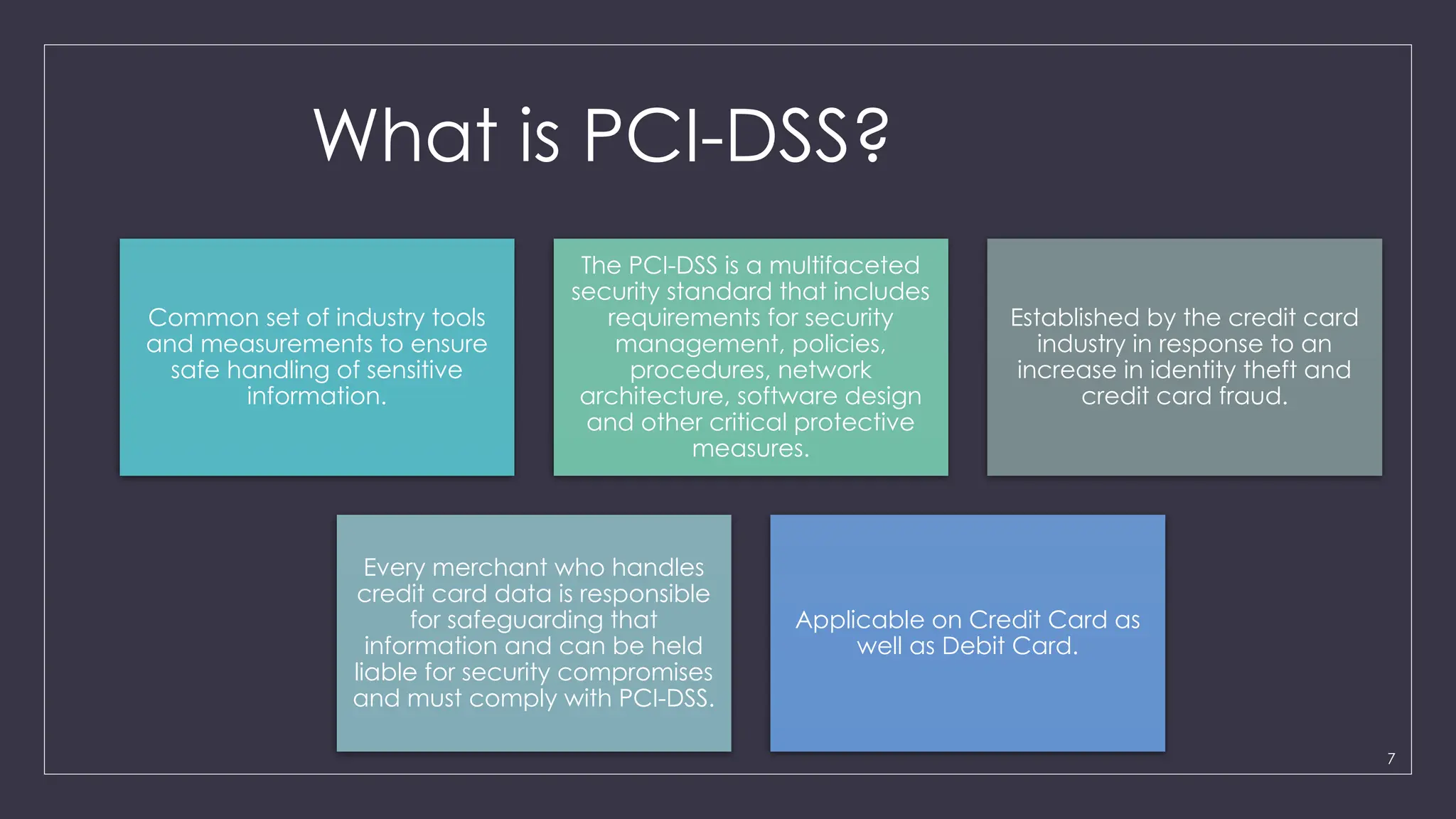
Commonset of industry tools
and measurements to ensure
safe handling of sensitive
information.
The PCI-DSS is a multifaceted
security standard that includes
requirements for security
management, policies,
procedures, network
architecture, software design
and other critical protective
measures.
Established by the credit card
industry in response to an
increase in identity theft and
credit card fraud.
Every merchant who handles
credit card data is responsible
for safeguarding that
information and can be held
liable for security compromises
and must comply with PCI-DSS.
Applicable on Credit Card as
well as Debit Card.
8.
Background
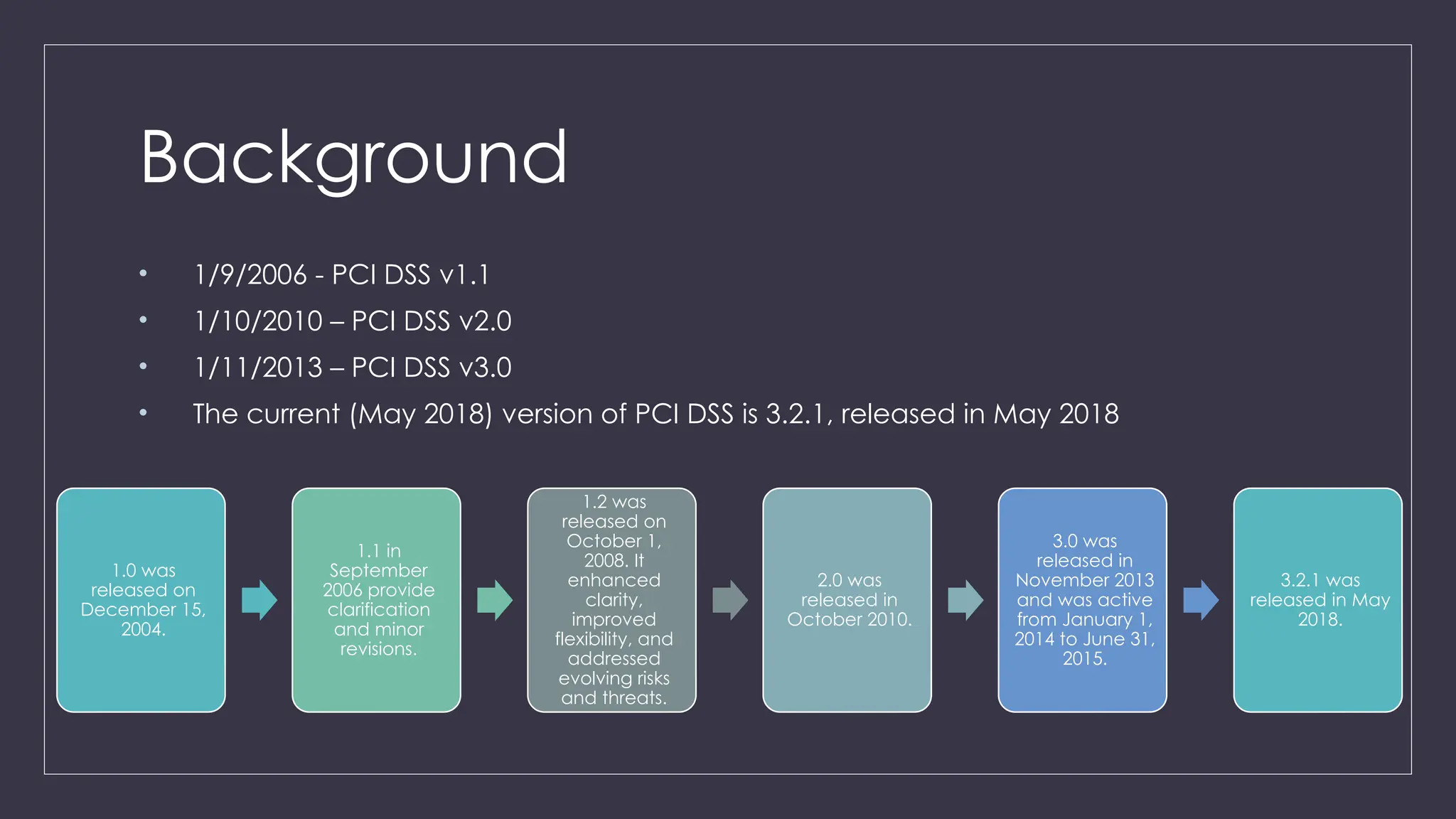
• 1/9/2006 -PCI DSS v1.1
• 1/10/2010 – PCI DSS v2.0
• 1/11/2013 – PCI DSS v3.0
• The current (May 2018) version of PCI DSS is 3.2.1, released in May 2018
1.0 was
released on
December 15,
2004.
1.1 in
September
2006 provide
clarification
and minor
revisions.
1.2 was
released on
October 1,
2008. It
enhanced
clarity,
improved
flexibility, and
addressed
evolving risks
and threats.
2.0 was
released in
October 2010.
3.0 was
released in
November 2013
and was active
from January 1,
2014 to June 31,
2015.
3.2.1 was
released in May
2018.
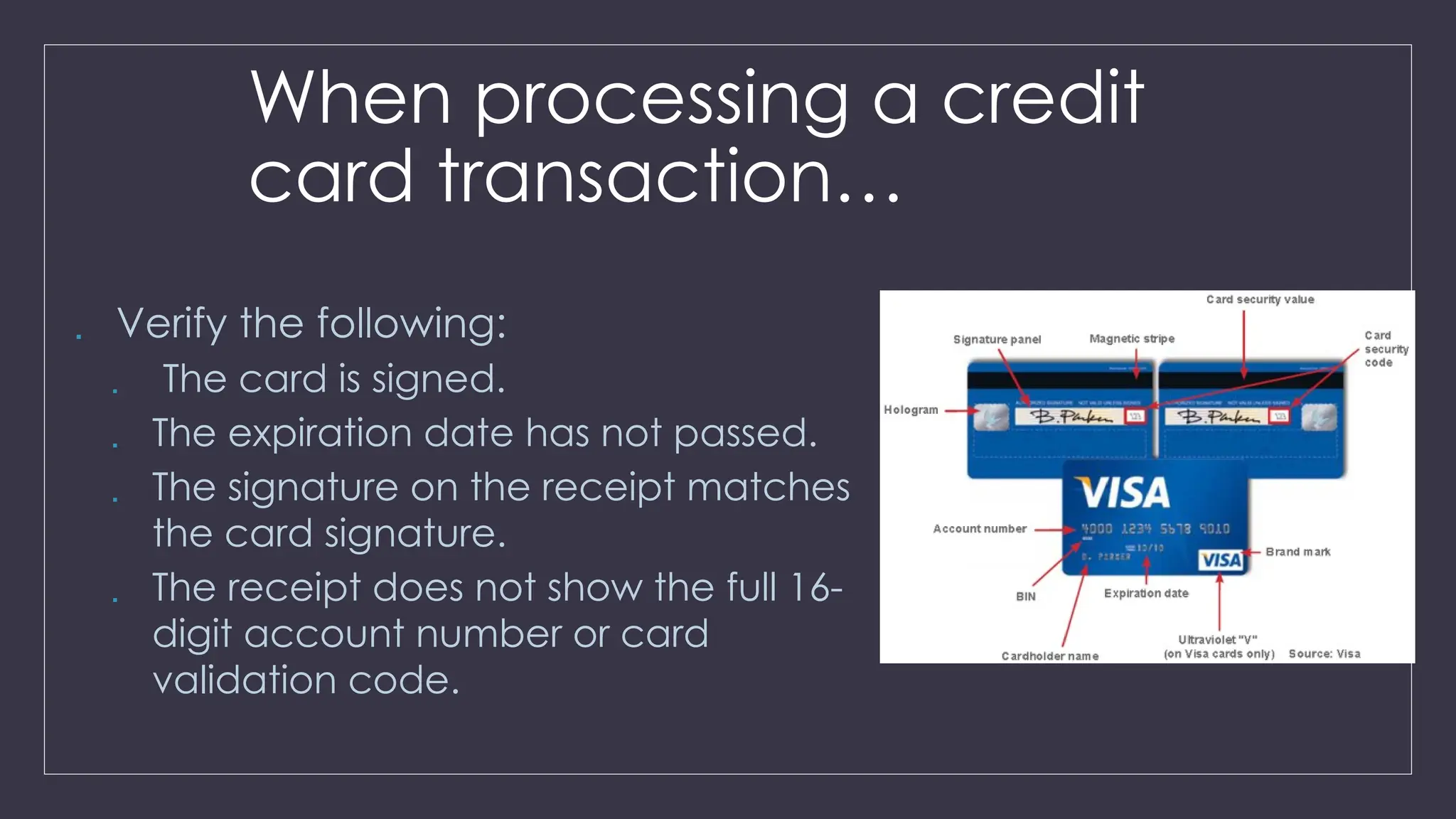
When processing acredit
card transaction…
Verify the following:
The card is signed.
The expiration date has not passed.
The signature on the receipt matches
the card signature.
The receipt does not show the full 16-
digit account number or card
validation code.
12.
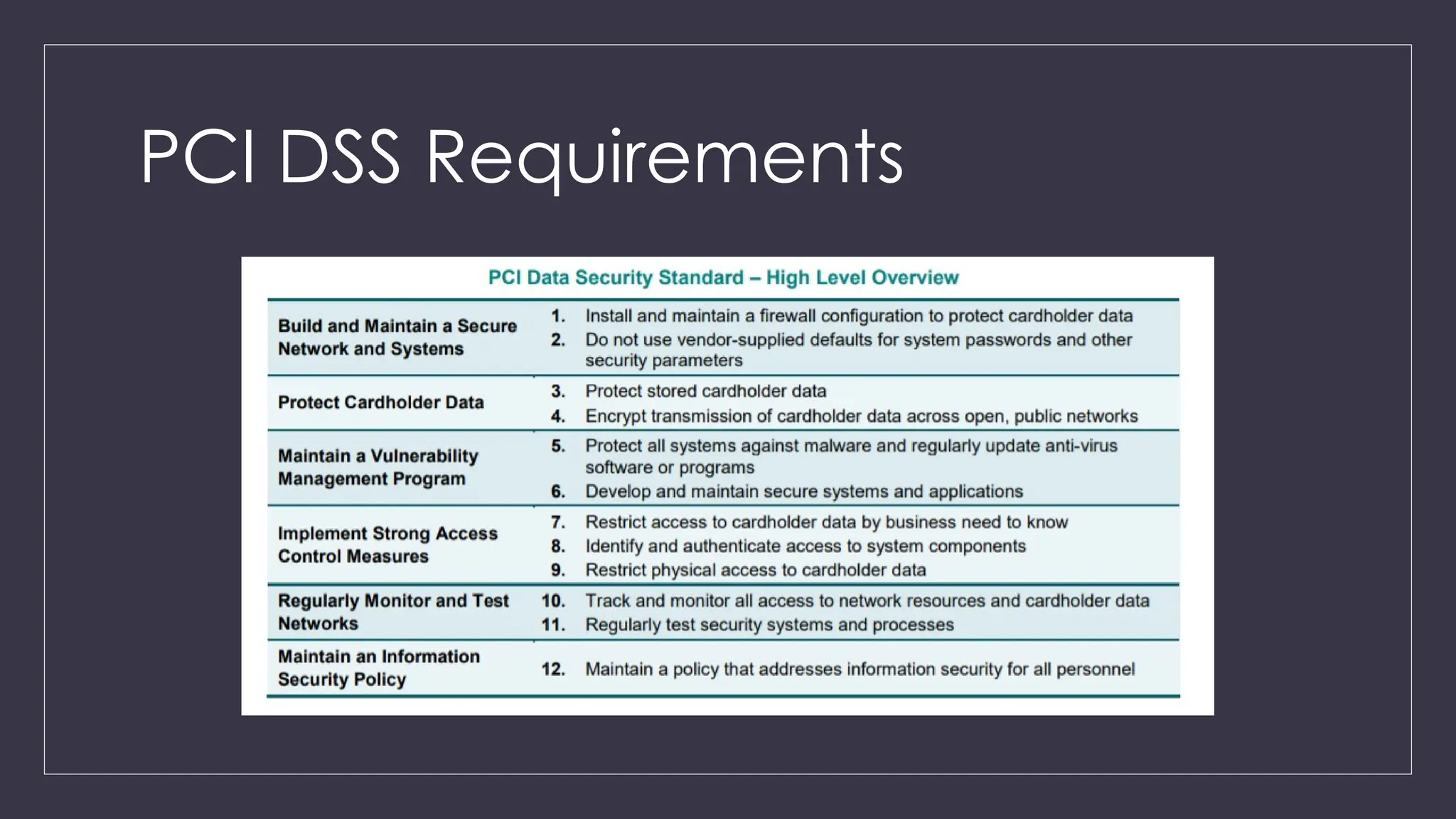
12 requirements
1. Protectyour system with firewalls
2. Configure passwords and settings
3. Protect stored cardholder data
4. Encrypt transmission of cardholder data across open, public networks
5. Use and regularly update anti-virus software
6. Regularly update and patch systems
7. Restrict access to cardholder data to business need to know
8. Assign a unique ID to each person with computer access
9. Restrict physical access to workplace and cardholder data
10. Implement logging and log management
11. Conduct vulnerability scans and penetration tests
12. Documentation and risk assessments
Compliance Levels
All companieswho are subject to PCI DSS standards
must be PCI compliant. There are four levels of PCI
Compliance and these are based on how much you
process per year, as well as other details about the level
of risk assessed by payment brands.
At a high level, the levels are following:
• Level 1 – Over 6 million transactions annually
• Level 2 – Between 1 and 6 million transactions annually
• Level 3 – Between 20,000 and 1 million transactions
annually
• Level 4 – Less than 20,000 transactions annually
16.
What can Ido?
1) Never see, store or have access to cardholder
data
2) Never tokenize credit card information
3) Never use third-party payment gateway
4) Logging, testing, audit trials before launching
website
5) Strictly follow security policies set by payment
partners
17.
Application
• PCI compliancecan be achieved by completing the Self-
Assessment Questionnaire (SAQ). The test you take depends on
how you integrate payment gateway and cardholder data.
• However, PCI certification requires a severe self-audit and a
special audit conducted by Qualified Security Assessor (QSA).
#8 The history of PCI-DSS begins in 2004. As payment fraud began to rise, credit card industry leaders convened to develop a common set of security standards. The PCI’s founding members—American Express, Discover Financial Services, JCB International, Mastercard and Visa—introduced PCI DSS 1.0 in December 2004.
#12 1. Protect your system with firewalls- The first and foremost requirement of the PCI DSS is to protect your system with firewalls. Ensuring proper configuration of firewalls shall ensure the protection of your card data environment.
2. Configure passwords and settings – Ensure you avoid keeping vendor-supplied passwords as your default password. Default passwords could pose a great threat to your system security.
3. Protect stored cardholder data- Protect and secure stored cardholder data and prevent a data breach. Card data stored in the system should be encrypted along with the encryption keys themselves being protected.
4. Encrypt transmission of cardholder data across networks- You need to use encryption and have security policies in place when you transmit cardholder data over open, public networks.
5. Use and regularly update an anti-virus software- Anti-virus software should be installed on all systems. Further, ensure anti-virus or anti-malware programs are updated regularly to detect known malware
6. Regularly update and patch systems- One should frequently release updates to patch security holes. This is very crucial to your security posture.
7. Restrict access to cardholder data- Access to cardholder data should be only provided to those who are appointed as an authorized person. this will secure data from being misused.
8. Assign a unique ID to each person with computer access- As a part of the security process, assigns a unique ID to every person who has access to computer access. This will ensure controlled access to sensitive data.
9. Restrict physical access to cardholder data- One should implement and strictly restrict physical access to cardholder data. This will prevent a data breach or misuse of data.
10. Implement logging and log management – Regularly review logs to identify errors, anomalies, and suspicious activities. You are also required to have a process in place to respond to these anomalies and exceptions. Use Security Information and Event Monitoring tools (SIEM), for monitoring systems regularly, oversee network activity, inspect system events, identify suspicious activity, inside your systems.
11. Conduct vulnerability scans and penetration tests- Conduct Vulnerability scans and pen test to detect unknow risks and threats. This should safeguard your system from any potential threats or risks.
12. Documentation and risk assessments- The final requirement for PCI compliance is to keep documentation, policies, procedures, and evidence relating to your company’s security practices in place for easy audit and remediation.