PCI COMPLIANCE
Introduction for developers mostly
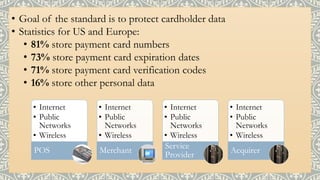
• Goal of the standard is to protect cardholder data
• Statistics for US and Europe:
• 81% store payment card numbers
• 73% store payment card expiration dates
• 71% store payment card verification codes
• 16% store other personal data
• Internet
• Public
Networks
• Wireless
POS
• Internet
• Public
Networks
• Wireless
Merchant
• Internet
• Public
Networks
• Wireless
Service
Provider
• Internet
• Public
Networks
• Wireless
Acquirer
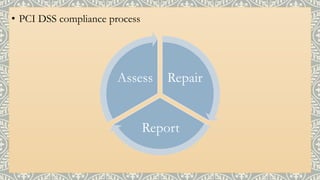
• PCI DSS compliance process
Repair
Report
Assess
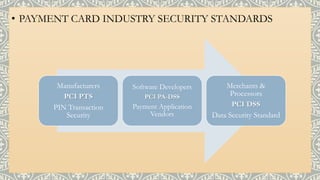
• PAYMENT CARD INDUSTRY SECURITY STANDARDS
Manufacturers
PCI PTS
PIN Transaction
Security
Software Developers
PCI PA-DSS
Payment Application
Vendors
Merchants &
Processors
PCI DSS
Data Security Standard
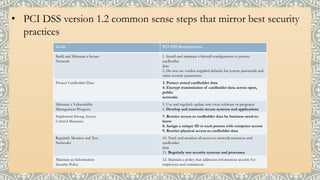
• PCI DSS version 1.2 common sense steps that mirror best security
practices
Goals PCI DSS Requirements
Build and Maintain a Secure
Network
1. Install and maintain a firewall configuration to protect
cardholder
data
2. Do not use vendor-supplied defaults for system passwords and
other security parameters
Protect Cardholder Data 3. Protect stored cardholder data
4. Encrypt transmission of cardholder data across open,
public
networks
Maintain a Vulnerability
Management Program
5. Use and regularly update anti-virus software or programs
6. Develop and maintain secure systems and applications
Implement Strong Access
Control Measures
7. Restrict access to cardholder data by business need-to-
know
8. Assign a unique ID to each person with computer access
9. Restrict physical access to cardholder data
Regularly Monitor and Test
Networks
10. Track and monitor all access to network resources and
cardholder
data
11. Regularly test security systems and processes
Maintain an Information
Security Policy
12. Maintain a policy that addresses information security for
employees and contractors
• Do NOT request, send or accept payment card information by email
• If you receive cardholder data via email, do NOT process the
transaction
• Make the sender aware that, for their safety, they should never email
credit card information
• Remove the cardholder data when responding and direct them to an
approved processing method
• Delete the email containing cardholder data completely from your
email account.
• Many of the above practices can be applied to Personal
Information or PI (SSN, home address, anything that can
uniquely identify a person)
In majority of the cases we can use cryptographic primitives,
methods and protocols (refer to my previous presentation on the
topic) to ensure secure path our data travels (card data and PI) from
initiator (data storage, POS, etc.) to the end-point.
Sometimes we need to make sure we also reflect country or project
specific legal requirements.
Always think of where your data might end-up and do NOT STORE
or TRANSMIT it without strong business reasons !
If you absolutely need to do it think of tokenizing sensitive data.
• The PA-DSS is a standard for developers of payment applications.
• Its goal is to help development of secure commercial payment applications that do not
store prohibited data, and ensure that payment applications support compliance with the
PCI DSS.
• Merchants and service providers should ensure that they are using Council-approved
payment applications; check with your acquiring financial institution to understand
requirements and associated timeframes for implementing approved applications.
• PA-DSS has 14 requirements: For details and a list of approved Payment Applications, see
PCI website.
Why building applications with PA-DSS in mind is important even if your
applications is not going to participate in the PCI pipeline?
Because it might! And chances are it will if you work with financial
industries.
When should we comply with the PCI requirements?
• We accept payments (credit card or debit card) in-person
• -”- over the phone
• -”- over the internet
• -”- over mail
• We act as a service providers (accept payments for others)
PCI standard applies to all actors that store, process or
transmit cardholder data.
Extract from the PCI guide:
“Requirement 3: Protect stored cardholder data
In general, no cardholder data should ever be stored unless it’s necessary to meet the needs of the
business. Sensitive data on the magnetic stripe or chip must never be stored. If your organization
stores PAN, it is crucial to render it unreadable (see 3.4, and table below for guidelines).
3.1 Limit cardholder data storage and retention time to that required for business, legal, and/or
regulatory purposes, as documented in your data retention policy.
3.2 Do not store sensitive authentication data after authorization (even if it is encrypted). See
guidelines in table below.
3.3 Mask PAN when displayed; the first six and last four digits are the maximum number of digits
you may display. Not applicable for authorized people with a legitimate business need to see
the full PAN. Does not supersede stricter requirements in place for displays of cardholder data
such as on a point-of-sale receipt.
3.4 Render PAN, at minimum, unreadable anywhere it is stored – including on portable digital
media, backup media, in logs, and data received from or stored by wireless networks.
Technology solutions for this requirement may include strong one-way hash functions,
truncation, index tokens, securely stored pads, or strong cryptography. (See PCI DSS Glossary for
definition of strong cryptography.)
3.5 Protect cryptographic keys used for encryption of cardholder data from disclosure and misuse.
3.6 Fully document and implement all appropriate key management processes and procedures for
cryptographic keys used for encryption of cardholder data.”
Extract from the PCI guide:
“Requirement 4: Encrypt transmission of cardholder data across open, public networks
Cyber criminals may be able to intercept transmissions of cardholder data over open, public networks
so it is important to prevent their ability to view these data. Encryption is a technology used to render
transmitted data unreadable by any unauthorized person.
4.1 Use strong cryptography and security protocols such as SSL/TLS or IPSEC to safeguard sensitive
cardholder data during transmission over open, public networks (e.g. Internet, wireless
technologies, global systems for communications [GSM], general packet radio systems [GPRS]).
Ensure wireless networks transmitting cardholder data or connected to the cardholder data
environment use industry best practices (e.g., IEEE 802.11ix) to implement strong encryption
for authentication and transmission. For new wireless implementations, it is prohibited to
implement WEP after March 31, 2009. For current implementations, it is prohibited to use WEP
after June 30, 2010.
4.2 Never send unencrypted PANs by end user messaging technologies.”
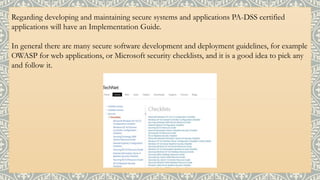
Regarding developing and maintaining secure systems and applications PA-DSS certified
applications will have an Implementation Guide.
In general there are many secure software development and deployment guidelines, for example
OWASP for web applications, or Microsoft security checklists, and it is a good idea to pick any
and follow it.
Annual penetration testing and quarterly wireless and vulnerability
testing is a part of testing efforts and should be performed.
Remember, using penetration testing frameworks during development
phase builds a solid foundation for your software!
If you don’t have to comply with the PCI standards, breaching your
application will bring you unsatisfaction with the clients and will hurt
your reputation, at the very least. The real trouble begins when your
organization and your software do need to comply. In that case:
“Breach Consequences- Even if a company is 100% PCI compliant and validated, a breach in
cardholder data may still occur. Cardholder Breaches can result in the following losses for a
merchant.$50-$90 fine per cardholder data compromised
Suspension of credit card acceptance by a merchant’s credit card account provider
Loss of reputation with customers, suppliers, and partners
Possible civil litigation from breached customers
Loss of customer trust which effects future sales”
And these are just a small part if the forthcoming troubles.
Project implementation examples
Questions?

PCI Compliance (for developers)

  • 1.
  • 2.
    • Goal ofthe standard is to protect cardholder data • Statistics for US and Europe: • 81% store payment card numbers • 73% store payment card expiration dates • 71% store payment card verification codes • 16% store other personal data • Internet • Public Networks • Wireless POS • Internet • Public Networks • Wireless Merchant • Internet • Public Networks • Wireless Service Provider • Internet • Public Networks • Wireless Acquirer
  • 3.
    • PCI DSScompliance process Repair Report Assess
  • 4.
    • PAYMENT CARDINDUSTRY SECURITY STANDARDS Manufacturers PCI PTS PIN Transaction Security Software Developers PCI PA-DSS Payment Application Vendors Merchants & Processors PCI DSS Data Security Standard
  • 5.
    • PCI DSSversion 1.2 common sense steps that mirror best security practices Goals PCI DSS Requirements Build and Maintain a Secure Network 1. Install and maintain a firewall configuration to protect cardholder data 2. Do not use vendor-supplied defaults for system passwords and other security parameters Protect Cardholder Data 3. Protect stored cardholder data 4. Encrypt transmission of cardholder data across open, public networks Maintain a Vulnerability Management Program 5. Use and regularly update anti-virus software or programs 6. Develop and maintain secure systems and applications Implement Strong Access Control Measures 7. Restrict access to cardholder data by business need-to- know 8. Assign a unique ID to each person with computer access 9. Restrict physical access to cardholder data Regularly Monitor and Test Networks 10. Track and monitor all access to network resources and cardholder data 11. Regularly test security systems and processes Maintain an Information Security Policy 12. Maintain a policy that addresses information security for employees and contractors
  • 6.
    • Do NOTrequest, send or accept payment card information by email • If you receive cardholder data via email, do NOT process the transaction • Make the sender aware that, for their safety, they should never email credit card information • Remove the cardholder data when responding and direct them to an approved processing method • Delete the email containing cardholder data completely from your email account. • Many of the above practices can be applied to Personal Information or PI (SSN, home address, anything that can uniquely identify a person)
  • 7.
    In majority ofthe cases we can use cryptographic primitives, methods and protocols (refer to my previous presentation on the topic) to ensure secure path our data travels (card data and PI) from initiator (data storage, POS, etc.) to the end-point. Sometimes we need to make sure we also reflect country or project specific legal requirements. Always think of where your data might end-up and do NOT STORE or TRANSMIT it without strong business reasons ! If you absolutely need to do it think of tokenizing sensitive data.
  • 8.
    • The PA-DSSis a standard for developers of payment applications. • Its goal is to help development of secure commercial payment applications that do not store prohibited data, and ensure that payment applications support compliance with the PCI DSS. • Merchants and service providers should ensure that they are using Council-approved payment applications; check with your acquiring financial institution to understand requirements and associated timeframes for implementing approved applications. • PA-DSS has 14 requirements: For details and a list of approved Payment Applications, see PCI website. Why building applications with PA-DSS in mind is important even if your applications is not going to participate in the PCI pipeline? Because it might! And chances are it will if you work with financial industries.
  • 9.
    When should wecomply with the PCI requirements? • We accept payments (credit card or debit card) in-person • -”- over the phone • -”- over the internet • -”- over mail • We act as a service providers (accept payments for others) PCI standard applies to all actors that store, process or transmit cardholder data.
  • 10.
    Extract from thePCI guide: “Requirement 3: Protect stored cardholder data In general, no cardholder data should ever be stored unless it’s necessary to meet the needs of the business. Sensitive data on the magnetic stripe or chip must never be stored. If your organization stores PAN, it is crucial to render it unreadable (see 3.4, and table below for guidelines). 3.1 Limit cardholder data storage and retention time to that required for business, legal, and/or regulatory purposes, as documented in your data retention policy. 3.2 Do not store sensitive authentication data after authorization (even if it is encrypted). See guidelines in table below. 3.3 Mask PAN when displayed; the first six and last four digits are the maximum number of digits you may display. Not applicable for authorized people with a legitimate business need to see the full PAN. Does not supersede stricter requirements in place for displays of cardholder data such as on a point-of-sale receipt. 3.4 Render PAN, at minimum, unreadable anywhere it is stored – including on portable digital media, backup media, in logs, and data received from or stored by wireless networks. Technology solutions for this requirement may include strong one-way hash functions, truncation, index tokens, securely stored pads, or strong cryptography. (See PCI DSS Glossary for definition of strong cryptography.) 3.5 Protect cryptographic keys used for encryption of cardholder data from disclosure and misuse. 3.6 Fully document and implement all appropriate key management processes and procedures for cryptographic keys used for encryption of cardholder data.”
  • 11.
    Extract from thePCI guide: “Requirement 4: Encrypt transmission of cardholder data across open, public networks Cyber criminals may be able to intercept transmissions of cardholder data over open, public networks so it is important to prevent their ability to view these data. Encryption is a technology used to render transmitted data unreadable by any unauthorized person. 4.1 Use strong cryptography and security protocols such as SSL/TLS or IPSEC to safeguard sensitive cardholder data during transmission over open, public networks (e.g. Internet, wireless technologies, global systems for communications [GSM], general packet radio systems [GPRS]). Ensure wireless networks transmitting cardholder data or connected to the cardholder data environment use industry best practices (e.g., IEEE 802.11ix) to implement strong encryption for authentication and transmission. For new wireless implementations, it is prohibited to implement WEP after March 31, 2009. For current implementations, it is prohibited to use WEP after June 30, 2010. 4.2 Never send unencrypted PANs by end user messaging technologies.”
  • 12.
    Regarding developing andmaintaining secure systems and applications PA-DSS certified applications will have an Implementation Guide. In general there are many secure software development and deployment guidelines, for example OWASP for web applications, or Microsoft security checklists, and it is a good idea to pick any and follow it.
  • 13.
    Annual penetration testingand quarterly wireless and vulnerability testing is a part of testing efforts and should be performed. Remember, using penetration testing frameworks during development phase builds a solid foundation for your software!
  • 14.
    If you don’thave to comply with the PCI standards, breaching your application will bring you unsatisfaction with the clients and will hurt your reputation, at the very least. The real trouble begins when your organization and your software do need to comply. In that case: “Breach Consequences- Even if a company is 100% PCI compliant and validated, a breach in cardholder data may still occur. Cardholder Breaches can result in the following losses for a merchant.$50-$90 fine per cardholder data compromised Suspension of credit card acceptance by a merchant’s credit card account provider Loss of reputation with customers, suppliers, and partners Possible civil litigation from breached customers Loss of customer trust which effects future sales” And these are just a small part if the forthcoming troubles.
  • 15.
  • 16.

Editor's Notes

  • #2 Payment Card Industry Data Security Standards (PCI DSS) are administered by the PCI Security Standards Council, which was founded by VISA, MC, AMEX, DISCOVER, and JCB.
  • #3 Issuer Bank or other financial institution that issues payment cards to consumers (cardholders) Acquirer Contracts for payment services with merchant; merchant must validate PCI DSS compliance with its “acquirer”; acquirer reports compliance status to card associations Merchant Entity that sells goods/services and accepts cards; responsible for safeguarding credit card data and complying with the PCI DSS Service Provider Entity that provides all or some of the payment services for the merchant; responsible for safeguarding credit card data and complying with the PCI DSS Merchant-based vulnerabilities may appear almost anywhere in the card-processing ecosystem including point-of-sale devices; personal computers or servers; wireless hotspots or Web shopping applications; in paper-based storage systems; and unsecured transmission of cardholder data to service providers. Vulnerabilities may even extend to systems operated by service providers and acquirers, which are the financial institutions that initiate and maintain the relationships with merchants that accept payment cards.
  • #4 There are three ongoing steps for adhering to the PCI DSS: Assess — identifying cardholder data, taking an inventory of your IT assets and business processes for payment card processing, and analyzing them for vulnerabilities that could expose cardholder data. Remediate — fixing vulnerabilities and not storing cardholder data unless you need it. Report — compiling and submitting required remediation validation records (if applicable), and submitting compliance reports to the acquiring bank and card brands you do business with.
  • #5 PCI Data Security Standard (DSS) The PCI DSS applies to all entities that store, process, and/or transmit cardholder data. It covers technical and operational system components included in or connected to cardholder data. If you are a merchant who accepts or processes payment cards, you must comply with the PCI DSS. PIN Transaction (PTS) Security Requirements PCI PTS (formerly PCI PED) is a set of security requirements focused on characteristics and management of devices used in the protection of cardholder PINs and other payment processing related activities. The requirements are for manufacturers to follow in the design, manufacture and transport of a device to the entity that implements it. Financial institutions, processors, merchants and service providers should only use devices or components that are tested and approved by the PCI SSC (www.pcisecuritystandards.org/security_standards/ped/pedapprovallist.html). Payment Application Data Security Standard (PA-DSS) The PA-DSS is for software developers and integrators of payment applications that store, process or transmit cardholder data as part of authorization or settlement when these applications are sold, distributed or licensed to third parties. Most card brands encourage merchants to use payment applications that are tested and approved by the PCI SSC. Validated applications are listed at: www.pcisecuritystandards.org/security_standards/pa_dss.shtml
  • #8 It is not always necessary to use cryptographic primitives to ensure data secrecy and consistency. For example, do we need to calculate hash of the files we transfer between server while using trusted VPN network?