
BCS-4

Exact String Matching

COMSATS Institute Of Information Technology, wah
 Ehtisham Arshad (FA11-BsCS-059)
 Hissam Yousaf (Sp12-BsCS-036)
Exact String Matching Algorithms
 Knuth Morris And Pratt – KMP
 Boyer Moore - BM
The goal of any string-searching algorithm is to
determine whether or not a match of a particular
string exists within another (typically much longer)
string.
Many such algorithms exist, with varying efficiencies.
• Knuth Morris And Pratt - KMP
• Boyer Moore - BM
 Introduction

The algorithm was conceived in 1974 by Donald
Knuth and Vaughan Pratt, and independently by James H.
Morris. The three published it jointly in 1977

 KMP, linear time algorithm for the string matching

problem, every character is checked.
 Introduction

Developed in 1977, the BM string search algorithm is a
particularly efficient algorithm.
 This algorithm’s execution time can be sub-linear, as not

every character of the string to be searched needs to be
checked.
 Left to Right Check

Scans the string from left to right to match a particular
given pattern
 If a match is found at the first index, the next index is

checked otherwise the pointer moves to right of the
string
 Character Skip using KMP table
Partial_lenght – 1 (for Initial Match)
Partial_lenght – index value = SKIP
 Step 1:compare p[1] with S[1]

S a b c a b a a b c a b a c
p

a b a a

 Step 2: compare p[2] with S[2]

a b c a b a a b c a b a c
a b a a
 Step 3: compare p[3] with S[3]

S

a b c a b a a b c a b a c

P

a b a a
Mismatch occurs here..

Since mismatch is detected, shift ‘p’ one position to the left and
perform steps analogous to those from step 1 to step 3.
 Final Step:

S
P

a b c a b a ab c a b a c
ab aa

Finally, a match would be found after shifting ‘p’ three times to the right
side.
 Bad Character Rule

Occurs when rightmost character of the pattern
doesn’t match with the given string’s index.
 Good Suffix Rule

If a number of characters match with the given string
then the good suffix shift occurs.
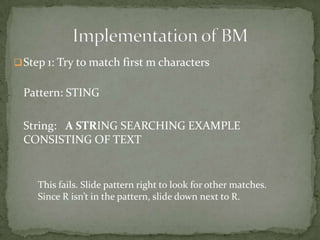
 Step 1: Try to match first m characters

Pattern: STING
String: A STRING SEARCHING EXAMPLE
CONSISTING OF TEXT

This fails. Slide pattern right to look for other matches.
Since R isn’t in the pattern, slide down next to R.
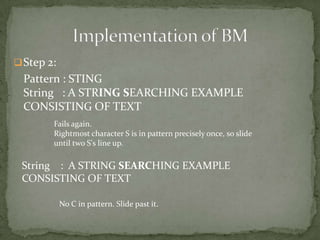
 Step 2:

Pattern : STING
String : A STRING SEARCHING EXAMPLE
CONSISTING OF TEXT
Fails again.
Rightmost character S is in pattern precisely once, so slide
until two S's line up.

String : A STRING SEARCHING EXAMPLE
CONSISTING OF TEXT
No C in pattern. Slide past it.
 Final Step:

Pattern : STING
String : A STRING SEARCHING EXAMPLE
CONSISTING OF TEXT

Match found..
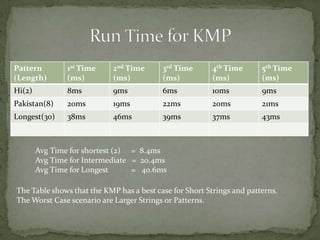
Pattern
(Length)

1st Time
(ms)

2nd Time
(ms)

3rd Time
(ms)

4th Time
(ms)

5th Time
(ms)

Hi(2)

8ms

9ms

6ms

10ms

9ms

Pakistan(8)

20ms

19ms

22ms

20ms

21ms

Longest(30)

38ms

46ms

39ms

37ms

43ms

Avg Time for shortest (2) = 8.4ms
Avg Time for Intermediate = 20.4ms
Avg Time for Longest
= 40.6ms

The Table shows that the KMP has a best case for Short Strings and patterns.
The Worst Case scenario are Larger Strings or Patterns.
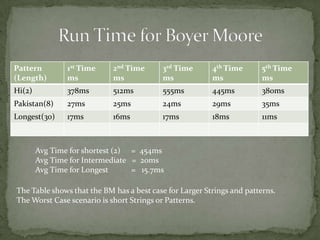
Pattern
(Length)

1st Time
ms

2nd Time
ms

3rd Time
ms

4th Time
ms

5th Time
ms

Hi(2)

378ms

512ms

555ms

445ms

380ms

Pakistan(8)

27ms

25ms

24ms

29ms

35ms

Longest(30)

17ms

16ms

17ms

18ms

11ms

Avg Time for shortest (2) = 454ms
Avg Time for Intermediate = 20ms
Avg Time for Longest
= 15.7ms

The Table shows that the BM has a best case for Larger Strings and patterns.
The Worst Case scenario is short Strings or Patterns.
Processing time (ms)

 On average, for sufficiently large alphabets (8 characters) BoyerMoore has fast running time and sub-linear number of character
comparisons.
 On average, and in worst cases Boyer-Moore is faster than “BoyerMoore-like” algorithms.
 The running time of Knuth-Morris-Pratt algorithm is

proportional to the time needed to read the characters
in text and pattern. In other words, the worst-case
running time of the algorithm is O(m + n) and it
requires O(m) extra space.
• Boyer requires a preprocessing time of O(m+∂)
• The running time of BM algorithm is O(mn)

• The Boyer Moore Algorithm performs best for
O(n/m)
•

• Worst Case of BM is 3n.
KMP and Boyer Moore finds its applications in many
core Digital Systems and processes e.g.
 Digital libraries
 Screen scrapers
 Word processors
 Web search engines
 Spam filters
 Natural language processing
Thank you

STRING MATCHING

  • 1.
    BCS-4 Exact String Matching COMSATSInstitute Of Information Technology, wah
  • 2.
     Ehtisham Arshad(FA11-BsCS-059)  Hissam Yousaf (Sp12-BsCS-036)
  • 3.
    Exact String MatchingAlgorithms  Knuth Morris And Pratt – KMP  Boyer Moore - BM
  • 4.
    The goal ofany string-searching algorithm is to determine whether or not a match of a particular string exists within another (typically much longer) string. Many such algorithms exist, with varying efficiencies. • Knuth Morris And Pratt - KMP • Boyer Moore - BM
  • 5.
     Introduction The algorithmwas conceived in 1974 by Donald Knuth and Vaughan Pratt, and independently by James H. Morris. The three published it jointly in 1977  KMP, linear time algorithm for the string matching problem, every character is checked.
  • 6.
     Introduction Developed in1977, the BM string search algorithm is a particularly efficient algorithm.  This algorithm’s execution time can be sub-linear, as not every character of the string to be searched needs to be checked.
  • 8.
     Left toRight Check Scans the string from left to right to match a particular given pattern  If a match is found at the first index, the next index is checked otherwise the pointer moves to right of the string  Character Skip using KMP table Partial_lenght – 1 (for Initial Match) Partial_lenght – index value = SKIP
  • 9.
     Step 1:comparep[1] with S[1] S a b c a b a a b c a b a c p a b a a  Step 2: compare p[2] with S[2] a b c a b a a b c a b a c a b a a
  • 10.
     Step 3:compare p[3] with S[3] S a b c a b a a b c a b a c P a b a a Mismatch occurs here.. Since mismatch is detected, shift ‘p’ one position to the left and perform steps analogous to those from step 1 to step 3.
  • 11.
     Final Step: S P ab c a b a ab c a b a c ab aa Finally, a match would be found after shifting ‘p’ three times to the right side.
  • 13.
     Bad CharacterRule Occurs when rightmost character of the pattern doesn’t match with the given string’s index.  Good Suffix Rule If a number of characters match with the given string then the good suffix shift occurs.
  • 14.
     Step 1:Try to match first m characters Pattern: STING String: A STRING SEARCHING EXAMPLE CONSISTING OF TEXT This fails. Slide pattern right to look for other matches. Since R isn’t in the pattern, slide down next to R.
  • 15.
     Step 2: Pattern: STING String : A STRING SEARCHING EXAMPLE CONSISTING OF TEXT Fails again. Rightmost character S is in pattern precisely once, so slide until two S's line up. String : A STRING SEARCHING EXAMPLE CONSISTING OF TEXT No C in pattern. Slide past it.
  • 16.
     Final Step: Pattern: STING String : A STRING SEARCHING EXAMPLE CONSISTING OF TEXT Match found..
  • 17.
    Pattern (Length) 1st Time (ms) 2nd Time (ms) 3rdTime (ms) 4th Time (ms) 5th Time (ms) Hi(2) 8ms 9ms 6ms 10ms 9ms Pakistan(8) 20ms 19ms 22ms 20ms 21ms Longest(30) 38ms 46ms 39ms 37ms 43ms Avg Time for shortest (2) = 8.4ms Avg Time for Intermediate = 20.4ms Avg Time for Longest = 40.6ms The Table shows that the KMP has a best case for Short Strings and patterns. The Worst Case scenario are Larger Strings or Patterns.
  • 18.
    Pattern (Length) 1st Time ms 2nd Time ms 3rdTime ms 4th Time ms 5th Time ms Hi(2) 378ms 512ms 555ms 445ms 380ms Pakistan(8) 27ms 25ms 24ms 29ms 35ms Longest(30) 17ms 16ms 17ms 18ms 11ms Avg Time for shortest (2) = 454ms Avg Time for Intermediate = 20ms Avg Time for Longest = 15.7ms The Table shows that the BM has a best case for Larger Strings and patterns. The Worst Case scenario is short Strings or Patterns.
  • 19.
    Processing time (ms) On average, for sufficiently large alphabets (8 characters) BoyerMoore has fast running time and sub-linear number of character comparisons.  On average, and in worst cases Boyer-Moore is faster than “BoyerMoore-like” algorithms.
  • 20.
     The runningtime of Knuth-Morris-Pratt algorithm is proportional to the time needed to read the characters in text and pattern. In other words, the worst-case running time of the algorithm is O(m + n) and it requires O(m) extra space.
  • 21.
    • Boyer requiresa preprocessing time of O(m+∂) • The running time of BM algorithm is O(mn) • The Boyer Moore Algorithm performs best for O(n/m) • • Worst Case of BM is 3n.
  • 22.
    KMP and BoyerMoore finds its applications in many core Digital Systems and processes e.g.  Digital libraries  Screen scrapers  Word processors  Web search engines  Spam filters  Natural language processing
  • 23.