Intelligent Sensor Systems
Ricardo Gutierrez-Osuna
Wright State University
1
Lecture 9: Introduction to Pattern Analysis
g Features, patterns and classifiers
g Components of a PR system
g An example
g Probability definitions
g Bayes Theorem
g Gaussian densities
Intelligent Sensor Systems
Ricardo Gutierrez-Osuna
Wright State University
2
Features, patterns and classifiers
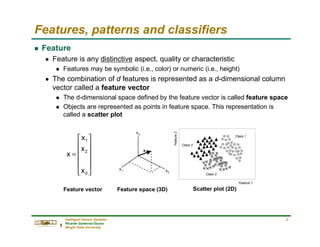
g Feature
n Feature is any distinctive aspect, quality or characteristic
g Features may be symbolic (i.e., color) or numeric (i.e., height)
n The combination of d features is represented as a d-dimensional column
vector called a feature vector
g The d-dimensional space defined by the feature vector is called feature space
g Objects are represented as points in feature space. This representation is
called a scatter plot
Feature vector Feature space (3D)












=
d
2
1
x
x
x
x
x3
x1 x2
x
Feature
2
Feature 1
Class 1
Class 2
Class 3
Scatter plot (2D)
Intelligent Sensor Systems
Ricardo Gutierrez-Osuna
Wright State University
3
Features, patterns and classifiers
g Pattern
n Pattern is a composite of traits or features characteristic of an individual
n In classification, a pattern is a pair of variables {x,ω} where
g x is a collection of observations or features (feature vector)
g ω is the concept behind the observation (label)
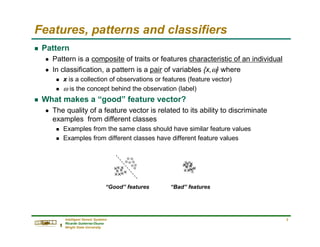
g What makes a “good” feature vector?
n The quality of a feature vector is related to its ability to discriminate
examples from different classes
g Examples from the same class should have similar feature values
g Examples from different classes have different feature values
“Good” features “Bad” features
Intelligent Sensor Systems
Ricardo Gutierrez-Osuna
Wright State University
4
Features, patterns and classifiers
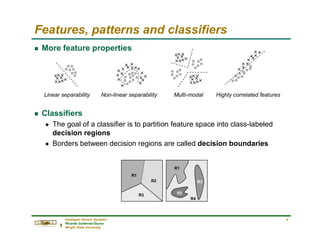
g More feature properties
g Classifiers
n The goal of a classifier is to partition feature space into class-labeled
decision regions
n Borders between decision regions are called decision boundaries
Highly correlated features
Non-linear separability
Linear separability Multi-modal
R1
R2
R3
R1
R2
R3
R4
Intelligent Sensor Systems
Ricardo Gutierrez-Osuna
Wright State University
5
Components of a pattern rec. system
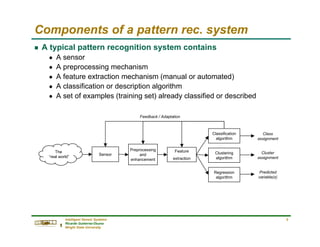
g A typical pattern recognition system contains
n A sensor
n A preprocessing mechanism
n A feature extraction mechanism (manual or automated)
n A classification or description algorithm
n A set of examples (training set) already classified or described
Sensor
Preprocessing
and
enhancement
Feature
extraction
Classification
algorithm
Clustering
algorithm
The
“real world”
Class
assignment
Feedback / Adaptation
Regression
algorithm
Predicted
variable(s)
Cluster
assignment
Intelligent Sensor Systems
Ricardo Gutierrez-Osuna
Wright State University
6
An example
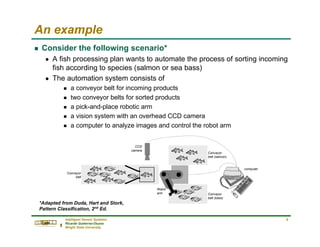
g Consider the following scenario*
n A fish processing plan wants to automate the process of sorting incoming
fish according to species (salmon or sea bass)
n The automation system consists of
g a conveyor belt for incoming products
g two conveyor belts for sorted products
g a pick-and-place robotic arm
g a vision system with an overhead CCD camera
g a computer to analyze images and control the robot arm
*Adapted from Duda, Hart and Stork,
Pattern Classification, 2nd
Ed.
Conveyor
belt
CCD
camera
Conveyor
belt (bass)
Conveyor
belt (salmon)
Robot
arm
computer
Intelligent Sensor Systems
Ricardo Gutierrez-Osuna
Wright State University
7
An example
g Sensor
n The camera captures an image as a new fish enters the sorting area
g Preprocessing
n Adjustments for average intensity levels
n Segmentation to separate fish from background
g Feature Extraction
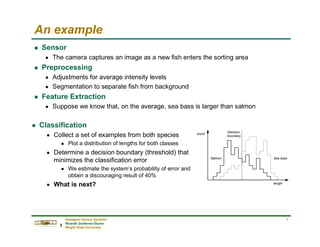
n Suppose we know that, on the average, sea bass is larger than salmon
count
length
Sea bass
Salmon
Decision
boundary
g Classification
n Collect a set of examples from both species
g Plot a distribution of lengths for both classes
n Determine a decision boundary (threshold) that
minimizes the classification error
g We estimate the system’s probability of error and
obtain a discouraging result of 40%
n What is next?
Intelligent Sensor Systems
Ricardo Gutierrez-Osuna
Wright State University
8
Avg. scale intensity
length
Decision
boundary
Sea bass Salmon
count
Avg. scale intensity
Sea bass Salmon
Decision
boundary
An example
g Improving the performance of our PR system
n Committed to achieve a recognition rate of 95%, we try a number of features
g Width, Area, Position of the eyes w.r.t. mouth...
g only to find out that these features contain no discriminatory information
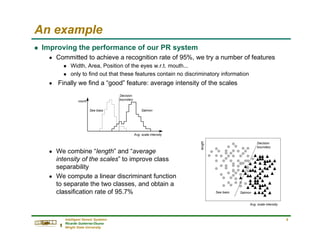
n Finally we find a “good” feature: average intensity of the scales
n We combine “length” and “average
intensity of the scales” to improve class
separability
n We compute a linear discriminant function
to separate the two classes, and obtain a
classification rate of 95.7%
Intelligent Sensor Systems
Ricardo Gutierrez-Osuna
Wright State University
9
An example
g Cost Versus Classification rate
n Is classification rate the best objective function for this problem?
g The cost of misclassifying salmon as sea bass is that the end customer will
occasionally find a tasty piece of salmon when he purchases sea bass
g The cost of misclassifying sea bass as salmon is a customer upset when
he finds a piece of sea bass purchased at the price of salmon
n We could intuitively shift the decision boundary to minimize an
alternative cost function
Avg. scale intensity
length
Decision
boundary
Sea bass Salmon
Avg. scale intensity
length
New
Decision
boundary
Sea bass
Salmon
Intelligent Sensor Systems
Ricardo Gutierrez-Osuna
Wright State University
10
An example
g The issue of generalization
n The recognition rate of our linear classifier (95.7%) met the design
specs, but we still think we can improve the performance of the system
g We then design an artificial neural
network with five hidden layers, a
combination of logistic and hyperbolic
tangent activation functions, train it
with the Levenberg-Marquardt algorithm
and obtain an impressive classification
rate of 99.9975% with the following
decision boundary
n Satisfied with our classifier, we integrate the system and deploy it to the
fish processing plant
g A few days later the plant manager calls to complain that the system is
misclassifying an average of 25% of the fish
g What went wrong?
Avg. scale intensity
length
Salmon
Sea bass
Intelligent Sensor Systems
Ricardo Gutierrez-Osuna
Wright State University
11
Review of probability theory
g Probability
n Probabilities are numbers assigned to events that indicate “how likely” it
is that the event will occur when a random experiment is performed
g Conditional Probability
n If A and B are two events, the probability of event A when we already
know that event B has occurred P[A|B] is defined by the relation
g P[A|B] is read as the “conditional probability of A conditioned on B”,
or simply the “probability of A given B”
A1
A2
A3
A4
event
probability
A1 A2 A3
Probability
Law
A4
Sample space
0
P[B]
for
P[B]
B]
P[A
B]
|
P[A >
=
I
Intelligent Sensor Systems
Ricardo Gutierrez-Osuna
Wright State University
12
Review of probability theory
g Conditional probability: graphical interpretation
g Theorem of Total Probability
n Let B1, B2, …, BN be mutually exclusive events, then
S S
“B has
occurred”
A A∩B B A A∩B B
∑
=
=
+
=
N
1
k
k
k
N
N
1
1 ]
]P[B
B
|
P[A
]
]P[B
B
|
...P[A
]
]P[B
B
|
P[A
P[A]
B1
B2
B3
BN-1
BN
A
Intelligent Sensor Systems
Ricardo Gutierrez-Osuna
Wright State University
13
Review of probability theory
g Bayes Theorem
n Given B1, B2, …, BN, a partition of the sample space S. Suppose that
event A occurs; what is the probability of event Bj?
n Using the definition of conditional probability and the Theorem of total
probability we obtain
n Bayes Theorem is definitely the
fundamental relationship in
Statistical Pattern Recognition
∑
=
⋅
⋅
=
= N
1
k
k
k
j
j
j
j
]
P[B
]
B
|
P[A
]
P[B
]
B
|
P[A
P[A]
]
B
P[A
A]
|
P[B
I
Rev. Thomas Bayes (1702-1761)
Intelligent Sensor Systems
Ricardo Gutierrez-Osuna
Wright State University
14
Review of probability theory
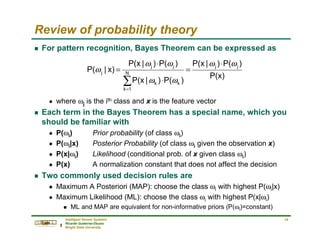
g For pattern recognition, Bayes Theorem can be expressed as
n where ωj is the ith class and x is the feature vector
g Each term in the Bayes Theorem has a special name, which you
should be familiar with
n P(ωi) Prior probability (of class ωi)
n P(ωi|x) Posterior Probability (of class ωi given the observation x)
n P(x|ωi) Likelihood (conditional prob. of x given class ωi)
n P(x) A normalization constant that does not affect the decision
g Two commonly used decision rules are
n Maximum A Posteriori (MAP): choose the class ωi with highest P(ωi|x)
n Maximum Likelihood (ML): choose the class ωi with highest P(x|ωi)
g ML and MAP are equivalent for non-informative priors (P(ωi)=constant)
P(x)
)
P(
)
|
P(x
)
P(
)
|
P(x
)
P(
)
|
P(x
x)
|
P( j
j
N
1
k
k
k
j
j
j
ω
ω
ω
ω
ω
ω
ω
⋅
=
⋅
⋅
=
∑
=
Intelligent Sensor Systems
Ricardo Gutierrez-Osuna
Wright State University
15
Review of probability theory
g Characterizing features/vectors
n Complete: Probability mass/density function
n Partial: Statistics
g Expectation
n The expectation represents the center of mass of a density
g Variance
n The variance represents the spread about the mean
g Covariance (only for random vectors)
n The tendency of each pair of features to vary together, i.e., to co-vary
100 200 300 400 500
pdf
x(lb)
pdf for a person’s weight
1
1 2 3 4 5 6
pmf
x
pmf for rolling a (fair) dice
1
5/6
4/6
3/6
2/6
1/6
Intelligent Sensor Systems
Ricardo Gutierrez-Osuna
Wright State University
16
Review of probability theory
g The covariance matrix (cont.)
n The covariance terms can be expressed as
g where ρik is called the correlation coefficient
g Graphical interpretation










=










−
−
−
−
−
−
−
−
=
−
−
=
∑
=
2
N
1N
1N
2
1
N
N
N
N
1
1
N
N
N
N
1
1
1
1
1
1
T
...
c
...
...
c
...
)]
)(x
E[(x
...
)]
)(x
E[(x
...
)]
)(x
E[(x
...
)]
)(x
E[(x
]
;
E[(X
COV[X]
σ
σ
O
Xi
Xk
Cik=-σiσk
ρik=-1
Xi
Xk
Cik=-½σiσk
ρik=-½
Xi
Xk
Cik=0
ρik=0
Xi
Xk
Cik=+½σiσk
ρik=+½
Xi
Xk
Cik=σiσk
ρik=+1
k
i
ik
ik
2
i
ii c
and
c σ
σ
ρ
σ =
=
Intelligent Sensor Systems
Ricardo Gutierrez-Osuna
Wright State University
17
Review of probability theory
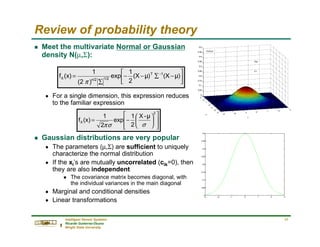
g Meet the multivariate Normal or Gaussian
density N(µ,Σ):
n For a single dimension, this expression reduces
to the familiar expression
g Gaussian distributions are very popular
n The parameters (µ,Σ) are sufficient to uniquely
characterize the normal distribution
n If the xi’s are mutually uncorrelated (cik=0), then
they are also independent
g The covariance matrix becomes diagonal, with
the individual variances in the main diagonal
n Marginal and conditional densities
n Linear transformations






−
∑
−
−
∑
= −
(X
(X
2
1
exp
)
(2
1
(x)
f 1
T
1/2
n/2
X
π














−
=
2
X
-
X
2
1
exp
2
1
(x)
f
σ
σ
π

Pattern-Analysis (1).pdf

  • 1.
    Intelligent Sensor Systems RicardoGutierrez-Osuna Wright State University 1 Lecture 9: Introduction to Pattern Analysis g Features, patterns and classifiers g Components of a PR system g An example g Probability definitions g Bayes Theorem g Gaussian densities
  • 2.
    Intelligent Sensor Systems RicardoGutierrez-Osuna Wright State University 2 Features, patterns and classifiers g Feature n Feature is any distinctive aspect, quality or characteristic g Features may be symbolic (i.e., color) or numeric (i.e., height) n The combination of d features is represented as a d-dimensional column vector called a feature vector g The d-dimensional space defined by the feature vector is called feature space g Objects are represented as points in feature space. This representation is called a scatter plot Feature vector Feature space (3D)             = d 2 1 x x x x x3 x1 x2 x Feature 2 Feature 1 Class 1 Class 2 Class 3 Scatter plot (2D)
  • 3.
    Intelligent Sensor Systems RicardoGutierrez-Osuna Wright State University 3 Features, patterns and classifiers g Pattern n Pattern is a composite of traits or features characteristic of an individual n In classification, a pattern is a pair of variables {x,ω} where g x is a collection of observations or features (feature vector) g ω is the concept behind the observation (label) g What makes a “good” feature vector? n The quality of a feature vector is related to its ability to discriminate examples from different classes g Examples from the same class should have similar feature values g Examples from different classes have different feature values “Good” features “Bad” features
  • 4.
    Intelligent Sensor Systems RicardoGutierrez-Osuna Wright State University 4 Features, patterns and classifiers g More feature properties g Classifiers n The goal of a classifier is to partition feature space into class-labeled decision regions n Borders between decision regions are called decision boundaries Highly correlated features Non-linear separability Linear separability Multi-modal R1 R2 R3 R1 R2 R3 R4
  • 5.
    Intelligent Sensor Systems RicardoGutierrez-Osuna Wright State University 5 Components of a pattern rec. system g A typical pattern recognition system contains n A sensor n A preprocessing mechanism n A feature extraction mechanism (manual or automated) n A classification or description algorithm n A set of examples (training set) already classified or described Sensor Preprocessing and enhancement Feature extraction Classification algorithm Clustering algorithm The “real world” Class assignment Feedback / Adaptation Regression algorithm Predicted variable(s) Cluster assignment
  • 6.
    Intelligent Sensor Systems RicardoGutierrez-Osuna Wright State University 6 An example g Consider the following scenario* n A fish processing plan wants to automate the process of sorting incoming fish according to species (salmon or sea bass) n The automation system consists of g a conveyor belt for incoming products g two conveyor belts for sorted products g a pick-and-place robotic arm g a vision system with an overhead CCD camera g a computer to analyze images and control the robot arm *Adapted from Duda, Hart and Stork, Pattern Classification, 2nd Ed. Conveyor belt CCD camera Conveyor belt (bass) Conveyor belt (salmon) Robot arm computer
  • 7.
    Intelligent Sensor Systems RicardoGutierrez-Osuna Wright State University 7 An example g Sensor n The camera captures an image as a new fish enters the sorting area g Preprocessing n Adjustments for average intensity levels n Segmentation to separate fish from background g Feature Extraction n Suppose we know that, on the average, sea bass is larger than salmon count length Sea bass Salmon Decision boundary g Classification n Collect a set of examples from both species g Plot a distribution of lengths for both classes n Determine a decision boundary (threshold) that minimizes the classification error g We estimate the system’s probability of error and obtain a discouraging result of 40% n What is next?
  • 8.
    Intelligent Sensor Systems RicardoGutierrez-Osuna Wright State University 8 Avg. scale intensity length Decision boundary Sea bass Salmon count Avg. scale intensity Sea bass Salmon Decision boundary An example g Improving the performance of our PR system n Committed to achieve a recognition rate of 95%, we try a number of features g Width, Area, Position of the eyes w.r.t. mouth... g only to find out that these features contain no discriminatory information n Finally we find a “good” feature: average intensity of the scales n We combine “length” and “average intensity of the scales” to improve class separability n We compute a linear discriminant function to separate the two classes, and obtain a classification rate of 95.7%
  • 9.
    Intelligent Sensor Systems RicardoGutierrez-Osuna Wright State University 9 An example g Cost Versus Classification rate n Is classification rate the best objective function for this problem? g The cost of misclassifying salmon as sea bass is that the end customer will occasionally find a tasty piece of salmon when he purchases sea bass g The cost of misclassifying sea bass as salmon is a customer upset when he finds a piece of sea bass purchased at the price of salmon n We could intuitively shift the decision boundary to minimize an alternative cost function Avg. scale intensity length Decision boundary Sea bass Salmon Avg. scale intensity length New Decision boundary Sea bass Salmon
  • 10.
    Intelligent Sensor Systems RicardoGutierrez-Osuna Wright State University 10 An example g The issue of generalization n The recognition rate of our linear classifier (95.7%) met the design specs, but we still think we can improve the performance of the system g We then design an artificial neural network with five hidden layers, a combination of logistic and hyperbolic tangent activation functions, train it with the Levenberg-Marquardt algorithm and obtain an impressive classification rate of 99.9975% with the following decision boundary n Satisfied with our classifier, we integrate the system and deploy it to the fish processing plant g A few days later the plant manager calls to complain that the system is misclassifying an average of 25% of the fish g What went wrong? Avg. scale intensity length Salmon Sea bass
  • 11.
    Intelligent Sensor Systems RicardoGutierrez-Osuna Wright State University 11 Review of probability theory g Probability n Probabilities are numbers assigned to events that indicate “how likely” it is that the event will occur when a random experiment is performed g Conditional Probability n If A and B are two events, the probability of event A when we already know that event B has occurred P[A|B] is defined by the relation g P[A|B] is read as the “conditional probability of A conditioned on B”, or simply the “probability of A given B” A1 A2 A3 A4 event probability A1 A2 A3 Probability Law A4 Sample space 0 P[B] for P[B] B] P[A B] | P[A > = I
  • 12.
    Intelligent Sensor Systems RicardoGutierrez-Osuna Wright State University 12 Review of probability theory g Conditional probability: graphical interpretation g Theorem of Total Probability n Let B1, B2, …, BN be mutually exclusive events, then S S “B has occurred” A A∩B B A A∩B B ∑ = = + = N 1 k k k N N 1 1 ] ]P[B B | P[A ] ]P[B B | ...P[A ] ]P[B B | P[A P[A] B1 B2 B3 BN-1 BN A
  • 13.
    Intelligent Sensor Systems RicardoGutierrez-Osuna Wright State University 13 Review of probability theory g Bayes Theorem n Given B1, B2, …, BN, a partition of the sample space S. Suppose that event A occurs; what is the probability of event Bj? n Using the definition of conditional probability and the Theorem of total probability we obtain n Bayes Theorem is definitely the fundamental relationship in Statistical Pattern Recognition ∑ = ⋅ ⋅ = = N 1 k k k j j j j ] P[B ] B | P[A ] P[B ] B | P[A P[A] ] B P[A A] | P[B I Rev. Thomas Bayes (1702-1761)
  • 14.
    Intelligent Sensor Systems RicardoGutierrez-Osuna Wright State University 14 Review of probability theory g For pattern recognition, Bayes Theorem can be expressed as n where ωj is the ith class and x is the feature vector g Each term in the Bayes Theorem has a special name, which you should be familiar with n P(ωi) Prior probability (of class ωi) n P(ωi|x) Posterior Probability (of class ωi given the observation x) n P(x|ωi) Likelihood (conditional prob. of x given class ωi) n P(x) A normalization constant that does not affect the decision g Two commonly used decision rules are n Maximum A Posteriori (MAP): choose the class ωi with highest P(ωi|x) n Maximum Likelihood (ML): choose the class ωi with highest P(x|ωi) g ML and MAP are equivalent for non-informative priors (P(ωi)=constant) P(x) ) P( ) | P(x ) P( ) | P(x ) P( ) | P(x x) | P( j j N 1 k k k j j j ω ω ω ω ω ω ω ⋅ = ⋅ ⋅ = ∑ =
  • 15.
    Intelligent Sensor Systems RicardoGutierrez-Osuna Wright State University 15 Review of probability theory g Characterizing features/vectors n Complete: Probability mass/density function n Partial: Statistics g Expectation n The expectation represents the center of mass of a density g Variance n The variance represents the spread about the mean g Covariance (only for random vectors) n The tendency of each pair of features to vary together, i.e., to co-vary 100 200 300 400 500 pdf x(lb) pdf for a person’s weight 1 1 2 3 4 5 6 pmf x pmf for rolling a (fair) dice 1 5/6 4/6 3/6 2/6 1/6
  • 16.
    Intelligent Sensor Systems RicardoGutierrez-Osuna Wright State University 16 Review of probability theory g The covariance matrix (cont.) n The covariance terms can be expressed as g where ρik is called the correlation coefficient g Graphical interpretation           =           − − − − − − − − = − − = ∑ = 2 N 1N 1N 2 1 N N N N 1 1 N N N N 1 1 1 1 1 1 T ... c ... ... c ... )] )(x E[(x ... )] )(x E[(x ... )] )(x E[(x ... )] )(x E[(x ] ; E[(X COV[X] σ σ O Xi Xk Cik=-σiσk ρik=-1 Xi Xk Cik=-½σiσk ρik=-½ Xi Xk Cik=0 ρik=0 Xi Xk Cik=+½σiσk ρik=+½ Xi Xk Cik=σiσk ρik=+1 k i ik ik 2 i ii c and c σ σ ρ σ = =
  • 17.
    Intelligent Sensor Systems RicardoGutierrez-Osuna Wright State University 17 Review of probability theory g Meet the multivariate Normal or Gaussian density N(µ,Σ): n For a single dimension, this expression reduces to the familiar expression g Gaussian distributions are very popular n The parameters (µ,Σ) are sufficient to uniquely characterize the normal distribution n If the xi’s are mutually uncorrelated (cik=0), then they are also independent g The covariance matrix becomes diagonal, with the individual variances in the main diagonal n Marginal and conditional densities n Linear transformations       − ∑ − − ∑ = − (X (X 2 1 exp ) (2 1 (x) f 1 T 1/2 n/2 X π               − = 2 X - X 2 1 exp 2 1 (x) f σ σ π