Introduction to Pattern
Recognition
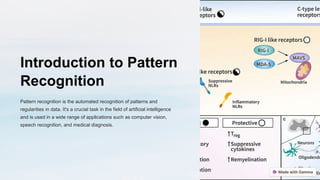
Pattern recognition is the automated recognition of patterns and
regularities in data. It's a crucial task in the field of artificial intelligence
and is used in a wide range of applications such as computer vision,
speech recognition, and medical diagnosis.
Definition and Importance of Pattern
Recognition
1 Complex Data
Analysis
Pattern recognition
involves analyzing
complex datasets to
identify meaningful
patterns and structures.
2 Automation
Efficiency
By automating the
process of pattern
recognition, tasks can be
performed with greater
efficiency and accuracy.
3 Scientific Research
It plays a critical role in
scientific research,
aiding in the analysis of
large datasets and the
identification of trends.
Types of Pattern Recognition Problems
Supervised Learning
Identifying patterns under
specific guidance with labeled
data for training.
Unsupervised Learning
Finding patterns in data
without explicit labels through
self-learning algorithms.
Semi-Supervised
Learning
Utilizing a combination of
labeled and unlabeled data
for pattern recognition.
Challenges and Limitations in Pattern
Recognition
1 Complexity of Data
The complexity and
variability of real-world
data pose significant
challenges for accurate
pattern recognition.
2 Overfitting
Dealing with overfitting,
where a model learns to
recognize specific
patterns that do not
generalize well.
3 Interpretable
Models
Creating models that not
only recognize patterns
but also provide
explanations for their
decisions.
Approaches and Algorithms for
Pattern Recognition
Feature Extraction
Identifying significant features from raw
data to facilitate pattern recognition.
Neural Networks
Applying advanced neural network
architectures for complex pattern
recognition tasks.
Ensemble Methods
Utilizing ensemble learning methods to improve pattern recognition accuracy and
robustness.
Applications of Pattern
Recognition
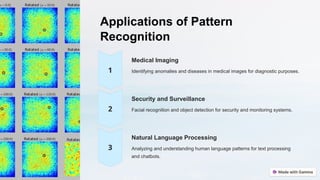
Medical Imaging
Identifying anomalies and diseases in medical images for diagnostic purposes.
Security and Surveillance
Facial recognition and object detection for security and monitoring systems.
Natural Language Processing
Analyzing and understanding human language patterns for text processing
and chatbots.
Case Studies and Examples of Pattern
Recognition
1 Image Classification
Classifying images into predefined
categories using deep learning
models.
2
Fraud Detection
Utilizing pattern recognition to identify
fraudulent activities in financial
transactions. 3 Speech Recognition
Transcribing spoken language into text
with high accuracy using speech
recognition algorithms.
Conclusion and Future Directions
in Pattern Recognition Research
1 Explainable AI
Advancing pattern recognition
models to provide transparent and
interpretable results.
2 Enhanced Accuracy
Improving the accuracy and
robustness of pattern recognition
algorithms for real-world
applications.
3 Integration with IoT
Utilizing pattern recognition in conjunction with the Internet of Things for smart and
adaptive systems.

Introduction-to-Pattern-Recognition.pptx

  • 1.
    Introduction to Pattern Recognition Patternrecognition is the automated recognition of patterns and regularities in data. It's a crucial task in the field of artificial intelligence and is used in a wide range of applications such as computer vision, speech recognition, and medical diagnosis.
  • 2.
    Definition and Importanceof Pattern Recognition 1 Complex Data Analysis Pattern recognition involves analyzing complex datasets to identify meaningful patterns and structures. 2 Automation Efficiency By automating the process of pattern recognition, tasks can be performed with greater efficiency and accuracy. 3 Scientific Research It plays a critical role in scientific research, aiding in the analysis of large datasets and the identification of trends.
  • 3.
    Types of PatternRecognition Problems Supervised Learning Identifying patterns under specific guidance with labeled data for training. Unsupervised Learning Finding patterns in data without explicit labels through self-learning algorithms. Semi-Supervised Learning Utilizing a combination of labeled and unlabeled data for pattern recognition.
  • 4.
    Challenges and Limitationsin Pattern Recognition 1 Complexity of Data The complexity and variability of real-world data pose significant challenges for accurate pattern recognition. 2 Overfitting Dealing with overfitting, where a model learns to recognize specific patterns that do not generalize well. 3 Interpretable Models Creating models that not only recognize patterns but also provide explanations for their decisions.
  • 5.
    Approaches and Algorithmsfor Pattern Recognition Feature Extraction Identifying significant features from raw data to facilitate pattern recognition. Neural Networks Applying advanced neural network architectures for complex pattern recognition tasks. Ensemble Methods Utilizing ensemble learning methods to improve pattern recognition accuracy and robustness.
  • 6.
    Applications of Pattern Recognition MedicalImaging Identifying anomalies and diseases in medical images for diagnostic purposes. Security and Surveillance Facial recognition and object detection for security and monitoring systems. Natural Language Processing Analyzing and understanding human language patterns for text processing and chatbots.
  • 7.
    Case Studies andExamples of Pattern Recognition 1 Image Classification Classifying images into predefined categories using deep learning models. 2 Fraud Detection Utilizing pattern recognition to identify fraudulent activities in financial transactions. 3 Speech Recognition Transcribing spoken language into text with high accuracy using speech recognition algorithms.
  • 8.
    Conclusion and FutureDirections in Pattern Recognition Research 1 Explainable AI Advancing pattern recognition models to provide transparent and interpretable results. 2 Enhanced Accuracy Improving the accuracy and robustness of pattern recognition algorithms for real-world applications. 3 Integration with IoT Utilizing pattern recognition in conjunction with the Internet of Things for smart and adaptive systems.