Pattern Recognition
prepared by eng:Mohmed Ahmed Mustafa
abdelati.
Luxor university.
Faculty of computers and information
,computer science department.
Foreword
 using big data and machine learning technologies emergence, a lot of data
became available that was previously either deduced or speculated but by using
a pattern recognition we moved to analyzing and understanding this data.
 Big data depends on pattern recognition as main tools ,it gets the core of data
concerned in it hidden meaning.
Objectives
 The focus of this chapter on two fundamental questions:
• What is Pattern Identification and it’s techniques.
• What is the Use Cases for Pattern Recognition and it’s apps.
What is Pattern Identification?
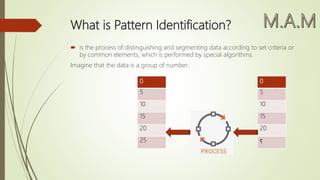
 is the process of distinguishing and segmenting data according to set criteria or
by common elements, which is performed by special algorithms.
Imagine that the data is a group of number:
0
5
10
15
20
‫؟‬
0
5
10
15
20
25
Data
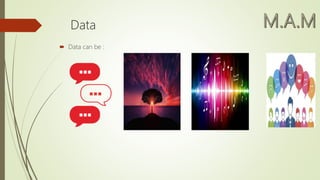
 Data can be :
Pattern Recognition Techniques
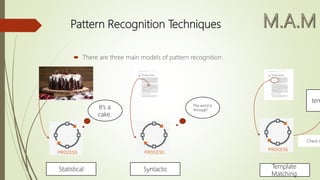
 There are three main models of pattern recognition:
It’s a
cake.
Statistical
The word is
‘through’
Syntactic Template
Matching
tem
Check w
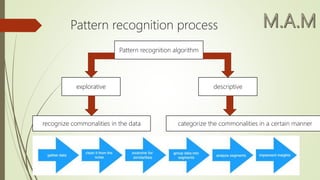
Pattern recognition process
Pattern recognition algorithm
explorative descriptive
recognize commonalities in the data categorize the commonalities in a certain manner
Use Cases for Pattern Recognition
 Data Analytics.
 Natural Language Processing.
 Optical Character Recognition.
 Image Recognition.
 voice Recognition.
 Sentiment Analysis.
Data Analytics
 pattern recognition is used to describe data, show its distinct features and
put it into a broader context as Stock market forecasting using yard charts
and Audience research as Google analytics.
Natural Language Processing(NLP).
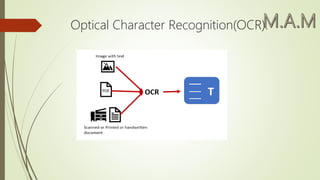
Optical Character Recognition(OCR).
Image Recognition
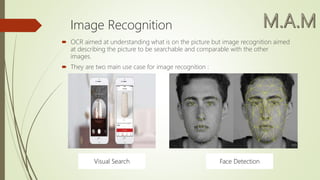
 OCR aimed at understanding what is on the picture but image recognition aimed
at describing the picture to be searchable and comparable with the other
images.
 They are two main use case for image recognition :
Visual Search Face Detection
voice Recognition
 Like Personal Assistant apps, Speech-to-text and text-to-speech
transformation and Automatic Captions
Sentiment Analysis
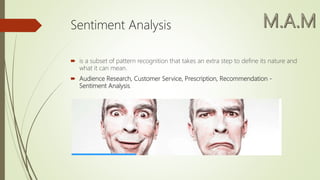
 is a subset of pattern recognition that takes an extra step to define its nature and
what it can mean.
 Audience Research, Customer Service, Prescription, Recommendation -
Sentiment Analysis.
conclusion
 Pattern recognition is the key to the further evolution of computational
technology. With its help, big data analytics can progress further and we can all
benefit from the machine learning algorithms getting smarter and smarter.
 As you can see, pattern recognition can be implemented in any kind of industry
because where there is data, there are similarities in the data. Therefore, it's wise
to consider the possibility of implementing this technology into your business
operations to make them more efficient.
Summary
 An active example for pattern recognition :
Teaching :the prof should teach scientific content he should Explains the meanings
hidden behind the words not just Indoctrination.
Replacing:
prof------>programmer.
students-------->machines.
scientific content --------->data.
we can got the meaning of pattern recognition.
Summary…..
 Most of Thoughts that uses in technology that have effect in our society are
based on pattern recognition.
 A message for all: learning pattern recognition work manly to help all in their
graduation projects .
Summary….
 Part I like it in this presentation is sentiment analysis and transform sentiment to a
data that can be process ,it’s imaginary.

Pattern recognition

  • 1.
    Pattern Recognition prepared byeng:Mohmed Ahmed Mustafa abdelati. Luxor university. Faculty of computers and information ,computer science department.
  • 2.
    Foreword  using bigdata and machine learning technologies emergence, a lot of data became available that was previously either deduced or speculated but by using a pattern recognition we moved to analyzing and understanding this data.  Big data depends on pattern recognition as main tools ,it gets the core of data concerned in it hidden meaning.
  • 3.
    Objectives  The focusof this chapter on two fundamental questions: • What is Pattern Identification and it’s techniques. • What is the Use Cases for Pattern Recognition and it’s apps.
  • 4.
    What is PatternIdentification?  is the process of distinguishing and segmenting data according to set criteria or by common elements, which is performed by special algorithms. Imagine that the data is a group of number: 0 5 10 15 20 ‫؟‬ 0 5 10 15 20 25
  • 5.
  • 6.
    Pattern Recognition Techniques There are three main models of pattern recognition: It’s a cake. Statistical The word is ‘through’ Syntactic Template Matching tem Check w
  • 7.
    Pattern recognition process Patternrecognition algorithm explorative descriptive recognize commonalities in the data categorize the commonalities in a certain manner
  • 8.
    Use Cases forPattern Recognition  Data Analytics.  Natural Language Processing.  Optical Character Recognition.  Image Recognition.  voice Recognition.  Sentiment Analysis.
  • 9.
    Data Analytics  patternrecognition is used to describe data, show its distinct features and put it into a broader context as Stock market forecasting using yard charts and Audience research as Google analytics.
  • 10.
  • 11.
  • 12.
    Image Recognition  OCRaimed at understanding what is on the picture but image recognition aimed at describing the picture to be searchable and comparable with the other images.  They are two main use case for image recognition : Visual Search Face Detection
  • 13.
    voice Recognition  LikePersonal Assistant apps, Speech-to-text and text-to-speech transformation and Automatic Captions
  • 14.
    Sentiment Analysis  isa subset of pattern recognition that takes an extra step to define its nature and what it can mean.  Audience Research, Customer Service, Prescription, Recommendation - Sentiment Analysis.
  • 15.
    conclusion  Pattern recognitionis the key to the further evolution of computational technology. With its help, big data analytics can progress further and we can all benefit from the machine learning algorithms getting smarter and smarter.  As you can see, pattern recognition can be implemented in any kind of industry because where there is data, there are similarities in the data. Therefore, it's wise to consider the possibility of implementing this technology into your business operations to make them more efficient.
  • 16.
    Summary  An activeexample for pattern recognition : Teaching :the prof should teach scientific content he should Explains the meanings hidden behind the words not just Indoctrination. Replacing: prof------>programmer. students-------->machines. scientific content --------->data. we can got the meaning of pattern recognition.
  • 17.
    Summary…..  Most ofThoughts that uses in technology that have effect in our society are based on pattern recognition.  A message for all: learning pattern recognition work manly to help all in their graduation projects .
  • 18.
    Summary….  Part Ilike it in this presentation is sentiment analysis and transform sentiment to a data that can be process ,it’s imaginary.

Editor's Notes

  • #5 Any information on the sequential nature can be processed by pattern recognition algorithms, making the sequences comprehensible and enabling its practical use.
  • #6 data can be : 1-text. 2-image. 3-Voice. 4-Sentiments, and others.
  • #7 Statistical : uses supervised machine learning. Syntactic : uses semi-supervised machine learning. Template Matching : One of the uses of such a model is plagiarism checking.
  • #8 Data is gathered from its sources (via tracking or input) Data is cleaned up from the noise Information is examined for relevant features or common elements These elements are subsequently grouped in specific segments; The segments are analyzed for insights into data sets; The extracted insights are implemented into the business operation.
  • #11 used in such fields as:Text analysis, Plagiarism detection, Text summarization and contextual extraction and others
  • #12 The most common source of the optical characters are scanned documents or photographs, but the thing can also be used on computer-generated unlabeled images* As Text Transcription and Document Classification.
  • #13 A famous example for visual search is Google lens. Facebook and instagram used face detection.
  • #14 Note:voice recognition works on the same principles as OCR. The only difference is the source of information.