“KnowYourRights”
Presented by:- Puneet Nirmal
M.Pharm 1st year
Dept. of QUALITY ASSURANCE
ISF COLLEGE OF PHARMACY
Mobile: 8285841601
Website: - www.isfcp.org
INTELLECTUAL
PROPERTY
 Law governingIP
 Meaning
 Types ofIP
Patent
Trademark
Copyright
 Conclusion
Overview
2
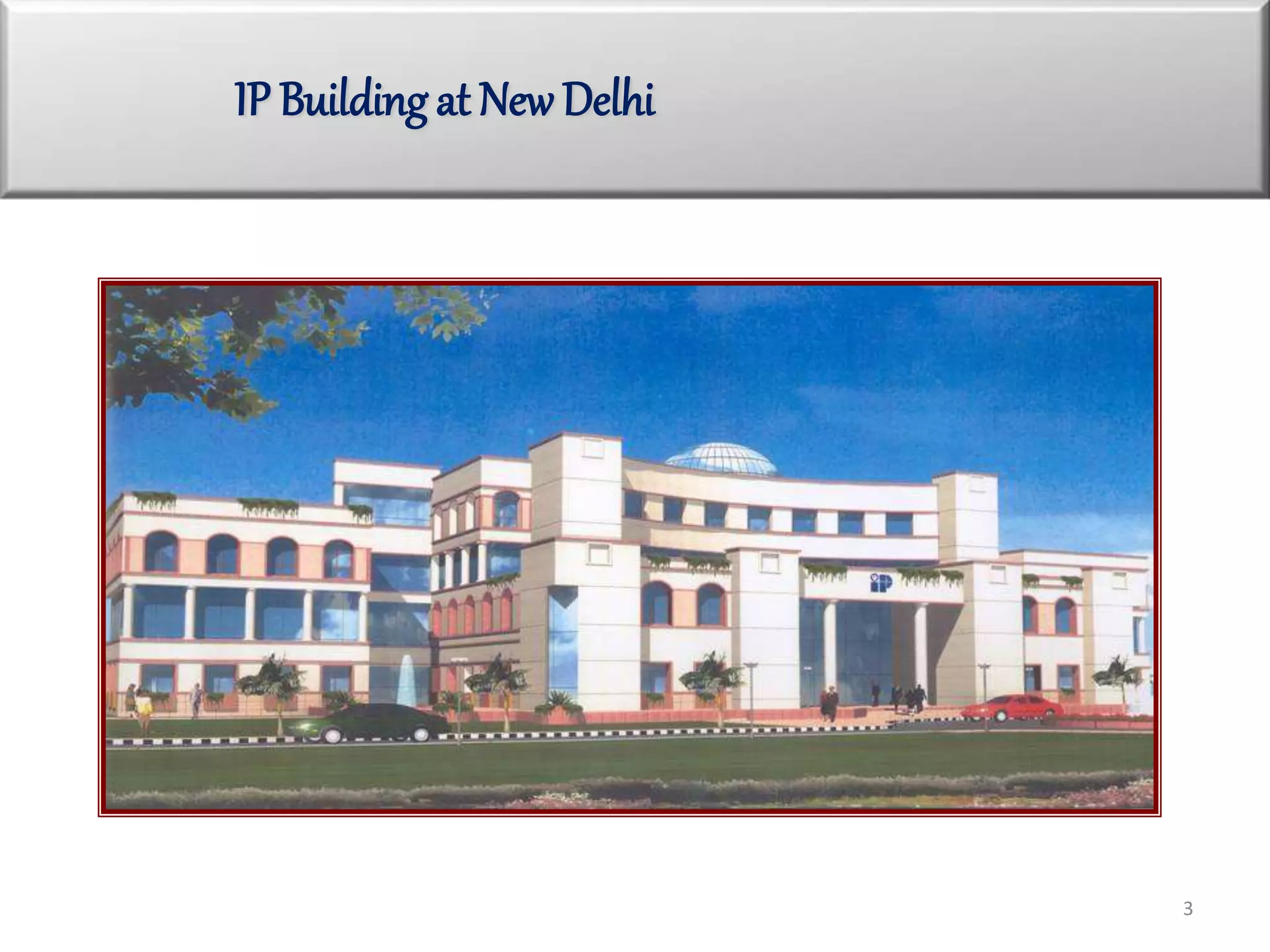
IP Building at New Delhi
3
 WIPO (World Intellectual Property Organization )
was established by the WIPO Convention in 1967
 The WIPO is a specialized agency of the United
Nations.
 It promote the protection of IP
throughout the world.
 Its headquarters are in Geneva,
Switzerland.
 World Intellectual Property Day- 26th April
WIPO
4
 There are many bigand small intellectual property law
firms worldwide, like in India, USA, UK, Chicago etc,
providing qualitative help to inventors and creators of
product.
 In India intellectual property rights are safely
protected and controlled by well- established
judicial framework.
 Apart From that, there are many attorneys and law firm
of intellectual property in India in various states.
Intellectual Property Law In India
5
Intellectual Property is a property that
arises from the human intellect. It is a
product of human creation.
Intellectual Property comprises 2 distinct
forms:
• Literary &ArtisticWorks
• Industrial Property
What is “Intellectual Property”?
6
*They are books, paintings, musical
compositions, plays, movies, radio/tv
programs, performances, &other artistic works.
 Howare they Protected?
*Protected by“COPYRIGHT”
“Literary & Artistic Worls”
7
 Industrial Property describes physical matter that
is the product of an idea or concept for commercial
purposes.
 Howare they Protected?
* By Patented objects
* By Trademarks
* By Industrial Designs
* By Trade Secrets
* By Layout-designs
* By Geographical Indications
“Industrial Property”
8
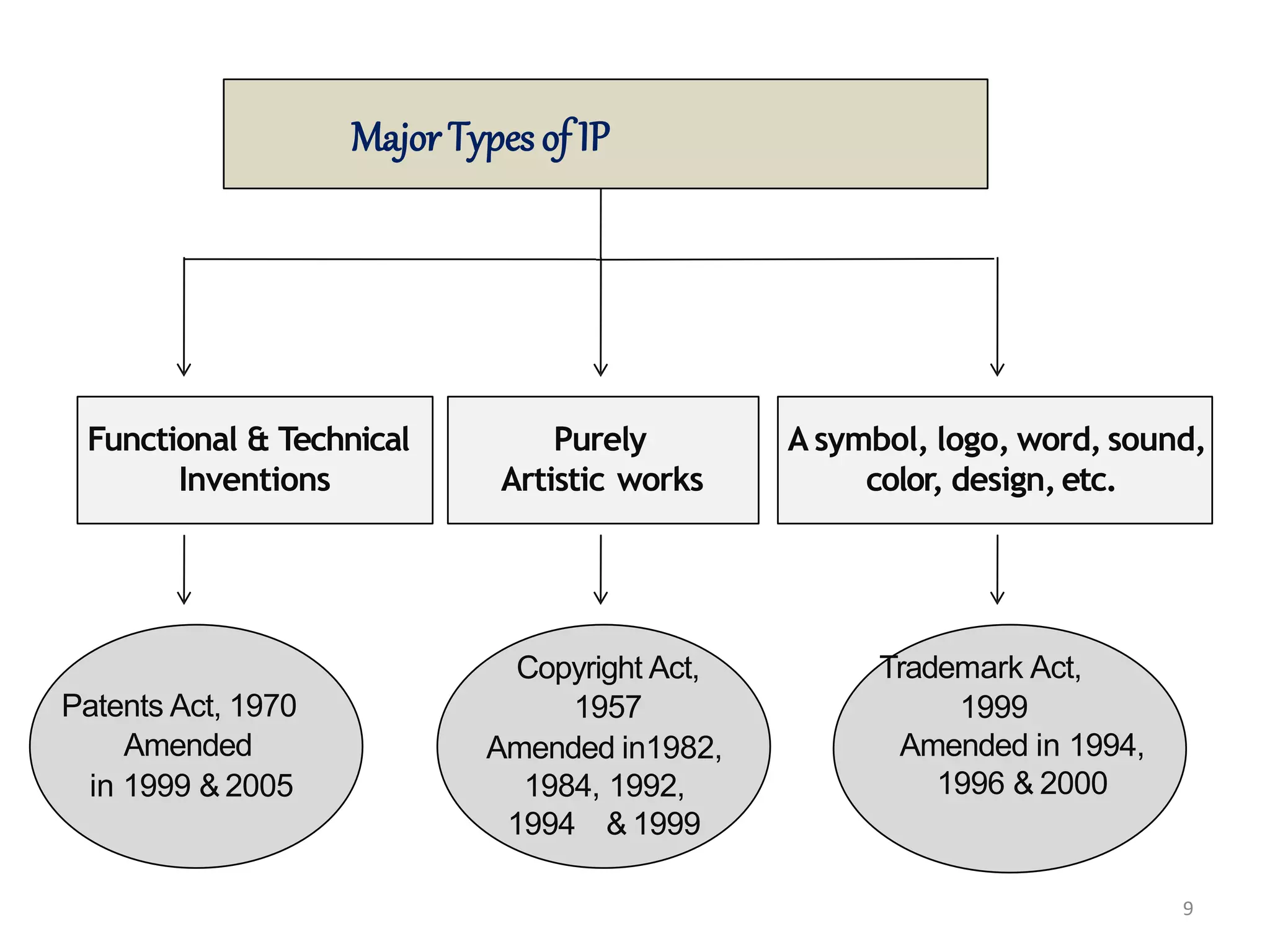
Functional & Technical
Inventions
Patents Act, 1970
Amended
in 1999 & 2005
Purely
Artistic works
Copyright Act,
1957
Amended in1982,
1984, 1992,
1994 & 1999
A symbol, logo, word, sound,
color, design, etc.
Trademark Act,
1999
Amended in 1994,
1996 & 2000
Major Types of IP
9
(1) It is coveredunder theAct called the Patents
Act, 1970 [Amended by PatentsAct, 2005]
(2) It extends to the whole of India.
(3) It shall come into forceon such date as the
Central Government may publish, by
notification in the Official Gazette.
Patents
10
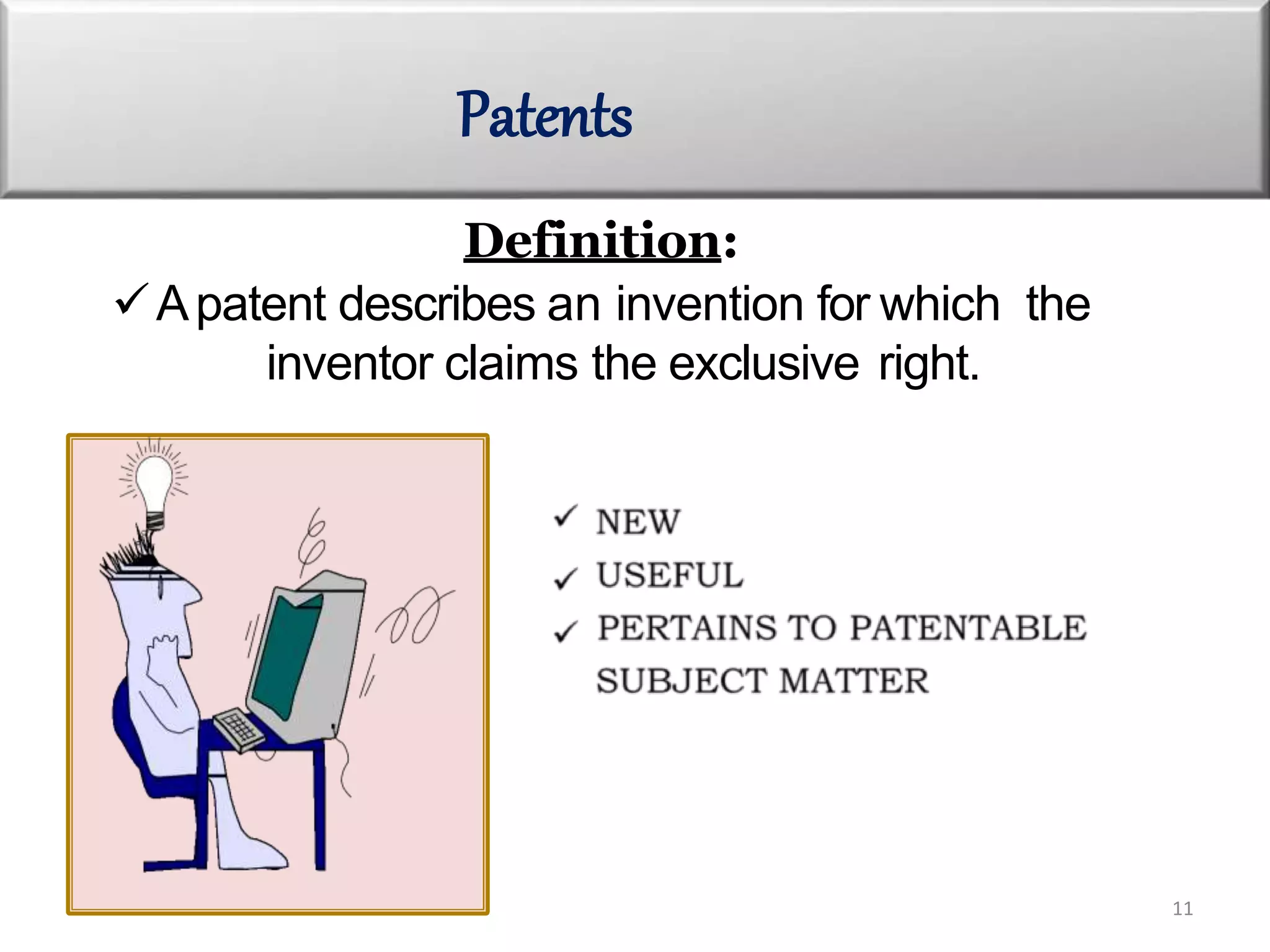
Definition:
Apatent describes an invention for which the
inventor claims the exclusive right.
Patents
11
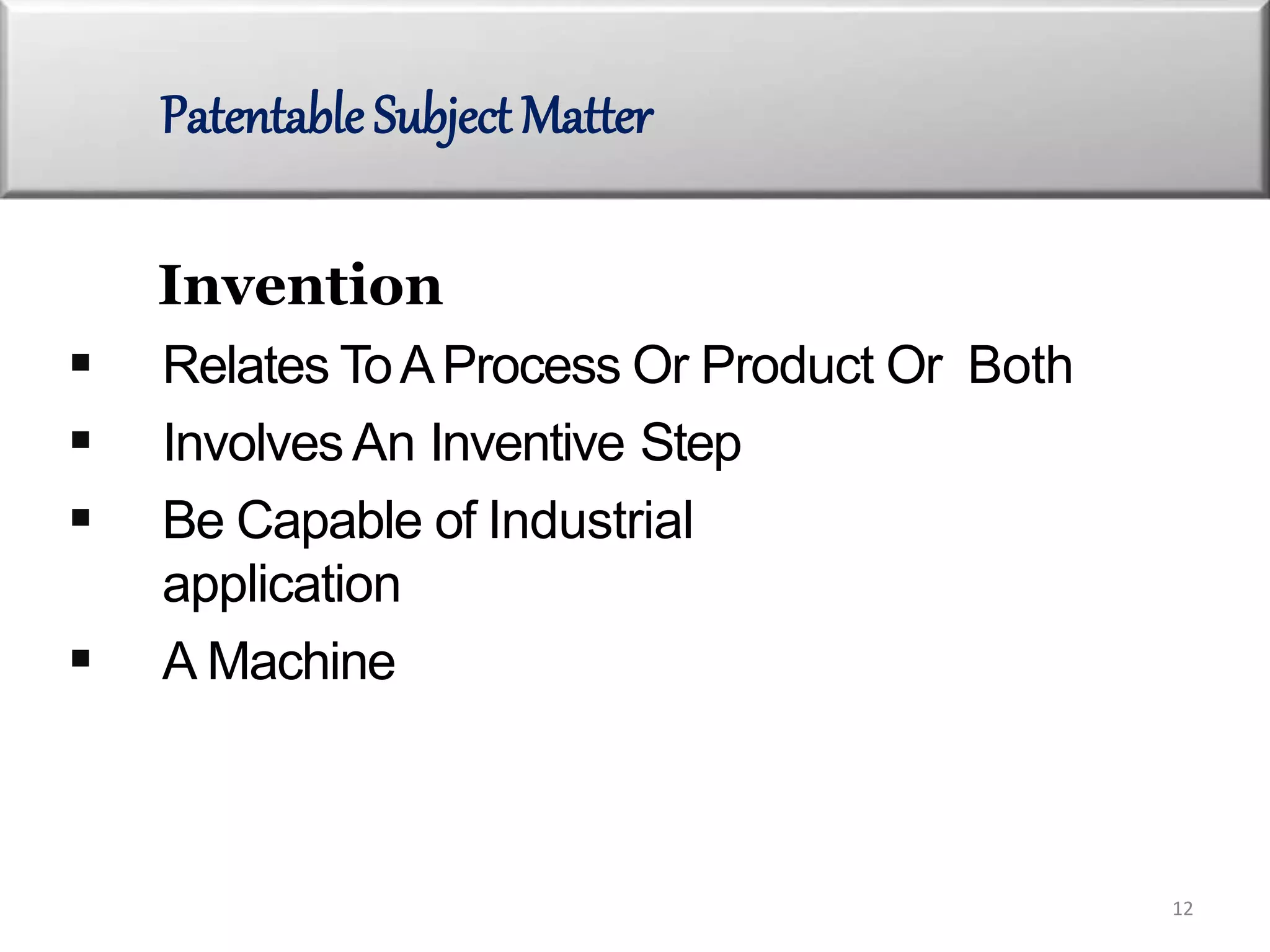
Invention
 Relates ToAProcess Or Product Or Both
 InvolvesAn Inventive Step
 Be Capable of Industrial
application
 A Machine
Patentable Subject Matter
12
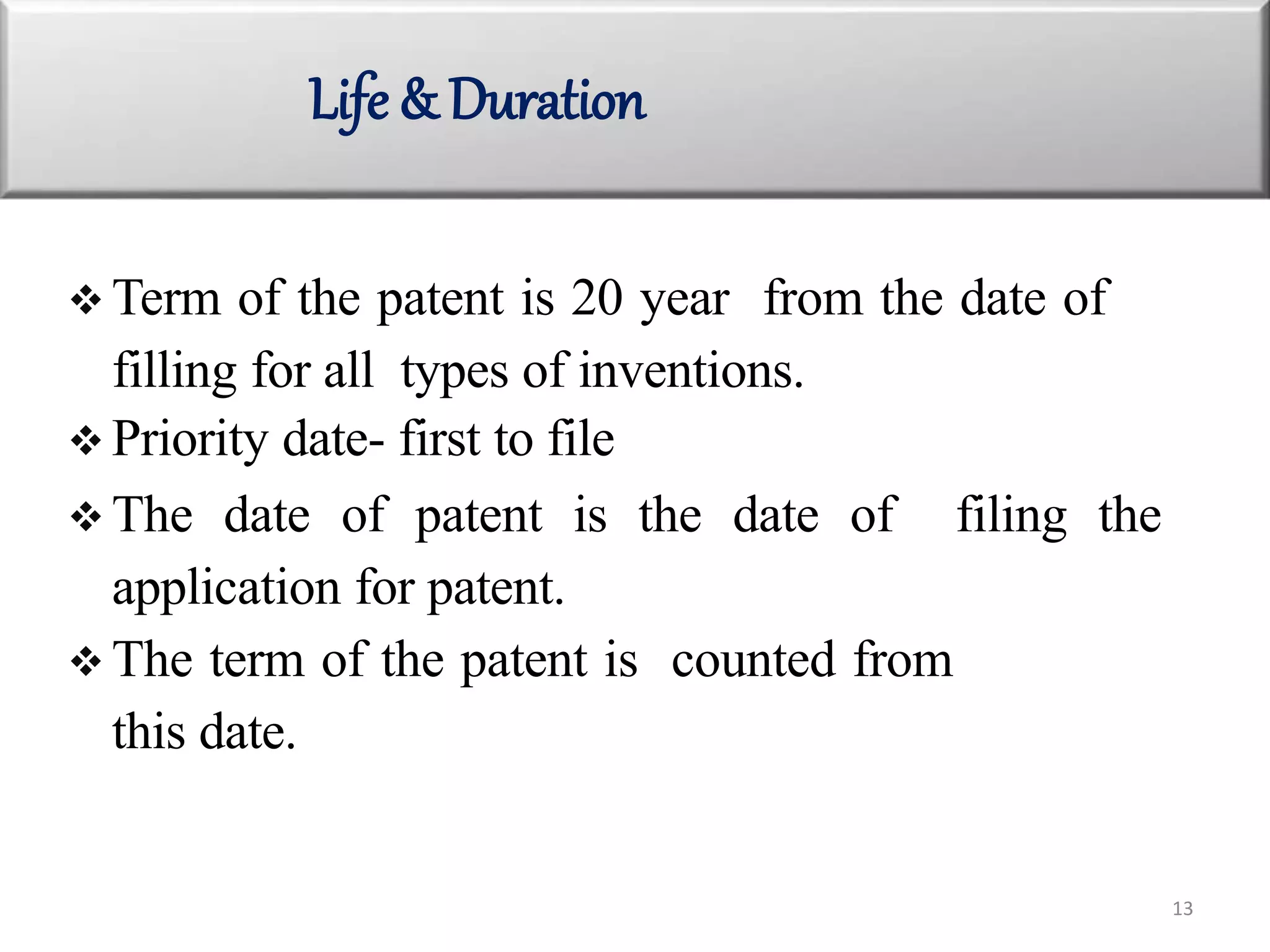
Life & Duration
13
 Term of the patent is 20 year from the date of
filling for all types of inventions.
 Priority date- first to file
 The date of patent is the date of filing the
application for patent.
 The term of the patent is counted from
this date.
 The Government fee for filing a patent application
in India is Rs.750/- for individuals and
Rs.3,000/- for legal entities.
 No fee for 1st and 2nd year
 Renewal fee, on yearly basis, is required to be
paid for 3rd to 20th for keeping the patent in
force.
 Patent lapses if renewal fee is not paid within the
prescribed period.
Fees For Filing Patent
14
 No,there is nothing like a global patent or a world
patent. Patent rights are essentially territorial in
nature
 Granting a patent in one country of the Union
does not force other countries to grant the patent
for the same invention.
 The refusal of the patent in one country does not
mean that it will be terminated in all the countries
Is A Patent GrantedIn One Country Enforceable In Other
Countries
15
 The list of top 10 patents holders in India
comprises only pharmaceutical and bio-tech
companies.
 In India, 184 patents are held by the Council of
Scientific and Industrial Research, followed by
Ranbaxy
 While the top 10 patents holders across the world
are ITcompanies, in India, no ITfirm has patents.
Patent Holders In India
16
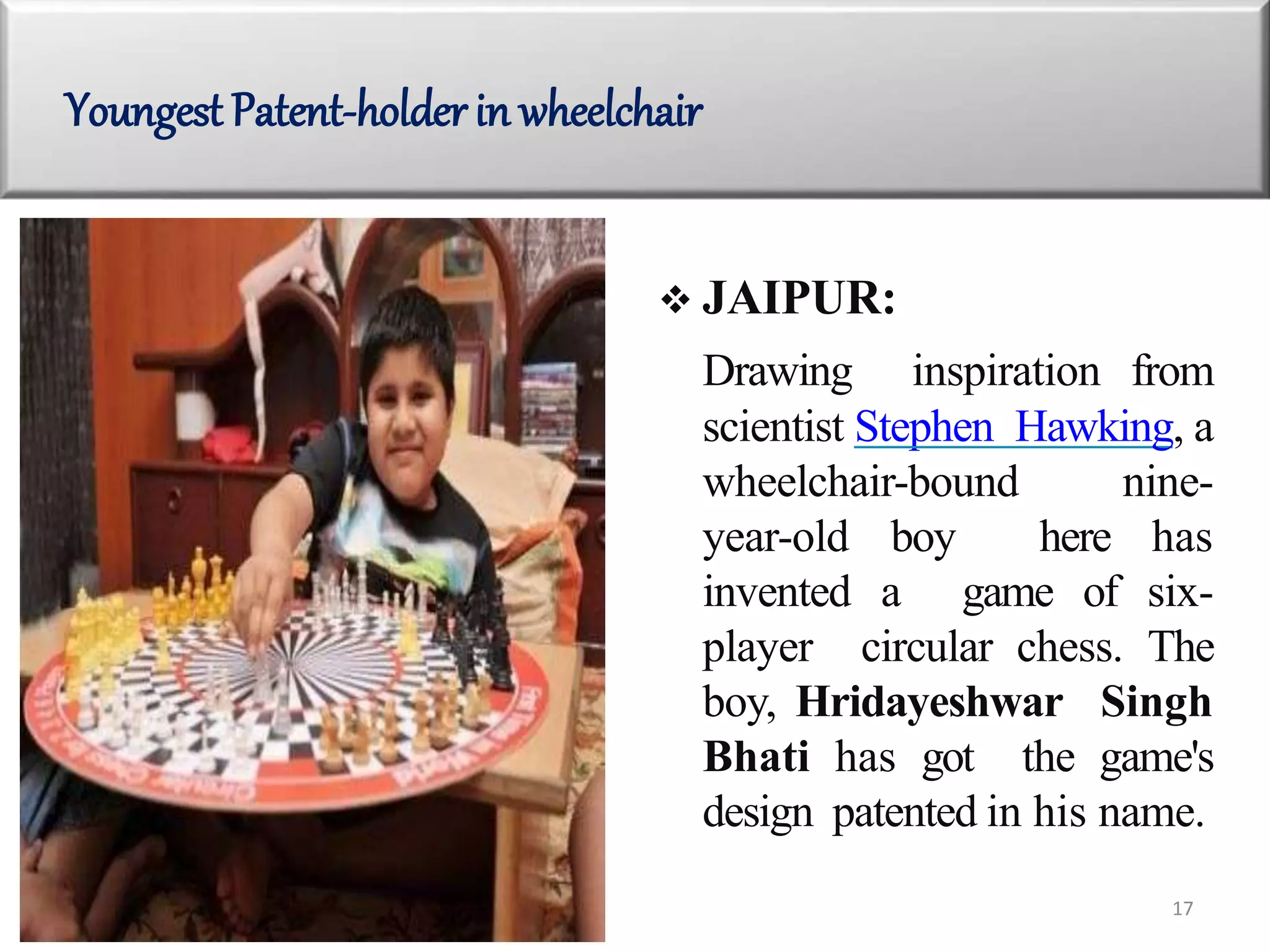
 JAIPUR:
Drawing inspiration from
scientist Stephen Hawking, a
wheelchair-bound nine-
year-old boy here has
invented a game of six-
player circular chess. The
boy, Hridayeshwar Singh
Bhati has got the game's
design patented in his name.
Youngest Patent-holderin wheelchair
17
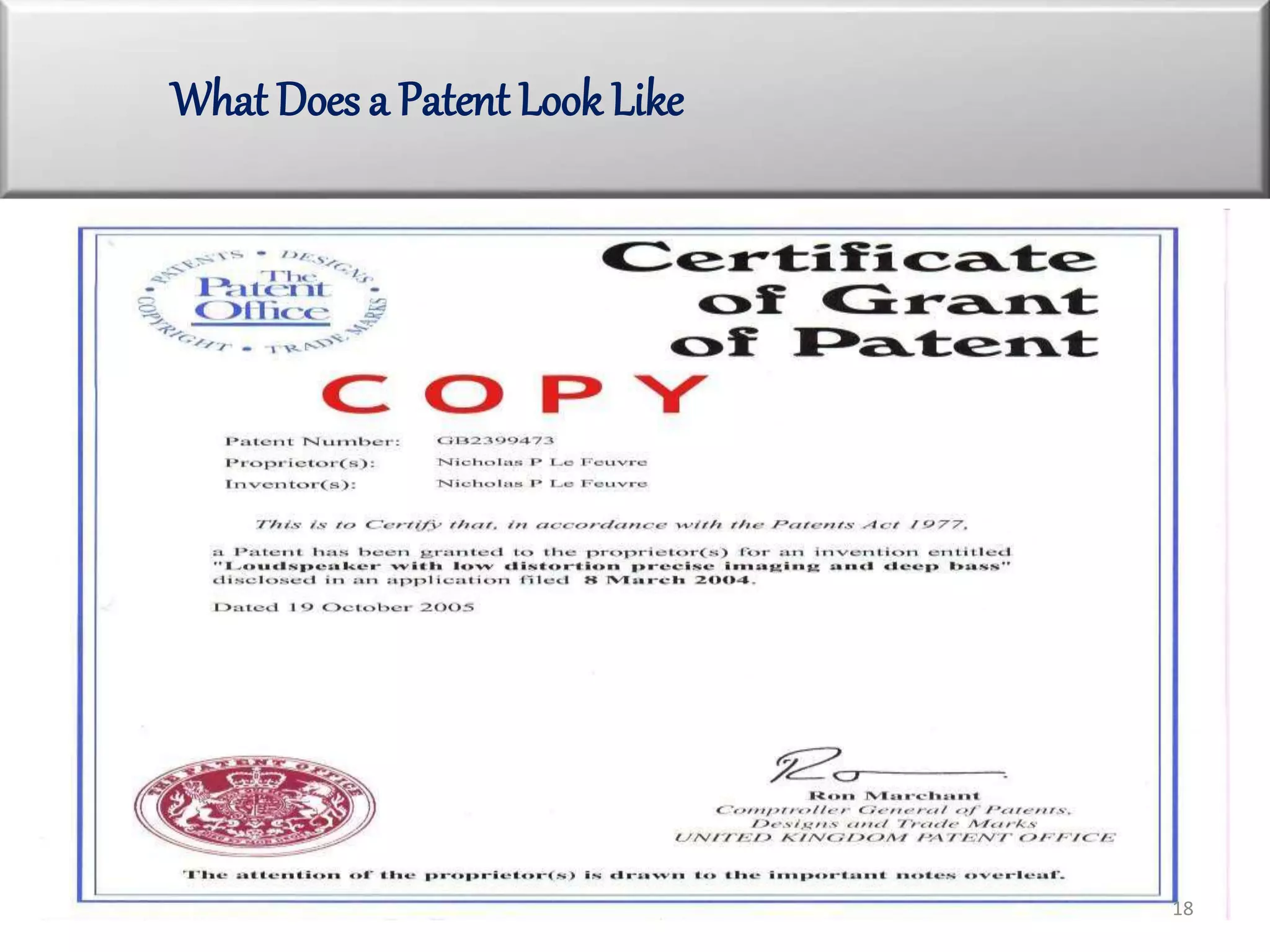
What Does a Patent Look Like
18
1. It is covered under the Act called the Trade
MarksAct, 1999.
2. The Act came into effect on September 15,
2003. It replaced the Trade and Merchandise
MarksAct, 1958.
3. It extends to the whole of India.
4. It shall come into force on such date as the
Central Government may publish, by
notification in the Official Gazette.
TRADEMARK
19
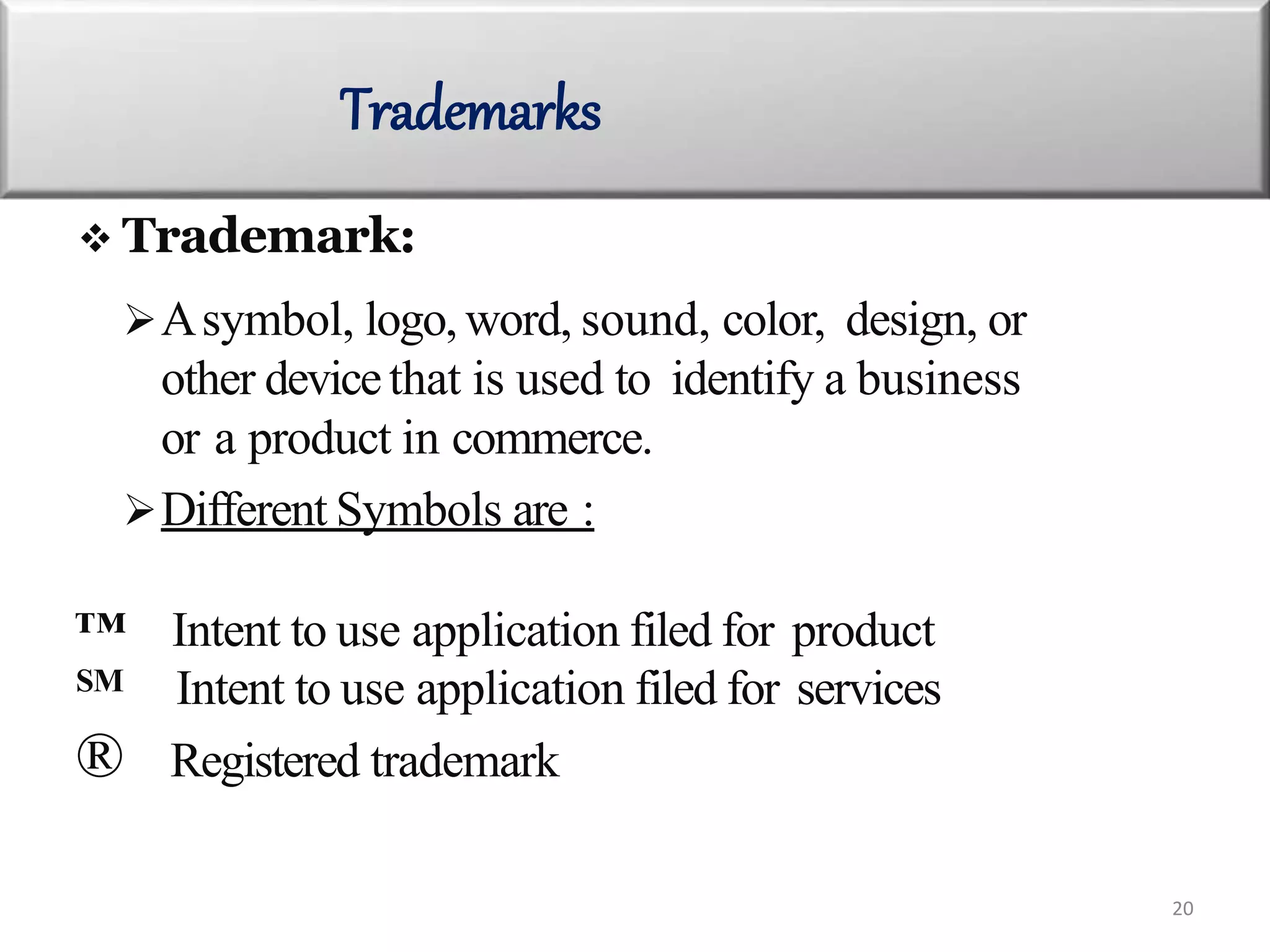
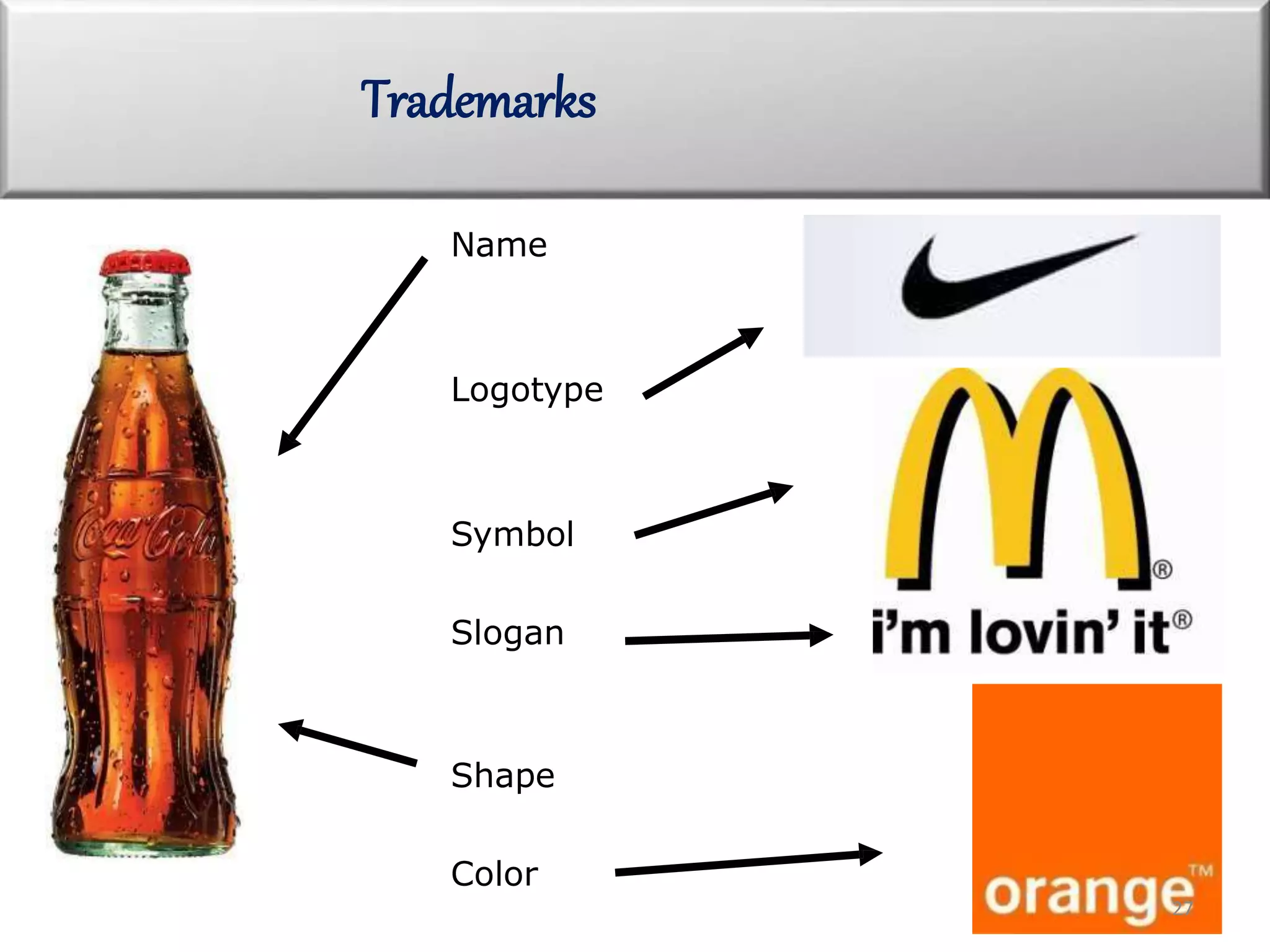
 Trademark:
Asymbol, logo, word, sound, color, design, or
other devicethat is used to identify a business
or a product in commerce.
Different Symbols are :
™ Intent to use application filed for product
SM Intent to use application filed for services
® Registered trademark
Trademarks
20
• Application for search.
• Application for registration.
• Examination of trademark.
• Advertisement of trademark.
• Filing of opposition.
• Certificate issued.
RegistrationProcedure
21
 Trademark is valid for 10 years from the date of
application which may be renewed for further period
of 10 years on payment of prescribed fees.
 Service mark Rights are reserved exclusively for
owners for 17 year &it can also be renewed.
 The Govt. fees is Rs. 2,500 for each class of
goods or services.
Duration & Fees of Trademarks
22
 Atrademark is a sign Used on, or in connection with
the marketing ofgoods or services.
 “Used on” the goods means that it may appear not
only on the goods themselves but on the container
or wrapper in which the goods are when they are
sold.
Application of Trademark
23
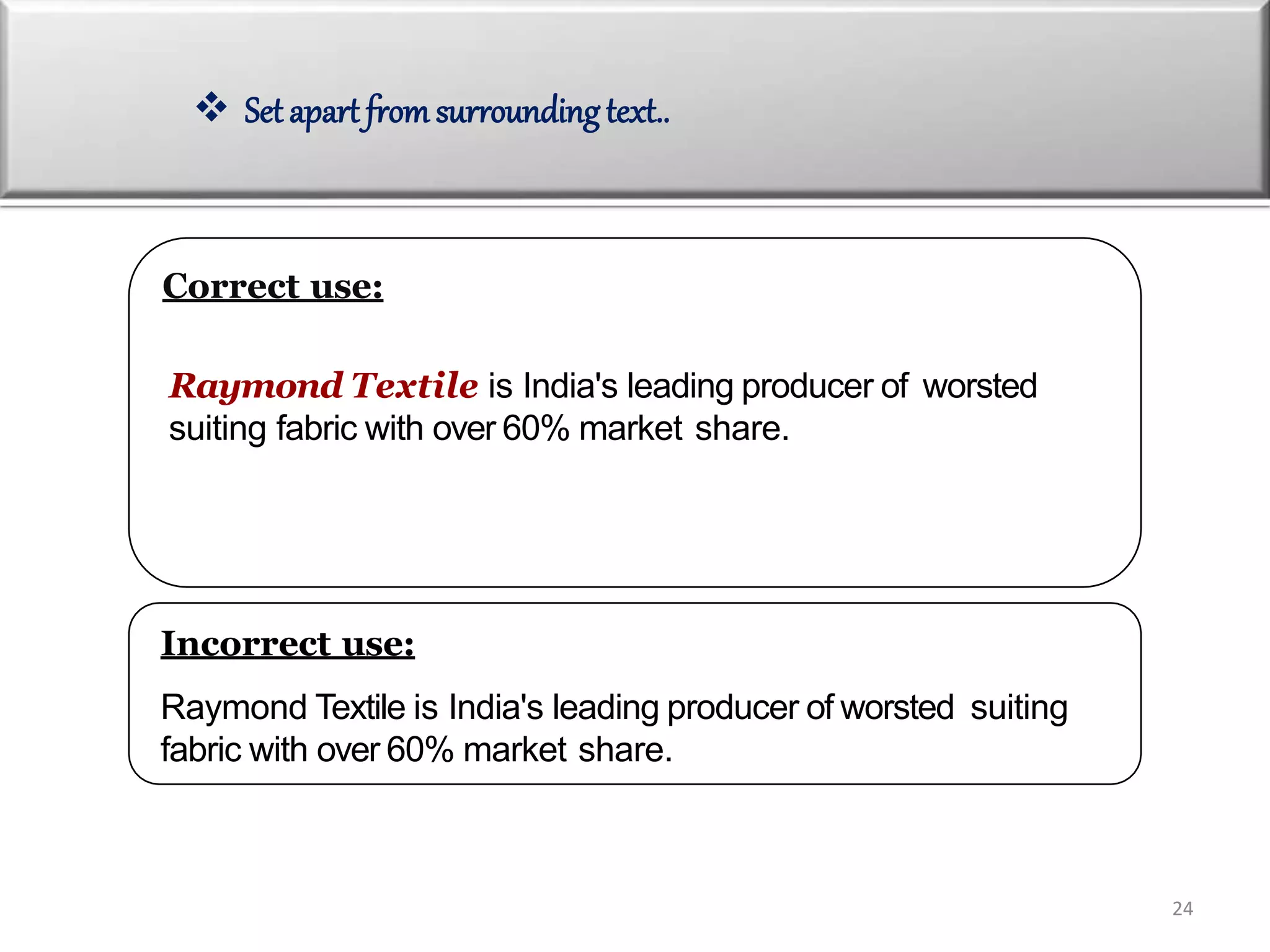
Correct use:
Raymond Textile is India's leading producer of worsted
suiting fabric with over 60% market share.
Incorrect use:
Raymond Textile is India's leading producer of worsted suiting
fabric with over 60% market share.
 Set apart from surroundingtext..
24
Correct use:
Incorrect use:
VIMAL ADT
A
ftosa
 Specifyfont, size, proportionand placement
25
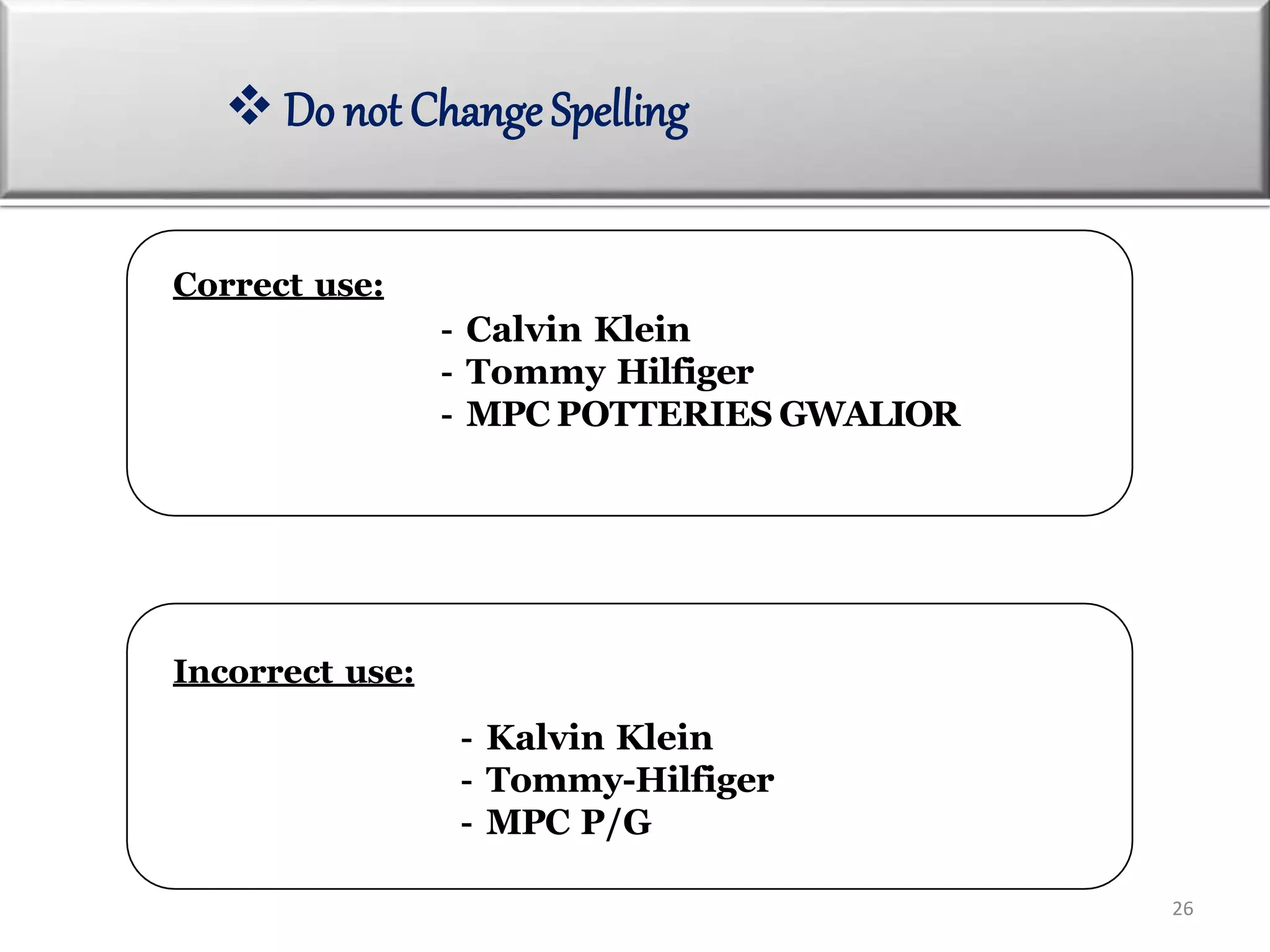
Incorrect use:
- Kalvin Klein
- Tommy-Hilfiger
- MPC P/G
Correct use:
- Calvin Klein
- Tommy Hilfiger
- MPC POTTERIES GWALIOR
 Do not Change Spelling
26
Name
Logotype
Symbol
Slogan
Shape
Color
Trademarks
27
The Indian CopyrightAct,1957 governs the
system of copyrights in India. [Amended in 1982,
1984, 1992, 1994 & 1999]
Meaning : It is a right which Grants protection
to the unique expression of Ideas.
Copyright
28
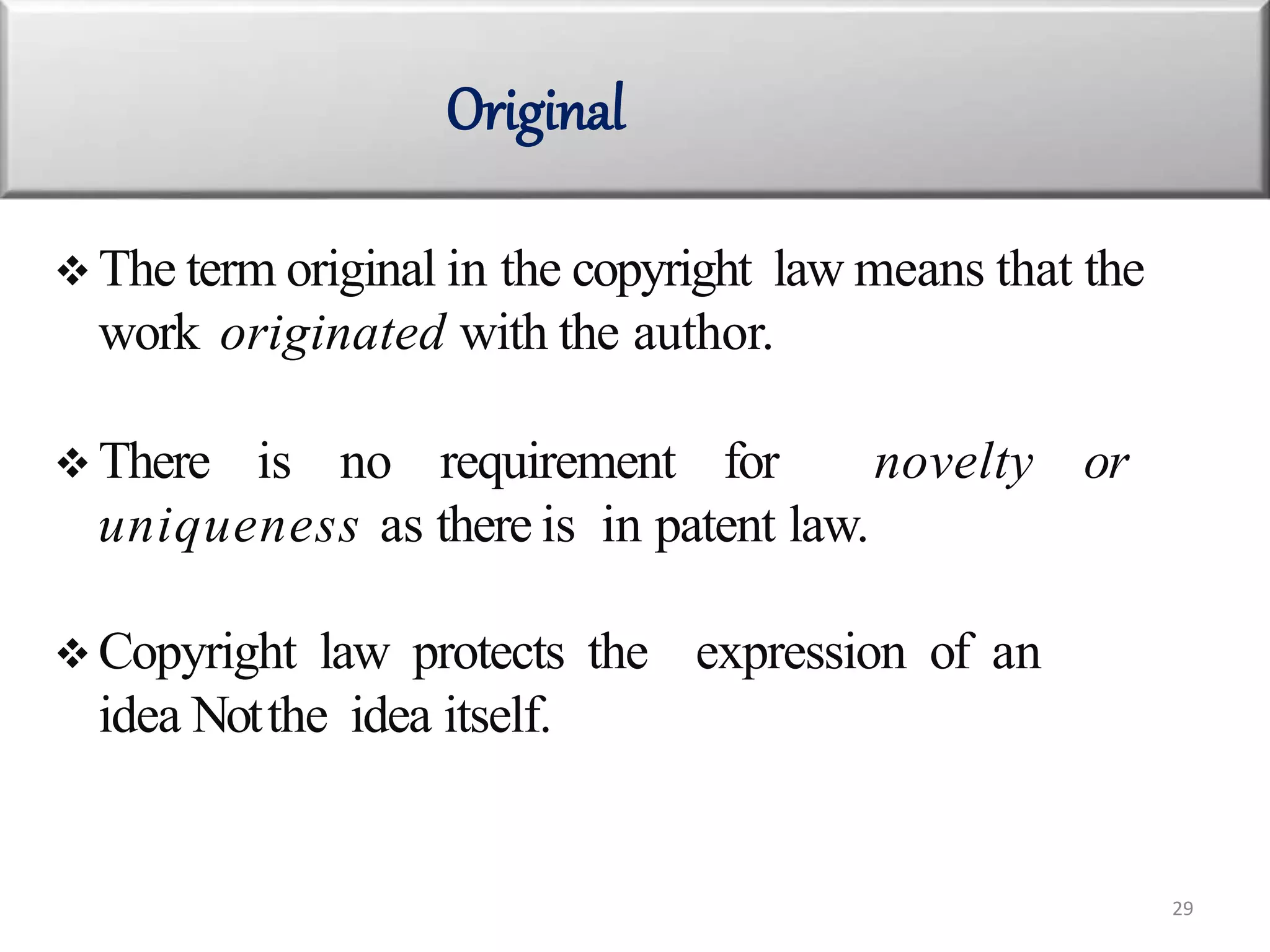
 The term original in the copyright law means that the
work originated with the author.
 There is no requirement for novelty or
uniqueness as there is in patent law.
 Copyright law protects the expression of an
idea Notthe idea itself.
Original
29
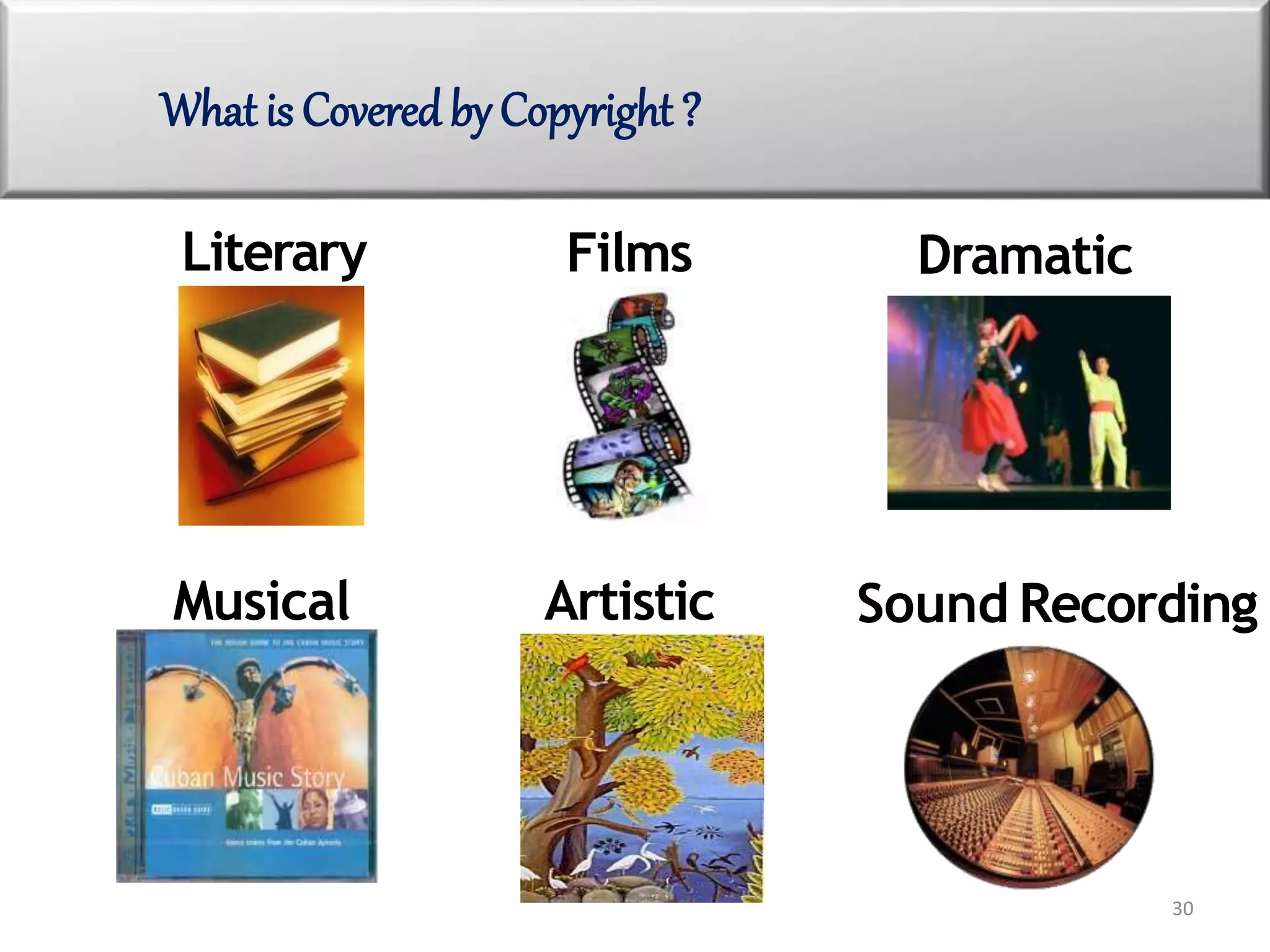
Literary Films Dramatic
Musical Sound RecordingArtistic
What is Covered by Copyright ?
30
• Ideas
• Facts
• Recipes
• Works lacking originality (e.g.The phone book)
• Names, titles or short phrases
What is not Covered by Copyright ?
31
• Register a copyright by completing a simple
application form, along with the appropriate fee
• Neednot send a copy of your work,
• It may appear with the same title, but if each work
has been created independently, each will have its
own copyright protection.
Registration Procedure
32
Copyright lasts for the-
 Author's lifetime + 50 years from the end of the
calendar year in which the author dies, 50 years
for films and sound recordings,
 25 years for typographical arrangements of a
published edition,
 Copyright protection always expires on December
31 of the last calendar year of
protection.
Duration of Copyright
33
Take action against
Infringements
34
Create yourself, rather than using other‟s
creations
Do not use competiton’smark in such way that
it harms competitor in unfair way
Nocomparisons that arelikely to cause confusion
CONCLUSION
35
Reference
36
https://www.slideshare.net/ParimalKowtal/intellectual-property-right-ipr-
trademark?qid=d9dbdc97-886d-4826-9250-f47beb31988d&v=&b=&from_search=3
https://www.slideshare.net/indravi/intellectual-property-rights-ipr-in-
engineering?qid=d9dbdc97-886d-4826-9250-f47beb31988d&v=&b=&from_search=9
https://www.esa.int/About_Us/Law_at_ESA/Intellectual_Property_Rights/What_is_int
ellectual_property
https://www.esa.int/About_Us/Law_at_ESA/Intellectual_Property_Rights/What_is_int
ellectual_property
https://www.ncbi.nlm.nih.gov/pmc/articles/PMC3217699/
37
Any Question
38

Intellectual Property-IP PPT

  • 1.
    “KnowYourRights” Presented by:- PuneetNirmal M.Pharm 1st year Dept. of QUALITY ASSURANCE ISF COLLEGE OF PHARMACY Mobile: 8285841601 Website: - www.isfcp.org INTELLECTUAL PROPERTY
  • 2.
     Law governingIP Meaning  Types ofIP Patent Trademark Copyright  Conclusion Overview 2
  • 3.
    IP Building atNew Delhi 3
  • 4.
     WIPO (WorldIntellectual Property Organization ) was established by the WIPO Convention in 1967  The WIPO is a specialized agency of the United Nations.  It promote the protection of IP throughout the world.  Its headquarters are in Geneva, Switzerland.  World Intellectual Property Day- 26th April WIPO 4
  • 5.
     There aremany bigand small intellectual property law firms worldwide, like in India, USA, UK, Chicago etc, providing qualitative help to inventors and creators of product.  In India intellectual property rights are safely protected and controlled by well- established judicial framework.  Apart From that, there are many attorneys and law firm of intellectual property in India in various states. Intellectual Property Law In India 5
  • 6.
    Intellectual Property isa property that arises from the human intellect. It is a product of human creation. Intellectual Property comprises 2 distinct forms: • Literary &ArtisticWorks • Industrial Property What is “Intellectual Property”? 6
  • 7.
    *They are books,paintings, musical compositions, plays, movies, radio/tv programs, performances, &other artistic works.  Howare they Protected? *Protected by“COPYRIGHT” “Literary & Artistic Worls” 7
  • 8.
     Industrial Propertydescribes physical matter that is the product of an idea or concept for commercial purposes.  Howare they Protected? * By Patented objects * By Trademarks * By Industrial Designs * By Trade Secrets * By Layout-designs * By Geographical Indications “Industrial Property” 8
  • 9.
    Functional & Technical Inventions PatentsAct, 1970 Amended in 1999 & 2005 Purely Artistic works Copyright Act, 1957 Amended in1982, 1984, 1992, 1994 & 1999 A symbol, logo, word, sound, color, design, etc. Trademark Act, 1999 Amended in 1994, 1996 & 2000 Major Types of IP 9
  • 10.
    (1) It iscoveredunder theAct called the Patents Act, 1970 [Amended by PatentsAct, 2005] (2) It extends to the whole of India. (3) It shall come into forceon such date as the Central Government may publish, by notification in the Official Gazette. Patents 10
  • 11.
    Definition: Apatent describes aninvention for which the inventor claims the exclusive right. Patents 11
  • 12.
    Invention  Relates ToAProcessOr Product Or Both  InvolvesAn Inventive Step  Be Capable of Industrial application  A Machine Patentable Subject Matter 12
  • 13.
    Life & Duration 13 Term of the patent is 20 year from the date of filling for all types of inventions.  Priority date- first to file  The date of patent is the date of filing the application for patent.  The term of the patent is counted from this date.
  • 14.
     The Governmentfee for filing a patent application in India is Rs.750/- for individuals and Rs.3,000/- for legal entities.  No fee for 1st and 2nd year  Renewal fee, on yearly basis, is required to be paid for 3rd to 20th for keeping the patent in force.  Patent lapses if renewal fee is not paid within the prescribed period. Fees For Filing Patent 14
  • 15.
     No,there isnothing like a global patent or a world patent. Patent rights are essentially territorial in nature  Granting a patent in one country of the Union does not force other countries to grant the patent for the same invention.  The refusal of the patent in one country does not mean that it will be terminated in all the countries Is A Patent GrantedIn One Country Enforceable In Other Countries 15
  • 16.
     The listof top 10 patents holders in India comprises only pharmaceutical and bio-tech companies.  In India, 184 patents are held by the Council of Scientific and Industrial Research, followed by Ranbaxy  While the top 10 patents holders across the world are ITcompanies, in India, no ITfirm has patents. Patent Holders In India 16
  • 17.
     JAIPUR: Drawing inspirationfrom scientist Stephen Hawking, a wheelchair-bound nine- year-old boy here has invented a game of six- player circular chess. The boy, Hridayeshwar Singh Bhati has got the game's design patented in his name. Youngest Patent-holderin wheelchair 17
  • 18.
    What Does aPatent Look Like 18
  • 19.
    1. It iscovered under the Act called the Trade MarksAct, 1999. 2. The Act came into effect on September 15, 2003. It replaced the Trade and Merchandise MarksAct, 1958. 3. It extends to the whole of India. 4. It shall come into force on such date as the Central Government may publish, by notification in the Official Gazette. TRADEMARK 19
  • 20.
     Trademark: Asymbol, logo,word, sound, color, design, or other devicethat is used to identify a business or a product in commerce. Different Symbols are : ™ Intent to use application filed for product SM Intent to use application filed for services ® Registered trademark Trademarks 20
  • 21.
    • Application forsearch. • Application for registration. • Examination of trademark. • Advertisement of trademark. • Filing of opposition. • Certificate issued. RegistrationProcedure 21
  • 22.
     Trademark isvalid for 10 years from the date of application which may be renewed for further period of 10 years on payment of prescribed fees.  Service mark Rights are reserved exclusively for owners for 17 year &it can also be renewed.  The Govt. fees is Rs. 2,500 for each class of goods or services. Duration & Fees of Trademarks 22
  • 23.
     Atrademark isa sign Used on, or in connection with the marketing ofgoods or services.  “Used on” the goods means that it may appear not only on the goods themselves but on the container or wrapper in which the goods are when they are sold. Application of Trademark 23
  • 24.
    Correct use: Raymond Textileis India's leading producer of worsted suiting fabric with over 60% market share. Incorrect use: Raymond Textile is India's leading producer of worsted suiting fabric with over 60% market share.  Set apart from surroundingtext.. 24
  • 25.
    Correct use: Incorrect use: VIMALADT A ftosa  Specifyfont, size, proportionand placement 25
  • 26.
    Incorrect use: - KalvinKlein - Tommy-Hilfiger - MPC P/G Correct use: - Calvin Klein - Tommy Hilfiger - MPC POTTERIES GWALIOR  Do not Change Spelling 26
  • 27.
  • 28.
    The Indian CopyrightAct,1957governs the system of copyrights in India. [Amended in 1982, 1984, 1992, 1994 & 1999] Meaning : It is a right which Grants protection to the unique expression of Ideas. Copyright 28
  • 29.
     The termoriginal in the copyright law means that the work originated with the author.  There is no requirement for novelty or uniqueness as there is in patent law.  Copyright law protects the expression of an idea Notthe idea itself. Original 29
  • 30.
    Literary Films Dramatic MusicalSound RecordingArtistic What is Covered by Copyright ? 30
  • 31.
    • Ideas • Facts •Recipes • Works lacking originality (e.g.The phone book) • Names, titles or short phrases What is not Covered by Copyright ? 31
  • 32.
    • Register acopyright by completing a simple application form, along with the appropriate fee • Neednot send a copy of your work, • It may appear with the same title, but if each work has been created independently, each will have its own copyright protection. Registration Procedure 32
  • 33.
    Copyright lasts forthe-  Author's lifetime + 50 years from the end of the calendar year in which the author dies, 50 years for films and sound recordings,  25 years for typographical arrangements of a published edition,  Copyright protection always expires on December 31 of the last calendar year of protection. Duration of Copyright 33
  • 34.
  • 35.
    Create yourself, ratherthan using other‟s creations Do not use competiton’smark in such way that it harms competitor in unfair way Nocomparisons that arelikely to cause confusion CONCLUSION 35
  • 36.
  • 37.
  • 38.