Intellectual Property Rights - IPR
Patent Filing Procedure in INDIA
Dr. M. Sivasubramanian
Associate Professor
Department of Automobile Engineering
Kalasalingam Academy of Research and Education
2/8/2024 IPR Presentation at RIT
Introduction
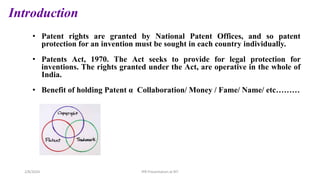
• Patent rights are granted by National Patent Offices, and so patent
protection for an invention must be sought in each country individually.
• Patents Act, 1970. The Act seeks to provide for legal protection for
inventions. The rights granted under the Act, are operative in the whole of
India.
• Benefit of holding Patent α Collaboration/ Money / Fame/ Name/ etc………
IPR Presentation at RIT
2/8/2024
Intellectual Property Rights
Patents Designs
Trademarks
Geographical Indications
IPR Presentation at RIT
2/8/2024
Utility (Function) and
Design (Aesthetic).
2/8/2024 IPR Presentation at RIT
Patent
To get a patent grant, the first and foremost step is to file a patent application.
Who can file a patent application?
1. By any person claiming to be true and first inventor(s)
2. By any person being the assignee of person claiming to be true and first inventor(s)
(proof of assignment has to be submitted along with the application)
3. By the legal representative of any deceased person or assignee
Where to file a patent application?
1. The appropriate office of the patent office shall be the head office of the patent office or
the branch office as the case may be within whose territorial limits …
2. Residence of applicant or Domicile; or
3. His the place of business; or
4. The place where the invention actually originated.
5. If the applicant has no business or domicile in India, the address for service in India is
given by such applicant
IPR Presentation at RIT
2/8/2024
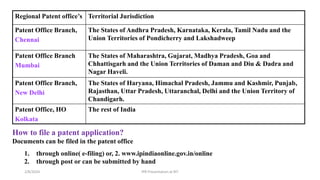
Regional Patent office’s Territorial Jurisdiction
Patent Office Branch,
Chennai
The States of Andhra Pradesh, Karnataka, Kerala, Tamil Nadu and the
Union Territories of Pondicherry and Lakshadweep
Patent Office Branch
Mumbai
The States of Maharashtra, Gujarat, Madhya Pradesh, Goa and
Chhattisgarh and the Union Territories of Daman and Diu & Dadra and
Nagar Haveli.
Patent Office Branch,
New Delhi
The States of Haryana, Himachal Pradesh, Jammu and Kashmir, Punjab,
Rajasthan, Uttar Pradesh, Uttaranchal, Delhi and the Union Territory of
Chandigarh.
Patent Office, HO
Kolkata
The rest of India
How to file a patent application?
Documents can be filed in the patent office
1. through online( e-filing) or, 2. www.ipindiaonline.gov.in/online
2. through post or can be submitted by hand
IPR Presentation at RIT
2/8/2024
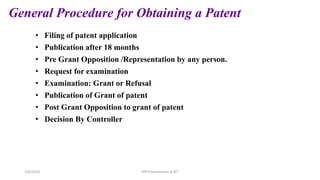
General Procedure for Obtaining a Patent
• Filing of patent application
• Publication after 18 months
• Pre Grant Opposition /Representation by any person.
• Request for examination
• Examination: Grant or Refusal
• Publication of Grant of patent
• Post Grant Opposition to grant of patent
• Decision By Controller
IPR Presentation at RIT
2/8/2024
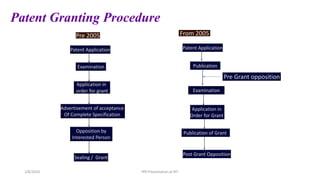
Pre 2005
Patent Application
Examination
Application in
order for grant
Advertisement of acceptance
Of Complete Specification
Opposition by
Interested Person
Sealing / Grant
From 2005
Patent Application
Publication
Examination
Application in
Order for Grant
Publication of Grant
Post Grant Opposition
Pre Grant opposition
Patent Granting Procedure
IPR Presentation at RIT
2/8/2024
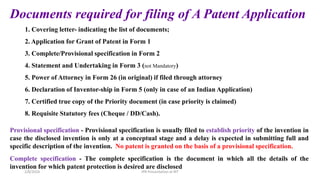
Documents required for filing of A Patent Application
1. Covering letter- indicating the list of documents;
2. Application for Grant of Patent in Form 1
3. Complete/Provisional specification in Form 2
4. Statement and Undertaking in Form 3 (not Mandatory)
5. Power of Attorney in Form 26 (in original) if filed through attorney
6. Declaration of Inventor-ship in Form 5 (only in case of an Indian Application)
7. Certified true copy of the Priority document (in case priority is claimed)
8. Requisite Statutory fees (Cheque / DD/Cash).
Provisional specification - Provisional specification is usually filed to establish priority of the invention in
case the disclosed invention is only at a conceptual stage and a delay is expected in submitting full and
specific description of the invention. No patent is granted on the basis of a provisional specification.
Complete specification - The complete specification is the document in which all the details of the
invention for which patent protection is desired are disclosed
IPR Presentation at RIT
2/8/2024
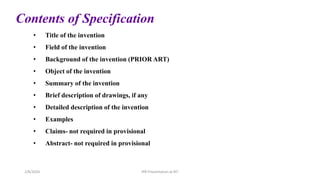
Contents of Specification
• Title of the invention
• Field of the invention
• Background of the invention (PRIOR ART)
• Object of the invention
• Summary of the invention
• Brief description of drawings, if any
• Detailed description of the invention
• Examples
• Claims- not required in provisional
• Abstract- not required in provisional
IPR Presentation at RIT
2/8/2024
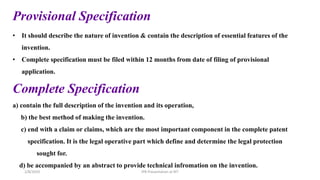
Provisional Specification
• It should describe the nature of invention & contain the description of essential features of the
invention.
• Complete specification must be filed within 12 months from date of filing of provisional
application.
Complete Specification
a) contain the full description of the invention and its operation,
b) the best method of making the invention.
c) end with a claim or claims, which are the most important component in the complete patent
specification. It is the legal operative part which define and determine the legal protection
sought for.
d) be accompanied by an abstract to provide technical infromation on the invention.
IPR Presentation at RIT
2/8/2024
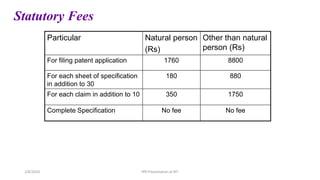
Statutory Fees
Particular Natural person
(Rs)
Other than natural
person (Rs)
For filing patent application 1760 8800
For each sheet of specification
in addition to 30
180 880
For each claim in addition to 10 350 1750
Complete Specification No fee No fee
IPR Presentation at RIT
2/8/2024
Publication
• A patent application will be published automatically in the official journal after expiry of 18
months from date of filing or date of priority of the application containing title, abstract,
application no. and name of applicant[s] and inventor[s].
• This way, the world is informed about the fact that a patent can be expected on that particular
invention.
• Someone else using the invention could then switch to a different technology, or make reservations
to pay for a license once the patent is granted.
• Request for early publication: Form 9 any time after filing of the application. Upon such request,
the application will be published in one month from the date of such request.
• Fees for Request for Early Publication for Natural person is Rs. 2,750
• Fees for Request for Early Publication for Other than natural person is Rs. 13,750
• For more details please refer to : http://www.ipindia.nic.in/ipr/patent/patents.htm
IPR Presentation at RIT
2/8/2024
Pre-grant Opposition
• [Section 25(1)] Upon publication, but before the grant of patent any person, based on different
grounds may file a pre grant opposition, in writing, represent by way of opposition to the
Controller against the grant of patent.
• However the opposition will be taken by the patent office only after the filing of Request for
Examination.
• Time limit: May be filed within 3 months from the date of publication of the application [sec
25(1); rule 55(1)] OR Before the grant of patent, whichever is later.
• Fee: NO FEE
IPR Presentation at RIT
2/8/2024
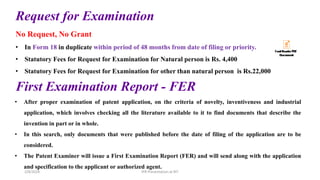
Request for Examination
No Request, No Grant
• In Form 18 in duplicate within period of 48 months from date of filing or priority.
• Statutory Fees for Request for Examination for Natural person is Rs. 4,400
• Statutory Fees for Request for Examination for other than natural person is Rs.22,000
First Examination Report - FER
• After proper examination of patent application, on the criteria of novelty, inventiveness and industrial
application, which involves checking all the literature available to it to find documents that describe the
invention in part or in whole.
• In this search, only documents that were published before the date of filing of the application are to be
considered.
• The Patent Examiner will issue a First Examination Report (FER) and will send along with the application
and specification to the applicant or authorized agent.
IPR Presentation at RIT
2/8/2024
• The issued FER give an opportunity to the applicant to file a response and overcome the
objections raised by the Examiner.
• Time limit: [Rule 24B(4)(iii)] Within 12 months from the date on which the First Examination
Report has been issued to the applicant, the application should be placed in order of acceptance.
• In case of the unjustified response, the Controller has power to refuse the grant of patent or ask
for amended claim[s] or make order for the Division of Application [Section 15, 16].
Amendment of objections by the applicant
Grant of Patent
• The Controller will grant the application upon overcome the all objections raised in the FER.
• On the grant of a patent the application will be accorded a number, called serial number in the
series of numbers accorded to patents under the Indian Patents and Designs Act, 1911(2 of 1911).
IPR Presentation at RIT
2/8/2024
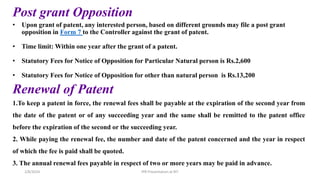
Post grant Opposition
• Upon grant of patent, any interested person, based on different grounds may file a post grant
opposition in Form 7 to the Controller against the grant of patent.
• Time limit: Within one year after the grant of a patent.
• Statutory Fees for Notice of Opposition for Particular Natural person is Rs.2,600
• Statutory Fees for Notice of Opposition for other than natural person is Rs.13,200
1.To keep a patent in force, the renewal fees shall be payable at the expiration of the second year from
the date of the patent or of any succeeding year and the same shall be remitted to the patent office
before the expiration of the second or the succeeding year.
2. While paying the renewal fee, the number and date of the patent concerned and the year in respect
of which the fee is paid shall be quoted.
3. The annual renewal fees payable in respect of two or more years may be paid in advance.
Renewal of Patent
IPR Presentation at RIT
2/8/2024
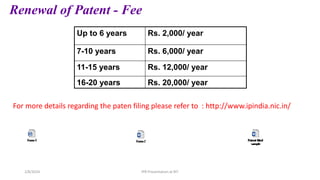
Up to 6 years Rs. 2,000/ year
7-10 years Rs. 6,000/ year
11-15 years Rs. 12,000/ year
16-20 years Rs. 20,000/ year
Renewal of Patent - Fee
For more details regarding the paten filing please refer to : http://www.ipindia.nic.in/
IPR Presentation at RIT
2/8/2024
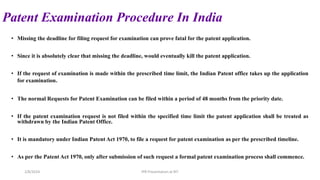
Patent Examination Procedure In India
• Missing the deadline for filing request for examination can prove fatal for the patent application.
• Since it is absolutely clear that missing the deadline, would eventually kill the patent application.
• If the request of examination is made within the prescribed time limit, the Indian Patent office takes up the application
for examination.
• The normal Requests for Patent Examination can be filed within a period of 48 months from the priority date.
• If the patent examination request is not filed within the specified time limit the patent application shall be treated as
withdrawn by the Indian Patent Office.
• It is mandatory under Indian Patent Act 1970, to file a request for patent examination as per the prescribed timeline.
• As per the Patent Act 1970, only after submission of such request a formal patent examination process shall commence.
2/8/2024 IPR Presentation at RIT
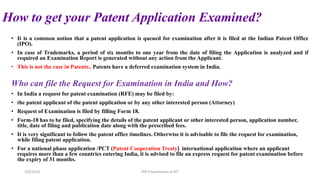
How to get your Patent Application Examined?
• It is a common notion that a patent application is queued for examination after it is filed at the Indian Patent Office
(IPO).
• In case of Trademarks, a period of six months to one year from the date of filing the Application is analyzed and if
required an Examination Report is generated without any action from the Applicant.
• This is not the case in Patents.. Patents have a deferred examination system in India.
Who can file the Request for Examination in India and How?
• In India a request for patent examination (RFE) may be filed by:
• the patent applicant of the patent application or by any other interested person (Attorney)
• Request of Examination is filed by filling Form 18.
• Form-18 has to be filed, specifying the details of the patent applicant or other interested person, application number,
title, date of filing and publication date along with the prescribed fees.
• It is very significant to follow the patent office timelines. Otherwise it is advisable to file the request for examination,
while filing patent application.
• For a national phase application /PCT (Patent Cooperation Treaty) international application where an applicant
requires more than a few countries entering India, it is advised to file an express request for patent examination before
the expiry of 31 months.
2/8/2024 IPR Presentation at RIT
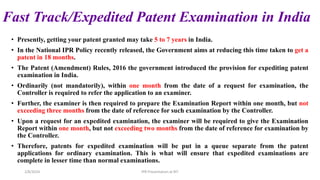
Fast Track/Expedited Patent Examination in India
• Presently, getting your patent granted may take 5 to 7 years in India.
• In the National IPR Policy recently released, the Government aims at reducing this time taken to get a
patent in 18 months.
• The Patent (Amendment) Rules, 2016 the government introduced the provision for expediting patent
examination in India.
• Ordinarily (not mandatorily), within one month from the date of a request for examination, the
Controller is required to refer the application to an examiner.
• Further, the examiner is then required to prepare the Examination Report within one month, but not
exceeding three months from the date of reference for such examination by the Controller.
• Upon a request for an expedited examination, the examiner will be required to give the Examination
Report within one month, but not exceeding two months from the date of reference for examination by
the Controller.
• Therefore, patents for expedited examination will be put in a queue separate from the patent
applications for ordinary examination. This is what will ensure that expedited examinations are
complete in lesser time than normal examinations.
2/8/2024 IPR Presentation at RIT
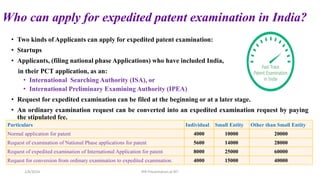
Who can apply for expedited patent examination in India?
• Two kinds of Applicants can apply for expedited patent examination:
• Startups
• Applicants, (filing national phase Applications) who have included India,
in their PCT application, as an:
• International Searching Authority (ISA), or
• International Preliminary Examining Authority (IPEA)
• Request for expedited examination can be filed at the beginning or at a later stage.
• An ordinary examination request can be converted into an expedited examination request by paying
the stipulated fee.
2/8/2024 IPR Presentation at RIT
Particulars Individual Small Entity Other than Small Entity
Normal application for patent 4000 10000 20000
Request of examination of National Phase applications for patent 5600 14000 28000
Request of expedited examination of International Application for patent 8000 25000 60000
Request for conversion from ordinary examination to expedited examination. 4000 15000 40000
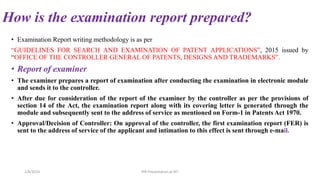
How is the examination report prepared?
• Examination Report writing methodology is as per
“GUIDELINES FOR SEARCH AND EXAMINATION OF PATENT APPLICATIONS”, 2015 issued by
“OFFICE OF THE CONTROLLER GENERAL OF PATENTS, DESIGNS AND TRADEMARKS”.
• Report of examiner
• The examiner prepares a report of examination after conducting the examination in electronic module
and sends it to the controller.
• After due for consideration of the report of the examiner by the controller as per the provisions of
section 14 of the Act, the examination report along with its covering letter is generated through the
module and subsequently sent to the address of service as mentioned on Form-1 in Patents Act 1970.
• Approval/Decision of Controller: On approval of the controller, the first examination report (FER) is
sent to the address of service of the applicant and intimation to this effect is sent through e-mail.
2/8/2024 IPR Presentation at RIT
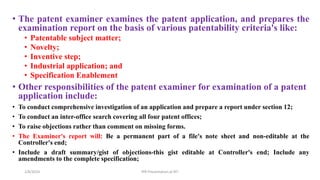
• The patent examiner examines the patent application, and prepares the
examination report on the basis of various patentability criteria's like:
• Patentable subject matter;
• Novelty;
• Inventive step;
• Industrial application; and
• Specification Enablement
• Other responsibilities of the patent examiner for examination of a patent
application include:
• To conduct comprehensive investigation of an application and prepare a report under section 12;
• To conduct an inter-office search covering all four patent offices;
• To raise objections rather than comment on missing forms.
• The Examiner's report will: Be a permanent part of a file's note sheet and non-editable at the
Controller's end;
• Include a draft summary/gist of objections-this gist editable at Controller's end; Include any
amendments to the complete specification;
2/8/2024 IPR Presentation at RIT
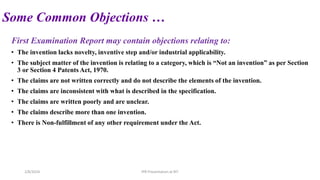
Some Common Objections …
First Examination Report may contain objections relating to:
• The invention lacks novelty, inventive step and/or industrial applicability.
• The subject matter of the invention is relating to a category, which is “Not an invention” as per Section
3 or Section 4 Patents Act, 1970.
• The claims are not written correctly and do not describe the elements of the invention.
• The claims are inconsistent with what is described in the specification.
• The claims are written poorly and are unclear.
• The claims describe more than one invention.
• There is Non-fulfillment of any other requirement under the Act.
2/8/2024 IPR Presentation at RIT
Why is The Examination Report Reply Important?
• The Applicant should reply the objections (if any) and place the application in order for grant within 12
months from the date of issue of the FER (First Examination Report).
• In this case too, if the reply to the examination report is not made within prescribed time limit, which is 12
months, the application is deemed to be abandoned.
• In case, the patent application is found to be in order for grant, the patent is granted, if there is no pre-
grant opposition filed or pending by a third party.
Types Of Replies
• A template is followed to begin drafting a response that keeps things accurate, fast and efficiently
punctual.
• Things that need to be considered and focused on during an Examination Report Reply drafting can
become very technical or just plain simple legal procedure compliance issue.
2/8/2024 IPR Presentation at RIT
Why is The Examination Report Reply Important?
Procedural
• If the objection is related to a procedure that the Patent Act, 1970 demands then the Applicant has no choice but
to comply with taking necessary steps.
• For example, when there are several novel subjects matters the unity of invention needs to be identified and
because an application may have only one novel subject matter, another application may be filed for each new
subject matter.
Technical
• Technical objections can be countered by arguments. A few steps can be followed in case of technical arguments.
• It has to be identified whether the arguments in the reply will be based on the original claim set or amendment is
required. Further, Amending claims if required keeping in mind cited arts whether it predates the patent
application filing date or not.
• In case of objections relating to Novelty and obviousness, the technical differentiation with respect to prior art
needs to be brought out.
• Novelty is a subject of facts and arguments are based on eye to eye analysis and is subjective, so the only thing
that can be done is explain own invention in a better manner.
• Obviousness arguments are generally based on point of law which involves determining difference between the
prior art and present claims.
• Doing a technical study and exploration to a point of scrutiny helps in drafting an appropriate legal response to
the examination report.
2/8/2024 IPR Presentation at RIT
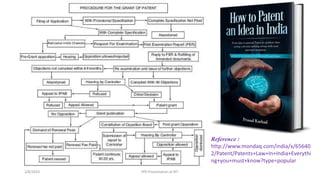
Reference :
http://www.mondaq.com/india/x/65640
2/Patent/Patents+Law+In+India+Everythi
ng+you+must+know?type=popular
References….
• http://www.ipindia.nic.in
• http://www.mondaq.com/india/x/561716/Patent/Patent+Examination+Procedure+in+India
• https://www.intepat.com/blog/patent/expedited-patent-examination-
india/?utm_source=Mondaq&utm_medium=syndication&utm_campaign=inter-article-link
• https://blog.ipleaders.in/patent-first-examination-report/
• http://www.ipindia.nic.in/Facilitators-Patents.htm
• http://www.ipindia.nic.in/writereaddata/Portal/Images/pdf/Final_FREQUENTLY_ASKED_
QUESTIONS_-PATENT.pdf
2/8/2024 IPR Presentation at RIT
Protect your Inventions by IPR
IPR Presentation at RIT
2/8/2024

IPR Presentation.pptx

  • 1.
    Intellectual Property Rights- IPR Patent Filing Procedure in INDIA Dr. M. Sivasubramanian Associate Professor Department of Automobile Engineering Kalasalingam Academy of Research and Education 2/8/2024 IPR Presentation at RIT
  • 2.
    Introduction • Patent rightsare granted by National Patent Offices, and so patent protection for an invention must be sought in each country individually. • Patents Act, 1970. The Act seeks to provide for legal protection for inventions. The rights granted under the Act, are operative in the whole of India. • Benefit of holding Patent α Collaboration/ Money / Fame/ Name/ etc……… IPR Presentation at RIT 2/8/2024
  • 3.
    Intellectual Property Rights PatentsDesigns Trademarks Geographical Indications IPR Presentation at RIT 2/8/2024 Utility (Function) and Design (Aesthetic).
  • 4.
  • 5.
    Patent To get apatent grant, the first and foremost step is to file a patent application. Who can file a patent application? 1. By any person claiming to be true and first inventor(s) 2. By any person being the assignee of person claiming to be true and first inventor(s) (proof of assignment has to be submitted along with the application) 3. By the legal representative of any deceased person or assignee Where to file a patent application? 1. The appropriate office of the patent office shall be the head office of the patent office or the branch office as the case may be within whose territorial limits … 2. Residence of applicant or Domicile; or 3. His the place of business; or 4. The place where the invention actually originated. 5. If the applicant has no business or domicile in India, the address for service in India is given by such applicant IPR Presentation at RIT 2/8/2024
  • 6.
    Regional Patent office’sTerritorial Jurisdiction Patent Office Branch, Chennai The States of Andhra Pradesh, Karnataka, Kerala, Tamil Nadu and the Union Territories of Pondicherry and Lakshadweep Patent Office Branch Mumbai The States of Maharashtra, Gujarat, Madhya Pradesh, Goa and Chhattisgarh and the Union Territories of Daman and Diu & Dadra and Nagar Haveli. Patent Office Branch, New Delhi The States of Haryana, Himachal Pradesh, Jammu and Kashmir, Punjab, Rajasthan, Uttar Pradesh, Uttaranchal, Delhi and the Union Territory of Chandigarh. Patent Office, HO Kolkata The rest of India How to file a patent application? Documents can be filed in the patent office 1. through online( e-filing) or, 2. www.ipindiaonline.gov.in/online 2. through post or can be submitted by hand IPR Presentation at RIT 2/8/2024
  • 7.
    General Procedure forObtaining a Patent • Filing of patent application • Publication after 18 months • Pre Grant Opposition /Representation by any person. • Request for examination • Examination: Grant or Refusal • Publication of Grant of patent • Post Grant Opposition to grant of patent • Decision By Controller IPR Presentation at RIT 2/8/2024
  • 8.
    Pre 2005 Patent Application Examination Applicationin order for grant Advertisement of acceptance Of Complete Specification Opposition by Interested Person Sealing / Grant From 2005 Patent Application Publication Examination Application in Order for Grant Publication of Grant Post Grant Opposition Pre Grant opposition Patent Granting Procedure IPR Presentation at RIT 2/8/2024
  • 9.
    Documents required forfiling of A Patent Application 1. Covering letter- indicating the list of documents; 2. Application for Grant of Patent in Form 1 3. Complete/Provisional specification in Form 2 4. Statement and Undertaking in Form 3 (not Mandatory) 5. Power of Attorney in Form 26 (in original) if filed through attorney 6. Declaration of Inventor-ship in Form 5 (only in case of an Indian Application) 7. Certified true copy of the Priority document (in case priority is claimed) 8. Requisite Statutory fees (Cheque / DD/Cash). Provisional specification - Provisional specification is usually filed to establish priority of the invention in case the disclosed invention is only at a conceptual stage and a delay is expected in submitting full and specific description of the invention. No patent is granted on the basis of a provisional specification. Complete specification - The complete specification is the document in which all the details of the invention for which patent protection is desired are disclosed IPR Presentation at RIT 2/8/2024
  • 10.
    Contents of Specification •Title of the invention • Field of the invention • Background of the invention (PRIOR ART) • Object of the invention • Summary of the invention • Brief description of drawings, if any • Detailed description of the invention • Examples • Claims- not required in provisional • Abstract- not required in provisional IPR Presentation at RIT 2/8/2024
  • 11.
    Provisional Specification • Itshould describe the nature of invention & contain the description of essential features of the invention. • Complete specification must be filed within 12 months from date of filing of provisional application. Complete Specification a) contain the full description of the invention and its operation, b) the best method of making the invention. c) end with a claim or claims, which are the most important component in the complete patent specification. It is the legal operative part which define and determine the legal protection sought for. d) be accompanied by an abstract to provide technical infromation on the invention. IPR Presentation at RIT 2/8/2024
  • 12.
    Statutory Fees Particular Naturalperson (Rs) Other than natural person (Rs) For filing patent application 1760 8800 For each sheet of specification in addition to 30 180 880 For each claim in addition to 10 350 1750 Complete Specification No fee No fee IPR Presentation at RIT 2/8/2024
  • 13.
    Publication • A patentapplication will be published automatically in the official journal after expiry of 18 months from date of filing or date of priority of the application containing title, abstract, application no. and name of applicant[s] and inventor[s]. • This way, the world is informed about the fact that a patent can be expected on that particular invention. • Someone else using the invention could then switch to a different technology, or make reservations to pay for a license once the patent is granted. • Request for early publication: Form 9 any time after filing of the application. Upon such request, the application will be published in one month from the date of such request. • Fees for Request for Early Publication for Natural person is Rs. 2,750 • Fees for Request for Early Publication for Other than natural person is Rs. 13,750 • For more details please refer to : http://www.ipindia.nic.in/ipr/patent/patents.htm IPR Presentation at RIT 2/8/2024
  • 14.
    Pre-grant Opposition • [Section25(1)] Upon publication, but before the grant of patent any person, based on different grounds may file a pre grant opposition, in writing, represent by way of opposition to the Controller against the grant of patent. • However the opposition will be taken by the patent office only after the filing of Request for Examination. • Time limit: May be filed within 3 months from the date of publication of the application [sec 25(1); rule 55(1)] OR Before the grant of patent, whichever is later. • Fee: NO FEE IPR Presentation at RIT 2/8/2024
  • 15.
    Request for Examination NoRequest, No Grant • In Form 18 in duplicate within period of 48 months from date of filing or priority. • Statutory Fees for Request for Examination for Natural person is Rs. 4,400 • Statutory Fees for Request for Examination for other than natural person is Rs.22,000 First Examination Report - FER • After proper examination of patent application, on the criteria of novelty, inventiveness and industrial application, which involves checking all the literature available to it to find documents that describe the invention in part or in whole. • In this search, only documents that were published before the date of filing of the application are to be considered. • The Patent Examiner will issue a First Examination Report (FER) and will send along with the application and specification to the applicant or authorized agent. IPR Presentation at RIT 2/8/2024
  • 16.
    • The issuedFER give an opportunity to the applicant to file a response and overcome the objections raised by the Examiner. • Time limit: [Rule 24B(4)(iii)] Within 12 months from the date on which the First Examination Report has been issued to the applicant, the application should be placed in order of acceptance. • In case of the unjustified response, the Controller has power to refuse the grant of patent or ask for amended claim[s] or make order for the Division of Application [Section 15, 16]. Amendment of objections by the applicant Grant of Patent • The Controller will grant the application upon overcome the all objections raised in the FER. • On the grant of a patent the application will be accorded a number, called serial number in the series of numbers accorded to patents under the Indian Patents and Designs Act, 1911(2 of 1911). IPR Presentation at RIT 2/8/2024
  • 17.
    Post grant Opposition •Upon grant of patent, any interested person, based on different grounds may file a post grant opposition in Form 7 to the Controller against the grant of patent. • Time limit: Within one year after the grant of a patent. • Statutory Fees for Notice of Opposition for Particular Natural person is Rs.2,600 • Statutory Fees for Notice of Opposition for other than natural person is Rs.13,200 1.To keep a patent in force, the renewal fees shall be payable at the expiration of the second year from the date of the patent or of any succeeding year and the same shall be remitted to the patent office before the expiration of the second or the succeeding year. 2. While paying the renewal fee, the number and date of the patent concerned and the year in respect of which the fee is paid shall be quoted. 3. The annual renewal fees payable in respect of two or more years may be paid in advance. Renewal of Patent IPR Presentation at RIT 2/8/2024
  • 18.
    Up to 6years Rs. 2,000/ year 7-10 years Rs. 6,000/ year 11-15 years Rs. 12,000/ year 16-20 years Rs. 20,000/ year Renewal of Patent - Fee For more details regarding the paten filing please refer to : http://www.ipindia.nic.in/ IPR Presentation at RIT 2/8/2024
  • 19.
    Patent Examination ProcedureIn India • Missing the deadline for filing request for examination can prove fatal for the patent application. • Since it is absolutely clear that missing the deadline, would eventually kill the patent application. • If the request of examination is made within the prescribed time limit, the Indian Patent office takes up the application for examination. • The normal Requests for Patent Examination can be filed within a period of 48 months from the priority date. • If the patent examination request is not filed within the specified time limit the patent application shall be treated as withdrawn by the Indian Patent Office. • It is mandatory under Indian Patent Act 1970, to file a request for patent examination as per the prescribed timeline. • As per the Patent Act 1970, only after submission of such request a formal patent examination process shall commence. 2/8/2024 IPR Presentation at RIT
  • 20.
    How to getyour Patent Application Examined? • It is a common notion that a patent application is queued for examination after it is filed at the Indian Patent Office (IPO). • In case of Trademarks, a period of six months to one year from the date of filing the Application is analyzed and if required an Examination Report is generated without any action from the Applicant. • This is not the case in Patents.. Patents have a deferred examination system in India. Who can file the Request for Examination in India and How? • In India a request for patent examination (RFE) may be filed by: • the patent applicant of the patent application or by any other interested person (Attorney) • Request of Examination is filed by filling Form 18. • Form-18 has to be filed, specifying the details of the patent applicant or other interested person, application number, title, date of filing and publication date along with the prescribed fees. • It is very significant to follow the patent office timelines. Otherwise it is advisable to file the request for examination, while filing patent application. • For a national phase application /PCT (Patent Cooperation Treaty) international application where an applicant requires more than a few countries entering India, it is advised to file an express request for patent examination before the expiry of 31 months. 2/8/2024 IPR Presentation at RIT
  • 21.
    Fast Track/Expedited PatentExamination in India • Presently, getting your patent granted may take 5 to 7 years in India. • In the National IPR Policy recently released, the Government aims at reducing this time taken to get a patent in 18 months. • The Patent (Amendment) Rules, 2016 the government introduced the provision for expediting patent examination in India. • Ordinarily (not mandatorily), within one month from the date of a request for examination, the Controller is required to refer the application to an examiner. • Further, the examiner is then required to prepare the Examination Report within one month, but not exceeding three months from the date of reference for such examination by the Controller. • Upon a request for an expedited examination, the examiner will be required to give the Examination Report within one month, but not exceeding two months from the date of reference for examination by the Controller. • Therefore, patents for expedited examination will be put in a queue separate from the patent applications for ordinary examination. This is what will ensure that expedited examinations are complete in lesser time than normal examinations. 2/8/2024 IPR Presentation at RIT
  • 22.
    Who can applyfor expedited patent examination in India? • Two kinds of Applicants can apply for expedited patent examination: • Startups • Applicants, (filing national phase Applications) who have included India, in their PCT application, as an: • International Searching Authority (ISA), or • International Preliminary Examining Authority (IPEA) • Request for expedited examination can be filed at the beginning or at a later stage. • An ordinary examination request can be converted into an expedited examination request by paying the stipulated fee. 2/8/2024 IPR Presentation at RIT Particulars Individual Small Entity Other than Small Entity Normal application for patent 4000 10000 20000 Request of examination of National Phase applications for patent 5600 14000 28000 Request of expedited examination of International Application for patent 8000 25000 60000 Request for conversion from ordinary examination to expedited examination. 4000 15000 40000
  • 23.
    How is theexamination report prepared? • Examination Report writing methodology is as per “GUIDELINES FOR SEARCH AND EXAMINATION OF PATENT APPLICATIONS”, 2015 issued by “OFFICE OF THE CONTROLLER GENERAL OF PATENTS, DESIGNS AND TRADEMARKS”. • Report of examiner • The examiner prepares a report of examination after conducting the examination in electronic module and sends it to the controller. • After due for consideration of the report of the examiner by the controller as per the provisions of section 14 of the Act, the examination report along with its covering letter is generated through the module and subsequently sent to the address of service as mentioned on Form-1 in Patents Act 1970. • Approval/Decision of Controller: On approval of the controller, the first examination report (FER) is sent to the address of service of the applicant and intimation to this effect is sent through e-mail. 2/8/2024 IPR Presentation at RIT
  • 24.
    • The patentexaminer examines the patent application, and prepares the examination report on the basis of various patentability criteria's like: • Patentable subject matter; • Novelty; • Inventive step; • Industrial application; and • Specification Enablement • Other responsibilities of the patent examiner for examination of a patent application include: • To conduct comprehensive investigation of an application and prepare a report under section 12; • To conduct an inter-office search covering all four patent offices; • To raise objections rather than comment on missing forms. • The Examiner's report will: Be a permanent part of a file's note sheet and non-editable at the Controller's end; • Include a draft summary/gist of objections-this gist editable at Controller's end; Include any amendments to the complete specification; 2/8/2024 IPR Presentation at RIT
  • 25.
    Some Common Objections… First Examination Report may contain objections relating to: • The invention lacks novelty, inventive step and/or industrial applicability. • The subject matter of the invention is relating to a category, which is “Not an invention” as per Section 3 or Section 4 Patents Act, 1970. • The claims are not written correctly and do not describe the elements of the invention. • The claims are inconsistent with what is described in the specification. • The claims are written poorly and are unclear. • The claims describe more than one invention. • There is Non-fulfillment of any other requirement under the Act. 2/8/2024 IPR Presentation at RIT
  • 26.
    Why is TheExamination Report Reply Important? • The Applicant should reply the objections (if any) and place the application in order for grant within 12 months from the date of issue of the FER (First Examination Report). • In this case too, if the reply to the examination report is not made within prescribed time limit, which is 12 months, the application is deemed to be abandoned. • In case, the patent application is found to be in order for grant, the patent is granted, if there is no pre- grant opposition filed or pending by a third party. Types Of Replies • A template is followed to begin drafting a response that keeps things accurate, fast and efficiently punctual. • Things that need to be considered and focused on during an Examination Report Reply drafting can become very technical or just plain simple legal procedure compliance issue. 2/8/2024 IPR Presentation at RIT
  • 27.
    Why is TheExamination Report Reply Important? Procedural • If the objection is related to a procedure that the Patent Act, 1970 demands then the Applicant has no choice but to comply with taking necessary steps. • For example, when there are several novel subjects matters the unity of invention needs to be identified and because an application may have only one novel subject matter, another application may be filed for each new subject matter. Technical • Technical objections can be countered by arguments. A few steps can be followed in case of technical arguments. • It has to be identified whether the arguments in the reply will be based on the original claim set or amendment is required. Further, Amending claims if required keeping in mind cited arts whether it predates the patent application filing date or not. • In case of objections relating to Novelty and obviousness, the technical differentiation with respect to prior art needs to be brought out. • Novelty is a subject of facts and arguments are based on eye to eye analysis and is subjective, so the only thing that can be done is explain own invention in a better manner. • Obviousness arguments are generally based on point of law which involves determining difference between the prior art and present claims. • Doing a technical study and exploration to a point of scrutiny helps in drafting an appropriate legal response to the examination report. 2/8/2024 IPR Presentation at RIT
  • 28.
    2/8/2024 IPR Presentationat RIT Reference : http://www.mondaq.com/india/x/65640 2/Patent/Patents+Law+In+India+Everythi ng+you+must+know?type=popular
  • 29.
    References…. • http://www.ipindia.nic.in • http://www.mondaq.com/india/x/561716/Patent/Patent+Examination+Procedure+in+India •https://www.intepat.com/blog/patent/expedited-patent-examination- india/?utm_source=Mondaq&utm_medium=syndication&utm_campaign=inter-article-link • https://blog.ipleaders.in/patent-first-examination-report/ • http://www.ipindia.nic.in/Facilitators-Patents.htm • http://www.ipindia.nic.in/writereaddata/Portal/Images/pdf/Final_FREQUENTLY_ASKED_ QUESTIONS_-PATENT.pdf 2/8/2024 IPR Presentation at RIT
  • 30.
    Protect your Inventionsby IPR IPR Presentation at RIT 2/8/2024