i
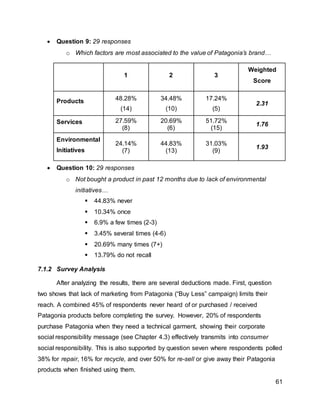
PATAGONIA:
TRANSMITTING SUSTAINABILITY
A Capstone
Presented to the Faculty of European University
In Partial Fulfilment of the Requirements for
The Degree: Bachelor in Business Administration
By: Jonathan James Carter
(January 26th
, 2015)
ii
ExecutiveSummary
The following thesis addresses the question: How organizations in the outdoor
industry, specifically The North Face (TNF), Columbia Sportswear Company (CSC), and
Recreational Equipment Inc. (REI) benefit from embedding sustainability into their
companies as Patagonia Inc. has done. Having learned from the economic crisis in
2009 that current business practices are susceptible to external changes, the world
must search for alternative methods. Customers who purchase products for the
outdoors essentially invest in the environment they intend to ‘play’ in. Using Michael
Porter’s concept of Creating Shared Value, any organization operating in the Outdoors
Market would do well to invest in sustainable methods.
Yvon Chouinard, the founder and sole-owner of Patagonia Inc. is known as the
pioneer of true corporate social responsibility. The company walks the talk so well; they
even transmit their message into consumer social responsibility; with customers playing
catch-up to their initiatives. Since the early 90’s, Chouinard and Patagonia have been
on a mission to ‘build the best product, cause no unnecessary harm, and use business
to inspire and implement solutions to the environmental crisis’.
By embedding sustainability into every facet of the business, Patagonia focuses on
four core-values: integrity, quality, environmentalism, and to not be bound by
conventionalism. It is through these values that stakeholders of Patagonia find
guidance. This led to a competitive advantage consisting of three key aspects:
organizational structure, transparency, and stakeholder engagement. In sequence, each
offers the ability to achieve the next. Privately held, now registered as a Benefit
Corporation, Patagonia is committed to sustainability by law. Their commitment to being
honest with all stakeholders increases the efficiency and effectiveness of suppliers and
employees, leaving customers satisfied with knowledge of a products true origin. This
opens up communication channels successively driving innovation all throughout.
A comparison of other companies in the outdoor, performance-apparel market
shows the importance of embedding sustainability into a company. The North Face
(TNF), Columbia Sportswear Company (CSC), and Recreational Equipment Inc. (REI)
each manufacture their own brand label while operating in their own unique way.
iii
The North Face is owned by the parent company VF Corporation. TNF began
sustainability initiatives in 2008. They continue to cut costs and invest in community
wide initiatives; geared at increasing participation and education, in and around the
outdoors. VF Corp. pushes for growth as TNF struggles to cope with a decline in loyal
customers and a shift towards more mainstream consumers, like those of CSC.
Columbia Sportswear Company is the parent company for a few other outdoor
brands. They position its main label as the quality, yet less expensive outdoor apparel.
CSC is publicly owned and family run. Their corporate social responsibility initiatives are
aimed at cost-cutting and marketing. CSC is susceptible to external changes in the
market, from warming winters to lacking consumer knowledge. They have yet to grasp
the need for stakeholder engagement as they attempt to grow as big as Nike.
Recreational Equipment Inc. was established as a Co-op for hard-core outdoor
enthusiasts. They acquired quality equipment from Europe for less money this way.
Membership has grown to over five million active members with $2 billion in annual
sales. A brick-and-mortar style business, they offer products from their own label and
every other leading outdoor brand. Today, they are dedicated to environmental
stewardship and provide courses and education to members. However, they lack the
urgency to require true changes from suppliers causing a glut in their supply chain
environmental efficacy.
The four companies were compared using the following: primary research in the
form of an online survey, secondary research from a publication differentiating between
‘mainstream sustainability’ and ‘hybrid businesses’, and from dissecting available
financial information. In conclusion, embedding sustainability into a company creates an
ability to endeavor a long, successful life. It forges a clear path for employees and other
stakeholders to adhere to, allowing for individuals to exercise greater freedom with a
stronger desire. Customers in the outdoor market are growing into sustainable initiatives
and will soon demand them from companies. Sustainability properly embedded into a
company drives a deep analysis of business practices in order to simplify, cut-costs,
increase efficiency, and eventually increasing the effectiveness of a business’s products
and services.
iv
Table of Contents
Executive Summary................................................................................................................... ii
List of Figures and Tables .....................................................................................................vii
Chapter 1: Introduction........................................................................................................1
Chapter 2: The Outdoor Market and High-Performance Apparel.............................3
Chapter 3: Patagonia Inc.....................................................................................................7
3.1 The Founder...................................................................................................................7
3.2 The “Dirt Bags”...............................................................................................................9
Chapter 4: Patagonia’s Sustainability Strategy ..........................................................13
4.1 Quality ...........................................................................................................................15
4.2 Integrity..........................................................................................................................16
4.3 Not Bound by Convention ..........................................................................................17
4.4 Environmentalism ........................................................................................................18
4.4.1 The Conservation Alliance..................................................................................19
4.4.2 1% for the planet ..................................................................................................19
4.4.3 The Footprint Chronicles.....................................................................................20
4.4.4 Common Threads Partnership...........................................................................22
4.4.5 Eco Index...............................................................................................................24
4.4.6 Recent Initiatives..................................................................................................24
Chapter 5: Key Aspects of Patagonia’s Strategy .......................................................26
5.1 Situational Analysis .....................................................................................................26
5.1.1 Threats...................................................................................................................26
5.1.2 Opportunities.........................................................................................................27
5.1.3 Weaknesses..........................................................................................................28
v
5.1.4 Strengths ...............................................................................................................28
5.2 Impacts of Key Aspects ..............................................................................................29
5.2.1 Organizational Structure .....................................................................................29
5.2.2 Transparency........................................................................................................30
5.2.3 Stakeholder Engagement ...................................................................................31
Chapter 6: Analysis of Competing Companies...........................................................33
6.1 The North Face (VF Corporation) .............................................................................33
6.1.1 Overview................................................................................................................33
6.1.2 The North Face and Sustainability ....................................................................35
6.2 Colombia Sportswear Company ...............................................................................44
6.2.1 Overview................................................................................................................44
6.2.2 Environmental Responsibility at Columbia.......................................................46
6.3 Recreational Equipment Inc. (REI) ...........................................................................49
6.3.1 Overview................................................................................................................49
6.3.2 REI’s Environmental Stewardship Program.....................................................51
Chapter 7: Comparison of Companies..........................................................................58
7.1 Research Methodology...............................................................................................58
7.1.1 Survey Results......................................................................................................59
7.1.2 Survey Analysis....................................................................................................61
7.2 Main-stream Corporate Sustainability vs. Hybrid Organizations .........................63
7.2.1 Growth....................................................................................................................63
7.2.2 Profits .....................................................................................................................64
7.2.3 Integrating Stakeholders .....................................................................................64
7.2.4 Resources .............................................................................................................65
vi
7.2.5 Transparency and Cooperation .........................................................................66
7.2.6 Proactive Sustainability.......................................................................................66
7.3 Company Financials....................................................................................................67
7.3.1 The North Face.....................................................................................................67
7.3.2 Columbia Sportswear Company........................................................................68
7.3.3 Recreational Equipment Incorporated (REI)....................................................69
7.3.4 Patagonia...............................................................................................................70
Chapter 8: Conclusion.......................................................................................................71
Bibliography............................................................................................................................75
Appendices.............................................................................................................................83
Appendix 1: Patagonia and Selected Competitors (Financial Data) ..............................83
Appendix 2: Lost Arrow Corporation Financial ..................................................................84
Appendix 3: Lost Arrow Corporation Balance Sheet (FY 2010) .....................................85
Appendix 4: Patagonia's Environmental Commitment.....................................................85
Appendix 5: The Outdoor Industry Association’s ‘Eco-Index’ .........................................87
Appendix 6: REI Paper Policy - Source of Fiber ...............................................................88
Appendix 7: Survey of Patagonia.........................................................................................88
vii
List of Figures and Tables
Figure 3-1: Key Executives....................................................................................................10
Figure 4-1: “Buy Less” Campaign.......................................................................................16
Figure 4-2: The Footprint Chronicles .................................................................................20
Figure 6-1: TNF Solar Data ....................................................................................................38
Figure 6-2: TNF U.S. Facility Emissions ............................................................................39
Figure 6-3: Explore Your Parks ............................................................................................42
Figure 6-4: TNF Employee Volunteer Rates......................................................................43
Figure 6-5: REI Green & Renewable Energy.....................................................................53
Figure 6-6: REI Waste Stream...............................................................................................54
Figure 6-7: REI Employee Engagement Index..................................................................57
Table 6-1: TNF Warranty Repair Volume ...........................................................................37
Table 6-2: Explore Fund Metrics ..........................................................................................41
Table 6-3: CSC Consolidated Financial Data....................................................................46
1
Chapter 1: Introduction
This thesis addresses the question: How organizations in the outdoor industry,
specifically The North Face (TNF), Columbia Sportswear Company (CSC), and
Recreational Equipment Inc. (REI) benefit from embedding sustainability into their
companies, as Patagonia Inc. has done.
It is important to note that Patagonia’s success over the previous decades is
synonymous with their environmental initiatives. The company continues to grow,
cementing their position in the outdoor industry for the long haul. Yvon Chouinard, the
founder, took his company from the back of his car to the global stage with revenues of
about 600 million dollars in 2013.1 Despite the increased investment in going “green”,
Patagonia became an example of how a sustainable business is beneficial for all
stakeholders.
Customers in the Outdoor Industry have a vested interest in the longevity of our
natural world as it has become their ‘playground’. Chouinard, an expert rock climber, ice
climber, skier, surfer, and kayaker, empathizes with his customers, driving sustainability
throughout every facet of the organization. Patagonia looks to the long-term, as every
business should. As Dr. David Brower, an avid mountaineer and charismatic
environmentalist from the early 20th century once said: “There’s no business to be done
on a dead planet”.2
Environmental programs have recently become part of political agendas in both
Western economies and the developing world. Governments around the globe are
beginning to work towards a low carbon economy. In October of 2014, EU leaders
agreed on a greenhouse gas reduction target of at least 40% compared to the levels in
1990.3 Companies need to change how they do business and respect all stakeholders.
1 Drake Baer. (2014, February 28). How Patagonia’s New CEO is Increasing Profits While Trying to Save
the World. Retrieved from http://www.fastcompany.com/3026713/lessons-learned/how-patagonias-new-
ceo-is-increasing-profits-while-trying-to-save-the-world [accessed 2014, August 27].
2 FORTUNE. (2007, April 2). Going Green. Retrieved from
http://summit.as/DBFx/Dokumenter/23/Fortune_YC_mainarticle.pdf [accessed 2014, June 7].
3 European Commission. (n.d.). 2030 Framework for Climate and Energy Policies. Retrieved from
http://ec.europa.eu/clima/policies/2030/index_en.htm [accessed 2014, June 7].
2
Those looking for a competitive advantage must take steps to advance in the market
and create industry change rather than reacting to it. Michael Porter, Harvard Business
School professor and creator of the “5 Forces” industry analysis model, introduced the
world to a strategy called “creating shared value” (CSV). It helps to develop future
markets and simultaneously strengthens communities and economies, decreasing
social harms that create internal costs for firms.4 Through deep examination of
environmental problems, companies develop effective innovations satisfying the market.
Industries, such as the outdoor market, revolve around the natural world. The
customers, employees, and societies involved demand more than the pursuit of profits.
Businesses must adapt if they are to remain competitive.
This thesis begins by examining the outdoors and high-performance apparel
markets. An investigation into Patagonia’s early beginnings and insight into Patagonia’s
sustainability strategy and their core-values as a business is provided in chapter’s three
and four. The fifth chapter explains the impact of key aspects of their sustainability
strategy on the overall business. Chapter six looks at the history and current states of
the four companies: The North Face, Columbia Sportswear Company, and Recreational
Equipment Inc. Lastly, a comparison of the companies using primary and secondary
research underlines the benefits of embedding sustainability.
There are a number of limitations to the research conducted. First, there is little
availability of financial information for Patagonia after the year 2010. Request for
accounting information for the purpose of academic research was denied. Financial
information for The North Face as a separate entity from their parent company, VF
Corporation, is also limited. Research regarding each company’s future strategies was
derived from both past initiatives and from their mission statements as there were no
clear indicators available. Lastly, primary research was conducted in the form of a
survey. The target market was limited to Facebook users who liked the outdoors in
general, consisting of 40 participants. This thesis is discussed and analyzed by
accommodating for these limitations.
4 Michael Porter and Mark Kramer. (2011, January). Creating Shared Value. Retrieved from
https://hbr.org/2011/01/the-big-idea-creating-shared-value [accessed 2014, June 7].
3
Chapter 2: The OutdoorMarket and High-PerformanceApparel
Patagonia’s market is essential to understanding their urgency for driving
sustainability throughout the organization. It sets the background for seeing why any
company operating in the outdoor market should strive to protect the planet they do
business on.
The ‘performance apparel’ segment, Patagonia’s main product offering, is thought
of as any garment that is created to perform or function for a purpose. It is a growing
segment in both the global apparel and outdoor industries. These products assist
athletes with maintaining body temperature, dryness, and high comfort levels with
moisture management technologies and other techniques.5 Outdoor enthusiasts looking
to develop a healthier lifestyle and who need more industrial wear in their daily lives
demand high-performance apparel. Active outdoor sports such as hiking, camping,
fishing, snow sports and paddling make up most of the industry’s foundation.
The segment continues to rise since it first came around in the 60’s. Market analysts
estimate that the current performance apparel segment is growing at double the pace of
the overall sports apparel sector.6 Even through the economic crisis, the segment as a
whole fared well. In Europe, the continuation of the sovereign-debt crisis hindered
spending across the continent, merely slowing growth. Globally, the segment averaged
10% annual growth over the last decade, with sales forecasted of €15.7 billion by 2018.7
The great outdoors is a place where people around the world can go to escape the
chaos of the city, making it truly a global industry. Performance apparel will continue to
grow at a faster pace for men than women, in North America, East Asia, and Europe,
5 Textile Exchange. (n.d.). Performance Apparel and its Global Market Trends. Retrieved from
http://www.teonline.com/knowledge-centre/performance-apparel-global-market.html [accessed 2014, April
7].
6 Yahoo! Finance. (2012, December 18). Market Research Report – Outdoor Apparel is the Fastest-
Growing Segment of the Global Sports Apparel Market. Retrieved from
http://finance.yahoo.com/news/market-research-report-outdoor-apparel-090800202.html, [accessed 2014,
April 7].
7 Thomson Reuters. (2013, July 11). Outdoor Clothing Makers Seek Growth as Europe Stagnates.
Retrieved from http://www.businessoffashion.com/2013/07/outdoor-clothing-makers-seek-growth-as-
europe-stagnates.html [accessed 2014, April 7].
4
with underwear, fleece products, and weather resistant outerwear trumping all other
product categories.8
As consumers demand multi-functional clothing, new competitors are entering the
performance apparel market. Originally the niche segment was limited to a few
companies such as The North Face (VF Corporation) and Columbia Sportswear
Company. However, since the early 90’s multi-nationals like Nike and Adidas introduced
high-performance apparel (refer to Appendix 1). These ‘powerhouses’ increase the
need for innovation as they have the resources to expand globally and rapidly take
market share from smaller niche players. Still, most outdoor apparel companies lack the
initiative and urgency demanded by customers to change over to more sustainable
practices. An example of this was uncovered by the environmental organization,
Greenpeace, which commissioned two independent studies. They tested a total of 14
products from leading outdoor apparel companies to identify if PFC’s (see footnote for
explanation)9 were used. The results showed that PFC’s were found in the coatings
and/or waterproof membrane of all apparel tested. The North Face responded by saying
they were “in compliance or exceeded all federal and international use of chemical
products”.10 This passive approach shows a reaction to the use of environmentally
hazardous materials rather than a proactive one.
High-performance apparel was originally reserved for those in team sports, such as
rugby and football back in the 1970’s. Outdoor sports emerged during this time with only
a few competitors in the segment, each with a unique offering. The definition of quality
clothing also began to change with this new segment. Clothes needed durability to last
in extreme conditions and to be multi-functional. During the early 2000’s, the apparel
segment of the outdoor industry increased market share by 35%, while equipment
8 Textile Exchange. (n.d.). Performance Apparel and its Global Market Trends. [accessed 2014, April 8].
9 PFC (Perflourinated Compound): Class of chemical substances which belong to the larger family of
fluorinated chemicals which could potentially cause disruptions to the hormones. Guarantee’s the high-
performance of clothing, sleeping bags, tents, and shoes with water, dirt, and oil repellent properties.
Retrieved from http://www.epa.gov/oppt/existingchemicals/pubs/pfcs_action_plan1230_09.pdf [accessed
2014, April 8].
10 The North Face. (n.d.). Chemical Responsibility. Retrieved from
http://www.thenorthface.eu/blog/eu/en/chemical-responsibility [accessed 2014, April 8].
5
decreased by 11%.11 The consumer group is broadening as technical apparel
aesthetics matches that of casual apparel. The target market now includes people in
urban centers, not just adventure seekers who live, work, and play in the mountains or
seas.
The emergence of outdoor sporting participants consistently grew since the late
90’s. So much so, that there is a polarized shift into two distinct target groups in North
America corresponding to transitions in the lives of the Baby Boomers (born 1946-1964)
and Millennials (born 1978-2003). This represents nearly 200 million people (78 million
& 100 million respectively), a majority of the population.12 These groups find similar
satisfaction in performing risky sports but in different ways.
Thirty years ago there was no guide book explaining the proper technique to
place ice climbing equipment safely and effectively or was there a river guide willing to
take a group of businessman down class 5 rapids. As the infrastructure to train and
provide safety information becomes accessible, more people pursue these types of
activities. However, outdoor sports are more than just activities. Over 3/4th’s of
participants in a 2004 study confirm that participating in outdoor activities gives them a
feeling of accomplishment, an escape from life pressures, and a connection with
themselves.13 These sports are often reflected by the person’s values, from which a
lifestyle develops. Skiing is an example of a lifestyle sport whereby participants often
spend more time relaxing at the bar on the ski slopes rather than actually skiing.
People’s behaviors, attitudes, and communication styles become a reflection of their
hobbies.
11 The Outdoor Industry Association. (2012). The Outdoor Recreation Economy [Technical Report].
[accessed 2014, April 8].
12 The Outdoor Industry Association. (2012). The Outdoor Recreation Economy [Technical Report].
Retrieved from
http://outdoorindustry.org/images/researchfiles/OIA_OutdoorRecEconomyReport2012.pdf?167 [accessed
2014, April 8].
13 The Outdoor Industry Association. (2004). Exploring the Active Lifestyle [Technical Report]. Retrieved
from http://www.outdoorfoundation.org/pdf/ResearchActiveLifestyleExecutive.pdf [accessed 2014, April
8].
6
The two groups participate in the same sports, which require an emphasis on social
interaction. This interaction first began as a need for quality equipment, word-of-mouth
having the largest impact on consumer decisions. Faulty equipment has no place in
extreme environments which athletes partake in. However, throughout the 2000’s more
information regarding the deterioration of the natural environment spread and
Millennials became consciously aware of the damage. In their ‘social settings’, on the
ski slopes or camping grounds, both groups developed a need to protect their
‘playgrounds’. Today, they demand eco-friendly products, yet are not willing to sacrifice
any characteristics regarding quality or aesthetics.14 This means outdoor companies
must innovate and invest in new technologies in order to survive in such a competitive
industry.
Most companies are slowly implementing organic-cotton and recycled polyester into
clothing lines, while maintaining the quality of their products. Over 90% of consumers
are likely to purchase cotton athletic apparel over synthetics, if it performs similarly in fit,
style, and in quick-drying and moisture wicking. However, only 30% of organic cotton
apparel advertises these performance enhancing properties.15 Alternative methods are
available in the industry. Research and development is crucial for the procurement of
something financially viable for the outdoor market and its consumers.
Today, the focus in the industry remains streamlined towards quality and aesthetics.
Many continue to ignore a shift towards more environmentally conscious business
practices. If these businesses focus more on collaboration than competition, they will be
more in sync with future customer demands.
14 Textile Exchange. (n.d.). Performance Apparel and its Global Market Trends. [accessed 2014, April 8].
15 Cotton Incorporated. (n.d.). Athletic Apparel: A Robust Market. Retrieved from
http://www.cottoninc.com/corporate/Market-Data/SupplyChainInsights/Athletic-Apparel-A-Robust-Market/
[accessed 2014, April 8].
7
Chapter 3: PatagoniaInc.
Yvon Chouinard, the founder of Patagonia, has been the striving pioneer behind
their transformation into a company driven by sustainability. His steadfastness and
curiosity to always do better has led an entire industry to do more than what
governments regulate.
3.1 The Founder
Yvon Chouinard was born 1939, the son of a tough French-Canadian living in the
United States. His foreign background was the initial cause of his solitude. The young
entrepreneur spent his days inventing games near the ocean, creeks, and hillsides
surrounding Los Angeles.16 In 1953, Yvon and some friends from their Falconry Club
continued to practice and improve their rappelling skills in the San Fernando Valley. He
soon after stumbled upon the sport of rock climbing and found a new love for the
outdoors. Yvon spent entire summers climbing big walls in Wyoming. There he met
other climbers such as TM Herbert, Royal Robbins, and Tom Frost, all gunning for the
rock walls in Yosemite National Park. Driven by an urge to improve the durability and
functionality of climbing equipment for himself and his friends, Chouinard began making
and selling pitons17 from the back of his car. As word spread of his hard, re-usable
pitons, he sufficiently provided for his climbing and surfing lifestyle.
Although Chouinard was in business, he never considered himself to be a
businessman. He and his friends, known as the Valley Cong in Yosemite for their
rebellious behavior with the park rangers (hiding behind boulders to extend the 2-week
camping limit) took pride in the fact that their hobbies held no economic value.18 They all
had a disdain for the multi-nationals and everything they represented, believing whole
heartedly that they could escape it all by remaining in the outdoors. With demand
16 Yvon Chouinard. (2006). Let My People Go Surfing: The Education of a Reluctant Businessman. New
York, NY: Penguin Group Inc.
17 Piton: a pointed piece of metal used in rock climbing that is hammered into a crack in the rock in order
to hold the rope which is attached to the climber. Retrieved from http://www.merriam-
webster.com/dictionary/piton [accessed 2014, March 18].
18 Patagonia Inc. (n.d.). Company History. Retrieved from
http://www.patagonia.com/us/patagonia.go?assetid=3351 [accessed 2014, March 18].
8
growing for Yvon’s pitons, he decided to partner with Tom Frost in 1965, an
aeronautical engineer with a keen sense for design and aesthetics. Producing and
selling climbing hardware out of Ventura, California, they named the company
Chouinard Equipment. The name soon became synonymous to the sport of climbing.
During the following nine years, the two redesigned and improved almost every climbing
tool, making them stronger, lighter, simpler, and more functional.19
Chouinard and Frost, well known in the climbing community for their big-wall
ascents, quality tested all of their equipment first-hand in the field, to innovate and test
the safety of each product. Dedicated to not only providing the best, but to also
improving products, Chouinard Equipment became the largest supplier of climbing
hardware in the U.S. by 1970.20 The two took their first steps in 1972 to decrease their
environmental or ecological footprint, the measure of human or business demand on the
Earth’s ecosystems. While climbers around the world were using Chouinard Equipment
Pitons (the Backbone of the business at the time), Yvon noticed the damage their tools
were doing during one of his climbs. Pitons were hammered into and then back out of
the rock, leaving it scarred and damaged for the next climber. Finding a need for
change, they phased out pitons completely and introducing aluminum chocks.21
Simultaneously, they introduced the first Patagonia Catalog discussing the
environmental hazards of pitons, including a 14-page essay on ‘Clean Climbing’ by
climber Doug Robinson. Within a few months of the catalog’s mailing, the piton
business had atrophied; chocks sold faster than they could be made.22 This was the first
step towards promoting a greater good for others, having understood the consequences
of their business practices.
As progressive with the sport of climbing as Chouinard was, he continued to
innovate all of his climbing equipment. “Where other designers would work to improve a
19 Patagonia Inc. (n.d.). Company History. [accessed 2014, March 18].
20 Patagonia Inc. (n.d.). Company History. [accessed 2014, March 18].
21 Aluminum Chalks: Different sizes of hexcentric shapes which can be placed by hand into cracks in the
rock and again removed by hand, leaving the rock unaltered by the passing climber. Retrieved from
http://www.traditionalmountaineering.org/Book_Chouinard1972Catalog.html [accessed 2014, March 18].
22 Patagonia Inc. (n.d.). Company History. [accessed 2014, March 18].
9
tool’s performance by adding on, Tom Frost and I would achieve the same ends by
taking away – reducing weight and bulk without sacrificing strength or the level of
protection”-Yvon Chouinard.23 From climbing hardware, Chouinard and Frost moved on
to outdoor clothing in 1979, a Blue Ocean24 in the apparel industry at that time. Their
first product was a durable rugby shirt for the rough sport of climbing. Establishing a few
products for climbing apparel over the next few years they decided to spin-off the
division into its own company called Patagonia.
They would continue to run Chouinard Equipment until several law suits were
filed against Chouinard and Frost during the late 80’s (none involving faulty equipment
or climbers). Improper warning labels on products caused them to file for Chapter 11.
The old hardware company was bought by the employees and moved to Salt Lake City
where it continues to produce climbing and backcountry ski gear under the name Black
Diamond. Patagonia, now Chouinard’s sole company, was born with the intention of
milking an easy cash-cow25, due to considerably higher margins in apparel than in
hardware. The ensuing environmentally obsessed, daring, and abnormal company that
followed could never have been predicted by the owners, yet today they clearly
understand their role in leading by example.
3.2 The “Dirt Bags”
When Patagonia was created in 1979, Chouinard invited good friend and past
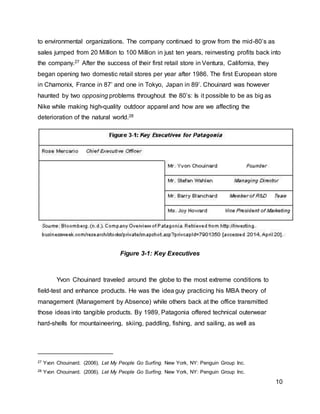
retail store manager Kristin McDivett Tompkins to be the company’s first CEO (see
Figure 3-1). He considered her to be a “Dirt Bag” climber and skier like himself, his term
for someone who wandered through “temp jobs and long summers,” pursuing a life of
adventure in the outdoors.26 Chouinard and his wife Malinda created and operated the
Lost Arrow Corporation in 1984 as the parent company for Patagonia. They made their
first dedicated move towards sustainability the year after by donating 1% of total sales
23 Yvon Chouinard. (2006). Let My People Go Surfing. New York, NY: Penguin Group Inc.
24 Blue Ocean Strategy: One of two “market spaces” which denotes all the industries not in existence
today—the unknown market space, untainted by competition, where demand is created rather than fought
over. Retrieved from http://hbr.org/2004/10/blue-ocean-strategy/ar/1 [accessed 2014, March 18].
25 Sergei Gil. (2013). Strategic Marketing [Lecture Notes]. Barcelona, Spain. European University.
26 Patagonia Inc. (n.d.). Company History. [accessed 2014, March 18].
10
to environmental organizations. The company continued to grow from the mid-80’s as
sales jumped from 20 Million to 100 Million in just ten years, reinvesting profits back into
the company.27 After the success of their first retail store in Ventura, California, they
began opening two domestic retail stores per year after 1986. The first European store
in Chamonix, France in 87’ and one in Tokyo, Japan in 89’. Chouinard was however
haunted by two opposing problems throughout the 80’s: Is it possible to be as big as
Nike while making high-quality outdoor apparel and how are we affecting the
deterioration of the natural world.28
Figure 3-1: Key Executives
Yvon Chouinard traveled around the globe to the most extreme conditions to
field-test and enhance products. He was the idea guy practicing his MBA theory of
management (Management by Absence) while others back at the office transmitted
those ideas into tangible products. By 1989, Patagonia offered technical outerwear
hard-shells for mountaineering, skiing, paddling, fishing, and sailing, as well as
27 Yvon Chouinard. (2006). Let My People Go Surfing. New York, NY: Penguin Group Inc.
28 Yvon Chouinard. (2006). Let My People Go Surfing. New York, NY: Penguin Group Inc.
11
insulation and underwear for all outdoor activities.29 Yvon and Malinda had pushed for
the Retail and Mail Order expansion in order to build more direct customer relationships
and to decrease sales to wholesalers, specifically larger department stores. The
company had developed a few distribution channels by this point, their own retail stores,
wholesalers and Mail Order. They refused to send out “new” catalog’s to customers
when only the cover changed. This caused mismanagement in the mail-order inventory,
eventually leading the company to funnel out ‘hoarded’ products to wholesalers who
would dump them on the market at low-cost.30 They eventually dropped certain dealers
who did not treat the Patagonia brand with enough respect, bringing inventory under
control.
Today the company is financially stable (refer to Appendix 2 and 3). The holding
company, Patagonia Works manages Patagonia, Inc. (apparel), Patagonia Provisions
(food), and Patagonia Media (books, films and multimedia projects) all under one CEO
Rose Mercario.31 Each company under Patagonia Works is registered as a Benefit
Corporation, ensuring that their ethos-led values live on in perpetuity.
Patagonia’s ability to strategize alongside their organic growth has paved the
way for many innovations as they work to become the model for a responsible
company. They continue to distribute high-performance outdoor apparel for climbing,
ski/snowboarding, surfing, fly fishing, and trail running through four distribution outlets:
Mail Order, Internet, Retail, & Wholesale. Foreseeing the warming of the planet, the
company has made shift into increasing their surfing product variety, including wetsuits
made from algae as a way to counter a drop in winter sales. In 2013, the surfing
category, representing 10% of their overall sales, were about $54 million, three times
greater than in 2009.32 Patagonia has also been heading “The Responsible Economy”
campaign. Rose Mercario alongside Mr. Chouinard believe that a Responsible
29 Patagonia Inc. (n.d.). Company History. [accessed 2014, March 20].
30 Yvon Chouinard. (2006). Let My People Go Surfing. New York, NY: Penguin Group Inc.
31 Patagonia Works. (n.d.). FAQ’s. Retrieved from http://www.patagoniaworks.com/faq/ [accessed 2014,
July 20].
32 Lauren Sherman. (2014, November 13). Surf’s Up For Indie Brands. Retrieved from
http://www.businessoffashion.com/2014/11/surfs-indie-brands.html [accessed 2014, November 18].
12
Economy is one that cultivates healthy communities, creates meaningful work, and
takes from the earth only what it can replenish.33
Over the next two years the company plans to search for the answers to current
global environmental questions regarding our current economic practices. This
ambitious initiative is surely not to be the last of Patagonia’s endeavors as their urgency
to prevail is in full-throttle.
33 Patagonia Inc. (n.d.). The Responsible Economy. Retrieved from
http://www.patagonia.com/us/patagonia.go?assetid=1865 [accessed 2014, March 20].
13
Chapter 4: Patagonia’s Sustainability Strategy
The strategy behind Patagonia’s success over the decades is due to their
dedication to true sustainability. It means more than just publishing an annual report on
environmental or social initiatives. Rather they must continuously analyze what they are
doing and how they could do it better. This is a mindset throughout the entire
organizational structure from the origin of each resource to the final stage of each
product and business practice.
When the credit-crunch hit in the 90’s even Patagonia succumbed to it. The
company’s shortfall came not from a decrease in sales, but from a mere 20% increase,
shy from a decade long 30-50% compound annual growth.34 Patagonia hired too many
employees in advance without sufficient training. Chouinard learned the hard way on
July 31st, 1991, Black Wednesday, when they had to cut their overhead and let go of
120 employees – 20% of the workforce.35 From this point, Yvon Chouinard began to
make his move towards “enlightenment”. The company had exceeded their resources
and became dependent on the global economy.
They needed to analyze how to achieve a sustained growth. Yvon took a dozen
of his top managers to the real Patagonia in the south of Argentina, to discuss why they
were in business. He wanted to discover the values they held in common, their shared
culture and the type of business they wanted it to become. When they managed to
finally put these values into words, they found the primary concern of the Patagonia
community was the loss of biodiversity, cultural diversity, and the planet’s life support
systems. They believe the “root causes of this situation include the basic values
embodied in our economic system, including those of the corporate world. Primary
among the problematic corporate values is the primacy of expansion and short-term
profit over other considerations such as quality, sustainability, environmental and
human health, and successful communities”.36
34 Yvon Chouinard. (2006). Let My People Go Surfing. New York, NY: Penguin Group Inc.
35 Patagonia Inc. (n.d.). Company History. [accessed 2014, March 20].
36 Yvon Chouinard. (2006). Let My People Go Surfing. New York, NY: Penguin Group Inc.
14
Opting for a long-term business, the company began to investigate their
ecological footprint. What they least expected, was to discover that cotton could be as
dangerous to the planets health as coal. In 1994, the company chose to take all their
sportswear to the 4-times more expensive organic cotton by 1996.37 They had only 66
products to changeover, however they found that there simply was not enough
commercially organic cotton available. To accomplish their goal, they had to go to the
bottom of their supply chain. They searched out the few organic farmers and convinced
the ginners and spinners to clean out their “contaminated” equipment. Patagonia
invested in other sustainable resources, such as recycled polyester, in the hopes of
making a more durable end-product. The move paid off as customers found Patagonia’s
products to be not only high-quality, but also environmentally friendly.
Patagonia has always held a desire to build the best product while consciously
contributing to the environment in which they often ‘play’. Back in 1991 when Yvon
Chouinard took his managers down to the real Patagonia in South America, they
developed the company mission: “Build the best product, cause no unnecessary
harm, and use business to inspire and implement solutions to the environmental
crisis.”
In order to facilitate it, they consolidated and simplified their core values:38
 Quality: Pursuit of ever-greater quality in everything they do.
 Integrity: Relationships built on integrity and respect.
 Not Bound by Convention: Their success – and much of the fun – lies in
developing innovative ways to do things.
 Environmentalism: Serve as a catalyst for personal and corporate action
37 Patagonia Inc. (n.d.). Company History. [accessed 2014, March 20].
38 Patagonia Inc. (2007). Corporate Social Responsibility. Retrieved from
http://www.patagonia.com/pdf/en_EU/social_response2.pdf [accessed 2014, March 25].
15
4.1 Quality
The first part of Patagonia’s mission “Make the best product,” is the foundation of
their business philosophy. Chouinard Equipment was founded with the purpose to
create lighter and stronger climbing ‘tools’ that your life could be dependent upon.
Designing 2nd tier clothing was not an option. This attitude of building the ‘best product’
inspires the entire Patagonia community to become the best at every step in the
process. As one of the first companies to create industrial apparel, the designers
developed a checklist of criteria when considering a products quality: Functional,
Multifunctional, Durable, Customer-Fit, Simple as Possible, Product Line Simple,
Innovation / Invention, Global Design, Easy Maintenance, Added-Value, Authentic,
Artistic / Fashion, and does it cause any Unnecessary Harm.39
By designing from the basis of satisfying a functional need helps focus the entire
process and eventually delivers a far superior product. Today, Patagonia relies on
“Ambassadors”40 to enhance products through extreme field-testing while Yvon
Chouinard is now focused on business practices. Walking the talk, Patagonia offers an
Ironclad Guarantee to all customers, guaranteeing everything they make for life. If a
customer is not satisfied with one of their products, they can return it for repair,
replacement or refund.41 This helps the company promote their “Buy Less” campaign
(see Figure 4-1), proving that a product should have an unlimited lifetime. If you are
willing to accept your product to be returned, a “Businessman” would make it last as
long as possible.
39 Chouinard, Y. (2006). Let My People Go Surfing. New York, NY: Penguin Group Inc.
40 Patagonia Ambassadors: work closely with the design department to test, refine and validate their
products in the harshest and most remote locations on the planet. They are not just athletes, but field
testers for Patagonia gear and storytellers for the Patagonia Community. Retrieved from
http://www.patagonia.com/eu/enES/ambassadors [accessed 2014, March 25].
41 Patagonia Inc. (n.d.). Patagonia Ironclad Guarantee. Retrieved from
http://www.patagonia.com/us/patagonia.go?assetid=38565 [accessed 2014, March 25].
16
4.2 Integrity
At Patagonia, every stakeholder is just as important as the next. Building trust
and transparency amongst each is crucial to achieving sustainability. Patagonia is an
ecosystem and suppliers and customers alike are integral to it efficacy and survivability.
As a small producer of climbing goods, Chouinard and Frost hand inspected every tool
that was made. The challenge is reproducing this dedication to a quality product on an
industrial scale. Involving the designer with the producer is the first of Chouinard’s
production principles. Both parties can improve their own work when they understand
the needs of the others. This led Patagonia to develop long-term relationships with
suppliers and contractors. The company has a strict code of conduct, in which suppliers
alike must adhere too. When they do not, Patagonia does not drop these companies but
rather works harder to make the necessary changes within. This helps build up the vital
communication channels between the two in order to create the best product while
considering environmental factors. Patagonia is willing to invest heavily in the
development of their suppliers because as a product driven company, success begins
with them.42
42 Luiz Diaz. (2014). Supply Chain Management [Lecture Notes]. Barcelona, Spain. European University.
Figure 4-1: “Buy Less” Campaign
17
Today’s distribution channels have been integrated fully to enhance each other.
Using Mail Order, Internet, Retail, & Wholesale, Patagonia has mastered the four in
concert, considering each to be essential to their relationship with the customer.43 The
first three channels are directly controlled by Patagonia and easily adjustable.
Developing a partnership with dealers is crucial as they become the voice of Patagonia.
Identifying the advantages for both parties is part of the transparency and trust that
ensures a long-lasting relationship. Chouinard believes deeply in customer satisfaction,
however in order to maintain their integrity, Patagonia will never sacrifice a products
quality over on-time delivery. This reflects their philosophy of doing things right, the first
time.
4.3 Not Bound by Convention
Ever since Yvon Chouinard’s early beginnings with Chouinard Equipment, his
management style has been anything but conventional. Patagonia’s headquarters in
Ventura, California are no exception. From the ‘barefoot’ employees to the lack of
offices, there is an egalitarian atmosphere present. As an avid outdoor enthusiast
himself, Chouinard has always offered a flextime and “Let My People go Surfing” policy:
employees may take time off of work to go surfing when the waves are just right, or
when the ‘snow gods’ have unleashed a blizzard on one’s favorite ski resort as long as
they complete their work. Even from the early 90’s Patagonia was one of the first 150
companies in the USA to introduce an on-site child care center, retaining valuable
woman in the company and maintaining a familial feel rather than corporate.44 Focused
on preserving their core values allows Patagonia to be adaptive, resilient and to
constantly embrace new ideas and methods of operation.
In lieu of their environmental activism, Patagonia encourages employees to undergo
a six week Internship with a non-profit organization of their choice, for a social or
environmental cause. By fully supporting employees own ambitious goals, Patagonia
43 Chouinard, Y. (2006). Let My People Go Surfing. New York, NY: Penguin Group Inc.
44 Chouinard, Y. (2006). Let My People Go Surfing. New York, NY: Penguin Group Inc.
18
receives a solid return from individualistic and creative employees who consistently
innovate through collaboration. Whenever there’s been a crisis, Patagonia’s best work
is done.45 A leader or CEO must always be willing to challenge their employees with
change or else the status quo will become stagnant and be buried under external
changes in the environment. By staying far from the traditional business strategies,
Patagonia continues its Zen Philosophy, focusing on finding the right processes rather
than looking merely for profit. This proves the correct course of action over and over
again as they manage to “change” industry standards and norms, such as the use of
organic cotton, sometimes a decade in advanced.
These core values guide everyone at Patagonia in everything that they do. They
are constantly reminded about why they are in business and what the company’s
mission is. Core values are embodied in the company by hiring those who are aligned
with them, following modern Human Resources practices.46 Patagonia’s capacity to find
similarly aligned employees both limits growth and offers a deep culture within through
shared values, streamlining operations.
4.4 Environmentalism
Patagonia has, through the values of its owners and employees, been concerned
for the health of our planet. The ability to continue enjoying the non-motor sports they
participate in, in the locations best suited for them, is degrading constantly. By 2039,
more than half of the 103 ski resorts in the Northeastern U.S.A. will not be able to
maintain a 100-day season.47 This advanced the Patagonia community to act
responsibly and urgently. They have even motivated other companies to join forces to
create more environmentally friendly practices. Patagonia, implementing many
innovative programs geared at solving the environmental crisis (refer to Appendix 4),
45 Chouinard, Y. (2006). Let My People Go Surfing. New York, NY: Penguin Group Inc.
46 Charles, A. (2012). Human Resources Management [Lecture Notes]. Barcelona, Spain. European
University.
47 Katherine Seelye. (2012, December 12). Rising Temperatures Threaten Fundamental Change for Ski
Slopes. Retrieved from http://www.nytimes.com/2012/12/13/us/climate-change-threatens-ski-industrys-
livelihood.html?pagewanted=all &_r=0 [accessed 2014, June 14].
19
openly shares these practices with other companies. Their cooperativeness advances
technological and business process giving way to a revolution in clothing design.
4.4.1 The Conservation Alliance
The mission of the Conversation Alliance is to engage other businesses to fund
and partner with organizations to protect wild places for habitat and recreational
values.48 The organization collects annual membership dues. These are then distributed
as grants to organizations working to permanently protect wild places such as the
California Wilderness Coalition and the Canadian Parks and Wilderness Society.
The Alliance was created in 1989 when Patagonia, The North Face, REI, and
Kelty decided that through coopetition (cooperation between competition companies)49;
their environmental efforts would have a worthier impact. There are now more than 160
member countries who have contributed more than $6.5 million to the North American
conservation projects since their inauguration.50
4.4.2 1% for the planet
Yvon Chouinard and good friend Craig Mathews, owner of Blue Ribbon Flies,
founded 1% For the Planet in 2002. Both men understood the importance of protecting
vital business resources. 1% for the Planet’s mission is to build, support and activate an
alliance of businesses financially committed to creating a healthy planet. In just over 10
years 1% for the Planet has grown into a global movement of more than 1200 member
companies and 3,300 non-profits in 48 countries, all donating at least 1% of annual
48 The Conservation Alliance. (n.d.). Mission and History. Retrieved from
http://www.conservationalliance.com/about [accessed 2014, June 14].
49 Jan Kingsley. (2014). Leadership and Team Building [Lecture Notes]. Barcelona, Spain. European
University.
50 FootZone. (n.d.). The Conservation Alliance. Retrieved from
http://www.footzonebend.com/community/conservationalliance [accessed 2014, April 14].
20
sales to sustainability initiatives, together totaling over $100 million.51 Members use the
1% For the Planet logo on products allowing customers to feel confident about where
their money goes.
4.4.3 The Footprint Chronicles
This is one of the most unique and innovative methods Patagonia developed to
increase transparency. The Footprint Chronicles, created in 2012, is an online tool for
anyone to evaluate the company’s entire supply chain, from both social and
environmental standpoints (see Figure 4-2). They not only display the factories and mills
in which workers are treated above standard, but also the problematic ones in which
they are working hard to change. They hope to encourage customers to make more
informed decisions about the clothing line. Simultaneously, they embolden other
businesses to divulge information about their own supply chains, successively pushing
51 One Percent for the Planet. (n.d.). Historty. Retrieved from
http://onepercentfortheplanet.org/about/history/ [accessed 2014, April 14].
Figure 4-2: The Footprint Chronicles
21
them to clean up their factories.52 Patagonia works constantly to improve the working
conditions and quality of products in their own supply chain through various methods
described below. Each fosters the relationship with suppliers and customers, through
transparency and authenticity.
4.4.3.1 Bluesign Standard Limits
Established in 2000, Bluesign considers the production process as a whole:
resource productivity, consumer safety, air emission, water emission, and occupational
health & safety. Input Stream Management helps the textile business to produce in an
environmentally friendly and resource-efficient way. It combines both the economic and
ecological advantages for the benefit of everyone involved.53 Patagonia uses Bluesign
certification to ensure the most sustainable textile production, eliminating harmful
products right from the beginning and setting control standards for environmentally
friendly and safe production.
4.4.3.2 Raw Materials Social Responsibility Program
One of the longest and most important initiatives of Patagonia, this program is
crucial to their mission of building the ‘best product and causing no unnecessary harm’.
It requires that all of Patagonia’s fabric and trims suppliers audit their factories for key
social responsibility indicators: hiring practices, employee grievance mechanisms,
recycling policies and other social and environmental efforts. Implemented in the mid
1990’s, the program offered a way to monitor garment factories for social compliance,
leading to the formation of the Fair Labor Association.
4.4.3.3 Fair Labor Association (FLA)
Since 1999, the FLA has led a global effort to solve workplace abuse with the
help of socially responsible companies, universities, and civil society organizations.
They offer the resources and training to companies and workers alike, conducting due-
52 Joseph Tohill. (2012, May 18). Patagonia Maps out its Supply Chain with “The Footprint Chronicles”.
http://www.the9billion.com/2012/05/18/patagonia-maps-out-its-supply-chain-with-the-footprint-chronicles/
[accessed 2014, April 14].
53 Bluesign.(n.d.). Approach. Retrieved from http://www.bluesign.com/home/approach#.U0JmGPkbVb4
[accessed 2014, May 5].
22
diligence through independent assessments and increasing transparency and
accountability. This year Patagonia launched ten new clothing styles, each a Fair Trade-
certified product.54 For every product sold, the company will donate it to worker’s funds,
where the staff will have the option of taking the premium cash in the form of a bonus.
These initiatives directly affect the ability of Patagonia to regularly deliver high-quality
products.
4.4.4 Common Threads Partnership
This initiative is a pledge between Patagonia and its customers to make all
decisions with sustainability in mind. It is a partnership to reduce excess consumption
and give the planet’s vital systems a rest from pollution, resource depletion, and
greenhouse gases. The following five “R’s” are pursued in order of importance so as to
eventually close the loop on a products lifecycle and eliminate its environmental
footprint altogether.55
1. Reduce: If one is to properly implement a ‘recycling’ program, then one must
first look at how they can reduce consumption in the first place. Through Bluesign audits
and a focus on building quality products, Patagonia pledges to redouble their efforts to
make useful, long-lasting products. In turn they ask their customers to pledge ‘not to buy
what they do not need or what will not last’.
2. Repair: Next, Patagonia asks customers to repair before replacing. Their step-
by-step guide on Ifixit.com offers ‘Learn to Sew’ and ‘Product Care’ information.56 The
company’s Ironclad Guarantee upsized their repair department to handle a higher
volume and return it to the customer expediently.
54 Stephen Kennett. (2013, November 1). Patagonia to Ringfence Revenues from New Fair Trade
Products. Retrieved from https://www.2degreesnetwork.com/groups/2degrees-
community/resources/patagonia-ringfence-revenues-new-fair-trade-products/ [accessed 2014, June 5].
55 Chouinard, Y. and Stanley, V. (2012). The Responsible Company: What we’ve learned from
Patagonia’s first 40 years. Ventura, CA: Patagonia Books.
56 IFixit. (n.d.). Patagonia Common Threads Partnership: Repair. Retrieved from
http://www.ifixit.com/patagonia [accessed 2014 June 8]).
23
3. Reuse: Next is to reuse or recirculate what one no longer wears. Patagonia
established a program on E-Bay for customers to sell their own used gear along with
Patagonia’s own used gear offering. As of September 2013, the company announced
the opening of their Worn Wear™ section. Customers can purchase used Patagonia
clothing from four locations across the US. If clean and in good condition, customers will
receive credit for bringing in clothes for resale (possibly up to 50% of the items original
price) which is then to be resold through the Common Threads Worn Wear™ section.57
4. Recycle: This is a key component of reducing waste and conserving natural
resources. Since July 2005 the company recycled 56.6 tons of worn out Patagonia
clothing and gear. To do this, the company consciously invested in E-Fibers including
recycled polyester, organic cotton, hemp, chlorine-free wool, recycled nylon and
TENCEL® lyocell.58 Today, customers can return any Patagonia product ever made
and it will be reused or recycled into new fabric for a new product.
5. Reimagine: In 2011, Patagonia added this 5th “R” to the mantra. Mutually,
they pledge with the customer to re-imagine a world in which we take from nature only
what it can replace. This last one underpins the other four by keeping the long-term
view in mind.59 Having used Goose feathers in products since early 2000’s (such as in a
“down” insulated jacket), the company took 6 years to create their ‘Traceable Down
Standard’. Since fall 2014, Patagonia uses only 100% traceable “down” in those product
categories.
An external audit system begins with the farm where the eggs are laid and ends
at the garment factory, where the “down” is placed in jackets and other products.60 For
half a decade the company believed their “down” was sourced socially and
57 PR Newswire. (n.d.). Patagonia Worn Wear ™ Section Now Open in Seattle. Retrieved from
http://www.prnewswire.com/ news-releases/patagonia-worn-wear-section-now-open-in-seattle-
224239031.html [accessed 2014, June 8].
58 Patagonia Inc. (n.d.). Patagonia Common Threads Partnership: Recycle. Retrieved from
http://www.patagonia.com/eu/enES/ common-threads/ [accessed 2014, June 9].
59 Chouinard, Y. and Stanley, V. (2012). The Responsible Company. Ventura, CA: Patagonia Books.
60 Environmental Leader. (n.d.). Patagonia to use 100% Traceable Down. Retrieved from
http://www.environmentalleader.com/2013/11/14/patagonia-to-use-100-traceable-down/ [accessed 2014,
June 9].
24
environmentally responsibly until a third-party accused them of using a ‘corrupted
supply chain’. This led the company to reimagine the methods in which they could
select “down” vendors that would ensure complete transparency.
4.4.5 Eco Index
Patagonia’s most prominent initiative is in development with the Outdoor Industry
Association (OIA). The Eco Index or Higgs Index is an environmental tool designed to
advance sustainability practices in the industry. It provides companies throughout the
supply chain a way to benchmark and measure the environmental impact of a product
over its lifetime. By enhancing transparency and communication in the supply chain,
companies will more effectively be able to incorporate environmental considerations into
the design and management of any product.61 The projects output and tools have a
wide range of applicability in other industries and sectors. It will be the new standard
supply chain tool supporting environmental goals (refer to Appendix 5).
4.4.6 Recent Initiatives
Patagonia continues to extend their environmental reach. Examining the third
part of their mission, ‘use business to inspire solutions to the environmental crisis’, they
decided to expand two more divisions under Patagonia Works: a new in-house venture
fund called $20 Million and Change and a start-up called Patagonia Provisions. The
venture will consider a startup’s social and environmental impact rather than economic
returns. Focusing on cultivating those who share Patagonia’s values, such as using only
sustainably sourced cotton, reducing waste, and carefully examining how supply chains
affect workers.62 The first company chosen uses pressurized CO2 to dye clothing rather
than copious amounts of water, offering future cooperation between the two companies.
61 European Outdoor Group. (n.d.). Eco Index. Retrieved from
http://www.europeanoutdoorgroup.com/conserve-sustain-care/sustainability/eco-index [accessed 2014,
June 9].
62 Caroline Winter. (2013, May 6). Patagonia’s Latest Project: A Venture Fund. Retrieved from
http://www.businessweek.com/articles/2013-05-06/patagonias-latest-product-an-in-house-venture-fund
[accessed 2014, June 18].
25
Patagonia Provisions offers organic and sustainably sourced food such as jerky
from grass fed, free roaming bison and wild sockeye salmon caught by native tribes.63
Although food is a territory far from high-tech outdoor apparel, it is much closer to
Patagonia’s mission. Agriculture is responsible for an estimated 15% of greenhouse
gases, which, in terms of its contribution to global warming, is 23 times more powerful
than carbon dioxide.64 If the world is to be truly sustainable, a re-examination of our food
supply is a must and Patagonia aims to inspire others.
63 Erika Fry. (2014, April 9). More than Jerky: Patagonia Expands in Food. Retrieved from
http://fortune.com/2014/04/09/more-than-jerky-patagonia-expands-in-food/ [accessed 2014, June 18].
64 Damian Carrington. (2014, December 3). Eating Less Meat Essential to Curbing Climate Change, says
Report. Retrieved from http://www.theguardian.com/environment/2014/dec/03/eating-less-meat-curb-
climate-change [accessed 2014, December 10].
26
Chapter 5: Key Aspects of Patagonia’s Strategy
Patagonia has been successful over the past decades due to a few key aspects
which have paved the way for most of their initiatives. They are important for the pursuit
of sustainability for any company. Most critically, these have been vital in mitigating
external risks many in the outdoor industry face.
5.1 Situational Analysis
A thorough analysis of both internal and external variables must be considered in
order to understand the key aspects of Patagonia’s strategy. With over 40 years in
business, Mr. Chouinard has unconventionally influenced the market and many of the
standard business operations as well.65 Through an analysis of the company’s four core
values (refer to Chapter 4), it is possible to extract certain capacities they have which
correspond to the external environment. In lieu of this, it is necessary to perform a
TOWS (Threats, Opportunities, Weaknesses, and Strengths) analysis66, rather than a
SWOT, so as to better identify their true strengths and weaknesses in relation to
externalities.
5.1.1 Threats
Since Yvon Chouinard first saw how his, once most sought after, piton destroyed
the rock face, he understood the current threat Patagonia faces: Climate Change. The
world may be able to adapt to this, however particular elements of the outdoor industry
could cease to exist if major changes are to occur. The current average of 150 days per
season ski season directly impacts Patagonia’s bottom line. Winter is half the season
for any outdoor company. Their ability to find and or create demand during that time is
important to be successful.
65 Kristall Lutz. (2011, January 27). What Makes Patagonia “The Coolest Company on the Planet”.
Retrieved from http://www.opportunitygreen.com/green-business-blog/2011/01/27/what-makes-
patagonia-the-coolest-company-on-the-planet-insights-from-founder-yvon-chouinard/ [accessed 2014,
November 5].
66 Christine Clarke. (2012). Foundations of Business Management [Lecture Notes]. Barcelona, Spain.
European University.
27
Secondly, the continuation of the economic crisis may at first glance appear ‘ok’
for Patagonia.67 They claim consumers make smarter, longer lasting purchases during a
recession. Yet, if Patagonia truly believes in building a sustainable future, everyone
must prosper. They may find it easier to educate customers in tough times; however
customers may not listen when their security is threatened.
5.1.2 Opportunities
The emergence of the outdoor industry in the last decade attracts a broad range
of individuals. Both young and old, people are actively participating in the outdoors. The
Patagonia brand effectively created its own lifestyle, one which becomes easier to
associate with for those interested in extreme sports and the outdoors. The apparel
sector alone in the outdoor industry captured 35% market-share (see Chapter 2).
Patagonia has a chance to capture the minds and hearts of new customers in the
industry.
Also the performance apparel segment continues to grow. Anticipating global
sales of over 18 billion dollars by 2018 (see Chapter 2) the segment will increase
market-share in the overall sports apparel sector. This trend shows Millennials are
switching activities towards ones requiring performance enhancing technologies,
leading us to the last opportunity.
The development of new technologies in every facet of the business world
enables Patagonia to meet their goals. The opportunities provided by the Eco-Index
(see Chapter 4.3.5) alone substantially increases information about the long-term costs
of ‘conventional business’. The persistent research, development, and sourcing of e-
fibers continues to decrease those costs and increase benefits. As technological
innovations regarding sustainability become available, all stakeholders benefit.
67 Olivia Wetzel. (2014, November 19). Financial Crisis Remains, says Expert. Retrieved from
http://www.nyunews.com/2014/11/19/inequality/ [accessed 2014, November 21].
28
5.1.3 Weaknesses
Internally, they are always preparing for the long-term. The biggest drawback
from Mr. Chouinard’s decades of business: they have built such reliable, functional, and
durable products that compromising quality for more ‘eco-friendly’ alternatives becomes
very difficult. Their commitment to “building the best product” constantly brings them to
a crossroad. Polyester, derived from oil, is not renewable, yet it is a very high-
performing fiber. Employees must determine whether the harm caused by the
production and use of polyester is ‘necessary’ or not. To this extent, their values of
“Quality” and “Environmentalism” can be dichotomous in the short-term.
A second weakness facing the company: internal expansion. As the company
grows, their ability to find individuals who equally, if not more so believe in Patagonia’s
mission diminishes. The workforce is creative and intelligent, though not everyone will
as effectively “Walk the Talk” like Mr. Chouinard. His unconventional management style
(Management By Absence) leaves Patagonia vulnerable to a lack of continuity in
sustainability practices.
5.1.4 Strengths
Being a Private company allows freedom to innovate in line with Patagonia’s
mission. However it is their internal collaboration that extends far beyond the doors of
the Ventura headquarters. Their commitment to Integrity leads to lasting relationships
with suppliers and customers, the development of the Fair Labor Association, 1% for the
Planet, and the Conservation Alliance (see Chapter 4.3). Their transparent
communication across all stakeholder channels (The Footprint Chronicles) propels the
company’s growth year on year.
Advertising at Patagonia is a low priority proving that their success in the last
decade is attributed to brand equity. Many customers, especially in North America,
moved from brand awareness, to brand insistence as the company is useful and shows
29
useful information to enhance people’s lives.68 Mr. Chouinard creates products that he
would use in life and death situations. Patagonia’s commitment to developing a ‘hand-
like’ inspection model on an industrial scale, as well as a ‘hands-on’ field testing model
continues to enhance the design and materials of their products.
A focus on “building the best product” since the 60’s turned an intangible asset,
intellectual propriety, into a strength. The internal knowledge and collaboration from
employees (often times end-users themselves) allows Patagonia to innovate products
and processes. This has led to them increasing their surf wear collection, preparing
themselves for an Earth in global warming. Although Yvon Chouinard is the guiding
force, he could never have achieved so much without a team of individuals behind him.
Their ability to empathize with customers gives them a competitive advantage over
other players, many of which search for employees with MBA’s rather than a
background in skiing.
5.2 Impacts of Key Aspects
The following three key aspects: Organizational Structure, Transparency, and
Stakeholder Engagement are interconnected. Each is required to ensure the full
commitment to the other aspects. This allows the company to embed sustainability into
their mission statement and be actionable.
5.2.1 Organizational Structure
A second key aspect to Patagonia’s strategy is in the organization of the
company. Up until 2012, Patagonia was incorporated as a privately owned company,
allowing Yvon Chouinard to do as he wished. In January of 2012 though, they became
the first company in California to register as a “Benefit Corporation”.
As a private company, Yvon Chouinard chose a direction for Patagonia. Instead
of profit maximization, they acted in favor of all stakeholders, remaining true to their
68 Meredith Berg. (2013, December 17). Why Advertising is ‘Dead Last’ Priority at Outerwear Marketer
Patagonia. Retrieved from http://adage.com/article/cmo-strategy/advertising-dead-priority-
patagonia/245712/ [accessed 2014, November 21].
30
core values. Now, as a Benefit Corporation, they must commit to creating an
overarching “general public benefit”. Considering an array of stakeholders beyond just
shareholders, including workers, suppliers, the environment and the local community
and are protected by law for doing so in case they go public.69 Under today’s current
system, shareholders have the legal right to sue corporate boards for not maximizing
profits. For the first few decades, Patagonia led the industry and pioneered Corporate
Social Responsibility.70 Once the law caught up to Patagonia, they easily transferred to
a “Benefit Corporation”.
5.2.2 Transparency
Yvon Chouinard, once said “How you climb a mountain is more important than
reaching the top”, and applied this concept throughout his high-performance, outdoor
apparel company.71 In business terms, day-to-day operations are as important as long
term objectives. Through transparency in Patagonia’s business practices, employees
have the opportunity to routinely act in favor of the environment. This aspect of their
strategy led to the creation of the Footprint Chronicles, allowing stakeholders to
effectively examine a products life-cycle and their unique marketing campaign dubbed
“Buy Less”.
In 2012—after 9 months of pleading customers to ask themselves: do I really
need a new fleece jacket and all the carbon output that comes with it?—Patagonia sales
increased nearly one-third, to $543 million, as the company opened 14 more stores.72
Patagonia employees transparently educated customers and the company benefited
economically. The increase in revenue appears to contradict the ‘reduce, reuse, repair,
recycle’ mantra of Patagonia. However, Yvon Chouinard says this increase was not
69 John Tozzi. (2012, January 4). Patagonia Road Test New Sustainability Legal Status. Retrieved from
http://www.bloomberg.com/news/2012-01-04/patagonia-road-tests-new-sustainability-legal-status.html
[accessed 2014, November 21].
70 Melissa Pongtratic. (2007). Greening the Supply Chain: A Case Analysis of Patagonia [Case Study].
Retrieved from http://irps.ucsd.edu/assets/021/8430.pdf [accessed 2014, November 21].
71 Chouinard, Y. (2006). Let My People Go Surfing. New York, NY: Penguin Group Inc.
72 Kyle Stock. (2013, August 28). Patagonia’s ‘Buy Less’ Plea Spurs More Buying. Retrieved from
http://www.businessweek.com/articles/2013-08-28/patagonias-buy-less-plea-spurs-more-buying
[accessed 2014, November 21].
31
from old customers buying more, but from new customers switching to Patagonia.73 If
they can change consumer habit to purchase from a more responsible company, that is
better than purchasing from an irresponsible competitor.
5.2.3 Stakeholder Engagement
Engaging all stakeholders and committing to long-term relationships is a part of
Patagonia’s philosophy. However, one important element to this final aspect is taking
necessary risks with or without stakeholder approval. The decision to switch from
conventional cotton to organic cotton in 1996 was implemented without the support of
government, customers, suppliers or even some executives. Patagonia guaranteed a
long-term contract to convince suppliers to transition over to organic cotton farming.74
The company is today an example for others in the apparel industry looking to source
cotton organically on an industrial scale.
As a first mover in environmental initiatives such organic cotton and their
collaboration with others in the industry, the Sustainable Apparel Coalition was born.
‘Through multi-stakeholder engagement, the Coalition seeks to lead the industry toward
a shared vision of sustainability. It is built upon a common approach for measuring and
evaluating apparel and footwear product sustainability performance that will spotlight
priorities for action and opportunities for technological innovation.’75 Their persuasion
over competitors to commit to sustainable processes, benefits Patagonia. For example,
the more demand there is for organic cotton, the price to acquire the material goes
down as supply increases76. To this extent, Chouinard leads the way for businesses
73 GreenBiz. (2014, July 18). Yvon Chouinard: The Company as an Activist [Video File]. Retrieved from
https://www.youtube.com/watch?v=sbsLeXldDrg [accessed 2014, November 21].
74 Chuck Culp and Justin Purnell. (2012, October 6). Making The Ecosystem Part of Your Ecosystem:
Patagonia Moves to Organic Cotton [Technical Report]. Retrieved from
http://faculty.tuck.dartmouth.edu/images/uploads/faculty/ron-adner/Patagonia__Organic_Cotton_-
_Culp+Purnell.pdf [accessed 2014, November 21].
75 Sustainable Apparel Coalition. (2014). Overview. Retrieved from
http://www.apparelcoalition.org/overview/ [accessed 2014, November 21].
76 Wetherall, J. (2012). Micro-economics [Lecture Notes]. Barcelona, Spain. European University.
32
looking to ‘minimize their environmental impact, thus decreasing their long-term costs’77
and simultaneously building something of quality.
Overall, these key aspects are basic ideas, yet provide depth for an employee’s
job. Now as a Benefit Corporation, they must continuously understand the ever
changing external communities around Patagonia. Transparency becomes more difficult
the larger the supply chain and increased complexity of business practices. Whereas
stakeholder engagement requires a constant focus on their needs and desires to ensure
maximum effectiveness.78 These aspects keep Patagonia focused on the long-term
objectives and goals.
77 Queensland Government. (2013). The Benefits of an Environmentally Friendly Business. Retrieved
from http://www.business.qld.gov.au/business/running/environment/environment -your-business/benefits-
environmentally-friendly [accessed 2014, November 21].
78 Christine Clarke. (2011). Foundations of Business Management [Lecture Notes]. Barcelona, Spain.
European University.
33
Chapter 6: Analysis of Competing Companies
A more in depth look at three select companies in the outdoor market will provide
credibility to Patagonia’s sustainability strategy. The following companies have been
chosen because of their competition, collaboration, and differing organizational structure
to that of Patagonia.
1. The North Face (TNF):
a. Subsidiary of VF Corporation (Public Company)
b. Direct competitor to Patagonia
c. Member of Outdoor Industry Association, Conservation Alliance, Fair
Labor Association and Sustainable Apparel Coalition
2. Columbia Sportswear Company (CSC):
a. Corporation with several subsidiaries (Public Company)
b. Direct competitor to Patagonia
c. Member of Outdoor Industry Association, Conservation Alliance, Fair
Labor Association and Sustainable Apparel Coalition
3. Recreational Equipment Inc. (REI):
a. Consumer Co-op
b. Direct competitor and distributor of Patagonia, also sells outdoor hardware
c. Member of Outdoor Industry Association, Conservation Alliance, and
Sustainable Apparel Coalition
6.1 The North Face (VF Corporation)
6.1.1 Overview
The North Face brand has been around since the very beginning of high-
performance outdoor equipment. It was named for the coldest, most unforgiving side of
a mountain. Ironically, the idea for the mountaineering retail store began in San
Francisco in 1964, at an altitude of only 50 meters on a beach.79 By 1968, the current
owner, Dick “Klopp” Hopkins, began designing and manufacturing The North Face’s
79 The North Face. (n.d.). Over 40 Years of Innovation and Exploration. Retrieved from
http://www.thenorthface.com/en_US/our-story/ [accessed 2014, July 15].
34
own brand of technical outdoor apparel and equipment. Throughout the 70’s, the
company helped fund outdoor excursions around the globe, further cementing The
North Face’s position in the industry. The employees of The North Face enjoy playing in
the outdoors, often in untouched corners of Earth, leading to the mantra and mission
statement “Never stop exploring”.80 Here the company found a segment where they
could produce more functional equipment, for those who push the limits.
By the 90’s, The North Face offered full toe-to-head set-up for a number of
outdoor sports, helping athletes to explore further into the wild. Over the previous
decades, introductions of “down” parkas, Gore-Tex ski jackets, and movable hip straps
on backpacks helped build a loyal following of outdoor enthusiasts. Since 74’ the
company promoted the use of solar power and encouraged innovations through
ecological means. Yet, over the years The North Face has passed through many
holding companies experiencing financial problems more than once. 81 This is common
when working in a niche industry where there are limited customers. Not to mention the
constant innovation from competitors.
One’s ability to sustain growth is limited by these two factors and innovative
ideas are necessary not just in product development, but also through business
processes. The largest area of opportunity for The North Face to expand into during the
90’s was casual apparel.82 This helped them gain a foothold into the leisure apparel
industry, thus increasing their market share. Although competition from other outdoor
companies remained, The North Face brand recognition built up a loyal following.
Today, as a wholly owned subsidiary of the VF Corporation, The North Face
offers technically advanced products to accomplished climbers, mountaineers, snow
sport athletes, endurance athletes, explorers and urban dwellers.83 By collaborating with
80 The North Face. (n.d.). Over 40 Years of Innovation and Exploration. [accessed 2014, July 15].
81 Compass: Chartering the Evolution of Outdoor Gear. (n.d.). The North Face History. Retrieved from
http://www.inov8.au.com/compass/northfacehistory.html [accessed 2014, July 20].
82 Funding Universe. (n.d.). The North Face Inc. History. Retrieved from
http://www.fundinguniverse.com/company-histories/the-north-face-inc-history/ [accessed 2014, July 20].
83 VF Corporation. (n.d.). Our Brands. Retrieved from http://www.vfc.com/brands/outdoor/the-north-face
[accessed 2014, July 20].
35
leading ambassadors in their respective sports, the company remains at the forefront of
product innovation. However, not until the last 5 years have they refocused efforts on
sustaining the world in which their stakeholders live and play. Today they work to inspire
a movement of outdoor exploration and one of conservation.
6.1.2 The North Face and Sustainability
More recently, The North Face took on a leading role in sustainable business
practices. With the following focus areas: Product Leadership, Operational Efficiency,
and Community Engagement84, the company is on path to a more planet-friendly
business model. With the addition of their first sustainability report published in 2010,
they have applied transparency to better communicate and engage with customers.
6.1.2.1 Product Leadership
Apart from the pursuit of product superiority through innovations, The North Face
looks to develop environmentally and socially responsible products. As a member of the
Sustainable Apparel Coalition, they use the Higgs Index to assess product lifecycles.
From this they deduced the majority of their environmental impact comes from the
processing of materials and manufacturing of products.85 For this reason, they began
innovating materials used in high-volume products. In 2008, all new Denali Fleece
jackets were created with 65-87% recycled content, using post-consumer waste from
soda or water bottles. Four years later this increased to 100%.86 This enables the
company to use waste they have already created and turn it back into products of value.
Through product examination, they have developed more efficient ways to dye
their clothes where water, chemical, and energy consumption is reduced. Partnering
with Bluesign textile industry experts help mills reduce their impact. As an ineffective
84 The North Face. (n.d.). Sustainability: Overview. Retrieved from
http://www.thenorthface.com/en_US/innovation/sustainability/ [accessed 2014, July 25].
85 The North Face. (n.d.). Sustainability: Product Leadership. Retrieved from
http://www.thenorthface.com/en_US/innovation/sustainability/sustainable-product-leadership/ [accessed
2014, July 25].
86 The North Face. (n.d.). Product Leadership: Fleece Innovations. Retrieved from
http://www.thenorthface.com/en_US/innovation/sustainability/sustainable-product-leadership/fleece-
innovations/ [accessed 2014, July 25].
36
voluntary program for their suppliers, Bluesign approved products decreased from 36%
in 2012 to 27% in 2013.87 The company uses certain chemicals to aid in water, stain
and oil repellency in outerwear. As pointed out by Greenpeace, the most common
chemical is PFCs (perfluorinated chemicals). The North Face’s Restricted Substance
List (RSL) does not cover this in order to remain competitive.88 They are searching for
an alternative which will maintain the same product integrity as set by current industry
standards. However, as North Face is focused on product leadership, they should look
to go above and beyond what is required by law and do what is necessary to be socially
and environmentally responsible.
In this respect, The North Face has taken other steps in product development.
Apart from fleece, they have developed innovate methods for polyester products. With
the oil based textile, polyester makes up approximately 80% of their fabric volume which
in 2013, 7% was made from recycled plastic.89 The company’s goal is to use 100%
recycled plastic in their polyester products by 2016. Increasing consumer awareness to
recycling products keeps valuable materials out of the landfill and turns them back into
something of worth. The North Face’s clothes the loop initiative allows customers to
recycle apparel and footwear in bins at participating retail stores which are then sorted
into 400 different categories to be reused as raw materials in new products.90 Before a
product reaches this stage of its life, ensuring long-lasting durable products post-pones
this process and the need for customers to purchase new ones. With a lifetime
warranty, the company invests in repairing products (see Table 6-1) to extend their life
and maintain a commitment to high-quality products.
87 The North Face. (n.d.). Product Leadership: Responsible Production. Retrieved from
http://www.thenorthface.com/en_US/innovation/sustainability/sustainable-product-leadership/responsible-
production/ [accessed 2014, July 25].
88 VF Corporation. (2013). Restricted Substance List: Supplier Policy[Technical Report]. Retrieved from
http://www.vfc.com/VF/corporation/resources/images/Content-Pages/Global-
Compliance/VF%202013%20RSL.pdf [accessed 2014, July 28].
89 The North Face. (n.d.). Product Leadership: Product Design. Retrieved from
http://www.thenorthface.com/en_US/innovation/sustainability/sustainable-product-leadership/product-
design/ [accessed 2014, July 28].
90 The North Face. (n.d.). Clothes the Loop. Retrieved from http://www.thenorthface.com/en_US/clothes-
the-loop/ [accessed 2014, July 30].
37
The North Face’s most recent commitment to Product Leadership is their
sourcing of goose “down” feathers for insulated outdoor jackets. The ‘Responsible
Down Standard’ was developed in partnership with Control Union, a respected global
certification body, and Textile Exchange, ensuring the material comes from ethically
treated geese (not force-fed or live-plucked).91 The standard is applied to “down”
sourced from Hungary, Poland, Romania, China, and Ukraine. The outdoor industry’s
“down” is mainly sourced from the slaughterhouses in these regions. It is, however a
byproduct of waterfowl grown for meat, which are subject to the controversial practices
listed above.92 The North Face shares the standard with the Textile Exchange. This
collaboration increases awareness for all stakeholders. As Adam Mott, Director of
Sustainability explains: “Our hope is that the collective use of the RDS will effectively
promote positive animal welfare conditions and traceability in the “down” supply chain at
a much larger scale than we could accomplish alone. We firmly believe that by driving
91 Textile Exchange. (n.d.). Responsible Down Standard. Retrieved from http://textileexchange.org/RDS
[accessed 2014, August 10].
92 Marc Gunther. (2014, August 27). Down Smackdown: The North Face v Patagonia on Ethical Feather
Standards. Retrieved from http://www.theguardian.com/sustainable-business/2014/aug/27/goose-feather-
down-live-pluck-outerwear-clothing-north-face-patagonia [accessed 2014, September 1].
Table 6-1: TNF Warranty Repair Volume
38
positive change across the global supply chain, the RDS will benefit the industry at
large.”93
6.1.2.2 Operational Efficiency
With numerous suppliers, The North Face has only so much influence over the efficient
use of resources during product development. However, they do have an ability to
change the facilities they own. In 2012 and 2013, they opened new headquarter offices
in both the United States and Europe, each with renewable energy and green building
solutions. In their Almeda, California HQ’s, the use of a 953KW solar power system
produces over 100% of electrical needs, including five backup vertical wind turbines.94
The HQ in Stabio, Switzerland implements rain capture, certified and recovered timber,
and is supplied by 100% renewable energy. They have similar systems in their
93 The North Face. (n.d.). Product Leadership: Down Standard. Retrieved from
http://www.thenorthface.com/en_US/innovation/sustainability/sustainable-product-leadership/down-
standard/ [accessed 2014, September 1].
94 The North Face. (n.d.). Operational Efficiency: Facilities. Retrieved from
http://www.thenorthface.com/en_US/innovation/sustainability/operational-efficiency/facilities/ [accessed
2014, September 3].
Figure 6-1: TNF Solar Data
39
distribution centers in both North America and Europe, benefiting from decreased
overhead costs. In attempt to make their California HQ energy systems more intelligible,
they use a Solar Monitor (see Figure 6-1) on their website showing real-time data. In the
United States, The North Face retail stores accounted for 67% of total greenhouse gas
(GHG) emissions in 2013. Combined with Distribution Centers and Headquarters, they
reduced Green House Gas (GHG) Emissions by 21% indexed against total sales from
2008 (see Figure 6-2).95
95 The North Face. (n.d.). Operational Efficiency: GHG Emissions. Retrieved from
www.thenorthface.com/en_US/innovation/sustainability/operational-efficiency/chg-emissions/ [accessed
2014, September 3].
Figure 6-2: TNF U.S. Facility Emissions
40
Their retail stores have a real growth of GHG Emissions up nearly 1000 metric
tons in five years. The Distribution Centers and Headquarters are adapted more rapidly
and easily. However, as they cannot eliminate all carbon emissions, The North Face
invests in GreenShipping offsets for their online store and in Green-E Climate Certified
carbon offsets and Renewable Energy Certificates (RECs). This is done through the
non-profit Bonneville Environmental Foundation for their owned and operated facilities.96
They continue to push for innovative initiatives as industry leaders and experts, with the
EPA acknowledging them in both 2012 and 2013 for excellence in Green Power
Purchasing.97
6.1.2.3 Community Engagement
The North Face is on a mission to help others explore the world. In order to
achieve this, they invest in non-profit organizations, establish programs to build a
deeper connection between participants and the environment, and help others find
close-to-home outdoor recreation. Initiatives created by The North Face include:
 Donations: Donates both funds and products to organizations with the same
values towards conservation, outdoor exploration and community engagement.
Since 2004, they have donated over $10 million dollars through a corporate
giving platform. The Conservation Alliance being an example of cooperation
between outdoor companies.98
 Planet Explore: An online community designed to help individuals and families
learn about and participate in outdoor activities and events in their area. It
features over 120,000 events in 12, 000 places with Urban Nature Guides across
the U.S.99
96 The North Face. (n.d.). Operational Efficiency: GHG Emissions. [accessed 2014, September 3].
97 EPA. (2013). Green Power Leadership Awards. Retrieved from
http://www.epa.gov/greenpower/awards/winners2013.htm [accessed 2014, September 8].
98 The North Face. (n.d.). Community Engagement: Employees. Retrieved from
http://www.thenorthface.com/en_US/innovation/sustainability/community-engagement/employees/
[accessed 2014, September 20].
99 Planet Explore. (n.d.). Home. Retrieved from http://www.planetexplore.com/ [accessed 2014,
September 8].
41
 Explore Fund: This inspires and enables the next generation of explorers by
funding non-profit organizations working to re-connect children with nature. From
2010 – 2013, the fund has invested $1,405,700 to grants in the U.S.A., Canada,
and eight countries within Europe (see Table 6-2). 100
 Outdoor Nation: A millennial led movement re-connecting youth with the
outdoors with a vision towards a systematic social change. Recently, they have
awarded $50,000 to ten schools with the best idea to engage more people in
outdoor recreation.101
100 Explore Fund. (n.d.). About. Retrieved from http://www.explorefund.org/ [accessed 2014, September
10].
101 Outdoor Nation. (n.d.). About The Outdoor Nation. Retrieved from http://outdoornation.org/page/about-
2 [accessed 2014, September 20].
Table 6-2: Explore Fund Metrics
42
 Explore Your Parks: The goal is to encourage people to get outdoors, whether it
is your first or hundredth time. Beginning with just 350 participants in 2010, today
they have over 3,250 and are present in 16 markets making up 45% of the U.S.
population (see Figure 6-3). 102
 Employees: TNF nurtures employees with more than just good business habits.
They offer opportunities to volunteer their time and events which connect them
102 Explore Your Parks. (n.d.). About. Retrieved from http://www.exploreyourparks.com/about/ [accessed
2014, September 8].
Figure 6-3: Explore Your Parks
43
closer to the brand mission, enabling exploration. Since 20ll, they have nearly
doubled their U.S. employee volunteering participation rates to 44% (see Figure
6-4).103
 Social Compliance: Through the parent company VF, they established a set of
social, environmental and ethical standards throughout the entire supply chain
supported and enforced by a team of IRCA Certified Compliance Specialists.
From Health & Safety to No Forced Labor in more than 1,400 facilities around the
globe, VF is committed to creating long-lasting relationships, bringing 29% of
factory partners up to standard over the past seven years.104
103 The North Face. (n.d.). Community Engagement: Employees. [accessed 2014, September 20].
104 The North Face. (n.d.). Community Engagement: Social Compliance. Retrieved from
http://www.thenorthface.com/en_US/innovation/sustainability/community-engagement/social-compliance/
[accessed 2014, September 20].
Figure 6-4: TNF Employee Volunteer Rates
44
The North Face shows a clear commitment to reaching external and internal
stakeholders. Aligning customer values and beliefs with the outdoors creates a deep
connection to a brand with unique capabilities to do so. The North Face continues to
enable people to explore the outdoors, furthering their ability to achieve the company
mission.
6.2 Colombia Sportswear Company
6.2.1 Overview
Colombia Sportswear Company (CSC) was born from a hat company back in the
1930’s by a German immigrant. Half a century later they are a national leader in the
high-performance outdoor apparel market.105 The transformation took many years, while
the family had many hardships. Failing miserably for the first few years under the
mother-son management team, Gertrude and Tim Boyle invested heavily in building a
brand label presence in the outdoor market, eventually leading to $1 million in sales by
1978.106 With a solid brand to build off of, the company began shipping overseas. By the
late 80’s, Colombia disrupted the market with new technological advances, mainly in the
skiwear market. The development of a parka jacket named ‘Bugaboo’ increased sales
from $18 million to $80 million just two years later and eclipsed the $100 million mark by
the beginning of the 90’s.107
Columbia went on to diversify their product portfolio with footwear. This took off
with the construction of a flagship retail store in Portland, Oregon and one in Seoul,
South Korea, where they first began offshore manufacturing. In 1998, the owners took
the company public on the NASDAQ, with investors paying over $100 million at $18 per
105 Funding Universe. (n.d.). Columbia Sportswear Company History. Retrieved from
http://www.fundinguniverse.com/company-histories/columbia-sportswear-company-history/ [accessed
2014, September 25].
106 Funding Universe. (n.d.). Columbia Sportswear Company History. [accessed 2014, September 25].
107 Funding Universe. (n.d.). Columbia Sportswear Company History. [accessed 2014, September 25].
45
share.108 With a new influx in funding, Columbia continued its overseas expansion, built
another manufacturing center, and invested in nearly 600 ‘concept shops’ (stores within
a store selling entire Colombia product lines). Their position offered technically
advanced products for everyone, with prices below competitors.
Throughout the last decade, Columbia’s acquisition phase included apparel and
footwear companies: Sorel, Mountain Hardwear, Prana, and Montrail. Hitting the $1
billion in sales mark in 2004, the company found themselves in a slump four years later
during the recession. In order to remain competitive in the industry, the company
underwent a second rebranding to promote their products as innovative. The team
created a new product innovation lab and started churning out new kinds of flashy
technologies: Omni-Heat Reflective, Omni-Wind Block, Omni-Dry Ultra breathable
Waterproof and so on, elevating fashion along high-tech functionality.109 This rebranding
and new product development helped them remain at the fore-front of a highly
competitive industry. However they still rely heavily on cold weather products to push
sales and are dependent on the economy. Although they have revenues of $1.7 billion,
their stock price has declined (see Table 6-3). As CEO Tim Boyle says, “Our share price
will rise based on the color of the precipitation in New York City. If it snows, the share
price goes up, so it is hard to connect more strategic happenings with the share
price.”110 Operating in over 72 countries with more than 13,000 retailers, the company
will need to look for alternative ways to remain sustainable.
108 Find the Company. (n.d.). Columbia Sportswear Company (COLM) Initial Public Offering. Retrieved
from http://ipo.findthebest.com/l/1010/Columbia-Sportswear-Co [accessed 2014, September 25].
109 Linda Baker. (2013, January 28). Tim Boyle Charts the Future as Columbia Sportswear Turns 75.
Retrieved from http://www.oregonbusiness.com/articles/122-february-2013/9088-tim-boyle-profile-
columbia-sportswear?start=1 [accessed 2014, September 25].
110 Kathryn Dill. (2013, November 8). Columbia Sportswear Thrives, Lifting CEO Tim Boyle to Billionaire
Ranks. Retrieved from http://www.forbes.com/sites/kathryndill/2013/11/08/columbia-sportswear-thrives-
lifting-ceo-tim-boyle-to-billionaire-ranks/ [accessed 2014, September 28].
46
6.2.2 Environmental Responsibility at Columbia
“At Columbia, we believe in using less to do more and are focused on achieving
resource efficiency and reduction in every aspect of our business.”111
6.2.2.1 Product and Manufacturing
With such a large footprint, Columbia Sportswear Company looks for ways to
both protect the environment that make economic sense. The main tool used is the
Higgs Index framework to track and improve the supply chain environmental
performance.112 For the past two years Columbia has examined the complicated
apparel supply chain. This begins with each product manufactured. Columbia has their
own auditing team which ensures their suppliers follow the CSC’s Standards of
Manufacturing Practices (SMP). The document outlines business practices such as
forced and child labor to wages and benefits, as well as environmental friendly ones.
111 Columbia Sportswear Company. (n.d.). Environmental Responsibility. Retrieved from
http://www.columbia.com/About-Us_Corporate-Responsibility_Environmental-Responsibility.html
[accessed 2014, September 28].
112 Columbia Sportswear Company. (n.d.). Environmental Responsibility. [accessed 2014, September 28].
Table 6-3: CSC Consolidated Financial Data
47
Audits are conducted unannounced and are collaborated with other brands which
use the manufacturing plants. It is not known to what extent these standards are met.
By some measurement of transparency, CSC does release a list of factories directly
contracted by the brand and their subsidiaries.113 This list offers the factory name,
address, city, zip code, and country. No distinction is made between products and the
factories which supply them. By disclosing the list, Columbia Sportswear Company
helps improves their suppliers’ code of conduct and other business practices. The
company also publishes a report detailing their Restricted Substance List.114 The goal of
this list is to protect workers, the environment, and consumers from harmful substances.
It is created by Columbia Sportswear Company and is not subject to a third-party
certification. Chemicals such as PFC compounds are used as Durable Water Repellents
on Colombia’s jackets despite Greenpeace’s insistence on their harmful attributes.
6.2.2.2 Transport and Packaging
The Columbia Sportswear Company provider selection process requires
information about their sustainability practices, among other criteria; age of their fleet, to
what degree they have adopted alternative fuels such as LNG and biodiesel, and for
quantitative measures of their environmental impact such as fuel consumption and CO2
emissions.115 Once again, there is no third party audit conducted to ensure that these
measures are either instituted or upheld with their providers.
As such a large company, Columbia Sportswear actively seeks disclosures about
environmental practices, but does not necessarily require changes. Through the
implementation of the Higgs Index, CSC has managed to increase their product
113 Columbia Sportswear Company. (2014). Factory List [pdf.]. Retrieved from
http://demandware.edgesuite.net/aasn_prd/on/demandware.static/Sites-Columbia_US-Site/Sites-
Columbia_US-Library/en_US/v1413330294240/AboutUs/PDF/Factory-list-update-2014-04-24.pdf
[accessed 2014, September 28].
114 Columbia Sportswear Company. (2014, May 12). Restricted Substance List (RSL) and Product Safety
Manual [Technical Report]. Retrieved from
http://demandware.edgesuite.net/aasn_prd/on/demandware.static/Sites-Columbia_US-Site/Sites-
Columbia_US-
Library/en_US/v1412901188158/AboutUs/PDF/Columbia%20Sportswear%20Company%20RSL%20and
%20Product%20Safety%20Manual%20May%202014.pdf [accessed 2014, September 28].
115 Columbia Sportswear Company. (n.d.). Environmental Responsibility. [accessed 2014, September 28].
48
shipping efficiency through container optimization, thus eliminating approximately 750
containers and reducing 400 tons of fiber usage in 2013.116 By redesigning the cartons
to more efficiently fit products as well as shipping containers, they reduce their use of
resources and save economically on the materials.
6.2.2.3 Facilities and Retail Stores
In 2009 CSC introduced a Solar Powered system on the roof of their Beaverton
area Headquarters. The 570 Photovoltaic panels, 100 Kilowatt grid-tied solar electric
system reduces 2,002 tons of carbon emissions over 25 years, all while the company
recovers the cost within four years.117 This is the largest contributor to the company’s
“Green” improvements; however there are a number of other initiatives which also prove
to make economic and environmental sense.
This includes an Energy Management System at their Rivergate Distribution
Center as well as a Computerized Lighting Control Management and an HVAC
Environmental Controls Computer at their headquarters. Respectively, these decrease
conveyor belt usage by 23% and increase efficiency of lighting and heating/AC by
opening economizers to cool the building with outside air.118 Their flagship store in
Portland and Seattle branded store have earned LEED certification for Retail
Commercial Interiors. From bicycle parking to low/no VOC paint adhesives and 45%
water savings, these two stores are “Walking the Talk”.119
Over the last four years, they implemented “green” office habits. Common
practices such as double-sided printing and communal waste and recycling stations
offer ways for employees to participate in environmental initiatives. The most unique
office initiative at their headquarters is the “print release” system. It requires users to
116 Columbia Sportswear Company. (n.d.). Environmental Responsibility. [accessed 2014, September 28].
117 Portland Business Journal. (2008, October 22). Columbia Sportswear to Use Solar System. Retrieved
from http://www.bizjournals.com/portland/stories/2008/10/20/daily31.html [accessed 2014, September
28].
118 Columbia Sportswear Company. (n.d.). Environmental Responsibility. [accessed 2014, September 28].
119 Green Building Services. (n.d.). Columbia Sportswear [Case Study]. Retrieved from
http://demandware.edgesuite.net/aasn_prd/on/demandware.static/Sites-Columbia_US-Site/Sites-
Columbia_US-Library/en_US/v1413330294240/AboutUs/PDF/Portland_Flagship_CaseStudy.pdf
[accessed 2014, September 28].
49
swipe a badge in order to pick up print jobs, estimating an annual decrease in print
volumes by up to 1 million pages through the elimination of unclaimed print jobs. This
equates to approximately 517 trees of wood cut, eleven cars of CO2 output, seven
homes of electricity, and one garbage truck of waste. Initiated in 2010, CSC has seen
environmental benefits such as decreased paper usage, toner usage, and electricity
usage with the “print release” system. 120
The Columbia Sportswear Company has many brands under its leadership, each
with a growing impact on the planet. However such a large company has resources and
buyer power121 to influence and change other businesses. They prove they are willing to
make changes and take risks. Now it is time to take big steps forward. Initiatives
towards environmental and business sustainability mentioned above are in the right
direction. Yet, to lead the outdoor apparel industry, they must take advantage of their
current position and implement more drastic changes.
6.3 Recreational Equipment Inc. (REI)
6.3.1 Overview
The need for quality climbing gear back in 1938 at reasonable prices caused
Loyd and Mary Anderson to co-found REI and help outdoor enthusiasts. They
structured REI as a consumer cooperative to purchase high-quality ice axes and
climbing equipment from Europe as such gear could not be purchased locally.122 From
the 1940’s till the 1950’s their membership grew from 200 to 3,000, with annual sales
reaching $40,000. Growing slowly with the sports they provided equipment to, it was not
until 1956 when members voted to incorporate as a non-profit, becoming the
120 Columbia Sportswear Company. (n.d.). HQ Smart Print Project [Technical Report]. Retrieved from
http://demandware.edgesuite.net/aasn_prd/on/demandware.static/Sites-Columbia_US-Site/Sites-
Columbia_US-Library/en_US/v1413330294240/AboutUs/PDF/Print_Smart_Project.pdf [accessed 2014,
September 28].
121 Christine Clarke. (2013). Sales and Purchasing Management [Lecture Notes]. Barcelona, Spain.
European University.
122 Oregon Photos. (2014, November 8). REI, Recreational Equipment Inc., “The Co-op” Since 1938.
Retrieved from http://www.oregonphotos.com/REI-history1.html [accessed 2014, September 29].
50
Recreational Equipment, Inc. (REI). 123 As REI’s membership grew, so did their range of
products. After nearly 30 years of storing equipment in the Andersons home, in 1959
REI rented out their first warehouse. This proved necessary as the next decade would
see the company’s membership grow to 20,000.
They began pushing initiatives such as used-gear sales and sponsoring one of
their first employee’s, Jim Wittaker’s, exploratory trip to be the first American to summit
Mount Everest. The company continued to experience rapid growth, supporting
expeditions around the world, offering annual gear swaps, and introducing quality
control managers for products. On December 31st, 1971, founder and CEO, Lloyd
Anderson retired as the co-op’s membership hit 200,000 with $5 million in annual
sales.124 By 1976 REI began its first environmental initiative supporting outdoor
recreation. Since then they have donated more than $40 million to such projects on
public land, including 3% of operating profits annually.125 The 80’s moved quick for the
company, having registered over a million new members, developing their own product
lines, launching REI Adventures that offered “off the beaten path” itineraries, and co-
funding the Conservation Alliance.
As the 21st century approached, REI now served five million members.
Launching the largest outdoor gear and apparel store on the internet in 1996, they also
opened an outlet online store two years later due to the success of the first. Along with
61 retail stores in the USA, annual sales reached $700 million when REI began looking
at overseas options.126 However, despite extensive market research and planning, one
year after opening their first international store in Tokyo, Japan, they closed it due to
missed financial targets.
123 REI History. (n.d.). Celebrating 75 Years of Adventure. Retrieved from http://reihistory.com/ [accessed
2014, September 29].
124 REI History. (n.d.). Celebrating 75 Years of Adventure. [accessed 2014, September 29].
125 Funding Universe. (n.d.). Recreational Equipment, Inc. History. Retrieved from
http://www.fundinguniverse.com/company-histories/recreational-equipment-inc-history/ [accessed 2014,
September 29].
126 REI History. (n.d.). 2000: Membership/Sales. Retrieved from http://www.reihistory.com/open-photo-
vertical.php?xd=50 [accessed 2014, September 29].
51
Re-establishing focus on their home country market, REI created a
comprehensive sustainability strategy aimed at environmental stewardship. The first
report released in 2007, a year after hitting $1 billion in annual sales.127 Through
environmental stewardship practices, REI stores build a regional feel through employee
involvement. For the 17th consecutive year in a row, FORTUNE magazine listed them
as one of the “Top 100 Companies to Work for”.128 Their ability to reign in talented
individuals who are passionate about the work and sports they enjoy keeps the
company focused and profitable.
Today, they have over 5 million active members with sales topping $2 billion in
2013. As a co-op, their members share profits totaling $114.7 million in dividends from
their annual patronage refund.129 REI’s core purpose guides the company: work to
inspire, educate and outfit for a lifetime of outdoor adventure and stewardship. With
products ranging from camping gear to outdoor apparel, the REI brand continues to
expand their presence domestically.
6.3.2 REI’s Environmental Stewardship Program
Since 2005, REI releases an annual stewardship report, to educate stakeholders.
It provides transparency for the company’s actions, taking accountability. The report
outlines accomplishments for each calendar year and is divided into four sections:
Community, Sustainable Operations, Product Sustainability, and Workplace.130
127 REI History. (n.d.). 2007: First Annual Stewardship Report. Retrieved from
http://www.reihistory.com/open-text-vertical.php?xd=58 [accessed 2014, September 29].
128 Fortune. (n.d.). Best Companies 2014 [Report]. http://fortune.com/best-companies/recreational-
equipment-inc-rei-69/?iid=BC14_fl_toprr [accessed 2014, September 29].
129 REI. (2014, March 17). Newsroom: REI Sales Top $2 Billion in 2013. Retrieved from
http://www.rei.com/about-rei/newsroom/2014/rei-sales-top--2-billion-in-2013.html [accessed 2014,
September 29].
130 REI. (n.d.). 2013 Stewardship Report [Technical Report]. Retrieved from
http://www.rei.com/content/dam/documents/pdf/Stewardship%20Reports/2013%20Stewardship%20Repo
rt.pdf [accessed 2014, September 29].
52
Stewardship at REI begins with the following three priorities:131
1. Encourage the active conservation of nature
2. Inspire the responsible use and enjoyment of the outdoors
3. Enhance the natural world and our communities through responsible business
practices
6.3.2.1 Community
REI connects with the community first and foremost through store teams. These
teams interact with non-profits in several ways: promoting or partnering for events or
service projects, product donations, or an REI grant. In 2013, REI awarded $4.2 million
in grants to more than 300 non-profit organizations for preservation and restoration
projects in 650 locations in the U.S. The REI Foundation aims to encourage more youth,
from diverse populations, into nature.132
Apart from the foundation, REI offers different ways internally for one to learn
about the outdoors. This includes expert advice, classes and events, outdoor videos,
and the Family Adventure Program, helping families to experience the outdoors.133
Information is found both online and in the stores, allowing for hands on or a personal
learning experience.
6.3.2.2 Sustainable Operations
With the availability of new technology, REI has a targeted approach to reducing
their environmental impact in the following areas:
 Energy: By actively analyzing energy usage, they discover risks as well as
opportunities, minimizing overall exposure to external pressures in a bid to
become carbon neutral by 2020. A few ways they manage energy and increase
efficiency is through Solar Technology, Green Power Contracts, Lighting, and
131 REI. (n.d.). Stewardship. Retrieved from http://www.rei.com/stewardship.html [accessed 2014,
September 29].
132 REI. (n.d.). Stewardship: REI in the Community. Retrieved from
http://www.rei.com/stewardship/community.html [accessed 2014, September 29].
133 REI. (n.d.). Learn at REI. Retrieved from http://www.rei.com/learn.html [accessed 2014, September
29].
53
 Heating & Cooling (HVAC) systems at retail locations and their Data Center.
These initiatives reduce greenhouse gas emissions and operating costs, as well
as mitigate their exposure to the volatile energy markets (see Figure 6-5).134
 Waste: With the goal of becoming a zero waste-to-landfill organization by 2020,
REI seek ways to reduce solid waste and the costs associated with it, such as
packaging, disposal and shipping. They use the Outdoor Industry Association’s
“sustainable packaging design principles and guidelines” in order to reduce,
reuse, and recycle more sustainable materials.135 Through steady innovation and
the use of the Higgs Index, REI successfully decreased their waste two years in
a row. From 2012 to 2013, they decreased 124 tons of waste across all areas of
operation (see Figure 6-6).136
134 REI. (n.d.). Stewardship: Energy Use. Retrieved from http://www.rei.com/stewardship/sustainable-
operations/energy-use.html [accessed 2014, September 29].
135 Outdoor Industry Association. (n.d.). Outdoor Industry Packaging Roadmap 2.0 [Report]. Retrieved
from http://www.rei.com/content/dam/documents/pdf/Outdoor-Industry-Sustainable-Pkg-Guidelines.pdf
[accessed 2014, September 29].
136 REI. (n.d.). Stewardship: Waste & Recycling. Retrieved from
http://www.rei.com/stewardship/sustainable-operations/waste-recycling.html [accessed 2014, September
29].
Figure 6-5: REI Green & Renewable Energy
54
 Paper: Since 2006, REI’s paper policy derives from their values and aspirations.
They commit to using responsible forest products, socially and environmentally
friendly sources of fiber, verifying the chain of custody, recycling within REI, and
reporting on KPI’s (Key Performance Indicators) annually.137 In 2013, shipping
boxes, direct mail, and catalogs made up 75% of the total 6,768 tons of paper
used. Of this paper, over 65% was recycled or from third-party certified forests
(refer to Appendix 6).138
137 REI. (n.d.). 2013 Stewardship Report: Paper Policy. Retrieved from
http://www.rei.com/stewardship/report/2013/sustainable-operations/paper-usage/paper-policy.html
[accessed 2014, September 29].
138 REI. (n.d.). 2013 Stewardship Report: Paper. Retrieved from
http://www.rei.com/stewardship/report/2013/sustainable-operations/paper-usage.html [accessed 2014,
September 29].
Figure 6-6: REI Waste Stream
55
The initiatives above reflect REI’s core purpose and values. Sustainable processes
are integrated into everyday tasks as well as long-term goals, adhering to strict
environmental policies.
6.3.2.3 Product Sustainability
This describes the process to better understand and manage the long-term
social, environmental, and economic impacts of each product REI sells. While a majority
of products sold at REI are not their own brand, they do attempt to influence others to
take similar actions, mainly through the Sustainable Apparel Coalition. As a founding
member, REI has helped to develop the Higgs Index, a tool for measuring clothing’s
environmental impact across the supply chain.139 A quality product begins with its
development. For this reason, REI encourages vendors and suppliers to take
accountability in their social compliance. The Fair Labor Compliance team helps by
working with departments across the co-op, collaborating on process alignment,
supplier approvals and audit remediation.140 This creates transparency in the supply
chain, developing worker health and safety and environmental impacts.
Today, more and more companies look to source products from suppliers who
treat animals ethically and humanely. At REI, they view supply chain issues as complex
and often beyond their direct control.141 The company promotes business responsibility
and accountability. Yet, without properly examining their own supply chain for REI
branded products, they cannot effectively lead by example. PETA (People for the
Ethical Treatment of Animals) sent an open letter to REI in November 2013 asking them
to reconsider their “down” policy.142 Through an undercover investigation, they reported
139 Environmental Leader. (2013, February 7). REI CEO Brings Sustainability Know-Ho to Interior.
Retrieved from http://www.environmentalleader.com/2013/02/07/rei-ceo-brings-sustainability-know-how-
to-interior/ [accessed 2014, November 2].
140 REI. (n.d.). 2013 Stewardship Report: Factory Compliance. Retrieved from
http://www.rei.com/stewardship/report/2013/product-sustainability/factory-compliance.html [accessed
2014, November 2].
141 REI. (n.d.). REI Down and Feather Sourcing Policy [Report]. Retrieved from
http://www.rei.com/content/dam/images/Public%20Affairs/REI%20Down%20and%20Feather%20Sourcin
g%20Policy.pdf [accessed 2014, November 2].
142 PETA. (2013, November 21). An Open Letter to REI Employees About Duck and Goose Down [Blog].
Retrieved from http://www.peta.org/blog/rei-employees-letter/ [accessed 2014, November 2].
56
that their “down” suppliers were falsifying claims about their production methods and
were in fact live-plucking birds and force feeding them for foi gras. REI is one small link
in a very large chain and their collaboration with others helps to increase the visibility
and importance of these issues so change is possible in the future.
The material usage in REI’s branded products range from conventional ones
such as Cotton to Polyester. They have also been experimenting with others: Organic
Cotton and Wool, Hemp, Polylactic Acid (PLA), Recycled Polyethylene Terephthalate
(PET), Post-Industrial Recycled Polyester from Polartec® (Formerly Malden Mills), and
Bamboo Fabrics.143 There are a plethora of fibers available, which is constantly being
examined to increase products durability and functionality. The company however will
no longer offer a lifetime warranty which some customers used to justify shopping there.
To receive a refund or exchange, warranties must now be claimed within one year of
their purchase date.144 Most REI products are used in risky environments, from rock
climbing to white water rafting. Products backed up by a lifetime guarantee add intrinsic
value and confidence in a brand. With outdoor products online sales growth reaching
26%, companies like Backcountry.com (who maintain their lifetime warranty) will slowly
eat away at brick-and-mortar companies such as REI.145
6.3.2.4 Workplace
With front-line employees being the first line of communication between REI’s
value proposition and customers and/or members of the Co-op, it is important for them
to be engaged every day. They must have deep technical expertise of products as well
as customer service. With over 10,000 employees, REI continues to be in FORTUNE
magazine’s “100 Best Companies to Work For” (see Chapter 6.3.1).
143 REI. (n.d). Stewardship: Product Sustainability. Retrieved from
http://www.rei.com/stewardship/sustainable-operations/product-impact.html [accessed 2014, November
2].
144 Sami Edge. (2014, June 4). REI Changes Famous Return Policy, Limiting Lifetime Warranty to One
Year. Retrieved from http://dailyemerald.com/2013/06/04/rei-changes-infamous-return-policy-limiting-
lifetime-warranty-to-one-year/ [accessed 2014, November 2].
145 Amy Martinez. (2013, April 1). REI Reports Lower Profit as Online Competition Heats Up. Retrieved
from http://seattletimes.com/html/businesstechnology/2020688483_reisalesxml.html [accessed 2014,
November 2].
57
From gear discounts to incentive pay programs and a retirement plan that does
not require individual contributions; employees are driven to express REI’s core
purpose. Through the 2013 Employee Engagement Index (see Figure 6-7) attributes
gauged reflect a low turnover and high retention rate.146 This means that training given
to employees has greater effect over a longer period.
REI is in a difficult position. They cannot control every aspect of their supply
chain. However, they have the ability in the store to influence consumer choices.
Through product positioning and advertising they should educate customers on
environmental and sustainable qualities found in products. REI is a place for outdoor
enthusiasts to communicate with each other. By guiding the discussion, they will create
consumer demand for more sustainable products.
146 REI. (n.d.). 2013 Stewardship Report: Workplace. Retrieved from
http://www.rei.com/stewardship/report/2013/workplace/employee-engagement-retention.html [accessed
2014, November 2].
Figure 6-7: REI Employee Engagement Index
58
Chapter 7: Comparisonof Companies
In order to distinguish between the companies environmental and social benefits
derived from initiatives, external benchmarks are graded. Firstly, a survey conducted as
primary research for the thesis establishes first-hand opinions about the companies in
question. Secondary research is provided as support. Secondly, differences between
mainstream corporate responsibility and a “hybrid company” are analyzed. Lastly, a look
at each company’s financial situations over the years offers a view on how sustainable
initiatives impact their bottom line. This compares and contrasts the different types of
performance apparel companies’ individual approaches to the outdoor industry.
(*Please note that information in the following chapter is sourced earlier in the thesis,
unless otherwise noted.)
7.1 Research Methodology
The survey is designed to gauge participants’ views on Patagonia’s
environmental initiatives in relationship to their products and services, compared to
those of TNF, CSC, and REI. The survey, “Patagonia – Outdoor Apparel”, was
conducted online through Facebook. With limited resources to find participants, simply
posting the survey on the pages of all four companies was efficient and effective. The
final sample consisted of 40 total respondents.
The online company ‘Survey Monkey’ offered various tools to design the survey,
which limited the number and style of questions (i.e. multiple choice, dropdown menu,
etc…) for free. The survey begins with narrow questions to distinguish participants from
those who have used Patagonia products and those who have not. It finishes with open
answer questions to allow respondents to offer their personal views. Clear, unbiased,
and non-loaded questions were designed and approved by a European University
faculty member.147
147 Andrew Ward. (2013). Marketing Research [Lecture Notes]. Barcelona, Spain. European University.
[approved 2014, October].
59
The following sections will discuss the results of each question and then offer an
analysis of the primary research in synthesis to secondary research. Please see
Appendix 7 for the complete survey.
7.1.1 Survey Results148
 Question 1: 39 responses
o 82% are between 18-29 years old
o 10.3% are between 30-49 years old
o 7.7% are over 50 years old
 Question 2: 40 responses
o Purchase/receive Patagonia products…
 20% once or more a year
 15% once every 2 or more years
 20% when absolutely need technical apparel
o 27.5% have never heard of Patagonia before today
o 17.5% have never purchased / received Patagonia products
 Question 3: 19 responses
o Respondents keep Patagonia products for…
 5.26% 1-2 years
 42.11% 2-5 years
 36.8% 5-10 years
 15.8% more than 10 years
 Question 4: 19 responses
o Think Patagonia prices are…
 10.5% too low
 57.89% about right
 31.58% too high
148 Jonathan Carter. (2014, October 11). Patagonia: Outdoor Apparel [Online Survey]. Retrieved from
https://www.surveymonkey.com/results/SM-TN8LCVCV/ [accessed 2014, November 21].
60
 Question 5: 20 responses
o How likely to recommend Patagonia to a friend or colleague…
 25% detractors (0-6)
 30% passives (7-8)
 45% promoters (9-10)
 Question 6: 19 responses
o Why purchase Patagonia products over other brands…
 89.47% products
 26.32% services
 57.89% environmental initiatives
 Question 7: 18 responses
o What they do with Patagonia products after use…
 16.67% dispose in trash
 33.33% give away
 22.22% re-sell
 16.67% re-cycle
 38.89% repair
 4 respondents commented on the fact that they have yet to finish
using their Patagonia products or keep them as a reminder of a
great experience in the outdoors.
 Question 8: 29 responses
o Which factors are most representative of each company…
Patagonia TNF CSC REI
Total
Respondents
Products 68.97%
(20)
79.31%
(23)
41.38%
(12)
37.93%
(11)
29
Services 50%
(14)
32.14%
(9)
28.57%
(8)
53.57%
(15)
28
Environmental
Initiatives
92.31%
(24)
11.54%
(3)
3.85%
(1)
23.08%
(6)
26
61
 Question 9: 29 responses
o Which factors are most associated to the value of Patagonia’s brand…
1 2 3
Weighted
Score
Products 48.28%
(14)
34.48%
(10)
17.24%
(5)
2.31
Services 27.59%
(8)
20.69%
(6)
51.72%
(15)
1.76
Environmental
Initiatives
24.14%
(7)
44.83%
(13)
31.03%
(9)
1.93
 Question 10: 29 responses
o Not bought a product in past 12 months due to lack of environmental
initiatives…
 44.83% never
 10.34% once
 6.9% a few times (2-3)
 3.45% several times (4-6)
 20.69% many times (7+)
 13.79% do not recall
7.1.2 Survey Analysis
After analyzing the results, there are several deductions made. First, question
two shows that lack of marketing from Patagonia (“Buy Less” campaign) limits their
reach. A combined 45% of respondents never heard of or purchased / received
Patagonia products before completing the survey. However, 20% of respondents
purchase Patagonia when they need a technical garment, showing their corporate
social responsibility message (see Chapter 4.3) effectively transmits into consumer
social responsibility. This is also supported by question seven where respondents polled
38% for repair, 16% for recycle, and over 50% for re-sell or give away their Patagonia
products when finished using them.
62
Answers to question three indicate the use of environmental fibers leads to a
longer product life-cycle with more than 50% of respondents keeping their Patagonia
apparel for five or more years. With respect to Patagonia’s environmental initiatives and
their lifetime guarantee (see Chapter 4.3), 57% of respondents think prices are correct
and 45% would recommend Patagonia to friends or colleagues
In comparison to the three competitors, respondents choose Patagonia 89% of
the time because of products and 57% of the time because of their environmental
initiatives. Data indicates since 2011 that Corporate Social Responsibility (CSR) is
responsible for more than 40% of a company’s reputation, increasing the importance of
noticeable environmental initiatives.149
In question eight, respondents are asked to choose which factors are most
representative of the four companies. 80% of respondents recognize The North Face’s
products and 32% recognize their service. Colombia Sportswear Company’s products
were recognized by 41% of respondents with only 28% seeing service as representative
of the brand. REI’s service was recognized the highest out of all companies with 53%
although their products were thought of least with 37%. Patagonia’s products were
recognized by 68% of respondents and their service by 50%.
Respondents that recognized environmental initiatives as representative of the
brands gave Patagonia a 92% rating with REI coming in second with 23%. Colombia
was rated at 3% and The North Face with 11%. Overall, respondents see products and
environmental initiatives as adding the most value to the Patagonia brand. This adds a
great deal of loyalty to Patagonia’s customer base with more than 23% of respondents
refusing to purchase a product because the company that manufacturers it does not
take steps to reduce global warming. PriceWaterhouseCoopers found that 88% of
millennials, or “echo boomers,” choose employers based on strong CSR values, and
86% would consider leaving if the companies’ CSR values no longer met their
149 Tim Mohin. (2012, January 18). The Top Ten Trends in CSR For 2012. Retrieved from
http://www.forbes.com/sites/forbesleadershipforum/2012/01/18/the-top-10-trends-in-csr-for-2012/
[accessed 2014, November 25].
63
expectations.150 This will soon apply to consumer purchasing habits as companies are
increasingly pressured to become more environmentally friendly. Patagonia is just
ahead of the game.
7.2 Main-stream Corporate Sustainability vs. Hybrid Organizations
Corporate Sustainability (also known as Corporate Social Responsibility) is now
main-stream. Every aspect, from Business Universities to Chief Sustainability Officers
and the publishing of CSR reports are demanded by customers, shareholders, and
other stakeholders alike.151 This leads to a new communication channel, once deemed
unimportant, now a major tool. Yet, despite an overall awareness of corporate
sustainability, studies continue to emerge arguing ecological systems are still in decline.
‘Climate scientists predicted 2014 to be the warmest year on record, since records
began in 1880.’152
Sustainability is still young and takes many forms. It is still being defined.
Research completed by Nardia Haigh and Andrew J. Hoffman offer a new kind of
organization called a Hybrid: one that combines elements of for-profit and non-profit
domains; maintaining a mixture of market- and mission-oriented practices, beliefs, and
rationale.153 The criteria below are used to determine the degree to which Patagonia,
The North Face, Columbia Sportswear Company, and REI are sustainably driven.
7.2.1 Growth
What many call the “elephant in the room” also known as exponential growth is
an assumption challenged by hybrid organizations. Patagonia grows in order to remain
150 Tim Mohin. (2012, January 18). The Top Ten Trends in CSR For 2012. [accessed 2014, November
25].
151 Dina Medland. (2014, May 26). ‘Sustainability’ Moves into The Mainstream as ‘Profits With Principles
and Less Risk’. Retrieved from http://www.forbes.com/sites/dinamedland/2014/05/26/sustainability-
moves-into-the-mainstream-as-profits-with-principles-and-less-risk/ [accessed 2014, November 25].
152 Andrea Thompson. (2014, November 21). 2014 Set for Record Hot; Record Cold Thing of the Past.
Retrieved from http://www.livescience.com/48849-2014-set-for-record-hot-record-cold-thing-of-the-
past.html [accessed 2014, November 25].
153 Nardia Haigh and Andrew Hoffman. (2014, September 12). The New Heretics: Hybrid Organizations
and the Challenges They Present to Corporate Sustainability [Technical Report]. Retrieved from
http://oae.sagepub.com/content/early/2014/08/07/1086026614545345 [accessed 2014, November 25].
64
economically viable; however they exercise their ability to constrain growth. Hybrid
organizations experience less than maximum speed of growth because of self-imposed
mission constraints.154 This long-term view of survival is important for mitigating external
risks such as the economy, whereby Colombia Sportswear Company attempts to be as
big as Nike through rapid and possibly unrestrained growth.
7.2.2 Profits
Corporate companies experience difficulties in convincing shareholders of the
benefits from investing in social and environmental causes. Profit maximization is a
priority, contended by law. However, in the 90’s John Elkington introduced an
accounting framework called the Triple Bottom Line (TBL), also known as the 3P’s
(People, Planet, & Profit) in attempt to measure the effect of sustainability.155 This puts
environmental and societal issues in terms of how they facilitate profitability and
competitive advantage. A hybrid organization would voluntarily limit distribution of profits
and instead reinvest them in social or environmental issues, internally and externally.156
Through their Common Threads Initiative, Patagonia asked customers to repair or
purchase second hand clothing through their E-bay store before investing in a new
piece of apparel. The North Face, as a subsidiary of VF Corporation (VFC), shares
profits in the form of dividends and reinvests internally through their explorer programs.
As a member of the Conservation Alliance, they donate as others in the outdoor
industry do to conservation projects.
7.2.3 Integrating Stakeholders
Mainstream Corporate Sustainability refers to “external stakeholders” and
“internal stakeholders” of an organization that remains competitive while weighing
sustainability issues. Patagonia claims ownership of their products from birth-to-death,
investing in social and environmental issues with suppliers and customers. The
154 Nardia Haigh and Andrew Hoffman. (2014, September 12). The New Heretics [Technical Report].
[accessed 2014, November 25].
155 Dr. Timothy Slaper and Tanya Hall. (2011). The Triple Bottom Line: What is it and How does it work.
Retrieved from http://www.ibrc.indiana.edu/ibr/2011/spring/article2.html [accessed 2014, November 25].
156 Nardia Haigh and Andrew Hoffman. (2014, September 12). The New Heretics [Technical Report].
[accessed 2014, November 25].
65
Footprint Chronicles is a transparent communication channel between all. Their blog,
“The Cleanest Line” has always engaged customers on safety and environmental
protocols found in nature. ‘Hybrids often internalize relationships with shareholders and
communities and invest in a deep understanding of local systems.157 REI does offer
courses to members locally and The North Face invests globally in promoting outdoor
enthusiasm and education. The North Face’s investments are done as subsidiary
companies while REI makes available paid programs and trips.
7.2.4 Resources
Humans always discover ways to maximize their use of natural resources. At one
time resources were abundant, yet now are conserved and thought of as a tradeoff
between a good economy and a healthy environment. Water is probably India's most
precious resource, which industries have exploited and fueled India's rapid economic
growth, however at the cost of a now toxic water supply.158 Colombia Sportswear
Company shares a list of suppliers, yet does not disclose more information on
resources consumed by these companies. Asking more questions and investing in
social and environmental initiatives locally builds a stronger relationship with suppliers
and a deeper understanding with nature and its efficiencies. Hybrids addressing
ecological issues strive for a more holistic understanding of nature’s value beyond
providing extractable resources and assimilating waste, and seek to understand their
relationship with nature both as steward and as student.159 Patagonia manifests this
through 1% For the Planet by supporting the restoration and protection of local habitats.
Despite making a profit or not, they are dedicated to paying their annual “tax” to the
planet for resources they could not replenish.
157 Nardia Haigh and Andrew Hoffman. (2014, September 12). The New Heretics [Technical Report].
[accessed 2014, November 25].
158 Jo Erickson. (2013, January 14). India: The Exploitation of Natural Resources for Economic Gain.
Retrieved from http://www.mintpressnews.com/india-the-exploitation-of-natural-resources-for-economic-
gain/45607/ [accessed 2014, November 25].
159 Nardia Haigh and Andrew Hoffman. (2014, September 12). The New Heretics [Technical Report].
[accessed 2014, November 25].
66
7.2.5 Transparency and Cooperation
General business strategies assume that control over valuable resources is vital
to success. They work hard to prevent competitors from imitating products, processes,
and methods for a competitive advantage. Hybrid organizations maintain relatively high
levels of transparency and even seek to diffuse their practices to others in their
industry.160 Patagonia continuously is at the forefront, founding the Conservation
Alliance, The Outdoor Industry Association, The Fair Labor Association, The
Sustainable Apparel Coalition and 1% For the Planet. The third part of their mission
statement “use business to help inspire solutions to the environmental crisis” is a
method of cooperation to enhance all impacts by businesses. “The Footprint Chronicles”
is a great example of transparency between all stakeholders of Patagonia. Others in the
industry work together in many ways (such as with the Higgs Index), however, apart
from Patagonia, they have yet to create an industry wide initiative outside of their own
company.
7.2.6 Proactive Sustainability
Mainstream Corporate Sustainability reduces social and ecological impacts
through recycling, purchasing carbon offsets, and other eco-efficient initiatives. Although
published in annual CSR reports, these are the outcome of profits reinvested in
processes to meet ISO 14001, Environmental Protection Agency standards, or other
regulations. Hybrids are more interested in proactive sustainability strategies which
enable firms to go beyond regulatory requirements and industry norms.161 This
commitment to environmental or societal causes is often derived from the hybrid
organizations mission, which allows them to forgo expectations and invest in their
values or beliefs. Patagonia is often thought of the pioneer of Corporate Social
Responsibility as they have pushed boundaries farther than what any government or
customer demands. Both The North Face and Patagonia developed “down” sourcing
160 Nardia Haigh and Andrew Hoffman. (2014, September 12). The New Heretics [Technical Report].
[accessed 2014, November 25].
161 Nardia Haigh and Andrew Hoffman. (2014, September 12). The New Heretics [Technical Report].
[accessed 2014, November 25].
67
standards pushing others to do the same. Still, water proofing chemicals on jackets are
still socially and environmentally harmful as companies will not degrade quality until a
solution is discovered. Companies must look to generate positive change through
commercial transactions and not as an outcome of profits generated by them.
Overall, Patagonia fits the criteria for a Hybrid organization, helping others begin
to see the inherit benefits of moving in the same direction. Yvon Chouinard is committed
to putting the planet and people before that of profits. The North Face company, as a
subsidiary of VF Corporation, cannot entirely break free of the mainstream corporate
sustainability. There are traces of them becoming a hybrid, yet they maintain a strong
commitment to staying competitive through the use of certain resources and growth.
Colombia Sportswear Company is clearly practicing CSR for marketing and for some
economic benefits such as cutting the cost of resources. Lastly, REI, as a Co-op is
pushing towards becoming a hybrid organization. As a retailer for multiple brands and
products, they have yet to commit to increasing social and ecological demands on
suppliers and are focused on continued growth. Patagonia, rather than view the normal
dichotomy of external and internal elements of value creation, uses social and
ecological elements to create value globally. By broadening their definition of
stakeholder to non-human ones, Patagonia is able to ask more questions examining the
true root of the problem. This process leads to better products, better practices, and
overall, a more sustainable business.
7.3 Company Financials
For a more straightforward look at the effects of embedding sustainability in an
organization, the economic successes and fails of each company must be considered.
7.3.1 The North Face
Today, The North Face is one of the largest outdoor brands on the market. VF
Corporation acquired them in 2000 and turned it into a successful, global company.
Since committing to sustainability efforts in 2008/2009 with sales of $181.3 million,
68
revenues nearly doubled during the recession in both North America and Europe.162
This once technical and niche outdoor company is now mainstream. With sales of $1.9
billion in 2012 and the VF Corporation projecting annual growth of 12% to $3.3 billion in
sales by 2017, they are concentrated on profits.163 However, in 2012 even The North
Face could not mitigate external factors. Warmer temps left retailers in both Europe and
North America with more inventory and more cautious with an uncertain economic
backdrop. The company reported a mid-single digit sales decline during the quarter,
despite growth elsewhere in the industry.164 With VF Corporation focused on growing
The North Face brand globally, they risk missing projections with market uncertainty
and increasing temperatures that directly impacting their products. Their push into the
mainstream marketplace causes once loyal customers to now disapprove, saying The
North Face is no longer independent or authentic under the VF’s ownership.165
7.3.2 Columbia Sportswear Company
Tim Boyle is focused on making Columbia Sportswear Company as big as Nike.
For a company so focused on growing, they are far behind industry annual growth
averages (see Chapter 2). The Columbia brand net sales grew just 2% to $1.41 billion
in fiscal year 2013.166 With a large global footprint, the company does not manage their
resources well enough to account for external factors such as global warming and the
economy. Forecasting growth while scientists indicate warming temperatures for a
162 Kailee Bradstreet. (2011, February 22). VF Corp Q4 Revenue up 8%. Retrieved from
http://business.transworld.net/58211/news/vf-corp-q4-revenue-up-11/ [accessed 2014, November 28].
163 Katie Arcieri. (2013, August 20). Is The North Face Slipping for VF Corp.?. Retrieved from
http://www.bizjournals.com/triad/blog/2013/08/is-north-face-slipping-for-vf-corp.html [accessed 2014,
November 27].
164 Andria Cheng. (2012, October 22). North Face Sales Slump in Europe Slams VF. Retrieved from
http://www.marketwatch.com/story/vf-also-not-immune-from-europe-worries-2012-10-22 [accessed 2014,
November 27].
165 Katie Arcieri. (2013, August 20). Is The North Face Slipping for VF Corp.?. Retrieved from
http://www.bizjournals.com/triad/blog/2013/08/is-north-face-slipping-for-vf-corp.html [accessed 2014,
November 27].
166 Market Watch. (2014, February 18). Columbia Sportswear Company Reports Fourth Quarter and
FY2013 Financial Results. Retrieved from http://www.marketwatch.com/story/columbia-sportswear-
company-reports-fourth-quarter-and-fy2013-financial-results-raises-dividend-12-percent-2014-financial-
outlook-anticipates-high-teen-operating-income-growth-on-mid-teen-sales-growth-2014-02-18 [accessed
2014, November 27].
69
company that relies heavily on a cold climate is problematic. In 2012, the company,
which employed around 4,100 people, saw a 2% labor force reduction.167 Their
innovation lab at the same time introduced new products. The differentiators in products
were, however too subtle for consumers to notice. Instead of working hard to innovate
as other companies do, Columbia slowed the pace of new introductions and allowed
their innovations to register with consumers’ outdoor awareness. Rather than research
in alternative methods to create more advanced products at a lower cost, funds will be
redirected into marketing to increase their EBIT (Earnings before Interest Taxes) from
8.1% to the industry average of 12.5%.168
7.3.3 Recreational Equipment Incorporated (REI)
Operated as a Co-op, REI invests largely in environmental and societal
stewardship. They also continue to increase members’ year on year. However, in 2008
despite annual sales growth, their profit decreased 65% from $41.4 to around $14.5
million.169 They were at risk to the whims of the economy and felt a serious blow during
the recession. Still, at the end of 2009 the company had been aggressively financing
their growth with debt with a debt to equity ratio of 77% (refer to Appendix 1). REI’s
online store was once the largest provider of outdoor goods in the USA. Yet again,
external factors in 2012 caused the company to slowdown. Economic uncertainty,
erratic ski weather, and a heated online sales competition caused a 4% decrease in
profits and a limited number of layoffs at their headquarters in Kent, Washington.170
With so many different brands sold by REI, managing inventory among so much
uncertainty proved difficult. Re-focusing efforts on examining where the true problems
167 Allan Brettman. (2012, March 14). Columbia Sportswear Expected to Lay Off About 80 Employees.
Retrieved from http://www.oregonlive.com/playbooks-
profits/index.ssf/2012/03/columbia_sportswear_expected_t.html [accessed 2014, November 27].
168 Allan Brettman. (2012, December 5). Columbia Sportswear to Slow Pace of Innovation Introductions.
Retrieved from http://www.oregonlive.com/playbooks-profits/index.ssf/2012/12/post_22.html [accessed
2014, November 27].
169 Transworld Business. (2009, February 12). REI 08’ Profits Plummet 65 Percent Despite Increased
Sales. Retrieved from http://business.transworld.net/13107/news/rei-08-profits-plummet-65-percent-
despite-increased-sales/ [accessed 2014, December 12].
170 Amy Martinez. (2013, April 1). REI Reports Lower Profit as Online Competition Heats Up. Retrieved
from http://seattletimes.com/html/businesstechnology/2020688483_reisalesxml.html [accessed 2014,
November 27].
70
occur mitigates risk. This applies to methods of sourcing energy for stores and in all
products. Investing in and fostering deep relationships with suppliers creates a sense of
urgency. One can then adapt their methods and processes in order to sustain a
manageable growth into the future.
7.3.4 Patagonia
Since the recession in 1992, Patagonia continues to grow sustainably in relation
to their resources. In terms of liquidity, Patagonia’s quick ratio of 2.5% and current ratio
of 3.27% (refer to Appendix 1) clearly show an ability to cover short-term obligations.
They have been debt free for nearly two decades now, avoiding the banking crisis.171
Their gross profit margin is nearly 10% higher than the industry average. Even their net-
income growth far surpasses competitors (refer to Appendix 1) While the company asks
consumers to buy less, they manage to sell more. About eight years ago, Patagonia
introduced their surf-inspired line and beachwear products which help balance revenues
during years with mild winters. Since the recession in 2008, the company doubled
revenues and tripled profits.172 Yvon Chouinard’s company preserves an ability most
companies would yearn for during such troubled economic times. Even if the company
were to go public, as a Benefit Corporation, Patagonia will continue to donate to
environmental causes without fear of being sued by shareholders. It only takes a
pioneering company such as Patagonia to set the stage for a “sustainable revolution”.
Each company has clear differences when it comes to their strategies and
finances. Customers also reflect that in the survey “Patagonia – Outdoor Apparel”.
Sustainability is still in its infancy and may yet come to define each and every company.
Currently though, each is still vying for market share through their high-performance
products. Other initiatives aimed at the community are secondary to their product
offering. However, they are slowly pulling sway with customers.
171 Jennifer Wang. (2010, May 12). Patagonia, From the Ground Up. Retrieved from
http://www.entrepreneur.com/article/206536 [accessed 2014, November 27].
172 Hugo Martín. (2012, May 24). Outdoor Retailer Patagonia Puts Environment Ahead of Sales Growth.
Retrieved from http://articles.latimes.com/2012/may/24/business/la-fi-patagonia-20120525 [accessed
2014, November 27].
71
Chapter 8: Conclusion
Forward looking businesses must be prepared for a future with billions of people all
vying for their right to the Earth’s resources. The focus is no longer just on land or
water, but on raw materials mined or grown from the land and the proprietary
knowledge behind those methods. Competitive advantage will soon come from one’s
ability to position themselves for future externalities, whether they are natural or man-
made (i.e. global warming or competition). An analysis of both internal and external
operations for a successful business revolves around their economics, efficiency, and
effectiveness. Embedding sustainability into an organization allows for a detailed
reflection into all three processes.
Economic: Patagonia has proven over and over again that by increasing
sustainability initiatives in the long-term lowers costs. They use less packaging thereby
decreasing cost and increasing product visibility. Solar panels offer free energy.
Bluesign approved products increase supplier effectiveness and on-time delivery while
decreasing defective products. The discovery that conventional cotton has the largest
ecological impact caused executives to pursue organic cotton, four times more
expensive at the time. Now, the price has gone down and the technical properties of
organic cotton match that of polyester, a non-renewable oil-based fabric.
The shift over to e-fibers (organic cotton, recycled polyester, hemp, responsibly
sourced “down”, etc…) may have an initially high cost. Yet, Patagonia, ahead of their
consumers, aligns their values with that of the Baby Boomers and Millennials. These
two consumer groups are shifting their purchasing habits in favor of companies whose
values match. Patagonia is prepared for a future of eco-minded, intelligent consumers.
Efficiency: Yvon Chouinard has driven the outdoor and apparel industries to
develop tools in coopetition. The Higgs index is in continuous development, offering
innovative ways for companies to explore their supply chain; simplifying their processes.
Analysis completed on separate companies supply chains are shared with the industry,
thus providing a benefit for all stakeholders. Patagonia’s creation of The Footprint
Chronicles caused other companies to offer similar information.
72
The depth at which Patagonia allows any individual to investigate far surpasses
that demanded by regulations. This new communication channel between all
stakeholders opens the door for new and improved processes. Suppliers from all over
the world can work together to implement solutions to problematic business methods.
By engaging with their competition, Patagonia speeds up the process of ‘using business
to inspire solutions to the environmental crises’. From the Conservation Alliance and 1%
For the Planet, they involved other like-minded organizations to accelerate their mission
of ‘using business to inspire and implement solutions to the environmental crises’.
Effective: Products from Patagonia are more than satisfactory for customers. The
warranty guarantees a products function and lifespan, which the survey responses
reflected. More so, it offers a sense of security for customers when they are in the
outdoors and need the product most. With sustainability embedded in Patagonia,
employees are able to reflect on how they can increase a products function for the long-
term. This has led them to investigate effective ways to “close the loop” on a products
life-cycle.
Their five “R’s” mantra is a reflection of how a product is effectively transformed
into a new product of near equal value, creating shared value across all stakeholders.
Products of Patagonia are now offered on a second-hand marketplace. Whether the
customer receives a repair or re-sells a product, they convey confidence in Patagonia.
Thus, Patagonia too has confidence in their successful suppliers.
The North Face has been slow to implement sustainability initiatives. Their baseline
year for all current actions is 2008, when the financial crisis began. The economic
growth experienced worldwide was not sustainable and TNF responded by instilling new
values throughout the company. Costs have decreased since and their customer base
continues to rise globally. They still pursue rapid expansion under VF Corp’s leadership.
This is problematic if not managed in relation to available resources for all stakeholders.
The North Face is top of mind for many consumers looking to enter the outdoors;
however, once die-hard enthusiasts are switching brands. The lack of authenticity and
dedication to creating top-quality, purposeful apparel is slowly pushing them into the
same mainstream category as Columbia Sportswear Company. VF Corp. owns other
73
prevailing brands, such as Timberland, and may not be able to strategize for a company
in a niche market. The lack of foresight from the parent company could see The North
Face tumble out of control and witness yet another sell-off.
Columbia Sportswear Company has not been financially stable in many years.
They continue to grow rapidly using unsustainable resources and have no true vision for
the future. After their failed attempt at introducing new technologies, they have settled
back into their old ways. CSC produces today’s “standard” annual CSR report, yet still
feels a hit whenever the sun comes out. The “green” revolution in the eyes of their
executives “smells” more like currency rather than a sustainable business. For a
company that began over a century ago, sustainability should be the go to answer for
every question. However, new leadership must reign in shareholders, re-focusing the
company on what its capacity and needs rather than on profits. Then they can become
a role model for others in the industry and spawn industry change with new
technologies.
Recreational Equipment Inc. is a difficult organization. As a co-op, they are
dedicated to their members. They offer great deals on the outdoors’ greatest equipment.
Stewardship towards the environment is embedded quite successfully in the company.
Stores are LEED certified and employees are prepared to do what is necessary for the
co-op. However, the organization is not effective at transmitting their environmental
stewardship into stewards of sourcing materials. Customers and members are educated
to a high level (employees are trained constantly). Yet, REI lacks a commitment to
change the ecological perceptions of their suppliers. Without a full integration of
stakeholder commitment to the company’s mission, they may succumb to external
changes in the marketplace.
How organizations in the outdoor industry, specifically The North Face (TNF),
Columbia Sportswear Company (CSC), and Recreational Equipment Inc. (REI) benefit
from embedding sustainability into their companies, as Patagonia Inc. has done?
Overall, an organization will benefit from embedding sustainability by adapting
their position for the long-term. Sustainability is not just about going green. It is about
building a company that is truly meant to exist perpetually. Not one that will be sold off
74
to the highest bidder in two years. The knock-on effects of analyzing a company’s
supply chain, in order to “green” it, creates an organization that will sustain itself through
externalities; such as an economic crisis or global warming. However, as Nardia Haigh
and Andrew Hoffman discuss in their publication, “The New Heretics”, the sustainable
revolution is only beginning.
Companies must continue to delve deeper into the sourcing of their materials.
Solar panels and windmills are made from finite rare earth metals which will one day dry
up. Organic cotton consumes an unnecessarily large amount of water. Global markets
continue to create economic disparities, trading goods and services across the world
using unsustainable transportation methods. The North Face, Columbia Sportswear
Company, and Recreational Equipment Inc. must take it upon themselves to investigate
their own, individual methods. Each has a unique position and ability to innovate in the
industry and create a shared value across all stakeholders. Finding ways to truly embed
sustainability into every facet of their organizations will, in effect, embed their company
in society. Patagonia is here to stay, and so should be the others.
75
Bibliography
A
- Arcieri, K. (2013, August 20). Is The North Face Slipping for VF Corp. BizJournals. Retrieved from
http://www.bizjournals.com/triad/blog/2013/08/is-north-face-slipping-for-vf-corp.html [accessed 2014,
November 27].
B
- Baer, D. (2014, February 28). How Patagonia’s New CEO is Increasing Profits While Trying to Save the
World. Fast Company. Retrieved from http://www.fastcompany.com/3026713/lessons-learned/how-
patagonias-new-ceo-is-increasing-profits-while-trying-to-save-the-world [accessed 2014, August 27].
- Baker, L. (2013, January 28). Tim Boyle Charts the Future as Columbia Sportswear Turns 75. Oregon
Business. Retrieved from http://www.oregonbusiness.com/articles/122-february-2013/9088-tim-boyle-
profile-columbia-sportswear?start=1 [accessed 2014, September 25].
- Berg, M. (2013, December 17). Why Advertising is ‘Dead Last’ Priority at Outerwear Marketer
Patagonia. Adage. Retrieved from http://adage.com/article/cmo-strategy/advertising-dead-priority-
patagonia/245712/ [accessed 2014, November 21].
- Bluesign.(n.d.). Approach. Retrieved from http://www.bluesign.com/home/approach#.U0JmGPkbVb4
[accessed 2014, May 5].
- Bradstreet, K. (2011, February 22). VF Corp Q4 Revenue up 8%. Business Transworld. Retrieved from
http://business.transworld.net/58211/news/vf-corp-q4-revenue-up-11/ [accessed 2014, November 28].
- Brettman, A. (2012, March 14). Columbia Sportswear Expected to Lay Off About 80 Employees. Oregon
Live. Retrieved from http://www.oregonlive.com/playbooks-
profits/index.ssf/2012/03/columbia_sportswear_expected_t.html [accessed 2014, November 27].
C
- Carrington, D. (2014, December 3). Eating Less Meat Essential to Curbing Climate Change, says
Report. The Gaurdian. Retrieved from http://www.theguardian.com/environment/2014/dec/03/eating-less-
meat-curb-climate-change [accessed 2014, December 10].
- Carter, J.(2014, October 11). Patagonia: Outdoor Apparel [Online Survey]. Retrieved from
https://www.surveymonkey.com/results/SM-TN8LCVCV/ [accessed 2014, November 21].
- Charles, A. (2012). Human Resources Management [Lecture Notes]. Barcelona, Spain. European
University.
- Cheng, A. (2012, October 22). North Face Sales Slump in Europe Slams VF. MarketWatch. Retrieved
from http://www.marketwatch.com/story/vf-also-not-immune-from-europe-worries-2012-10-22 [accessed
2014, November 27].
- Chouinard, Y. (2006). Let My People Go Surfing: The Education of a Reluctant Businessman. New
York, NY: Penguin Group Inc.
- Chouinard, Y. and Stanley, V. (2012). The Responsible Company: What we’ve learned from Patagonia’s
first 40 years. Ventura, CA: Patagonia Books.
76
- Clarke, C. (2012). Foundations of Business Management [Lecture Notes]. Barcelona, Spain. European
University.
- Clarke, C. (2013). Sales and Purchasing Management [Lecture Notes]. Barcelona, Spain. European
University.
- Columbia Sportswear Company. (n.d.). Environmental Responsibility. Retrieved from
http://www.columbia.com/About-Us_Corporate-Responsibility_Environmental-Responsibility.html
[accessed 2014, September 28].
- Columbia Sportswear Company. (2014). Factory List [Technical Report]. Retrieved from
http://demandware.edgesuite.net/aasn_prd/on/demandware.static/Sites-Columbia_US-Site/Sites-
Columbia_US-Library/en_US/v1413330294240/AboutUs/PDF/Factory-list-update-2014-04-24.pdf
[accessed 2014, September 28].
- Columbia Sportswear Company. (2014, May 12). Restricted Substance List (RSL) and Product Safety
Manual [Technical Report]. Retrieved from http://demandware.edgesuite.net/aasn_prd/on/demandware.
static/Sites-Columbia_US-Site/Sites-Columbia_US-Library/en_US/v1412901188158/AboutUs/PDF/
Columbia%20Sportswear%20Company%20RSL%20and%20Product%20Safety%20Manual%20May%20
2014.pdf [accessed 2014, September 28].
- Compass: Chartering the Evolution of Outdoor Gear. (n.d.). The North Face History. Innov8. Retrieved
from http://www.inov8.au.com/compass/northfacehistory.html [accessed 2014, July 20].
- The Conservation Alliance. (n.d.). Mission and History. Retrieved from
http://www.conservationalliance.com/about [accessed 2014, June 14].
- Cotton Incorporated. (n.d.). Athletic Apparel: A Robust Market. Retrieved from
http://www.cottoninc.com/corporate/Market-Data/SupplyChainInsights/Athletic-Apparel-A-Robust-Market/
[accessed 2014, April 8].
- Culp, C and Purnell, J. (2012, October 6). Making The Ecosystem Part of Your Ecosystem: Patagonia
Moves to Organic Cotton [Technical Report]. Retrieved from http://faculty.tuck.dartmouth.edu/
images/uploads/faculty/ron-adner/Patagonia__Organic_Cotton_-_Culp+Purnell.pdf [accessed 2014,
November 21].
D
- Diaz, L. (2014). Supply Chain Management [Lecture Notes]. Barcelona, Spain. European University.
- Dill, K. (n.d.). Lifting CEO Tim Boyle to Billionaire Ranks. Forbes. Retrieved from
http://www.forbes.com/sites/kathryndill/2013/11/08/columbia-sportswear-thrives-lifting-ceo-tim-boyle-to-
billionaire-ranks/ [accessed 2014, September 28].
E
- Edge, S. (2014, June 4). REI Changes Famous Return Policy, Limiting Lifetime Warranty to One Year.
Daily Emerald. Retrieved from http://dailyemerald.com/2013/06/04/rei-changes-infamous-return-policy-
limiting-lifetime-warranty-to-one-year/ [accessed 2014, November 2].
- Environmental Leader. (n.d.). Patagonia to use 100% Traceable Down. Retrieved from
http://www.environmentalleader.com/2013/11/14/patagonia-to-use-100-traceable-down/ [accessed 2014,
June 9].
77
- Environmental Leader. (2013, February 7). REI CEO Brings Sustainability Know-Ho to Interior.
Retrieved from http://www.environmentalleader.com/2013/02/07/rei-ceo-brings-sustainability-know-how-
to-interior/ [accessed 2014, November 2].
- EPA. (2013). Green Power Leadership Awards. Retrieved from http://www.epa.gov/greenpower/
awards/winners2013.htm [accessed 2014, September 8].
- EPA. (2013). Existing Chemicals [Technical Report]. Retrieved from http://www.epa.gov/oppt/
existingchemicals/pubs/pfcs_action_plan1230_09.pdf [accessed 2014, April 8].
- European Commission. (n.d.). 2030 Framework for Climate and Energy Policies. Retrieved from
http://ec.europa.eu/clima/policies/2030/index_en.htm [accessed 2014, June 7].
- European Outdoor Group. (n.d.). Eco Index. Retrieved from http://www.europeanoutdoorgroup.com/
conserve-sustain-care/sustainability/eco-index [accessed 2014, June 9].
- Erickson, J. (2013, January 14). India: The Exploitation of Natural Resources for Economic Gain.
MintPress News. Retrieved from http://www.mintpressnews.com/india-the-exploitation-of-natural-
resources-for-economic-gain/45607/ [accessed 2014, November 25].
- Explore Fund. (n.d.). About. Retrieved from http://www.explorefund.org/ [accessed 2014, September
10].
- Explore Your Parks. (n.d.). About. Retrieved from http://www.exploreyourparks.com/about/ [accessed
2014, September 8].
F
- Find the Company. (n.d.). Columbia Sportswear Company (COLM) Initial Public Offering. Find The Best
Company. Retrieved from http://ipo.findthebest.com/l/1010/Columbia-Sportswear-Co [accessed 2014,
September 25].
- Fleischer, D. (2010, September 2). Three Reasons to Pilot The Outdoor Industry Association’s New
Eco-Index. Triple Pundit. Retrieved from http://www.triplepundit.com/2010/09/three-reasons-to-pilot-the-
oias-new-eco-index/ [accessed 2014. September 10]
- FootZone. (n.d.). The Conservation Alliance. Retrieved from http://www.footzonebend.com/community/
conservationalliance [accessed 2014, April 14].
- Fortune. (n.d.). Best Companies 2014 [Report]. http://fortune.com/best-companies/recreational-
equipment-inc-rei-69/?iid=BC14_fl_toprr [accessed 2014, September 29].
- Fortune. (2007, April 2). Going Green. Retrieved from
http://summit.as/DBFx/Dokumenter/23/Fortune_YC_mainarticle.pdf [accessed 2014, June 7].
- Fry, E. (2014, April 9). More than Jerky: Patagonia Expands in Food. Fortune. Retrieved from
http://fortune.com/2014/04/09/more-than-jerky-patagonia-expands-in-food/ [accessed 2014, June 18].
- Funding Universe. (n.d.). Columbia Sportswear Company History. Retrieved from http://www.
fundinguniverse.com/company-histories/columbia-sportswear-company-history/ [accessed 2014,
September 25].
- Funding Universe. (n.d.). The North Face Inc. History. Retrieved from http://www.fundinguniverse.com/
company-histories/the-north-face-inc-history/ [accessed 2014, July 20].
78
- Funding Universe. (n.d.). Recreational Equipment, Inc. History. Retrieved from http://www.
fundinguniverse.com/company-histories/recreational-equipment-inc-history/ [accessed 2014, September
29].
G
- Gil, S. (2013). Strategic Marketing [Lecture Notes]. Barcelona, Spain. European University.
- GreenBiz. (2014, July 18). Yvon Chouinard: The Company as an Activist [Video File]. Retrieved from
https://www.youtube.com/watch?v=sbsLeXldDrg [accessed 2014, November 21].
- Green Building Services. (n.d.). Columbia Sportswear [Case Study]. Retrieved from http://demandware.
edgesuite.net/aasn_prd/on/demandware.static/Sites-Columbia_US-Site/Sites-Columbia_US-Library/en
_US/v1413330294240/AboutUs/PDF/Portland_Flagship_CaseStudy.pdf [accessed 2014, September 28].
- Gunther, M. (2014, August 27). Down Smackdown: The North Face v Patagonia on Ethical Feather
Standards. The Gaurdian. Retrieved from http://www.theguardian.com/sustainable-business/2014/aug/27/
goose-feather-down-live-pluck-outerwear-clothing-north-face-patagonia [accessed 2014, September 1].
H
- Haigh, N and Hoffman, A. (2014, September 12). The New Heretics: Hybrid Organizations and the
Challenges They Present to Corporate Sustainability [Technical Report]. Retrieved from http://oae.
sagepub.com/content/early/2014/08/07/1086026614545345 [accessed 2014, November 25].
- Harvard Business Review. (n.d.). Blue Ocean Strategy. Retrieved from http://hbr.org/2004/10/blue-
ocean-strategy/ar/1 [accessed 2014, March 18].
I
- IFixit. (n.d.). Patagonia Common Threads Partnership: Repair. Retrieved from http://www.ifixit.com/
patagonia [accessed 2014 June 8].
K
- Kennett, S. (2013, November 1). Patagonia to Ringfence Revenues from New Fair Trade Products.
2Degrees Network. Retrieved from https://www.2degreesnetwork.com/groups/2degrees-community/
resources/patagonia-ringfence-revenues-new-fair-trade-products/ [accessed 2014, June 5].
- Kingsley, J. (2014). Leadership and Team Building [Lecture Notes]. Barcelona, Spain. European
University.
L
- Lutz, K. (2011, January 27). What Makes Patagonia “The Coolest Company on the Planet”. Opportunity
Green. Retrieved from http://www.opportunitygreen.com/green-business-blog/2011/01/27/what-makes-
patagonia-the-coolest-company-on-the-planet-insights-from-founder-yvon-chouinard/ [accessed 2014,
November 5].
79
M
- Market Watch. (2014, February 18). Columbia Sportswear Company Reports Fourth Quarter and
FY2013 Financial Results. Retrieved from http://www.marketwatch.com/story/columbia-sportswear-
company-reports-fourth-quarter-and-fy2013-financial-results-raises-dividend-12-percent-2014-financial-
outlook-anticipates-high-teen-operating-income-growth-on-mid-teen-sales-growth-2014-02-18 [accessed
2014, November 27].
- Martín, H. (2012, May 24). Outdoor Retailer Patagonia Puts Environment Ahead of Sales Growth. LA
Times. Retrieved from http://articles.latimes.com/2012/may/24/business/la-fi-patagonia-20120525
[accessed 2014, November 27].
-Martinez, A. (2013, April 1). REI Reports Lower Profit as Online Competition Heats Up. Seattle Times.
Retrieved from http://seattletimes.com/html/businesstechnology/2020688483_reisalesxml.html [accessed
2014, November 2].
- Medland, D. (2014, May 26). ‘Sustainability’ Moves into The Mainstream as ‘Profits With Principles and
Less Risk’. Forbes. Retrieved from http://www.forbes.com/sites/dinamedland/2014/05/26/sustainability-
moves-into-the-mainstream-as-profits-with-principles-and-less-risk/ [accessed 2014, November 25].
- Merriam-Webster. (n.d.). Piton. Retrieved from http://www.merriam-webster.com/dictionary/piton
[accessed 2014, March 18].
- Mohin, T. (2012, January 18). The Top Ten Trends in CSR For 2012. Forbes. Retrieved from
http://www.forbes.com/sites/forbesleadershipforum/2012/01/18/the-top-10-trends-in-csr-for-2012/
[accessed 2014, November 25].
N
- The North Face. (n.d.). Chemical Responsibility. Retrieved from http://www.thenorthface.eu/
blog/eu/en/chemical-responsibility [accessed 2014, April 8].
- The North Face. (n.d.). Over 40 Years of Innovation and Exploration. Retrieved from http://www.
thenorthface.com/en_US/our-story/ [accessed 2014, July 15].
- The North Face. (n.d.). Sustainability: Overview. Retrieved from http://www.thenorthface.com/
en_US/innovation/sustainability/ [accessed 2014, July 25].
O
- One Percent for the Planet. (n.d.). Historty. Retrieved from http://onepercentfortheplanet.org/
about/history/ [accessed 2014, April 14].
- Oregon Photos. (2014, November 8). REI, Recreational Equipment Inc., “The Co-op” Since 1938. The
Oregon Photos. Retrieved from http://www.oregonphotos.com/REI-history1.html [accessed 2014,
September 29].1
- Outdoor Nation. (n.d.). About The Outdoor Nation. Retrieved from http://outdoornation.org/page/about-2
[accessed 2014, September 20].
- The Outdoor Industry Association. (2004). Exploring the Active Lifestyle [Technical Report]. Retrieved
from http://www.outdoorfoundation.org/pdf/ResearchActiveLifestyleExecutive.pdf [accessed 2014, April
8].
80
-The Outdoor Industry Association. (2012). The Outdoor Recreation Economy [Technical Report].
Retrieved from http://outdoorindustry.org/images/researchfiles/OIA_OutdoorRecEconomyReport2012.
pdf?167 [accessed 2014, April 8].
P
- Patagonia Inc. (2010). Internal Company Documents [Case Study]. Retrieved from http://mitsteam.files.
wordpress.com/2012/08/patagonia-case-711020-pdf-eng.pdf [accessed 2014, September 15].
- Patagonia Inc. (n.d.). Patagonia Common Threads Partnership: Recycle. Retrieved from http://www.
patagonia.com/eu/enES/ common-threads/ [accessed 2014, June 9].
- Patagonia Inc. (n.d.). Company History. Retrieved from http://www.patagonia.com/us/patagonia.
go?assetid=3351 [accessed 2014, March 18].
- Patagonia Works. (n.d.). FAQ’s. Retrieved from http://www.patagoniaworks.com/faq/ [accessed 2014,
July 20].
- PETA. (2013, November 21). An Open Letter to REI Employees About Duck and Goose Down [Blog].
Retrieved from http://www.peta.org/blog/rei-employees-letter/ [accessed 2014, November 2].
- Planet Explore. (n.d.). Home. Retrieved from http://www.planetexplore.com/ [accessed 2014, September
8].
- Pongtratic, M. (2007). Greening the Supply Chain: A Case Analysis of Patagonia [Case Study].
Retrieved from http://irps.ucsd.edu/assets/021/8430.pdf [accessed 2014, November 21].
- Porter, M. and Kramer, M. (2011, January). Creating Shared Value. Harvard Business Review.
Retrieved from https://hbr.org/2011/01/the-big-idea-creating-shared-value [accessed 2014, June 7].
- PR Newswire. (n.d.). Patagonia Worn Wear ™ Section Now Open in Seattle. Retrieved from http://www.
prnewswire.com/ news-releases/patagonia-worn-wear-section-now-open-in-seattle-224239031.html
[accessed 2014, June 8].
Q
- Queensland Government. (2013). The Benefits of an Environmentally Friendly Business. Retrieved from
http://www.business.qld.gov.au/business/running/environment/environment-your-business/benefits-
environmentally-friendly [accessed 2014, November 21].
R
- REI. (2014, March 17). Newsroom: REI Sales Top $2 Billion in 2013. Retrieved from http://www.rei.com/
about-rei/newsroom/2014/rei-sales-top--2-billion-in-2013.html [accessed 2014, September 29].
- REI. (n.d.). REI Down and Feather Sourcing Policy [Report]. Retrieved from http://www.rei.com/content/
dam/images/Public%20Affairs/REI%20Down%20and%20Feather%20Sourcing%20Policy.pdf [accessed
2014, November 2].
- REI. (n.d.). 2013 Stewardship Report [Technical Report]. Retrieved from http://www.rei.com/content/
dam/documents/pdf/Stewardship%20Reports/2013%20Stewardship%20Report.pdf [accessed 2014,
September 29].
81
- REI History. (n.d.). Celebrating 75 Years of Adventure. Retrieved from http://reihistory.com/ [accessed
2014, September 29].
- REI History. (n.d.). 2007: First Annual Stewardship Report [Technical Report]. Retrieved from http://
www.reihistory.com/open-text-vertical.php?xd=58 [accessed 2014, September 29].
S
- Seelye, K. (2012, December 12). Rising Temperatures Threaten Fundamental Change for Ski Slopes.
New York Times. Retrieved from http://www.nytimes.com/2012/12/13/us/climate-change-threatens-ski-
industrys-livelihood.html?pagewanted=all &_r=0 [accessed 2014, June 14].
- Sherman, L. (2014, November 13). Surf’s Up For Indie Brands. Business of Fashion. Retrieved from
http://www.businessoffashion.com/2014/11/surfs-indie-brands.html [accessed 2014, November 18].
- Dr. Slaper, T. and Hall, T. (2011). The Triple Bottom Line: What is it and How does it work. IBRC.
Retrieved from http://www.ibrc.indiana.edu/ibr/2011/spring/article2.html [accessed 2014, November 25].
- Stock, K. (2013, August 28). Patagonia’s ‘Buy Less’ Plea Spurs More Buying. BusinessWeek. Retrieved
from http://www.businessweek.com/articles/2013-08-28/patagonias-buy-less-plea-spurs-more-buying
[accessed 2014, November 21].
- Sustainable Apparel Coalition. (2014). Overview. Retrieved from http://www.apparelcoalition.org/
overview/ [accessed 2014, November 21].
T
- Textile Exchange. (n.d.). Performance Apparel and its Global Market Trends. Retrieved from http://www.
teonline.com/knowledge-centre/performance-apparel-global-market.html [accessed 2014, April 7].
-Thompson, A. (2014, November 21). 2014 Set for Record Hot; Record Cold Thing of the Past. Live
Science. Retrieved from http://www.livescience.com/48849-2014-set-for-record-hot-record-cold-thing-of-
the-past.html [accessed 2014, November 25].
- Thomson Reuters. (2013, July 11). Outdoor Clothing Makers Seek Growth as Europe Stagnates.
Business of Fashion. Retrieved from http://www.businessoffashion.com/2013/07/outdoor-clothing-
makers-seek-growth-as-europe-stagnates.html [accessed 2014, April 7].
- Tohill, J. (2012, May 18). Patagonia Maps out its Supply Chain with “The Footprint Chronicles”. The 9
Billion. Retrieved from http://www.the9billion.com/2012/05/18/patagonia-maps-out-its-supply-chain-with-
the-footprint-chronicles/ [accessed 2014, April 14].
- Tossi, J. (2012, January 4). Patagonia Road Test New Sustainability Legal Status. Bloomberg.
Retrieved from http://www.bloomberg.com/news/2012-01-04/patagonia-road-tests-new-sustainability-
legal-status.html [accessed 2014, November 21].
- Traditional Mountaineering. (n.d.). Patagonia Catalog. Retrieved from http://www.
traditionalmountaineering.org/Book_Chouinard1972Catalog.html [accessed 2014, March 18].
- Transworld Business. (2009, February 12). REI 08’ Profits Plummet 65 Percent Despite Increased
Sales. Retrieved from http://business.transworld.net/13107/news/rei-08-profits-plummet-65-percent-
despite-increased-sales/ [accessed 2014, December 12].
82
V
- VF Corporation. (n.d.). Our Brands. Retrieved from http://www.vfc.com/brands/outdoor/the-north-face
[accessed 2014, July 20].
- VF Corporation. (2013). Restricted Substance List: Supplier Policy [Technical Report]. Retrieved from
http://www.vfc.com/VF/corporation/resources/images/Content-Pages/Global-Compliance/VF%202013%
20RSL.pdf [accessed 2014, July 28].
W
- Wang. (2010, May 12). Patagonia, From the Ground Up. Entrepreneur. Retrieved from http://www.
entrepreneur.com/article/206536 [accessed 2014, November 27].
- Ward, A. (2013). Marketing Research [Lecture Notes]. Barcelona, Spain. European University.
[approved 2014, October].
- Wetherall, J. (2012). Micro-economics [Lecture Notes]. Barcelona, Spain. European University.
- Wetzel, O. (2014, November 19). Financial Crisis Remains, says Expert. New York News. Retrieved
from http://www.nyunews.com/2014/11/19/inequality/ [accessed 2014, November 21].
- Winter, C. (2013, May 6). Patagonia’s Latest Project: A Venture Fund. Business Week. Retrieved from
http://www.businessweek.com/articles/2013-05-06/patagonias-latest-product-an-in-house-venture-fund
[accessed 2014, June 18].
Y
- Yahoo! Finance. (2012, December 18). Market Research Report – Outdoor Apparel is the Fastest-
Growing Segment of the Global Sports Apparel Market. Yahoo! Finance. Retrieved from http://finance.
yahoo.com/news/market-research-report-outdoor-apparel-090800202.html, [accessed 2014, April 7].
83
Appendices
Appendix 1: Patagonia and Selected Competitors (Financial Data)
CSC
V.F.
Corporation* Nike REI Patagonia
Date Dec. 2009 Dec. 2009 Dec. 2009 Dec. 2009 Jun. 2010
Annual Sales ($ million) 1,244 7,220 19,176 1,455 333
Employees 3,113 45,700 34,300 9,137 1,400
Market Value ($ million) 1,727 8,872 36,112 N/A N/A
Gross Profit Margin 42.5% 44.3% 45.2% 12% 52.6%
Pre-Tax Profit Margin 7.2% 9.1% 12.4% N/A 8.9%
Net Profit Margin 5.5% 6.4% 9.3% N/A N/A
Return on Equity 7.2% 12.5% 19.6% N/A 9.6%
Return on Assets 6.1% 7.1% 13.4% 3.24% 7.1%
Total Debt/Equity 2.0% 31.0% 9.0% 77% 2.5%
12-Month Revenue Growth 5.6% 5.5% 2.9% 5.5% 5.8%
12-Month Net Income
Growth 29.5% 23.5% 21.1% 106% 42.5%
*V.F. Corporation owns The North Face, Inc. The North Face has annual sales of $1.2
billion and 749 employees.
Source: Patagonia. (2010). Internal Company Documents. Retrieved from
http://mitsteam.files. wordpress.com/2012/08/patagonia-case-711020-pdf-eng.pdf
[accessed 2014, September 15].
84
Appendix 2: Lost Arrow Corporation Financial
Year 2002 2003 2004 2005 2006 2007 2008 2009 2010
Net Sales 220,344 218,861 233,381 241,896 261,878 275,941 296,079 314,522 332,896
% Change -1% 6% 4% 8% 5% 7% 6% 6%
Gross
Margin 104,929 110,278 118,631 123,518 126,839 133,417 147,169 160,198 175,125
% Change 5% 7% 4% 3% 5% 9% 8% 9%
% of
Sales 48% 50% 51% 51% 48% 48% 50% 51% 53%
SG&A
Expenses 83,168 85,862 98,951 106,225 113,141 121,111 128,878 141,275 148,162
% Change 3% 13% 7% 6% 7% 6% 9% 5%
% of
Sales 38% 39% 42% 44% 43% 44% 44% 45% 45%
Operating
Margin 21,761 24,416 19,680 17,293 13,698 12,306 18,291 18,923 26,963
% Change 11% -24% -14% -26% -11% 33% 3% 30%
% of
Sales 10% 11% 8% 7% 5% 4% 6% 6% 8%
Source: Patagonia. (2010). Internal Company Documents. Retrieved from
http://mitsteam.files. wordpress.com/2012/08/patagonia-case-711020-pdf-eng.pdf
[accessed 2014, September 15].
85
Appendix 4: Patagonia's Environmental Commitment
(FY 2009)
Environmental Grants Program
(US
Dollars)
Biodiversity
714,618
Forests
248,680
Sustainable Agriculture
143,700
Resource Extraction
281,304
Toxics / Nuclear
Appendix 3: Lost Arrow Corporation Balance Sheet (FY 2010)
Assets:
Cash $ 96,118
Accounts Receivable $ 28,925
Inventory $ 46,837
Prepaid and Other Current Assets $ 28,353
Total Current Assets $ 200,233
Property Plant & Equipment $ 116,403
Net of Accumulated Depreciation $ 49,660
Other Assets $ 3,520
Total Assets $ 253,413
Liabilities and Equity:
Current Liabilities $ 61,150
Long Term Debt $ 4,716
Total Liabilities $ 65,866
Equity $ 187,547
Total Liabilities and Equity $ 253,413
Source: Patagonia. (2010). Internal Company Documents. Retrieved from
http://mitsteam.files. wordpress.com/2012/08/patagonia-case-711020-pdf-eng.pdf
[accessed 2014, September 15].
86
89,140
Water / Marine
682,137
Alternative Energy
31,500
Social Activism
291,925
Total
2,483,004
Non-Cash Donations
Product Donations
100,000
Creative Services Projects
11,280
Total
111,280
Company Campaigns
Catalog Spreads
338,000
Ads/placement
28,932
In-Store Displays
30,741
Retail Events
100,000
Initiatives Booklet
102,793
World Trout
50,000
Voice Your Choice
92,000
Wild & Scenic Film Festival
50,000
Total
792,466
Other
1% for the Planet Dues
50,000
Conservation Alliance
110,000
Employee Internship Program
70,000
87
Appendix 5: The Outdoor Industry Association’s ‘Eco-Index’
Employee Charity Match Program
200,000
Total
430,000
TOTAL
3,816,750
Source: Patagonia. (2010). Internal Company Documents. Retrieved
from http://mitsteam.files. wordpress.com/2012/08/patagonia-case-
711020-pdf-eng.pdf [accessed 2014, September 15].
Source: Deborah Fleischer. (2010, September 2). Three Reasons to
Pilot The Outdoor Industry Association’s New Eco-Index. Retrieved
from http://www.triplepundit.com/2010/09/three-reasons-to-pilot-the-
oias-new-eco-index/ [accessed 2014. September 10]
88
Appendix 6: REI Paper Policy - Source of Fiber
2006 2007 2008 2009 2010 2011 2012 2013
Unknown &
Undesirabl
e
21.6% 17.1% 14.9% 12.7% 19.0% 22.3% 22.1% 22.6%
Recycled 25.6% 21.2% 27.1% 23.4% 30.1% 39.2% 32.1% 35.7%
Acceptable 52.8% 50.0% 39.0% 36.5% 11.0% 12.1% 10.5% 11.2%
Certified 0.0% 11.7% 19.0% 27.3% 39.9% 26.4% 35.3% 30.5%
Total 100.0
%
100.0
%
100.0
%
100.0
%
100.0
%
100.0
%
100.0
%
100.0
%
Source: REI. (2013). Stewardship Report: Sustainable Operations [Technical Report]. Retrieved
from http://www.rei.com/stewardship/report/2013/sustainable-operations/paper-usage.html
[accessed 2014, November 11].
Appendix 7: Survey of Patagonia
1. What is your age?
17 or younger
18-29
30-49
50 or older
*2. How often do you purchase or receive Patagonia products?
I have never heard of Patagonia before today (if selected, please proceed to Question 8)
Once a year or more
Once every 2 or more years
Only when I absolutely need a piece of technical apparel (outgrew / worn out / other...)
I have never purchased or owned a product from Patagonia (if selected, please proceed to
Question 8)
89
3. On average, how long do you keepyour Patagonia products for?
 1-2 years
 2-5 years
 5-10 years
 10 or more years
4. Having used Patagonia products, what do you think about their prices?
Having used Patagonia products, what do you think about their prices? Too low
About right
Too high
5. How likely is it that you would recommend Patagonia to a friend or colleague?
Not
recommended
- 0
1 2 3 4 5 6 7 8 9
Highly
recommended
- 10
6. Why do you purchase Patagonia products over other outdoor, high-performance and
technical apparel companies? (Check all that apply)
Products (selection and color, quality, durability, functionality, etc...)
Service (delivery, after-sales, in-store, online, etc...)
Environmental Initiatives (product materials and sourcing, funding towards non-profits,
etc...)
Other (please share)
7. What do you do with your Patagonia products when you no longer want them? (check all
that apply)
Throw them in the trash
Give away
Re-sell them
Recycle them
Repair them
Other (please share)
90
*8. Which factors below are most representative of the following companies? (Check all
that apply)
The North Face
Columbia
Sportswear
Company
Patagonia
REI (Recreational
Equipment Inc.)
Products
(selection,
quality,
durability,
functionality,
etc...)
Service
(delivery,
after-sales, in-
store, online,
etc...)
Environmental
Initiatives
(product
materials and
sourcing,
funding
towards non-
profits, etc...)
*9. In order of preference, what factors below do you associate most with the value of the
Patagonia brand? (order by number 1, 2, or 3)
_ Products (selection, quality, durability, functionality, etc...)
_ Service (delivery, after-sales, in-store, online, etc...)
_ Environmental Initiatives (product materials and sourcing, funding towards non-profits,
etc...)
*10. Over the past 12 months, how many times have you NOT bought a product because
the Company that manufacturers it does NOT take steps to reduce global warming?
Never
Once
A few times (2-3)
Several times (4-6)
Many times (7+)
Don not know if I have
Source: Jonathan Carter. (2014, October 11). Patagonia – Outdoor Apparel [Online Survey]. Retrieved
from https://www.surveymonkey.com/s/WJPT9TT [accessed 2014, October 11].

Patagonia Thesis - Transmitting Sustainability

  • 1.
    i PATAGONIA: TRANSMITTING SUSTAINABILITY A Capstone Presentedto the Faculty of European University In Partial Fulfilment of the Requirements for The Degree: Bachelor in Business Administration By: Jonathan James Carter (January 26th , 2015)
  • 2.
    ii ExecutiveSummary The following thesisaddresses the question: How organizations in the outdoor industry, specifically The North Face (TNF), Columbia Sportswear Company (CSC), and Recreational Equipment Inc. (REI) benefit from embedding sustainability into their companies as Patagonia Inc. has done. Having learned from the economic crisis in 2009 that current business practices are susceptible to external changes, the world must search for alternative methods. Customers who purchase products for the outdoors essentially invest in the environment they intend to ‘play’ in. Using Michael Porter’s concept of Creating Shared Value, any organization operating in the Outdoors Market would do well to invest in sustainable methods. Yvon Chouinard, the founder and sole-owner of Patagonia Inc. is known as the pioneer of true corporate social responsibility. The company walks the talk so well; they even transmit their message into consumer social responsibility; with customers playing catch-up to their initiatives. Since the early 90’s, Chouinard and Patagonia have been on a mission to ‘build the best product, cause no unnecessary harm, and use business to inspire and implement solutions to the environmental crisis’. By embedding sustainability into every facet of the business, Patagonia focuses on four core-values: integrity, quality, environmentalism, and to not be bound by conventionalism. It is through these values that stakeholders of Patagonia find guidance. This led to a competitive advantage consisting of three key aspects: organizational structure, transparency, and stakeholder engagement. In sequence, each offers the ability to achieve the next. Privately held, now registered as a Benefit Corporation, Patagonia is committed to sustainability by law. Their commitment to being honest with all stakeholders increases the efficiency and effectiveness of suppliers and employees, leaving customers satisfied with knowledge of a products true origin. This opens up communication channels successively driving innovation all throughout. A comparison of other companies in the outdoor, performance-apparel market shows the importance of embedding sustainability into a company. The North Face (TNF), Columbia Sportswear Company (CSC), and Recreational Equipment Inc. (REI) each manufacture their own brand label while operating in their own unique way.
  • 3.
    iii The North Faceis owned by the parent company VF Corporation. TNF began sustainability initiatives in 2008. They continue to cut costs and invest in community wide initiatives; geared at increasing participation and education, in and around the outdoors. VF Corp. pushes for growth as TNF struggles to cope with a decline in loyal customers and a shift towards more mainstream consumers, like those of CSC. Columbia Sportswear Company is the parent company for a few other outdoor brands. They position its main label as the quality, yet less expensive outdoor apparel. CSC is publicly owned and family run. Their corporate social responsibility initiatives are aimed at cost-cutting and marketing. CSC is susceptible to external changes in the market, from warming winters to lacking consumer knowledge. They have yet to grasp the need for stakeholder engagement as they attempt to grow as big as Nike. Recreational Equipment Inc. was established as a Co-op for hard-core outdoor enthusiasts. They acquired quality equipment from Europe for less money this way. Membership has grown to over five million active members with $2 billion in annual sales. A brick-and-mortar style business, they offer products from their own label and every other leading outdoor brand. Today, they are dedicated to environmental stewardship and provide courses and education to members. However, they lack the urgency to require true changes from suppliers causing a glut in their supply chain environmental efficacy. The four companies were compared using the following: primary research in the form of an online survey, secondary research from a publication differentiating between ‘mainstream sustainability’ and ‘hybrid businesses’, and from dissecting available financial information. In conclusion, embedding sustainability into a company creates an ability to endeavor a long, successful life. It forges a clear path for employees and other stakeholders to adhere to, allowing for individuals to exercise greater freedom with a stronger desire. Customers in the outdoor market are growing into sustainable initiatives and will soon demand them from companies. Sustainability properly embedded into a company drives a deep analysis of business practices in order to simplify, cut-costs, increase efficiency, and eventually increasing the effectiveness of a business’s products and services.
  • 4.
    iv Table of Contents ExecutiveSummary................................................................................................................... ii List of Figures and Tables .....................................................................................................vii Chapter 1: Introduction........................................................................................................1 Chapter 2: The Outdoor Market and High-Performance Apparel.............................3 Chapter 3: Patagonia Inc.....................................................................................................7 3.1 The Founder...................................................................................................................7 3.2 The “Dirt Bags”...............................................................................................................9 Chapter 4: Patagonia’s Sustainability Strategy ..........................................................13 4.1 Quality ...........................................................................................................................15 4.2 Integrity..........................................................................................................................16 4.3 Not Bound by Convention ..........................................................................................17 4.4 Environmentalism ........................................................................................................18 4.4.1 The Conservation Alliance..................................................................................19 4.4.2 1% for the planet ..................................................................................................19 4.4.3 The Footprint Chronicles.....................................................................................20 4.4.4 Common Threads Partnership...........................................................................22 4.4.5 Eco Index...............................................................................................................24 4.4.6 Recent Initiatives..................................................................................................24 Chapter 5: Key Aspects of Patagonia’s Strategy .......................................................26 5.1 Situational Analysis .....................................................................................................26 5.1.1 Threats...................................................................................................................26 5.1.2 Opportunities.........................................................................................................27 5.1.3 Weaknesses..........................................................................................................28
  • 5.
    v 5.1.4 Strengths ...............................................................................................................28 5.2Impacts of Key Aspects ..............................................................................................29 5.2.1 Organizational Structure .....................................................................................29 5.2.2 Transparency........................................................................................................30 5.2.3 Stakeholder Engagement ...................................................................................31 Chapter 6: Analysis of Competing Companies...........................................................33 6.1 The North Face (VF Corporation) .............................................................................33 6.1.1 Overview................................................................................................................33 6.1.2 The North Face and Sustainability ....................................................................35 6.2 Colombia Sportswear Company ...............................................................................44 6.2.1 Overview................................................................................................................44 6.2.2 Environmental Responsibility at Columbia.......................................................46 6.3 Recreational Equipment Inc. (REI) ...........................................................................49 6.3.1 Overview................................................................................................................49 6.3.2 REI’s Environmental Stewardship Program.....................................................51 Chapter 7: Comparison of Companies..........................................................................58 7.1 Research Methodology...............................................................................................58 7.1.1 Survey Results......................................................................................................59 7.1.2 Survey Analysis....................................................................................................61 7.2 Main-stream Corporate Sustainability vs. Hybrid Organizations .........................63 7.2.1 Growth....................................................................................................................63 7.2.2 Profits .....................................................................................................................64 7.2.3 Integrating Stakeholders .....................................................................................64 7.2.4 Resources .............................................................................................................65
  • 6.
    vi 7.2.5 Transparency andCooperation .........................................................................66 7.2.6 Proactive Sustainability.......................................................................................66 7.3 Company Financials....................................................................................................67 7.3.1 The North Face.....................................................................................................67 7.3.2 Columbia Sportswear Company........................................................................68 7.3.3 Recreational Equipment Incorporated (REI)....................................................69 7.3.4 Patagonia...............................................................................................................70 Chapter 8: Conclusion.......................................................................................................71 Bibliography............................................................................................................................75 Appendices.............................................................................................................................83 Appendix 1: Patagonia and Selected Competitors (Financial Data) ..............................83 Appendix 2: Lost Arrow Corporation Financial ..................................................................84 Appendix 3: Lost Arrow Corporation Balance Sheet (FY 2010) .....................................85 Appendix 4: Patagonia's Environmental Commitment.....................................................85 Appendix 5: The Outdoor Industry Association’s ‘Eco-Index’ .........................................87 Appendix 6: REI Paper Policy - Source of Fiber ...............................................................88 Appendix 7: Survey of Patagonia.........................................................................................88
  • 7.
    vii List of Figuresand Tables Figure 3-1: Key Executives....................................................................................................10 Figure 4-1: “Buy Less” Campaign.......................................................................................16 Figure 4-2: The Footprint Chronicles .................................................................................20 Figure 6-1: TNF Solar Data ....................................................................................................38 Figure 6-2: TNF U.S. Facility Emissions ............................................................................39 Figure 6-3: Explore Your Parks ............................................................................................42 Figure 6-4: TNF Employee Volunteer Rates......................................................................43 Figure 6-5: REI Green & Renewable Energy.....................................................................53 Figure 6-6: REI Waste Stream...............................................................................................54 Figure 6-7: REI Employee Engagement Index..................................................................57 Table 6-1: TNF Warranty Repair Volume ...........................................................................37 Table 6-2: Explore Fund Metrics ..........................................................................................41 Table 6-3: CSC Consolidated Financial Data....................................................................46
  • 8.
    1 Chapter 1: Introduction Thisthesis addresses the question: How organizations in the outdoor industry, specifically The North Face (TNF), Columbia Sportswear Company (CSC), and Recreational Equipment Inc. (REI) benefit from embedding sustainability into their companies, as Patagonia Inc. has done. It is important to note that Patagonia’s success over the previous decades is synonymous with their environmental initiatives. The company continues to grow, cementing their position in the outdoor industry for the long haul. Yvon Chouinard, the founder, took his company from the back of his car to the global stage with revenues of about 600 million dollars in 2013.1 Despite the increased investment in going “green”, Patagonia became an example of how a sustainable business is beneficial for all stakeholders. Customers in the Outdoor Industry have a vested interest in the longevity of our natural world as it has become their ‘playground’. Chouinard, an expert rock climber, ice climber, skier, surfer, and kayaker, empathizes with his customers, driving sustainability throughout every facet of the organization. Patagonia looks to the long-term, as every business should. As Dr. David Brower, an avid mountaineer and charismatic environmentalist from the early 20th century once said: “There’s no business to be done on a dead planet”.2 Environmental programs have recently become part of political agendas in both Western economies and the developing world. Governments around the globe are beginning to work towards a low carbon economy. In October of 2014, EU leaders agreed on a greenhouse gas reduction target of at least 40% compared to the levels in 1990.3 Companies need to change how they do business and respect all stakeholders. 1 Drake Baer. (2014, February 28). How Patagonia’s New CEO is Increasing Profits While Trying to Save the World. Retrieved from http://www.fastcompany.com/3026713/lessons-learned/how-patagonias-new- ceo-is-increasing-profits-while-trying-to-save-the-world [accessed 2014, August 27]. 2 FORTUNE. (2007, April 2). Going Green. Retrieved from http://summit.as/DBFx/Dokumenter/23/Fortune_YC_mainarticle.pdf [accessed 2014, June 7]. 3 European Commission. (n.d.). 2030 Framework for Climate and Energy Policies. Retrieved from http://ec.europa.eu/clima/policies/2030/index_en.htm [accessed 2014, June 7].
  • 9.
    2 Those looking fora competitive advantage must take steps to advance in the market and create industry change rather than reacting to it. Michael Porter, Harvard Business School professor and creator of the “5 Forces” industry analysis model, introduced the world to a strategy called “creating shared value” (CSV). It helps to develop future markets and simultaneously strengthens communities and economies, decreasing social harms that create internal costs for firms.4 Through deep examination of environmental problems, companies develop effective innovations satisfying the market. Industries, such as the outdoor market, revolve around the natural world. The customers, employees, and societies involved demand more than the pursuit of profits. Businesses must adapt if they are to remain competitive. This thesis begins by examining the outdoors and high-performance apparel markets. An investigation into Patagonia’s early beginnings and insight into Patagonia’s sustainability strategy and their core-values as a business is provided in chapter’s three and four. The fifth chapter explains the impact of key aspects of their sustainability strategy on the overall business. Chapter six looks at the history and current states of the four companies: The North Face, Columbia Sportswear Company, and Recreational Equipment Inc. Lastly, a comparison of the companies using primary and secondary research underlines the benefits of embedding sustainability. There are a number of limitations to the research conducted. First, there is little availability of financial information for Patagonia after the year 2010. Request for accounting information for the purpose of academic research was denied. Financial information for The North Face as a separate entity from their parent company, VF Corporation, is also limited. Research regarding each company’s future strategies was derived from both past initiatives and from their mission statements as there were no clear indicators available. Lastly, primary research was conducted in the form of a survey. The target market was limited to Facebook users who liked the outdoors in general, consisting of 40 participants. This thesis is discussed and analyzed by accommodating for these limitations. 4 Michael Porter and Mark Kramer. (2011, January). Creating Shared Value. Retrieved from https://hbr.org/2011/01/the-big-idea-creating-shared-value [accessed 2014, June 7].
  • 10.
    3 Chapter 2: TheOutdoorMarket and High-PerformanceApparel Patagonia’s market is essential to understanding their urgency for driving sustainability throughout the organization. It sets the background for seeing why any company operating in the outdoor market should strive to protect the planet they do business on. The ‘performance apparel’ segment, Patagonia’s main product offering, is thought of as any garment that is created to perform or function for a purpose. It is a growing segment in both the global apparel and outdoor industries. These products assist athletes with maintaining body temperature, dryness, and high comfort levels with moisture management technologies and other techniques.5 Outdoor enthusiasts looking to develop a healthier lifestyle and who need more industrial wear in their daily lives demand high-performance apparel. Active outdoor sports such as hiking, camping, fishing, snow sports and paddling make up most of the industry’s foundation. The segment continues to rise since it first came around in the 60’s. Market analysts estimate that the current performance apparel segment is growing at double the pace of the overall sports apparel sector.6 Even through the economic crisis, the segment as a whole fared well. In Europe, the continuation of the sovereign-debt crisis hindered spending across the continent, merely slowing growth. Globally, the segment averaged 10% annual growth over the last decade, with sales forecasted of €15.7 billion by 2018.7 The great outdoors is a place where people around the world can go to escape the chaos of the city, making it truly a global industry. Performance apparel will continue to grow at a faster pace for men than women, in North America, East Asia, and Europe, 5 Textile Exchange. (n.d.). Performance Apparel and its Global Market Trends. Retrieved from http://www.teonline.com/knowledge-centre/performance-apparel-global-market.html [accessed 2014, April 7]. 6 Yahoo! Finance. (2012, December 18). Market Research Report – Outdoor Apparel is the Fastest- Growing Segment of the Global Sports Apparel Market. Retrieved from http://finance.yahoo.com/news/market-research-report-outdoor-apparel-090800202.html, [accessed 2014, April 7]. 7 Thomson Reuters. (2013, July 11). Outdoor Clothing Makers Seek Growth as Europe Stagnates. Retrieved from http://www.businessoffashion.com/2013/07/outdoor-clothing-makers-seek-growth-as- europe-stagnates.html [accessed 2014, April 7].
  • 11.
    4 with underwear, fleeceproducts, and weather resistant outerwear trumping all other product categories.8 As consumers demand multi-functional clothing, new competitors are entering the performance apparel market. Originally the niche segment was limited to a few companies such as The North Face (VF Corporation) and Columbia Sportswear Company. However, since the early 90’s multi-nationals like Nike and Adidas introduced high-performance apparel (refer to Appendix 1). These ‘powerhouses’ increase the need for innovation as they have the resources to expand globally and rapidly take market share from smaller niche players. Still, most outdoor apparel companies lack the initiative and urgency demanded by customers to change over to more sustainable practices. An example of this was uncovered by the environmental organization, Greenpeace, which commissioned two independent studies. They tested a total of 14 products from leading outdoor apparel companies to identify if PFC’s (see footnote for explanation)9 were used. The results showed that PFC’s were found in the coatings and/or waterproof membrane of all apparel tested. The North Face responded by saying they were “in compliance or exceeded all federal and international use of chemical products”.10 This passive approach shows a reaction to the use of environmentally hazardous materials rather than a proactive one. High-performance apparel was originally reserved for those in team sports, such as rugby and football back in the 1970’s. Outdoor sports emerged during this time with only a few competitors in the segment, each with a unique offering. The definition of quality clothing also began to change with this new segment. Clothes needed durability to last in extreme conditions and to be multi-functional. During the early 2000’s, the apparel segment of the outdoor industry increased market share by 35%, while equipment 8 Textile Exchange. (n.d.). Performance Apparel and its Global Market Trends. [accessed 2014, April 8]. 9 PFC (Perflourinated Compound): Class of chemical substances which belong to the larger family of fluorinated chemicals which could potentially cause disruptions to the hormones. Guarantee’s the high- performance of clothing, sleeping bags, tents, and shoes with water, dirt, and oil repellent properties. Retrieved from http://www.epa.gov/oppt/existingchemicals/pubs/pfcs_action_plan1230_09.pdf [accessed 2014, April 8]. 10 The North Face. (n.d.). Chemical Responsibility. Retrieved from http://www.thenorthface.eu/blog/eu/en/chemical-responsibility [accessed 2014, April 8].
  • 12.
    5 decreased by 11%.11The consumer group is broadening as technical apparel aesthetics matches that of casual apparel. The target market now includes people in urban centers, not just adventure seekers who live, work, and play in the mountains or seas. The emergence of outdoor sporting participants consistently grew since the late 90’s. So much so, that there is a polarized shift into two distinct target groups in North America corresponding to transitions in the lives of the Baby Boomers (born 1946-1964) and Millennials (born 1978-2003). This represents nearly 200 million people (78 million & 100 million respectively), a majority of the population.12 These groups find similar satisfaction in performing risky sports but in different ways. Thirty years ago there was no guide book explaining the proper technique to place ice climbing equipment safely and effectively or was there a river guide willing to take a group of businessman down class 5 rapids. As the infrastructure to train and provide safety information becomes accessible, more people pursue these types of activities. However, outdoor sports are more than just activities. Over 3/4th’s of participants in a 2004 study confirm that participating in outdoor activities gives them a feeling of accomplishment, an escape from life pressures, and a connection with themselves.13 These sports are often reflected by the person’s values, from which a lifestyle develops. Skiing is an example of a lifestyle sport whereby participants often spend more time relaxing at the bar on the ski slopes rather than actually skiing. People’s behaviors, attitudes, and communication styles become a reflection of their hobbies. 11 The Outdoor Industry Association. (2012). The Outdoor Recreation Economy [Technical Report]. [accessed 2014, April 8]. 12 The Outdoor Industry Association. (2012). The Outdoor Recreation Economy [Technical Report]. Retrieved from http://outdoorindustry.org/images/researchfiles/OIA_OutdoorRecEconomyReport2012.pdf?167 [accessed 2014, April 8]. 13 The Outdoor Industry Association. (2004). Exploring the Active Lifestyle [Technical Report]. Retrieved from http://www.outdoorfoundation.org/pdf/ResearchActiveLifestyleExecutive.pdf [accessed 2014, April 8].
  • 13.
    6 The two groupsparticipate in the same sports, which require an emphasis on social interaction. This interaction first began as a need for quality equipment, word-of-mouth having the largest impact on consumer decisions. Faulty equipment has no place in extreme environments which athletes partake in. However, throughout the 2000’s more information regarding the deterioration of the natural environment spread and Millennials became consciously aware of the damage. In their ‘social settings’, on the ski slopes or camping grounds, both groups developed a need to protect their ‘playgrounds’. Today, they demand eco-friendly products, yet are not willing to sacrifice any characteristics regarding quality or aesthetics.14 This means outdoor companies must innovate and invest in new technologies in order to survive in such a competitive industry. Most companies are slowly implementing organic-cotton and recycled polyester into clothing lines, while maintaining the quality of their products. Over 90% of consumers are likely to purchase cotton athletic apparel over synthetics, if it performs similarly in fit, style, and in quick-drying and moisture wicking. However, only 30% of organic cotton apparel advertises these performance enhancing properties.15 Alternative methods are available in the industry. Research and development is crucial for the procurement of something financially viable for the outdoor market and its consumers. Today, the focus in the industry remains streamlined towards quality and aesthetics. Many continue to ignore a shift towards more environmentally conscious business practices. If these businesses focus more on collaboration than competition, they will be more in sync with future customer demands. 14 Textile Exchange. (n.d.). Performance Apparel and its Global Market Trends. [accessed 2014, April 8]. 15 Cotton Incorporated. (n.d.). Athletic Apparel: A Robust Market. Retrieved from http://www.cottoninc.com/corporate/Market-Data/SupplyChainInsights/Athletic-Apparel-A-Robust-Market/ [accessed 2014, April 8].
  • 14.
    7 Chapter 3: PatagoniaInc. YvonChouinard, the founder of Patagonia, has been the striving pioneer behind their transformation into a company driven by sustainability. His steadfastness and curiosity to always do better has led an entire industry to do more than what governments regulate. 3.1 The Founder Yvon Chouinard was born 1939, the son of a tough French-Canadian living in the United States. His foreign background was the initial cause of his solitude. The young entrepreneur spent his days inventing games near the ocean, creeks, and hillsides surrounding Los Angeles.16 In 1953, Yvon and some friends from their Falconry Club continued to practice and improve their rappelling skills in the San Fernando Valley. He soon after stumbled upon the sport of rock climbing and found a new love for the outdoors. Yvon spent entire summers climbing big walls in Wyoming. There he met other climbers such as TM Herbert, Royal Robbins, and Tom Frost, all gunning for the rock walls in Yosemite National Park. Driven by an urge to improve the durability and functionality of climbing equipment for himself and his friends, Chouinard began making and selling pitons17 from the back of his car. As word spread of his hard, re-usable pitons, he sufficiently provided for his climbing and surfing lifestyle. Although Chouinard was in business, he never considered himself to be a businessman. He and his friends, known as the Valley Cong in Yosemite for their rebellious behavior with the park rangers (hiding behind boulders to extend the 2-week camping limit) took pride in the fact that their hobbies held no economic value.18 They all had a disdain for the multi-nationals and everything they represented, believing whole heartedly that they could escape it all by remaining in the outdoors. With demand 16 Yvon Chouinard. (2006). Let My People Go Surfing: The Education of a Reluctant Businessman. New York, NY: Penguin Group Inc. 17 Piton: a pointed piece of metal used in rock climbing that is hammered into a crack in the rock in order to hold the rope which is attached to the climber. Retrieved from http://www.merriam- webster.com/dictionary/piton [accessed 2014, March 18]. 18 Patagonia Inc. (n.d.). Company History. Retrieved from http://www.patagonia.com/us/patagonia.go?assetid=3351 [accessed 2014, March 18].
  • 15.
    8 growing for Yvon’spitons, he decided to partner with Tom Frost in 1965, an aeronautical engineer with a keen sense for design and aesthetics. Producing and selling climbing hardware out of Ventura, California, they named the company Chouinard Equipment. The name soon became synonymous to the sport of climbing. During the following nine years, the two redesigned and improved almost every climbing tool, making them stronger, lighter, simpler, and more functional.19 Chouinard and Frost, well known in the climbing community for their big-wall ascents, quality tested all of their equipment first-hand in the field, to innovate and test the safety of each product. Dedicated to not only providing the best, but to also improving products, Chouinard Equipment became the largest supplier of climbing hardware in the U.S. by 1970.20 The two took their first steps in 1972 to decrease their environmental or ecological footprint, the measure of human or business demand on the Earth’s ecosystems. While climbers around the world were using Chouinard Equipment Pitons (the Backbone of the business at the time), Yvon noticed the damage their tools were doing during one of his climbs. Pitons were hammered into and then back out of the rock, leaving it scarred and damaged for the next climber. Finding a need for change, they phased out pitons completely and introducing aluminum chocks.21 Simultaneously, they introduced the first Patagonia Catalog discussing the environmental hazards of pitons, including a 14-page essay on ‘Clean Climbing’ by climber Doug Robinson. Within a few months of the catalog’s mailing, the piton business had atrophied; chocks sold faster than they could be made.22 This was the first step towards promoting a greater good for others, having understood the consequences of their business practices. As progressive with the sport of climbing as Chouinard was, he continued to innovate all of his climbing equipment. “Where other designers would work to improve a 19 Patagonia Inc. (n.d.). Company History. [accessed 2014, March 18]. 20 Patagonia Inc. (n.d.). Company History. [accessed 2014, March 18]. 21 Aluminum Chalks: Different sizes of hexcentric shapes which can be placed by hand into cracks in the rock and again removed by hand, leaving the rock unaltered by the passing climber. Retrieved from http://www.traditionalmountaineering.org/Book_Chouinard1972Catalog.html [accessed 2014, March 18]. 22 Patagonia Inc. (n.d.). Company History. [accessed 2014, March 18].
  • 16.
    9 tool’s performance byadding on, Tom Frost and I would achieve the same ends by taking away – reducing weight and bulk without sacrificing strength or the level of protection”-Yvon Chouinard.23 From climbing hardware, Chouinard and Frost moved on to outdoor clothing in 1979, a Blue Ocean24 in the apparel industry at that time. Their first product was a durable rugby shirt for the rough sport of climbing. Establishing a few products for climbing apparel over the next few years they decided to spin-off the division into its own company called Patagonia. They would continue to run Chouinard Equipment until several law suits were filed against Chouinard and Frost during the late 80’s (none involving faulty equipment or climbers). Improper warning labels on products caused them to file for Chapter 11. The old hardware company was bought by the employees and moved to Salt Lake City where it continues to produce climbing and backcountry ski gear under the name Black Diamond. Patagonia, now Chouinard’s sole company, was born with the intention of milking an easy cash-cow25, due to considerably higher margins in apparel than in hardware. The ensuing environmentally obsessed, daring, and abnormal company that followed could never have been predicted by the owners, yet today they clearly understand their role in leading by example. 3.2 The “Dirt Bags” When Patagonia was created in 1979, Chouinard invited good friend and past retail store manager Kristin McDivett Tompkins to be the company’s first CEO (see Figure 3-1). He considered her to be a “Dirt Bag” climber and skier like himself, his term for someone who wandered through “temp jobs and long summers,” pursuing a life of adventure in the outdoors.26 Chouinard and his wife Malinda created and operated the Lost Arrow Corporation in 1984 as the parent company for Patagonia. They made their first dedicated move towards sustainability the year after by donating 1% of total sales 23 Yvon Chouinard. (2006). Let My People Go Surfing. New York, NY: Penguin Group Inc. 24 Blue Ocean Strategy: One of two “market spaces” which denotes all the industries not in existence today—the unknown market space, untainted by competition, where demand is created rather than fought over. Retrieved from http://hbr.org/2004/10/blue-ocean-strategy/ar/1 [accessed 2014, March 18]. 25 Sergei Gil. (2013). Strategic Marketing [Lecture Notes]. Barcelona, Spain. European University. 26 Patagonia Inc. (n.d.). Company History. [accessed 2014, March 18].
  • 17.
    10 to environmental organizations.The company continued to grow from the mid-80’s as sales jumped from 20 Million to 100 Million in just ten years, reinvesting profits back into the company.27 After the success of their first retail store in Ventura, California, they began opening two domestic retail stores per year after 1986. The first European store in Chamonix, France in 87’ and one in Tokyo, Japan in 89’. Chouinard was however haunted by two opposing problems throughout the 80’s: Is it possible to be as big as Nike while making high-quality outdoor apparel and how are we affecting the deterioration of the natural world.28 Figure 3-1: Key Executives Yvon Chouinard traveled around the globe to the most extreme conditions to field-test and enhance products. He was the idea guy practicing his MBA theory of management (Management by Absence) while others back at the office transmitted those ideas into tangible products. By 1989, Patagonia offered technical outerwear hard-shells for mountaineering, skiing, paddling, fishing, and sailing, as well as 27 Yvon Chouinard. (2006). Let My People Go Surfing. New York, NY: Penguin Group Inc. 28 Yvon Chouinard. (2006). Let My People Go Surfing. New York, NY: Penguin Group Inc.
  • 18.
    11 insulation and underwearfor all outdoor activities.29 Yvon and Malinda had pushed for the Retail and Mail Order expansion in order to build more direct customer relationships and to decrease sales to wholesalers, specifically larger department stores. The company had developed a few distribution channels by this point, their own retail stores, wholesalers and Mail Order. They refused to send out “new” catalog’s to customers when only the cover changed. This caused mismanagement in the mail-order inventory, eventually leading the company to funnel out ‘hoarded’ products to wholesalers who would dump them on the market at low-cost.30 They eventually dropped certain dealers who did not treat the Patagonia brand with enough respect, bringing inventory under control. Today the company is financially stable (refer to Appendix 2 and 3). The holding company, Patagonia Works manages Patagonia, Inc. (apparel), Patagonia Provisions (food), and Patagonia Media (books, films and multimedia projects) all under one CEO Rose Mercario.31 Each company under Patagonia Works is registered as a Benefit Corporation, ensuring that their ethos-led values live on in perpetuity. Patagonia’s ability to strategize alongside their organic growth has paved the way for many innovations as they work to become the model for a responsible company. They continue to distribute high-performance outdoor apparel for climbing, ski/snowboarding, surfing, fly fishing, and trail running through four distribution outlets: Mail Order, Internet, Retail, & Wholesale. Foreseeing the warming of the planet, the company has made shift into increasing their surfing product variety, including wetsuits made from algae as a way to counter a drop in winter sales. In 2013, the surfing category, representing 10% of their overall sales, were about $54 million, three times greater than in 2009.32 Patagonia has also been heading “The Responsible Economy” campaign. Rose Mercario alongside Mr. Chouinard believe that a Responsible 29 Patagonia Inc. (n.d.). Company History. [accessed 2014, March 20]. 30 Yvon Chouinard. (2006). Let My People Go Surfing. New York, NY: Penguin Group Inc. 31 Patagonia Works. (n.d.). FAQ’s. Retrieved from http://www.patagoniaworks.com/faq/ [accessed 2014, July 20]. 32 Lauren Sherman. (2014, November 13). Surf’s Up For Indie Brands. Retrieved from http://www.businessoffashion.com/2014/11/surfs-indie-brands.html [accessed 2014, November 18].
  • 19.
    12 Economy is onethat cultivates healthy communities, creates meaningful work, and takes from the earth only what it can replenish.33 Over the next two years the company plans to search for the answers to current global environmental questions regarding our current economic practices. This ambitious initiative is surely not to be the last of Patagonia’s endeavors as their urgency to prevail is in full-throttle. 33 Patagonia Inc. (n.d.). The Responsible Economy. Retrieved from http://www.patagonia.com/us/patagonia.go?assetid=1865 [accessed 2014, March 20].
  • 20.
    13 Chapter 4: Patagonia’sSustainability Strategy The strategy behind Patagonia’s success over the decades is due to their dedication to true sustainability. It means more than just publishing an annual report on environmental or social initiatives. Rather they must continuously analyze what they are doing and how they could do it better. This is a mindset throughout the entire organizational structure from the origin of each resource to the final stage of each product and business practice. When the credit-crunch hit in the 90’s even Patagonia succumbed to it. The company’s shortfall came not from a decrease in sales, but from a mere 20% increase, shy from a decade long 30-50% compound annual growth.34 Patagonia hired too many employees in advance without sufficient training. Chouinard learned the hard way on July 31st, 1991, Black Wednesday, when they had to cut their overhead and let go of 120 employees – 20% of the workforce.35 From this point, Yvon Chouinard began to make his move towards “enlightenment”. The company had exceeded their resources and became dependent on the global economy. They needed to analyze how to achieve a sustained growth. Yvon took a dozen of his top managers to the real Patagonia in the south of Argentina, to discuss why they were in business. He wanted to discover the values they held in common, their shared culture and the type of business they wanted it to become. When they managed to finally put these values into words, they found the primary concern of the Patagonia community was the loss of biodiversity, cultural diversity, and the planet’s life support systems. They believe the “root causes of this situation include the basic values embodied in our economic system, including those of the corporate world. Primary among the problematic corporate values is the primacy of expansion and short-term profit over other considerations such as quality, sustainability, environmental and human health, and successful communities”.36 34 Yvon Chouinard. (2006). Let My People Go Surfing. New York, NY: Penguin Group Inc. 35 Patagonia Inc. (n.d.). Company History. [accessed 2014, March 20]. 36 Yvon Chouinard. (2006). Let My People Go Surfing. New York, NY: Penguin Group Inc.
  • 21.
    14 Opting for along-term business, the company began to investigate their ecological footprint. What they least expected, was to discover that cotton could be as dangerous to the planets health as coal. In 1994, the company chose to take all their sportswear to the 4-times more expensive organic cotton by 1996.37 They had only 66 products to changeover, however they found that there simply was not enough commercially organic cotton available. To accomplish their goal, they had to go to the bottom of their supply chain. They searched out the few organic farmers and convinced the ginners and spinners to clean out their “contaminated” equipment. Patagonia invested in other sustainable resources, such as recycled polyester, in the hopes of making a more durable end-product. The move paid off as customers found Patagonia’s products to be not only high-quality, but also environmentally friendly. Patagonia has always held a desire to build the best product while consciously contributing to the environment in which they often ‘play’. Back in 1991 when Yvon Chouinard took his managers down to the real Patagonia in South America, they developed the company mission: “Build the best product, cause no unnecessary harm, and use business to inspire and implement solutions to the environmental crisis.” In order to facilitate it, they consolidated and simplified their core values:38  Quality: Pursuit of ever-greater quality in everything they do.  Integrity: Relationships built on integrity and respect.  Not Bound by Convention: Their success – and much of the fun – lies in developing innovative ways to do things.  Environmentalism: Serve as a catalyst for personal and corporate action 37 Patagonia Inc. (n.d.). Company History. [accessed 2014, March 20]. 38 Patagonia Inc. (2007). Corporate Social Responsibility. Retrieved from http://www.patagonia.com/pdf/en_EU/social_response2.pdf [accessed 2014, March 25].
  • 22.
    15 4.1 Quality The firstpart of Patagonia’s mission “Make the best product,” is the foundation of their business philosophy. Chouinard Equipment was founded with the purpose to create lighter and stronger climbing ‘tools’ that your life could be dependent upon. Designing 2nd tier clothing was not an option. This attitude of building the ‘best product’ inspires the entire Patagonia community to become the best at every step in the process. As one of the first companies to create industrial apparel, the designers developed a checklist of criteria when considering a products quality: Functional, Multifunctional, Durable, Customer-Fit, Simple as Possible, Product Line Simple, Innovation / Invention, Global Design, Easy Maintenance, Added-Value, Authentic, Artistic / Fashion, and does it cause any Unnecessary Harm.39 By designing from the basis of satisfying a functional need helps focus the entire process and eventually delivers a far superior product. Today, Patagonia relies on “Ambassadors”40 to enhance products through extreme field-testing while Yvon Chouinard is now focused on business practices. Walking the talk, Patagonia offers an Ironclad Guarantee to all customers, guaranteeing everything they make for life. If a customer is not satisfied with one of their products, they can return it for repair, replacement or refund.41 This helps the company promote their “Buy Less” campaign (see Figure 4-1), proving that a product should have an unlimited lifetime. If you are willing to accept your product to be returned, a “Businessman” would make it last as long as possible. 39 Chouinard, Y. (2006). Let My People Go Surfing. New York, NY: Penguin Group Inc. 40 Patagonia Ambassadors: work closely with the design department to test, refine and validate their products in the harshest and most remote locations on the planet. They are not just athletes, but field testers for Patagonia gear and storytellers for the Patagonia Community. Retrieved from http://www.patagonia.com/eu/enES/ambassadors [accessed 2014, March 25]. 41 Patagonia Inc. (n.d.). Patagonia Ironclad Guarantee. Retrieved from http://www.patagonia.com/us/patagonia.go?assetid=38565 [accessed 2014, March 25].
  • 23.
    16 4.2 Integrity At Patagonia,every stakeholder is just as important as the next. Building trust and transparency amongst each is crucial to achieving sustainability. Patagonia is an ecosystem and suppliers and customers alike are integral to it efficacy and survivability. As a small producer of climbing goods, Chouinard and Frost hand inspected every tool that was made. The challenge is reproducing this dedication to a quality product on an industrial scale. Involving the designer with the producer is the first of Chouinard’s production principles. Both parties can improve their own work when they understand the needs of the others. This led Patagonia to develop long-term relationships with suppliers and contractors. The company has a strict code of conduct, in which suppliers alike must adhere too. When they do not, Patagonia does not drop these companies but rather works harder to make the necessary changes within. This helps build up the vital communication channels between the two in order to create the best product while considering environmental factors. Patagonia is willing to invest heavily in the development of their suppliers because as a product driven company, success begins with them.42 42 Luiz Diaz. (2014). Supply Chain Management [Lecture Notes]. Barcelona, Spain. European University. Figure 4-1: “Buy Less” Campaign
  • 24.
    17 Today’s distribution channelshave been integrated fully to enhance each other. Using Mail Order, Internet, Retail, & Wholesale, Patagonia has mastered the four in concert, considering each to be essential to their relationship with the customer.43 The first three channels are directly controlled by Patagonia and easily adjustable. Developing a partnership with dealers is crucial as they become the voice of Patagonia. Identifying the advantages for both parties is part of the transparency and trust that ensures a long-lasting relationship. Chouinard believes deeply in customer satisfaction, however in order to maintain their integrity, Patagonia will never sacrifice a products quality over on-time delivery. This reflects their philosophy of doing things right, the first time. 4.3 Not Bound by Convention Ever since Yvon Chouinard’s early beginnings with Chouinard Equipment, his management style has been anything but conventional. Patagonia’s headquarters in Ventura, California are no exception. From the ‘barefoot’ employees to the lack of offices, there is an egalitarian atmosphere present. As an avid outdoor enthusiast himself, Chouinard has always offered a flextime and “Let My People go Surfing” policy: employees may take time off of work to go surfing when the waves are just right, or when the ‘snow gods’ have unleashed a blizzard on one’s favorite ski resort as long as they complete their work. Even from the early 90’s Patagonia was one of the first 150 companies in the USA to introduce an on-site child care center, retaining valuable woman in the company and maintaining a familial feel rather than corporate.44 Focused on preserving their core values allows Patagonia to be adaptive, resilient and to constantly embrace new ideas and methods of operation. In lieu of their environmental activism, Patagonia encourages employees to undergo a six week Internship with a non-profit organization of their choice, for a social or environmental cause. By fully supporting employees own ambitious goals, Patagonia 43 Chouinard, Y. (2006). Let My People Go Surfing. New York, NY: Penguin Group Inc. 44 Chouinard, Y. (2006). Let My People Go Surfing. New York, NY: Penguin Group Inc.
  • 25.
    18 receives a solidreturn from individualistic and creative employees who consistently innovate through collaboration. Whenever there’s been a crisis, Patagonia’s best work is done.45 A leader or CEO must always be willing to challenge their employees with change or else the status quo will become stagnant and be buried under external changes in the environment. By staying far from the traditional business strategies, Patagonia continues its Zen Philosophy, focusing on finding the right processes rather than looking merely for profit. This proves the correct course of action over and over again as they manage to “change” industry standards and norms, such as the use of organic cotton, sometimes a decade in advanced. These core values guide everyone at Patagonia in everything that they do. They are constantly reminded about why they are in business and what the company’s mission is. Core values are embodied in the company by hiring those who are aligned with them, following modern Human Resources practices.46 Patagonia’s capacity to find similarly aligned employees both limits growth and offers a deep culture within through shared values, streamlining operations. 4.4 Environmentalism Patagonia has, through the values of its owners and employees, been concerned for the health of our planet. The ability to continue enjoying the non-motor sports they participate in, in the locations best suited for them, is degrading constantly. By 2039, more than half of the 103 ski resorts in the Northeastern U.S.A. will not be able to maintain a 100-day season.47 This advanced the Patagonia community to act responsibly and urgently. They have even motivated other companies to join forces to create more environmentally friendly practices. Patagonia, implementing many innovative programs geared at solving the environmental crisis (refer to Appendix 4), 45 Chouinard, Y. (2006). Let My People Go Surfing. New York, NY: Penguin Group Inc. 46 Charles, A. (2012). Human Resources Management [Lecture Notes]. Barcelona, Spain. European University. 47 Katherine Seelye. (2012, December 12). Rising Temperatures Threaten Fundamental Change for Ski Slopes. Retrieved from http://www.nytimes.com/2012/12/13/us/climate-change-threatens-ski-industrys- livelihood.html?pagewanted=all &_r=0 [accessed 2014, June 14].
  • 26.
    19 openly shares thesepractices with other companies. Their cooperativeness advances technological and business process giving way to a revolution in clothing design. 4.4.1 The Conservation Alliance The mission of the Conversation Alliance is to engage other businesses to fund and partner with organizations to protect wild places for habitat and recreational values.48 The organization collects annual membership dues. These are then distributed as grants to organizations working to permanently protect wild places such as the California Wilderness Coalition and the Canadian Parks and Wilderness Society. The Alliance was created in 1989 when Patagonia, The North Face, REI, and Kelty decided that through coopetition (cooperation between competition companies)49; their environmental efforts would have a worthier impact. There are now more than 160 member countries who have contributed more than $6.5 million to the North American conservation projects since their inauguration.50 4.4.2 1% for the planet Yvon Chouinard and good friend Craig Mathews, owner of Blue Ribbon Flies, founded 1% For the Planet in 2002. Both men understood the importance of protecting vital business resources. 1% for the Planet’s mission is to build, support and activate an alliance of businesses financially committed to creating a healthy planet. In just over 10 years 1% for the Planet has grown into a global movement of more than 1200 member companies and 3,300 non-profits in 48 countries, all donating at least 1% of annual 48 The Conservation Alliance. (n.d.). Mission and History. Retrieved from http://www.conservationalliance.com/about [accessed 2014, June 14]. 49 Jan Kingsley. (2014). Leadership and Team Building [Lecture Notes]. Barcelona, Spain. European University. 50 FootZone. (n.d.). The Conservation Alliance. Retrieved from http://www.footzonebend.com/community/conservationalliance [accessed 2014, April 14].
  • 27.
    20 sales to sustainabilityinitiatives, together totaling over $100 million.51 Members use the 1% For the Planet logo on products allowing customers to feel confident about where their money goes. 4.4.3 The Footprint Chronicles This is one of the most unique and innovative methods Patagonia developed to increase transparency. The Footprint Chronicles, created in 2012, is an online tool for anyone to evaluate the company’s entire supply chain, from both social and environmental standpoints (see Figure 4-2). They not only display the factories and mills in which workers are treated above standard, but also the problematic ones in which they are working hard to change. They hope to encourage customers to make more informed decisions about the clothing line. Simultaneously, they embolden other businesses to divulge information about their own supply chains, successively pushing 51 One Percent for the Planet. (n.d.). Historty. Retrieved from http://onepercentfortheplanet.org/about/history/ [accessed 2014, April 14]. Figure 4-2: The Footprint Chronicles
  • 28.
    21 them to cleanup their factories.52 Patagonia works constantly to improve the working conditions and quality of products in their own supply chain through various methods described below. Each fosters the relationship with suppliers and customers, through transparency and authenticity. 4.4.3.1 Bluesign Standard Limits Established in 2000, Bluesign considers the production process as a whole: resource productivity, consumer safety, air emission, water emission, and occupational health & safety. Input Stream Management helps the textile business to produce in an environmentally friendly and resource-efficient way. It combines both the economic and ecological advantages for the benefit of everyone involved.53 Patagonia uses Bluesign certification to ensure the most sustainable textile production, eliminating harmful products right from the beginning and setting control standards for environmentally friendly and safe production. 4.4.3.2 Raw Materials Social Responsibility Program One of the longest and most important initiatives of Patagonia, this program is crucial to their mission of building the ‘best product and causing no unnecessary harm’. It requires that all of Patagonia’s fabric and trims suppliers audit their factories for key social responsibility indicators: hiring practices, employee grievance mechanisms, recycling policies and other social and environmental efforts. Implemented in the mid 1990’s, the program offered a way to monitor garment factories for social compliance, leading to the formation of the Fair Labor Association. 4.4.3.3 Fair Labor Association (FLA) Since 1999, the FLA has led a global effort to solve workplace abuse with the help of socially responsible companies, universities, and civil society organizations. They offer the resources and training to companies and workers alike, conducting due- 52 Joseph Tohill. (2012, May 18). Patagonia Maps out its Supply Chain with “The Footprint Chronicles”. http://www.the9billion.com/2012/05/18/patagonia-maps-out-its-supply-chain-with-the-footprint-chronicles/ [accessed 2014, April 14]. 53 Bluesign.(n.d.). Approach. Retrieved from http://www.bluesign.com/home/approach#.U0JmGPkbVb4 [accessed 2014, May 5].
  • 29.
    22 diligence through independentassessments and increasing transparency and accountability. This year Patagonia launched ten new clothing styles, each a Fair Trade- certified product.54 For every product sold, the company will donate it to worker’s funds, where the staff will have the option of taking the premium cash in the form of a bonus. These initiatives directly affect the ability of Patagonia to regularly deliver high-quality products. 4.4.4 Common Threads Partnership This initiative is a pledge between Patagonia and its customers to make all decisions with sustainability in mind. It is a partnership to reduce excess consumption and give the planet’s vital systems a rest from pollution, resource depletion, and greenhouse gases. The following five “R’s” are pursued in order of importance so as to eventually close the loop on a products lifecycle and eliminate its environmental footprint altogether.55 1. Reduce: If one is to properly implement a ‘recycling’ program, then one must first look at how they can reduce consumption in the first place. Through Bluesign audits and a focus on building quality products, Patagonia pledges to redouble their efforts to make useful, long-lasting products. In turn they ask their customers to pledge ‘not to buy what they do not need or what will not last’. 2. Repair: Next, Patagonia asks customers to repair before replacing. Their step- by-step guide on Ifixit.com offers ‘Learn to Sew’ and ‘Product Care’ information.56 The company’s Ironclad Guarantee upsized their repair department to handle a higher volume and return it to the customer expediently. 54 Stephen Kennett. (2013, November 1). Patagonia to Ringfence Revenues from New Fair Trade Products. Retrieved from https://www.2degreesnetwork.com/groups/2degrees- community/resources/patagonia-ringfence-revenues-new-fair-trade-products/ [accessed 2014, June 5]. 55 Chouinard, Y. and Stanley, V. (2012). The Responsible Company: What we’ve learned from Patagonia’s first 40 years. Ventura, CA: Patagonia Books. 56 IFixit. (n.d.). Patagonia Common Threads Partnership: Repair. Retrieved from http://www.ifixit.com/patagonia [accessed 2014 June 8]).
  • 30.
    23 3. Reuse: Nextis to reuse or recirculate what one no longer wears. Patagonia established a program on E-Bay for customers to sell their own used gear along with Patagonia’s own used gear offering. As of September 2013, the company announced the opening of their Worn Wear™ section. Customers can purchase used Patagonia clothing from four locations across the US. If clean and in good condition, customers will receive credit for bringing in clothes for resale (possibly up to 50% of the items original price) which is then to be resold through the Common Threads Worn Wear™ section.57 4. Recycle: This is a key component of reducing waste and conserving natural resources. Since July 2005 the company recycled 56.6 tons of worn out Patagonia clothing and gear. To do this, the company consciously invested in E-Fibers including recycled polyester, organic cotton, hemp, chlorine-free wool, recycled nylon and TENCEL® lyocell.58 Today, customers can return any Patagonia product ever made and it will be reused or recycled into new fabric for a new product. 5. Reimagine: In 2011, Patagonia added this 5th “R” to the mantra. Mutually, they pledge with the customer to re-imagine a world in which we take from nature only what it can replace. This last one underpins the other four by keeping the long-term view in mind.59 Having used Goose feathers in products since early 2000’s (such as in a “down” insulated jacket), the company took 6 years to create their ‘Traceable Down Standard’. Since fall 2014, Patagonia uses only 100% traceable “down” in those product categories. An external audit system begins with the farm where the eggs are laid and ends at the garment factory, where the “down” is placed in jackets and other products.60 For half a decade the company believed their “down” was sourced socially and 57 PR Newswire. (n.d.). Patagonia Worn Wear ™ Section Now Open in Seattle. Retrieved from http://www.prnewswire.com/ news-releases/patagonia-worn-wear-section-now-open-in-seattle- 224239031.html [accessed 2014, June 8]. 58 Patagonia Inc. (n.d.). Patagonia Common Threads Partnership: Recycle. Retrieved from http://www.patagonia.com/eu/enES/ common-threads/ [accessed 2014, June 9]. 59 Chouinard, Y. and Stanley, V. (2012). The Responsible Company. Ventura, CA: Patagonia Books. 60 Environmental Leader. (n.d.). Patagonia to use 100% Traceable Down. Retrieved from http://www.environmentalleader.com/2013/11/14/patagonia-to-use-100-traceable-down/ [accessed 2014, June 9].
  • 31.
    24 environmentally responsibly untila third-party accused them of using a ‘corrupted supply chain’. This led the company to reimagine the methods in which they could select “down” vendors that would ensure complete transparency. 4.4.5 Eco Index Patagonia’s most prominent initiative is in development with the Outdoor Industry Association (OIA). The Eco Index or Higgs Index is an environmental tool designed to advance sustainability practices in the industry. It provides companies throughout the supply chain a way to benchmark and measure the environmental impact of a product over its lifetime. By enhancing transparency and communication in the supply chain, companies will more effectively be able to incorporate environmental considerations into the design and management of any product.61 The projects output and tools have a wide range of applicability in other industries and sectors. It will be the new standard supply chain tool supporting environmental goals (refer to Appendix 5). 4.4.6 Recent Initiatives Patagonia continues to extend their environmental reach. Examining the third part of their mission, ‘use business to inspire solutions to the environmental crisis’, they decided to expand two more divisions under Patagonia Works: a new in-house venture fund called $20 Million and Change and a start-up called Patagonia Provisions. The venture will consider a startup’s social and environmental impact rather than economic returns. Focusing on cultivating those who share Patagonia’s values, such as using only sustainably sourced cotton, reducing waste, and carefully examining how supply chains affect workers.62 The first company chosen uses pressurized CO2 to dye clothing rather than copious amounts of water, offering future cooperation between the two companies. 61 European Outdoor Group. (n.d.). Eco Index. Retrieved from http://www.europeanoutdoorgroup.com/conserve-sustain-care/sustainability/eco-index [accessed 2014, June 9]. 62 Caroline Winter. (2013, May 6). Patagonia’s Latest Project: A Venture Fund. Retrieved from http://www.businessweek.com/articles/2013-05-06/patagonias-latest-product-an-in-house-venture-fund [accessed 2014, June 18].
  • 32.
    25 Patagonia Provisions offersorganic and sustainably sourced food such as jerky from grass fed, free roaming bison and wild sockeye salmon caught by native tribes.63 Although food is a territory far from high-tech outdoor apparel, it is much closer to Patagonia’s mission. Agriculture is responsible for an estimated 15% of greenhouse gases, which, in terms of its contribution to global warming, is 23 times more powerful than carbon dioxide.64 If the world is to be truly sustainable, a re-examination of our food supply is a must and Patagonia aims to inspire others. 63 Erika Fry. (2014, April 9). More than Jerky: Patagonia Expands in Food. Retrieved from http://fortune.com/2014/04/09/more-than-jerky-patagonia-expands-in-food/ [accessed 2014, June 18]. 64 Damian Carrington. (2014, December 3). Eating Less Meat Essential to Curbing Climate Change, says Report. Retrieved from http://www.theguardian.com/environment/2014/dec/03/eating-less-meat-curb- climate-change [accessed 2014, December 10].
  • 33.
    26 Chapter 5: KeyAspects of Patagonia’s Strategy Patagonia has been successful over the past decades due to a few key aspects which have paved the way for most of their initiatives. They are important for the pursuit of sustainability for any company. Most critically, these have been vital in mitigating external risks many in the outdoor industry face. 5.1 Situational Analysis A thorough analysis of both internal and external variables must be considered in order to understand the key aspects of Patagonia’s strategy. With over 40 years in business, Mr. Chouinard has unconventionally influenced the market and many of the standard business operations as well.65 Through an analysis of the company’s four core values (refer to Chapter 4), it is possible to extract certain capacities they have which correspond to the external environment. In lieu of this, it is necessary to perform a TOWS (Threats, Opportunities, Weaknesses, and Strengths) analysis66, rather than a SWOT, so as to better identify their true strengths and weaknesses in relation to externalities. 5.1.1 Threats Since Yvon Chouinard first saw how his, once most sought after, piton destroyed the rock face, he understood the current threat Patagonia faces: Climate Change. The world may be able to adapt to this, however particular elements of the outdoor industry could cease to exist if major changes are to occur. The current average of 150 days per season ski season directly impacts Patagonia’s bottom line. Winter is half the season for any outdoor company. Their ability to find and or create demand during that time is important to be successful. 65 Kristall Lutz. (2011, January 27). What Makes Patagonia “The Coolest Company on the Planet”. Retrieved from http://www.opportunitygreen.com/green-business-blog/2011/01/27/what-makes- patagonia-the-coolest-company-on-the-planet-insights-from-founder-yvon-chouinard/ [accessed 2014, November 5]. 66 Christine Clarke. (2012). Foundations of Business Management [Lecture Notes]. Barcelona, Spain. European University.
  • 34.
    27 Secondly, the continuationof the economic crisis may at first glance appear ‘ok’ for Patagonia.67 They claim consumers make smarter, longer lasting purchases during a recession. Yet, if Patagonia truly believes in building a sustainable future, everyone must prosper. They may find it easier to educate customers in tough times; however customers may not listen when their security is threatened. 5.1.2 Opportunities The emergence of the outdoor industry in the last decade attracts a broad range of individuals. Both young and old, people are actively participating in the outdoors. The Patagonia brand effectively created its own lifestyle, one which becomes easier to associate with for those interested in extreme sports and the outdoors. The apparel sector alone in the outdoor industry captured 35% market-share (see Chapter 2). Patagonia has a chance to capture the minds and hearts of new customers in the industry. Also the performance apparel segment continues to grow. Anticipating global sales of over 18 billion dollars by 2018 (see Chapter 2) the segment will increase market-share in the overall sports apparel sector. This trend shows Millennials are switching activities towards ones requiring performance enhancing technologies, leading us to the last opportunity. The development of new technologies in every facet of the business world enables Patagonia to meet their goals. The opportunities provided by the Eco-Index (see Chapter 4.3.5) alone substantially increases information about the long-term costs of ‘conventional business’. The persistent research, development, and sourcing of e- fibers continues to decrease those costs and increase benefits. As technological innovations regarding sustainability become available, all stakeholders benefit. 67 Olivia Wetzel. (2014, November 19). Financial Crisis Remains, says Expert. Retrieved from http://www.nyunews.com/2014/11/19/inequality/ [accessed 2014, November 21].
  • 35.
    28 5.1.3 Weaknesses Internally, theyare always preparing for the long-term. The biggest drawback from Mr. Chouinard’s decades of business: they have built such reliable, functional, and durable products that compromising quality for more ‘eco-friendly’ alternatives becomes very difficult. Their commitment to “building the best product” constantly brings them to a crossroad. Polyester, derived from oil, is not renewable, yet it is a very high- performing fiber. Employees must determine whether the harm caused by the production and use of polyester is ‘necessary’ or not. To this extent, their values of “Quality” and “Environmentalism” can be dichotomous in the short-term. A second weakness facing the company: internal expansion. As the company grows, their ability to find individuals who equally, if not more so believe in Patagonia’s mission diminishes. The workforce is creative and intelligent, though not everyone will as effectively “Walk the Talk” like Mr. Chouinard. His unconventional management style (Management By Absence) leaves Patagonia vulnerable to a lack of continuity in sustainability practices. 5.1.4 Strengths Being a Private company allows freedom to innovate in line with Patagonia’s mission. However it is their internal collaboration that extends far beyond the doors of the Ventura headquarters. Their commitment to Integrity leads to lasting relationships with suppliers and customers, the development of the Fair Labor Association, 1% for the Planet, and the Conservation Alliance (see Chapter 4.3). Their transparent communication across all stakeholder channels (The Footprint Chronicles) propels the company’s growth year on year. Advertising at Patagonia is a low priority proving that their success in the last decade is attributed to brand equity. Many customers, especially in North America, moved from brand awareness, to brand insistence as the company is useful and shows
  • 36.
    29 useful information toenhance people’s lives.68 Mr. Chouinard creates products that he would use in life and death situations. Patagonia’s commitment to developing a ‘hand- like’ inspection model on an industrial scale, as well as a ‘hands-on’ field testing model continues to enhance the design and materials of their products. A focus on “building the best product” since the 60’s turned an intangible asset, intellectual propriety, into a strength. The internal knowledge and collaboration from employees (often times end-users themselves) allows Patagonia to innovate products and processes. This has led to them increasing their surf wear collection, preparing themselves for an Earth in global warming. Although Yvon Chouinard is the guiding force, he could never have achieved so much without a team of individuals behind him. Their ability to empathize with customers gives them a competitive advantage over other players, many of which search for employees with MBA’s rather than a background in skiing. 5.2 Impacts of Key Aspects The following three key aspects: Organizational Structure, Transparency, and Stakeholder Engagement are interconnected. Each is required to ensure the full commitment to the other aspects. This allows the company to embed sustainability into their mission statement and be actionable. 5.2.1 Organizational Structure A second key aspect to Patagonia’s strategy is in the organization of the company. Up until 2012, Patagonia was incorporated as a privately owned company, allowing Yvon Chouinard to do as he wished. In January of 2012 though, they became the first company in California to register as a “Benefit Corporation”. As a private company, Yvon Chouinard chose a direction for Patagonia. Instead of profit maximization, they acted in favor of all stakeholders, remaining true to their 68 Meredith Berg. (2013, December 17). Why Advertising is ‘Dead Last’ Priority at Outerwear Marketer Patagonia. Retrieved from http://adage.com/article/cmo-strategy/advertising-dead-priority- patagonia/245712/ [accessed 2014, November 21].
  • 37.
    30 core values. Now,as a Benefit Corporation, they must commit to creating an overarching “general public benefit”. Considering an array of stakeholders beyond just shareholders, including workers, suppliers, the environment and the local community and are protected by law for doing so in case they go public.69 Under today’s current system, shareholders have the legal right to sue corporate boards for not maximizing profits. For the first few decades, Patagonia led the industry and pioneered Corporate Social Responsibility.70 Once the law caught up to Patagonia, they easily transferred to a “Benefit Corporation”. 5.2.2 Transparency Yvon Chouinard, once said “How you climb a mountain is more important than reaching the top”, and applied this concept throughout his high-performance, outdoor apparel company.71 In business terms, day-to-day operations are as important as long term objectives. Through transparency in Patagonia’s business practices, employees have the opportunity to routinely act in favor of the environment. This aspect of their strategy led to the creation of the Footprint Chronicles, allowing stakeholders to effectively examine a products life-cycle and their unique marketing campaign dubbed “Buy Less”. In 2012—after 9 months of pleading customers to ask themselves: do I really need a new fleece jacket and all the carbon output that comes with it?—Patagonia sales increased nearly one-third, to $543 million, as the company opened 14 more stores.72 Patagonia employees transparently educated customers and the company benefited economically. The increase in revenue appears to contradict the ‘reduce, reuse, repair, recycle’ mantra of Patagonia. However, Yvon Chouinard says this increase was not 69 John Tozzi. (2012, January 4). Patagonia Road Test New Sustainability Legal Status. Retrieved from http://www.bloomberg.com/news/2012-01-04/patagonia-road-tests-new-sustainability-legal-status.html [accessed 2014, November 21]. 70 Melissa Pongtratic. (2007). Greening the Supply Chain: A Case Analysis of Patagonia [Case Study]. Retrieved from http://irps.ucsd.edu/assets/021/8430.pdf [accessed 2014, November 21]. 71 Chouinard, Y. (2006). Let My People Go Surfing. New York, NY: Penguin Group Inc. 72 Kyle Stock. (2013, August 28). Patagonia’s ‘Buy Less’ Plea Spurs More Buying. Retrieved from http://www.businessweek.com/articles/2013-08-28/patagonias-buy-less-plea-spurs-more-buying [accessed 2014, November 21].
  • 38.
    31 from old customersbuying more, but from new customers switching to Patagonia.73 If they can change consumer habit to purchase from a more responsible company, that is better than purchasing from an irresponsible competitor. 5.2.3 Stakeholder Engagement Engaging all stakeholders and committing to long-term relationships is a part of Patagonia’s philosophy. However, one important element to this final aspect is taking necessary risks with or without stakeholder approval. The decision to switch from conventional cotton to organic cotton in 1996 was implemented without the support of government, customers, suppliers or even some executives. Patagonia guaranteed a long-term contract to convince suppliers to transition over to organic cotton farming.74 The company is today an example for others in the apparel industry looking to source cotton organically on an industrial scale. As a first mover in environmental initiatives such organic cotton and their collaboration with others in the industry, the Sustainable Apparel Coalition was born. ‘Through multi-stakeholder engagement, the Coalition seeks to lead the industry toward a shared vision of sustainability. It is built upon a common approach for measuring and evaluating apparel and footwear product sustainability performance that will spotlight priorities for action and opportunities for technological innovation.’75 Their persuasion over competitors to commit to sustainable processes, benefits Patagonia. For example, the more demand there is for organic cotton, the price to acquire the material goes down as supply increases76. To this extent, Chouinard leads the way for businesses 73 GreenBiz. (2014, July 18). Yvon Chouinard: The Company as an Activist [Video File]. Retrieved from https://www.youtube.com/watch?v=sbsLeXldDrg [accessed 2014, November 21]. 74 Chuck Culp and Justin Purnell. (2012, October 6). Making The Ecosystem Part of Your Ecosystem: Patagonia Moves to Organic Cotton [Technical Report]. Retrieved from http://faculty.tuck.dartmouth.edu/images/uploads/faculty/ron-adner/Patagonia__Organic_Cotton_- _Culp+Purnell.pdf [accessed 2014, November 21]. 75 Sustainable Apparel Coalition. (2014). Overview. Retrieved from http://www.apparelcoalition.org/overview/ [accessed 2014, November 21]. 76 Wetherall, J. (2012). Micro-economics [Lecture Notes]. Barcelona, Spain. European University.
  • 39.
    32 looking to ‘minimizetheir environmental impact, thus decreasing their long-term costs’77 and simultaneously building something of quality. Overall, these key aspects are basic ideas, yet provide depth for an employee’s job. Now as a Benefit Corporation, they must continuously understand the ever changing external communities around Patagonia. Transparency becomes more difficult the larger the supply chain and increased complexity of business practices. Whereas stakeholder engagement requires a constant focus on their needs and desires to ensure maximum effectiveness.78 These aspects keep Patagonia focused on the long-term objectives and goals. 77 Queensland Government. (2013). The Benefits of an Environmentally Friendly Business. Retrieved from http://www.business.qld.gov.au/business/running/environment/environment -your-business/benefits- environmentally-friendly [accessed 2014, November 21]. 78 Christine Clarke. (2011). Foundations of Business Management [Lecture Notes]. Barcelona, Spain. European University.
  • 40.
    33 Chapter 6: Analysisof Competing Companies A more in depth look at three select companies in the outdoor market will provide credibility to Patagonia’s sustainability strategy. The following companies have been chosen because of their competition, collaboration, and differing organizational structure to that of Patagonia. 1. The North Face (TNF): a. Subsidiary of VF Corporation (Public Company) b. Direct competitor to Patagonia c. Member of Outdoor Industry Association, Conservation Alliance, Fair Labor Association and Sustainable Apparel Coalition 2. Columbia Sportswear Company (CSC): a. Corporation with several subsidiaries (Public Company) b. Direct competitor to Patagonia c. Member of Outdoor Industry Association, Conservation Alliance, Fair Labor Association and Sustainable Apparel Coalition 3. Recreational Equipment Inc. (REI): a. Consumer Co-op b. Direct competitor and distributor of Patagonia, also sells outdoor hardware c. Member of Outdoor Industry Association, Conservation Alliance, and Sustainable Apparel Coalition 6.1 The North Face (VF Corporation) 6.1.1 Overview The North Face brand has been around since the very beginning of high- performance outdoor equipment. It was named for the coldest, most unforgiving side of a mountain. Ironically, the idea for the mountaineering retail store began in San Francisco in 1964, at an altitude of only 50 meters on a beach.79 By 1968, the current owner, Dick “Klopp” Hopkins, began designing and manufacturing The North Face’s 79 The North Face. (n.d.). Over 40 Years of Innovation and Exploration. Retrieved from http://www.thenorthface.com/en_US/our-story/ [accessed 2014, July 15].
  • 41.
    34 own brand oftechnical outdoor apparel and equipment. Throughout the 70’s, the company helped fund outdoor excursions around the globe, further cementing The North Face’s position in the industry. The employees of The North Face enjoy playing in the outdoors, often in untouched corners of Earth, leading to the mantra and mission statement “Never stop exploring”.80 Here the company found a segment where they could produce more functional equipment, for those who push the limits. By the 90’s, The North Face offered full toe-to-head set-up for a number of outdoor sports, helping athletes to explore further into the wild. Over the previous decades, introductions of “down” parkas, Gore-Tex ski jackets, and movable hip straps on backpacks helped build a loyal following of outdoor enthusiasts. Since 74’ the company promoted the use of solar power and encouraged innovations through ecological means. Yet, over the years The North Face has passed through many holding companies experiencing financial problems more than once. 81 This is common when working in a niche industry where there are limited customers. Not to mention the constant innovation from competitors. One’s ability to sustain growth is limited by these two factors and innovative ideas are necessary not just in product development, but also through business processes. The largest area of opportunity for The North Face to expand into during the 90’s was casual apparel.82 This helped them gain a foothold into the leisure apparel industry, thus increasing their market share. Although competition from other outdoor companies remained, The North Face brand recognition built up a loyal following. Today, as a wholly owned subsidiary of the VF Corporation, The North Face offers technically advanced products to accomplished climbers, mountaineers, snow sport athletes, endurance athletes, explorers and urban dwellers.83 By collaborating with 80 The North Face. (n.d.). Over 40 Years of Innovation and Exploration. [accessed 2014, July 15]. 81 Compass: Chartering the Evolution of Outdoor Gear. (n.d.). The North Face History. Retrieved from http://www.inov8.au.com/compass/northfacehistory.html [accessed 2014, July 20]. 82 Funding Universe. (n.d.). The North Face Inc. History. Retrieved from http://www.fundinguniverse.com/company-histories/the-north-face-inc-history/ [accessed 2014, July 20]. 83 VF Corporation. (n.d.). Our Brands. Retrieved from http://www.vfc.com/brands/outdoor/the-north-face [accessed 2014, July 20].
  • 42.
    35 leading ambassadors intheir respective sports, the company remains at the forefront of product innovation. However, not until the last 5 years have they refocused efforts on sustaining the world in which their stakeholders live and play. Today they work to inspire a movement of outdoor exploration and one of conservation. 6.1.2 The North Face and Sustainability More recently, The North Face took on a leading role in sustainable business practices. With the following focus areas: Product Leadership, Operational Efficiency, and Community Engagement84, the company is on path to a more planet-friendly business model. With the addition of their first sustainability report published in 2010, they have applied transparency to better communicate and engage with customers. 6.1.2.1 Product Leadership Apart from the pursuit of product superiority through innovations, The North Face looks to develop environmentally and socially responsible products. As a member of the Sustainable Apparel Coalition, they use the Higgs Index to assess product lifecycles. From this they deduced the majority of their environmental impact comes from the processing of materials and manufacturing of products.85 For this reason, they began innovating materials used in high-volume products. In 2008, all new Denali Fleece jackets were created with 65-87% recycled content, using post-consumer waste from soda or water bottles. Four years later this increased to 100%.86 This enables the company to use waste they have already created and turn it back into products of value. Through product examination, they have developed more efficient ways to dye their clothes where water, chemical, and energy consumption is reduced. Partnering with Bluesign textile industry experts help mills reduce their impact. As an ineffective 84 The North Face. (n.d.). Sustainability: Overview. Retrieved from http://www.thenorthface.com/en_US/innovation/sustainability/ [accessed 2014, July 25]. 85 The North Face. (n.d.). Sustainability: Product Leadership. Retrieved from http://www.thenorthface.com/en_US/innovation/sustainability/sustainable-product-leadership/ [accessed 2014, July 25]. 86 The North Face. (n.d.). Product Leadership: Fleece Innovations. Retrieved from http://www.thenorthface.com/en_US/innovation/sustainability/sustainable-product-leadership/fleece- innovations/ [accessed 2014, July 25].
  • 43.
    36 voluntary program fortheir suppliers, Bluesign approved products decreased from 36% in 2012 to 27% in 2013.87 The company uses certain chemicals to aid in water, stain and oil repellency in outerwear. As pointed out by Greenpeace, the most common chemical is PFCs (perfluorinated chemicals). The North Face’s Restricted Substance List (RSL) does not cover this in order to remain competitive.88 They are searching for an alternative which will maintain the same product integrity as set by current industry standards. However, as North Face is focused on product leadership, they should look to go above and beyond what is required by law and do what is necessary to be socially and environmentally responsible. In this respect, The North Face has taken other steps in product development. Apart from fleece, they have developed innovate methods for polyester products. With the oil based textile, polyester makes up approximately 80% of their fabric volume which in 2013, 7% was made from recycled plastic.89 The company’s goal is to use 100% recycled plastic in their polyester products by 2016. Increasing consumer awareness to recycling products keeps valuable materials out of the landfill and turns them back into something of worth. The North Face’s clothes the loop initiative allows customers to recycle apparel and footwear in bins at participating retail stores which are then sorted into 400 different categories to be reused as raw materials in new products.90 Before a product reaches this stage of its life, ensuring long-lasting durable products post-pones this process and the need for customers to purchase new ones. With a lifetime warranty, the company invests in repairing products (see Table 6-1) to extend their life and maintain a commitment to high-quality products. 87 The North Face. (n.d.). Product Leadership: Responsible Production. Retrieved from http://www.thenorthface.com/en_US/innovation/sustainability/sustainable-product-leadership/responsible- production/ [accessed 2014, July 25]. 88 VF Corporation. (2013). Restricted Substance List: Supplier Policy[Technical Report]. Retrieved from http://www.vfc.com/VF/corporation/resources/images/Content-Pages/Global- Compliance/VF%202013%20RSL.pdf [accessed 2014, July 28]. 89 The North Face. (n.d.). Product Leadership: Product Design. Retrieved from http://www.thenorthface.com/en_US/innovation/sustainability/sustainable-product-leadership/product- design/ [accessed 2014, July 28]. 90 The North Face. (n.d.). Clothes the Loop. Retrieved from http://www.thenorthface.com/en_US/clothes- the-loop/ [accessed 2014, July 30].
  • 44.
    37 The North Face’smost recent commitment to Product Leadership is their sourcing of goose “down” feathers for insulated outdoor jackets. The ‘Responsible Down Standard’ was developed in partnership with Control Union, a respected global certification body, and Textile Exchange, ensuring the material comes from ethically treated geese (not force-fed or live-plucked).91 The standard is applied to “down” sourced from Hungary, Poland, Romania, China, and Ukraine. The outdoor industry’s “down” is mainly sourced from the slaughterhouses in these regions. It is, however a byproduct of waterfowl grown for meat, which are subject to the controversial practices listed above.92 The North Face shares the standard with the Textile Exchange. This collaboration increases awareness for all stakeholders. As Adam Mott, Director of Sustainability explains: “Our hope is that the collective use of the RDS will effectively promote positive animal welfare conditions and traceability in the “down” supply chain at a much larger scale than we could accomplish alone. We firmly believe that by driving 91 Textile Exchange. (n.d.). Responsible Down Standard. Retrieved from http://textileexchange.org/RDS [accessed 2014, August 10]. 92 Marc Gunther. (2014, August 27). Down Smackdown: The North Face v Patagonia on Ethical Feather Standards. Retrieved from http://www.theguardian.com/sustainable-business/2014/aug/27/goose-feather- down-live-pluck-outerwear-clothing-north-face-patagonia [accessed 2014, September 1]. Table 6-1: TNF Warranty Repair Volume
  • 45.
    38 positive change acrossthe global supply chain, the RDS will benefit the industry at large.”93 6.1.2.2 Operational Efficiency With numerous suppliers, The North Face has only so much influence over the efficient use of resources during product development. However, they do have an ability to change the facilities they own. In 2012 and 2013, they opened new headquarter offices in both the United States and Europe, each with renewable energy and green building solutions. In their Almeda, California HQ’s, the use of a 953KW solar power system produces over 100% of electrical needs, including five backup vertical wind turbines.94 The HQ in Stabio, Switzerland implements rain capture, certified and recovered timber, and is supplied by 100% renewable energy. They have similar systems in their 93 The North Face. (n.d.). Product Leadership: Down Standard. Retrieved from http://www.thenorthface.com/en_US/innovation/sustainability/sustainable-product-leadership/down- standard/ [accessed 2014, September 1]. 94 The North Face. (n.d.). Operational Efficiency: Facilities. Retrieved from http://www.thenorthface.com/en_US/innovation/sustainability/operational-efficiency/facilities/ [accessed 2014, September 3]. Figure 6-1: TNF Solar Data
  • 46.
    39 distribution centers inboth North America and Europe, benefiting from decreased overhead costs. In attempt to make their California HQ energy systems more intelligible, they use a Solar Monitor (see Figure 6-1) on their website showing real-time data. In the United States, The North Face retail stores accounted for 67% of total greenhouse gas (GHG) emissions in 2013. Combined with Distribution Centers and Headquarters, they reduced Green House Gas (GHG) Emissions by 21% indexed against total sales from 2008 (see Figure 6-2).95 95 The North Face. (n.d.). Operational Efficiency: GHG Emissions. Retrieved from www.thenorthface.com/en_US/innovation/sustainability/operational-efficiency/chg-emissions/ [accessed 2014, September 3]. Figure 6-2: TNF U.S. Facility Emissions
  • 47.
    40 Their retail storeshave a real growth of GHG Emissions up nearly 1000 metric tons in five years. The Distribution Centers and Headquarters are adapted more rapidly and easily. However, as they cannot eliminate all carbon emissions, The North Face invests in GreenShipping offsets for their online store and in Green-E Climate Certified carbon offsets and Renewable Energy Certificates (RECs). This is done through the non-profit Bonneville Environmental Foundation for their owned and operated facilities.96 They continue to push for innovative initiatives as industry leaders and experts, with the EPA acknowledging them in both 2012 and 2013 for excellence in Green Power Purchasing.97 6.1.2.3 Community Engagement The North Face is on a mission to help others explore the world. In order to achieve this, they invest in non-profit organizations, establish programs to build a deeper connection between participants and the environment, and help others find close-to-home outdoor recreation. Initiatives created by The North Face include:  Donations: Donates both funds and products to organizations with the same values towards conservation, outdoor exploration and community engagement. Since 2004, they have donated over $10 million dollars through a corporate giving platform. The Conservation Alliance being an example of cooperation between outdoor companies.98  Planet Explore: An online community designed to help individuals and families learn about and participate in outdoor activities and events in their area. It features over 120,000 events in 12, 000 places with Urban Nature Guides across the U.S.99 96 The North Face. (n.d.). Operational Efficiency: GHG Emissions. [accessed 2014, September 3]. 97 EPA. (2013). Green Power Leadership Awards. Retrieved from http://www.epa.gov/greenpower/awards/winners2013.htm [accessed 2014, September 8]. 98 The North Face. (n.d.). Community Engagement: Employees. Retrieved from http://www.thenorthface.com/en_US/innovation/sustainability/community-engagement/employees/ [accessed 2014, September 20]. 99 Planet Explore. (n.d.). Home. Retrieved from http://www.planetexplore.com/ [accessed 2014, September 8].
  • 48.
    41  Explore Fund:This inspires and enables the next generation of explorers by funding non-profit organizations working to re-connect children with nature. From 2010 – 2013, the fund has invested $1,405,700 to grants in the U.S.A., Canada, and eight countries within Europe (see Table 6-2). 100  Outdoor Nation: A millennial led movement re-connecting youth with the outdoors with a vision towards a systematic social change. Recently, they have awarded $50,000 to ten schools with the best idea to engage more people in outdoor recreation.101 100 Explore Fund. (n.d.). About. Retrieved from http://www.explorefund.org/ [accessed 2014, September 10]. 101 Outdoor Nation. (n.d.). About The Outdoor Nation. Retrieved from http://outdoornation.org/page/about- 2 [accessed 2014, September 20]. Table 6-2: Explore Fund Metrics
  • 49.
    42  Explore YourParks: The goal is to encourage people to get outdoors, whether it is your first or hundredth time. Beginning with just 350 participants in 2010, today they have over 3,250 and are present in 16 markets making up 45% of the U.S. population (see Figure 6-3). 102  Employees: TNF nurtures employees with more than just good business habits. They offer opportunities to volunteer their time and events which connect them 102 Explore Your Parks. (n.d.). About. Retrieved from http://www.exploreyourparks.com/about/ [accessed 2014, September 8]. Figure 6-3: Explore Your Parks
  • 50.
    43 closer to thebrand mission, enabling exploration. Since 20ll, they have nearly doubled their U.S. employee volunteering participation rates to 44% (see Figure 6-4).103  Social Compliance: Through the parent company VF, they established a set of social, environmental and ethical standards throughout the entire supply chain supported and enforced by a team of IRCA Certified Compliance Specialists. From Health & Safety to No Forced Labor in more than 1,400 facilities around the globe, VF is committed to creating long-lasting relationships, bringing 29% of factory partners up to standard over the past seven years.104 103 The North Face. (n.d.). Community Engagement: Employees. [accessed 2014, September 20]. 104 The North Face. (n.d.). Community Engagement: Social Compliance. Retrieved from http://www.thenorthface.com/en_US/innovation/sustainability/community-engagement/social-compliance/ [accessed 2014, September 20]. Figure 6-4: TNF Employee Volunteer Rates
  • 51.
    44 The North Faceshows a clear commitment to reaching external and internal stakeholders. Aligning customer values and beliefs with the outdoors creates a deep connection to a brand with unique capabilities to do so. The North Face continues to enable people to explore the outdoors, furthering their ability to achieve the company mission. 6.2 Colombia Sportswear Company 6.2.1 Overview Colombia Sportswear Company (CSC) was born from a hat company back in the 1930’s by a German immigrant. Half a century later they are a national leader in the high-performance outdoor apparel market.105 The transformation took many years, while the family had many hardships. Failing miserably for the first few years under the mother-son management team, Gertrude and Tim Boyle invested heavily in building a brand label presence in the outdoor market, eventually leading to $1 million in sales by 1978.106 With a solid brand to build off of, the company began shipping overseas. By the late 80’s, Colombia disrupted the market with new technological advances, mainly in the skiwear market. The development of a parka jacket named ‘Bugaboo’ increased sales from $18 million to $80 million just two years later and eclipsed the $100 million mark by the beginning of the 90’s.107 Columbia went on to diversify their product portfolio with footwear. This took off with the construction of a flagship retail store in Portland, Oregon and one in Seoul, South Korea, where they first began offshore manufacturing. In 1998, the owners took the company public on the NASDAQ, with investors paying over $100 million at $18 per 105 Funding Universe. (n.d.). Columbia Sportswear Company History. Retrieved from http://www.fundinguniverse.com/company-histories/columbia-sportswear-company-history/ [accessed 2014, September 25]. 106 Funding Universe. (n.d.). Columbia Sportswear Company History. [accessed 2014, September 25]. 107 Funding Universe. (n.d.). Columbia Sportswear Company History. [accessed 2014, September 25].
  • 52.
    45 share.108 With anew influx in funding, Columbia continued its overseas expansion, built another manufacturing center, and invested in nearly 600 ‘concept shops’ (stores within a store selling entire Colombia product lines). Their position offered technically advanced products for everyone, with prices below competitors. Throughout the last decade, Columbia’s acquisition phase included apparel and footwear companies: Sorel, Mountain Hardwear, Prana, and Montrail. Hitting the $1 billion in sales mark in 2004, the company found themselves in a slump four years later during the recession. In order to remain competitive in the industry, the company underwent a second rebranding to promote their products as innovative. The team created a new product innovation lab and started churning out new kinds of flashy technologies: Omni-Heat Reflective, Omni-Wind Block, Omni-Dry Ultra breathable Waterproof and so on, elevating fashion along high-tech functionality.109 This rebranding and new product development helped them remain at the fore-front of a highly competitive industry. However they still rely heavily on cold weather products to push sales and are dependent on the economy. Although they have revenues of $1.7 billion, their stock price has declined (see Table 6-3). As CEO Tim Boyle says, “Our share price will rise based on the color of the precipitation in New York City. If it snows, the share price goes up, so it is hard to connect more strategic happenings with the share price.”110 Operating in over 72 countries with more than 13,000 retailers, the company will need to look for alternative ways to remain sustainable. 108 Find the Company. (n.d.). Columbia Sportswear Company (COLM) Initial Public Offering. Retrieved from http://ipo.findthebest.com/l/1010/Columbia-Sportswear-Co [accessed 2014, September 25]. 109 Linda Baker. (2013, January 28). Tim Boyle Charts the Future as Columbia Sportswear Turns 75. Retrieved from http://www.oregonbusiness.com/articles/122-february-2013/9088-tim-boyle-profile- columbia-sportswear?start=1 [accessed 2014, September 25]. 110 Kathryn Dill. (2013, November 8). Columbia Sportswear Thrives, Lifting CEO Tim Boyle to Billionaire Ranks. Retrieved from http://www.forbes.com/sites/kathryndill/2013/11/08/columbia-sportswear-thrives- lifting-ceo-tim-boyle-to-billionaire-ranks/ [accessed 2014, September 28].
  • 53.
    46 6.2.2 Environmental Responsibilityat Columbia “At Columbia, we believe in using less to do more and are focused on achieving resource efficiency and reduction in every aspect of our business.”111 6.2.2.1 Product and Manufacturing With such a large footprint, Columbia Sportswear Company looks for ways to both protect the environment that make economic sense. The main tool used is the Higgs Index framework to track and improve the supply chain environmental performance.112 For the past two years Columbia has examined the complicated apparel supply chain. This begins with each product manufactured. Columbia has their own auditing team which ensures their suppliers follow the CSC’s Standards of Manufacturing Practices (SMP). The document outlines business practices such as forced and child labor to wages and benefits, as well as environmental friendly ones. 111 Columbia Sportswear Company. (n.d.). Environmental Responsibility. Retrieved from http://www.columbia.com/About-Us_Corporate-Responsibility_Environmental-Responsibility.html [accessed 2014, September 28]. 112 Columbia Sportswear Company. (n.d.). Environmental Responsibility. [accessed 2014, September 28]. Table 6-3: CSC Consolidated Financial Data
  • 54.
    47 Audits are conductedunannounced and are collaborated with other brands which use the manufacturing plants. It is not known to what extent these standards are met. By some measurement of transparency, CSC does release a list of factories directly contracted by the brand and their subsidiaries.113 This list offers the factory name, address, city, zip code, and country. No distinction is made between products and the factories which supply them. By disclosing the list, Columbia Sportswear Company helps improves their suppliers’ code of conduct and other business practices. The company also publishes a report detailing their Restricted Substance List.114 The goal of this list is to protect workers, the environment, and consumers from harmful substances. It is created by Columbia Sportswear Company and is not subject to a third-party certification. Chemicals such as PFC compounds are used as Durable Water Repellents on Colombia’s jackets despite Greenpeace’s insistence on their harmful attributes. 6.2.2.2 Transport and Packaging The Columbia Sportswear Company provider selection process requires information about their sustainability practices, among other criteria; age of their fleet, to what degree they have adopted alternative fuels such as LNG and biodiesel, and for quantitative measures of their environmental impact such as fuel consumption and CO2 emissions.115 Once again, there is no third party audit conducted to ensure that these measures are either instituted or upheld with their providers. As such a large company, Columbia Sportswear actively seeks disclosures about environmental practices, but does not necessarily require changes. Through the implementation of the Higgs Index, CSC has managed to increase their product 113 Columbia Sportswear Company. (2014). Factory List [pdf.]. Retrieved from http://demandware.edgesuite.net/aasn_prd/on/demandware.static/Sites-Columbia_US-Site/Sites- Columbia_US-Library/en_US/v1413330294240/AboutUs/PDF/Factory-list-update-2014-04-24.pdf [accessed 2014, September 28]. 114 Columbia Sportswear Company. (2014, May 12). Restricted Substance List (RSL) and Product Safety Manual [Technical Report]. Retrieved from http://demandware.edgesuite.net/aasn_prd/on/demandware.static/Sites-Columbia_US-Site/Sites- Columbia_US- Library/en_US/v1412901188158/AboutUs/PDF/Columbia%20Sportswear%20Company%20RSL%20and %20Product%20Safety%20Manual%20May%202014.pdf [accessed 2014, September 28]. 115 Columbia Sportswear Company. (n.d.). Environmental Responsibility. [accessed 2014, September 28].
  • 55.
    48 shipping efficiency throughcontainer optimization, thus eliminating approximately 750 containers and reducing 400 tons of fiber usage in 2013.116 By redesigning the cartons to more efficiently fit products as well as shipping containers, they reduce their use of resources and save economically on the materials. 6.2.2.3 Facilities and Retail Stores In 2009 CSC introduced a Solar Powered system on the roof of their Beaverton area Headquarters. The 570 Photovoltaic panels, 100 Kilowatt grid-tied solar electric system reduces 2,002 tons of carbon emissions over 25 years, all while the company recovers the cost within four years.117 This is the largest contributor to the company’s “Green” improvements; however there are a number of other initiatives which also prove to make economic and environmental sense. This includes an Energy Management System at their Rivergate Distribution Center as well as a Computerized Lighting Control Management and an HVAC Environmental Controls Computer at their headquarters. Respectively, these decrease conveyor belt usage by 23% and increase efficiency of lighting and heating/AC by opening economizers to cool the building with outside air.118 Their flagship store in Portland and Seattle branded store have earned LEED certification for Retail Commercial Interiors. From bicycle parking to low/no VOC paint adhesives and 45% water savings, these two stores are “Walking the Talk”.119 Over the last four years, they implemented “green” office habits. Common practices such as double-sided printing and communal waste and recycling stations offer ways for employees to participate in environmental initiatives. The most unique office initiative at their headquarters is the “print release” system. It requires users to 116 Columbia Sportswear Company. (n.d.). Environmental Responsibility. [accessed 2014, September 28]. 117 Portland Business Journal. (2008, October 22). Columbia Sportswear to Use Solar System. Retrieved from http://www.bizjournals.com/portland/stories/2008/10/20/daily31.html [accessed 2014, September 28]. 118 Columbia Sportswear Company. (n.d.). Environmental Responsibility. [accessed 2014, September 28]. 119 Green Building Services. (n.d.). Columbia Sportswear [Case Study]. Retrieved from http://demandware.edgesuite.net/aasn_prd/on/demandware.static/Sites-Columbia_US-Site/Sites- Columbia_US-Library/en_US/v1413330294240/AboutUs/PDF/Portland_Flagship_CaseStudy.pdf [accessed 2014, September 28].
  • 56.
    49 swipe a badgein order to pick up print jobs, estimating an annual decrease in print volumes by up to 1 million pages through the elimination of unclaimed print jobs. This equates to approximately 517 trees of wood cut, eleven cars of CO2 output, seven homes of electricity, and one garbage truck of waste. Initiated in 2010, CSC has seen environmental benefits such as decreased paper usage, toner usage, and electricity usage with the “print release” system. 120 The Columbia Sportswear Company has many brands under its leadership, each with a growing impact on the planet. However such a large company has resources and buyer power121 to influence and change other businesses. They prove they are willing to make changes and take risks. Now it is time to take big steps forward. Initiatives towards environmental and business sustainability mentioned above are in the right direction. Yet, to lead the outdoor apparel industry, they must take advantage of their current position and implement more drastic changes. 6.3 Recreational Equipment Inc. (REI) 6.3.1 Overview The need for quality climbing gear back in 1938 at reasonable prices caused Loyd and Mary Anderson to co-found REI and help outdoor enthusiasts. They structured REI as a consumer cooperative to purchase high-quality ice axes and climbing equipment from Europe as such gear could not be purchased locally.122 From the 1940’s till the 1950’s their membership grew from 200 to 3,000, with annual sales reaching $40,000. Growing slowly with the sports they provided equipment to, it was not until 1956 when members voted to incorporate as a non-profit, becoming the 120 Columbia Sportswear Company. (n.d.). HQ Smart Print Project [Technical Report]. Retrieved from http://demandware.edgesuite.net/aasn_prd/on/demandware.static/Sites-Columbia_US-Site/Sites- Columbia_US-Library/en_US/v1413330294240/AboutUs/PDF/Print_Smart_Project.pdf [accessed 2014, September 28]. 121 Christine Clarke. (2013). Sales and Purchasing Management [Lecture Notes]. Barcelona, Spain. European University. 122 Oregon Photos. (2014, November 8). REI, Recreational Equipment Inc., “The Co-op” Since 1938. Retrieved from http://www.oregonphotos.com/REI-history1.html [accessed 2014, September 29].
  • 57.
    50 Recreational Equipment, Inc.(REI). 123 As REI’s membership grew, so did their range of products. After nearly 30 years of storing equipment in the Andersons home, in 1959 REI rented out their first warehouse. This proved necessary as the next decade would see the company’s membership grow to 20,000. They began pushing initiatives such as used-gear sales and sponsoring one of their first employee’s, Jim Wittaker’s, exploratory trip to be the first American to summit Mount Everest. The company continued to experience rapid growth, supporting expeditions around the world, offering annual gear swaps, and introducing quality control managers for products. On December 31st, 1971, founder and CEO, Lloyd Anderson retired as the co-op’s membership hit 200,000 with $5 million in annual sales.124 By 1976 REI began its first environmental initiative supporting outdoor recreation. Since then they have donated more than $40 million to such projects on public land, including 3% of operating profits annually.125 The 80’s moved quick for the company, having registered over a million new members, developing their own product lines, launching REI Adventures that offered “off the beaten path” itineraries, and co- funding the Conservation Alliance. As the 21st century approached, REI now served five million members. Launching the largest outdoor gear and apparel store on the internet in 1996, they also opened an outlet online store two years later due to the success of the first. Along with 61 retail stores in the USA, annual sales reached $700 million when REI began looking at overseas options.126 However, despite extensive market research and planning, one year after opening their first international store in Tokyo, Japan, they closed it due to missed financial targets. 123 REI History. (n.d.). Celebrating 75 Years of Adventure. Retrieved from http://reihistory.com/ [accessed 2014, September 29]. 124 REI History. (n.d.). Celebrating 75 Years of Adventure. [accessed 2014, September 29]. 125 Funding Universe. (n.d.). Recreational Equipment, Inc. History. Retrieved from http://www.fundinguniverse.com/company-histories/recreational-equipment-inc-history/ [accessed 2014, September 29]. 126 REI History. (n.d.). 2000: Membership/Sales. Retrieved from http://www.reihistory.com/open-photo- vertical.php?xd=50 [accessed 2014, September 29].
  • 58.
    51 Re-establishing focus ontheir home country market, REI created a comprehensive sustainability strategy aimed at environmental stewardship. The first report released in 2007, a year after hitting $1 billion in annual sales.127 Through environmental stewardship practices, REI stores build a regional feel through employee involvement. For the 17th consecutive year in a row, FORTUNE magazine listed them as one of the “Top 100 Companies to Work for”.128 Their ability to reign in talented individuals who are passionate about the work and sports they enjoy keeps the company focused and profitable. Today, they have over 5 million active members with sales topping $2 billion in 2013. As a co-op, their members share profits totaling $114.7 million in dividends from their annual patronage refund.129 REI’s core purpose guides the company: work to inspire, educate and outfit for a lifetime of outdoor adventure and stewardship. With products ranging from camping gear to outdoor apparel, the REI brand continues to expand their presence domestically. 6.3.2 REI’s Environmental Stewardship Program Since 2005, REI releases an annual stewardship report, to educate stakeholders. It provides transparency for the company’s actions, taking accountability. The report outlines accomplishments for each calendar year and is divided into four sections: Community, Sustainable Operations, Product Sustainability, and Workplace.130 127 REI History. (n.d.). 2007: First Annual Stewardship Report. Retrieved from http://www.reihistory.com/open-text-vertical.php?xd=58 [accessed 2014, September 29]. 128 Fortune. (n.d.). Best Companies 2014 [Report]. http://fortune.com/best-companies/recreational- equipment-inc-rei-69/?iid=BC14_fl_toprr [accessed 2014, September 29]. 129 REI. (2014, March 17). Newsroom: REI Sales Top $2 Billion in 2013. Retrieved from http://www.rei.com/about-rei/newsroom/2014/rei-sales-top--2-billion-in-2013.html [accessed 2014, September 29]. 130 REI. (n.d.). 2013 Stewardship Report [Technical Report]. Retrieved from http://www.rei.com/content/dam/documents/pdf/Stewardship%20Reports/2013%20Stewardship%20Repo rt.pdf [accessed 2014, September 29].
  • 59.
    52 Stewardship at REIbegins with the following three priorities:131 1. Encourage the active conservation of nature 2. Inspire the responsible use and enjoyment of the outdoors 3. Enhance the natural world and our communities through responsible business practices 6.3.2.1 Community REI connects with the community first and foremost through store teams. These teams interact with non-profits in several ways: promoting or partnering for events or service projects, product donations, or an REI grant. In 2013, REI awarded $4.2 million in grants to more than 300 non-profit organizations for preservation and restoration projects in 650 locations in the U.S. The REI Foundation aims to encourage more youth, from diverse populations, into nature.132 Apart from the foundation, REI offers different ways internally for one to learn about the outdoors. This includes expert advice, classes and events, outdoor videos, and the Family Adventure Program, helping families to experience the outdoors.133 Information is found both online and in the stores, allowing for hands on or a personal learning experience. 6.3.2.2 Sustainable Operations With the availability of new technology, REI has a targeted approach to reducing their environmental impact in the following areas:  Energy: By actively analyzing energy usage, they discover risks as well as opportunities, minimizing overall exposure to external pressures in a bid to become carbon neutral by 2020. A few ways they manage energy and increase efficiency is through Solar Technology, Green Power Contracts, Lighting, and 131 REI. (n.d.). Stewardship. Retrieved from http://www.rei.com/stewardship.html [accessed 2014, September 29]. 132 REI. (n.d.). Stewardship: REI in the Community. Retrieved from http://www.rei.com/stewardship/community.html [accessed 2014, September 29]. 133 REI. (n.d.). Learn at REI. Retrieved from http://www.rei.com/learn.html [accessed 2014, September 29].
  • 60.
    53  Heating &Cooling (HVAC) systems at retail locations and their Data Center. These initiatives reduce greenhouse gas emissions and operating costs, as well as mitigate their exposure to the volatile energy markets (see Figure 6-5).134  Waste: With the goal of becoming a zero waste-to-landfill organization by 2020, REI seek ways to reduce solid waste and the costs associated with it, such as packaging, disposal and shipping. They use the Outdoor Industry Association’s “sustainable packaging design principles and guidelines” in order to reduce, reuse, and recycle more sustainable materials.135 Through steady innovation and the use of the Higgs Index, REI successfully decreased their waste two years in a row. From 2012 to 2013, they decreased 124 tons of waste across all areas of operation (see Figure 6-6).136 134 REI. (n.d.). Stewardship: Energy Use. Retrieved from http://www.rei.com/stewardship/sustainable- operations/energy-use.html [accessed 2014, September 29]. 135 Outdoor Industry Association. (n.d.). Outdoor Industry Packaging Roadmap 2.0 [Report]. Retrieved from http://www.rei.com/content/dam/documents/pdf/Outdoor-Industry-Sustainable-Pkg-Guidelines.pdf [accessed 2014, September 29]. 136 REI. (n.d.). Stewardship: Waste & Recycling. Retrieved from http://www.rei.com/stewardship/sustainable-operations/waste-recycling.html [accessed 2014, September 29]. Figure 6-5: REI Green & Renewable Energy
  • 61.
    54  Paper: Since2006, REI’s paper policy derives from their values and aspirations. They commit to using responsible forest products, socially and environmentally friendly sources of fiber, verifying the chain of custody, recycling within REI, and reporting on KPI’s (Key Performance Indicators) annually.137 In 2013, shipping boxes, direct mail, and catalogs made up 75% of the total 6,768 tons of paper used. Of this paper, over 65% was recycled or from third-party certified forests (refer to Appendix 6).138 137 REI. (n.d.). 2013 Stewardship Report: Paper Policy. Retrieved from http://www.rei.com/stewardship/report/2013/sustainable-operations/paper-usage/paper-policy.html [accessed 2014, September 29]. 138 REI. (n.d.). 2013 Stewardship Report: Paper. Retrieved from http://www.rei.com/stewardship/report/2013/sustainable-operations/paper-usage.html [accessed 2014, September 29]. Figure 6-6: REI Waste Stream
  • 62.
    55 The initiatives abovereflect REI’s core purpose and values. Sustainable processes are integrated into everyday tasks as well as long-term goals, adhering to strict environmental policies. 6.3.2.3 Product Sustainability This describes the process to better understand and manage the long-term social, environmental, and economic impacts of each product REI sells. While a majority of products sold at REI are not their own brand, they do attempt to influence others to take similar actions, mainly through the Sustainable Apparel Coalition. As a founding member, REI has helped to develop the Higgs Index, a tool for measuring clothing’s environmental impact across the supply chain.139 A quality product begins with its development. For this reason, REI encourages vendors and suppliers to take accountability in their social compliance. The Fair Labor Compliance team helps by working with departments across the co-op, collaborating on process alignment, supplier approvals and audit remediation.140 This creates transparency in the supply chain, developing worker health and safety and environmental impacts. Today, more and more companies look to source products from suppliers who treat animals ethically and humanely. At REI, they view supply chain issues as complex and often beyond their direct control.141 The company promotes business responsibility and accountability. Yet, without properly examining their own supply chain for REI branded products, they cannot effectively lead by example. PETA (People for the Ethical Treatment of Animals) sent an open letter to REI in November 2013 asking them to reconsider their “down” policy.142 Through an undercover investigation, they reported 139 Environmental Leader. (2013, February 7). REI CEO Brings Sustainability Know-Ho to Interior. Retrieved from http://www.environmentalleader.com/2013/02/07/rei-ceo-brings-sustainability-know-how- to-interior/ [accessed 2014, November 2]. 140 REI. (n.d.). 2013 Stewardship Report: Factory Compliance. Retrieved from http://www.rei.com/stewardship/report/2013/product-sustainability/factory-compliance.html [accessed 2014, November 2]. 141 REI. (n.d.). REI Down and Feather Sourcing Policy [Report]. Retrieved from http://www.rei.com/content/dam/images/Public%20Affairs/REI%20Down%20and%20Feather%20Sourcin g%20Policy.pdf [accessed 2014, November 2]. 142 PETA. (2013, November 21). An Open Letter to REI Employees About Duck and Goose Down [Blog]. Retrieved from http://www.peta.org/blog/rei-employees-letter/ [accessed 2014, November 2].
  • 63.
    56 that their “down”suppliers were falsifying claims about their production methods and were in fact live-plucking birds and force feeding them for foi gras. REI is one small link in a very large chain and their collaboration with others helps to increase the visibility and importance of these issues so change is possible in the future. The material usage in REI’s branded products range from conventional ones such as Cotton to Polyester. They have also been experimenting with others: Organic Cotton and Wool, Hemp, Polylactic Acid (PLA), Recycled Polyethylene Terephthalate (PET), Post-Industrial Recycled Polyester from Polartec® (Formerly Malden Mills), and Bamboo Fabrics.143 There are a plethora of fibers available, which is constantly being examined to increase products durability and functionality. The company however will no longer offer a lifetime warranty which some customers used to justify shopping there. To receive a refund or exchange, warranties must now be claimed within one year of their purchase date.144 Most REI products are used in risky environments, from rock climbing to white water rafting. Products backed up by a lifetime guarantee add intrinsic value and confidence in a brand. With outdoor products online sales growth reaching 26%, companies like Backcountry.com (who maintain their lifetime warranty) will slowly eat away at brick-and-mortar companies such as REI.145 6.3.2.4 Workplace With front-line employees being the first line of communication between REI’s value proposition and customers and/or members of the Co-op, it is important for them to be engaged every day. They must have deep technical expertise of products as well as customer service. With over 10,000 employees, REI continues to be in FORTUNE magazine’s “100 Best Companies to Work For” (see Chapter 6.3.1). 143 REI. (n.d). Stewardship: Product Sustainability. Retrieved from http://www.rei.com/stewardship/sustainable-operations/product-impact.html [accessed 2014, November 2]. 144 Sami Edge. (2014, June 4). REI Changes Famous Return Policy, Limiting Lifetime Warranty to One Year. Retrieved from http://dailyemerald.com/2013/06/04/rei-changes-infamous-return-policy-limiting- lifetime-warranty-to-one-year/ [accessed 2014, November 2]. 145 Amy Martinez. (2013, April 1). REI Reports Lower Profit as Online Competition Heats Up. Retrieved from http://seattletimes.com/html/businesstechnology/2020688483_reisalesxml.html [accessed 2014, November 2].
  • 64.
    57 From gear discountsto incentive pay programs and a retirement plan that does not require individual contributions; employees are driven to express REI’s core purpose. Through the 2013 Employee Engagement Index (see Figure 6-7) attributes gauged reflect a low turnover and high retention rate.146 This means that training given to employees has greater effect over a longer period. REI is in a difficult position. They cannot control every aspect of their supply chain. However, they have the ability in the store to influence consumer choices. Through product positioning and advertising they should educate customers on environmental and sustainable qualities found in products. REI is a place for outdoor enthusiasts to communicate with each other. By guiding the discussion, they will create consumer demand for more sustainable products. 146 REI. (n.d.). 2013 Stewardship Report: Workplace. Retrieved from http://www.rei.com/stewardship/report/2013/workplace/employee-engagement-retention.html [accessed 2014, November 2]. Figure 6-7: REI Employee Engagement Index
  • 65.
    58 Chapter 7: ComparisonofCompanies In order to distinguish between the companies environmental and social benefits derived from initiatives, external benchmarks are graded. Firstly, a survey conducted as primary research for the thesis establishes first-hand opinions about the companies in question. Secondary research is provided as support. Secondly, differences between mainstream corporate responsibility and a “hybrid company” are analyzed. Lastly, a look at each company’s financial situations over the years offers a view on how sustainable initiatives impact their bottom line. This compares and contrasts the different types of performance apparel companies’ individual approaches to the outdoor industry. (*Please note that information in the following chapter is sourced earlier in the thesis, unless otherwise noted.) 7.1 Research Methodology The survey is designed to gauge participants’ views on Patagonia’s environmental initiatives in relationship to their products and services, compared to those of TNF, CSC, and REI. The survey, “Patagonia – Outdoor Apparel”, was conducted online through Facebook. With limited resources to find participants, simply posting the survey on the pages of all four companies was efficient and effective. The final sample consisted of 40 total respondents. The online company ‘Survey Monkey’ offered various tools to design the survey, which limited the number and style of questions (i.e. multiple choice, dropdown menu, etc…) for free. The survey begins with narrow questions to distinguish participants from those who have used Patagonia products and those who have not. It finishes with open answer questions to allow respondents to offer their personal views. Clear, unbiased, and non-loaded questions were designed and approved by a European University faculty member.147 147 Andrew Ward. (2013). Marketing Research [Lecture Notes]. Barcelona, Spain. European University. [approved 2014, October].
  • 66.
    59 The following sectionswill discuss the results of each question and then offer an analysis of the primary research in synthesis to secondary research. Please see Appendix 7 for the complete survey. 7.1.1 Survey Results148  Question 1: 39 responses o 82% are between 18-29 years old o 10.3% are between 30-49 years old o 7.7% are over 50 years old  Question 2: 40 responses o Purchase/receive Patagonia products…  20% once or more a year  15% once every 2 or more years  20% when absolutely need technical apparel o 27.5% have never heard of Patagonia before today o 17.5% have never purchased / received Patagonia products  Question 3: 19 responses o Respondents keep Patagonia products for…  5.26% 1-2 years  42.11% 2-5 years  36.8% 5-10 years  15.8% more than 10 years  Question 4: 19 responses o Think Patagonia prices are…  10.5% too low  57.89% about right  31.58% too high 148 Jonathan Carter. (2014, October 11). Patagonia: Outdoor Apparel [Online Survey]. Retrieved from https://www.surveymonkey.com/results/SM-TN8LCVCV/ [accessed 2014, November 21].
  • 67.
    60  Question 5:20 responses o How likely to recommend Patagonia to a friend or colleague…  25% detractors (0-6)  30% passives (7-8)  45% promoters (9-10)  Question 6: 19 responses o Why purchase Patagonia products over other brands…  89.47% products  26.32% services  57.89% environmental initiatives  Question 7: 18 responses o What they do with Patagonia products after use…  16.67% dispose in trash  33.33% give away  22.22% re-sell  16.67% re-cycle  38.89% repair  4 respondents commented on the fact that they have yet to finish using their Patagonia products or keep them as a reminder of a great experience in the outdoors.  Question 8: 29 responses o Which factors are most representative of each company… Patagonia TNF CSC REI Total Respondents Products 68.97% (20) 79.31% (23) 41.38% (12) 37.93% (11) 29 Services 50% (14) 32.14% (9) 28.57% (8) 53.57% (15) 28 Environmental Initiatives 92.31% (24) 11.54% (3) 3.85% (1) 23.08% (6) 26
  • 68.
    61  Question 9:29 responses o Which factors are most associated to the value of Patagonia’s brand… 1 2 3 Weighted Score Products 48.28% (14) 34.48% (10) 17.24% (5) 2.31 Services 27.59% (8) 20.69% (6) 51.72% (15) 1.76 Environmental Initiatives 24.14% (7) 44.83% (13) 31.03% (9) 1.93  Question 10: 29 responses o Not bought a product in past 12 months due to lack of environmental initiatives…  44.83% never  10.34% once  6.9% a few times (2-3)  3.45% several times (4-6)  20.69% many times (7+)  13.79% do not recall 7.1.2 Survey Analysis After analyzing the results, there are several deductions made. First, question two shows that lack of marketing from Patagonia (“Buy Less” campaign) limits their reach. A combined 45% of respondents never heard of or purchased / received Patagonia products before completing the survey. However, 20% of respondents purchase Patagonia when they need a technical garment, showing their corporate social responsibility message (see Chapter 4.3) effectively transmits into consumer social responsibility. This is also supported by question seven where respondents polled 38% for repair, 16% for recycle, and over 50% for re-sell or give away their Patagonia products when finished using them.
  • 69.
    62 Answers to questionthree indicate the use of environmental fibers leads to a longer product life-cycle with more than 50% of respondents keeping their Patagonia apparel for five or more years. With respect to Patagonia’s environmental initiatives and their lifetime guarantee (see Chapter 4.3), 57% of respondents think prices are correct and 45% would recommend Patagonia to friends or colleagues In comparison to the three competitors, respondents choose Patagonia 89% of the time because of products and 57% of the time because of their environmental initiatives. Data indicates since 2011 that Corporate Social Responsibility (CSR) is responsible for more than 40% of a company’s reputation, increasing the importance of noticeable environmental initiatives.149 In question eight, respondents are asked to choose which factors are most representative of the four companies. 80% of respondents recognize The North Face’s products and 32% recognize their service. Colombia Sportswear Company’s products were recognized by 41% of respondents with only 28% seeing service as representative of the brand. REI’s service was recognized the highest out of all companies with 53% although their products were thought of least with 37%. Patagonia’s products were recognized by 68% of respondents and their service by 50%. Respondents that recognized environmental initiatives as representative of the brands gave Patagonia a 92% rating with REI coming in second with 23%. Colombia was rated at 3% and The North Face with 11%. Overall, respondents see products and environmental initiatives as adding the most value to the Patagonia brand. This adds a great deal of loyalty to Patagonia’s customer base with more than 23% of respondents refusing to purchase a product because the company that manufacturers it does not take steps to reduce global warming. PriceWaterhouseCoopers found that 88% of millennials, or “echo boomers,” choose employers based on strong CSR values, and 86% would consider leaving if the companies’ CSR values no longer met their 149 Tim Mohin. (2012, January 18). The Top Ten Trends in CSR For 2012. Retrieved from http://www.forbes.com/sites/forbesleadershipforum/2012/01/18/the-top-10-trends-in-csr-for-2012/ [accessed 2014, November 25].
  • 70.
    63 expectations.150 This willsoon apply to consumer purchasing habits as companies are increasingly pressured to become more environmentally friendly. Patagonia is just ahead of the game. 7.2 Main-stream Corporate Sustainability vs. Hybrid Organizations Corporate Sustainability (also known as Corporate Social Responsibility) is now main-stream. Every aspect, from Business Universities to Chief Sustainability Officers and the publishing of CSR reports are demanded by customers, shareholders, and other stakeholders alike.151 This leads to a new communication channel, once deemed unimportant, now a major tool. Yet, despite an overall awareness of corporate sustainability, studies continue to emerge arguing ecological systems are still in decline. ‘Climate scientists predicted 2014 to be the warmest year on record, since records began in 1880.’152 Sustainability is still young and takes many forms. It is still being defined. Research completed by Nardia Haigh and Andrew J. Hoffman offer a new kind of organization called a Hybrid: one that combines elements of for-profit and non-profit domains; maintaining a mixture of market- and mission-oriented practices, beliefs, and rationale.153 The criteria below are used to determine the degree to which Patagonia, The North Face, Columbia Sportswear Company, and REI are sustainably driven. 7.2.1 Growth What many call the “elephant in the room” also known as exponential growth is an assumption challenged by hybrid organizations. Patagonia grows in order to remain 150 Tim Mohin. (2012, January 18). The Top Ten Trends in CSR For 2012. [accessed 2014, November 25]. 151 Dina Medland. (2014, May 26). ‘Sustainability’ Moves into The Mainstream as ‘Profits With Principles and Less Risk’. Retrieved from http://www.forbes.com/sites/dinamedland/2014/05/26/sustainability- moves-into-the-mainstream-as-profits-with-principles-and-less-risk/ [accessed 2014, November 25]. 152 Andrea Thompson. (2014, November 21). 2014 Set for Record Hot; Record Cold Thing of the Past. Retrieved from http://www.livescience.com/48849-2014-set-for-record-hot-record-cold-thing-of-the- past.html [accessed 2014, November 25]. 153 Nardia Haigh and Andrew Hoffman. (2014, September 12). The New Heretics: Hybrid Organizations and the Challenges They Present to Corporate Sustainability [Technical Report]. Retrieved from http://oae.sagepub.com/content/early/2014/08/07/1086026614545345 [accessed 2014, November 25].
  • 71.
    64 economically viable; howeverthey exercise their ability to constrain growth. Hybrid organizations experience less than maximum speed of growth because of self-imposed mission constraints.154 This long-term view of survival is important for mitigating external risks such as the economy, whereby Colombia Sportswear Company attempts to be as big as Nike through rapid and possibly unrestrained growth. 7.2.2 Profits Corporate companies experience difficulties in convincing shareholders of the benefits from investing in social and environmental causes. Profit maximization is a priority, contended by law. However, in the 90’s John Elkington introduced an accounting framework called the Triple Bottom Line (TBL), also known as the 3P’s (People, Planet, & Profit) in attempt to measure the effect of sustainability.155 This puts environmental and societal issues in terms of how they facilitate profitability and competitive advantage. A hybrid organization would voluntarily limit distribution of profits and instead reinvest them in social or environmental issues, internally and externally.156 Through their Common Threads Initiative, Patagonia asked customers to repair or purchase second hand clothing through their E-bay store before investing in a new piece of apparel. The North Face, as a subsidiary of VF Corporation (VFC), shares profits in the form of dividends and reinvests internally through their explorer programs. As a member of the Conservation Alliance, they donate as others in the outdoor industry do to conservation projects. 7.2.3 Integrating Stakeholders Mainstream Corporate Sustainability refers to “external stakeholders” and “internal stakeholders” of an organization that remains competitive while weighing sustainability issues. Patagonia claims ownership of their products from birth-to-death, investing in social and environmental issues with suppliers and customers. The 154 Nardia Haigh and Andrew Hoffman. (2014, September 12). The New Heretics [Technical Report]. [accessed 2014, November 25]. 155 Dr. Timothy Slaper and Tanya Hall. (2011). The Triple Bottom Line: What is it and How does it work. Retrieved from http://www.ibrc.indiana.edu/ibr/2011/spring/article2.html [accessed 2014, November 25]. 156 Nardia Haigh and Andrew Hoffman. (2014, September 12). The New Heretics [Technical Report]. [accessed 2014, November 25].
  • 72.
    65 Footprint Chronicles isa transparent communication channel between all. Their blog, “The Cleanest Line” has always engaged customers on safety and environmental protocols found in nature. ‘Hybrids often internalize relationships with shareholders and communities and invest in a deep understanding of local systems.157 REI does offer courses to members locally and The North Face invests globally in promoting outdoor enthusiasm and education. The North Face’s investments are done as subsidiary companies while REI makes available paid programs and trips. 7.2.4 Resources Humans always discover ways to maximize their use of natural resources. At one time resources were abundant, yet now are conserved and thought of as a tradeoff between a good economy and a healthy environment. Water is probably India's most precious resource, which industries have exploited and fueled India's rapid economic growth, however at the cost of a now toxic water supply.158 Colombia Sportswear Company shares a list of suppliers, yet does not disclose more information on resources consumed by these companies. Asking more questions and investing in social and environmental initiatives locally builds a stronger relationship with suppliers and a deeper understanding with nature and its efficiencies. Hybrids addressing ecological issues strive for a more holistic understanding of nature’s value beyond providing extractable resources and assimilating waste, and seek to understand their relationship with nature both as steward and as student.159 Patagonia manifests this through 1% For the Planet by supporting the restoration and protection of local habitats. Despite making a profit or not, they are dedicated to paying their annual “tax” to the planet for resources they could not replenish. 157 Nardia Haigh and Andrew Hoffman. (2014, September 12). The New Heretics [Technical Report]. [accessed 2014, November 25]. 158 Jo Erickson. (2013, January 14). India: The Exploitation of Natural Resources for Economic Gain. Retrieved from http://www.mintpressnews.com/india-the-exploitation-of-natural-resources-for-economic- gain/45607/ [accessed 2014, November 25]. 159 Nardia Haigh and Andrew Hoffman. (2014, September 12). The New Heretics [Technical Report]. [accessed 2014, November 25].
  • 73.
    66 7.2.5 Transparency andCooperation General business strategies assume that control over valuable resources is vital to success. They work hard to prevent competitors from imitating products, processes, and methods for a competitive advantage. Hybrid organizations maintain relatively high levels of transparency and even seek to diffuse their practices to others in their industry.160 Patagonia continuously is at the forefront, founding the Conservation Alliance, The Outdoor Industry Association, The Fair Labor Association, The Sustainable Apparel Coalition and 1% For the Planet. The third part of their mission statement “use business to help inspire solutions to the environmental crisis” is a method of cooperation to enhance all impacts by businesses. “The Footprint Chronicles” is a great example of transparency between all stakeholders of Patagonia. Others in the industry work together in many ways (such as with the Higgs Index), however, apart from Patagonia, they have yet to create an industry wide initiative outside of their own company. 7.2.6 Proactive Sustainability Mainstream Corporate Sustainability reduces social and ecological impacts through recycling, purchasing carbon offsets, and other eco-efficient initiatives. Although published in annual CSR reports, these are the outcome of profits reinvested in processes to meet ISO 14001, Environmental Protection Agency standards, or other regulations. Hybrids are more interested in proactive sustainability strategies which enable firms to go beyond regulatory requirements and industry norms.161 This commitment to environmental or societal causes is often derived from the hybrid organizations mission, which allows them to forgo expectations and invest in their values or beliefs. Patagonia is often thought of the pioneer of Corporate Social Responsibility as they have pushed boundaries farther than what any government or customer demands. Both The North Face and Patagonia developed “down” sourcing 160 Nardia Haigh and Andrew Hoffman. (2014, September 12). The New Heretics [Technical Report]. [accessed 2014, November 25]. 161 Nardia Haigh and Andrew Hoffman. (2014, September 12). The New Heretics [Technical Report]. [accessed 2014, November 25].
  • 74.
    67 standards pushing othersto do the same. Still, water proofing chemicals on jackets are still socially and environmentally harmful as companies will not degrade quality until a solution is discovered. Companies must look to generate positive change through commercial transactions and not as an outcome of profits generated by them. Overall, Patagonia fits the criteria for a Hybrid organization, helping others begin to see the inherit benefits of moving in the same direction. Yvon Chouinard is committed to putting the planet and people before that of profits. The North Face company, as a subsidiary of VF Corporation, cannot entirely break free of the mainstream corporate sustainability. There are traces of them becoming a hybrid, yet they maintain a strong commitment to staying competitive through the use of certain resources and growth. Colombia Sportswear Company is clearly practicing CSR for marketing and for some economic benefits such as cutting the cost of resources. Lastly, REI, as a Co-op is pushing towards becoming a hybrid organization. As a retailer for multiple brands and products, they have yet to commit to increasing social and ecological demands on suppliers and are focused on continued growth. Patagonia, rather than view the normal dichotomy of external and internal elements of value creation, uses social and ecological elements to create value globally. By broadening their definition of stakeholder to non-human ones, Patagonia is able to ask more questions examining the true root of the problem. This process leads to better products, better practices, and overall, a more sustainable business. 7.3 Company Financials For a more straightforward look at the effects of embedding sustainability in an organization, the economic successes and fails of each company must be considered. 7.3.1 The North Face Today, The North Face is one of the largest outdoor brands on the market. VF Corporation acquired them in 2000 and turned it into a successful, global company. Since committing to sustainability efforts in 2008/2009 with sales of $181.3 million,
  • 75.
    68 revenues nearly doubledduring the recession in both North America and Europe.162 This once technical and niche outdoor company is now mainstream. With sales of $1.9 billion in 2012 and the VF Corporation projecting annual growth of 12% to $3.3 billion in sales by 2017, they are concentrated on profits.163 However, in 2012 even The North Face could not mitigate external factors. Warmer temps left retailers in both Europe and North America with more inventory and more cautious with an uncertain economic backdrop. The company reported a mid-single digit sales decline during the quarter, despite growth elsewhere in the industry.164 With VF Corporation focused on growing The North Face brand globally, they risk missing projections with market uncertainty and increasing temperatures that directly impacting their products. Their push into the mainstream marketplace causes once loyal customers to now disapprove, saying The North Face is no longer independent or authentic under the VF’s ownership.165 7.3.2 Columbia Sportswear Company Tim Boyle is focused on making Columbia Sportswear Company as big as Nike. For a company so focused on growing, they are far behind industry annual growth averages (see Chapter 2). The Columbia brand net sales grew just 2% to $1.41 billion in fiscal year 2013.166 With a large global footprint, the company does not manage their resources well enough to account for external factors such as global warming and the economy. Forecasting growth while scientists indicate warming temperatures for a 162 Kailee Bradstreet. (2011, February 22). VF Corp Q4 Revenue up 8%. Retrieved from http://business.transworld.net/58211/news/vf-corp-q4-revenue-up-11/ [accessed 2014, November 28]. 163 Katie Arcieri. (2013, August 20). Is The North Face Slipping for VF Corp.?. Retrieved from http://www.bizjournals.com/triad/blog/2013/08/is-north-face-slipping-for-vf-corp.html [accessed 2014, November 27]. 164 Andria Cheng. (2012, October 22). North Face Sales Slump in Europe Slams VF. Retrieved from http://www.marketwatch.com/story/vf-also-not-immune-from-europe-worries-2012-10-22 [accessed 2014, November 27]. 165 Katie Arcieri. (2013, August 20). Is The North Face Slipping for VF Corp.?. Retrieved from http://www.bizjournals.com/triad/blog/2013/08/is-north-face-slipping-for-vf-corp.html [accessed 2014, November 27]. 166 Market Watch. (2014, February 18). Columbia Sportswear Company Reports Fourth Quarter and FY2013 Financial Results. Retrieved from http://www.marketwatch.com/story/columbia-sportswear- company-reports-fourth-quarter-and-fy2013-financial-results-raises-dividend-12-percent-2014-financial- outlook-anticipates-high-teen-operating-income-growth-on-mid-teen-sales-growth-2014-02-18 [accessed 2014, November 27].
  • 76.
    69 company that reliesheavily on a cold climate is problematic. In 2012, the company, which employed around 4,100 people, saw a 2% labor force reduction.167 Their innovation lab at the same time introduced new products. The differentiators in products were, however too subtle for consumers to notice. Instead of working hard to innovate as other companies do, Columbia slowed the pace of new introductions and allowed their innovations to register with consumers’ outdoor awareness. Rather than research in alternative methods to create more advanced products at a lower cost, funds will be redirected into marketing to increase their EBIT (Earnings before Interest Taxes) from 8.1% to the industry average of 12.5%.168 7.3.3 Recreational Equipment Incorporated (REI) Operated as a Co-op, REI invests largely in environmental and societal stewardship. They also continue to increase members’ year on year. However, in 2008 despite annual sales growth, their profit decreased 65% from $41.4 to around $14.5 million.169 They were at risk to the whims of the economy and felt a serious blow during the recession. Still, at the end of 2009 the company had been aggressively financing their growth with debt with a debt to equity ratio of 77% (refer to Appendix 1). REI’s online store was once the largest provider of outdoor goods in the USA. Yet again, external factors in 2012 caused the company to slowdown. Economic uncertainty, erratic ski weather, and a heated online sales competition caused a 4% decrease in profits and a limited number of layoffs at their headquarters in Kent, Washington.170 With so many different brands sold by REI, managing inventory among so much uncertainty proved difficult. Re-focusing efforts on examining where the true problems 167 Allan Brettman. (2012, March 14). Columbia Sportswear Expected to Lay Off About 80 Employees. Retrieved from http://www.oregonlive.com/playbooks- profits/index.ssf/2012/03/columbia_sportswear_expected_t.html [accessed 2014, November 27]. 168 Allan Brettman. (2012, December 5). Columbia Sportswear to Slow Pace of Innovation Introductions. Retrieved from http://www.oregonlive.com/playbooks-profits/index.ssf/2012/12/post_22.html [accessed 2014, November 27]. 169 Transworld Business. (2009, February 12). REI 08’ Profits Plummet 65 Percent Despite Increased Sales. Retrieved from http://business.transworld.net/13107/news/rei-08-profits-plummet-65-percent- despite-increased-sales/ [accessed 2014, December 12]. 170 Amy Martinez. (2013, April 1). REI Reports Lower Profit as Online Competition Heats Up. Retrieved from http://seattletimes.com/html/businesstechnology/2020688483_reisalesxml.html [accessed 2014, November 27].
  • 77.
    70 occur mitigates risk.This applies to methods of sourcing energy for stores and in all products. Investing in and fostering deep relationships with suppliers creates a sense of urgency. One can then adapt their methods and processes in order to sustain a manageable growth into the future. 7.3.4 Patagonia Since the recession in 1992, Patagonia continues to grow sustainably in relation to their resources. In terms of liquidity, Patagonia’s quick ratio of 2.5% and current ratio of 3.27% (refer to Appendix 1) clearly show an ability to cover short-term obligations. They have been debt free for nearly two decades now, avoiding the banking crisis.171 Their gross profit margin is nearly 10% higher than the industry average. Even their net- income growth far surpasses competitors (refer to Appendix 1) While the company asks consumers to buy less, they manage to sell more. About eight years ago, Patagonia introduced their surf-inspired line and beachwear products which help balance revenues during years with mild winters. Since the recession in 2008, the company doubled revenues and tripled profits.172 Yvon Chouinard’s company preserves an ability most companies would yearn for during such troubled economic times. Even if the company were to go public, as a Benefit Corporation, Patagonia will continue to donate to environmental causes without fear of being sued by shareholders. It only takes a pioneering company such as Patagonia to set the stage for a “sustainable revolution”. Each company has clear differences when it comes to their strategies and finances. Customers also reflect that in the survey “Patagonia – Outdoor Apparel”. Sustainability is still in its infancy and may yet come to define each and every company. Currently though, each is still vying for market share through their high-performance products. Other initiatives aimed at the community are secondary to their product offering. However, they are slowly pulling sway with customers. 171 Jennifer Wang. (2010, May 12). Patagonia, From the Ground Up. Retrieved from http://www.entrepreneur.com/article/206536 [accessed 2014, November 27]. 172 Hugo Martín. (2012, May 24). Outdoor Retailer Patagonia Puts Environment Ahead of Sales Growth. Retrieved from http://articles.latimes.com/2012/may/24/business/la-fi-patagonia-20120525 [accessed 2014, November 27].
  • 78.
    71 Chapter 8: Conclusion Forwardlooking businesses must be prepared for a future with billions of people all vying for their right to the Earth’s resources. The focus is no longer just on land or water, but on raw materials mined or grown from the land and the proprietary knowledge behind those methods. Competitive advantage will soon come from one’s ability to position themselves for future externalities, whether they are natural or man- made (i.e. global warming or competition). An analysis of both internal and external operations for a successful business revolves around their economics, efficiency, and effectiveness. Embedding sustainability into an organization allows for a detailed reflection into all three processes. Economic: Patagonia has proven over and over again that by increasing sustainability initiatives in the long-term lowers costs. They use less packaging thereby decreasing cost and increasing product visibility. Solar panels offer free energy. Bluesign approved products increase supplier effectiveness and on-time delivery while decreasing defective products. The discovery that conventional cotton has the largest ecological impact caused executives to pursue organic cotton, four times more expensive at the time. Now, the price has gone down and the technical properties of organic cotton match that of polyester, a non-renewable oil-based fabric. The shift over to e-fibers (organic cotton, recycled polyester, hemp, responsibly sourced “down”, etc…) may have an initially high cost. Yet, Patagonia, ahead of their consumers, aligns their values with that of the Baby Boomers and Millennials. These two consumer groups are shifting their purchasing habits in favor of companies whose values match. Patagonia is prepared for a future of eco-minded, intelligent consumers. Efficiency: Yvon Chouinard has driven the outdoor and apparel industries to develop tools in coopetition. The Higgs index is in continuous development, offering innovative ways for companies to explore their supply chain; simplifying their processes. Analysis completed on separate companies supply chains are shared with the industry, thus providing a benefit for all stakeholders. Patagonia’s creation of The Footprint Chronicles caused other companies to offer similar information.
  • 79.
    72 The depth atwhich Patagonia allows any individual to investigate far surpasses that demanded by regulations. This new communication channel between all stakeholders opens the door for new and improved processes. Suppliers from all over the world can work together to implement solutions to problematic business methods. By engaging with their competition, Patagonia speeds up the process of ‘using business to inspire solutions to the environmental crises’. From the Conservation Alliance and 1% For the Planet, they involved other like-minded organizations to accelerate their mission of ‘using business to inspire and implement solutions to the environmental crises’. Effective: Products from Patagonia are more than satisfactory for customers. The warranty guarantees a products function and lifespan, which the survey responses reflected. More so, it offers a sense of security for customers when they are in the outdoors and need the product most. With sustainability embedded in Patagonia, employees are able to reflect on how they can increase a products function for the long- term. This has led them to investigate effective ways to “close the loop” on a products life-cycle. Their five “R’s” mantra is a reflection of how a product is effectively transformed into a new product of near equal value, creating shared value across all stakeholders. Products of Patagonia are now offered on a second-hand marketplace. Whether the customer receives a repair or re-sells a product, they convey confidence in Patagonia. Thus, Patagonia too has confidence in their successful suppliers. The North Face has been slow to implement sustainability initiatives. Their baseline year for all current actions is 2008, when the financial crisis began. The economic growth experienced worldwide was not sustainable and TNF responded by instilling new values throughout the company. Costs have decreased since and their customer base continues to rise globally. They still pursue rapid expansion under VF Corp’s leadership. This is problematic if not managed in relation to available resources for all stakeholders. The North Face is top of mind for many consumers looking to enter the outdoors; however, once die-hard enthusiasts are switching brands. The lack of authenticity and dedication to creating top-quality, purposeful apparel is slowly pushing them into the same mainstream category as Columbia Sportswear Company. VF Corp. owns other
  • 80.
    73 prevailing brands, suchas Timberland, and may not be able to strategize for a company in a niche market. The lack of foresight from the parent company could see The North Face tumble out of control and witness yet another sell-off. Columbia Sportswear Company has not been financially stable in many years. They continue to grow rapidly using unsustainable resources and have no true vision for the future. After their failed attempt at introducing new technologies, they have settled back into their old ways. CSC produces today’s “standard” annual CSR report, yet still feels a hit whenever the sun comes out. The “green” revolution in the eyes of their executives “smells” more like currency rather than a sustainable business. For a company that began over a century ago, sustainability should be the go to answer for every question. However, new leadership must reign in shareholders, re-focusing the company on what its capacity and needs rather than on profits. Then they can become a role model for others in the industry and spawn industry change with new technologies. Recreational Equipment Inc. is a difficult organization. As a co-op, they are dedicated to their members. They offer great deals on the outdoors’ greatest equipment. Stewardship towards the environment is embedded quite successfully in the company. Stores are LEED certified and employees are prepared to do what is necessary for the co-op. However, the organization is not effective at transmitting their environmental stewardship into stewards of sourcing materials. Customers and members are educated to a high level (employees are trained constantly). Yet, REI lacks a commitment to change the ecological perceptions of their suppliers. Without a full integration of stakeholder commitment to the company’s mission, they may succumb to external changes in the marketplace. How organizations in the outdoor industry, specifically The North Face (TNF), Columbia Sportswear Company (CSC), and Recreational Equipment Inc. (REI) benefit from embedding sustainability into their companies, as Patagonia Inc. has done? Overall, an organization will benefit from embedding sustainability by adapting their position for the long-term. Sustainability is not just about going green. It is about building a company that is truly meant to exist perpetually. Not one that will be sold off
  • 81.
    74 to the highestbidder in two years. The knock-on effects of analyzing a company’s supply chain, in order to “green” it, creates an organization that will sustain itself through externalities; such as an economic crisis or global warming. However, as Nardia Haigh and Andrew Hoffman discuss in their publication, “The New Heretics”, the sustainable revolution is only beginning. Companies must continue to delve deeper into the sourcing of their materials. Solar panels and windmills are made from finite rare earth metals which will one day dry up. Organic cotton consumes an unnecessarily large amount of water. Global markets continue to create economic disparities, trading goods and services across the world using unsustainable transportation methods. The North Face, Columbia Sportswear Company, and Recreational Equipment Inc. must take it upon themselves to investigate their own, individual methods. Each has a unique position and ability to innovate in the industry and create a shared value across all stakeholders. Finding ways to truly embed sustainability into every facet of their organizations will, in effect, embed their company in society. Patagonia is here to stay, and so should be the others.
  • 82.
    75 Bibliography A - Arcieri, K.(2013, August 20). Is The North Face Slipping for VF Corp. BizJournals. Retrieved from http://www.bizjournals.com/triad/blog/2013/08/is-north-face-slipping-for-vf-corp.html [accessed 2014, November 27]. B - Baer, D. (2014, February 28). How Patagonia’s New CEO is Increasing Profits While Trying to Save the World. Fast Company. Retrieved from http://www.fastcompany.com/3026713/lessons-learned/how- patagonias-new-ceo-is-increasing-profits-while-trying-to-save-the-world [accessed 2014, August 27]. - Baker, L. (2013, January 28). Tim Boyle Charts the Future as Columbia Sportswear Turns 75. Oregon Business. Retrieved from http://www.oregonbusiness.com/articles/122-february-2013/9088-tim-boyle- profile-columbia-sportswear?start=1 [accessed 2014, September 25]. - Berg, M. (2013, December 17). Why Advertising is ‘Dead Last’ Priority at Outerwear Marketer Patagonia. Adage. Retrieved from http://adage.com/article/cmo-strategy/advertising-dead-priority- patagonia/245712/ [accessed 2014, November 21]. - Bluesign.(n.d.). Approach. Retrieved from http://www.bluesign.com/home/approach#.U0JmGPkbVb4 [accessed 2014, May 5]. - Bradstreet, K. (2011, February 22). VF Corp Q4 Revenue up 8%. Business Transworld. Retrieved from http://business.transworld.net/58211/news/vf-corp-q4-revenue-up-11/ [accessed 2014, November 28]. - Brettman, A. (2012, March 14). Columbia Sportswear Expected to Lay Off About 80 Employees. Oregon Live. Retrieved from http://www.oregonlive.com/playbooks- profits/index.ssf/2012/03/columbia_sportswear_expected_t.html [accessed 2014, November 27]. C - Carrington, D. (2014, December 3). Eating Less Meat Essential to Curbing Climate Change, says Report. The Gaurdian. Retrieved from http://www.theguardian.com/environment/2014/dec/03/eating-less- meat-curb-climate-change [accessed 2014, December 10]. - Carter, J.(2014, October 11). Patagonia: Outdoor Apparel [Online Survey]. Retrieved from https://www.surveymonkey.com/results/SM-TN8LCVCV/ [accessed 2014, November 21]. - Charles, A. (2012). Human Resources Management [Lecture Notes]. Barcelona, Spain. European University. - Cheng, A. (2012, October 22). North Face Sales Slump in Europe Slams VF. MarketWatch. Retrieved from http://www.marketwatch.com/story/vf-also-not-immune-from-europe-worries-2012-10-22 [accessed 2014, November 27]. - Chouinard, Y. (2006). Let My People Go Surfing: The Education of a Reluctant Businessman. New York, NY: Penguin Group Inc. - Chouinard, Y. and Stanley, V. (2012). The Responsible Company: What we’ve learned from Patagonia’s first 40 years. Ventura, CA: Patagonia Books.
  • 83.
    76 - Clarke, C.(2012). Foundations of Business Management [Lecture Notes]. Barcelona, Spain. European University. - Clarke, C. (2013). Sales and Purchasing Management [Lecture Notes]. Barcelona, Spain. European University. - Columbia Sportswear Company. (n.d.). Environmental Responsibility. Retrieved from http://www.columbia.com/About-Us_Corporate-Responsibility_Environmental-Responsibility.html [accessed 2014, September 28]. - Columbia Sportswear Company. (2014). Factory List [Technical Report]. Retrieved from http://demandware.edgesuite.net/aasn_prd/on/demandware.static/Sites-Columbia_US-Site/Sites- Columbia_US-Library/en_US/v1413330294240/AboutUs/PDF/Factory-list-update-2014-04-24.pdf [accessed 2014, September 28]. - Columbia Sportswear Company. (2014, May 12). Restricted Substance List (RSL) and Product Safety Manual [Technical Report]. Retrieved from http://demandware.edgesuite.net/aasn_prd/on/demandware. static/Sites-Columbia_US-Site/Sites-Columbia_US-Library/en_US/v1412901188158/AboutUs/PDF/ Columbia%20Sportswear%20Company%20RSL%20and%20Product%20Safety%20Manual%20May%20 2014.pdf [accessed 2014, September 28]. - Compass: Chartering the Evolution of Outdoor Gear. (n.d.). The North Face History. Innov8. Retrieved from http://www.inov8.au.com/compass/northfacehistory.html [accessed 2014, July 20]. - The Conservation Alliance. (n.d.). Mission and History. Retrieved from http://www.conservationalliance.com/about [accessed 2014, June 14]. - Cotton Incorporated. (n.d.). Athletic Apparel: A Robust Market. Retrieved from http://www.cottoninc.com/corporate/Market-Data/SupplyChainInsights/Athletic-Apparel-A-Robust-Market/ [accessed 2014, April 8]. - Culp, C and Purnell, J. (2012, October 6). Making The Ecosystem Part of Your Ecosystem: Patagonia Moves to Organic Cotton [Technical Report]. Retrieved from http://faculty.tuck.dartmouth.edu/ images/uploads/faculty/ron-adner/Patagonia__Organic_Cotton_-_Culp+Purnell.pdf [accessed 2014, November 21]. D - Diaz, L. (2014). Supply Chain Management [Lecture Notes]. Barcelona, Spain. European University. - Dill, K. (n.d.). Lifting CEO Tim Boyle to Billionaire Ranks. Forbes. Retrieved from http://www.forbes.com/sites/kathryndill/2013/11/08/columbia-sportswear-thrives-lifting-ceo-tim-boyle-to- billionaire-ranks/ [accessed 2014, September 28]. E - Edge, S. (2014, June 4). REI Changes Famous Return Policy, Limiting Lifetime Warranty to One Year. Daily Emerald. Retrieved from http://dailyemerald.com/2013/06/04/rei-changes-infamous-return-policy- limiting-lifetime-warranty-to-one-year/ [accessed 2014, November 2]. - Environmental Leader. (n.d.). Patagonia to use 100% Traceable Down. Retrieved from http://www.environmentalleader.com/2013/11/14/patagonia-to-use-100-traceable-down/ [accessed 2014, June 9].
  • 84.
    77 - Environmental Leader.(2013, February 7). REI CEO Brings Sustainability Know-Ho to Interior. Retrieved from http://www.environmentalleader.com/2013/02/07/rei-ceo-brings-sustainability-know-how- to-interior/ [accessed 2014, November 2]. - EPA. (2013). Green Power Leadership Awards. Retrieved from http://www.epa.gov/greenpower/ awards/winners2013.htm [accessed 2014, September 8]. - EPA. (2013). Existing Chemicals [Technical Report]. Retrieved from http://www.epa.gov/oppt/ existingchemicals/pubs/pfcs_action_plan1230_09.pdf [accessed 2014, April 8]. - European Commission. (n.d.). 2030 Framework for Climate and Energy Policies. Retrieved from http://ec.europa.eu/clima/policies/2030/index_en.htm [accessed 2014, June 7]. - European Outdoor Group. (n.d.). Eco Index. Retrieved from http://www.europeanoutdoorgroup.com/ conserve-sustain-care/sustainability/eco-index [accessed 2014, June 9]. - Erickson, J. (2013, January 14). India: The Exploitation of Natural Resources for Economic Gain. MintPress News. Retrieved from http://www.mintpressnews.com/india-the-exploitation-of-natural- resources-for-economic-gain/45607/ [accessed 2014, November 25]. - Explore Fund. (n.d.). About. Retrieved from http://www.explorefund.org/ [accessed 2014, September 10]. - Explore Your Parks. (n.d.). About. Retrieved from http://www.exploreyourparks.com/about/ [accessed 2014, September 8]. F - Find the Company. (n.d.). Columbia Sportswear Company (COLM) Initial Public Offering. Find The Best Company. Retrieved from http://ipo.findthebest.com/l/1010/Columbia-Sportswear-Co [accessed 2014, September 25]. - Fleischer, D. (2010, September 2). Three Reasons to Pilot The Outdoor Industry Association’s New Eco-Index. Triple Pundit. Retrieved from http://www.triplepundit.com/2010/09/three-reasons-to-pilot-the- oias-new-eco-index/ [accessed 2014. September 10] - FootZone. (n.d.). The Conservation Alliance. Retrieved from http://www.footzonebend.com/community/ conservationalliance [accessed 2014, April 14]. - Fortune. (n.d.). Best Companies 2014 [Report]. http://fortune.com/best-companies/recreational- equipment-inc-rei-69/?iid=BC14_fl_toprr [accessed 2014, September 29]. - Fortune. (2007, April 2). Going Green. Retrieved from http://summit.as/DBFx/Dokumenter/23/Fortune_YC_mainarticle.pdf [accessed 2014, June 7]. - Fry, E. (2014, April 9). More than Jerky: Patagonia Expands in Food. Fortune. Retrieved from http://fortune.com/2014/04/09/more-than-jerky-patagonia-expands-in-food/ [accessed 2014, June 18]. - Funding Universe. (n.d.). Columbia Sportswear Company History. Retrieved from http://www. fundinguniverse.com/company-histories/columbia-sportswear-company-history/ [accessed 2014, September 25]. - Funding Universe. (n.d.). The North Face Inc. History. Retrieved from http://www.fundinguniverse.com/ company-histories/the-north-face-inc-history/ [accessed 2014, July 20].
  • 85.
    78 - Funding Universe.(n.d.). Recreational Equipment, Inc. History. Retrieved from http://www. fundinguniverse.com/company-histories/recreational-equipment-inc-history/ [accessed 2014, September 29]. G - Gil, S. (2013). Strategic Marketing [Lecture Notes]. Barcelona, Spain. European University. - GreenBiz. (2014, July 18). Yvon Chouinard: The Company as an Activist [Video File]. Retrieved from https://www.youtube.com/watch?v=sbsLeXldDrg [accessed 2014, November 21]. - Green Building Services. (n.d.). Columbia Sportswear [Case Study]. Retrieved from http://demandware. edgesuite.net/aasn_prd/on/demandware.static/Sites-Columbia_US-Site/Sites-Columbia_US-Library/en _US/v1413330294240/AboutUs/PDF/Portland_Flagship_CaseStudy.pdf [accessed 2014, September 28]. - Gunther, M. (2014, August 27). Down Smackdown: The North Face v Patagonia on Ethical Feather Standards. The Gaurdian. Retrieved from http://www.theguardian.com/sustainable-business/2014/aug/27/ goose-feather-down-live-pluck-outerwear-clothing-north-face-patagonia [accessed 2014, September 1]. H - Haigh, N and Hoffman, A. (2014, September 12). The New Heretics: Hybrid Organizations and the Challenges They Present to Corporate Sustainability [Technical Report]. Retrieved from http://oae. sagepub.com/content/early/2014/08/07/1086026614545345 [accessed 2014, November 25]. - Harvard Business Review. (n.d.). Blue Ocean Strategy. Retrieved from http://hbr.org/2004/10/blue- ocean-strategy/ar/1 [accessed 2014, March 18]. I - IFixit. (n.d.). Patagonia Common Threads Partnership: Repair. Retrieved from http://www.ifixit.com/ patagonia [accessed 2014 June 8]. K - Kennett, S. (2013, November 1). Patagonia to Ringfence Revenues from New Fair Trade Products. 2Degrees Network. Retrieved from https://www.2degreesnetwork.com/groups/2degrees-community/ resources/patagonia-ringfence-revenues-new-fair-trade-products/ [accessed 2014, June 5]. - Kingsley, J. (2014). Leadership and Team Building [Lecture Notes]. Barcelona, Spain. European University. L - Lutz, K. (2011, January 27). What Makes Patagonia “The Coolest Company on the Planet”. Opportunity Green. Retrieved from http://www.opportunitygreen.com/green-business-blog/2011/01/27/what-makes- patagonia-the-coolest-company-on-the-planet-insights-from-founder-yvon-chouinard/ [accessed 2014, November 5].
  • 86.
    79 M - Market Watch.(2014, February 18). Columbia Sportswear Company Reports Fourth Quarter and FY2013 Financial Results. Retrieved from http://www.marketwatch.com/story/columbia-sportswear- company-reports-fourth-quarter-and-fy2013-financial-results-raises-dividend-12-percent-2014-financial- outlook-anticipates-high-teen-operating-income-growth-on-mid-teen-sales-growth-2014-02-18 [accessed 2014, November 27]. - Martín, H. (2012, May 24). Outdoor Retailer Patagonia Puts Environment Ahead of Sales Growth. LA Times. Retrieved from http://articles.latimes.com/2012/may/24/business/la-fi-patagonia-20120525 [accessed 2014, November 27]. -Martinez, A. (2013, April 1). REI Reports Lower Profit as Online Competition Heats Up. Seattle Times. Retrieved from http://seattletimes.com/html/businesstechnology/2020688483_reisalesxml.html [accessed 2014, November 2]. - Medland, D. (2014, May 26). ‘Sustainability’ Moves into The Mainstream as ‘Profits With Principles and Less Risk’. Forbes. Retrieved from http://www.forbes.com/sites/dinamedland/2014/05/26/sustainability- moves-into-the-mainstream-as-profits-with-principles-and-less-risk/ [accessed 2014, November 25]. - Merriam-Webster. (n.d.). Piton. Retrieved from http://www.merriam-webster.com/dictionary/piton [accessed 2014, March 18]. - Mohin, T. (2012, January 18). The Top Ten Trends in CSR For 2012. Forbes. Retrieved from http://www.forbes.com/sites/forbesleadershipforum/2012/01/18/the-top-10-trends-in-csr-for-2012/ [accessed 2014, November 25]. N - The North Face. (n.d.). Chemical Responsibility. Retrieved from http://www.thenorthface.eu/ blog/eu/en/chemical-responsibility [accessed 2014, April 8]. - The North Face. (n.d.). Over 40 Years of Innovation and Exploration. Retrieved from http://www. thenorthface.com/en_US/our-story/ [accessed 2014, July 15]. - The North Face. (n.d.). Sustainability: Overview. Retrieved from http://www.thenorthface.com/ en_US/innovation/sustainability/ [accessed 2014, July 25]. O - One Percent for the Planet. (n.d.). Historty. Retrieved from http://onepercentfortheplanet.org/ about/history/ [accessed 2014, April 14]. - Oregon Photos. (2014, November 8). REI, Recreational Equipment Inc., “The Co-op” Since 1938. The Oregon Photos. Retrieved from http://www.oregonphotos.com/REI-history1.html [accessed 2014, September 29].1 - Outdoor Nation. (n.d.). About The Outdoor Nation. Retrieved from http://outdoornation.org/page/about-2 [accessed 2014, September 20]. - The Outdoor Industry Association. (2004). Exploring the Active Lifestyle [Technical Report]. Retrieved from http://www.outdoorfoundation.org/pdf/ResearchActiveLifestyleExecutive.pdf [accessed 2014, April 8].
  • 87.
    80 -The Outdoor IndustryAssociation. (2012). The Outdoor Recreation Economy [Technical Report]. Retrieved from http://outdoorindustry.org/images/researchfiles/OIA_OutdoorRecEconomyReport2012. pdf?167 [accessed 2014, April 8]. P - Patagonia Inc. (2010). Internal Company Documents [Case Study]. Retrieved from http://mitsteam.files. wordpress.com/2012/08/patagonia-case-711020-pdf-eng.pdf [accessed 2014, September 15]. - Patagonia Inc. (n.d.). Patagonia Common Threads Partnership: Recycle. Retrieved from http://www. patagonia.com/eu/enES/ common-threads/ [accessed 2014, June 9]. - Patagonia Inc. (n.d.). Company History. Retrieved from http://www.patagonia.com/us/patagonia. go?assetid=3351 [accessed 2014, March 18]. - Patagonia Works. (n.d.). FAQ’s. Retrieved from http://www.patagoniaworks.com/faq/ [accessed 2014, July 20]. - PETA. (2013, November 21). An Open Letter to REI Employees About Duck and Goose Down [Blog]. Retrieved from http://www.peta.org/blog/rei-employees-letter/ [accessed 2014, November 2]. - Planet Explore. (n.d.). Home. Retrieved from http://www.planetexplore.com/ [accessed 2014, September 8]. - Pongtratic, M. (2007). Greening the Supply Chain: A Case Analysis of Patagonia [Case Study]. Retrieved from http://irps.ucsd.edu/assets/021/8430.pdf [accessed 2014, November 21]. - Porter, M. and Kramer, M. (2011, January). Creating Shared Value. Harvard Business Review. Retrieved from https://hbr.org/2011/01/the-big-idea-creating-shared-value [accessed 2014, June 7]. - PR Newswire. (n.d.). Patagonia Worn Wear ™ Section Now Open in Seattle. Retrieved from http://www. prnewswire.com/ news-releases/patagonia-worn-wear-section-now-open-in-seattle-224239031.html [accessed 2014, June 8]. Q - Queensland Government. (2013). The Benefits of an Environmentally Friendly Business. Retrieved from http://www.business.qld.gov.au/business/running/environment/environment-your-business/benefits- environmentally-friendly [accessed 2014, November 21]. R - REI. (2014, March 17). Newsroom: REI Sales Top $2 Billion in 2013. Retrieved from http://www.rei.com/ about-rei/newsroom/2014/rei-sales-top--2-billion-in-2013.html [accessed 2014, September 29]. - REI. (n.d.). REI Down and Feather Sourcing Policy [Report]. Retrieved from http://www.rei.com/content/ dam/images/Public%20Affairs/REI%20Down%20and%20Feather%20Sourcing%20Policy.pdf [accessed 2014, November 2]. - REI. (n.d.). 2013 Stewardship Report [Technical Report]. Retrieved from http://www.rei.com/content/ dam/documents/pdf/Stewardship%20Reports/2013%20Stewardship%20Report.pdf [accessed 2014, September 29].
  • 88.
    81 - REI History.(n.d.). Celebrating 75 Years of Adventure. Retrieved from http://reihistory.com/ [accessed 2014, September 29]. - REI History. (n.d.). 2007: First Annual Stewardship Report [Technical Report]. Retrieved from http:// www.reihistory.com/open-text-vertical.php?xd=58 [accessed 2014, September 29]. S - Seelye, K. (2012, December 12). Rising Temperatures Threaten Fundamental Change for Ski Slopes. New York Times. Retrieved from http://www.nytimes.com/2012/12/13/us/climate-change-threatens-ski- industrys-livelihood.html?pagewanted=all &_r=0 [accessed 2014, June 14]. - Sherman, L. (2014, November 13). Surf’s Up For Indie Brands. Business of Fashion. Retrieved from http://www.businessoffashion.com/2014/11/surfs-indie-brands.html [accessed 2014, November 18]. - Dr. Slaper, T. and Hall, T. (2011). The Triple Bottom Line: What is it and How does it work. IBRC. Retrieved from http://www.ibrc.indiana.edu/ibr/2011/spring/article2.html [accessed 2014, November 25]. - Stock, K. (2013, August 28). Patagonia’s ‘Buy Less’ Plea Spurs More Buying. BusinessWeek. Retrieved from http://www.businessweek.com/articles/2013-08-28/patagonias-buy-less-plea-spurs-more-buying [accessed 2014, November 21]. - Sustainable Apparel Coalition. (2014). Overview. Retrieved from http://www.apparelcoalition.org/ overview/ [accessed 2014, November 21]. T - Textile Exchange. (n.d.). Performance Apparel and its Global Market Trends. Retrieved from http://www. teonline.com/knowledge-centre/performance-apparel-global-market.html [accessed 2014, April 7]. -Thompson, A. (2014, November 21). 2014 Set for Record Hot; Record Cold Thing of the Past. Live Science. Retrieved from http://www.livescience.com/48849-2014-set-for-record-hot-record-cold-thing-of- the-past.html [accessed 2014, November 25]. - Thomson Reuters. (2013, July 11). Outdoor Clothing Makers Seek Growth as Europe Stagnates. Business of Fashion. Retrieved from http://www.businessoffashion.com/2013/07/outdoor-clothing- makers-seek-growth-as-europe-stagnates.html [accessed 2014, April 7]. - Tohill, J. (2012, May 18). Patagonia Maps out its Supply Chain with “The Footprint Chronicles”. The 9 Billion. Retrieved from http://www.the9billion.com/2012/05/18/patagonia-maps-out-its-supply-chain-with- the-footprint-chronicles/ [accessed 2014, April 14]. - Tossi, J. (2012, January 4). Patagonia Road Test New Sustainability Legal Status. Bloomberg. Retrieved from http://www.bloomberg.com/news/2012-01-04/patagonia-road-tests-new-sustainability- legal-status.html [accessed 2014, November 21]. - Traditional Mountaineering. (n.d.). Patagonia Catalog. Retrieved from http://www. traditionalmountaineering.org/Book_Chouinard1972Catalog.html [accessed 2014, March 18]. - Transworld Business. (2009, February 12). REI 08’ Profits Plummet 65 Percent Despite Increased Sales. Retrieved from http://business.transworld.net/13107/news/rei-08-profits-plummet-65-percent- despite-increased-sales/ [accessed 2014, December 12].
  • 89.
    82 V - VF Corporation.(n.d.). Our Brands. Retrieved from http://www.vfc.com/brands/outdoor/the-north-face [accessed 2014, July 20]. - VF Corporation. (2013). Restricted Substance List: Supplier Policy [Technical Report]. Retrieved from http://www.vfc.com/VF/corporation/resources/images/Content-Pages/Global-Compliance/VF%202013% 20RSL.pdf [accessed 2014, July 28]. W - Wang. (2010, May 12). Patagonia, From the Ground Up. Entrepreneur. Retrieved from http://www. entrepreneur.com/article/206536 [accessed 2014, November 27]. - Ward, A. (2013). Marketing Research [Lecture Notes]. Barcelona, Spain. European University. [approved 2014, October]. - Wetherall, J. (2012). Micro-economics [Lecture Notes]. Barcelona, Spain. European University. - Wetzel, O. (2014, November 19). Financial Crisis Remains, says Expert. New York News. Retrieved from http://www.nyunews.com/2014/11/19/inequality/ [accessed 2014, November 21]. - Winter, C. (2013, May 6). Patagonia’s Latest Project: A Venture Fund. Business Week. Retrieved from http://www.businessweek.com/articles/2013-05-06/patagonias-latest-product-an-in-house-venture-fund [accessed 2014, June 18]. Y - Yahoo! Finance. (2012, December 18). Market Research Report – Outdoor Apparel is the Fastest- Growing Segment of the Global Sports Apparel Market. Yahoo! Finance. Retrieved from http://finance. yahoo.com/news/market-research-report-outdoor-apparel-090800202.html, [accessed 2014, April 7].
  • 90.
    83 Appendices Appendix 1: Patagoniaand Selected Competitors (Financial Data) CSC V.F. Corporation* Nike REI Patagonia Date Dec. 2009 Dec. 2009 Dec. 2009 Dec. 2009 Jun. 2010 Annual Sales ($ million) 1,244 7,220 19,176 1,455 333 Employees 3,113 45,700 34,300 9,137 1,400 Market Value ($ million) 1,727 8,872 36,112 N/A N/A Gross Profit Margin 42.5% 44.3% 45.2% 12% 52.6% Pre-Tax Profit Margin 7.2% 9.1% 12.4% N/A 8.9% Net Profit Margin 5.5% 6.4% 9.3% N/A N/A Return on Equity 7.2% 12.5% 19.6% N/A 9.6% Return on Assets 6.1% 7.1% 13.4% 3.24% 7.1% Total Debt/Equity 2.0% 31.0% 9.0% 77% 2.5% 12-Month Revenue Growth 5.6% 5.5% 2.9% 5.5% 5.8% 12-Month Net Income Growth 29.5% 23.5% 21.1% 106% 42.5% *V.F. Corporation owns The North Face, Inc. The North Face has annual sales of $1.2 billion and 749 employees. Source: Patagonia. (2010). Internal Company Documents. Retrieved from http://mitsteam.files. wordpress.com/2012/08/patagonia-case-711020-pdf-eng.pdf [accessed 2014, September 15].
  • 91.
    84 Appendix 2: LostArrow Corporation Financial Year 2002 2003 2004 2005 2006 2007 2008 2009 2010 Net Sales 220,344 218,861 233,381 241,896 261,878 275,941 296,079 314,522 332,896 % Change -1% 6% 4% 8% 5% 7% 6% 6% Gross Margin 104,929 110,278 118,631 123,518 126,839 133,417 147,169 160,198 175,125 % Change 5% 7% 4% 3% 5% 9% 8% 9% % of Sales 48% 50% 51% 51% 48% 48% 50% 51% 53% SG&A Expenses 83,168 85,862 98,951 106,225 113,141 121,111 128,878 141,275 148,162 % Change 3% 13% 7% 6% 7% 6% 9% 5% % of Sales 38% 39% 42% 44% 43% 44% 44% 45% 45% Operating Margin 21,761 24,416 19,680 17,293 13,698 12,306 18,291 18,923 26,963 % Change 11% -24% -14% -26% -11% 33% 3% 30% % of Sales 10% 11% 8% 7% 5% 4% 6% 6% 8% Source: Patagonia. (2010). Internal Company Documents. Retrieved from http://mitsteam.files. wordpress.com/2012/08/patagonia-case-711020-pdf-eng.pdf [accessed 2014, September 15].
  • 92.
    85 Appendix 4: Patagonia'sEnvironmental Commitment (FY 2009) Environmental Grants Program (US Dollars) Biodiversity 714,618 Forests 248,680 Sustainable Agriculture 143,700 Resource Extraction 281,304 Toxics / Nuclear Appendix 3: Lost Arrow Corporation Balance Sheet (FY 2010) Assets: Cash $ 96,118 Accounts Receivable $ 28,925 Inventory $ 46,837 Prepaid and Other Current Assets $ 28,353 Total Current Assets $ 200,233 Property Plant & Equipment $ 116,403 Net of Accumulated Depreciation $ 49,660 Other Assets $ 3,520 Total Assets $ 253,413 Liabilities and Equity: Current Liabilities $ 61,150 Long Term Debt $ 4,716 Total Liabilities $ 65,866 Equity $ 187,547 Total Liabilities and Equity $ 253,413 Source: Patagonia. (2010). Internal Company Documents. Retrieved from http://mitsteam.files. wordpress.com/2012/08/patagonia-case-711020-pdf-eng.pdf [accessed 2014, September 15].
  • 93.
    86 89,140 Water / Marine 682,137 AlternativeEnergy 31,500 Social Activism 291,925 Total 2,483,004 Non-Cash Donations Product Donations 100,000 Creative Services Projects 11,280 Total 111,280 Company Campaigns Catalog Spreads 338,000 Ads/placement 28,932 In-Store Displays 30,741 Retail Events 100,000 Initiatives Booklet 102,793 World Trout 50,000 Voice Your Choice 92,000 Wild & Scenic Film Festival 50,000 Total 792,466 Other 1% for the Planet Dues 50,000 Conservation Alliance 110,000 Employee Internship Program 70,000
  • 94.
    87 Appendix 5: TheOutdoor Industry Association’s ‘Eco-Index’ Employee Charity Match Program 200,000 Total 430,000 TOTAL 3,816,750 Source: Patagonia. (2010). Internal Company Documents. Retrieved from http://mitsteam.files. wordpress.com/2012/08/patagonia-case- 711020-pdf-eng.pdf [accessed 2014, September 15]. Source: Deborah Fleischer. (2010, September 2). Three Reasons to Pilot The Outdoor Industry Association’s New Eco-Index. Retrieved from http://www.triplepundit.com/2010/09/three-reasons-to-pilot-the- oias-new-eco-index/ [accessed 2014. September 10]
  • 95.
    88 Appendix 6: REIPaper Policy - Source of Fiber 2006 2007 2008 2009 2010 2011 2012 2013 Unknown & Undesirabl e 21.6% 17.1% 14.9% 12.7% 19.0% 22.3% 22.1% 22.6% Recycled 25.6% 21.2% 27.1% 23.4% 30.1% 39.2% 32.1% 35.7% Acceptable 52.8% 50.0% 39.0% 36.5% 11.0% 12.1% 10.5% 11.2% Certified 0.0% 11.7% 19.0% 27.3% 39.9% 26.4% 35.3% 30.5% Total 100.0 % 100.0 % 100.0 % 100.0 % 100.0 % 100.0 % 100.0 % 100.0 % Source: REI. (2013). Stewardship Report: Sustainable Operations [Technical Report]. Retrieved from http://www.rei.com/stewardship/report/2013/sustainable-operations/paper-usage.html [accessed 2014, November 11]. Appendix 7: Survey of Patagonia 1. What is your age? 17 or younger 18-29 30-49 50 or older *2. How often do you purchase or receive Patagonia products? I have never heard of Patagonia before today (if selected, please proceed to Question 8) Once a year or more Once every 2 or more years Only when I absolutely need a piece of technical apparel (outgrew / worn out / other...) I have never purchased or owned a product from Patagonia (if selected, please proceed to Question 8)
  • 96.
    89 3. On average,how long do you keepyour Patagonia products for?  1-2 years  2-5 years  5-10 years  10 or more years 4. Having used Patagonia products, what do you think about their prices? Having used Patagonia products, what do you think about their prices? Too low About right Too high 5. How likely is it that you would recommend Patagonia to a friend or colleague? Not recommended - 0 1 2 3 4 5 6 7 8 9 Highly recommended - 10 6. Why do you purchase Patagonia products over other outdoor, high-performance and technical apparel companies? (Check all that apply) Products (selection and color, quality, durability, functionality, etc...) Service (delivery, after-sales, in-store, online, etc...) Environmental Initiatives (product materials and sourcing, funding towards non-profits, etc...) Other (please share) 7. What do you do with your Patagonia products when you no longer want them? (check all that apply) Throw them in the trash Give away Re-sell them Recycle them Repair them Other (please share)
  • 97.
    90 *8. Which factorsbelow are most representative of the following companies? (Check all that apply) The North Face Columbia Sportswear Company Patagonia REI (Recreational Equipment Inc.) Products (selection, quality, durability, functionality, etc...) Service (delivery, after-sales, in- store, online, etc...) Environmental Initiatives (product materials and sourcing, funding towards non- profits, etc...) *9. In order of preference, what factors below do you associate most with the value of the Patagonia brand? (order by number 1, 2, or 3) _ Products (selection, quality, durability, functionality, etc...) _ Service (delivery, after-sales, in-store, online, etc...) _ Environmental Initiatives (product materials and sourcing, funding towards non-profits, etc...) *10. Over the past 12 months, how many times have you NOT bought a product because the Company that manufacturers it does NOT take steps to reduce global warming? Never Once A few times (2-3) Several times (4-6) Many times (7+) Don not know if I have Source: Jonathan Carter. (2014, October 11). Patagonia – Outdoor Apparel [Online Survey]. Retrieved from https://www.surveymonkey.com/s/WJPT9TT [accessed 2014, October 11].