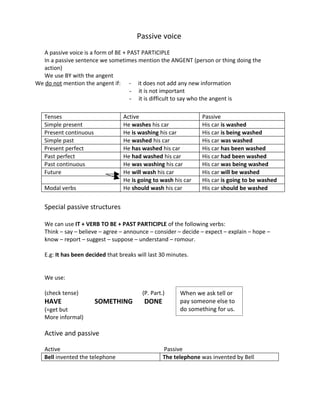
Passive voice
   A passive voice is a form of BE + PAST PARTICIPLE
   In a passive sentence we sometimes mention the ANGENT (person or thing doing the
   action)
   We use BY with the angent
We do not mention the angent if: - it does not add any new information
                                      - it is not important
                                      - it is difficult to say who the angent is

   Tenses                         Active                         Passive
   Simple present                 He washes his car              His car is washed
   Present continuous             He is washing his car          His car is being washed
   Simple past                    He washed his car              His car was washed
   Present perfect                He has washed his car          His car has been washed
   Past perfect                   He had washed his car          His car had been washed
   Past continuous                He was washing his car         His car was being washed
   Future                         He will wash his car           His car will be washed
                                  He is going to wash his car    His car is going to be washed
   Modal verbs                    He should wash his car         His car should be washed


   Special passive structures

   We can use IT + VERB TO BE + PAST PARTICIPLE of the following verbs:
   Think – say – believe – agree – announce – consider – decide – expect – explain – hope –
   know – report – suggest – suppose – understand – romour.

   E.g: It has been decided that breaks will last 30 minutes.


   We use:

   (check tense)                          (P. Part.)     When we ask tell or
   HAVE                 SOMETHING          DONE          pay someone else to
   (=get but                                             do something for us.
   More informal)

   Active and passive

   Active                                          Passive
   Bell invented the telephone                     The telephone was invented by Bell

Passive voice

  • 1.
    Passive voice A passive voice is a form of BE + PAST PARTICIPLE In a passive sentence we sometimes mention the ANGENT (person or thing doing the action) We use BY with the angent We do not mention the angent if: - it does not add any new information - it is not important - it is difficult to say who the angent is Tenses Active Passive Simple present He washes his car His car is washed Present continuous He is washing his car His car is being washed Simple past He washed his car His car was washed Present perfect He has washed his car His car has been washed Past perfect He had washed his car His car had been washed Past continuous He was washing his car His car was being washed Future He will wash his car His car will be washed He is going to wash his car His car is going to be washed Modal verbs He should wash his car His car should be washed Special passive structures We can use IT + VERB TO BE + PAST PARTICIPLE of the following verbs: Think – say – believe – agree – announce – consider – decide – expect – explain – hope – know – report – suggest – suppose – understand – romour. E.g: It has been decided that breaks will last 30 minutes. We use: (check tense) (P. Part.) When we ask tell or HAVE SOMETHING DONE pay someone else to (=get but do something for us. More informal) Active and passive Active Passive Bell invented the telephone The telephone was invented by Bell