


Michaelson Jasper P. Duyan, LPT
FOUNDATION OF SPECIAL AND
INCLUSIVE EDUCATION
(EDUC 103)
FOUNDATION OF SPECIAL AND
INCLUSIVE EDUCATION
(EDUC 103)
ST. JOHN PAUL II COLLEGE OF DAVAO
ECOLAND DRIVE, MATINA, DAVAO CITY
BE PREPARED CELL PHONE POLICY
HOUSE RULES :
BE ON TIME
Be on class at least
10 minutes
before class.
All your things
must be prepared
before joining the class.
Kindly place your cell
phone on silent mode
or vibrate mode.
ST. JOHN PAUL II COLLEGE OF DAVAO
HOUSE RULES :
DRESS APPROPRIATELY RAISE YOUR HAND LISTEN ATTENTIVELY
Wear something
comfortable but
presentable.
Raise your hand
when you have questions
and/or clarifications.
Especially when the
Teacher is discussing.
ST. JOHN PAUL II COLLEGE OF DAVAO
CHILDREN'S DISABILITIES AND
EXCEPTIONALITIES
Lesson Outcomes:
Define and distinguish the differences between speech and language
impairments, autism spectrum disorder, visual impairments, hearing
impairments, physical, intellectual, and learning disabilities, ADHD,
and exceptional brightness.
EDUC 103
CHILDREN'S DISABILITIES AND
EXCEPTIONALITIES
Lesson Outcomes:
Understand the impact of these conditions on individuals'
communication, social interactions, learning, and daily functioning.
Explore various strategies and accommodations to support
individuals with these conditions in educational and social settings.
Reflect on the importance of inclusive practices and empathy
towards individuals with diverse needs.
EDUC 103
CHILDREN'S DISABILITIES AND
EXCEPTIONALITIES
Lesson Outcomes:
Demonstrate awareness and sensitivity towards individuals with
speech and language impairments, autism spectrum disorder, visual
impairments, hearing impairments, physical, intellectual, and
learning disabilities, ADHD, and exceptional brightness in their
interactions and academic environments.
EDUC 103
CHILDREN'S
DISABILITIES AND
EXCEPTIONALITIES
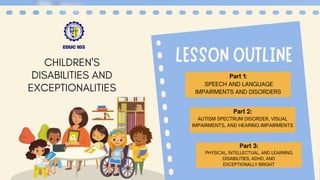
Part 1:
SPEECH AND LANGUAGE
IMPAIRMENTS AND DISORDERS
LESSON OUTLINE
EDUC 103
Part 2:
AUTISM SPECTRUM DISORDER, VISUAL
IMPAIRMENTS, AND HEARING IMPAIRMENTS
Part 3:
PHYSICAL, INTELLECTUAL, AND LEARNING
DISABILITIES, ADHD, AND
EXCEPTIONALLY BRIGHT
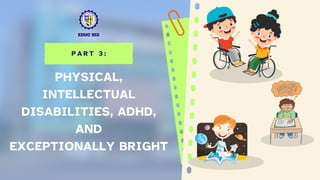
P A R T 3 :
PHYSICAL,
INTELLECTUAL
DISABILITIES, ADHD,
AND
EXCEPTIONALLY BRIGHT
EDUC 103
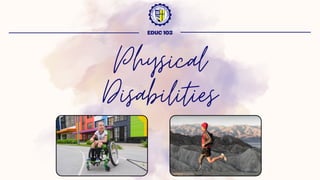
Physical
Disabilities
EDUC 103
Physical disability generally refers to someone's limitation to
perform basic physical activities (holding, walking, climbing,
lifting, carrying, etc.). These limitations limit the person's
capacity to do tasks necessary to live a normal life (Monroe
County Community College, 2010).
EDUC 103
Physical Disabilities
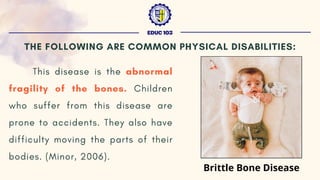
This disease is the abnormal
fragility of the bones. Children
who suffer from this disease are
prone to accidents. They also have
difficulty moving the parts of their
bodies. (Minor, 2006).
EDUC 103
THE FOLLOWING ARE COMMON PHYSICAL DISABILITIES:
Brittle Bone Disease
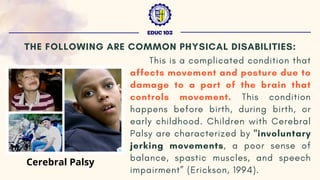
This is a complicated condition that
affects movement and posture due to
damage to a part of the brain that
controls movement. This condition
happens before birth, during birth, or
early childhood. Children with Cerebral
Palsy are characterized by "involuntary
jerking movements, a poor sense of
balance, spastic muscles, and speech
impairment” (Erickson, 1994).
EDUC 103
THE FOLLOWING ARE COMMON PHYSICAL DISABILITIES:
Cerebral Palsy
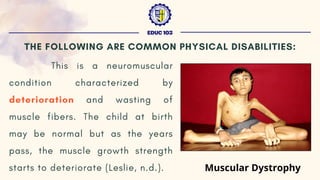
This is a neuromuscular
condition characterized by
deterioration and wasting of
muscle fibers. The child at birth
may be normal but as the years
pass, the muscle growth strength
starts to deteriorate (Leslie, n.d.).
EDUC 103
THE FOLLOWING ARE COMMON PHYSICAL DISABILITIES:
Muscular Dystrophy
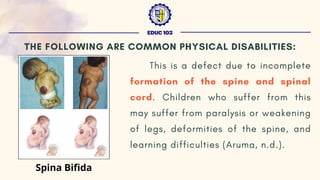
This is a defect due to incomplete
formation of the spine and spinal
cord. Children who suffer from this
may suffer from paralysis or weakening
of legs, deformities of the spine, and
learning difficulties (Aruma, n.d.).
EDUC 103
THE FOLLOWING ARE COMMON PHYSICAL DISABILITIES:
Spina Bifida
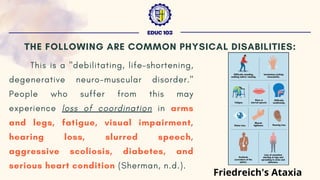
This is a "debilitating, life-shortening,
degenerative neuro-muscular disorder."
People who suffer from this may
experience loss of coordination in arms
and legs, fatigue, visual impairment,
hearing loss, slurred speech,
aggressive scoliosis, diabetes, and
serious heart condition (Sherman, n.d.).
EDUC 103
THE FOLLOWING ARE COMMON PHYSICAL DISABILITIES:
Friedreich's Ataxia
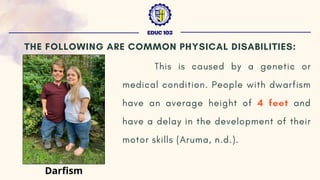
This is caused by a genetic or
medical condition. People with dwarfism
have an average height of 4 feet and
have a delay in the development of their
motor skills (Aruma, n.d.).
EDUC 103
THE FOLLOWING ARE COMMON PHYSICAL DISABILITIES:
Darfism
Monroe County Community College (2010) suggested the
following considerations that may be provided to children
with physical disabilities:
Make the classroom free from obstruction so that the child
can freely move and roam around;
1.
Provide a wheelchair or accessible chair, desk, or table;
2.
Consider the child's punctuality and attendance; give
extensions for tests and quizzes;
3.
Provide an exemption for tiring or heavy physical activities
or tasks; and
4.
Give tasks that the child can do or perform.
5.
EDUC 103
Intellectual Disability
EDUC 103
Intellectual Disability; once termed as Mental Retardation,
is characterized by poor or below-average intellectual capacity
towards communicating, learning, thinking, and communicating.
Children who suffer from intellectual disabilities have issues with
their adaptive behavior such as routines, social skills, and
personal hygiene:
EDUC 103
Intellectual Disability
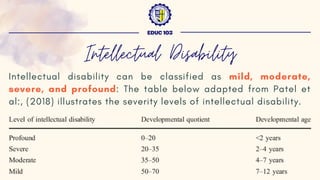
Intellectual disability can be classified as mild, moderate,
severe, and profound: The table below adapted from Patel et
al:, (2018) illustrates the severity levels of intellectual disability.
EDUC 103
Intellectual Disability
Attention-Deficit
Hyperactivity Disorder
EDUC 103
(ADHD)
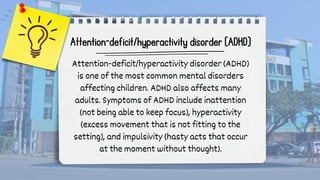
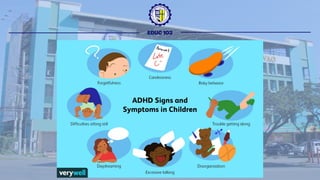
Attention-deficit/hyperactivity disorder (ADHD)
is one of the most common mental disorders
affecting children. ADHD also affects many
adults. Symptoms of ADHD include inattention
(not being able to keep focus), hyperactivity
(excess movement that is not fitting to the
setting), and impulsivity (hasty acts that occur
at the moment without thought).
EDUC 103
Symptoms and Diagnosis of
learners with
Attention-deficit/hyperactivity
disorder (ADHD)
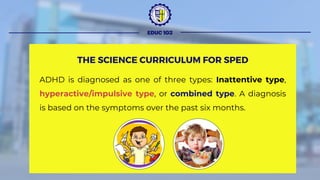
ADHD is diagnosed as one of three types: Inattentive type,
hyperactive/impulsive type, or combined type. A diagnosis
is based on the symptoms over the past six months.
EDUC 103
THE SCIENCE CURRICULUM FOR SPED
six (or five for people over 17
years) of the following
symptoms occur frequently:
INATTENTIVE TYPE
Does not pay close attention to details or make careless school or
job tasks.
Has problems staying focused on tasks or activities, such as
lectures, conversations, or extended reading.
Does not seem to listen when spoken to (i.e., seems to be
elsewhere).
Does not follow instructions and does not complete schoolwork,
chores, or job duties (may start tasks but quickly loses focus).
Has problems organizing tasks and work (for instance, does not
manage time well; has messy, disorganized work; misses deadlines).
EDUC 103
INATTENTIVE TYPE
Avoids or dislikes tasks that require sustained mental effort,
such as preparing reports and completing forms.
Often loses things needed for tasks or daily life, such as school
papers, books, keys, wallets, cell phones, and eyeglasses.
Is easily distracted.
Forget daily tasks, such as doing chores and running errands.
Older teens and adults may forget to return phone calls, pay
bills, and keep appointments.
EDUC 103
INATTENTIVE TYPE
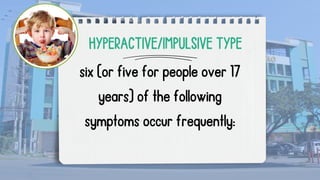
six (or five for people over 17
years) of the following
symptoms occur frequently:
HYPERACTIVE/IMPULSIVE TYPE
Fidgets with or taps hands or feet or squirms in seat.
Not able to stay seated (in classroom, workplace).
Runs about or climbs where it is inappropriate.
Unable to play or do leisure activities quietly.
Always “on the go,” as if driven by a motor.
Talks too much.
Blurts out an answer before a question has been finished (for
instance, may finish people’s sentences, cannot wait to speak in
conversations).
EDUC 103
HYPERACTIVE/IMPULSIVE TYPE
Has difficulty waiting for his or her turn, such as while waiting in line.
Interrupts or intrudes on others (for instance, cuts into
conversations, games, or activities, or starts using other people’s
things without permission). Older teens and adults may take over
what others are doing.
EDUC 103
HYPERACTIVE/IMPULSIVE TYPE
Exceptionally Bright
EDUC 103
Gadzikowski (2013) classified exceptionally bright children as
children "with advanced ability to use language, solve math
problems, or understand science concepts, or children who are
especially creative and seem to be able to make connections
between ideas that are not related."
The exceptionally bright children have already mastered
learning competencies in the advanced target timeline for their
age (Gadzikowski, 2013). In a general sense, they are smarter and
more advanced than normal children of their age.
EDUC 103
Exceptionally Bright
Correll (2019) gave twelve signs of a gifted child:
Learns fast
Has wide vocabulary
Too curious
Always wants to learn
Reads early
Can easily solve patterns or puzzles
Creative
Advanced reasoning skill
Energetic
EDUC 103
Can focus for a long period
Sensitive
Exceptionally high test results
In dealing with gifted children, teachers must do the following:
Familiarize themselves with the characteristics and behavior of
gifted children.
Assess and evaluate the child using standardized tests.
Challenge the child by giving him/her advanced activities.
Seek help from parents.
Immerse the child in a group of normal children.
Give the child the opportunity to think critically and creatively.
Provide independent learning for the child.
EDUC 103
EDUC 103
REFERENCE:
Boholano, D. B., Tizza Marie , D. M., Dr. Bernard Evangelicom
, J. V., & Cortes, D. M. (2024). Inclusive Education in Early
Childhood Settings. 10B Boston Street, Brgy. Kaunlaran,
Cubao Quezon City, Metro Manila, Philippines 1111: LORIMAR
PUBLISHING INC.
QUESTIONS?
THANK
YOU FOR
LISTENING
SPENE 100

(Part 3) CHILDREN'S DISABILITIES AND EXCEPTIONALITIES.pdf

  • 1.
    Michaelson Jasper P.Duyan, LPT FOUNDATION OF SPECIAL AND INCLUSIVE EDUCATION (EDUC 103) FOUNDATION OF SPECIAL AND INCLUSIVE EDUCATION (EDUC 103) ST. JOHN PAUL II COLLEGE OF DAVAO ST. JOHN PAUL II COLLEGE OF DAVAO ECOLAND DRIVE, MATINA, DAVAO CITY ECOLAND DRIVE, MATINA, DAVAO CITY
  • 2.
    BE PREPARED CELLPHONE POLICY HOUSE RULES : BE ON TIME Be on class at least 10 minutes before class. All your things must be prepared before joining the class. Kindly place your cell phone on silent mode or vibrate mode. ST. JOHN PAUL II COLLEGE OF DAVAO ST. JOHN PAUL II COLLEGE OF DAVAO
  • 3.
    HOUSE RULES : DRESSAPPROPRIATELY RAISE YOUR HAND LISTEN ATTENTIVELY Wear something comfortable but presentable. Raise your hand when you have questions and/or clarifications. Especially when the Teacher is discussing. ST. JOHN PAUL II COLLEGE OF DAVAO ST. JOHN PAUL II COLLEGE OF DAVAO
  • 4.
    ST. JOHN PAULII COLLEGE OF DAVAO ST. JOHN PAUL II COLLEGE OF DAVAO
  • 5.
    CHILDREN'S DISABILITIES AND EXCEPTIONALITIES LessonOutcomes: Define and distinguish the differences between speech and language impairments, autism spectrum disorder, visual impairments, hearing impairments, physical, intellectual, and learning disabilities, ADHD, and exceptional brightness. EDUC 103
  • 6.
    CHILDREN'S DISABILITIES AND EXCEPTIONALITIES LessonOutcomes: Understand the impact of these conditions on individuals' communication, social interactions, learning, and daily functioning. Explore various strategies and accommodations to support individuals with these conditions in educational and social settings. Reflect on the importance of inclusive practices and empathy towards individuals with diverse needs. EDUC 103
  • 7.
    CHILDREN'S DISABILITIES AND EXCEPTIONALITIES LessonOutcomes: Demonstrate awareness and sensitivity towards individuals with speech and language impairments, autism spectrum disorder, visual impairments, hearing impairments, physical, intellectual, and learning disabilities, ADHD, and exceptional brightness in their interactions and academic environments. EDUC 103
  • 8.
    CHILDREN'S DISABILITIES AND EXCEPTIONALITIES Part 1: SPEECHAND LANGUAGE IMPAIRMENTS AND DISORDERS LESSON OUTLINE EDUC 103 Part 2: AUTISM SPECTRUM DISORDER, VISUAL IMPAIRMENTS, AND HEARING IMPAIRMENTS Part 3: PHYSICAL, INTELLECTUAL, AND LEARNING DISABILITIES, ADHD, AND EXCEPTIONALLY BRIGHT
  • 9.
    P A RT 3 : PHYSICAL, INTELLECTUAL DISABILITIES, ADHD, AND EXCEPTIONALLY BRIGHT EDUC 103
  • 10.
  • 11.
    Physical disability generallyrefers to someone's limitation to perform basic physical activities (holding, walking, climbing, lifting, carrying, etc.). These limitations limit the person's capacity to do tasks necessary to live a normal life (Monroe County Community College, 2010). EDUC 103 Physical Disabilities
  • 12.
    This disease isthe abnormal fragility of the bones. Children who suffer from this disease are prone to accidents. They also have difficulty moving the parts of their bodies. (Minor, 2006). EDUC 103 THE FOLLOWING ARE COMMON PHYSICAL DISABILITIES: Brittle Bone Disease
  • 13.
    This is acomplicated condition that affects movement and posture due to damage to a part of the brain that controls movement. This condition happens before birth, during birth, or early childhood. Children with Cerebral Palsy are characterized by "involuntary jerking movements, a poor sense of balance, spastic muscles, and speech impairment” (Erickson, 1994). EDUC 103 THE FOLLOWING ARE COMMON PHYSICAL DISABILITIES: Cerebral Palsy
  • 14.
    This is aneuromuscular condition characterized by deterioration and wasting of muscle fibers. The child at birth may be normal but as the years pass, the muscle growth strength starts to deteriorate (Leslie, n.d.). EDUC 103 THE FOLLOWING ARE COMMON PHYSICAL DISABILITIES: Muscular Dystrophy
  • 15.
    This is adefect due to incomplete formation of the spine and spinal cord. Children who suffer from this may suffer from paralysis or weakening of legs, deformities of the spine, and learning difficulties (Aruma, n.d.). EDUC 103 THE FOLLOWING ARE COMMON PHYSICAL DISABILITIES: Spina Bifida
  • 16.
    This is a"debilitating, life-shortening, degenerative neuro-muscular disorder." People who suffer from this may experience loss of coordination in arms and legs, fatigue, visual impairment, hearing loss, slurred speech, aggressive scoliosis, diabetes, and serious heart condition (Sherman, n.d.). EDUC 103 THE FOLLOWING ARE COMMON PHYSICAL DISABILITIES: Friedreich's Ataxia
  • 17.
    This is causedby a genetic or medical condition. People with dwarfism have an average height of 4 feet and have a delay in the development of their motor skills (Aruma, n.d.). EDUC 103 THE FOLLOWING ARE COMMON PHYSICAL DISABILITIES: Darfism
  • 18.
    Monroe County CommunityCollege (2010) suggested the following considerations that may be provided to children with physical disabilities: Make the classroom free from obstruction so that the child can freely move and roam around; 1. Provide a wheelchair or accessible chair, desk, or table; 2. Consider the child's punctuality and attendance; give extensions for tests and quizzes; 3. Provide an exemption for tiring or heavy physical activities or tasks; and 4. Give tasks that the child can do or perform. 5. EDUC 103
  • 19.
  • 20.
    Intellectual Disability; oncetermed as Mental Retardation, is characterized by poor or below-average intellectual capacity towards communicating, learning, thinking, and communicating. Children who suffer from intellectual disabilities have issues with their adaptive behavior such as routines, social skills, and personal hygiene: EDUC 103 Intellectual Disability
  • 21.
    Intellectual disability canbe classified as mild, moderate, severe, and profound: The table below adapted from Patel et al:, (2018) illustrates the severity levels of intellectual disability. EDUC 103 Intellectual Disability
  • 22.
  • 23.
    Attention-deficit/hyperactivity disorder (ADHD) Attention-deficit/hyperactivitydisorder (ADHD) is one of the most common mental disorders affecting children. ADHD also affects many adults. Symptoms of ADHD include inattention (not being able to keep focus), hyperactivity (excess movement that is not fitting to the setting), and impulsivity (hasty acts that occur at the moment without thought).
  • 24.
  • 25.
    Symptoms and Diagnosisof learners with Attention-deficit/hyperactivity disorder (ADHD)
  • 26.
    ADHD is diagnosedas one of three types: Inattentive type, hyperactive/impulsive type, or combined type. A diagnosis is based on the symptoms over the past six months. EDUC 103 THE SCIENCE CURRICULUM FOR SPED
  • 27.
    six (or fivefor people over 17 years) of the following symptoms occur frequently: INATTENTIVE TYPE
  • 28.
    Does not payclose attention to details or make careless school or job tasks. Has problems staying focused on tasks or activities, such as lectures, conversations, or extended reading. Does not seem to listen when spoken to (i.e., seems to be elsewhere). Does not follow instructions and does not complete schoolwork, chores, or job duties (may start tasks but quickly loses focus). Has problems organizing tasks and work (for instance, does not manage time well; has messy, disorganized work; misses deadlines). EDUC 103 INATTENTIVE TYPE
  • 29.
    Avoids or dislikestasks that require sustained mental effort, such as preparing reports and completing forms. Often loses things needed for tasks or daily life, such as school papers, books, keys, wallets, cell phones, and eyeglasses. Is easily distracted. Forget daily tasks, such as doing chores and running errands. Older teens and adults may forget to return phone calls, pay bills, and keep appointments. EDUC 103 INATTENTIVE TYPE
  • 30.
    six (or fivefor people over 17 years) of the following symptoms occur frequently: HYPERACTIVE/IMPULSIVE TYPE
  • 31.
    Fidgets with ortaps hands or feet or squirms in seat. Not able to stay seated (in classroom, workplace). Runs about or climbs where it is inappropriate. Unable to play or do leisure activities quietly. Always “on the go,” as if driven by a motor. Talks too much. Blurts out an answer before a question has been finished (for instance, may finish people’s sentences, cannot wait to speak in conversations). EDUC 103 HYPERACTIVE/IMPULSIVE TYPE
  • 32.
    Has difficulty waitingfor his or her turn, such as while waiting in line. Interrupts or intrudes on others (for instance, cuts into conversations, games, or activities, or starts using other people’s things without permission). Older teens and adults may take over what others are doing. EDUC 103 HYPERACTIVE/IMPULSIVE TYPE
  • 33.
  • 34.
    Gadzikowski (2013) classifiedexceptionally bright children as children "with advanced ability to use language, solve math problems, or understand science concepts, or children who are especially creative and seem to be able to make connections between ideas that are not related." The exceptionally bright children have already mastered learning competencies in the advanced target timeline for their age (Gadzikowski, 2013). In a general sense, they are smarter and more advanced than normal children of their age. EDUC 103 Exceptionally Bright
  • 35.
    Correll (2019) gavetwelve signs of a gifted child: Learns fast Has wide vocabulary Too curious Always wants to learn Reads early Can easily solve patterns or puzzles Creative Advanced reasoning skill Energetic EDUC 103 Can focus for a long period Sensitive Exceptionally high test results
  • 36.
    In dealing withgifted children, teachers must do the following: Familiarize themselves with the characteristics and behavior of gifted children. Assess and evaluate the child using standardized tests. Challenge the child by giving him/her advanced activities. Seek help from parents. Immerse the child in a group of normal children. Give the child the opportunity to think critically and creatively. Provide independent learning for the child. EDUC 103
  • 37.
    EDUC 103 REFERENCE: Boholano, D.B., Tizza Marie , D. M., Dr. Bernard Evangelicom , J. V., & Cortes, D. M. (2024). Inclusive Education in Early Childhood Settings. 10B Boston Street, Brgy. Kaunlaran, Cubao Quezon City, Metro Manila, Philippines 1111: LORIMAR PUBLISHING INC.
  • 38.
  • 39.