NADAR SARASWATHI COLLEGE
OF ARTS AND SCIENCE
By
M.PrathiYat
hi
I M.Sc(CS)
Introduction to
Parse Trees and
Syntax Trees
Parse trees and syntax trees are fundamental data structures used in
computer science for analyzing and representing the grammatical
structure of sentences and code. They provide a visual and hierarchical
representation of how language is structured.
What is a Parse Tree?
Definition
A parse tree is a tree-like structure
that represents the grammatical
structure of a sentence or a code
snippet according to a formal
grammar.
Purpose
Parse trees are used in parsing, a
process of analyzing a string of
symbols to determine its grammatical
structure.
Key Features
Nodes represent grammatical units,
and edges represent the hierarchical
relationships between them.
What is a Syntax Tree?
Definition
A syntax tree is a tree-like
structure that represents the
syntactic structure of a code
snippet according to a
programming language's
grammar.
Purpose
Syntax trees are used in
compilers and interpreters to
analyze and understand the
structure of programs.
Key Features
Nodes represent the syntactic elements of the program, and edges
represent the hierarchical relationships between them.
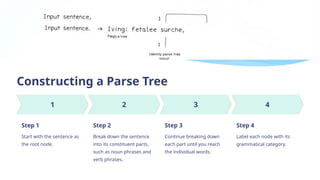
Constructing a Parse Tree
Step 1
Start with the sentence as
the root node.
Step 2
Break down the sentence
into its constituent parts,
such as noun phrases and
verb phrases.
Step 3
Continue breaking down
each part until you reach
the individual words.
Step 4
Label each node with its
grammatical category.
Constructing a Syntax
Tree
1 Step 1
Begin with the individual
lexical tokens, such as
variables, operators, and
constants.
2 Step 2
Combine the tokens
according to the grammar
rules, forming larger
syntactic units.
3 Step 3
Continue combining units
until you reach the root
node, representing the
entire code snippet.
4 Step 4
Label each node with its
type, such as variable,
operator, or expression.
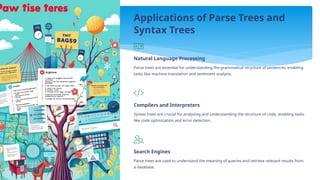
Applications of Parse Trees and
Syntax Trees
Natural Language Processing
Parse trees are essential for understanding the grammatical structure of sentences, enabling
tasks like machine translation and sentiment analysis.
Compilers and Interpreters
Syntax trees are crucial for analyzing and understanding the structure of code, enabling tasks
like code optimization and error detection.
Search Engines
Parse trees are used to understand the meaning of queries and retrieve relevant results from
a database.
Conclusion and Key
Takeaways
1 Parse Trees
Analyze the grammatical structure of sentences, essential for
natural language processing tasks.
2 Syntax Trees
Represent the syntactic structure of code, crucial for compilers
and interpreters.
3 Applications
Parse trees and syntax trees are widely used in computer
science, enabling tasks like machine translation, code
optimization, and search engines.
Three Address
Code: An Overview
Three address code (TAC) is a fundamental concept in compiler design.
It's a low-level intermediate representation (IR) of code, used to simplify
program analysis and optimization before machine code generation.
Advantages of Three Address
Code
1 Simplified Analysis
TAC's linear structure simplifies
data flow and control flow
analysis, aiding in optimization
and code generation.
2 Enhanced Readability
TAC's clear and concise
representation makes it easier
for humans to understand the
program logic and identify
potential issues.
3 Machine-Independent
TAC is independent of the target
machine's architecture, making it
versatile and portable across
different platforms.
4 Optimization
Foundation
TAC provides a solid base for
various code optimization
techniques, including constant
propagation and dead code
elimination.
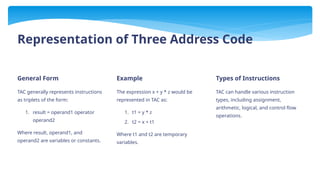
Representation of Three Address Code
General Form
TAC generally represents instructions
as triplets of the form:
1. result = operand1 operator
operand2
Where result, operand1, and
operand2 are variables or constants.
Example
The expression x + y * z would be
represented in TAC as:
1. t1 = y * z
2. t2 = x + t1
Where t1 and t2 are temporary
variables.
Types of Instructions
TAC can handle various instruction
types, including assignment,
arithmetic, logical, and control flow
operations.
Quadrupled Three Address
Code
Operator Operand 1 Operand 2 Result
+= x 5 x
* y z t1
= t1 None result
Benefits of Quadrupled
Three Address Code
Structured
Representation
Quadruples offer a structured
representation of TAC, making it
easier to analyze and manipulate
the code during optimization.
Efficient Optimization
The clear separation of operands
and results in quadruples allows
for efficient application of
various optimization techniques.
Code Generation Simplification
The organized structure of quadruples simplifies the process of
generating machine code from the intermediate representation.
Triples Three Address Code
Compact Representation
Triples use a compact representation, storing only the essential
information for each instruction, minimizing storage
requirements.
Implicit Information
Some information, like the operator, might be implicitly
understood from the context, reducing redundancy and
simplifying the representation.
Efficient Storage
The compact structure of triples can lead to efficient storage
utilization and faster access to individual instructions.
Advantages of Triples Three
Address Code
Compactness
Triples provide a space-efficient representation, reducing memory overhead and improving
performance.
Efficiency
The compact structure allows for faster processing and manipulation during code
optimization and generation.
Simplification
Triples can simplify certain optimization techniques by providing a clear and concise
representation of the code.
THANK YOU

Parse, syntax tree three adresscode. Ppt

  • 1.
    NADAR SARASWATHI COLLEGE OFARTS AND SCIENCE By M.PrathiYat hi I M.Sc(CS)
  • 2.
    Introduction to Parse Treesand Syntax Trees Parse trees and syntax trees are fundamental data structures used in computer science for analyzing and representing the grammatical structure of sentences and code. They provide a visual and hierarchical representation of how language is structured.
  • 3.
    What is aParse Tree? Definition A parse tree is a tree-like structure that represents the grammatical structure of a sentence or a code snippet according to a formal grammar. Purpose Parse trees are used in parsing, a process of analyzing a string of symbols to determine its grammatical structure. Key Features Nodes represent grammatical units, and edges represent the hierarchical relationships between them.
  • 4.
    What is aSyntax Tree? Definition A syntax tree is a tree-like structure that represents the syntactic structure of a code snippet according to a programming language's grammar. Purpose Syntax trees are used in compilers and interpreters to analyze and understand the structure of programs. Key Features Nodes represent the syntactic elements of the program, and edges represent the hierarchical relationships between them.
  • 5.
    Constructing a ParseTree Step 1 Start with the sentence as the root node. Step 2 Break down the sentence into its constituent parts, such as noun phrases and verb phrases. Step 3 Continue breaking down each part until you reach the individual words. Step 4 Label each node with its grammatical category.
  • 6.
    Constructing a Syntax Tree 1Step 1 Begin with the individual lexical tokens, such as variables, operators, and constants. 2 Step 2 Combine the tokens according to the grammar rules, forming larger syntactic units. 3 Step 3 Continue combining units until you reach the root node, representing the entire code snippet. 4 Step 4 Label each node with its type, such as variable, operator, or expression.
  • 7.
    Applications of ParseTrees and Syntax Trees Natural Language Processing Parse trees are essential for understanding the grammatical structure of sentences, enabling tasks like machine translation and sentiment analysis. Compilers and Interpreters Syntax trees are crucial for analyzing and understanding the structure of code, enabling tasks like code optimization and error detection. Search Engines Parse trees are used to understand the meaning of queries and retrieve relevant results from a database.
  • 8.
    Conclusion and Key Takeaways 1Parse Trees Analyze the grammatical structure of sentences, essential for natural language processing tasks. 2 Syntax Trees Represent the syntactic structure of code, crucial for compilers and interpreters. 3 Applications Parse trees and syntax trees are widely used in computer science, enabling tasks like machine translation, code optimization, and search engines.
  • 9.
    Three Address Code: AnOverview Three address code (TAC) is a fundamental concept in compiler design. It's a low-level intermediate representation (IR) of code, used to simplify program analysis and optimization before machine code generation.
  • 10.
    Advantages of ThreeAddress Code 1 Simplified Analysis TAC's linear structure simplifies data flow and control flow analysis, aiding in optimization and code generation. 2 Enhanced Readability TAC's clear and concise representation makes it easier for humans to understand the program logic and identify potential issues. 3 Machine-Independent TAC is independent of the target machine's architecture, making it versatile and portable across different platforms. 4 Optimization Foundation TAC provides a solid base for various code optimization techniques, including constant propagation and dead code elimination.
  • 11.
    Representation of ThreeAddress Code General Form TAC generally represents instructions as triplets of the form: 1. result = operand1 operator operand2 Where result, operand1, and operand2 are variables or constants. Example The expression x + y * z would be represented in TAC as: 1. t1 = y * z 2. t2 = x + t1 Where t1 and t2 are temporary variables. Types of Instructions TAC can handle various instruction types, including assignment, arithmetic, logical, and control flow operations.
  • 12.
    Quadrupled Three Address Code OperatorOperand 1 Operand 2 Result += x 5 x * y z t1 = t1 None result
  • 13.
    Benefits of Quadrupled ThreeAddress Code Structured Representation Quadruples offer a structured representation of TAC, making it easier to analyze and manipulate the code during optimization. Efficient Optimization The clear separation of operands and results in quadruples allows for efficient application of various optimization techniques. Code Generation Simplification The organized structure of quadruples simplifies the process of generating machine code from the intermediate representation.
  • 14.
    Triples Three AddressCode Compact Representation Triples use a compact representation, storing only the essential information for each instruction, minimizing storage requirements. Implicit Information Some information, like the operator, might be implicitly understood from the context, reducing redundancy and simplifying the representation. Efficient Storage The compact structure of triples can lead to efficient storage utilization and faster access to individual instructions.
  • 15.
    Advantages of TriplesThree Address Code Compactness Triples provide a space-efficient representation, reducing memory overhead and improving performance. Efficiency The compact structure allows for faster processing and manipulation during code optimization and generation. Simplification Triples can simplify certain optimization techniques by providing a clear and concise representation of the code.
  • 16.