Introduction to
Parse Trees and
Syntax Trees
Parse trees and syntax trees are fundamental data structures used in
computer science for analyzing and representing the grammatical
structure of sentences and code. They provide a visual and hierarchical
representation of how language is structured.
by Prathiyathi M
What is a Parse Tree?
Definition
A parse tree is a tree-like structure
that represents the grammatical
structure of a sentence or a code
snippet according to a formal
grammar.
Purpose
Parse trees are used in parsing, a
process of analyzing a string of
symbols to determine its grammatical
structure.
Key Features
Nodes represent grammatical units,
and edges represent the hierarchical
relationships between them.
What is a Syntax Tree?
Definition
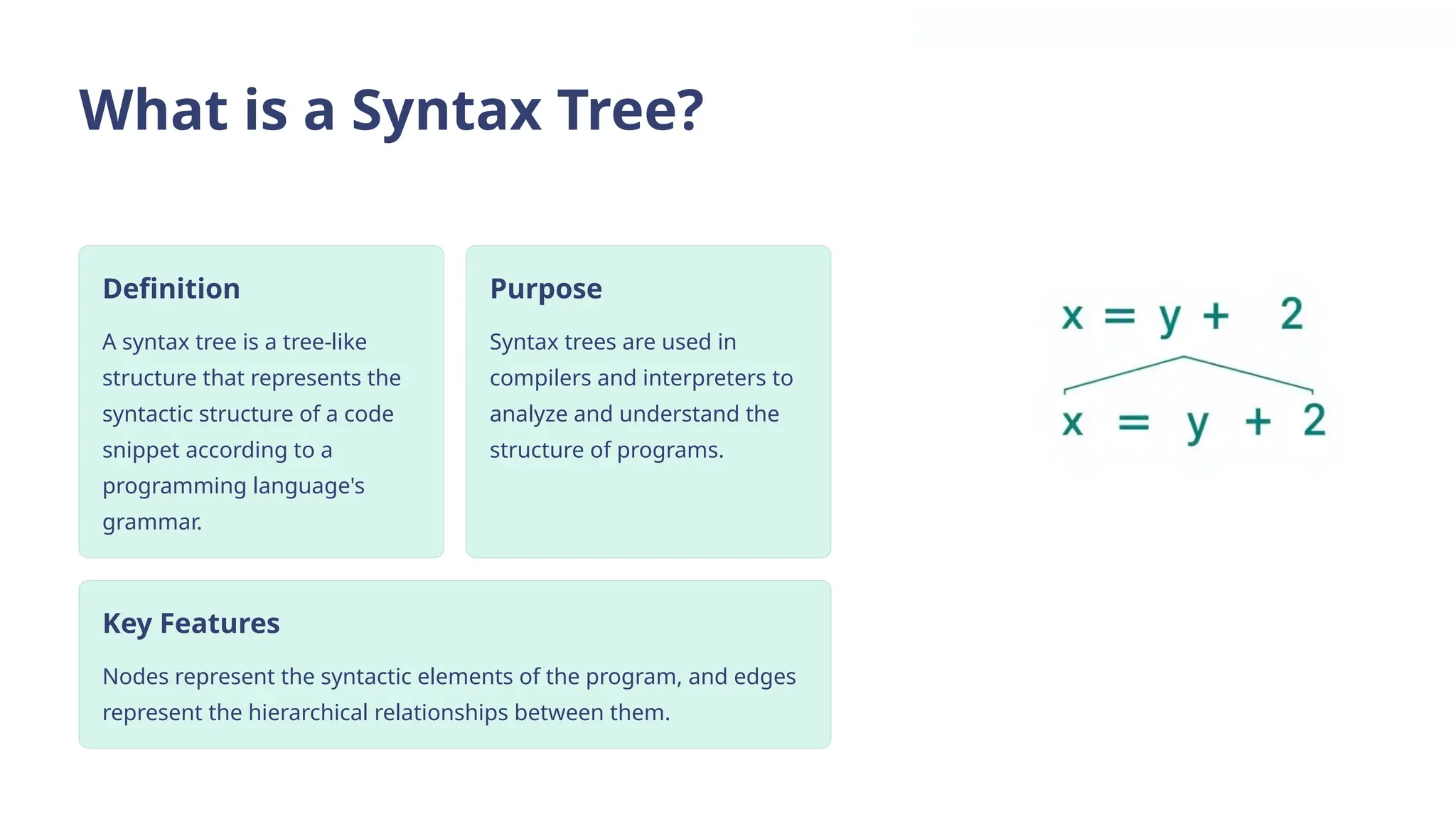
A syntax tree is a tree-like
structure that represents the
syntactic structure of a code
snippet according to a
programming language's
grammar.
Purpose
Syntax trees are used in
compilers and interpreters to
analyze and understand the
structure of programs.
Key Features
Nodes represent the syntactic elements of the program, and edges
represent the hierarchical relationships between them.
Differences between Parse Trees and Syntax Trees
Feature Parse Tree Syntax Tree
Focus Grammatical structure of sentences Syntactic structure of code
Grammar Natural language grammar Programming language grammar
Nodes Grammatical units (e.g., noun phrase,
verb phrase)
Syntactic elements (e.g., variables,
operators)
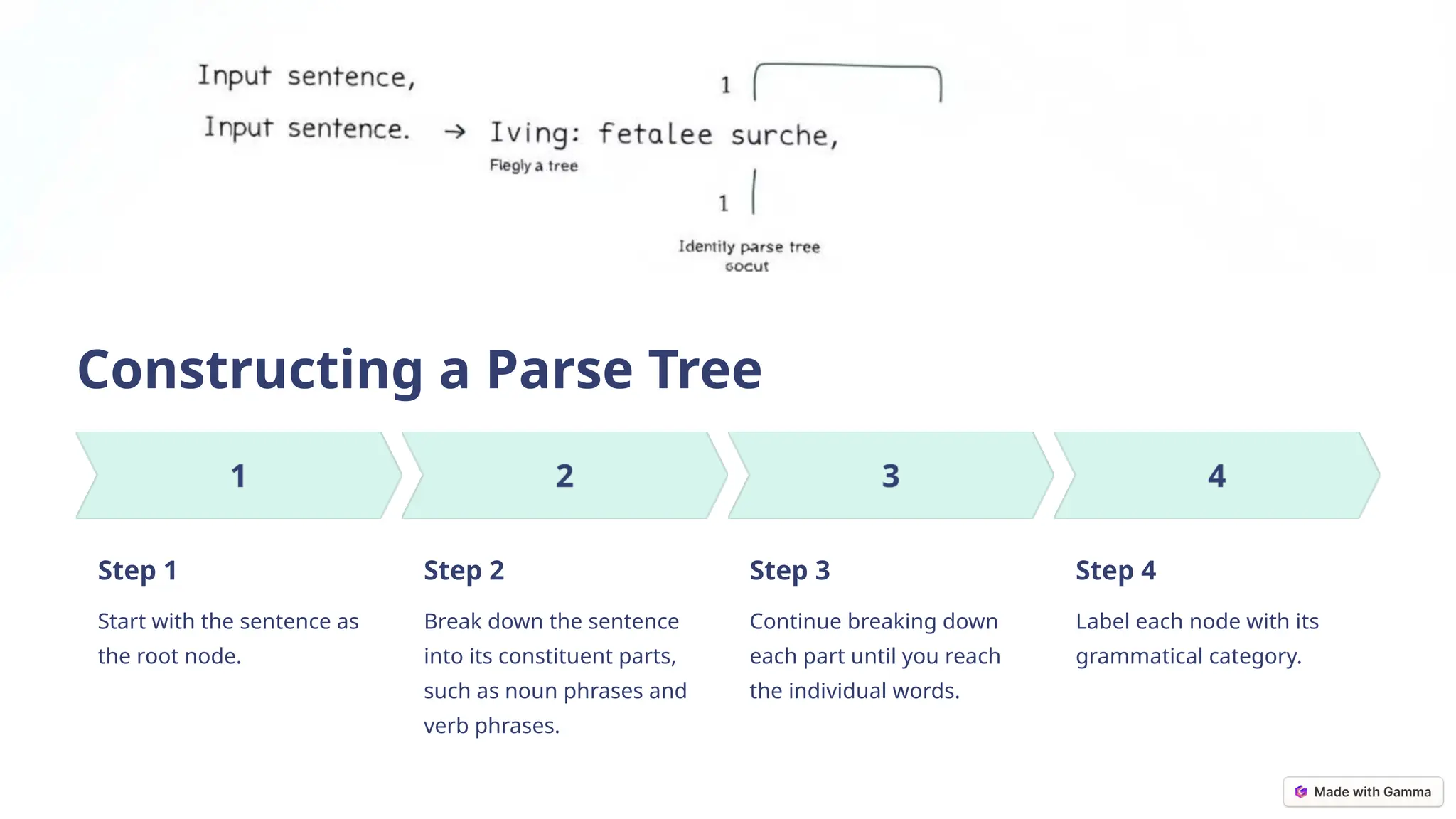
Constructing a Parse Tree
Step 1
Start with the sentence as
the root node.
Step 2
Break down the sentence
into its constituent parts,
such as noun phrases and
verb phrases.
Step 3
Continue breaking down
each part until you reach
the individual words.
Step 4
Label each node with its
grammatical category.
Constructing a Syntax
Tree
1 Step 1
Begin with the individual
lexical tokens, such as
variables, operators, and
constants.
2 Step 2
Combine the tokens
according to the grammar
rules, forming larger
syntactic units.
3 Step 3
Continue combining units
until you reach the root
node, representing the
entire code snippet.
4 Step 4
Label each node with its
type, such as variable,
operator, or expression.
Applications of Parse Trees and
Syntax Trees
Natural Language Processing
Parse trees are essential for understanding the grammatical structure of sentences, enabling
tasks like machine translation and sentiment analysis.
Compilers and Interpreters
Syntax trees are crucial for analyzing and understanding the structure of code, enabling tasks
like code optimization and error detection.
Search Engines
Parse trees are used to understand the meaning of queries and retrieve relevant results from
a database.
Conclusion and Key
Takeaways
1 Parse Trees
Analyze the grammatical structure of sentences, essential for
natural language processing tasks.
2 Syntax Trees
Represent the syntactic structure of code, crucial for compilers
and interpreters.
3 Applications
Parse trees and syntax trees are widely used in computer
science, enabling tasks like machine translation, code
optimization, and search engines.

Copy-of-Introduction-to-Parse-Trees-and-Syntax-Trees.pptx

  • 1.
    Introduction to Parse Treesand Syntax Trees Parse trees and syntax trees are fundamental data structures used in computer science for analyzing and representing the grammatical structure of sentences and code. They provide a visual and hierarchical representation of how language is structured. by Prathiyathi M
  • 2.
    What is aParse Tree? Definition A parse tree is a tree-like structure that represents the grammatical structure of a sentence or a code snippet according to a formal grammar. Purpose Parse trees are used in parsing, a process of analyzing a string of symbols to determine its grammatical structure. Key Features Nodes represent grammatical units, and edges represent the hierarchical relationships between them.
  • 3.
    What is aSyntax Tree? Definition A syntax tree is a tree-like structure that represents the syntactic structure of a code snippet according to a programming language's grammar. Purpose Syntax trees are used in compilers and interpreters to analyze and understand the structure of programs. Key Features Nodes represent the syntactic elements of the program, and edges represent the hierarchical relationships between them.
  • 4.
    Differences between ParseTrees and Syntax Trees Feature Parse Tree Syntax Tree Focus Grammatical structure of sentences Syntactic structure of code Grammar Natural language grammar Programming language grammar Nodes Grammatical units (e.g., noun phrase, verb phrase) Syntactic elements (e.g., variables, operators)
  • 5.
    Constructing a ParseTree Step 1 Start with the sentence as the root node. Step 2 Break down the sentence into its constituent parts, such as noun phrases and verb phrases. Step 3 Continue breaking down each part until you reach the individual words. Step 4 Label each node with its grammatical category.
  • 6.
    Constructing a Syntax Tree 1Step 1 Begin with the individual lexical tokens, such as variables, operators, and constants. 2 Step 2 Combine the tokens according to the grammar rules, forming larger syntactic units. 3 Step 3 Continue combining units until you reach the root node, representing the entire code snippet. 4 Step 4 Label each node with its type, such as variable, operator, or expression.
  • 7.
    Applications of ParseTrees and Syntax Trees Natural Language Processing Parse trees are essential for understanding the grammatical structure of sentences, enabling tasks like machine translation and sentiment analysis. Compilers and Interpreters Syntax trees are crucial for analyzing and understanding the structure of code, enabling tasks like code optimization and error detection. Search Engines Parse trees are used to understand the meaning of queries and retrieve relevant results from a database.
  • 8.
    Conclusion and Key Takeaways 1Parse Trees Analyze the grammatical structure of sentences, essential for natural language processing tasks. 2 Syntax Trees Represent the syntactic structure of code, crucial for compilers and interpreters. 3 Applications Parse trees and syntax trees are widely used in computer science, enabling tasks like machine translation, code optimization, and search engines.