www.atlanticgateway.co.uk
The Landscape for Prosperity
REGEN 2015, Liverpool
www.atlanticgateway.co.uk
1.
Accelerating Growth
www.atlanticgateway.co.uk
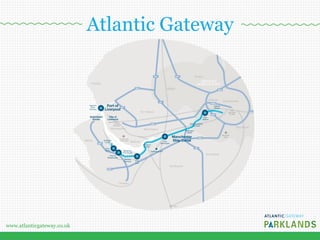
Atlantic Gateway
www.atlanticgateway.co.uk
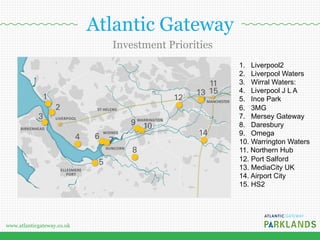
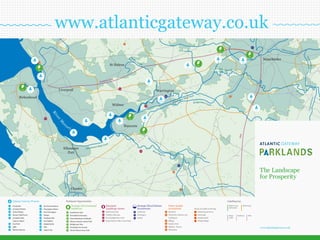
Atlantic Gateway
Investment Priorities
1. Liverpool2
2. Liverpool Waters
3. Wirral Waters:
4. Liverpool J L A
5. Ince Park
6. 3MG
7. Mersey Gateway
8. Daresbury
9. Omega
10. Warrington Waters
11. Northern Hub
12. Port Salford
13. MediaCity UK
14. Airport City
15. HS2
www.atlanticgateway.co.uk
2.
Landscape for Prosperity
www.atlanticgateway.co.uk
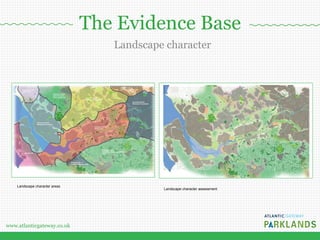
Landscape character assessment
Landscape character areas
Landscape character
The Evidence Base
www.atlanticgateway.co.uk
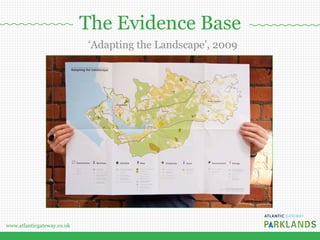
‘Adapting the Landscape’, 2009
The Evidence Base
www.atlanticgateway.co.uk
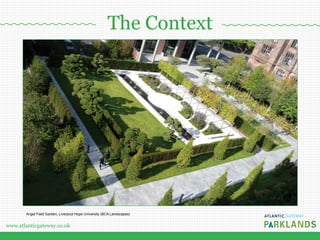
Angel Field Garden, Liverpool Hope University (BCA Landscapes)
The Context
www.atlanticgateway.co.uk
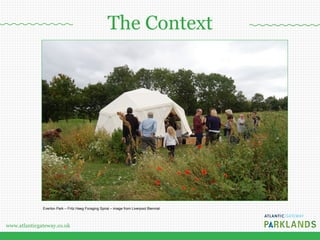
The Context
Everton Park – Fritz Haeg Foraging Spiral – image from Liverpool Biennial
www.atlanticgateway.co.uk
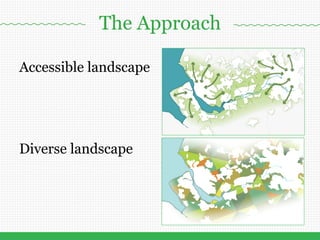
Accessible landscape
Diverse landscape
The Approach
www.atlanticgateway.co.uk
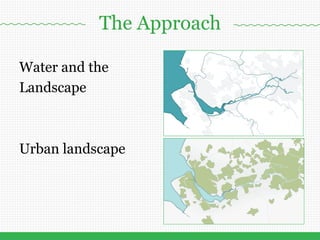
Water and the
Landscape
Urban landscape
The Approach
www.atlanticgateway.co.uk
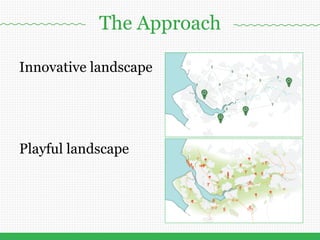
Innovative landscape
Playful landscape
The Approach
www.atlanticgateway.co.uk
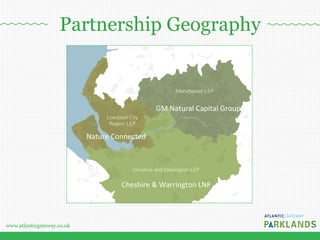
Partnership Geography
Nature'Connected''
GM'Natural'Capital'Group''
Cheshire'&'Warrington'LNP'
www.atlanticgateway.co.uk
3.
‘PLACE’ Projects
www.atlanticgateway.co.uk
Parklands PLACE
www.farrellreview.co.uk
www.atlanticgateway.co.uk
Turn up
the signal,
wipe out
the noise
www.atlanticgateway.co.uk
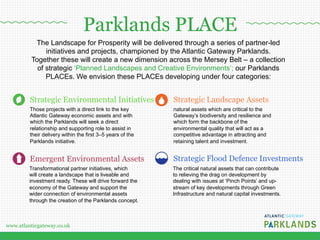
The Landscape for Prosperity will be delivered through a series of partner-led
initiatives and projects, championed by the Atlantic Gateway Parklands.
Together these will create a new dimension across the Mersey Belt – a collection
of strategic ‘Planned Landscapes and Creative Environments’; our Parklands
PLACEs. We envision these PLACEs developing under four categories:
Strategic Environmental Initiatives
Those projects with a direct link to the key
Atlantic Gateway economic assets and with
which the Parklands will seek a direct
relationship and supporting role to assist in
their delivery within the first 3–5 years of the
Parklands initiative.
Emergent Environmental Assets
Transformational partner initiatives, which
will create a landscape that is liveable and
investment ready. These will drive forward the
economy of the Gateway and support the
wider connection of environmental assets
through the creation of the Parklands concept.
natural assets which are critical to the
Gateway’s biodiversity and resilience and
which form the backbone of the
environmental quality that will act as a
competitive advantage in attracting and
retaining talent and investment.
Strategic Flood Defence Investments
Strategic Landscape Assets
The critical natural assets that can contribute
to relieving the drag on development by
dealing with issues at ‘Pinch Points’ and up-
stream of key developments through Green
Infrastructure and natural capital investments.
Parklands PLACE
www.atlanticgateway.co.uk
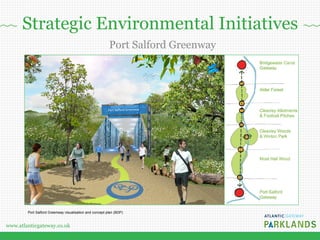
Port Salford Greenway visualisation and concept plan (BDP)
Port Salford Greenway
Strategic Environmental Initiatives
www.atlanticgateway.co.uk
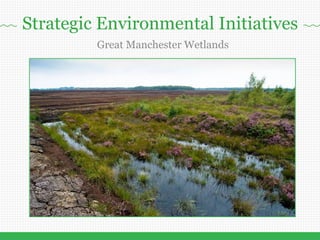
Great Manchester Wetlands
Strategic Environmental Initiatives
www.atlanticgateway.co.uk
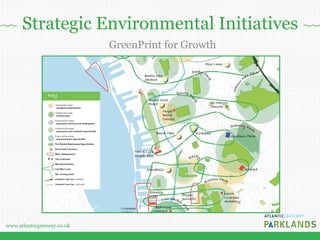
GreenPrint for Growth
Strategic Environmental Initiatives
www.atlanticgateway.co.uk
Wirral Waters Green Grid
Strategic Environment Initiatives
Town & Country Planning February 2015 77
this in the North End of Birkenhead. Ilchester Park
itself was never considered a park until 2014 – it has
only recently been adopted as a park by the local
authority. Before that, it was simply a neglected
green space in the middle of a windswept housing
estate that had seen better days.Ann McLachlan,
the local ward councillor and Deputy Leader of
Wirral Council, explains how much has changed:
‘Ten years ago, when I became a councillor, [the
park] had tenement buildings on it. It had a pub
known as the ‘Blood Tub’ (it was called the New
After a morning of unseasonal squalls, the sun
has broken through at Ilchester Park. Children are
gathering in a giant tipi in which African drummers
are ramping up the party mood. Others are preparing
costumes for a street parade. An avenue of young
silver birch trees has been yarn-bombed in bright
colours. Below them there are clusters of wild
flowers planted by local children.
It might sound like a typical August Bank Holiday
community festival in many parts of Britain. But
until recently nobody would have imagined doing
planting a sense
of pride
Julian Dobson looks at how the inclusion of green infrastructure
within regeneration activity in Birkenhead andWirralWaters has
improved local environments and helped to lay the ground
for further investment
Above
Fun for all – children queue up for the climbing wall at a community event in Ilchester Park
McCoyWynne
Dock Inn), and the old tenement style courtyard
was known as the ‘Bull Ring’. It was a rough,
tough area. But people from the North End live
in the North End, stay in the North End; their
families live here.’
In recent years a series of housing upgrades by
Magenta Living, the largest social landlord in the
borough, have provided new external cladding and
energy-saving improvements. Homes deemed unfit
or unsuitable have been demolished. A private
developer, Keepmoat, is starting to build homes for
sale on the demolition sites. But housing has not
been the only change. Ilchester Park is at the heart
of The Mersey Forest’s Green Streets initiative, a
key part of the jigsaw that is the regeneration of
the former industrial heart of Birkenhead and the
neighbourhoods that served the dock areas.
Green Streets is a programme to plant thousands
of trees across neighbourhoods in Merseyside and
North Cheshire, funded through a range of agencies,
including the Forestry Commission’s Setting the Scene
for Growth programme, the INTERREG ForeStClim
project, and the Government’s Local Sustainable
Transport Fund, as well as the Department of Business,
Innovation and Skills and the Big Tree Plant. In the
Wirral, it dovetails with long-term plans to improve the
green infrastructure and enhance biodiversity around
is being introduced to attract children and families.
The Veolia Environmental Trust has contributed
£67,000 through the Landfill Communities Fund to
construct natural play areas and a network of new
paths.
‘The community have got wide open green space
for their children to play in, for them to breathe in
really, rather than them being in an overcrowded
environment,’ Ann McLachlan says. ‘Physically
there’s a big difference, but it’s raised aspiration in
the community as well about a better quality of life.
I think local people feel a garden’s been brought to
them. Where people have no gardens, they feel the
greening of their community is a welcome addition
to their life.’
Anna Barnish, Manager of North Birkenhead
Development Trust, the main community organisation
for the area, sees the greening of local streets and
the revitalisation of the park as part of a long-term
change in the fortunes of one of the most deprived
neighbourhoods in the UK:
‘In spring when the trees are in blossom it looks
lovely, and people comment on how uplifting it is
to walk down a street which is lined with trees in
full blossom. If you look at the trees, there’s
been very little damage to them, which shows
the impact that the process of education and
engagement has had.’
That engagement has been secured through
close partnerships between Mersey Forest staff and
community organisations to involve local people in
choosing which trees are planted where, building a
sense of ownership of the greening of the wider
area. North Birkenhead Development Trust is now
supporting plans to set up a friends’ group to plan
events and activities and help care for Ilchester Park.
‘There are people that genuinely enjoy living here
and using the space and want to see it develop,’
Anna Barnish says. ‘It’s a very up and coming area –
there is the new Keepmoat housing development,
and Wirral Borough Council are doing loads and
loads to encourage positive development, with new
shops in the area. The fact that there’s new private
development in housebuilding says a lot. It says that
people want to live here.’
McCoyWynne
Above
A greener scene – tree planting by The Mersey Forest at
Egerton Dock, Birkenhead
www.atlanticgateway.co.uk
4.
Delivering Parklands
www.atlanticgateway.co.uk
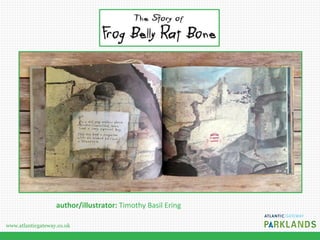
author/illustrator:'Timothy'Basil'Ering ''
www.atlanticgateway.co.uk
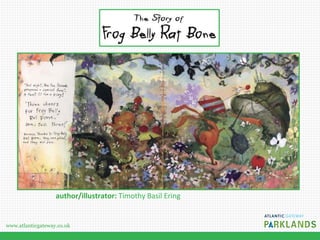
author/illustrator:'Timothy'Basil'Ering ''
www.atlanticgateway.co.uk
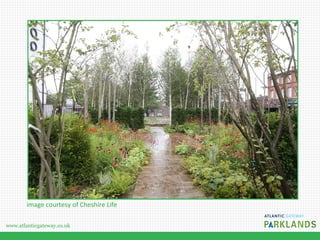
image'courtesy'of'Cheshire'Life'
www.atlanticgateway.co.uk
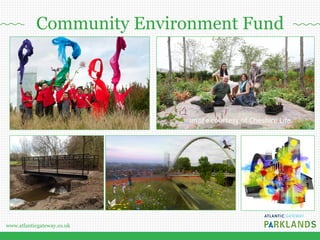
Community Environment Fund
image'courtesy'of'Cheshire'Life'
www.atlanticgateway.co.uk
4.
Next Steps
www.atlanticgateway.co.uk
'
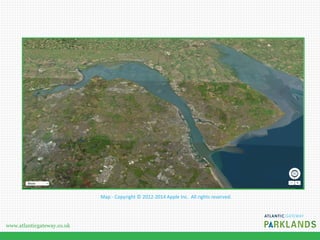
Map'@'Copyright'©'2012@2014'Apple'Inc.''All'rights'reserved.'
www.atlanticgateway.co.uk
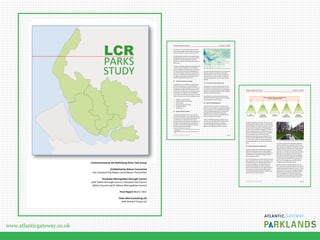
Liverpool City Region Parks Study    Final Report ‐ 18/03/15 
Peter Neal Consulting with Richard Tracey    page 0 


LCR 
PARKS 
STUDY 
Commissioned by the Rethinking Parks Task Group 
 
Established by Nature Connected  
the Liverpool City Region Local Nature Partnership 
 
Knowsley Metropolitan Borough Council 
with Halton Borough Council, Liverpool City Council 
Sefton Council and St Helens Metropolitan Council 
 
Final Report March 2015 
 
Peter Neal Consulting Ltd 
with Richard Tracey Ltd 
Liverpool City Region Parks Study    Final Report ‐ 18/03/15 
Peter Neal Consulting with Richard Tracey    page 13 
Its Prospectus13
 includes a wide‐ranging set of objec‐
tives and key messages that align closely with manag‐
ing and investing in the region’s asset base of parks.  
 
The Rethinking Parks Task Group has specifically been 
established within the LNP to work across boundaries 
and identify alternative approaches to promote, 
support and manage the city regions public parks and 
green spaces.  
 
The Group is seeking to develop more radical ideas and 
models that can be submitted to the LNP Board for 
further consideration. This study is part of the process 
and may include the potential for establishing some 
form of a Parks Agency concept. This could provide a 
structure to coordinate and share activities across the 
city region to support parks and green spaces and in 
particular high profile ‘destination’ parks. 
 
3.5  LCR Green Infrastructure Strategy 
 
The Mersey Forest has produced an extensive green 
infrastructure framework that includes Wirral and 
Warrington. With detailed mapping of the GI resource, 
including data on parks and private gardens, it makes 
reference to the ‘establishment of a Parks Task Group, 
to investigate a new approach to the management, 
maintenance and marketing of urban parks’. The action 
plan is structured around six ‘park compatible’ themes: 
 
Setting the scene for growth 
Supporting health and well being  
Climate change 
Recreation, leisure and tourism 
Ecological framework 
Rural economy 
 
3.6  Atlantic Gateway Parklands 
 
The Landscape for Prosperity14
 sets out a vision and 
investment framework for a wider region beyond the 
LCR and local authority boundaries spanning Liverpool 
and Manchester.  By making the best of existing 
environmental assets and resources, including many of 
the regions parks and green spaces, the framework 
provides an environmental foundation for long‐term 
economic development and growth.  
                                                            
13
  Nature Connected ‐ Liverpool City Region’s Natural Environment is 
a Unique Asset 
14
  Atlantic Gateway Parklands , The Landscape for Prosperity, June 
2014 
 
 
The Atlantic Gateway Parklands will use its approach to 
‘Planned Landscapes and Creative Environments’ ‐ 
Parklands PLACEs ‐ to drive investment using its own 
Community Environment Fund, which is available to 
third sector organisations to fund innovative projects 
and ideas.  
 
3.7  EU Structural and Investment Funds   
 
The European Union (EU) funding allocation for 2014‐
20 of £190m is coordinated by the LEP. This includes 
investment in economic infrastructure, including green 
infrastructure, to support growth, economic resilience 
and attract investment and visitors.  
 
The Blue/Green Economy and Place & Connectivity 
portfolios provide direct opportunities for investing in 
and managing parks and green spaces. 
 
3.8  Health and Wellbeing Boards 
 
Local councils now have direct responsibility, trans‐
ferred in part from the NHS, for improving the health of 
their communities. This is primarily delivered through 
Health and Wellbeing Boards that are established in 
partnership with clinical commissioning groups. 
Activities are structured and measured through the 
Public Health Outcomes Framework.  
 
Health and Wellbeing Strategies prepared for each 
authority across the LCR provide a number of direct 
and associated opportunities for using parks to 
improve local standards and deliver a number of 
agreed and pre‐defined public health outcomes. 
 
Liverpool City Region Parks Study    Final Report ‐ 18/03/15 
Peter Neal Consulting with Richard Tracey    page 19 
A flexible model allowing individual authorities to pool 
the management of particular parks, or park elements, 
could be adopted. For example one authority may only 
look to include heritage and HLF‐funded parks whilst 
another may also include green flag parks and those of 
further strategic importance.  It will be down to each 
authority to decide which of their parks is considered 
to be a strategic priority with all or part of their 
maintenance potentially resourced collectively. This 
process could also engage third sector expert advisors 
in a similar way to current work being undertaken by 
the Liverpool Strategic Green and Open Space Review 
Board.  
 
4.9  Phased Programme of Collaboration 
 
A phased or sliding scale of collaboration, cooperation 
and joint working across partners could be adopted 
allowing time for further research and the flexibility for 
individual partners to identify a strategy that meets 
their own particular needs.  
This could initially start as an informal network to share 
skills and expertise that evolves into developing a more 
coordinated approach to management and mainte‐
nance over the long‐term. The establishment of a 
formal LCR Parks Management Board could follow 
which could be endorsed at the city‐regional level and 
its work led by a core group of Park Commissioners. 
These would be recommended by each authority and 
appointed by the combined authority.  
 
 
Lord Street Gardens, Southport, restored with an HLF grant 
 
It is useful to note that when the Greater Manchester 
Combined Authority was established in 2011 it set up 
seven commissions to guide its development. Each was 
staffed by both elected members and a wider network 
of partners. The Environment Commission included a 
Green Spaces and Waterways Theme that was led by a 
Green Spaces and Waterways Infrastructure Board 
(which became the Greater Manchester Local Nature 
Partnership). The formal establishment of some form 
of a parks agency could follow that would provide a 
structure to increasingly support and then lead the 
management and maintenance of parks.  
Adopting a phased and flexible programme of transi‐
tion to new ways of working is expected to be easier to 
establish technically and politically.  However, it will be 
important that there is a clear and agreed strategy for 
establishing this model and each individual activity is 
seen as an integral part of the process to develop a 
more collaborative and coordinated model for deliver‐
ing park services across the city region in the future. 
 
www.atlanticgateway.co.uk
Confidential: Not for external dissemination
Private roundtable discussion
1
Private Advisory Roundtable Discussion:
“A Right to Beauty: The Role of Beauty and Good
Design in Fuelling Local Social Prosperity”
AGENDA & BRIEFING NOTES
Monday 23rd
March, 2.15 p.m. – 4.00 p.m.
Wilson Room, Portcullis House, Westminster, London SW1A 2LW
*Please allow sufficient time for passing through security*
Agenda
14.15 – 14.30 Participants arrive
14.30 – 14.40 Welcome and introductory remarks by Phillip Blond, Director, ResPublica
14.40 – 15.55 Discussion, chaired by Caroline Julian, Head of Policy Programmes, ResPublica
15.55 – 16.00 Conclusions and next steps
This project is kindly supported by:
Why, 
Mr. Wilde,
do you think
America is
such a violent
country?
www.atlanticgateway.co.uk
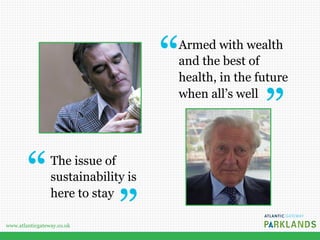
The issue of
sustainability is
here to stay
Armed with wealth
and the best of
health, in the future
when all’s well
www.atlanticgateway.co.uk
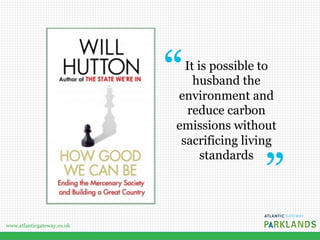
It is possible to
husband the
environment and
reduce carbon
emissions without
sacrificing living
standards
www.atlanticgateway.co.uk
Richard Tracey
Atlantic Gateway Parklands
t: 07841 458 696
e: richardtracey37@gmail.com
Interim Project Director

Parklands REGEN 2015 - final

  • 1.
    www.atlanticgateway.co.uk The Landscape forProsperity REGEN 2015, Liverpool
  • 2.
  • 3.
  • 4.
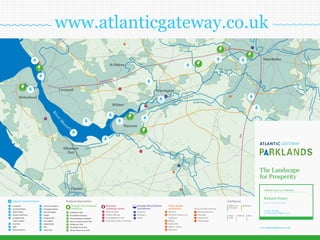
    www.atlanticgateway.co.uk Atlantic Gateway Investment Priorities 1.Liverpool2 2. Liverpool Waters 3. Wirral Waters: 4. Liverpool J L A 5. Ince Park 6. 3MG 7. Mersey Gateway 8. Daresbury 9. Omega 10. Warrington Waters 11. Northern Hub 12. Port Salford 13. MediaCity UK 14. Airport City 15. HS2
  • 5.
  • 6.
    www.atlanticgateway.co.uk Landscape character assessment Landscapecharacter areas Landscape character The Evidence Base
  • 7.
  • 8.
    www.atlanticgateway.co.uk Angel Field Garden,Liverpool Hope University (BCA Landscapes) The Context
  • 9.
    www.atlanticgateway.co.uk The Context Everton Park– Fritz Haeg Foraging Spiral – image from Liverpool Biennial
  • 10.
  • 11.
  • 12.
  • 13.
  • 14.
  • 15.
  • 16.
  • 17.
  • 18.
    www.atlanticgateway.co.uk The Landscape forProsperity will be delivered through a series of partner-led initiatives and projects, championed by the Atlantic Gateway Parklands. Together these will create a new dimension across the Mersey Belt – a collection of strategic ‘Planned Landscapes and Creative Environments’; our Parklands PLACEs. We envision these PLACEs developing under four categories: Strategic Environmental Initiatives Those projects with a direct link to the key Atlantic Gateway economic assets and with which the Parklands will seek a direct relationship and supporting role to assist in their delivery within the first 3–5 years of the Parklands initiative. Emergent Environmental Assets Transformational partner initiatives, which will create a landscape that is liveable and investment ready. These will drive forward the economy of the Gateway and support the wider connection of environmental assets through the creation of the Parklands concept. natural assets which are critical to the Gateway’s biodiversity and resilience and which form the backbone of the environmental quality that will act as a competitive advantage in attracting and retaining talent and investment. Strategic Flood Defence Investments Strategic Landscape Assets The critical natural assets that can contribute to relieving the drag on development by dealing with issues at ‘Pinch Points’ and up- stream of key developments through Green Infrastructure and natural capital investments. Parklands PLACE
  • 19.
    www.atlanticgateway.co.uk Port Salford Greenwayvisualisation and concept plan (BDP) Port Salford Greenway Strategic Environmental Initiatives
  • 20.
  • 21.
  • 22.
    www.atlanticgateway.co.uk Wirral Waters GreenGrid Strategic Environment Initiatives Town & Country Planning February 2015 77 this in the North End of Birkenhead. Ilchester Park itself was never considered a park until 2014 – it has only recently been adopted as a park by the local authority. Before that, it was simply a neglected green space in the middle of a windswept housing estate that had seen better days.Ann McLachlan, the local ward councillor and Deputy Leader of Wirral Council, explains how much has changed: ‘Ten years ago, when I became a councillor, [the park] had tenement buildings on it. It had a pub known as the ‘Blood Tub’ (it was called the New After a morning of unseasonal squalls, the sun has broken through at Ilchester Park. Children are gathering in a giant tipi in which African drummers are ramping up the party mood. Others are preparing costumes for a street parade. An avenue of young silver birch trees has been yarn-bombed in bright colours. Below them there are clusters of wild flowers planted by local children. It might sound like a typical August Bank Holiday community festival in many parts of Britain. But until recently nobody would have imagined doing planting a sense of pride Julian Dobson looks at how the inclusion of green infrastructure within regeneration activity in Birkenhead andWirralWaters has improved local environments and helped to lay the ground for further investment Above Fun for all – children queue up for the climbing wall at a community event in Ilchester Park McCoyWynne Dock Inn), and the old tenement style courtyard was known as the ‘Bull Ring’. It was a rough, tough area. But people from the North End live in the North End, stay in the North End; their families live here.’ In recent years a series of housing upgrades by Magenta Living, the largest social landlord in the borough, have provided new external cladding and energy-saving improvements. Homes deemed unfit or unsuitable have been demolished. A private developer, Keepmoat, is starting to build homes for sale on the demolition sites. But housing has not been the only change. Ilchester Park is at the heart of The Mersey Forest’s Green Streets initiative, a key part of the jigsaw that is the regeneration of the former industrial heart of Birkenhead and the neighbourhoods that served the dock areas. Green Streets is a programme to plant thousands of trees across neighbourhoods in Merseyside and North Cheshire, funded through a range of agencies, including the Forestry Commission’s Setting the Scene for Growth programme, the INTERREG ForeStClim project, and the Government’s Local Sustainable Transport Fund, as well as the Department of Business, Innovation and Skills and the Big Tree Plant. In the Wirral, it dovetails with long-term plans to improve the green infrastructure and enhance biodiversity around is being introduced to attract children and families. The Veolia Environmental Trust has contributed £67,000 through the Landfill Communities Fund to construct natural play areas and a network of new paths. ‘The community have got wide open green space for their children to play in, for them to breathe in really, rather than them being in an overcrowded environment,’ Ann McLachlan says. ‘Physically there’s a big difference, but it’s raised aspiration in the community as well about a better quality of life. I think local people feel a garden’s been brought to them. Where people have no gardens, they feel the greening of their community is a welcome addition to their life.’ Anna Barnish, Manager of North Birkenhead Development Trust, the main community organisation for the area, sees the greening of local streets and the revitalisation of the park as part of a long-term change in the fortunes of one of the most deprived neighbourhoods in the UK: ‘In spring when the trees are in blossom it looks lovely, and people comment on how uplifting it is to walk down a street which is lined with trees in full blossom. If you look at the trees, there’s been very little damage to them, which shows the impact that the process of education and engagement has had.’ That engagement has been secured through close partnerships between Mersey Forest staff and community organisations to involve local people in choosing which trees are planted where, building a sense of ownership of the greening of the wider area. North Birkenhead Development Trust is now supporting plans to set up a friends’ group to plan events and activities and help care for Ilchester Park. ‘There are people that genuinely enjoy living here and using the space and want to see it develop,’ Anna Barnish says. ‘It’s a very up and coming area – there is the new Keepmoat housing development, and Wirral Borough Council are doing loads and loads to encourage positive development, with new shops in the area. The fact that there’s new private development in housebuilding says a lot. It says that people want to live here.’ McCoyWynne Above A greener scene – tree planting by The Mersey Forest at Egerton Dock, Birkenhead
  • 23.
  • 24.
  • 25.
  • 26.
  • 27.
  • 28.
  • 29.
  • 30.
  • 31.
  • 32.
    www.atlanticgateway.co.uk Liverpool City Region Parks Study    Final Report ‐ 18/03/15  Peter Neal Consulting with Richard Tracey   page 0                LCR  PARKS  STUDY  Commissioned by the Rethinking Parks Task Group    Established by Nature Connected   the Liverpool City Region Local Nature Partnership    Knowsley Metropolitan Borough Council  with Halton Borough Council, Liverpool City Council  Sefton Council and St Helens Metropolitan Council    Final Report March 2015    Peter Neal Consulting Ltd  with Richard Tracey Ltd  Liverpool City Region Parks Study    Final Report ‐ 18/03/15  Peter Neal Consulting with Richard Tracey    page 13  Its Prospectus13  includes a wide‐ranging set of objec‐ tives and key messages that align closely with manag‐ ing and investing in the region’s asset base of parks.     The Rethinking Parks Task Group has specifically been  established within the LNP to work across boundaries  and identify alternative approaches to promote,  support and manage the city regions public parks and  green spaces.     The Group is seeking to develop more radical ideas and  models that can be submitted to the LNP Board for  further consideration. This study is part of the process  and may include the potential for establishing some  form of a Parks Agency concept. This could provide a  structure to coordinate and share activities across the  city region to support parks and green spaces and in  particular high profile ‘destination’ parks.    3.5  LCR Green Infrastructure Strategy    The Mersey Forest has produced an extensive green  infrastructure framework that includes Wirral and  Warrington. With detailed mapping of the GI resource,  including data on parks and private gardens, it makes  reference to the ‘establishment of a Parks Task Group,  to investigate a new approach to the management,  maintenance and marketing of urban parks’. The action  plan is structured around six ‘park compatible’ themes:    Setting the scene for growth  Supporting health and well being   Climate change  Recreation, leisure and tourism  Ecological framework  Rural economy    3.6  Atlantic Gateway Parklands    The Landscape for Prosperity14  sets out a vision and  investment framework for a wider region beyond the  LCR and local authority boundaries spanning Liverpool  and Manchester.  By making the best of existing  environmental assets and resources, including many of  the regions parks and green spaces, the framework  provides an environmental foundation for long‐term  economic development and growth.                                                                13   Nature Connected ‐ Liverpool City Region’s Natural Environment is  a Unique Asset  14   Atlantic Gateway Parklands , The Landscape for Prosperity, June  2014      The Atlantic Gateway Parklands will use its approach to  ‘Planned Landscapes and Creative Environments’ ‐  Parklands PLACEs ‐ to drive investment using its own  Community Environment Fund, which is available to  third sector organisations to fund innovative projects  and ideas.     3.7  EU Structural and Investment Funds      The European Union (EU) funding allocation for 2014‐ 20 of £190m is coordinated by the LEP. This includes  investment in economic infrastructure, including green  infrastructure, to support growth, economic resilience  and attract investment and visitors.     The Blue/Green Economy and Place & Connectivity  portfolios provide direct opportunities for investing in  and managing parks and green spaces.    3.8  Health and Wellbeing Boards    Local councils now have direct responsibility, trans‐ ferred in part from the NHS, for improving the health of  their communities. This is primarily delivered through  Health and Wellbeing Boards that are established in  partnership with clinical commissioning groups.  Activities are structured and measured through the  Public Health Outcomes Framework.     Health and Wellbeing Strategies prepared for each  authority across the LCR provide a number of direct  and associated opportunities for using parks to  improve local standards and deliver a number of  agreed and pre‐defined public health outcomes.    Liverpool City Region Parks Study    Final Report ‐ 18/03/15  Peter Neal Consulting with Richard Tracey    page 19  A flexible model allowing individual authorities to pool  the management of particular parks, or park elements,  could be adopted. For example one authority may only  look to include heritage and HLF‐funded parks whilst  another may also include green flag parks and those of  further strategic importance.  It will be down to each  authority to decide which of their parks is considered  to be a strategic priority with all or part of their  maintenance potentially resourced collectively. This  process could also engage third sector expert advisors  in a similar way to current work being undertaken by  the Liverpool Strategic Green and Open Space Review  Board.     4.9  Phased Programme of Collaboration    A phased or sliding scale of collaboration, cooperation  and joint working across partners could be adopted  allowing time for further research and the flexibility for  individual partners to identify a strategy that meets  their own particular needs.   This could initially start as an informal network to share  skills and expertise that evolves into developing a more  coordinated approach to management and mainte‐ nance over the long‐term. The establishment of a  formal LCR Parks Management Board could follow  which could be endorsed at the city‐regional level and  its work led by a core group of Park Commissioners.  These would be recommended by each authority and  appointed by the combined authority.       Lord Street Gardens, Southport, restored with an HLF grant    It is useful to note that when the Greater Manchester  Combined Authority was established in 2011 it set up  seven commissions to guide its development. Each was  staffed by both elected members and a wider network  of partners. The Environment Commission included a  Green Spaces and Waterways Theme that was led by a  Green Spaces and Waterways Infrastructure Board  (which became the Greater Manchester Local Nature  Partnership). The formal establishment of some form  of a parks agency could follow that would provide a  structure to increasingly support and then lead the  management and maintenance of parks.   Adopting a phased and flexible programme of transi‐ tion to new ways of working is expected to be easier to  establish technically and politically.  However, it will be  important that there is a clear and agreed strategy for  establishing this model and each individual activity is  seen as an integral part of the process to develop a  more collaborative and coordinated model for deliver‐ ing park services across the city region in the future.   
  • 33.
    www.atlanticgateway.co.uk Confidential: Not forexternal dissemination Private roundtable discussion 1 Private Advisory Roundtable Discussion: “A Right to Beauty: The Role of Beauty and Good Design in Fuelling Local Social Prosperity” AGENDA & BRIEFING NOTES Monday 23rd March, 2.15 p.m. – 4.00 p.m. Wilson Room, Portcullis House, Westminster, London SW1A 2LW *Please allow sufficient time for passing through security* Agenda 14.15 – 14.30 Participants arrive 14.30 – 14.40 Welcome and introductory remarks by Phillip Blond, Director, ResPublica 14.40 – 15.55 Discussion, chaired by Caroline Julian, Head of Policy Programmes, ResPublica 15.55 – 16.00 Conclusions and next steps This project is kindly supported by: Why,  Mr. Wilde, do you think America is such a violent country?
  • 34.
    www.atlanticgateway.co.uk The issue of sustainabilityis here to stay Armed with wealth and the best of health, in the future when all’s well
  • 35.
    www.atlanticgateway.co.uk It is possibleto husband the environment and reduce carbon emissions without sacrificing living standards
  • 36.
    www.atlanticgateway.co.uk www.atlanticgateway.co.uk Richard Tracey Atlantic GatewayParklands t: 07841 458 696 e: richardtracey37@gmail.com Interim Project Director