Parental aspirations for children's
education – is there a “girl effect”?
Experimental evidence from rural
Ethiopia
Tanguy Bernard (Bordeaux/IFPRI) Stefan Dercon (Oxford)
Kate Orkin (Oxford) Alemayehu Seyoum Taffesse (IFPRI)
ESSP/DSG
International Food Policy Research Institute
17th International Conference on the Ethiopian Economy
EEA Building | July 18, 2019
 Poor people in developing countries often do not invest, even when
returns are high:
 People may form beliefs that they are unable to improve their
economic position:
 Example 1: Rahmato and Kidanu, 1999
“It is a life of no thought for tomorrow”, “We have neither a
dream nor an imagination”
 Example 2: Taffesse and Tadesse (2017) – LoC and propensity to
adopt modern farm inputs;
 Limit effort, investment, uptake of new technologies;;
Motivation
2
 Questions:
 Are low aspirations a possible explanation?
 Can aspirations be changed persistently?
 Aspirations
 forward-looking goals or targets (Locke and
Latham, 2002).
 bounds among individuals’ preferences, the
elements of the choice sets which they consider as
relevant for them and motivate their actions.
 important – motivators, heterogenous;
Questions, Definition, Relevance
3
 Measurement – develop a survey instrument – four domains;
 Identification – aspirations and choice/behavior are interlinked;
 Randomize field experiment (an RCT):
o exogeneous/external shock to aspirations in a remote
rural district of Ethiopia using ‘role model’ documentaries;
o No other intervention – incentives, material support, specific
information/advice;
 Treatment – watch ‘role model’ documentaries;
 Placebo – watch Ethiopian TV entertainment programmes;
 Control I – survey within-treatment-village controls;
 Control II – survey pure controls (after five years).
Approach
4
 Four dimensions
 income, assets, education, social status
 weights
 Five questions;
 What is the level of (dimension k) that you have at present?”
 What is the level of (dimension k) that you would like to achieve
in your life?”
 What is the level of (dimension k) that you think you will reach
within ten years from now?
 What is the maximum (minimum) level of (dimension k) that
one can have in your current neighborhood?
 What is the minimum level of (dimension k) that one can have in
your current neighborhood?”
 Testing – Usability, Reliability, and Validity of the Aspiration
Measure (Bernard and Taffesse (2014));
Measurement of Aspiration
23/07/2019 5
Experimental design: individual treatment
23/07/2019 6
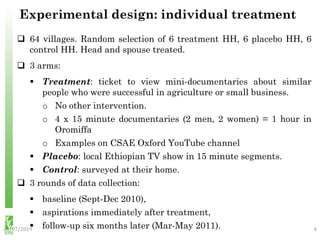
 64 villages. Random selection of 6 treatment HH, 6 placebo HH, 6
control HH. Head and spouse treated.
 3 arms:
 Treatment: ticket to view mini-documentaries about similar
people who were successful in agriculture or small business.
o No other intervention.
o 4 x 15 minute documentaries (2 men, 2 women) = 1 hour in
Oromiffa
o Examples on CSAE Oxford YouTube channel
 Placebo: local Ethiopian TV show in 15 minute segments.
 Control: surveyed at their home.
 3 rounds of data collection:
 baseline (Sept-Dec 2010),
 aspirations immediately after treatment,
 follow-up six months later (Mar-May 2011).
Timeline
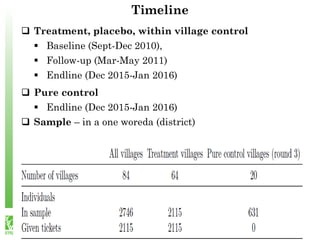
 Treatment, placebo, within village control
 Baseline (Sept-Dec 2010),
 Follow-up (Mar-May 2011)
 Endline (Dec 2015-Jan 2016)
 Pure control
 Endline (Dec 2015-Jan 2016)
 Sample – in a one woreda (district)
Education Aspiration effects by gender
Baseline Short-run Long-run
Mean
Difference
for girls
Treatment
effect
Difference
for girls
Treatment
effect
Difference
for girls
Aspirations for education
(years)
Mean/Coefficient 14.08 -0.47∗∗∗ 0.27∗ -0.1 0.28∗ 0.09
SD/SE 2.42 0.11 0.15 0.27 0.16 0.29
[=1] if aspires beyond
secondary education
Mean/Coefficient 0.6 -0.09∗∗∗ 0.05∗ -0.03 0.05∗ 0.01
SD/SE 0.49 0.02 0.03 0.05 0.03 0.05
Observations 1970 1932 1780
Notes: * denotes significance at 10 percent, ** at 5 percent, and *** at 1 percent level. The unit of
observation is the individual parent. Sample is restricted to households with children aged 6-20.
Figures in 2015 USD. We examine difference in means and treatment effects if the eldest child is a
girl. Standard errors are clustered at household level.
 Mean educational aspiration – about half-a-year lower for girls;
 Aspirations beyond secondary education – 9 percentage points (or 15
percent) lower for girls.
 Positive impact on overall educational aspirations,
 No impact towards reducing the gender differential.
Education Investment effects by gender
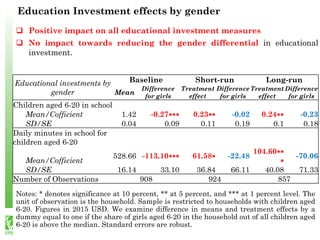
Educational investments by
gender
Baseline Short-run Long-run
Mean
Difference
for girls
Treatment
effect
Difference
for girls
Treatment
effect
Difference
for girls
Children aged 6-20 in school
Mean/Cofficient 1.42 -0.27∗∗∗ 0.23∗∗ -0.02 0.24∗∗ -0.23
SD/SE 0.04 0.09 0.11 0.19 0.1 0.18
Daily minutes in school for
children aged 6-20
Mean/Cofficient
528.66 -113.10∗∗∗ 61.58∗ -22.48
104.60∗∗
∗
-70.06
SD/SE 16.14 33.10 36.84 66.11 40.08 71.33
Number of Observations 908 924 857
Notes: * denotes significance at 10 percent, ** at 5 percent, and *** at 1 percent level. The
unit of observation is the household. Sample is restricted to households with children aged
6-20. Figures in 2015 USD. We examine difference in means and treatment effects by a
dummy equal to one if the share of girls aged 6-20 in the household out of all children aged
6-20 is above the median. Standard errors are robust.
 Positive impact on all educational investment measures
 No impact towards reducing the gender differential in educational
investment.
Education effects by gender
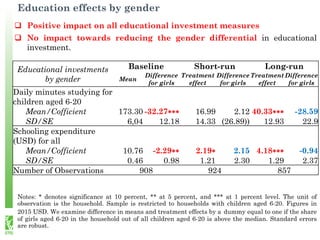
Educational investments
by gender
Baseline Short-run Long-run
Mean
Difference
for girls
Treatment
effect
Difference
for girls
Treatment
effect
Difference
for girls
Daily minutes studying for
children aged 6-20
Mean/Cofficient 173.30 -32.27∗∗∗ 16.99 2.12 40.33∗∗∗ -28.59
SD/SE 6,04 12.18 14.33 (26.89)) 12.93 22.9
Schooling expenditure
(USD) for all
Mean/Cofficient 10.76 -2.29∗∗ 2.19∗ 2.15 4.18∗∗∗ -0.94
SD/SE 0.46 0.98 1.21 2.30 1.29 2.37
Number of Observations 908 924 857
Notes: * denotes significance at 10 percent, ** at 5 percent, and *** at 1 percent level. The unit of
observation is the household. Sample is restricted to households with children aged 6-20. Figures in
2015 USD. We examine difference in means and treatment effects by a dummy equal to one if the share
of girls aged 6-20 in the household out of all children aged 6-20 is above the median. Standard errors
are robust.
 Positive impact on all educational investment measures
 No impact towards reducing the gender differential in educational
investment.
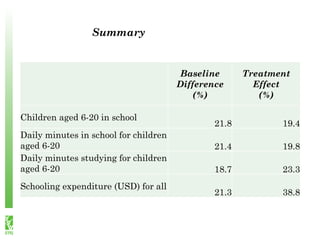
Baseline
Difference
(%)
Treatment
Effect
(%)
Children aged 6-20 in school
21.8 19.4
Daily minutes in school for children
aged 6-20 21.4 19.8
Daily minutes studying for children
aged 6-20 18.7 23.3
Schooling expenditure (USD) for all
21.3 38.8
Summary
Thank You

Parental aspirations for children's education

  • 1.
    Parental aspirations forchildren's education – is there a “girl effect”? Experimental evidence from rural Ethiopia Tanguy Bernard (Bordeaux/IFPRI) Stefan Dercon (Oxford) Kate Orkin (Oxford) Alemayehu Seyoum Taffesse (IFPRI) ESSP/DSG International Food Policy Research Institute 17th International Conference on the Ethiopian Economy EEA Building | July 18, 2019
  • 2.
     Poor peoplein developing countries often do not invest, even when returns are high:  People may form beliefs that they are unable to improve their economic position:  Example 1: Rahmato and Kidanu, 1999 “It is a life of no thought for tomorrow”, “We have neither a dream nor an imagination”  Example 2: Taffesse and Tadesse (2017) – LoC and propensity to adopt modern farm inputs;  Limit effort, investment, uptake of new technologies;; Motivation 2
  • 3.
     Questions:  Arelow aspirations a possible explanation?  Can aspirations be changed persistently?  Aspirations  forward-looking goals or targets (Locke and Latham, 2002).  bounds among individuals’ preferences, the elements of the choice sets which they consider as relevant for them and motivate their actions.  important – motivators, heterogenous; Questions, Definition, Relevance 3
  • 4.
     Measurement –develop a survey instrument – four domains;  Identification – aspirations and choice/behavior are interlinked;  Randomize field experiment (an RCT): o exogeneous/external shock to aspirations in a remote rural district of Ethiopia using ‘role model’ documentaries; o No other intervention – incentives, material support, specific information/advice;  Treatment – watch ‘role model’ documentaries;  Placebo – watch Ethiopian TV entertainment programmes;  Control I – survey within-treatment-village controls;  Control II – survey pure controls (after five years). Approach 4
  • 5.
     Four dimensions income, assets, education, social status  weights  Five questions;  What is the level of (dimension k) that you have at present?”  What is the level of (dimension k) that you would like to achieve in your life?”  What is the level of (dimension k) that you think you will reach within ten years from now?  What is the maximum (minimum) level of (dimension k) that one can have in your current neighborhood?  What is the minimum level of (dimension k) that one can have in your current neighborhood?”  Testing – Usability, Reliability, and Validity of the Aspiration Measure (Bernard and Taffesse (2014)); Measurement of Aspiration 23/07/2019 5
  • 6.
    Experimental design: individualtreatment 23/07/2019 6  64 villages. Random selection of 6 treatment HH, 6 placebo HH, 6 control HH. Head and spouse treated.  3 arms:  Treatment: ticket to view mini-documentaries about similar people who were successful in agriculture or small business. o No other intervention. o 4 x 15 minute documentaries (2 men, 2 women) = 1 hour in Oromiffa o Examples on CSAE Oxford YouTube channel  Placebo: local Ethiopian TV show in 15 minute segments.  Control: surveyed at their home.  3 rounds of data collection:  baseline (Sept-Dec 2010),  aspirations immediately after treatment,  follow-up six months later (Mar-May 2011).
  • 7.
    Timeline  Treatment, placebo,within village control  Baseline (Sept-Dec 2010),  Follow-up (Mar-May 2011)  Endline (Dec 2015-Jan 2016)  Pure control  Endline (Dec 2015-Jan 2016)  Sample – in a one woreda (district)
  • 8.
    Education Aspiration effectsby gender Baseline Short-run Long-run Mean Difference for girls Treatment effect Difference for girls Treatment effect Difference for girls Aspirations for education (years) Mean/Coefficient 14.08 -0.47∗∗∗ 0.27∗ -0.1 0.28∗ 0.09 SD/SE 2.42 0.11 0.15 0.27 0.16 0.29 [=1] if aspires beyond secondary education Mean/Coefficient 0.6 -0.09∗∗∗ 0.05∗ -0.03 0.05∗ 0.01 SD/SE 0.49 0.02 0.03 0.05 0.03 0.05 Observations 1970 1932 1780 Notes: * denotes significance at 10 percent, ** at 5 percent, and *** at 1 percent level. The unit of observation is the individual parent. Sample is restricted to households with children aged 6-20. Figures in 2015 USD. We examine difference in means and treatment effects if the eldest child is a girl. Standard errors are clustered at household level.  Mean educational aspiration – about half-a-year lower for girls;  Aspirations beyond secondary education – 9 percentage points (or 15 percent) lower for girls.  Positive impact on overall educational aspirations,  No impact towards reducing the gender differential.
  • 9.
    Education Investment effectsby gender Educational investments by gender Baseline Short-run Long-run Mean Difference for girls Treatment effect Difference for girls Treatment effect Difference for girls Children aged 6-20 in school Mean/Cofficient 1.42 -0.27∗∗∗ 0.23∗∗ -0.02 0.24∗∗ -0.23 SD/SE 0.04 0.09 0.11 0.19 0.1 0.18 Daily minutes in school for children aged 6-20 Mean/Cofficient 528.66 -113.10∗∗∗ 61.58∗ -22.48 104.60∗∗ ∗ -70.06 SD/SE 16.14 33.10 36.84 66.11 40.08 71.33 Number of Observations 908 924 857 Notes: * denotes significance at 10 percent, ** at 5 percent, and *** at 1 percent level. The unit of observation is the household. Sample is restricted to households with children aged 6-20. Figures in 2015 USD. We examine difference in means and treatment effects by a dummy equal to one if the share of girls aged 6-20 in the household out of all children aged 6-20 is above the median. Standard errors are robust.  Positive impact on all educational investment measures  No impact towards reducing the gender differential in educational investment.
  • 10.
    Education effects bygender Educational investments by gender Baseline Short-run Long-run Mean Difference for girls Treatment effect Difference for girls Treatment effect Difference for girls Daily minutes studying for children aged 6-20 Mean/Cofficient 173.30 -32.27∗∗∗ 16.99 2.12 40.33∗∗∗ -28.59 SD/SE 6,04 12.18 14.33 (26.89)) 12.93 22.9 Schooling expenditure (USD) for all Mean/Cofficient 10.76 -2.29∗∗ 2.19∗ 2.15 4.18∗∗∗ -0.94 SD/SE 0.46 0.98 1.21 2.30 1.29 2.37 Number of Observations 908 924 857 Notes: * denotes significance at 10 percent, ** at 5 percent, and *** at 1 percent level. The unit of observation is the household. Sample is restricted to households with children aged 6-20. Figures in 2015 USD. We examine difference in means and treatment effects by a dummy equal to one if the share of girls aged 6-20 in the household out of all children aged 6-20 is above the median. Standard errors are robust.  Positive impact on all educational investment measures  No impact towards reducing the gender differential in educational investment.
  • 11.
    Baseline Difference (%) Treatment Effect (%) Children aged 6-20in school 21.8 19.4 Daily minutes in school for children aged 6-20 21.4 19.8 Daily minutes studying for children aged 6-20 18.7 23.3 Schooling expenditure (USD) for all 21.3 38.8 Summary
  • 12.