Parboiling of Paddy
Next
Introduction
Next
End
Parboiling of Paddy
The rice obtained from milling pretreated paddy is
known as parboiled rice whereas rice obtained from
milling of untreated paddy is known as raw rice or white
rice.
Milling of paddy without any pretreatment is highly
susceptible to breakage and loss of minerals and
vitamins.
To reduce breakage and loss of minerals and vitamins,
pretreatment known as parboiling was developed.
About 60% of total production of paddy is parboiled in
India.
Advantages of parboiling
Parboiling of Paddy
Reduces grain breakage during milling and hence
higher head rice recovery.
Parboiled rice is nutritionally richer than raw rice.
During cooking there is less loss of solids in the
gruel than raw rice.
Bran from parboiled rice contains 25-30% oil as
compared to 15-20% from raw rice.
Next
Previous
End
Parboiling process
Parboiling of Paddy
Parboiling of paddy is a hydrothermal process
in which there is gelatinization of starch.
The process of parboiling is carried out in
three steps:
 Soaking
 Steaming
 Drying
Next
Previous
End
Soaking of Paddy
Parboiling of Paddy
Soaking of paddy is carried out by dipping in water.
Dipping in water at ambient temperature takes long
time (72 h) for soaking, making paddy susceptible
to development of micotoxins.
Hence, soaking at elevated temperature of water is
considered better. The soaking duration varies with
water temperature.
Next
Previous
End
Soaking of Paddy
Parboiling of Paddy
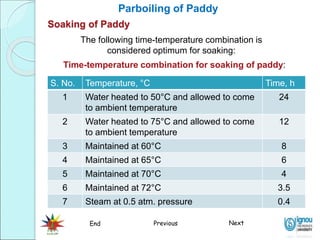
The following time-temperature combination is
considered optimum for soaking:
Time-temperature combination for soaking of paddy:
S. No. Temperature, °C Time, h
1 Water heated to 50°C and allowed to come
to ambient temperature
24
2 Water heated to 75°C and allowed to come
to ambient temperature
12
3 Maintained at 60°C 8
4 Maintained at 65°C 6
5 Maintained at 70°C 4
6 Maintained at 72°C 3.5
7 Steam at 0.5 atm. pressure 0.4
Next
Previous
End
Steaming of paddy
Parboiling of Paddy
Steaming is carried out to gelatinize starch.
Generally, saturated steam at a pressure of 1-5
kg/cm2 is used for steaming of soaked paddy.
Duration of steaming depends upon quantity of
paddy. For small batch, 2-3 min whereas for large
batch (6-8 tonnes), 25-30 min of steaming is
required.
Next
Previous
End
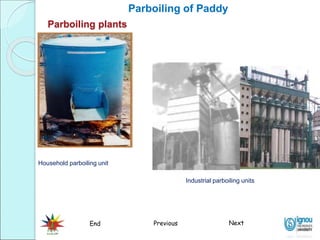
Parboiling plants
Parboiling of Paddy
Household parboiling unit
Industrial parboiling units
Next
Previous
End
Drying of paddy
Parboiling of Paddy
Drying of parboiled paddy from 45-50% (db) to
14-16% (db) needs to be done for proper milling
and storage.
Sun drying of paddy is generally practiced.
For uniform drying, it is important that paddy is
spread in 2-3 cm thickness layer and stirred at
an interval of half hour.
It is also important that paddy is dried in two
passes instead of continuous drying. In first
pass, paddy moisture content should be brought
down to 18-20% and rest in second pass.
Next
Previous
End
CFTRI method of parboiling
Previous
End
Parboiling of Paddy
Parboiling tank is filled with clean water and heated to about
85°C.
Paddy is dumped into hot water in tank for soaking. The
temperature of paddy-water mixture comes down to 70°C
which is maintained for 3-3.5 h.
After soaking, water is drained from tank and then exposed to
steam at a pressure of 4 kg/cm2 until husk starts splitting.
Steamed paddy is dried in multiple passes.
During parboiling, the water requirement is about 1.25 times
the weight of paddy and requirement of steam is about 200
kg/ton of paddy.

Parboiling_Paddy.ppt

  • 1.
  • 2.
    Introduction Next End Parboiling of Paddy Therice obtained from milling pretreated paddy is known as parboiled rice whereas rice obtained from milling of untreated paddy is known as raw rice or white rice. Milling of paddy without any pretreatment is highly susceptible to breakage and loss of minerals and vitamins. To reduce breakage and loss of minerals and vitamins, pretreatment known as parboiling was developed. About 60% of total production of paddy is parboiled in India.
  • 3.
    Advantages of parboiling Parboilingof Paddy Reduces grain breakage during milling and hence higher head rice recovery. Parboiled rice is nutritionally richer than raw rice. During cooking there is less loss of solids in the gruel than raw rice. Bran from parboiled rice contains 25-30% oil as compared to 15-20% from raw rice. Next Previous End
  • 4.
    Parboiling process Parboiling ofPaddy Parboiling of paddy is a hydrothermal process in which there is gelatinization of starch. The process of parboiling is carried out in three steps:  Soaking  Steaming  Drying Next Previous End
  • 5.
    Soaking of Paddy Parboilingof Paddy Soaking of paddy is carried out by dipping in water. Dipping in water at ambient temperature takes long time (72 h) for soaking, making paddy susceptible to development of micotoxins. Hence, soaking at elevated temperature of water is considered better. The soaking duration varies with water temperature. Next Previous End
  • 6.
    Soaking of Paddy Parboilingof Paddy The following time-temperature combination is considered optimum for soaking: Time-temperature combination for soaking of paddy: S. No. Temperature, °C Time, h 1 Water heated to 50°C and allowed to come to ambient temperature 24 2 Water heated to 75°C and allowed to come to ambient temperature 12 3 Maintained at 60°C 8 4 Maintained at 65°C 6 5 Maintained at 70°C 4 6 Maintained at 72°C 3.5 7 Steam at 0.5 atm. pressure 0.4 Next Previous End
  • 7.
    Steaming of paddy Parboilingof Paddy Steaming is carried out to gelatinize starch. Generally, saturated steam at a pressure of 1-5 kg/cm2 is used for steaming of soaked paddy. Duration of steaming depends upon quantity of paddy. For small batch, 2-3 min whereas for large batch (6-8 tonnes), 25-30 min of steaming is required. Next Previous End
  • 8.
    Parboiling plants Parboiling ofPaddy Household parboiling unit Industrial parboiling units Next Previous End
  • 9.
    Drying of paddy Parboilingof Paddy Drying of parboiled paddy from 45-50% (db) to 14-16% (db) needs to be done for proper milling and storage. Sun drying of paddy is generally practiced. For uniform drying, it is important that paddy is spread in 2-3 cm thickness layer and stirred at an interval of half hour. It is also important that paddy is dried in two passes instead of continuous drying. In first pass, paddy moisture content should be brought down to 18-20% and rest in second pass. Next Previous End
  • 10.
    CFTRI method ofparboiling Previous End Parboiling of Paddy Parboiling tank is filled with clean water and heated to about 85°C. Paddy is dumped into hot water in tank for soaking. The temperature of paddy-water mixture comes down to 70°C which is maintained for 3-3.5 h. After soaking, water is drained from tank and then exposed to steam at a pressure of 4 kg/cm2 until husk starts splitting. Steamed paddy is dried in multiple passes. During parboiling, the water requirement is about 1.25 times the weight of paddy and requirement of steam is about 200 kg/ton of paddy.