Sexual Disorders and
Dysfunctions
M.S Sara Dawod
Sexual response cycle
 Appetitive phase: sexual interests and
desires.
 Excitement: sexual pleasure, blood flow to
genitalia and breasts.
 Orgasm phase: sexual pleasure peaks,
ejaculation occurs.
 Resolution phase: relaxation and sense of
wellbeing.
Sexual & gender identity disorder
• Abnormal sexual disorders
• Sexual dysfunctions
• Paraphilia
• Identity disorders
Sexual Dysfunction
• A sexual dysfunction characterized by a
disturbance in the processes that characterize
the sexual response cycle or by pain
associated with sexual intercourse.
• Sexual dysfunction may associated with mood
disorders and anxiety disorders (OCD, panic
disorder with agrophobia and specific
disorder).
Sexual Dysfunction
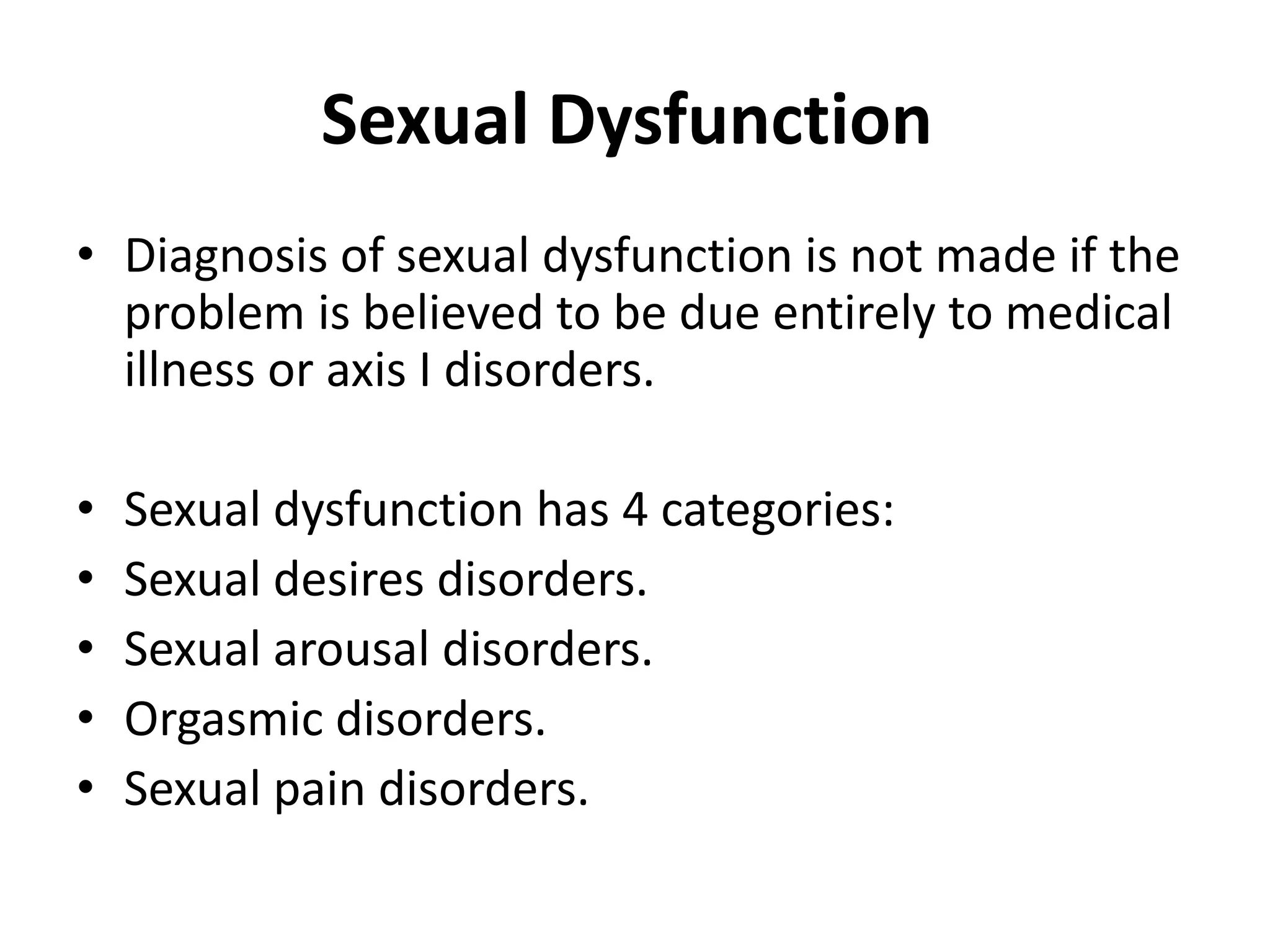
• Diagnosis of sexual dysfunction is not made if the
problem is believed to be due entirely to medical
illness or axis I disorders.
• Sexual dysfunction has 4 categories:
• Sexual desires disorders.
• Sexual arousal disorders.
• Orgasmic disorders.
• Sexual pain disorders.
Sexual Dysfunction
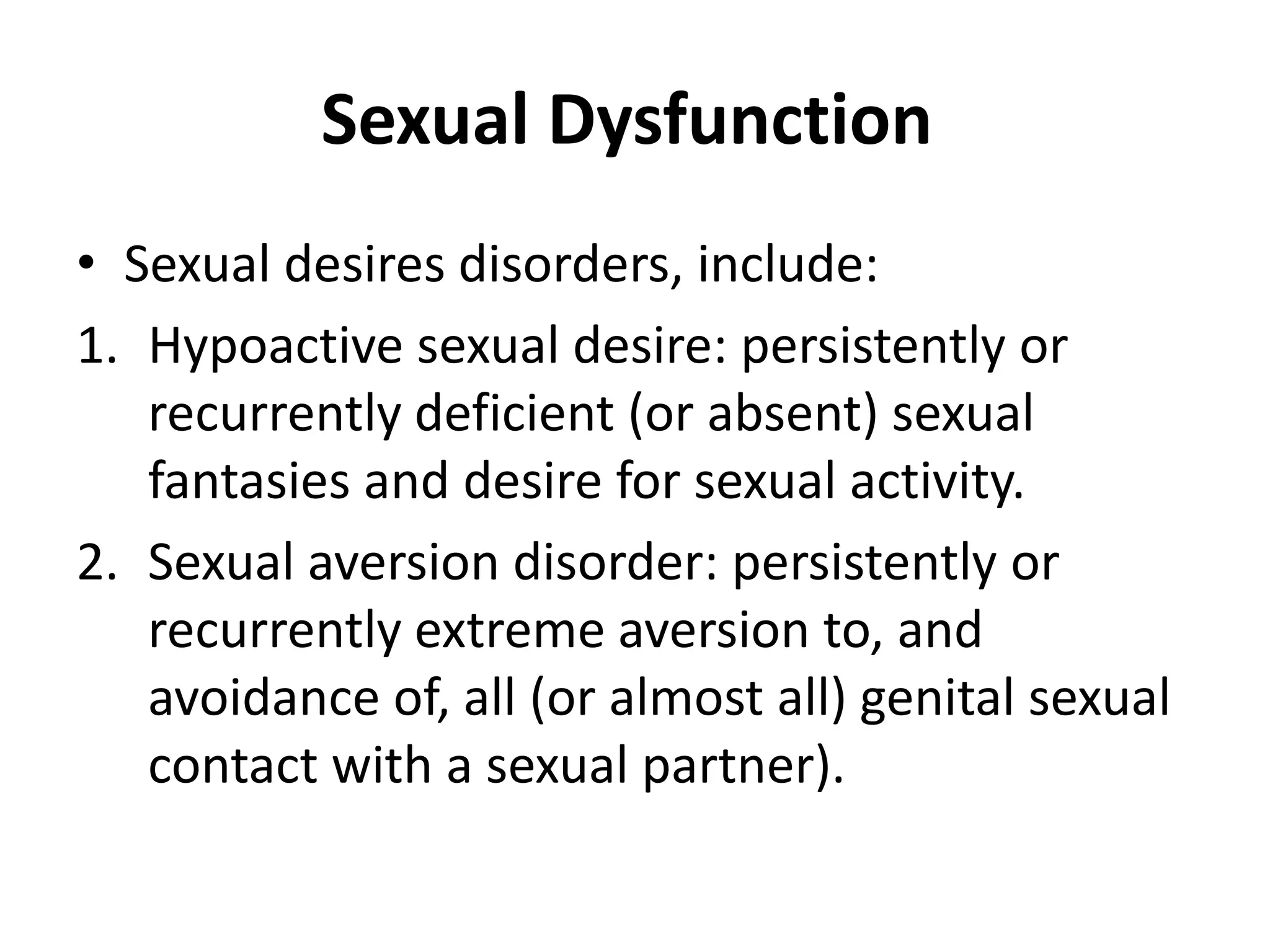
• Sexual desires disorders, include:
1. Hypoactive sexual desire: persistently or
recurrently deficient (or absent) sexual
fantasies and desire for sexual activity.
2. Sexual aversion disorder: persistently or
recurrently extreme aversion to, and
avoidance of, all (or almost all) genital sexual
contact with a sexual partner).
Sexual Dysfunction
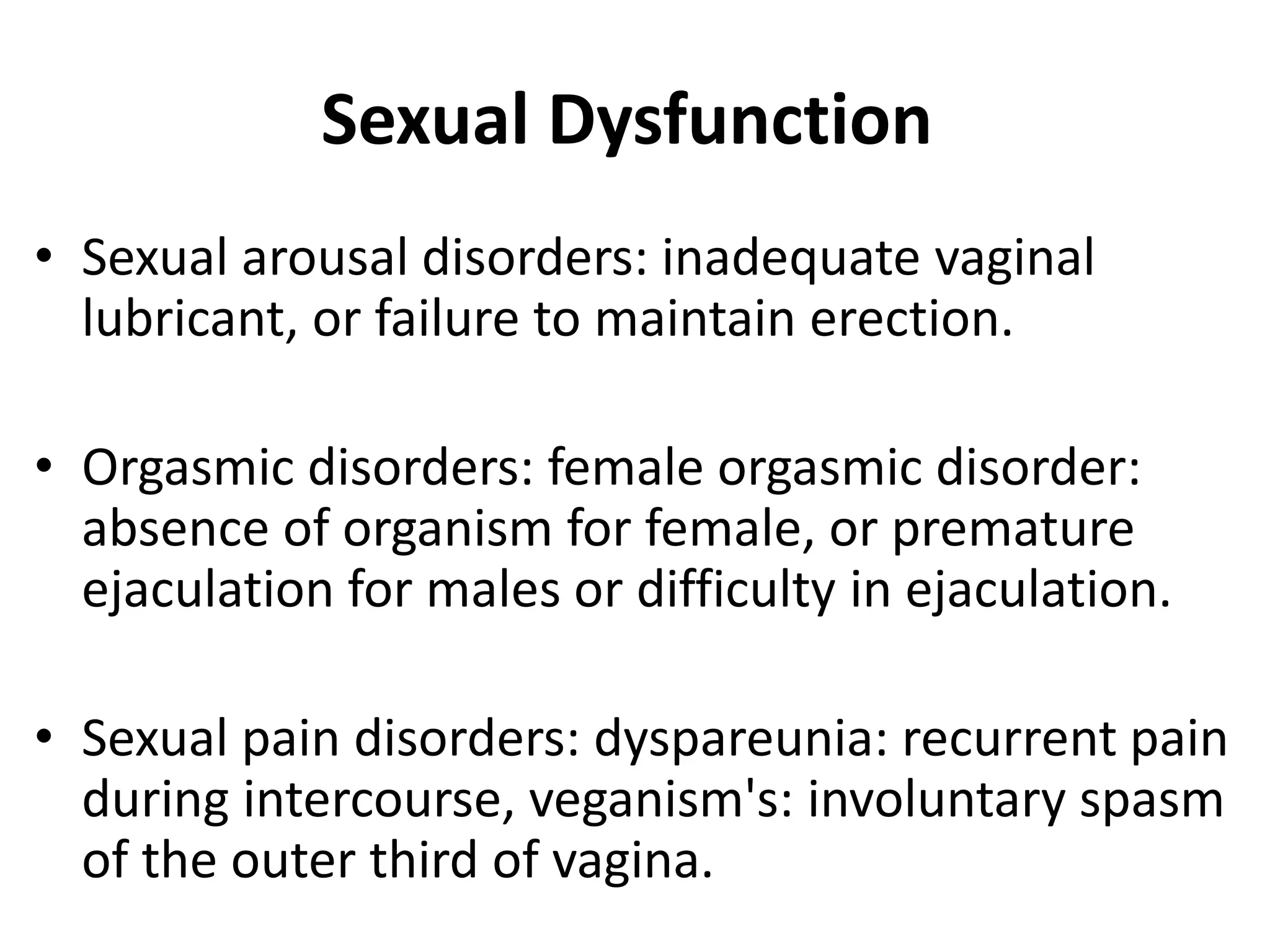
• Sexual arousal disorders: inadequate vaginal
lubricant, or failure to maintain erection.
• Orgasmic disorders: female orgasmic disorder:
absence of organism for female, or premature
ejaculation for males or difficulty in ejaculation.
• Sexual pain disorders: dyspareunia: recurrent pain
during intercourse, veganism's: involuntary spasm
of the outer third of vagina.
Sexual Dysfunction: Etiology
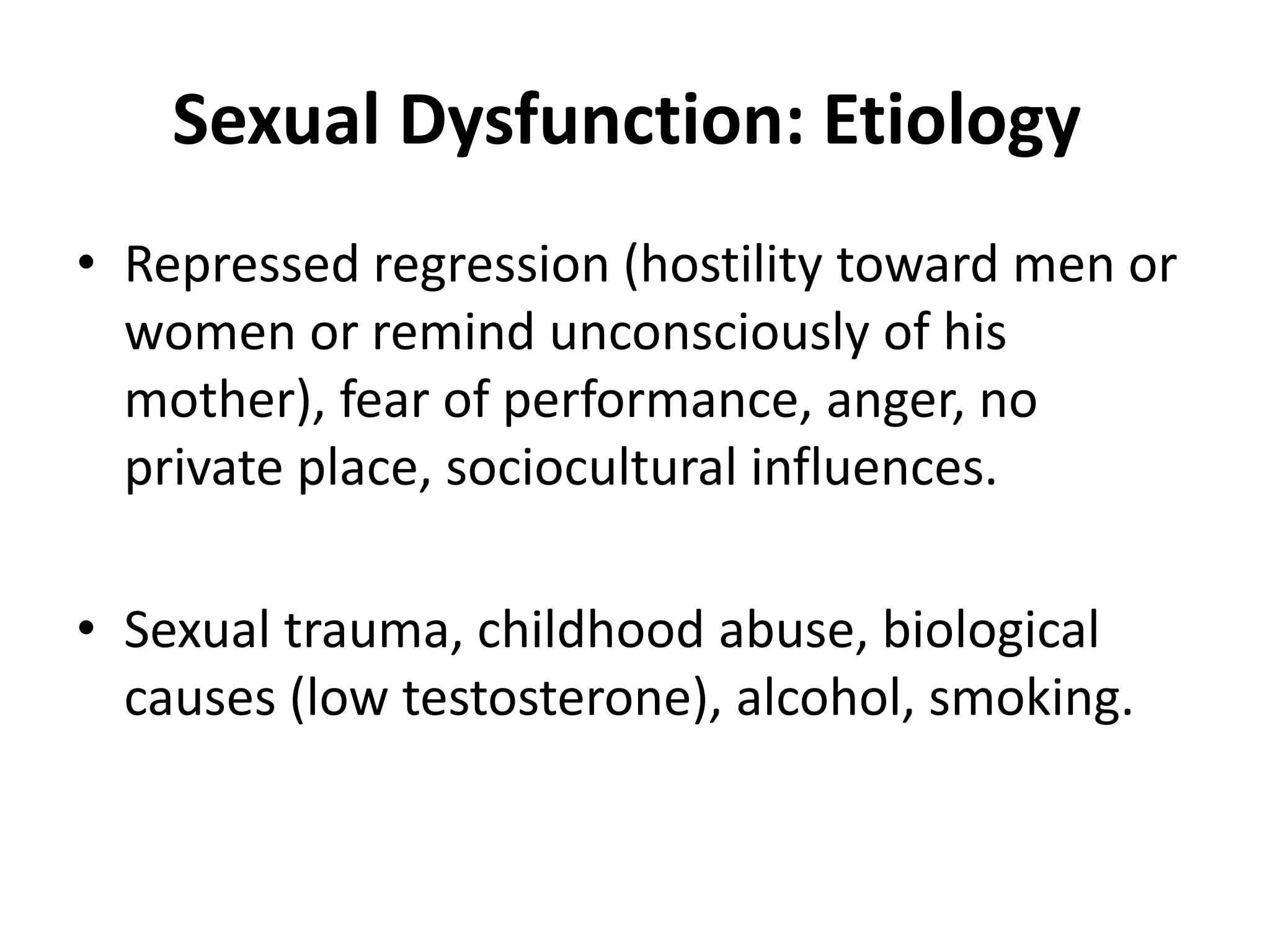
• Repressed regression (hostility toward men or
women or remind unconsciously of his
mother), fear of performance, anger, no
private place, sociocultural influences.
• Sexual trauma, childhood abuse, biological
causes (low testosterone), alcohol, smoking.
Sexual Dysfunction: Etiology
• Antihypertensive drugs: antidepressant
(prozac), diseases that affect NS (D.M, spinal
cord injury),homosexual desires, depression,
panic disorder, anxiety, stress, negative
attitude.
Treatment
• Anxiety reduction, psych education, skills and
communication training (like and dislike),
couple therapy, medications (antidepressant,
antianxiety, Viagra).
Paraphilias
• Recurrent, intense sexual arousal fantasies, sexual
urge or behaviors involve: non human object,
humiliation of oneself or the partner, children
over a period of 6 months.
• They may select a job or volunteer work that
brings them in contact with the desire stimuli.
• M>F
• Start during adolescence and early adulthood and
not diagnosed until causes marked impairment or
stress.
Paraphilias
• Paraphilias include:
• Fetishism
• Exhibitionism
• Frotteurism
• Pedophilia
• Transvestic fetishism
• Sexual masochism
• Sexual sadism
• Voyeurism
Exhibitionism
• Exposure of ones genitals to strangers (some
times masturbating) over a period of 6
months.
• Occurs before age 18 years.
• It becomes less severe after age 40 years.
Fetishism
• Over a period of 6 months, intense sexually
arousing and behaviors involving the use of
non living objects (female undergarment, bra,
stocking, shoes, high heel).
• It causes significant distress or impairment in
social, occupational and other functioning.
• Fetish objects are not limited to article of
female clothing used in cross dressing.
Frotteurism
• Over a period of at least 6 months, intense
sexually arousing and behavior involving
touching and rubbing against non consenting
person (occurs in crowded places,
transportation|).
• It causes marked distress or interpersonal
difficulty.
• Occurs at age 15-25 years.
Pedophilia
• Over a period of at least 6 months, intense
sexually arousing and behavior involving
sexual activity with prepubescent child (age 13
years or younger).
• The person is at least 15 years and at least 5
years older than the child.
• It causes marked distress or interpersonal
difficulty. (not important for DX).
Pedophilia
• Other information:
• They prefer female age (8-10) years and older
males.
• Can do activity with their children, their family,
outside the family, marry a women with attractive
child, trading children, taking in foster children
from non industrialized countries.
• Most of don’t involve violence other than sexual
act but some may murder their victims.
Pedophilia
• They may take drugs, has depression and
anxiety disorders, conduct disorder.
• Try to gain child's affection, interest and
loyalty and prevent the child from reporting
sexual activity.
• It is chronic.
• Begins in adolescence.
Sexual masochism
• Over a period of at least 6 months, intense
sexually arousing fantasies and behavior
involving the act of being humiliated, beaten,
bound.
• Fantasies involve being raped while held by
others (no possibility to escape), restraint
blindfolding, cutting, beating, electrical shock,
force to crawl, treated as children, cloths in
diapers, oxygen deprivation.
Sexual masochism
• Onset in early adulthood.
• It is chronic.
• It may result in injury or death.
Sexual sadism
• Over a period of at least 6 months, intense
sexually arousing fantasies and behavior
involving acts in which the psychological or
the physical suffering of the victim is sexually
exciting to the person.
• It causes marked distress or interpersonal
difficulty.
Sexual sadism
• Onset in early adulthood.
• It is chronic.
• It may result in injury or death.
• Action including: rape, restraint blindfolding,
cutting, beating, electrical shock, force to
crawl.
Transvestic fetishism
• Over a period of 6 months, in a heterosexual
male, recurrent, intense sexual arousing
fantasies or behavioral involving cross
dressing.
• Others: keeps collection of female cloths,
wear female cloths, and wear makeup.
• Tends to have few sexual partners and may
engage in occasional homosexual acts.
Transvestic fetishism
• Don’t identify themselves as the opposite sex,
may feel guilt and shame about their behaviors
and do it secretly and many married and hide it
from their wives.
• It begins in childhood and adolescence.
• Gender dysphoria may emerge and accompanied
by the desire to dress and live permanently as a
female (hormones or surgery).
Voyeurism
• Over a period of 6 months, intense sexual
arousing fantasies or behavioral involving the
act of observing an unsuspecting person who
is naked or engaging in sexual activity.
• No sexual activity with the observed person is
sought.
• Orgasm produced by masturbation during the
activity or after (depends on memory).
• Occur before age 15 years and its chronic.
Voyeurism
• Other information:
• The diagnosis wouldn't be given to people
who experience typical sexual arousal simply
by seeing nudity or sexual activity; the aspect
of spying is central to paraphilia voyeurism.
Etiology of paraphilias
• Neurobiological: high level of androgen
hormones which regulate sexual desires in men.
• Psychodynamic perspectives: defense to protect
ego from suppressed fears and memories (fear
from heterosexual).
• Psychological factors: inadequate sexual skills or
reinforcement by parents or relatives, physical or
sexual abuse, alcohol.
Treatment of paraphilias
• Illegal behaviors, prison and treatment forced
by court.
• They deny the problem and lack motivation to
change behaviors and they can control their
behaviors without professional help and drop
out of treatment.
Treatment of paraphilias
• Pts often drop from treatment and difficult to
deal with so the therapists should:
• Emphasize with the offenders reluctance to
admit their offending and treatment to reduce
defensiveness and hostility.
• Indicate that treatment might help them to
control their behaviors.
Treatment of paraphilias
• Emphasize the negative consequences of
refusing treatment.
• Explain that there will be psychobiological
assessment of pts sexual arousal without his
admitting to them.
Cognitive Behavioral Therapy
• Given shock on hand or feet or emetic drugs
when look at person with cross dressing, or
picture of nude child, covert sensitization
(imagine situation and imagine feeling sick or
guilt and ashamed or using foul odor).
• Imagine deviant activity and change its
ending.
• Social skills training, empathy toward others.
• Challenge negative thought (the younger the
girl the more harm).
Biological Treatment
• Depo-provers (medroxyprogesterone acetate):
to reduce androgens, cyproterrone acetat
(CPA), luteinizing hormone relasing hormone
agent (LHRH), SSRI antidepressant to reduce
sexual arousal.
• Side effects: liver problems, infertility, D.M,
osteoporosis.
Gender identity disorder
(transsexualism)
A. Strong and persistent cross gender
identification (not for perceived cultural
advantage of being other sex).
• In children manifested by 4 or more of the
following:
• Repeatedly stated desire to be the other sex.
• In boys, preference for cross dressing, in
females: wearing only stereotypical masculine
clothing.
Gender identity disorder
(transsexualism)
• Strong and persistent preference for cross sex
roles.
• Intense desires to participate in stereotypical
games of other sex.
• Strong preference for playmates of other sex.
• In adolescence and adult: desire to be other
sex, live and traeted as other sex, conviction
that they have the feeling and reaction of
other sex.
Gender identity disorder
(transsexualism)
B. Persistent discomfort with their sex ;in boys:
their penis is disgusting and will disappear, refuse
males games; In females: refuse to urinate in sitting
position, assertion that she has or will grow penis,
don’t want to grow breast or feminine cloths.
In adolescence and adult: get rid of secondary and
primary sex characteristics (hormones or surgery)
or beliefs that they were born the wrong sex.
Gender identity disorder
(transsexualism)
C. It is not better accounted with a physical
intersex condition.
• Other information:
• Usually socially isolated, drop from school,
prostitution, drugs & HIV , suicide, depression,
personality disorders, may had DX of
transvestic fetichism.
• M=F , chronic course, onset: 2-4 years old.
Etiology
• Genetics.
• Neurobiological factors: sex hormones during
pregnancy, androgens regulate sexual desires and
sexual desires increases among these pts.
• Psychodynamic perspectives: defense to protect
ego from dealing with suppressed fears and
memories. They fear heterosexual relationship
because they are fixated at pregenital phase.
Etiology
• Social factors: parent encouragement and
reinforcement.
• Psychological factors: physical abuse, sexual
abuse, poor parent-child relationship, alcohol,
cognitive distortion.
Treatment
• Surgery which is the meet common.
• Hormones block treatment.

Sexual disorders and dysfunctions

  • 1.
  • 2.
    Sexual response cycle Appetitive phase: sexual interests and desires.  Excitement: sexual pleasure, blood flow to genitalia and breasts.  Orgasm phase: sexual pleasure peaks, ejaculation occurs.  Resolution phase: relaxation and sense of wellbeing.
  • 3.
    Sexual & genderidentity disorder • Abnormal sexual disorders • Sexual dysfunctions • Paraphilia • Identity disorders
  • 4.
    Sexual Dysfunction • Asexual dysfunction characterized by a disturbance in the processes that characterize the sexual response cycle or by pain associated with sexual intercourse. • Sexual dysfunction may associated with mood disorders and anxiety disorders (OCD, panic disorder with agrophobia and specific disorder).
  • 5.
    Sexual Dysfunction • Diagnosisof sexual dysfunction is not made if the problem is believed to be due entirely to medical illness or axis I disorders. • Sexual dysfunction has 4 categories: • Sexual desires disorders. • Sexual arousal disorders. • Orgasmic disorders. • Sexual pain disorders.
  • 6.
    Sexual Dysfunction • Sexualdesires disorders, include: 1. Hypoactive sexual desire: persistently or recurrently deficient (or absent) sexual fantasies and desire for sexual activity. 2. Sexual aversion disorder: persistently or recurrently extreme aversion to, and avoidance of, all (or almost all) genital sexual contact with a sexual partner).
  • 7.
    Sexual Dysfunction • Sexualarousal disorders: inadequate vaginal lubricant, or failure to maintain erection. • Orgasmic disorders: female orgasmic disorder: absence of organism for female, or premature ejaculation for males or difficulty in ejaculation. • Sexual pain disorders: dyspareunia: recurrent pain during intercourse, veganism's: involuntary spasm of the outer third of vagina.
  • 8.
    Sexual Dysfunction: Etiology •Repressed regression (hostility toward men or women or remind unconsciously of his mother), fear of performance, anger, no private place, sociocultural influences. • Sexual trauma, childhood abuse, biological causes (low testosterone), alcohol, smoking.
  • 9.
    Sexual Dysfunction: Etiology •Antihypertensive drugs: antidepressant (prozac), diseases that affect NS (D.M, spinal cord injury),homosexual desires, depression, panic disorder, anxiety, stress, negative attitude.
  • 10.
    Treatment • Anxiety reduction,psych education, skills and communication training (like and dislike), couple therapy, medications (antidepressant, antianxiety, Viagra).
  • 11.
    Paraphilias • Recurrent, intensesexual arousal fantasies, sexual urge or behaviors involve: non human object, humiliation of oneself or the partner, children over a period of 6 months. • They may select a job or volunteer work that brings them in contact with the desire stimuli. • M>F • Start during adolescence and early adulthood and not diagnosed until causes marked impairment or stress.
  • 12.
    Paraphilias • Paraphilias include: •Fetishism • Exhibitionism • Frotteurism • Pedophilia • Transvestic fetishism • Sexual masochism • Sexual sadism • Voyeurism
  • 13.
    Exhibitionism • Exposure ofones genitals to strangers (some times masturbating) over a period of 6 months. • Occurs before age 18 years. • It becomes less severe after age 40 years.
  • 14.
    Fetishism • Over aperiod of 6 months, intense sexually arousing and behaviors involving the use of non living objects (female undergarment, bra, stocking, shoes, high heel). • It causes significant distress or impairment in social, occupational and other functioning. • Fetish objects are not limited to article of female clothing used in cross dressing.
  • 15.
    Frotteurism • Over aperiod of at least 6 months, intense sexually arousing and behavior involving touching and rubbing against non consenting person (occurs in crowded places, transportation|). • It causes marked distress or interpersonal difficulty. • Occurs at age 15-25 years.
  • 16.
    Pedophilia • Over aperiod of at least 6 months, intense sexually arousing and behavior involving sexual activity with prepubescent child (age 13 years or younger). • The person is at least 15 years and at least 5 years older than the child. • It causes marked distress or interpersonal difficulty. (not important for DX).
  • 17.
    Pedophilia • Other information: •They prefer female age (8-10) years and older males. • Can do activity with their children, their family, outside the family, marry a women with attractive child, trading children, taking in foster children from non industrialized countries. • Most of don’t involve violence other than sexual act but some may murder their victims.
  • 18.
    Pedophilia • They maytake drugs, has depression and anxiety disorders, conduct disorder. • Try to gain child's affection, interest and loyalty and prevent the child from reporting sexual activity. • It is chronic. • Begins in adolescence.
  • 19.
    Sexual masochism • Overa period of at least 6 months, intense sexually arousing fantasies and behavior involving the act of being humiliated, beaten, bound. • Fantasies involve being raped while held by others (no possibility to escape), restraint blindfolding, cutting, beating, electrical shock, force to crawl, treated as children, cloths in diapers, oxygen deprivation.
  • 20.
    Sexual masochism • Onsetin early adulthood. • It is chronic. • It may result in injury or death.
  • 21.
    Sexual sadism • Overa period of at least 6 months, intense sexually arousing fantasies and behavior involving acts in which the psychological or the physical suffering of the victim is sexually exciting to the person. • It causes marked distress or interpersonal difficulty.
  • 22.
    Sexual sadism • Onsetin early adulthood. • It is chronic. • It may result in injury or death. • Action including: rape, restraint blindfolding, cutting, beating, electrical shock, force to crawl.
  • 23.
    Transvestic fetishism • Overa period of 6 months, in a heterosexual male, recurrent, intense sexual arousing fantasies or behavioral involving cross dressing. • Others: keeps collection of female cloths, wear female cloths, and wear makeup. • Tends to have few sexual partners and may engage in occasional homosexual acts.
  • 24.
    Transvestic fetishism • Don’tidentify themselves as the opposite sex, may feel guilt and shame about their behaviors and do it secretly and many married and hide it from their wives. • It begins in childhood and adolescence. • Gender dysphoria may emerge and accompanied by the desire to dress and live permanently as a female (hormones or surgery).
  • 25.
    Voyeurism • Over aperiod of 6 months, intense sexual arousing fantasies or behavioral involving the act of observing an unsuspecting person who is naked or engaging in sexual activity. • No sexual activity with the observed person is sought. • Orgasm produced by masturbation during the activity or after (depends on memory). • Occur before age 15 years and its chronic.
  • 26.
    Voyeurism • Other information: •The diagnosis wouldn't be given to people who experience typical sexual arousal simply by seeing nudity or sexual activity; the aspect of spying is central to paraphilia voyeurism.
  • 27.
    Etiology of paraphilias •Neurobiological: high level of androgen hormones which regulate sexual desires in men. • Psychodynamic perspectives: defense to protect ego from suppressed fears and memories (fear from heterosexual). • Psychological factors: inadequate sexual skills or reinforcement by parents or relatives, physical or sexual abuse, alcohol.
  • 28.
    Treatment of paraphilias •Illegal behaviors, prison and treatment forced by court. • They deny the problem and lack motivation to change behaviors and they can control their behaviors without professional help and drop out of treatment.
  • 29.
    Treatment of paraphilias •Pts often drop from treatment and difficult to deal with so the therapists should: • Emphasize with the offenders reluctance to admit their offending and treatment to reduce defensiveness and hostility. • Indicate that treatment might help them to control their behaviors.
  • 30.
    Treatment of paraphilias •Emphasize the negative consequences of refusing treatment. • Explain that there will be psychobiological assessment of pts sexual arousal without his admitting to them.
  • 31.
    Cognitive Behavioral Therapy •Given shock on hand or feet or emetic drugs when look at person with cross dressing, or picture of nude child, covert sensitization (imagine situation and imagine feeling sick or guilt and ashamed or using foul odor). • Imagine deviant activity and change its ending. • Social skills training, empathy toward others. • Challenge negative thought (the younger the girl the more harm).
  • 32.
    Biological Treatment • Depo-provers(medroxyprogesterone acetate): to reduce androgens, cyproterrone acetat (CPA), luteinizing hormone relasing hormone agent (LHRH), SSRI antidepressant to reduce sexual arousal. • Side effects: liver problems, infertility, D.M, osteoporosis.
  • 33.
    Gender identity disorder (transsexualism) A.Strong and persistent cross gender identification (not for perceived cultural advantage of being other sex). • In children manifested by 4 or more of the following: • Repeatedly stated desire to be the other sex. • In boys, preference for cross dressing, in females: wearing only stereotypical masculine clothing.
  • 34.
    Gender identity disorder (transsexualism) •Strong and persistent preference for cross sex roles. • Intense desires to participate in stereotypical games of other sex. • Strong preference for playmates of other sex. • In adolescence and adult: desire to be other sex, live and traeted as other sex, conviction that they have the feeling and reaction of other sex.
  • 35.
    Gender identity disorder (transsexualism) B.Persistent discomfort with their sex ;in boys: their penis is disgusting and will disappear, refuse males games; In females: refuse to urinate in sitting position, assertion that she has or will grow penis, don’t want to grow breast or feminine cloths. In adolescence and adult: get rid of secondary and primary sex characteristics (hormones or surgery) or beliefs that they were born the wrong sex.
  • 36.
    Gender identity disorder (transsexualism) C.It is not better accounted with a physical intersex condition. • Other information: • Usually socially isolated, drop from school, prostitution, drugs & HIV , suicide, depression, personality disorders, may had DX of transvestic fetichism. • M=F , chronic course, onset: 2-4 years old.
  • 37.
    Etiology • Genetics. • Neurobiologicalfactors: sex hormones during pregnancy, androgens regulate sexual desires and sexual desires increases among these pts. • Psychodynamic perspectives: defense to protect ego from dealing with suppressed fears and memories. They fear heterosexual relationship because they are fixated at pregenital phase.
  • 38.
    Etiology • Social factors:parent encouragement and reinforcement. • Psychological factors: physical abuse, sexual abuse, poor parent-child relationship, alcohol, cognitive distortion.
  • 39.
    Treatment • Surgery whichis the meet common. • Hormones block treatment.