Parallel Transport: Additional Explorations Part One
Roa, F. J.P.
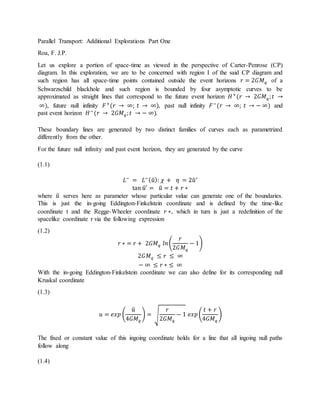
Let us explore a portion of space-time as viewed in the perspective of Carter-Penrose (CP)
diagram. In this exploration, we are to be concerned with region I of the said CP diagram and
such region has all space-time points contained outside the event horizons 𝑟 = 2𝐺𝑀 𝑞 of a
Schwarzschild blackhole and such region is bounded by four asymptotic curves to be
approximated as straight lines that correspond to the future event horizon 𝐻+
(𝑟 → 2𝐺𝑀 𝑞; 𝑡 →
∞), future null infinity 𝐹+
(𝑟 → ∞; 𝑡 → ∞), past null infinity 𝐹−
(𝑟 → ∞; 𝑡 → − ∞) and
past event horizon 𝐻−
(𝑟 → 2𝐺𝑀 𝑞; 𝑡 → − ∞).
These boundary lines are generated by two distinct families of curves each as parametrized
differently from the other.
For the future null infinity and past event horizon, they are generated by the curve
(1.1)
𝐿−
= 𝐿−( 𝑢̃): 𝜒 + 𝜂 = 2𝑢̃′
tan 𝑢̃′
= 𝑢̃ = 𝑡 + 𝑟 ∗
where 𝑢̃ serves here as parameter whose particular value can generate one of the boundaries.
This is just the in-going Eddington-Finkelstein coordinate and is defined by the time-like
coordinate t and the Regge-Wheeler coordinate 𝑟 ∗, which in turn is just a redefinition of the
spacelike coordinate r via the following expression
(1.2)
𝑟 ∗ = 𝑟 + 2𝐺𝑀 𝑞 𝑙𝑛(
𝑟
2𝐺𝑀 𝑞
− 1)
2𝐺𝑀 𝑞 ≤ 𝑟 ≤ ∞
− ∞ ≤ 𝑟 ∗ ≤ ∞
With the in-going Eddington-Finkelstein coordinate we can also define for its corresponding null
Kruskal coordinate
(1.3)
𝑢 = 𝑒𝑥𝑝 (
𝑢̃
4𝐺𝑀 𝑞
) = √
𝑟
2𝐺𝑀 𝑞
− 1 𝑒𝑥𝑝(
𝑡 + 𝑟
4𝐺𝑀 𝑞
)
The fixed or constant value of this ingoing coordinate holds for a line that all ingoing null paths
follow along
(1.4)
𝐿−( 𝑢̃0) = 𝛾−
∶ 𝜒 + 𝜂 = 2𝑢̃ ′
0
𝑢̃0 = 𝑐𝑜𝑛𝑠𝑡𝑎𝑛𝑡, 𝑢̃ ′
0 = 𝑐𝑜𝑛𝑠𝑡𝑎𝑛𝑡
We take that this constant value is non-infinite since when the ingoing coordinate goes infinite,
either the past event horizon or future null infinity is generated.
That is, say for instance the said coordinate is at a negative infinite value, this generates the past
event horizon
(1.5)
𝐿−( 𝑢̃ = − ∞) = 𝐻−
∶ 𝜒 + 𝜂 = − 𝜋
𝑢̃′
= −𝜋/2
𝑢 = 0, [𝑟 → 2𝐺𝑀 𝑞; 𝑟 ∗ → − ∞, 𝑡 → − ∞]
while on the opposite end where the same coordinate takes positive infinite value, the future null
infinity is generated.
(1.6)
𝐿−( 𝑢̃ = ∞) = 𝐹+
∶ 𝜒 + 𝜂 = 𝜋
𝑢̃′
= 𝜋/2
𝑢 = ∞, [𝑟 → ∞; 𝑟 ∗ → ∞, 𝑡 → ∞]
The other boundary lines namely, the future event horizon and the past null infinity are in turn
generated by the curve
(2.1)
𝐿+( 𝑣): 𝜒 − 𝜂 = −2𝑣̃′
tan 𝑣̃′
= 𝑣̃ = 𝑡 − 𝑟 ∗
In here, the specific parameter is 𝑣, which is also a component in the null Kruskal coordinate and
this can be defined by the other component (the out-going) of the Eddington-Finkelstein
coordinate 𝑣̃ via
(2.2)
𝑣 = 𝑒𝑥𝑝(−
𝑣̃
4𝐺𝑀 𝑞
) = √
𝑟
2𝐺𝑀 𝑞
− 1 𝑒𝑥𝑝(−
𝑡 − 𝑟
4𝐺𝑀 𝑞
)
and taking for a constant (noninfinite) value of this Kruskal coordinate generates all the out-
going null paths
(2.3)
𝐿+( 𝑣0) = 𝛾+
∶ 𝜒 − 𝜂 = −2𝑣̃ ′
0
Wth 𝑣 as the parameter we can reach the future event horizon at 𝑣 = 0,
(2.4)
𝐿+( 𝑣 = 0) = 𝐻+
∶ 𝜒 − 𝜂 = − 𝜋
𝑣̃ = ∞ , 𝑣̃′
= 𝜋/2
[𝑟 → 2𝐺𝑀 𝑞 ; 𝑟 ∗ → − ∞, 𝑡 → ∞]
and we can travel back in time towards an infinite past to reach the past null infinity where 𝑣 =
∞
(2.5)
𝐿+( 𝑣 = ∞) = 𝐹−
∶ 𝜒 − 𝜂 = 𝜋
𝑣̃ = −∞ , 𝑣̃′
= − 𝜋/2
[ 𝑟 ∗ → ∞, 𝑡 → − ∞]
The spacetime of region I is where events or specifically motions take place outside the BH
event horizons and such motions are fundamentally happening in a given geometry of the
spacetime and such geometry is encoded in the fundamental line element that is given with a
particular metric solution to Einstein’ field equation. In our present case, we have the
Schwarzschild metric solution and using the Eddington-Finkelstein coordinates we write the said
fundamental line element in the form given by
(2.6)
𝑑𝑆2( 𝑢̃, 𝑣̃) = −𝜂 𝑚 𝑑𝑢̃ 𝑑𝑣̃ + 𝑟2
𝑑Ω2
= −𝜂 𝑚 𝑑𝑢̃ 𝑑𝑣̃
in which for convenience, we suppress, setting 𝑑Ω2
= 0 the fundamental line element of the unit
two-sphere
(2.7)
𝑑Ω2
= 𝑑θ2
+ 𝑠𝑖𝑛2
θ 𝑑𝜙2
(2.8)
𝜂 𝑚 = 1 −
2𝐺𝑀 𝑞
𝑟
In the null Kruskal coordinates, we write (2.6) into an alternative form
(2.9)
𝑑𝑆2( 𝑢, 𝑣) =
32𝐺3
𝑀 𝑞
3
𝑟
𝑒𝑥𝑝(−
𝑟
2𝐺𝑀 𝑞
) 𝑑𝑢 𝑑𝑣
Ref’s
[1]Ohanian, H. C., GRAVITATION AND SPACETIME, New York: W. W. Norton and
Company Inc., copyright 1976
[2]Townsend, P. K., Blackholes – Lecture Notes, http://xxx.lanl.gov/abs/gr-qc/9707012
[3]Carroll, S. M., Lecture notes On General Relativity, http://www.arxiv.org/abs/gr-qc/9712019

Parallel transport additional explorations part i

  • 1.
    Parallel Transport: AdditionalExplorations Part One Roa, F. J.P. Let us explore a portion of space-time as viewed in the perspective of Carter-Penrose (CP) diagram. In this exploration, we are to be concerned with region I of the said CP diagram and such region has all space-time points contained outside the event horizons 𝑟 = 2𝐺𝑀 𝑞 of a Schwarzschild blackhole and such region is bounded by four asymptotic curves to be approximated as straight lines that correspond to the future event horizon 𝐻+ (𝑟 → 2𝐺𝑀 𝑞; 𝑡 → ∞), future null infinity 𝐹+ (𝑟 → ∞; 𝑡 → ∞), past null infinity 𝐹− (𝑟 → ∞; 𝑡 → − ∞) and past event horizon 𝐻− (𝑟 → 2𝐺𝑀 𝑞; 𝑡 → − ∞). These boundary lines are generated by two distinct families of curves each as parametrized differently from the other. For the future null infinity and past event horizon, they are generated by the curve (1.1) 𝐿− = 𝐿−( 𝑢̃): 𝜒 + 𝜂 = 2𝑢̃′ tan 𝑢̃′ = 𝑢̃ = 𝑡 + 𝑟 ∗ where 𝑢̃ serves here as parameter whose particular value can generate one of the boundaries. This is just the in-going Eddington-Finkelstein coordinate and is defined by the time-like coordinate t and the Regge-Wheeler coordinate 𝑟 ∗, which in turn is just a redefinition of the spacelike coordinate r via the following expression (1.2) 𝑟 ∗ = 𝑟 + 2𝐺𝑀 𝑞 𝑙𝑛( 𝑟 2𝐺𝑀 𝑞 − 1) 2𝐺𝑀 𝑞 ≤ 𝑟 ≤ ∞ − ∞ ≤ 𝑟 ∗ ≤ ∞ With the in-going Eddington-Finkelstein coordinate we can also define for its corresponding null Kruskal coordinate (1.3) 𝑢 = 𝑒𝑥𝑝 ( 𝑢̃ 4𝐺𝑀 𝑞 ) = √ 𝑟 2𝐺𝑀 𝑞 − 1 𝑒𝑥𝑝( 𝑡 + 𝑟 4𝐺𝑀 𝑞 ) The fixed or constant value of this ingoing coordinate holds for a line that all ingoing null paths follow along (1.4)
  • 2.
    𝐿−( 𝑢̃0) =𝛾− ∶ 𝜒 + 𝜂 = 2𝑢̃ ′ 0 𝑢̃0 = 𝑐𝑜𝑛𝑠𝑡𝑎𝑛𝑡, 𝑢̃ ′ 0 = 𝑐𝑜𝑛𝑠𝑡𝑎𝑛𝑡 We take that this constant value is non-infinite since when the ingoing coordinate goes infinite, either the past event horizon or future null infinity is generated. That is, say for instance the said coordinate is at a negative infinite value, this generates the past event horizon (1.5) 𝐿−( 𝑢̃ = − ∞) = 𝐻− ∶ 𝜒 + 𝜂 = − 𝜋 𝑢̃′ = −𝜋/2 𝑢 = 0, [𝑟 → 2𝐺𝑀 𝑞; 𝑟 ∗ → − ∞, 𝑡 → − ∞] while on the opposite end where the same coordinate takes positive infinite value, the future null infinity is generated. (1.6) 𝐿−( 𝑢̃ = ∞) = 𝐹+ ∶ 𝜒 + 𝜂 = 𝜋 𝑢̃′ = 𝜋/2 𝑢 = ∞, [𝑟 → ∞; 𝑟 ∗ → ∞, 𝑡 → ∞] The other boundary lines namely, the future event horizon and the past null infinity are in turn generated by the curve (2.1) 𝐿+( 𝑣): 𝜒 − 𝜂 = −2𝑣̃′ tan 𝑣̃′ = 𝑣̃ = 𝑡 − 𝑟 ∗ In here, the specific parameter is 𝑣, which is also a component in the null Kruskal coordinate and this can be defined by the other component (the out-going) of the Eddington-Finkelstein coordinate 𝑣̃ via (2.2) 𝑣 = 𝑒𝑥𝑝(− 𝑣̃ 4𝐺𝑀 𝑞 ) = √ 𝑟 2𝐺𝑀 𝑞 − 1 𝑒𝑥𝑝(− 𝑡 − 𝑟 4𝐺𝑀 𝑞 ) and taking for a constant (noninfinite) value of this Kruskal coordinate generates all the out- going null paths (2.3) 𝐿+( 𝑣0) = 𝛾+ ∶ 𝜒 − 𝜂 = −2𝑣̃ ′ 0 Wth 𝑣 as the parameter we can reach the future event horizon at 𝑣 = 0,
  • 3.
    (2.4) 𝐿+( 𝑣 =0) = 𝐻+ ∶ 𝜒 − 𝜂 = − 𝜋 𝑣̃ = ∞ , 𝑣̃′ = 𝜋/2 [𝑟 → 2𝐺𝑀 𝑞 ; 𝑟 ∗ → − ∞, 𝑡 → ∞] and we can travel back in time towards an infinite past to reach the past null infinity where 𝑣 = ∞ (2.5) 𝐿+( 𝑣 = ∞) = 𝐹− ∶ 𝜒 − 𝜂 = 𝜋 𝑣̃ = −∞ , 𝑣̃′ = − 𝜋/2 [ 𝑟 ∗ → ∞, 𝑡 → − ∞] The spacetime of region I is where events or specifically motions take place outside the BH event horizons and such motions are fundamentally happening in a given geometry of the spacetime and such geometry is encoded in the fundamental line element that is given with a particular metric solution to Einstein’ field equation. In our present case, we have the Schwarzschild metric solution and using the Eddington-Finkelstein coordinates we write the said fundamental line element in the form given by (2.6) 𝑑𝑆2( 𝑢̃, 𝑣̃) = −𝜂 𝑚 𝑑𝑢̃ 𝑑𝑣̃ + 𝑟2 𝑑Ω2 = −𝜂 𝑚 𝑑𝑢̃ 𝑑𝑣̃ in which for convenience, we suppress, setting 𝑑Ω2 = 0 the fundamental line element of the unit two-sphere (2.7) 𝑑Ω2 = 𝑑θ2 + 𝑠𝑖𝑛2 θ 𝑑𝜙2 (2.8) 𝜂 𝑚 = 1 − 2𝐺𝑀 𝑞 𝑟 In the null Kruskal coordinates, we write (2.6) into an alternative form (2.9) 𝑑𝑆2( 𝑢, 𝑣) = 32𝐺3 𝑀 𝑞 3 𝑟 𝑒𝑥𝑝(− 𝑟 2𝐺𝑀 𝑞 ) 𝑑𝑢 𝑑𝑣
  • 4.
    Ref’s [1]Ohanian, H. C.,GRAVITATION AND SPACETIME, New York: W. W. Norton and Company Inc., copyright 1976 [2]Townsend, P. K., Blackholes – Lecture Notes, http://xxx.lanl.gov/abs/gr-qc/9707012 [3]Carroll, S. M., Lecture notes On General Relativity, http://www.arxiv.org/abs/gr-qc/9712019