I N T E R N AT I O N A L A S S O C I AT I O N O F M U S E U M F A C I L I T Y A D M I N I S T R AT O R S


   PAPYRUS                                                              VOL. 12, NO. 3    WINTER 2011–2012


                                            Sm
                                                                                                      on
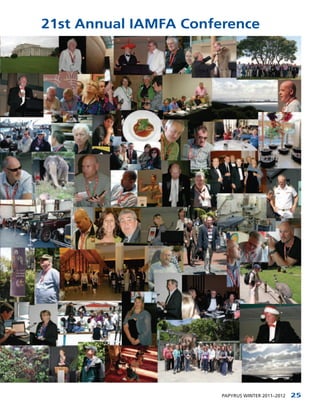
                                              ith
                                                    son                                           ati
                                                       ia                                    ific
                                                            n Rec
                                                                 eives 1st LEED          Cert

                                       Pre
Complete Coverage                         vie
                                             w                                            ce
      of the                                      of 2
                                                      2n                           onferen
                                                            d Mid-
   21st IAMFA                                                     Atl antic IAMFA C
Annual Conference
   in Auckland
Contents
Letter from the Editor . . . . . . . . . . . . . . . . . . . . . . . . . 2     A Sustainable Design Approach to Preservation
                                                                               Centres . . . . . . . . . . . . . . . . . . . . . . . . . . . . . . . . . . . . . 32
Message from the President . . . . . . . . . . . . . . . . . . . . 3
                                                                               An Unexpected Attendance at the Lighting
A Great Time was Had by All: Recap of the                                      Designer’s Academy Awards . . . . . . . . . . . . . . . . . . . . 35
21st IAMFA Conference in Auckland,
New Zealand—November 13–16, 2011 . . . . . . . . . . . 4                       Architect of the Capitol Begins Restoration
                                                                               of Capitol Dome Skirt . . . . . . . . . . . . . . . . . . . . . . . . . 37
KIWI Cooking Class. . . . . . . . . . . . . . . . . . . . . . . . . . . . 14
                                                                               Museum Environmental Standards in a
Looking at Art in a New Light—Part Four in a                                   Changing Environment . . . . . . . . . . . . . . . . . . . . . . . . 38
Four-Part Series: Greening Exhibition Spaces. . . . . . . 16
                                                                               Chapter News and Regional Updates . . . . . . . . . . . . . 40
LEED Certification for the National Museum
of the American Indian . . . . . . . . . . . . . . . . . . . . . . . . 19      IAMFA Member Directory 2011. . . . . . . . . . . . . . . . . . 42

Benchmarking Workshop Reveals Best Practices                                   IAMFA Members—Organizations . . . . . . . . . . . . . . . . 48
that Save Money . . . . . . . . . . . . . . . . . . . . . . . . . . . . . 21
                                                                               Index of Papyrus Technical and Historical Articles . . . 50
Out of Sight, Out of Mind: Museum Collections
in Storage at Serious Risk Around the World. . . . . . . 23                    Puzzle Page. . . . . . . . . . . . . . . . . . . . . . . . . . . . . . . . . . 52

Coming Attractions: Preview of the 2012                                        Cover photo: Choi Jeong Hwa’s beautiful Flower Chandelier at the
IAMFA Mid-Atlantic Conference . . . . . . . . . . . . . . . . 29               new Auckland Art Gallery. Photo: Daniel H. Davies


IAMFA BOARD OF DIRECTORS                                                        REGIONAL CHAPTERS
President                               Treasurer                               Atlanta, U.S.A. — Kevin Streiter,          Ottawa-Gatineau, Canada —
                                                                                High Museum of Art                         Marc Chretien, Canadian Museum
John de Lucy                            Alan Dirican                            kevin.streiter@woodruffcenter.org          of Nature
The British Library (Retired)           Baltimore Museum of Art                 Australia — Ray McMaster, Australian
                                                                                                                           mchretien@mus-nature.ca
London, United Kingdom                  Baltimore, MD, USA                      National Maritime Museum                   Philadelphia, USA — John Castle,
john.delucy@btinternet.com              adirican@artbma.org                     rmcmaster@anmm.gov.au                      Winterthur Museum & Garden
                                                                                                                           jcastle@winterthur.org
                                                                                Bilbao, Spain — Rogelio Diez,
V.P., Administration                    Secretary and Papyrus Editor            Guggenheim Museum                          San Francisco, USA — Joe Brennan,
                                                                                rdiez@guggenheim-bilbao.es                 San Francisco Museum of Modern Art
Randy Murphy                            Joseph E. May                                                                      jbrennan@sfmoma.org
                                                                                Chicago, USA — William Caddick,
Los Angeles County Museum               Sustainability Engineer                 Art Institute of Chicago                   United Kingdom — Jack Plumb,
   of Art                               Los Angeles, CA, USA                    wcaddick@artic.edu                         National Library of Scotland
                                                                                                                           j.plumb@nls.uk
Los Angeles, CA, USA                    joemay001@hotmail.com                   Los Angeles, USA — Randy Murphy,
                                                                                Los Angeles County Museum of Art           Washington/Baltimore, USA —
RMurphy@lacma.org                                                               rmurphy@lacma.org                          Maurice Evans, Smithsonian
                                                                                                                           Institution
V.P., Regional Affairs                                                          New England, USA — John H.                 evansma@si.edu
                                                                                Lannon, Boston Athenaeum
John Castle                                    For additional                   lannon@bostonathenaeum.org
                                                                                                                               For more information on
Winterthur Museum,                          contact information,                New York, USA — Mark Demairo,                becomming a member of the
Garden and Library                       please visit our website at            Neue Galerie                                 International Association of
                                                                                markdemairo@neuegalerie.org
Winterthur, DE, USA                           www.iamfa.org                                                                 Museum Facility Administrators,
                                                                                New Zealand — Patricia Morgan,                       please visit
jcastle@winterthur.org                                                          Auckland Art Gallery                               www.iamfa.org
                                                                                patricia.morgan@aucklandcity.govt.nz


IAMFA/ Papyrus                          Alan Dirican                           Design and Layout                          Statements of fact and opinion
Vol. 12, Number 3                       Maurice Evans                          Phredd Grafix                              are made on the responsibility of
Winter 2011–2012                                                                                                          authors alone and do not imply an
                                        Vicki Humphrey                         Editing                                    opinion on the part of the editors,
Editor                                  Simon Lambert                          Artistic License                           officers, or members of IAMFA. The
                                                                                                                          editors of IAMFA Papyrus reserve the
Joe May                                 Joe May                                Printed in the U.S.A. by                   right to accept or to reject any Article
                                        Lynn McGuire                           Knight Printing                            or advertisement submitted for
Papyrus Correspondents                                                                                                    publication.
                                        Mirjam Roos                            ISSN 1682-5241
2012 Mid-Atlantic Conference                                                                                              While we have made every attempt to
Planning Team                           Martin Turpin                                                                     ensure that reproduction rights have
Julian Bickersteth                      Emrah Baki Ulas                                                                   been acquired for the illustrations
                                                                                                                          used in this newsletter, please let
John Bixler                             Ian Williams                                                                      us know if we have inadvertently
John deLucy                             Stacey Wittig                                                                     overlooked your copyright, and
                                                                                                                          we will rectify the matter in a
                                                                                                                          future issue.
Past issues of Papyrus can be found on IAMFA's website: www.IAMFA.org
Letter from the Editor

Joe May
Editor, Papyrus


Greetings from Los Angeles!                   Varming’s series, “Seeing Art in a New       week exploring the region—and, in
                                              Light” by Emrah Ulas and Mirjam Roos.        Auckland, learning to cook seafood,


A
          s I write this, it’s been two
                                              There is also an article about the           Asian style. Thank you, Lynn, for your
          weeks since I returned home
                                              National Museum of the American              contribution to Papyrus!
          from the 21st IAMFA Annual
                                              Indian’s new LEED Silver Certification.          There is an article in this issue by one
Conference in Auckland, New
                                              If you recall, we visited NMAI two years     of the members of the IAMFA LinkedIn
Zealand. The Committee planned a
                                              ago when Washington, D.C. hosted the         Group, about sustainability features
wonderful conference—please read
                                              IAMFA Conference. Congratulations            at the Library and Archives Canada’s
the recap article in this issue of
                                              to NMAI, and to the Smithsonian for          Cellulose Nitrate Film Preservation
Papyrus, and enjoy the collection of
                                              achieving their first LEED Certification.    Facility. We welcome our LinkedIn
images from the Conference. If you
                                              This is a quite an accomplishment,           members’ contributions to Papyrus,
attended the Conference and would
                                              and reflects the Smithsonian’s dedi-         and hope they will in time find it bene-
like to save the images, just remove
                                              cation to sustainability, as well as their   ficial to join IAMFA. You will also find
the center section from this issue, and
                                              commitment to being a responsible            an article summarizing the results of a
you will have four pages of images
                                              member of the museum community.              survey about the state of collections in
from the Conference.                              You’ll find an article in this issue     storage at museums around the globe.
    IAMFA’s LinkedIn Group continues          about the increasing cooperative effort      Do these results reflect the situation at
to grow, with 213 members now from            between Facility Managers and their          your facility?
24 countries. There has been quite a          Conservation colleagues to revise                There are also articles about the very
lot of lively discussion recently about       temperature and humidity standards           creative architect, Shigeru Ban, who
topics such as Occupancy Loads, Zero          for collections. Please read this very       has designed a cardboard cathedral to
Waste Programs, Domestic Water                interesting article authored by Vicki        replace the one destroyed in last year’s
Procurement, Pre-action vs. Wet-Pipe          Humphrey and Julian Bickersteth. This        great earthquake in Christchurch,
sprinklers, FM software and more. We          process will have a significant sustain-     New Zealand; and about a new project
plan to use LinkedIn in the future to         ability impact on IAMFA members’             just announced by one of IAMFA’s
make announcements to IAMFA mem-              facilities in the future.                    members, Stephen Ayers, to restore
bers, as well as to reach out to those            You’ll also find an article authored     the dome skirt at the U.S. Capitol.
who may benefit from joining IAMFA.           by Lynn McGuire about the Guest                  Lastly, we have included a first look
If you have not yet joined the IAMFA          Program at the Auckland Conference.          at the venues included in next year’s
LinkedIn Group, please do so now,             If you’ve not brought your partner           Mid-Atlantic IAMFA Conference, sched-
and get involved in the discussions; it       before to the IAMFA conference,              uled for September 16–19, 2012. This
is a great way to get your fellow IAMFA       they’ve missed a real thrill. In addi-       region is rich in American history, and
members’ opinions on topics that may          tion to visiting the top cultural insti-     I urge you to join us in making plans
be causing you concern.                       tutions in the host city and wonderful       soon to attend!
    In this issue, you’ll find a variety of   social events in the evening, The                Thank you to everyone who
articles, including Part Four of Steensen     guests spend much of conference              contributed to this issue of Papyrus.


2    PAPYRUS WINTER 2011–2012
Message from the President

John de Lucy
President, IAMFA


C
        ongratulations to Pat Morgan      Steve Hyde of the Victoria and Albert—       tural institutions, and I hope part of
        and the Auckland Conference       said that he had never seen such a           our legacy in Auckland is that they
        Committee for putting on such     fantastic performance in all of his          continue to maintain the obvious
a successful conference—it was an         previous visits.                             rapport that has been generated, and
inspiring and amazing learning               The presentations Pat organised           continue to hold regular meetings to
experience. The six Auckland              at each venue again highlighted the          discuss common problems. A problem
museums and galleries had all             valuable contribution that Facility          shared is often a problem solved! We
recently been through refurbishment       Managers make to our cultural insti-         look forward to having reports in the
or new building works and were            tutions and, as in San Francisco, we         future from our New Zealand chapter!
looking fabulous. Both the member’s       enjoyed talks on integrating new build-         The Gala Dinner was held in the
programme and guest activities went       ings with existing heritage whilst con-      new extension to the Auckland Art
very smoothly, and we all enjoyed New     sidering seismic issues. We also heard       Gallery, under their gorgeous Kauri
Zealand hospitality with amazing food,    about the New Zealand approach to            wood ceiling. The kinetic art work of
and of course the local wines for which   conservation and green buildings, sys-       flowers hanging from the ceiling was
new Zealand is famous. As it was early    tems versus visitors, and construction       too much for some of our members,
summer, we were also to have fine
                                          in a marine environment. Pat arranged        who took to lying on the floor in their
weather for all our visits.
                                          for us to hear the story behind her new      black-tie outfits to stare at the revolving
   I was delighted that so many
                                          Auckland Art gallery—an art museum           flowers! Well done to the three winners
members made an effort to attend
                                          for the twenty-first century—as well as      of the highly coloured luminescent
the Conference, despite the financial
                                          a fascinating talk on the relationship       sock competition. Thank you to the
difficulties being experienced at their
                                          between art and architecture. The            Committee for my lovely Maori Chief-
museums, and of course we had an
                                          detailed behind-the-scene tours added        tain’s cloak, which attracted a great
excellent turnout from Australian and
                                          greatly to the learning experience,          deal of stroking from the ladies!
New Zealand museums—thank you all
for your commitment!                      and are one of the key reasons for our          John Castle and his team are look-
   The directors of each museum           members to attend. This year’s guest         ing forward to hosting you next year
welcomed us to their buildings, which     programme dovetailed beautifully             in the mid-Atlantic (not the ocean)
showed how important they saw our         with the member’s programme so               part of the States, and are sure to put
visit to be, and how much they valued     that on Monday and Wednesday we              on another great show. I am looking
having our Conference in New Zealand.     often shared the same exciting venues.       forward to seeing you all again this
They spoke to us about how proud they     The guests’ Tuesday trip to the bush         September (16-19). Bookings for the
were of their Facilities Management       and beach, like last year’s Napa Valley      Conference and the hotel through the
teams, and how vital FM was to their      excursion, was a real treat.                 web are already open.
institutions. We were blown away by the      One of the lasting benefits of put-          The preview of the Mid-Atlantic
formal Maori welcome and dance on         ting on the IAMFA Conference is the          Conference in this issue of Papyrus will
our first day at the Auckland Museum.     strong friendship that grows between         give you an idea of just how special this
A seasoned visitor to New Zealand—        the facilities fraternity of the host cul-   22nd IAMFA Conference will be.


                                                                                             PAPYRUS WINTER 2011–2012          3
A Great Time was Had by All
Recap of the 21st IAMFA Conference in Auckland,
New Zealand—November 13–16, 2011
By Joe May


D
        uring the IAMFA Conference a        members met in Bilbao, Spain at the        • Jinny Hong—Auckland Art Gallery
        year ago in San Francisco, a        Guggenheim Museum and its neigh-             Toi o T¯ maki
                                                                                                a
        survey was done that yielded a      boring cultural institutions. We were
                                                                                       • Amanda Julian—Auckland Art
very telling statistic: IAMFA members       all intrigued by the descriptions Pat
                                                                                         Gallery Toi o T¯ maki
                                                                                                        a
attending the 20th IAMFA Conference         gave of this exotic and faraway place
had, on average, missed just one con-       that most of us had never seen.            • Paul Ivory—Auckland Council
ference in all their years of member-           In September of this year, while
                                                                                       • John Glen—Auckland War
ship in IAMFA. As you read on, you’ll       final arrangements were being made
                                                                                         Memorial Museum
see why, once a member attends the          for the Conference, Auckland hosted
annual conference, they don’t want          the Rugby World Cup, and Pat’s own         • Adam Taylor—Auckland War
to ever miss another one.                   institution reopened after a multi-year      Memorial Museum
    T¯ maki Makau Rau (“Isthmus of
      o                                     renovation and expansion project, with
                                                                                       • Natalie Hansby—Auckland Zoo
one thousand lovers,” also translated       more than a hundred million dollars
as “Tamaki—the bride sought by a hun-       of capital invested. With New Zealand      • Sue Dell—Auckland Zoo
dred suitors”), now known as Auckland,      winning the 2011 Rugby World Cup,
                                                                                       • Shelley Osborne—Museum of
was first settled by the M aori around
                           ¯                the city was still celebrating when
                                                                                         Transport and Technology
1350. The narrow Auckland isthmus           IAMFA members arrived, and we’ll
was a strategic location, with two har-     never forget the hospitality shown         • Phil McGowan—Voyager
bours providing access to the sea on        by the Kiwis.                                New Zealand Maritime Museum
both the west and east coasts. It also          Let me begin by expressing
had fertile soils, which facilitated hor-   gratitude to all of the conference            I know how much time these indi-
ticulture, while the two harbours pro-      organizers:                                viduals spent planning the countless
vided plentiful kai moana (seafood). The                                               details that went into making this a
                                            • Patricia Morgan—Auckland Art
M aori constructed terraced pa (forti-
   ¯                             ¯                                                     truly great conference.
                                              Gallery Toi o Tamaki
                                                             ¯
fied villages) on the volcanic peaks.                                                     It’s also very important to recognize
The M aori population in the region
        ¯                                   • Petrina Keane—Auckland Art               the six sponsors who made this year’s
is estimated to have peaked at 20,000         Gallery Toi o Tamaki
                                                             ¯                         conference possible.
in pre-European-settlement times.
     Today’s Auckland is home to many
cultures. The majority of inhabitants
claim European—predominantly
British—descent, but substantial Maori,
                                      ¯
Pacific Islander and Asian communities
exist as well. Auckland has the largest
Polynesian population of any city in the
world. Ethnic groups from all corners of
the world have a presence in Auckland,
making it by far the country’s most
cosmopolitan city.
    In November 2011, IAMFA delegates
and guests converged on Auckland for
the 21st IAMFA Annual Conference.
Thank you, Auckland for an unforget-
table 21st Conference. Our host for this
year’s conference, Patricia Morgan,
first spoke of Auckland hosting an
IAMFA Conference six years ago when         The 21st IAMFA Conference Organizing Committee.


4   PAPYRUS WINTER 2011–2012
Steensen Varming is a Danish engi-          in mind when in need of products,           in central Auckland that seats 2,378
neering firm founded in 1933 by             services, and advice of the type offered    people. First opened on December 20,
Niels Steensen and Jørgen Varming           by these Conference sponsors.               1929, it was reopened in 2000 after a
in Copenhagen, Denmark. The firm               Day One of the Conference began,         major renovation and conservation
specializes in civil, structural and        as in past years, with the Benchmark-       effort. It is a famous example of the
building services engineering, with         ing Practices and Learning Workshop         atmospheric theatre style, in which
offices in Denmark, Australia, the          for those IAMFA members partici-            design and lighting were used to con-
United Kingdom, and Ireland.                pating in the annual benchmarking           vey an impression of being seated in
                                            exercise. This valuable undertaking         an outdoor auditorium at night, creat-
Coffey International Limited is a           allows member institutions to compare       ing the illusion of an open sky, complete
specialist professional services con-       building operation costs and practices,     with twinkling stars.
sultancy with expertise in geosciences,     in order to find better ways to accom-          Patricia Morgan welcomed every-
international development, and project      plish various tasks. Building operating     one and, along with IAMFA President
management. Coffey’s operations             costs have five components: Utilities,      John deLucy, described plans for the
include specialist businesses that          Security, Grounds, Building Mainte-         following three days of the Confer-
provide services at every stage of          nance, and Custodial. Benchmarking          ence. George Farrant, who is Princi-
the project lifecycle.                      participants compare cost per square        pal Heritage Advisor for the Theatre,
                                            foot (or meter) as well as work-processes   also spoke with the delegates and
The Camfil Farr Group is a developer        within these five categories. Those         guests about the history of this
and producer of air filters and clean-air   whose costs are lower than others share     magnificent venue.
products. Camfil Farr is also a global      their methods and processes with                The Auckland Civic Theatre is
air filtration specialist with 24 produc-   the group, creating a best practice in      internationally significant as the
tion units and R&D centers in four          itself. The 2011 benchmarking study         largest surviving atmospheric cinema
countries in the Americas, Europe           was sponsored by Conrad Engineers,          in Australasia (and also one of the
and the Asia-Pacific region.                McGuire Engineers and Steensen              only seven of its style remaining in the
                                            Varming. Please see Stacey Wittig’s         world), and as the first purpose-built
Black & McDonald is an integrated,          recap of the Benchmarking Practices         cinema of this type in New Zealand. It
multi-trade contractor providing            and Learning Workshop in this issue         is also known for its Indian-inspired
electrical, mechanical, utility and         of Papyrus.                                 foyer, which includes seated Buddhas,
maintenance services to government,            The opening reception for this year’s    twisted columns and domed ceilings.
industrial, commercial and institutional    IAMFA Conference was held at the            The main auditorium was designed
markets.                                    Auckland Civic Theatre on Sunday            in a similar style, imitating a Moorish
                                            evening, November 13. The Auckland          garden with turrets, minarets, spires
Cypress Private Security designs and        Civic Theatre is a large heritage theatre   and tiled roofs, as well as several famous
implements security solutions for a
wide range of clients, including public
and private institutions, office and
residential complexes, museums and
much more.

Hawkins Construction has over six
decades of building experience and is
one of New Zealand’s largest privately
owned construction and infrastructure
companies.

   These sponsors contributed to the
intellectual content of the Conference
through presentations, and through
their generous financial contributions,
enabling the spectacular venues, trips,
and meals we all enjoyed.
   The IAMFA organization wants all of
these sponsors to know how much we
appreciate their participation in, and
support of, our annual Conference.
We encourage members to keep this           Participants in the 2011 IAMFA Benchmarking and Learning Workshop.


                                                                                               PAPYRUS WINTER 2011–2012        5
Abyssinian panther statues. It could        for both delegates and their guests. Dur-          Members and guests were greeted
hold 2,750 people at its opening, and       ing the four days of events, the two pro-      by director Roy Clare, who welcomed
even with its reduced current seating, is   grams coincided frequently, so that both       everyone. We were then extremely
still the largest theatre in New Zealand.   members and guests could be together           honored to participate in a p¯ whir: a
                                                                                                                           o
    Canapés and cocktails followed          much of the time while accomplishing           M aori welcoming ceremony involving
                                                                                              ¯
the presentations, and IAMFA mem-           their individual objectives: learning          speeches, dancing, singing and finally
bers and guests renewed friendships         and networking for delegates, and              the hongi. Often presented for special
after last visiting a year earlier, when    exploration and discovery for guests.          visitors, the p¯ whir included the wero—
                                                                                                          o
we met in San Francisco for the 20th            On Monday morning, members and             an aggressive challenge to the visitor
IAMFA Conference.                           guests boarded coaches and travelled to        at the beginning of the ceremony—
    As in past years, the Auckland Con-     the Auckland War Memorial Museum.              and was the most spectacular part
ference included separate programs          The Auckland War Memorial Museum               of the p¯ whir. During this part of the
                                                                                                    o
                                            is one of New Zealand’s most important         ceremony, M aori warriors advanced
                                                                                                          ¯
                                            museums and war memorials. Its col-            tentatively towards the guests with
                                            lections concentrate on New Zealand            ceremonial weapons, and performed
                                            history (and especially the history of         threatening gestures and grimaces,
                                            the Auckland Region), natural history,         calling out battle screams, and gen-
                                            as well as military history. The Museum        erally giving an impression of being
                                            is also one of the most iconic Auckland        ready to explode into violence against
                                            buildings, constructed in the Neoclas-         the visitors at any moment. Historically,
                                            sical style, and sitting on a grassed plinth   this has roots in both showing off
                                            (the remains of a dormant volcano) in          the martial prowess of the warriors,
                                            the Auckland Domain: a large public            as well as testing the steadfastness of
IAMFA Conference Opening Reception at       park close to the Auckland central             the visitors.
Auckland Civic Theatre.                     business district.


IAMFA delegates and guests in front of the Auckland War Memorial Museum.


6   PAPYRUS WINTER 2011–2012
Once the manuhiri (guests) and          at the Voyager New Zealand Maritime          five entries in each category. The ses-
tangata whenua (M aori hosts) were
                     ¯                       Museum. Please read Lynn McGuire’s           sion was led by Guy Larocque, who will
seated, both sides offered speeches, be-     article on the Look, Cook, and Eat           post a summary of results in a future
ginning with the tangata whenua. The         event in this issue of Papyrus. We all       issue of Papyrus.
ceremony concluded when tangata              heard later that guests had a great             Delegates then heard a presenta-
whenua and manuhiri made physical            time learning to prepare new seafood         tion by Pete Bosley, designer of the
contact with a hongi. A hongi is a tradi-    dishes—and enjoying their gourmet            recent expansion to the Voyager Mari-
tional M aori greeting in New Zealand.
           ¯                                 creations afterwards.                        time Museum. This new expansion
It is done by pressing one’s nose and           Following lunch, delegates were           houses Black Magic, winner of the 1995
forehead (at the same time) to the           greeted by Chief Executive Murray
nose and forehead of another person          Reade, who provided background on
at an encounter.                             the Voyager Museum. Delegates then
     I was astonished by the welcome         continued a strategic planning work-
from the M aori representatives. This
              ¯                              shop initiated last year in San Francisco.
ceremony evoked unexpected emotion           The goal of this workshop is to identify
by everyone present. I remember look-        the current strengths, weaknesses,
ing over at Pat Morgan, and wondered         threats, and opportunities for improv-
. . . what is going to happen next. I        ing IAMFA. Last year in San Francisco,
wish that everyone reading this could        members brainstormed ideas for each
have experienced this M aori welcome
                           ¯                 of these categories, and this year IAMFA
to New Zealand.                              members refined this list to the top-
     Following our welcome to the
Auckland Museum, conference dele-
gates heard presentations on “Systems
versus Visitors” by David Hebblethwaite,
and “Building Conservation and Con-
struction” by John Glen, followed by a
back-of-house tour. Conference guests
had a guided tour of the Museum be-
fore both delegates and guests boarded
coaches headed for Auckland’s Viaduct
Harbour area.
     Guests attended a Look, Cook, and                                                    Black Magic, winner of the 1995
Eat cooking class and lunch at the           The finished gourmet lunch enjoyed by        America’s Cup race, on display at the
Harbour, while delegates had lunch           Conference guests at Viaduct Harbour.        Voyager New Zealand Maritime Museum.


                                                                                          The powhiri included the wero: an
                                                                                                ¯
Maori representatives and representatives from the Auckland War Memorial Museum greet
  ¯                                                                                       aggressive challenge to the visitor at
IAMFA delegates and guests with a powhiri.
                                    ¯                                                     the beginning of the ceremony.


                                                                                                 PAPYRUS WINTER 2011–2012          7
America’s Cup. Alex Cutler, CEO of the       a catamaran, and offered time to relax       The Auckland Art Gallery reopened
New Zealand Green Building Council,          after a very busy Day Two of Conference   to the public in September 2011, after
then presented a summary of the              presentations and tours.                  more than two years of renovation and
New Zealand Green Building system                Day Two of the 21st IAMFA Confer-     expansion. Director Chris Saines pre-
called the Green Star Rating System.         ence ended with a catamaran ride back     sented a talk on “The New Auckland
   Following afternoon presentations,        to Auckland, where coaches delivered      Art Gallery: an Art Museum for the
delegates had time for a brief tour of       everyone safely to the Langham Hotel,     21st Century”.
the Voyager Museum.                          our home during the Conference.              The Gallery hosted two additional
   After cooking class, guests boarded           For Conference delegates, Day Three   presentations: Architect Lindsay Mackie
the Ted Ashby, a ketch-rigged deck           of the Conference began with a short      from Archimedia spoke about the
scow, typical of the fleet of scows that     walk over to Auckland Art Gallery Toi     design of the Art Gallery, and Chris
once operated in New Zealand’s               o Tamaki, where members were
                                                  ¯                                    McKenzie presented “Integrating the
northern waters.                             greeted by Gallery Director Chris         New with Existing Heritage Fabric—
   Following tours of the Voyager, and       Saines. The Auckland Art Gallery Toi o    Seismic Considerations”. Delegates
a trip on the Ted Ashby, delegates and       Tamaki is the home of the visual arts
                                               ¯                                       were then given a back-of-house tour
guests boarded a ferry and headed for        in New Zealand, with a collection of      before a walk to the Skytower for lunch.
Mudbrick Vineyard on Waiheke Island          more than 15,000 works of art, and is        At 328 meters, the Skytower is
for dinner. The scenic trip to Waiheke       also home to our Conference host,         the tallest man-made structure in
Island took about 30 minutes aboard          Patricia Morgan.                          New Zealand, and offers breathtaking


The Ted Ashby, one of the Voyager            IAMFA members and guests network          Attendees enjoy dinner and a gorgeous
Museum’s working fleet of three heritage     with a cocktail at Mudbrick Winery        sunset at Mudbrick Winery.
vessels, which form an active and integral   before dinner.
part of the Museum’s collection.


Auckland Art Gallery Toi o Tamaki.
                            ¯                The Auckland Skytower in the distance.


8    PAPYRUS WINTER 2011–2012
views for up to 80 kilometers in every      they had lunch and a sampling of the       sentations “Casting New Light on
direction. Visitors rise in glass-fronted   best the Winery had to offer. Few          your Collection” by Emrah Ulas, and
elevators to one of the three spectac-      wineries in New Zealand can claim          “Benchmarking Recap”, by Keith
ular viewing platforms. For more thrills    such a proud winemaking history as         McClanahan.
and excitement, they can walk round         Soljans Estate Winery. Bartul Soljan          Delegates then boarded coaches,
the pergola at 192 metres up, or even       planted the first Soljan vineyard in       heading for the Royal New Zealand
jump off the Tower (with cables).           New Zealand in 1932, leaving behind a      Navy Museum in Devonport, where
   On Day Three, guests travelled by        legacy that has been carried on by his     they were welcomed by Commander
coach to Waitakere Regional Park.           son Frank and then grandson and cur-       David Wright, Director of the Museum.
The Waitakere Ranges are a chain of         rent owner, Tony Soljan. Today, Soljans    Housed in a nineteenth-century sub-
hills running approximately 25 kilo-        represents three generations of wine-      marine mining station, the Navy
meters (15.5 miles) from north to           making, with over 70 years experience.     Museum’s exhibitions showcase the
south, 25 km west of central Auckland.         Following lunch, delegates returned     story of the Navy’s contribution to
The maximum elevation within the            to Auckland Art Gallery for the pre-       the development of New Zealand’s
ranges is 474 meters (1,555 feet). The
subtropical ranges and surrounding
areas were traditionally known to the
local M aori as Te Wao Nui a Tiriwa (the
        ¯
Great Forest of Tiriwa).
   The western coastline of the Ranges
consists of cliffs exceeding 300 meters
(984 feet), interspersed infrequently
with beaches. The ranges are covered
in native forest, most of which is in the
process of regeneration since extensive
logging and farming in the mid to late
nineteenth and early twentieth cen-
turies. The Waitakere Ranges Regional
Park now contains about 15,985 hectares
(39,500 acres).
   After a stop at the Visitor Centre,
guests hiked approximately 2.4 kilo-
meters (1.5 miles) down to a reservoir,
where they could observe many of the
native plants and birds.
   Guests then boarded their coach
and headed for Soljans Winery, where        The Royal New Zealand Navy Museum at Torpedo Bay.


                                                                                       An old-growth Kauri tree, estimated to be
View from the Waitakere Visitor Centre.                                                700 years old.


                                                                                                PAPYRUS WINTER 2011–2012       9
identity through the lens of the Navy’s          The final day of the Conference            electronically ahead of the Conference
values: courage, commitment and               began for delegates at the Langham            eliminating the need to take time
comradeship. There, delegates enjoyed         Hotel, with the Annual General Meet-          during this meeting to elect officers.
a coffee break, and were given a guided       ing. Each of the IAMFA board members             Three board positions were up
tour of the Museum, before heading            and each Committee Chair addressed            for election this fall: Treasurer,
back to the Langham Hotel for a               the membership with a review of the           VP Regional Affairs, and Secretary/
free evening.                                 current state of Regional Affairs,            Papyrus Editor. Incumbents to these
    For Conference guests, after lunch        Administration, Treasury, Papyrus,            three positions each volunteered to
it was off to one of three gannet nest-       and future plans.                             serve another term, and were elected
ing colonies in New Zealand, at Muriwai          No election was held at the meeting        by the membership in a ballot ahead
beach, northwest of Auckland. Muriwai         this year. A recent change in IAMFA’s         of the Conference.
is one of Auckland’s west coast beaches,      bylaws now permits members to vote               John Castle made a presentation
with good fishing, strong winds and                                                         on preliminary plans for next year’s
rough waves. You can often see the                                                          22nd Mid-Atlantic IAMFA Conference.
gannets soaring around the cliffs on the                                                       Following the AGM, members
ever-present winds. As you might expect                                                     boarded coaches and departed for the
of a maritime bird, they’re very good                                                       Auckland Zoo. Guests began Day Four
at gliding, with wingspans up to 180 cm                                                     with a walking tour and marathon
(around six feet). Gannets feed by                                                          shopping in Parnell Village, before
diving from high up into a school of                                                        departing for the Zoo to rendezvous
fish near the surface of the water.                                                         with the delegates.
    Guests then hiked down to a beau-                                                          Auckland Zoo has New Zealand’s
tiful black sand beach, and made their                                                      largest collection of animals, and is
way back to the Langham to meet up                                                          recognized as one of the most pro-
with the delegates.                                                                         gressive zoos in the world. A winner
    Camfil Farr, one of the sponsors of                                                     of national and international environ-
this year’s IAMFA Conference, hosted                                                        mental-related awards, it is home to
attendees at the Langham for a cock-                                                        120 different species and over 750 ani-
tail reception . . . and it was a great way                                                 mals. Delegates were greeted by Zoo
to begin a free evening to explore                                                          Director Jonathan Wilcken, who fol-
Auckland’s nightlife.                                                                       lowed with a presentation “Te Wao
    IAMFA’s Board of Directors met to                                                       Nui—A Modern Zoo”. Delegates were
discuss the business of the organization                                                    then given a tour of the Zoo, and were
before walking to a local Malaysian                                                         met along the way by the guests, who
restaurant for dinner. Day Three of the                                                     had already arrived.
Conference was packed full of learning                                                         Guests then experienced one of the
and networking for delegates, and             Sponsor Camfil Farr, host of the Tuesday      highlights of their visit to Auckland.
                                              evening cocktail reception at the
exploration for guests.                       Langham Hotel.
                                                                                            The Zoo had arranged an animal


                                                                      Presenters at IAMFA’s annual general meeting. Left to right:
                                                                      John Castle, Guy Larocque, Randy Murphy, Joe May, Alan Dirican
Gannet nesting colony at Muriwai Beach.                               and John deLucy.


10     PAPYRUS WINTER 2011–2012
encounter for the guests, and Burma            New Zealand aviation pedigrees, and          early shops and houses, including a
was waiting when the guests arrived.           displayed in its new home, which             “fencible cottage” and a blacksmith
   Each of the guests was able to feed         just opened in September 2011. The           shop. The Road Transport Collection
Burma a piece of fruit and then pose           project had two parts. The first part        rotationally displays in excess of
with Burma for a photo op.                     was the relocation and refurbishment         100 cars, trucks, motorbikes and
   What a treat is was to meet Burma           of MOTAT’s existing Blister Hangar           emergency vehicles.
up close, and to feed her and pet her.         (workshop), and the second was the              The Tram Collection includes over
We will never forget it!                       construction of a custom-designed            20 electric, steam and cable trams,
   A little more touring around this           building to enhance the display of the       many of which are operational, with
magnificent zoo, and then it was time          Museum’s unique aviation collection.         support equipment and vehicles from
for lunch in the Old Elephant House,               MOTAT’s exhibits also include            former New Zealand tramway systems in
where everyone could sit and relax             trains, trams, vintage traction engines,     Auckland, Wellington and Wanganui,
a bit before boarding a tram, and              carriages, cars, buses, trolleybuses and     as well as the Mornington Cable tram
heading for the nearby Museum of               trucks (particularly fire engines), as       system in Dunedin.
Technology and Transport (MOTAT).              well as electrical equipment, space             MOTAT was built around the site
   MOTAT has one of the most impres-           flight exhibits including a Corporal         of a beam-engine pumphouse, which
sive aircraft collections in the South-        rocket, and general science exhibits.        originally provided Auckland’s water
ern Hemisphere, all with genuine               There is also a “colonial village” of        supply. Delegates heard presentations


Guests, like Livi deLucy, had a close
encounter with Burma, a 29 year-old
Asian elephant.                                Conference guests pose with Burma.


Historical aircraft in the new display hall.                          A sampling of MOTAT’s antique automobile collection.


                                                                                                PAPYRUS WINTER 2011–2012     11
on “Auckland’s Water Works History”            The setting for this year’s closing         their way towards the Atrium, but
by Mike Austin and Dave Pearson, and        gala could not have been more ele-             stopped along the way for a photo.
“Development and Challenges within          gant. The new North Atrium at the                 Attendees enjoyed a delicious din-
Architecture” by Evzen Novak.               Art Gallery was impressive, and dinner         ner accompanied by New Zealand fine
   Mid-afternoon, members and dele-         was held under Korean artist Choi              wines, and a full dinner program, begin-
gates returned to the Langham Hotel         Jeong Hwa’s Flower Chandelier, a colossal,     ning with the New Zealand National
for a short rest, a quick change, and       plump-petalled plant heaving and               Anthem performed by opera singer
then a coach ride to the Auckland           breathing.                                     Alene Wistrand.
Art Gallery Toi o Tamaki for the
                     ¯                         The evening began with cocktails               Prior to dinner, John deLucy,
closing Gala Dinner. This year’s Gala       and canapés in the Mackelvie Gallery,          IAMFA’s President was presented with
Dinner took place in the atrium of          built in 1916 and reinstated as part of        a korowai. The korowai is a traditional
the New Auckland Art Gallery, just          the recently completed development             and prized M aori garment. The
                                                                                                         ¯
opened in September 2011.                   project. Gala Attendees then made              korowai cloak is decorated with short


MOTAT’s beam-engine pumphouse.                                                             Choi Jeong Hwa’s beautiful Flower
                                                                                           Chandelier.


Attendees at the 21st IAMFA closing gala.                           John deLucy is presented with a korowai at the closing gala.


12     PAPYRUS WINTER 2011–2012
lengths of twisted fiber, usually dyed       years she’s had to make preparations        very different story! The IAMFA men
black. Of all cloaks, those adorned          amidst constant worry about whether         were not to be denied. Three were rec-
with feathers (kahu huruhuru) are            our world’s economy, which has caused       ognized for their outstanding socks:
the most prestigious and indicative          so many institutions to implement aus-      Tony McGuire for color, John Castle
of high rank.                                terity measures, would prevent IAMFA        for cuteness, and David Saunders for
   In the evening’s other presentations,     members from attending. During the          canniness, with his Peter Blake red
Alan Dirican and Patricia Morgan were        same time frame, the beautiful new          socks! We can only imagine what our
awarded the George Preston (IAMFA’s          Museum where we met for our closing         members may bring next year to cover
Founder) Memorial Award for their            gala reopened. As conference host, Pat      their feet!
efforts in advancing IAMFA’s mission.        served on the IAMFA Board of Directors          In conclusion, I believe I speak for
   Alan performed beyond what is             for the past year, and we’ve been able      all attendees of the 21st IAMFA Con-
expected of the Treasurer’s role over        to see her determination to make this       ference when I say that it was a true
the past year, by getting us back on track   21st IAMFA Conference a success. She        adventure this year visiting New Zealand.
with the changes needed to keep our          didn’t give up, and we are so grateful      The people of New Zealand were so
non-profit status in good standing, and      to Pat that she persisted in making         kind, helpful, and hospitable to all our
improving our financial documenta-           this year’s Conference one of the best      members. We learned, we explored,
tion, along with several measures to         in the history of our organization.         we laughed, and at times we were
reduce operating costs. All of this             In recent years a tradition has taken    nearly overcome by emotion from the
was done during a very challenging           hold, and now it wouldn’t be an offi-       welcome we were extended.
year, with a major capital project at        cial IAMFA Gala Dinner without the              Thank you, thank you, thank you
the Baltimore Museum of Art.                 “Annual Sock Competition”. Last year        to everyone who made IAMFA’s
   For Patricia Morgan, it has been a        in San Francisco, two ladies took home      21st Conference so memorable.
long road leading up to this 21st IAMFA      bragging rights for the most colourful
Conference, and during the past two          and unique socks. This year, it was a       Joe May is IAMFA’s Secretary, and Editor of
                                                                                         Papyrus Magazine.


Alan Dirican is awarded the 2011             Patricia Morgan being awarded the 2011 George Preston Memorial Award.
George Preston Memorial Award.


                               Become a Member of IAMFA
                                      For more information on becoming a member of the
                            International Association of Museum Facility Administrators, please visit
                                                             WWW.IAMFA.ORG


                                                                                             PAPYRUS WINTER 2011–2012          13
KIWI Cooking Class
By Lynn McGuire


T
      he 2011 IAMFA Annual Conference Guest Program                       After watching Chef Steve and his assistant prepare all
      was outstanding!                                                 of the food at one main station in a small auditorium, we
         Seeing Auckland from all sides, all of the delegates’         entered another room where cooking stations were set up
significant others enjoyed a chance to experience “down                with all of the food items, utensils, aprons, etc. we would
under” from the mountains to the beaches, and everywhere               need. We were to break into groups of four, sharing the
in-between.                                                            cooking responsibilities as we reproduced his meal.
   One of the most unique experiences was visiting the                    Our menu was as follows:
Auckland Seafood School, where Chef Steve Roberts                      • Grilled Salmon Skewers with Lime and Lemongrass Sauce
regaled us with stories as he prepared a succulent meal,
which we then attempted to copy. Chef Steve had lived in               • Asian Style Coleslaw
Japan for many years, so his recipes reflected the Asian               • Grilled Seasonal Fish, Bok Choy, Mandarin and
influence he had absorbed overseas.                                      Ginger Sauce


Nancy Evans mimics Chef Steve’s technique as she wraps salmon with strips of
leek during the Look, Cook, and Eat Luncheon.


                                                                                    Harry Wanless prepares Asian Style Coleslaw.


                                                                                    The Feast de Résistance prepared by IAMFA’s
Livi deLucy makes Lemongrass Sauce.                                                 talented guests.


14     PAPYRUS WINTER 2011–2012
We watched Chef Steve effortlessly blanch leek strips,
which he then wrapped around salmon pieces to form
medallions.
    We all laughed as we tried to produce perfect julienned
carrots, shredded coleslaw and other ingredients for the
coleslaw, dressing it with a sweet chili sauce. It looked
remarkably easy—not quite as easy when we tried our
hands at it.
    Chef Steve then prepared fish fillets over bok choy, with
two delicious sauces. Likewise, we chopped, diced, and
stirred tiny pats of butter into the sauces while we had our
fish entrees on the grill.
    Our presentation may not have mirrored Chef Steve’s
exactly, but as we all sat down to our meal we toasted
our efforts and enjoyed every morsel. It was a wonderful
afternoon.
Chicagoans Lynn McGuire and husband Tony are long-time
members of IAMFA, and are seasoned participants at the IAMFA
Conference each year.                                           We all enjoyed our seafood creations.


                                                                                           PAPYRUS WINTER 2011–2012   15
Looking at Art in a New Light
                                Part Four in a Four-Part Series:
                                Greening Exhibition Spaces
                                By Mirjam Roos and Emrah Baki Ulas


                                W
                                           e live in an era of sustainability and an increasing    concerns over the potential for mercury pollution and
                                           global emphasis on minimising energy use. This          contamination, particularly since the compact fluorescent
                                           requires a change in the way we think about             (CFL) type lamps that have been commonly proposed as
                                lighting in museum and gallery facilities. As a result, best-      replacement contain toxic mercury, and there is little
                                practice expectations for exhibition display are evolving,         regulation and guidance on the appropriate forms of
                                and appropriate display-lighting conditions for cultural           disposal and recycling.
                                collections and exhibitions continue to be a major topic of           As alternative lighting technologies continue to develop,
                                discussion at the international level. Most of these discussions   these concerns are lessening and alternative ways forward are
                                revolve around legislation regarding the phasing-out of            opening up new possibilities for museum and gallery lighting.
                                inefficient light sources, which have a significant impact            Common strategies taken on by many institutions to
                                on museums and galleries.                                          cope with the phase-out of certain lamps in the last few
                                   Most government activity around the issue of lighting is        years can be summarised as:
                                driven by energy savings issues, triggered by developments
                                                                                                   • bulk stocking of spare lamps
                                in lighting technologies within the past decade. These devel-
                                opments have shifted the focus of key lighting manufacturers       • direct replacement of lamps only with alternative lamp
                                into new areas of research and product development, which            technologies
                                has in turn resulted in a change in business interests and
                                                                                                   • replacement of the complete luminaires or systems with
                                manufacturing trends. It is predicted that the use of incan-
                                                                                                     alternative fixtures using alternative technologies
                                descent lighting is likely to shrink significantly within the
                                next decade, and even virtually disappear in some countries.
                                                                                                       Although it goes against the objectives of government
                                Given that most museum and gallery lighting is based pri-
                                                                                                   initiatives, bulk stocking of spare lamps has been effective
                                marily on incandescent lighting technology, as far as the
                                                                                                   as an interim measure—being a cost-effective solution in
                                museum and gallery sector is concerned, the phasing-out
                                                                                                   the short term, while providing museums and galleries with
                                of inefficient light sources is perhaps the most significant
                                                                                                   time to assess their budgets and consider a future major
                                legislation to date in the field of lighting.
                                                                                                   upgrade for their lighting systems. Stockpiling also gives
                                   Government legislation related to the phasing-out of
                                                                                                   museums and galleries the time to wait on any major up-
                                incandescent light sources has been widely criticized by dif-
                                                                                                   grade while alternative lighting technologies have continued
                                ferent groups and organisations for the extra costs imposed
                                                                                                   to evolve and develop in the past few years, and while the
                                on the public by government dicta. Another concern is the
                                                                                                   costs of these systems have been dropping to more afford-
                                characteristic light of available alternative technologies,
                                                                                                   able levels. In this way, many institutions have bulk-stocked
                                which do not match certain qualities of incandescent lamps,
                                                                                                   spare lamps in recent years, and have been able to maintain
                                such as the continuous colour spectrum, smooth dimming
                                                                                                   their lighting system for extended periods, without having
                                and colour shift when dimming, which can be preferable
                                                                                                   to undertake a major upgrade.
                                for certain applications. There are also environmental
                                                                                                       The industry is now moving on from bulk stocking of
                                                                                                   spare lamps, to a phase in which replacement technologies
ILLUSTRATION: EMRAH BAKI ULAS


                                                                                                   are widely being considered.
                                                                                                       Lighting is a very important element of the overall exhi-
                                                                                                   bition experience. It is a complex topic that extends beyond
                                                                                                   energy-saving considerations, requiring understanding on
                                                                                                   various other issues as well. When reviewing alternative
                                                                                                   lighting technologies to replace incandescent systems in
                                                                                                   museum and gallery lighting upgrades, it is important to
                                                                                                   study these wider issues and their impact in relation to spe-
                                                                                                   cific spaces and specific applications. It is also important to
                                                                                                   select systems able to respond to the requirements in an
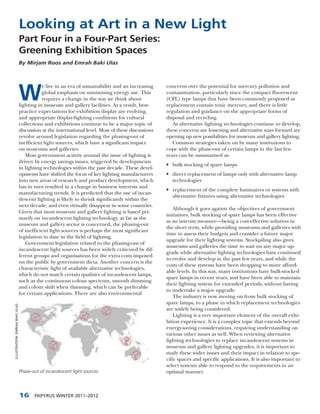
                                Phase-out of incandescent light sources.                           optimal manner.


                                16     PAPYRUS WINTER 2011–2012
It is important to understand that there is no one-size-           and white SON); low-pressure discharge sources (fluorescent
                                                      fits-all type of approach for exhibition lighting, and that a          lamps), and light-emitting diodes (LEDs). Although each has
                                                      wide range of lighting considerations need to be taken into            distinct characteristics and qualities, all of these technologies
                                                      account when looking for suitable options. These consid-               offer certain advantages and may be given consideration in
                                                      erations include issues such as the quality of light in terms          planning a new exhibition lighting system.
                                                      of its spectral characteristics, beam distribution and conser-            High-colour rendering versions of high-pressure discharge
                                                      vation aspects, as well as lamp life, maintenance, embodied            lamps have crisp white light and superior illumination
                                                      energy, disposal, recycling, flexibility, dimmability and con-         characteristics that are suitable for certain types of display
                                                      trol, future availability, and capital and operational costs.          lighting applications, whilst also being energy-efficient.
                                                      The change of lighting technologies also has an impact                 In addition, as a point source they can be controlled via
                                                      on air conditioning, as the new technologies generally                 optical means to achieve different effects. It must be taken
                                                      have a lower heat impact in the space, as compared to                  into account, however, that these types of lamps are not
                                                      incandescent lighting.                                                 practically dimmable through electronic means.
                                                          The oldest of all lighting techniques, daylight, should be            Low-pressure discharge lamps, such as linear fluorescent
                                                      considered as an option wherever possible. However, it is              tubes, are also available in high-colour rendering versions,
                                                      also perhaps the most challenging source of light compared             and can be effective in providing even and uniform display-
                                                      to the use of electrical lighting systems.                             lighting conditions. Furthermore, they are smoothly dim-
                                                          The dynamic and ever-changing characteristics of day-              mable using electronic control gear, are energy-efficient,
                                                      light make it difficult to apply in museum and gallery spaces.         and have long lamp life.
                                                      However, it is these same qualities that can often enhance                LEDs are the latest of the alternative technologies that
                                                      spaces significantly, adding comfort and enjoyment to the              have improved significantly within the past decade, and
                                                      visitor experience. Many museums and galleries have strict             have now become practical for some display-lighting appli-
                                                      guidelines on the use of daylight, and tend to eliminate it            cations. LEDs today are available in various warm, neutral
                                                      from exhibition spaces. Carefully designed use of daylight             or white colour temperatures, as well as tuneable colours,
                                                      helps save energy, however, while also increasing the spatial          and are dimmable on compatible control gear. The energy
                                                      quality of exhibition spaces.                                          performance of LEDs available on the market has just
                                                          As far as today’s alternative lamp technologies are con-           reached a stage that is comparable to fluorescent and
                                                      cerned, there are three current technologies that have                 metal-halide sources, and is expected to improve further.
                                                      reached the stage where they are able to provide good-                 Colour consistency, smooth dimmability and optical
                                                      quality lighting with significantly less operational energy,           control of the LEDs are still undergoing development,
                                                      compared to the incandescent sources. These are: high-                 and need to be carefully considered in the design and
                                                      pressure discharge sources (lamps such as the metal halide             planning process.
LIGHTING DESIGN: STEENSEN VARMING/PHOTO: SIMM STEEL


                                                                                                                                                                                                 LIGHTING DESIGN: STEENSEN VARMING/PHOTO: EMRAH BAKI ULAS


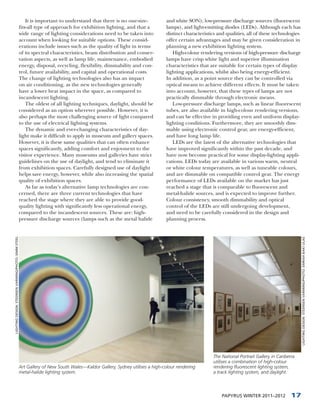
                                                                                                                                                   The National Portrait Gallery in Canberra
                                                                                                                                                   utilises a combination of high-colour
                                                      Art Gallery of New South Wales—Kaldor Gallery, Sydney utilises a high-colour rendering       rendering fluorescent lighting system,
                                                      metal-halide lighting system.                                                                a track lighting system, and daylight.


                                                                                                                                                       PAPYRUS WINTER 2011–2012           17
It is also worth mentioning Organic Light Emitting Diodes                            will become common within the architectural lighting
                                                       as an upcoming technology. There has been significant                                   market in the future.
                                                       interest and development in OLEDs in recent years.                                         Perspective on sustainability in lighting for exhibition
                                                       Whilst the practical uses of these sources are still limited                            spaces should be widened beyond light sources to include
                                                       to decorative effects and low-brightness applications for                               consideration of lighting controls as well. Often, how a
                                                       screens, mobile devices, etc., it is predicted that they                                lighting system is controlled can be at least as effective
                                                                                                                                               in saving energy as how efficient the light sources are in
LIGHTING DESIGN: STEENSEN VARMING/PHOTO: MIRJAM ROOS


                                                                                                                                               converting electricity to light. Techniques such as zoning,
                                                                                                                                               dimming, timer or occupancy controls can provide
                                                                                                                                               substantial cost and energy savings.
                                                                                                                                                  When planning new lighting systems or upgrading exist-
                                                                                                                                               ing lighting systems for exhibition display, a sustainable result
                                                                                                                                               should be achieved by focussing on the visitor experience,
                                                                                                                                               and by taking a holistic approach that understands the inter-
                                                                                                                                               dependence of design parameters and develops integral
                                                                                                                                               solutions. Consulting qualified and independent experts in
                                                                                                                                               the field of museum and gallery lighting not only simplifies
                                                                                                                                               a complex and multifaceted task, but also provides well-
                                                                                                                                               informed and tailored solutions that achieve a balance
                                                                                                                                               between optimal viewing conditions and conservation
                                                                                                                                               requirements, while often providing additional savings
                                                                                                                                               and creating sustainable outcomes.
                                                                                                                                               Mirjam Roos (MA, Dipl.Ing., Assoc PLDA) and Emrah Baki Ulas
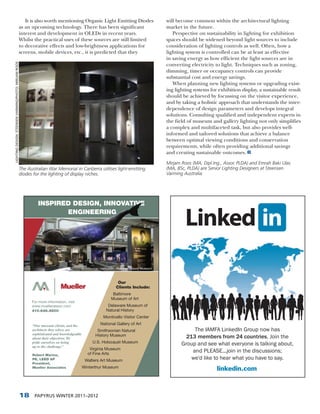
                                                       The Australian War Memorial in Canberra utilises light-emitting                         (MA, BSc, PLDA) are Senior Lighting Designers at Steensen
                                                       diodes for the lighting of display niches.                                              Varming Australia.


                                                                INSPIRED DESIGN, INNOVATIVE
                                                                       ENGINEERING


                                                                                           Smithsonian Institution - National History Museum


                                                                                                                    Our
                                                                                                                   Clients Include:
                                                                                                                Baltimore
                                                                                                               Museum of Art
                                                             For more information, visit
                                                             www.muellerassoc.com                            Delaware Museum of
                                                             410.646.4500                                   Natural History
                                                                                                          Monticello Visitor Center

                                                             “Our museum clients, and the               National Gallery of Art
                                                             architects they select, are              Smithsonian Natural                                  The IAMFA LinkedIn Group now has
                                                             sophisticated and knowledgeable
                                                             about their objectives. We
                                                                                                     History Museum                                     213 members from 24 countries. Join the
                                                             pride ourselves on being
                                                             up to the challenge.”
                                                                                                   U.S. Holocaust Museum                              Group and see what everyone is talking about,
                                                                                                  Virginia Museum
                                                                                                 of Fine Arts
                                                                                                                                                          and PLEASE...join in the discussions;
                                                             Robert Marino,
                                                             PE, LEED AP                        Walters Art Museum                                        we'd like to hear what you have to say.
                                                             President,
                                                                                               Winterthur Museum
                                                             Mueller Associates
                                                                                                                                                                       linkedin.com


                                                       18     PAPYRUS WINTER 2011–2012
LEED Certification for the National
Museum of the American Indian
By John Bixler


T
       he Smithsonian Institution’s
       Office of Facility Management
       and Reliability is all about best
practices in facility management, and
our latest best practice venture involves
LEED certification for the National
Museum of the American Indian.
   On November 14, 2011 a ceremony
was held in the Potomac Atrium at
the National Museum of the American
Indian, in celebration of the Museum
obtaining LEED Silver Certification.
NMAI is the first museum in the
Smithsonian Institution family to re-
ceive LEED certification credentials.
Contributors to this certification came
from various Office of Facility Manage-
ment and Reliability divisions, Building
Management, Energy Management,
Smithsonian Gardens, Engineering
Technicians, Facility Service Super-
visors and Workers, Life Safety and
Management Support Assistants.
   The Smithsonian Institution resolu-
tion to attempt LEED EB Certification       The National Museum of the American Indian in Washington, D.C. achieves LEED
                                            Silver Certification.
reflects its unique mission for the “the
increase and diffusion of knowledge,”
and aligns with its current strategic       have been some significant capital pur-      • Implementing policies/plans to
plan grand challenge: “sustaining a         chases, replacements, and equipment            improve the Museum’s sustainability
bio-diverse planet.”                        upgrades. These have included improv-
   In 2007, seeking to continue improv-     ing boiler-plant performance by up-             The National Museum of the
ing the sustainability of the NMAI, the     grading controls, providing variable-        American Indian (NMAI) was estab-
Museum’s founding director W. Richard       speed controllers on motors, and             lished in 1989 by Federal Public Law
West, Jr. made a commitment, with the       providing water softening for steam-         101-185 as a bureau within the Smith-
support of staff, to pursue Leadership      generating boilers. Improvements were        sonian Institution (SI). The legislation
in Energy and Environmental Design          also made to Museum-wide heating,            provided for the transfer from New York
(LEED) certification. Major motiva-         ventilation and air-conditioning             City of the extensive and extraordinary
tors included reducing the Museum’s         system performance, by upgrading             collection of the Heye Foundation’s
environmental impact, and providing         and integrating building automation          Museum of the American Indian. It
a healthier environment for staff and       with the Smithsonian-wide system.            also authorized the construction of
visitors. By the fall of 2007, the Smith-   Three major accomplishments of               three facilities which would together
sonian Institution had formed a core        the NMAI building’s sustainability           form the NMAI: an exhibition facility
team; engaged Indigo Engineering            performance were:                            at the Alexander Hamilton U.S.
Group, LLC to provide supporting                                                         Custom House in New York City (the
                                            • Reducting energy consumption
technical guidance; and commenced                                                        NMAI George Gustav Heye Center);
                                              by 20%
working on the necessary improvements.                                                   a public exhibition facility on the
    There had been no major renova-         • Choosing environmentally-friendly          National Mall in Washington, D.C.;
tions to the building since construction      certified products for 90% of              and a storage and resource facility (the
was completed in 2004. However there          chemical purchases                         NMAI Cultural Resources Center)


                                                                                             PAPYRUS WINTER 2011–2012       19
in Maryland at the Smithsonian’s          Engineer Design Team. The ground-            Gallery of Art, the National Air & Space
Suitland Collections Center.              breaking celebration for the NMAI Mall       Museum, the U.S. Department of
   The law also provided funding for      Museum was held on September 26,             Education, and the U.S. Department
outreach programs to Native commu-        1999. Site preparation was undertaken        of Health and Human Services. The
nities within the Western Hemisphere      from September 1999 to January 2001.         site is bounded by Jefferson Drive, SW
and established repatriation require-     Building construction began with the         on the north; Fourth Street, SW on
ments. These facilities and programs      Notice to Proceed on June 30, 2001.          the west; Independence and Maryland
are interdependent entities that, in      Construction was completed in mid-           Avenues to the south; and Third Street,
order to fulfill implementing agree-      2004, with occupation of the NMAI            SW to the east. The site covers an area
ments and legislation, must operate       building by SI staff beginning in            of approximately 4.4 acres.
together as one National Museum of        January of 2004. The official public             The curvilinear building was inspired
the American Indian. The legislation      grand opening was held on Septem-            by imagery of natural rock formations,
also mandated that the SI provide one-    ber 21, 2004, when visitors were first       eroded by wind and water. The build-
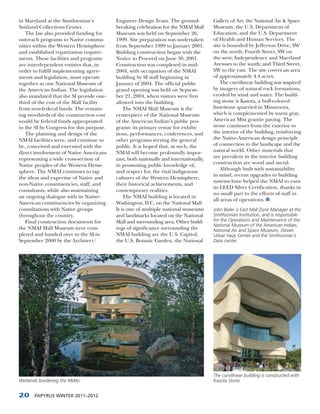
third of the cost of the Mall facility    allowed into the building.                   ing stone is Kasota, a buff-colored
from non-federal funds. The remain-           The NMAI Mall Museum is the              limestone quarried in Minnesota,
ing two-thirds of the construction cost   centerpiece of the National Museum           which is complemented by warm gray,
would be federal funds appropriated       of the American Indian’s public pro-         American Mist granite paving. The
to the SI by Congress for this purpose.   grams: its primary venue for exhibi-         stone continues from the exterior to
   The planning and design of the         tions, performances, conferences, and        the interior of the building, reinforcing
NMAI facilities were, and continue to     other programs serving the general           the Native-American design principle
be, conceived and executed with the       public. It is hoped that, as such, the       of connection to the landscape and the
direct involvement of Native Americans    NMAI will become profoundly impor-           natural world. Other materials that
representing a wide cross-section of      tant, both nationally and internationally,   are prevalent in the interior building
Native peoples of the Western Hemi-       in promoting public knowledge of,            construction are wood and metal.
                                                                                           Although built with sustainability
sphere. The NMAI continues to tap         and respect for, the vital indigenous
                                                                                       in mind, recent upgrades to building
the ideas and expertise of Native and     cultures of the Western Hemisphere,
                                                                                       systems have helped the NMAI to earn
non-Native constituencies, staff, and     their historical achievements, and
                                                                                       its LEED Silver Certification, thanks in
consultants, while also maintaining       contemporary realities.
                                                                                       no small part to the efforts of staff in
an ongoing dialogue with its Native-          The NMAI building is located in
                                                                                       all areas of operations.
American constituencies by organizing     Washington, D.C. on the National Mall.
consultations with Native groups          It is one of multiple national museums       John Bixler is East Mall Zone Manager at the
throughout the country.                   and landmarks located on the National        Smithsonian Institution, and is responsible
   Final construction documents for       Mall and surrounding area. Other build-      for the Operations and Maintenance of the
                                                                                       National Museum of the American Indian,
the NMAI Mall Museum were com-            ings of significance surrounding the         National Air and Space Museum, Steven
pleted and handed over to the SI in       NMAI building are the U.S. Capitol,          Udvar Hazy Center and the Smithsonian’s
September 2000 by the Architect/          the U.S. Botanic Garden, the National        Data center.


                                                                                       The curvilinear building is constructed with
Wetlands bordering the NMAI.                                                           Kasota Stone.


20     PAPYRUS WINTER 2011–2012
Benchmarking Workshop
                             Reveals Best Practices that
                             Save Money
                             By Stacey Wittig


“
 E
         ngagement with other participants after the data is             “How can some of you buy electricity at such low prices?”
         collected is key to the benchmarking process. This          one incredulous participant asked the group. Discussion
         is a strong type of professional improvement pro-           about collective purchasing and long-term futures contracts
gram,” said Keith McClanahan at the annual IAMFA Bench-              ensued. One member commented that perhaps political
marking Practices and Learning Workshop in Auckland.                 pressure might be superficially holding utility prices down
Designed to engage participants with roundtable forums               in his city.
and hot-topic discussions, the workshop kicked off the                   Another comparison in McClanahan’s analysis showed
2011 IAMFA Conference on November 13, 2011.                          that cleaning cost per area cleaned (square foot) had
   By comparing facility operating costs and practices,              bounced around over the past years: $2.85 in 2009, $2.23
the IAMFA benchmarking exercise uncovers the proven,                 in 2010, and $2.46 in the latest report. The discussion around
successful practices of better-performing institutions. The          cleaning brought to light many changes made over the
sharing of practical solutions and discussion of current             past year to try to get cleaning costs under control. While
issues is the main focus of the annual workshop. As best             some added shifts, others were eliminating shifts.
practices and lessons learned are shared and implemented                 “Day housekeeping was changed to day and night; that was
over the years, the group betters its overall performance.           mandated to us as a cost-cutting effort,” sighed one participant.
   Analyzing year-over-year trends for the group, McClanahan             Another institution switched to daytime-only cleaning
summarized, “Energy costs are getting more and more under            and found a positive result. “The cleaning people become
control. There is less consumption than last year.” In fact,         part of the team, the building is being handled better, there
the median electrical consumption per GSF was 19.50 kilo-            is less damage,” the institute’s facility director revealed.
watt hours (KWH) in 2011, as compared to 23.73 KWH in                    One participant explained, “We went from three shifts
2009 and 23.50 KWH in 2010. McClanahan, principal of                 to two shifts, but then overlapped the shifts during mid-day
Facility Issues, which runs the benchmarking exercise,               when cleaning was most needed. We bought chariots
noted little change in electrical cost per KWH reported              (stand-on floor cleaners) and increased technology.”
over the past three years: $0.113 in 2009, $0.114 in 2010,               “Night shifts eliminate overtime for after-hour events,”
and $0.112 in 2011.                                                  advised another.


Participants in the 2011 IAMFA Benchmarking and Learning Workshop.                         caption?


                                                                                               PAPYRUS WINTER 2011–2012          21
Frequency of cleaning was also in flux this year, as facility      Returning participants included the Art Institute
administrators looked to reduce costs. “We went from five          of Chicago, Baltimore Museum of Art, British Library,
cleanings per week to three cleanings per week. We revised         Canadian Museum of Civilization, Canadian Museum of
the scope of the cleaning contract and reduced the number          Nature, Canadian War Museum, Carnegie Museums of
of staff. Now there is a central location for trash collection     Pittsburgh, Denver Museum of Nature and Science, Getty
where employees empty their own wastebaskets. Areas with           Center, Getty Villa, Harley-Davidson Museum, Los Angeles
low visibility and low impact get fewer cleanings,” reported       County Museum of Art, Library of Congress, National
one participant.                                                   Gallery of Australia, National Gallery of Victoria, National
   “Let the contractor decide what needs to be cleaned two         Library of Scotland, National Portrait Gallery Australia,
times or three times per week,” suggested a fellow facility        Natural History Museum – London, Philadelphia Museum
administrator.                                                     of Art, Royal B.C. Museum, Smithsonian Anacostia Museum
   Feedback from the 2011 Benchmarking Practices and               and Center for African American History and Culture,
Learning Workshop suggests that discussions like these             Smithsonian Conservation Biology Institute, Smithsonian
lead to better understanding. Many participants say that           Donald W. Reynolds Center, Smithsonian Environmental
workshop take-aways can be implemented after they return           Research Center, Smithsonian Freer Gallery of Art,
home from the Conference. That could be one of the reasons         Smithsonian Hirshhorn Museum & Sculpture Garden,
that the average operating cost savings per institute since        Smithsonian Museum of American History, Smithsonian
2007 is now over $4 million. Don’t miss next year’s discus-        Museum Support Center, Smithsonian National Air &
sions. Be a part of the cost savings. Sign up now for the 2012     Space Museum, Smithsonian National Museum of Natural
IAMFA Benchmarking Exercise at: www.facilityissues.com/            History, Smithsonian National Museum of the American
Registration/IAMFA/REG_IAMFA.asp                                   Indian, Smithsonian National Museum of the American
   The 2011 IAMFA Benchmarking Exercise was sponsored              Indian—Cultural Resources Center, Smithsonian National
by Conrad Engineers, McGuire Engineers and Steensen                Zoological Park, Smithsonian Quadrangle, Smithsonian
Varming. New IAMFA benchmarking participants included              Renwick Gallery, Smithsonian Steven F. Udvar Hazy Center,
the Australian Centre for the Moving Image, the California         and Winterthur Museum.
Academy of Sciences, Library and Archives Canada, the
McMichael Canadian Art Collection, the Museum of                   Stacey Wittig is the Marketing Director for Facility Issues located in
Old and New Art, and Questacon—National Science &                  Flagstaff, AZ. She can be reached at Stacey.wittig@facilityissues.com
Technology Centre.


                                                                           Become a Member
                                                                               of IAMFA
                                                                                For more information on becoming
                                                                                           a member of the
                                                                               International Association of Museum
                                                                                 Facility Administrators, please visit
                                                                                          WWW.IAMFA.ORG
                                                                                                       or
                                                                                              See page 24
                                                                                   for details and enrollment form


22     PAPYRUS WINTER 2011–2012
Out of Sight, Out of Mind
Museum Collections in Storage at Serious Risk
Around the World
By Simon Lambert


P
      recious artifacts and national           For the past 20 years, ICCROM has        About ICCROM
      treasures hidden away in the          worked to improve the condition of          The International Centre for the Study
      underbelly of museums are not         museum storage worldwide by orga-           of the Preservation and Restoration of
as safe as we think. A recent interna-      nizing international training activities,   Cultural Property (ICCROM) is an
tional survey on museum storage by          developing assessment tools, raising        intergovernmental organization dedi-
the International Centre for the Study      public awareness, and sending expert        cated to the preservation of cultural
of the Preservation and Restoration of      missions.                                   heritage worldwide through training,
Cultural Property (ICCROM) and the             Mr. Gaël de Guichen, Special Advisor     information, research, cooperation
United Nations Educational, Scientific      to the Director General of ICCROM,          and advocacy programmes. It aims to
and Cultural Organization (UNESCO)          commented: “This is the first time we       enhance the field of conservation-
confirms that, all over the world,          have a clear picture of the situation.      restoration and raise awareness of the
museum collections in storage suffer        In my 40 years of service at ICCROM,        importance and fragility of cultural
from poor management and lack of            which has taken me all over the world,      heritage. The creation of the Centre
maintenance, adequate space and             I estimated that about 60% of museum        took place as a result of a proposal at
equipment. This is particularly dis-        storage was in unacceptable conditions.     the UNESCO General Conference
turbing because on average 90% of           With this data, we have a clearer picture   held in New Delhi, in 1956. Three years
museum objects are in storage, and          of the problem areas. Most importantly,     later, the Centre was established in
despite poor conditions, collections        we have confirmation that this is not       Rome, Italy, where its headquarters
continue to grow exponentially.             a developed vs. developing country          remain to this day. ICCROM responds
    Of the 1,490 responses received from    issue: all countries find themselves in     to the needs of its member states, which
136 countries, one in four museums          the same situation.”                        as of February 2010 numbered 129.
reports that its storage areas are so          The survey ran from June to Sep-
overcrowded that it has become diffi-       tember 2011, and was developed as part
cult or impossible to get from one end      of a joint activity between ICCROM and      About UNESCO
to the other.                               UNESCO on the Preventive Conserva-          The United Nations Educational,
    For two in three museums, the over-     tion of Endangered Museum Collections       Scientific and Cultural Organization
all lack of space is a problem identified   in Developing Countries. In September       (UNESCO) is a specialized agency of
as “major” or “drastic”. However, the       2011, ICCROM and UNESCO launched            the United Nations. Its stated purpose
survey points to important root causes:     “RE-ORG” [http://www.re-org.info],          is to contribute to peace and security
two in five museums report an impor-        a new online tool for storage reorgani-     by promoting international collabora-
tant lack of management support for         zation, developed by a task force of        tion through education, science, and
storage-related activities and a lack of    museum professionals from 15 coun-          culture, in order to further universal
trained staff.                              tries on five continents to assist small    respect for justice, the rule of law, and
    Equally striking is the fact that, in   museums in reorganizing their storage       human rights, along with fundamental
one out of three museums, it seems          and documentation systems. Online           freedoms proclaimed in the U.N.
unclear who is responsible for stor-        registration to RE-ORG is free and          Charter. It is the heir of the League of
age. Furthermore, in one out of ten         grants access to guidelines, assessment     Nations’ International Commission on
museums, the theft of objects from          tools, an image database, and teaching      Intellectual Cooperation. UNESCO
the collection is considered to be a        materials.                                  has 193 Member States and seven
major problem.                                 In response to the survey results,       Associate Members.
    One museum wrote: “Our storage          ICCROM is currently looking for part-
                                                                                        Simon Lambert works with the Collections
is 400% over capacity and growing at a      nerships and funding to launch an           Unit of ICCROM, and can be reached at
rate of 100–200 new objects per year.”      international programme to strengthen       sl@iccrom.org.
    “The main problem is taking care        professional and institutional capacity
of incoming material. A documenta-          in addressing the key needs identified
tion backlog of 10+ years is routine,”      in this survey.
said another.


                                                                                            PAPYRUS WINTER 2011–2012        23
Become a Member of IAMFA
AND GET A FRIEND TO JOIN
On behalf of the membership and Board, we invite you                  Membership Opportunities
to join with other museums and cultural organizations                 Join the IAMFA at any of the following levels and enjoy
throughout the world in becoming a member of the only                 full benefits of membership:
organization exclusively devoted to museum and cultural
facility administrators: the International Association of             Regular Member — $200 annually. A regular member
Museum Facility Administrators (IAMFA). As a member,                  holds the position of principal administration in direct
you will join a growing list of museum and cultural facility          charge of the management of facilities, and represents
administrators in their efforts to provide a standard of              their institution(s) as a member of the association.
excellence and quality in planning, development and design,           Associate Member — $75 annually. An associate member is
construction, operation and maintenance of cultural                   a full-time facilities management employee (professional,
facilities of all sizes and varieties of programming.                 administrative or supervisor), below the level of the
The Association currently has representation in several               facility administrator of the member association.
countries on three continents. Our goal is to increase                Affiliate Member — $75 annually. An affiliate member is
membership in institutions throughout the world.                      any full-time employee of a member institution who is not
                                                                      directly involved in the facilities management department.
Your involvement in IAMFA will continue the growth
of the organization and provide you with excellent                    Retired Member — $75 annually. A retired member is
educational and networking opportunities. As your                     retired, and no longer involved in facilities management.
colleagues, we look forward to welcoming you to
                                                                      Subscribing Member — $400 annually. A subscribing
membership in IAMFA.
                                                                      member is an individual, organization, manufacturer of
Cordially yours,                                                      supplier of goods services to the institutions who ascribes
The Board of the International Association of Museum                  to the policies and programmes of the Association, and
Facility Administrators                                               wishes to support the activities of the Association.


                     Send in your membership dues by using the convenient form below.
         Membership payments and conference registration can also be made online at www.IAMFA.org
                              Don’t forget to make a copy to give to a colleague.

    ¡
                  YES! I would like to join IAMFA as a:
                  Ⅺ Regular Member        $200          Ⅺ Retired Member            $ 75
                  Ⅺ Affiliate Member      $ 75          Ⅺ Subscribing Member        $400
                  Ⅺ Associate Member $ 75               Ⅺ I am interested in joining. Please have a member contact me.


    Institution: __________________________________________________________________________________________________________________

    Name: ______________________________________________________________________________     Title: ________________________________

    Address: ____________________________________________________________________________    City: _________________________________

    State/Province: _______________________      Zip/Postal Code: _______________________    Country:_____________________________

    Phone: _____________________________________ Fax: ____________________________________   E-mail: ______________________________

                                                                     Please remit to:
    ALL FEES ARE PAYABLE IN U.S. DOLLARS
                                                                     International Association of Museum Facility Administrators
                                                                     P.O. Box 454
    Ⅺ I enclose a check in the amount of $ ____________________
                                                                     Bel Air, MD 21014, USA
    Ⅺ Please invoice me
                                                                     Website: www.iamfa.org
21st Annual IAMFA Conference


                       PAPYRUS WINTER 2011–2012   25
21st Annual IAMFA Conferen


26   PAPYRUS WINTER 2011–2012
ce in Auckland, New Zealand


                              PAPYRUS WINTER 2011–2012   27
21st Annual IAMFA Conference


28   PAPYRUS WINTER 2011–2012
Coming Attractions
Preview of the 2012 IAMFA Mid-Atlantic                                                            IAMFA
                                                                                                   2012
Conference
By the 2012 Conference Team
                                                                                           INTERNATIONAL ASSOCIATION OF
                                                                                           MUSEUM FACILITY ADMINISTRATORS


W
           elcome to Philadelphia           Exposition of the same year. Originally    home. In rooms reflective of the inti-
           and the Brandywine Valley        called the Pennsylvania Museum and         mate layout and unique character
           in 2012!                         School of Industrial Art, its founding     of the original Merion galleries, this
   By the time you read this, it will be    was inspired by the South Kensington       renowned art collection will be acces-
just eight months until the start of the    Museum (now the Victoria and Albert        sible to the public as never before.
22nd IAMFA Annual Conference. The           Museum) in London, which grew out          Celebrated for its exceptional breadth,
2012 Conference will be called the          of the Great Exhibition of 1851. The       depth, and quality, the Barnes Foun-
Mid-Atlantic Conference because             Philadelphia Museum of Art houses          dation art collection includes works
venues will be in an area in the Mid-       over 225,000 works of art and a wealth     by some of the greatest European and
Atlantic region of the United States.       of exhibitions, encompassing some of       American masters of impressionism,
All venues will be within 30 minutes        the greatest achievements of human         post-impressionism, and early mod-
of each other, but are located in two       creativity.                                ern art, as well as African sculpture,
states: Delaware and Pennsylvania,                                                     Pennsylvania German decorative arts,
both rich in American history.                                                         Native-American textiles, metalwork,
                                            Rodin Museum
   The conference is scheduled for                                                     and more.
September 16–19, 2012, so mark your
calendars, and begin soon to make
your plans to attend. Registration infor-                                              The Delaware Art Museum
mation is up on the www.IAMFA.ORG
website now, so don’t wait—make your
plans now!
   Read on for information on each of
the 2012 Conference venues.

Philadelphia Museum
of Art                                      Located near the Philadelphia Museum
                                            of Art, the Rodin Museum houses
                                            the largest public collection of works,    The Delaware Art Museum is best
                                            outside of Paris, by the celebrated late   known for its large collection of
                                            nineteenth-century French sculptor         British Pre-Raphaelite art; works by
                                            Auguste Rodin.                             Wilmington-native Howard Pyle and
                                                                                       fellow American illustrators; and urban
                                                                                       landscapes by John Sloan and his circle.
                                            The Barnes Foundation                      Founded in 1912, the Delaware Art
                                                                                       Museum houses a world-renowned
                                                                                       collection that focuses on American
                                                                                       art and illustration from the nine-
                                                                                       teenth to the twenty-first centuries,
The Philadelphia Museum of Art is                                                      as well as the British Pre-Raphaelite
among the largest art museums in                                                       movement of the mid-nineteenth
the United States. It is located at the                                                century. The Museum features an
western end of the Benjamin Franklin                                                   outdoor Sculpture Park, the Helen
Parkway, in Philadelphia’s Fairmount                                                   Farr Sloan Library & Archives, Studio
Park. The Museum was established in         On May 19, 2012, the Barnes Founda-        Art Classes, and the interactive Kids’
1876 in conjunction with the Centennial     tion will unveil its new Philadelphia      Corner learning area.


                                                                                          PAPYRUS WINTER 2011–2012          29
Winterthur Museum and                        also home to the Winterthur Program          exotic plants and horticulture (both
Country Estate                               in Early American Culture and the            indoor and outdoor), events and
                                             Winterthur/University of Delaware            performances, seasonal and themed
                                             Art Conservation program.                    attractions, as well as educational
                                                                                          lectures, courses and workshops.
                                                                                              What is now Longwood Gardens
                                             Hagley Museum                                was originally purchased from William
                                                                                          Penn in 1700 by a fellow Quaker named
                                                                                          George Peirce (1646–1734). Although
                                                                                          it started as a working farm, in 1798
                                                                                          twin brothers Joshua and Samuel Peirce
                                                                                          planted the first specimens of an arbor-
                                                                                          etum, originally named Peirce’s Park,
                                                                                          which has been open to the public
                                                                                          almost continuously since that time.
                                                                                          By 1850, they had amassed one of the
                                                                                          finest collections of trees in the nation.
                                                                                              Industrialist Pierre S. du Pont
                                                                                          (1870–1954) purchased the property
Winterthur Museum and Country Estate
                                                                                          from the Peirce family in 1906 to save
is located in Winterthur, Delaware, and
                                                                                          the arboretum from being sold for
houses one of the most important col-
                                                                                          lumber. He made it his private estate
lections of Americana in the United          Located close to Winterthur, Hagley          and, from 1906 until the 1930s,
States. It was the former home of            Museum and Library is where the              du Pont added extensively to the
Henry Francis du Pont (1880–1969):           du Pont story begins. It was here that       property. A world traveler from an
a renowned antiques collector and            in 1802 E.I. du Pont established a gun-      early age, du Pont was often inspired
horticulturist. Until recently, it was       powder mill, which evolved into a major      to add features to the garden after
known as the “Henry Francis DuPont           international corporation with world-        attending world’s fairs, the most notable
Winterthur Museum”.                          wide impact. We will visit the scenic        additions being the massive conserva-
    Winterthur is situated on 979 acres      235-acre campus along the banks of the       tory, complete with a massive pipe
(4 km2), near Brandywine Creek, with         Brandywine River, which includes the         organ, and the extensive system of
60 acres (0.2 km2) of naturalistic gar-      original mills of the DuPont Company,        fountains. Mr. Du Pont opened his
dens. There were 2,500 acres (10 km2)        working machinery, a restored workers’       estate to the public many days of the
when it functioned as a country estate.      community, and the fascinating links         year during his occupancy and was
    There are 175 period-room displays       between history, science, and technology.    even known, on rare occasions,
in the Museum and approximately
                                                                                          to personally (and anonymously)
85,000 objects. Most rooms are open
to the public on small, guided tours.        Longwood Gardens                             provide tours to visitors.
The collection spans more than two
centuries of American decorative arts,                                                    National Museum of
notably from 1640 to 1860, and con-                                                       American Jewish History
tains some of the most important pieces
of American furniture and fine art.
The Winterthur Library and Research
Center includes more than 87,000 vol-
umes and approximately 500,000 manu-
scripts and images, mostly related to
American history, the decorative arts,
and architecture. The facility also houses
extensive conservation, research, and        Longwood Gardens consists of over
education facilities.                        1,077 acres (435 ha) of gardens, wood-
    In the 1990s, more informal museum       lands, and meadows in Kennett Square,
galleries were opened in a new build-        Pennsylvania in the Brandywine Creek         The National Museum of American
ing adjacent to the main house, where        Valley. It is one of the premier botanical   Jewish History has long been a vital
special rotating and permanent exhi-         gardens in the United States, and is         component in the cultural life of
bits are now housed. The Museum is           open to visitors year-round offering         Philadelphia. Over the course of its


30     PAPYRUS WINTER 2011–2012
history, the NMAJH has attracted a          the Declaration of Independence was         devoted to the Constitution, the Center
broad regional audience to its public       adopted here on July 4, 1776. In the        illuminates constitutional ideals and
programs, while exploring American          same room, the design of the American       inspires acts of citizenship, so that “We
Jewish identity through lectures, panel     flag was agreed upon in 1777; the           the People” may better secure the
discussions, authors’ talks, films, chil-   Articles of Confederation were adopted      blessings of liberty to ourselves and
dren’s activities, theater, and music.      in 1781; and the U. S. Constitution         our posterity.
The Museum has displayed more than          was drafted in 1787. The building,
a hundred exhibitions in its first three    inside and out, has been restored           Ritz-Carlton Philadelphia
decades of existence. As the reposi-        wherever possible to its original late-
tory of the largest collection of Jewish    eighteenth-century appearance. Most
Americana in the world, with more           of the furnishings are period pieces.
than 25,000 objects, the NMAJH has          The “rising sun” chair used by George
developed extensive institutional expe-     Washington as he presided over the
rience in preservation, conservation        Constitutional Convention is original.
and collections management sup-
porting the fulfillment of its mission      National Constitution
to preserve the material culture of
American Jews.
                                            Center
                                                                                        Located in one of Philadelphia’s most
Independence Hall                                                                       historic buildings, the Ritz-Carlton
                                                                                        Philadelphia is a luxury hotel situated on
                                                                                        the city’s Avenue of the Arts: a stretch
                                                                                        of Broad Street that is loaded with fine
                                                                                        arts venues. It is also within walking
                                                                                        distance of a number of other notable
                                                                                        attractions, including the Kimmel
                                                                                        Center, the Academy of Music, City Hall,
                                                                                        Rittenhouse Square, several theaters,
                                                                                        and many historical buildings.
                                                                                           The hotel itself is located in the old
Constructed between 1732 and 1756                                                       Girard Bank Building, which was built
as the State House of the Province of                                                   in the 1830s. This stunning Neoclassical
Pennsylvania, Independence Hall is                                                      building with its signature rotunda is
considered a fine example of Georgian                                                   an ideal setting for a luxury hotel, and
architecture. From 1775 to 1783 (except                                                 has become one of the most popular
for the winter of 1777–1778, when                                                       lodging choices in the city for those who
                                            Located on Independence Mall, the
Philadelphia was occupied by the                                                        are looking for upscale accommodation.
                                            National Constitution Center brings
British Army), this was the meeting                                                        This is just a taste of what awaits
                                            the U.S. Constitution to life for the
place for the Second Continental                                                        you at the Annual Conference in
                                            whole family through multimedia exhi-
Congress. It was in the Assembly Room                                                   Philadelphia and the Brandywine
                                            bitions, live performances, timely public
of this building that George Washington                                                 Valley in 2012. We look forward to
                                            programs and dynamic educational
was appointed Commander-in-Chief                                                        hosting you and your families.
                                            resources. As America’s first and only
of the Continental Army in 1775, and
                                            non-partisan, non-profit institution


                                                                 Past issues of Papyrus
                                                           can be found on IAMFA's website
                                                                  www.IAMFA.org


                                                                                            PAPYRUS WINTER 2011–2012         31
A Sustainable Design Approach to
Preservation Centres
By Martin Turpin


L
     ibrary and Archives Canada (LAC) recently completed


                                                                                                                                     PHOTO: GORDON KING, 2011
     a nitrate film preservation centre in Ottawa, Canada,
     merging strict conservation requirements and sustain-
able design principles. The facility houses LAC’s nitrate-
based holdings, which cover many of Canada’s important
efforts during the First and Second World Wars. Other
well-known archival holdings, such as the country’s early
work in filmmaking (Back to God’s Country, 1919) and
Yousuf Karsh’s earliest photographic works, are kept in
the preservation vaults.
   The project team demonstrated leadership in the area of
sustainable design, which resulted in a building having a min-
imal impact on the environment. Their work was recognized
with the Public Service of Canada Innovation Award.

Design Intent
When the design phase began in 2003, Library and Archives
Canada decided to make it a priority to build a green facility.
The building’s function as a preservation facility requires a
high level of energy to preserve its collection at 2°C and
25% relative humidity, which is the environment required
to ensure that the cellulose nitrate films and photographic
negatives are well preserved. While the project team opted
to use the same approach to design the facility as the LEED
standard (set by the Canadian Green Building Council),
with the available technologies, they did so without pur-
suing accreditation because of the building’s high energy
consumption and distance from the downtown core.
   Some concepts adopted for the project included a simple        LAC Nitrate Film Preservation Facility.
volume facility with an exterior building envelope comprised
of a green roof, highly insulated walls, and high-efficiency
windows. The mechanical and electrical systems include
energy-recovery ventilators, instant hot-water systems,
and occupancy light controls with LED/fluorescent light
fixtures. Care was taken to nestle the building within the
site’s bedrock, orienting it to minimize site excavation.
   The archival processing room and digitization room
were designed to be interchangeable, and are equipped
with adaptable workstations, allowing flexibility for future
conservation and digitization technologies. These rooms,
located on the northern side of the facility, highlighted in
red in the rendering below, include large high-efficiency
windows that are more airtight and provide superior
insulation value to regular window systems.
   While the inclusion of high-efficiency windows was
largely for occupant comfort, the northerly direction of          LEGEND
each room helps reduce the heat load and avoids the               Blue: Preservation vaults    Beige: Loading dock area
                                                                  Red: Laboratories            Yellow: Mechanical room
casting of direct sunlight on the collections handled in
these rooms.                                                      Architect’s rendering of the Nitrate Film Preservation Facility.


32     PAPYRUS WINTER 2011–2012
The preservation vault wing, represented in blue on the        which reduced the leakage of conditioned air in the adjacent
                           rendering, required thick walls for fire separation. These        occupied spaces. And finally, the inclusion of a green roof
                           walls were also used as structural support for the green roof,    over the preservation vault area contributes to the reduction
                           saving the cost premium to support the weight of the green        of the cooling load on the mechanical systems.
                           roof and helping to expedite the construction process. The           Due to the preservation vaults being kept at 2°C, the
                           utilization of fly ash in the concrete helped to reduce the       vault wing functions as a large refrigerator. Consequently,
                           quantity of Portland cement, lessening the environmental          efforts to design the mechanical system to minimize energy
                           impact, improving fire resistance, and reducing wall thickness.   use include an independent Energy Recovery Ventilator
                                                                                             (ERV) and Variable Speed Drives (VSD). The ERV recovers
                           Extensive Vegetative Green Roof                                   the energy from the vault exhaust air and reuses this energy
                           The main advantage of incorporating the vegetative roof           to cool the fresh air going into the building, while the
                           was to provide a buffer zone between the indoor 2°C envi-         VSD, on the building’s mechanical systems, operate only
                           ronment (of the preservation vaults), and outdoor heat            when required, and to the level of the occupant load,
                           during the summer months. According to research by the            instead of running continuously.
                           National Research Council of Canada, a green roof would              Instantaneous hot-water heaters, for all domestic water
                           reduce the summer peak roof temperature from 70°C, on             heating, eliminate the energy wasted with hot-water tanks
                           typical tar roofs, to 30°C on a green roof. To best explain       when they are not in use. Energy is thus used only when
                           this, it is the equivalent of the temperature of a grass lawn     the occupants need it. Duty boilers are used to provide the
                           versus paved asphalt on a hot summer day. Therefore, you          necessary heat to the desiccant wheels for dehumidification
                           only need to cool 28°C (30°C minus 2°C), on a green roof,         in the preservation vaults. To make the most of the boilers,
                           versus 68°C (70°C minus 2°C) for a typical tar roof. In           they are also used for supplemental radiant heating to the
                           addition, a green roof will reduce the load on the city’s         occupied spaces and to complement the heating, ventilation
                           water treatment plants by eliminating water runoff, and           and air conditioning systems, improving individual control
                           will extend the life of the roof membrane by 30 years.            of these spaces and occupant comfort.
                                                                                                Efficient fluorescent and LED fixtures, controlled with
                           Energy and Water Efficiency                                       occupancy sensors, were used in the facility to reduce the
                           The energy performance of the building was maximized              energy load. Occupied spaces are outfitted with large
                           through the selection of appropriate building components          windows to maximize daylight; and the metal roof decking,
                           and systems. Utilizing super-insulation construction details      which acts as the finished ceiling, is painted white to reflect
                           and capitalizing on thermal massing helps to retain the           as much light as possible into these spaces.
                           ambient temperature in the space, thereby lessening the              Water consumption for the facility is reduced by provid-
                           requirement for cooling or heating. To explain this in a          ing touchless (for improved sanitation) lowflush fixtures,
                           simpler way, think of your home refrigerator. It is more          and drought-resistant plants for the green roof and the site.
                           efficient when it is full than when it is empty, because the      The landscaping is a managed meadow of native species,
                           content (mass) helps to retain the desired temperature            with only a small portion requiring maintenance, thus
                           without continuously cooling the inside of the refrigerator.      reducing ongoing maintenance costs. The landscape
                              Another initiative to reduce air loss was the introduction     architect was committed to returning much of the site
                           of an acclimatization corridor in the preservation vault area,    to its pre-development state, using indigenous plants.
PHOTO: GORDON KING, 2011


                           Main entrance area.


                                                                                                                      PAPYRUS WINTER 2011–2012         33
Carbon Footprint                                                              Conclusion


  HAWKINS: PROUD BUILDER OF THE
  AUCKLAND ART GALLERY DEVELOPMENT.
In order to reduce our environmental impact, the criteria                     Even with construction completed, LAC continues to pro-
used to source the building finishes were based on: local                     mote sustainable practices by educating the occupants and
products (to reduce transportation from the producers to                      visitors about the benefits of sustainable design, specifying
our door); durable products with the same lifespan as the                     green maintenance practices (using non-toxic products
building;and products that require little to no maintenance.                  that have minimal impact on the environment) in the
Such products include interior and exterior metal walls                       facility, and through active design:a shower facility was
(using 25% recycled content) that were painted offsite to                     included in the building to encourage employees to lead
avoid the introduction of pollutants into the laboratories                    active lifestyles at the workplace.
and occupied spaces.                                                              Building construction has a significant impact on the
   Using polished concrete floors and poured concrete walls,                  use of non-renewable resources, as well as our environ-
with the maximum amount of post-industrial recycled                           ment. This is especially true when it comes to collection
material (fly ash), and exposed architectural concrete                        facilities, designed with high preservation standards, which
blocks, eliminated cyclical replacement and maintenance                       often consume a lot of energy.
of these finishes.
   Exposing the roof decking and structure not only allows                    Martin Turpin is Capital Project Manager at Library and Archives
                                                                              Canada, in Ottawa.
the reflection of light from the fixtures, but also provides
easy access for maintenance work, eliminating the need for
a suspended ceiling. Careful consideration was made in the                      Project Team
selection of the cabinetry for the kitchen and washrooms,
which were constructed with rapidly renewable agricultural                      Primary Consultants
fibres and Forest Stewardship Council Canada (FSC) wood.                        Schoeler & Heaton Architects
The interior design eliminates all unnecessary applied fin-
ishes and exposes the structural and mechanical building                        Sub-Consultants
systems (which are used as design elements).                                    Mechanical/Electrical: Goodkey Weedmark & Associates
   Creating the optimal preservation condition was para-                        Landscape Architect: F.D. Fountain Landscape Architecture


  The Auckland Art Gallery development has been an inspiring and ground breaking
  project for Hawkins, and we applaud the commitment and vision of Auckland Art
mount in the design of the facility, in order to preserve                       Structural: Adjeleian Allen Rubeli


  Gallery, and its wide network of supporters, in realising this ambitious project.
Canada’s nitrate-based documentary heritage for present                         Commissioning: Cathcart Mechanical Performance


  We expect that all users of this great facility will draw as much enjoyment from it
and future generations. While using a sustainable design


  as we have building it.
                                                                                Site Services: Stantec Consulting
approach, the project team managed to construct the
“coolest”—at 2°C—nitrate film preservation centre in                            General Contractor
North America, while minimizing its impact on the                               Laurin Group
environment and reducing its carbon footprint.


  Hawkins Auckland
  Level 2 - Hawkins House, 70 Stanley St, Parnell, Auckland

  Phone | 09 918 8100
  Private Bag 93214 Parnell, Auckland 1151
                                                                                                              Please join us
                                                                                                         September 16–19, 2012
                                                                                                          in Philadelphia for the
                                                                                                          22nd Annual IAMFA
                                                                                                             Conference
                                                                                                        It will be a Historical Event!
                                                                                                        For more information, please visit
                                                                                                                www.IAMFA.org


34      PAPYRUS WINTER 2011–2012
An Unexpected Attendance at the
Lighting Designer’s Academy Awards
By Alan Dirican


A
         fter attending a wonderful and           On my second day in Sydney, I                not be able to attend the awards dinner,
         highly educational IAMFA              met Emrah in his office at Steensen             which left an available seat at their
         Conference in Auckland,               Varming. After meeting his colleagues           table. I was so surprised when they
New Zealand, like many other atten-            and touring their very sleek and con-           asked me to join them. Having no
dees I also decided to take a few extra        temporary offices, Emrah gave me a              previous set plans of my own for the
vacation days and do some sightseeing.         personal tour of the Kaldor Gallery.            night, and already having a tux in
After all, most of us don’t get to travel to      Emrah also gave me a behind-the-             my suitcase—but more importantly
the Southern Hemisphere very often.            scenes tour of the Sydney Opera House,          curious about the outcome of the
I decided on spending the three                where I also saw Steensen Varming’s             awards—I accepted the invitation.
days after the IAMFA Conference                work. Steensen Varming were mechan-                I had never attended an event like
in Sydney, Australia.                          ical consulting engineers for the Sydney        the IESANZ before, but it became
    While in Sydney, I visited one of the      Opera House.                                    clear to me that this was like the light-
local residents whom we had all just              Just as Emrah was explaining that            ing designers’ Oscars. Throughout the
met at the IAMFA Conference, and               we had to cut our tour short due to             evening, there were a half-dozen dif-
who also happens to be a very talented         a previous engagement—he had to                 ferent awards presented to individuals
lighting designer: Emrah Baki Ulas. If         attend the Illumination Engineers               in different categories, each represent-
you attended the Auckland Conference,          Society of Australia and New Zealand            ing achievements in the lighting field.
you heard Emrah make a presentation.           (IESANZ) awards ceremony with his                  Like the Oscars, the most prestigious
If you didn’t attend, Emrah also co-           colleagues from Steensen Varming—               award was saved for the end of the
authored a recent four-part series             he received a phone call from his               evening. After showing all the final
article in Papyrus: Looking at Art in a        boss, Dan Mackenzie.                            project selections, including both
New Light. Emrah and his co-author                Emrah had earlier explained to me            Mirjam’s and Emrah’s designs from
Mirjam Roos, another very talented             that their firm submitted two differ-           Steensen Varming, the jury made its
lighting designer, both work for               ent lighting projects for the IESANZ            decision. The announcer informed the
Steensen Varming, a consulting firm            Lighting Design Excellence Awards.              audience that the IESANZ Lighting
based in Sydney, Australia, which was          One of the projects was his design for
also a Principal Sponsor of the 2011           the Kaldor Family Gallery; the other
Auckland Conference.                           was Mirjam’s design for the Australian
    After seeing and admiring Mirjam’s         War Memorial Hall of Valour Gallery.
lighting design work at the Auckland           I couldn’t help but sense the friendly
Art Gallery Toi o T¯ maki, I thought
                      a                        rivalry between these two talented
it might be nice to see some of Emrah’s        lighting designers, who are colleagues
design work as well. During the                at the same firm, and partners in
Auckland Conference, Emrah men-                personal life.
tioned his design at the John Kaldor              On the phone, Emrah’s boss Dan
Family Gallery at the Art Gallery of           was telling him that one of his col-
New South Wales, in Sydney.                    leagues was not feeling well, and would         The iconic Sydney Opera House.


The Kaldor Family Gallery at the Art Gallery of New South Wales. Lighting Design: Emrah Ulas


                                                                                                  PAPYRUS WINTER 2011–2012         35
Design Excellence Award went to the            win. I think he just didn’t want to   the announcer indicated that the jury
design work for the Kaldor Family              sleep in the doghouse that night.     had had a very difficult time making a
Gallery in the Art Gallery of New South           Then something very interesting    decision between two projects among
Wales. Earlier in the night, Emrah told        happened. Apparently for the first    the final selections, and ultimately de-
me that he was hoping for Mirjam to            time in the history of the IESANZ,    cided two give two Excellence Awards.
                                                                                     To the surprise of everyone, the other
                                                                                     winner was the Australia War Memorial,
                                                                                     which was also Steensen Varming
                                                                                     project, and designed by Mirjam Roos.
                                                                                        I could clearly see the joy and pride
                                                                                     in the faces of all of Mirjam’s colleagues,
                                                                                     but especially in Dan MacKenzie’s—
                                                                                     having submitted two separate projects
                                                                                     by two of his firm’s designers, both of
                                                                                     whom had won the most prestigious
                                                                                     award. For me, I was so happy to be
                                                                                     present for the evening, and to get
                                                                                     to know such talented designers.
                                                                                     Alan Dirican is Deputy Director for
                                                                                     Operations and Capital Planning at
                                                                                     the Baltimore Museum of Art, and is
                                                                                     Treasurer of IAMFA.
The Australian War Memorial Hall of Valour. Lighting Design: Mirjam Roos


      It may seem like common sense, but
       you should still always shelter your
      hand as you enter your banking code,
       even blocking the keypad with your
      body if you need to. Also, make sure
        you choose a PIN that is not easily
       associated with your name, address,
     phone number or birthdate—the more
         random it is, the more difficult it
     would be to guess from your personal
                info, or your family’s.


36     PAPYRUS WINTER 2011–2012
Architect of the Capitol Begins
Restoration of Capitol Dome Skirt

I
  n October 2011, Architect of the               “There is only one Capitol Dome,    of the Capitol Thomas U. Walter, and
  Capitol Stephen T. Ayers, AIA, LEED        and we are committed to preserving      is the Capitol’s second dome. The first,
  AP, announced that passersby at the        it for generations to come,” noted      finished in 1824, was a low dome made
U.S. Capitol would soon see workers          Mr. Ayers.                              of wood covered with copper. By the
beginning restoration of the Capitol             The iconic Capitol Dome serves as   1850s, this dome was considered a fire
Dome skirt: the lower level of the           a symbol of our country and our gov-    hazard, as well as too small for the
cast-iron Dome.                              ernment. It was designed by Architect   Capitol Building, which had been
   Restoration work will include repair-                                             enlarged over the years.
ing and restoring historical ironwork,                                                   Construction on the new dome
sandstone, and brick masonry. In                                                     began in 1856, and progressed
addition, old paint will be removed                                                  through the Civil War. Made of cast
from the interior and exterior of the                                                iron, the new dome was added to the
Dome skirt and it will be repainted.                                                 existing Rotunda walls. Its iron
   Work has been going on behind the                                                 columns were cast hollow, allowing
scenes for several months to prepare                                                 some to serve as chimneys or rain
the site for the restoration project. Cur-                                           downspouts. Work was completed on
rently, a large scaffold tower is in place                                           December 2, 1863, when the last
on the West Front Grounds. A second                                                  section of the Statue of Freedom was
scaffold tower will soon be erected at                                               put in place atop the new dome.
the terrace level, and will connect the                                                  The Architect of the Capitol has
lower tower with a bridge that will be                                               overseen regular maintenance to slow
used to move materials to the skirt level.                                           the deterioration and, in summer 2010,
The scaffolding installed around the                                                 had the Dome sealed and painted
Dome skirt will be covered with a white                                              to provide a protective coating that
scrim to allow it to blend in with the                                               would help preserve and protect the
building’s exterior. The majority of                                                 exterior cast-iron surfaces. To accom-
the work will be done at night and on                                                modate preparations for the 2013
weekends to ensure minimal disruption                                                Inaugural, work on the Dome skirt
to Congressional business, events, and                                               is scheduled for completion in
public tours.                                                                        fall 2012.


         Past issues of Papyrus can be found on IAMFA's website
                            www.IAMFA.org

                                                                                        PAPYRUS WINTER 2011–2012        37
Museum Environmental Standards in a
Changing Environment
By Vicki Humphrey and Julian Bickersteth


T
       he current generation of museum professionals has         4. When designing and constructing new buildings, or
       grown up working to the internationally recognised—          renovating old ones, architects and engineers should
       and until recently unassailable—standards of 20°C            be guided to reduce significantly the building’s carbon
+/- 2°C temperature and 50% +/- 5 % relative humidity. A            footprint as a primary objective.
number of factors, however, have led to these standards
being re-examined. The growing focus on sustainability,              Museum and gallery directors have been very active in
and an increasing awareness of the carbon footprint of           challenging what has been referred to as the “gold stan-
the world’s cultural institutions, have been significant         dard” of museum environmental control. The Art Newspaper
contributors to this re-examination.                             noted in Issue 212, April 2010, that “Leading directors
   There is no escaping the fact that the current recom-         have been questioning the scientific validity—and cost—
mended environmental standards for display and storage           of running air conditioning to the current standard
conditions in museums and galleries rely on significant          specification.” In this same article, they reported the fact
amounts of energy to keep these conditions constant, and         that the Indianapolis Museum of Art (IMA) has relaxed
Facilities Managers are all too aware of the cost of maintain-   its environmental standards and had offered lenders the
ing them. Facilities Managers may be less aware, however,        opportunity to remove their collection items if they were
that there is now general agreement amongst the interna-         not happy with these changes. None of the lenders chose
tional conservation community that collections can with-         to take up this offer. The Art Newspaper has continued to
stand conditions within a range outside of these currently       report on progress on this topic in subsequent issues. IIC
accepted standards.                                              has also continued the discussion in another roundtable
   The need for a review of museum environmental stan-           discussion, The Plus/Minus Dilemma: The Way Forward in
dards has been recognised for a number of years now. The         Environmental Guidelines (http://www.iiconservation.org/
impact of climate change and the vulnerability of delicate       dialogues/Plus_Minus_trans.pdf) held in Milwaukee in
collections that rely on controlled environments, as well as     May 2010.
the effects on built heritage, have been concerns for the            Environmental standards for museums, libraries and
National Trust in the U.K. and other such bodies for some        archives have been a matter for discussion in Australia as
time. In 2008, these matters were the topic of discussion at     well. In fact, the Australian Institute for the Conservation of
the International Institute for Conservation’s (IIC) inaugural   Cultural Material (AICCM) was advocating a more informed
roundtable discussion, Climate Change and Museum                 approach to environmental standards as early as 2002, when
Collections http://www.ii conservation.org/dialogues/            Guidelines for Environmental Control of Cultural Institutions was
IIC_climate_change_transcript.pdf                                published by the Heritage Collections Council. The issue
   In 2009, the EU’s Science and Heritage Programme              has become more pressing in recent years as, in common
research cluster, known as EGOR (“Environmental Guide-           with our colleagues the world over, the Australian museum
lines: Opportunities and Risks”), strongly recommended
that new environmental guidelines be developed, reflecting
recent scientific evidence.
   Also in 2009, the U.K.’s National Museums Directors
Conference produced a set of guiding principles for
reducing museums’ carbon footprint.
   These espoused four basic principles:
1. Environmental standards should become more intelli-
   gent and better tailored to clearly identified needs.
   Blanket conditions should no longer apply.
2. Care of collections should be achieved in a way that
   does not assume air-conditioning or any other current
   solutions. Passive methods and simple technologies that
   are easy to maintain, as well as lower-energy solutions,
   should be considered.
                                                                 The inaugural meeting of Facilities Managers and Conservators of
3. Natural and sustainable environmental controls should         Australia’s national collecting institutions based in Canberra, was
   be explored.                                                  held at the National Museum.


38     PAPYRUS WINTER 2011–2012
sector is facing a number of challenges: namely, rising               It must be noted, however, that it is no longer sufficient
energy costs; static or reduced budgets; and community            to implement blanket environmental standards that cover
pressure to be more environmentally sustainable. In               all material types, buildings, climates and eventualities. Thus,
response to these challenges and to the discussions and           the Guidelines offer broad indicators and supporting infor-
initiatives internationally—including the announcement            mation and data that can be used to aid in the development
that BS5454 was to be reviewed—AICCM established a                of site-specific and material-specific conditions. There is no
taskforce to develop a set of environmental guidelines for        universal range offered, although in a few instances actual
Australian conditions in 2009.                                    figures have been suggested: for example, the upper limit of
   It was acknowledged that there needs to be a shift in          RH recommended for prevention of mould growth. Optimal
environmental standards, and that this shift must reflect a       conditions vary, depending on the type of material an object
better understanding of the contemporary conservation             is made from, on the physical condition of that object, and
needs of different types of objects, and the climate in           in some cases the environmental conditions to which it
which they are held. It must also engage with the context         may already be acclimatised.
in which museums operate, from both a budgetary and                   This approach will certainly involve taking a different
an engineering perspective.                                       approach, and may be seen as more labour intensive for
   The taskforce began by gathering data on existing              smaller organisations. It sits well, however, with an inte-
Australian and international research in this area, along         grated collection-management approach that takes into
with details of initiatives that collecting institutions across   account the use of collections, evaluation of content, sig-
the country were already taking. One important consider-          nificance and condition, as well as consideration of the
ation was the fact that Australia is a net importer of museum     “life cycle” of the collection, the objects within it, and the
loans, and if we want to continue to borrow objects and           degrees of deterioration that are acceptable.
works of art from abroad, we have to take into account the            The Guidelines do not provide specific guidance on the
pace of revisions in the standards in other countries. It was     architectural or engineering aspects of environmental con-
interesting to note that a degree of frustration was expressed    trol. Conservators can encourage consideration being given
by a number of participants from the U.S. and U.K., during        to passive systems such as utilising building mass, internal
informal discussions at the recent IAMFA Conference in            rooms and storing like with like, and establishing micro-
Auckland, about the effect environmental requirements             climates with the aim of achieving low-energy approaches.
for loans was having on moves to revise the standards.            The Guidelines are intended to be useful for practical
   The AICCM taskforce found that Australian collecting           application, and thus each principal guideline is supported
institutions are already undertaking a range of significant       by advice on how that guideline should be implemented.
initiatives. Work had been done to start reducing energy              Links and cooperation between conservators and Facilities
requirements and therefore costs, and also to research what       Managers will be critical in determining, implementing and
wider tolerances can be achieved whilst still responsibly         managing specific environmental standards with organisa-
meeting the needs of our national collections. It is clear as     tions. This was also recognised during informal discussions
well that energy usage is not dictated only by environmental      at the recent IAMFA conference. To facilitate such coopera-
standards for collections. It also involves the ways in which     tion, Vicki Humphrey has hosted an initial meeting between
museums and galleries utilise what is generally their major       conservators and Facilities Managers from Australia’s
physical asset: their buildings. Museums may often be             national collecting institutions. The aim of this meeting
captive to international trends, and thus unable to make          was to establish a schedule of quarterly meetings to discuss
unilateral decisions at their own behest when it comes to         issues of common concern, and to provide a forum for
environmental conditions for loans; however, as we see            exchange of information between the two disciplines. It is
in the pages of Papyrus, museums in Australia and else-           also hoped that there will be updates on these meetings in
where are taking steps to manage their buildings in more          the AICCM newsletter and IAMFA’s Papyrus.
environmentally responsible ways.                                     The review of environmental standards is an important
                                                                  development in the management and care of collections.
   The importance of the work of the AICCM Taskforce to
                                                                  It has also served as a reminder of the common ground
Australia’s museum sector was evident when the Taskforce’s
                                                                  between Facilities Managers and their conservation col-
project—Environmental Guidelines for Museums and Galleries
                                                                  leagues, and as a catalyst for a closer working relationship
—was awarded not only the national prize in the Sustain-
                                                                  between these two groups.
ability category of the 2011 Museums & Galleries National
Awards (the MAGNAs) at the Museums Australia Conference           Vicki Humphrey is Head of Conservation at the National Museum
in Perth in November, but also the overall MAGNA Award.           of Australia, and has contributed to the development of conservation
   The purpose of the AICCM Environmental Guidelines is           facilities at the Royal Botanic Gardens, Kew and the British Library.
                                                                  She is an accredited conservator (ICON, UK) and is Vice-President
to bring Australian collecting institutions up to speed with      of AICCM.
the latest thinking on appropriate environmental conditions
for the long-term care of their collections, whether on dis-      Julian Bickersteth is the founder and Managing Director of
play or in storage, and to help collecting institutions meet      International Conservation Services. He is an AICCM Professional
                                                                  Member, and was AICCM Conservator of the Year in 2002. He is a
their responsibility for establishing and maintaining environ-    Fellow and current Vice-President of IIC, Vice-President of ADFAS,
mental conditions which will preserve the collections in          and sits on the Board of the National Trust of Australia (NSW).
their care for future use and enjoyment.                          Julian headed up the AICCM Environmental Guidelines Taskforce.


                                                                                              PAPYRUS WINTER 2011–2012            39
Chapter News and Regional Updates
Washington, D.C.-Baltimore Chapter                                 A Cardboard Cathedral for Christchurch
By Maurice Evans                                                   Japan-based Shigeru Ban Architects has unveiled their pro-
                                                                   posal for a “Cardboard Cathedral”: a replacement structure
The Washington, D.C.-Baltimore Chapter continues to grow           for the Christchurch Cathedral located in New Zealand.
and reach out to other museums and cultural institutions           An earthquake struck the city of Christchurch in February
in the area. This increased membership and participation           2011, heavily damaging the existing church, and leaving
was evident at its most recent quarterly meeting.                  the community in need of an interim structure to continue
   The Chapter held its final quarterly meeting of the 2011        their daily activities.
calendar year on September 14 at the National Archives in
Washington, D.C. The meeting was well attended with over
30 participants, including several first-time attendees.
   The educational topic for this meeting was “Moving
Towards Sustainable Operations at the National Archives”,
presented by Mark Sprouse of the National Archives. Mark’s
presentation was indeed informative. Mark shared his pre-
sentation electronically with the Chapter, providing us with       Damaged Cathedral in Christchurch, New Zealand.
good reference material if we wanted to implement any of
the recommendations from his presentation.                            The design consists of an A-frame quickly erected with
   The next chapter meeting will take place in January 2012.       cardboard tubes and polycarbonate, which will rest upon
The host for this meeting will be the United States Holocaust      foundations fabricated from shipping containers measur-
Memorial Museum. This will be the first time the Holocaust         ing 20 feet (six metres) in length. The interior volume will
Museum has hosted the Chapter meeting. All of the mem-             serve as an event and concert space capable of holding up
bers are looking forward to visiting the Holocaust Museum,         to 700 people.
and to our upcoming meeting.


                                                                                                                                         IMAGES COURTESY OF
                                                                                                                                     SHIGERU BAN ARCHITECTS
U.K. Chapter
By Ian Williams

We’ve been a little busy here in sunny Liverpool, as our new
building opened on July 19, 2011. We had 400,000 visitors
in the first two
months, who                                                        Front façade (left) and proposed structural A-frame (right).
have tested
the place to                                                           The monumental
destruction—                                                       triangular entry facade
which keeps my                                                     would be composed of a
stress levels                                                      series of smaller triangles,
high, and our                                                      filled with stained-glass
contractors        Landmark buildings on Liverpool’s waterfront,   windowpanes sourced
busy.              including the Museum of Liverpool.
                                                                   from local artists.
   We also use                                                         Once the initial re-
one of our main windows as a big screen on which to                search and engineering
project for events taking place in the city.                       phases—currently un-          Interior of proposed cathedral.
                                                                   derway—are resolved, the
                                                                   structure will take three months to assemble, with a projected
                                                                   completion of February 2012. The durable materials are
                                             One of the            weatherproof and fireproof, with a functional lifespan of at
                                             Museum of
                                             Liverpool’s main
                                                                   least fifteen years. Volunteers may assist with the rebuilding
                                             windows is used       process, as structural connections of the tubes with three-inch
                                             to project images.    (8 cm) diameter require minimal construction experience.
                                                                       Shigeru Ban Architects has offices in Tokyo, Paris and
                                                                   New York and a long history of producing projects
                                                                   throughout the world.

40     PAPYRUS WINTER 2011–2012
San Francisco Chapter                                          year tenure, he led the de Young Museum in Golden Gate
Those attending the 2010 IAMFA Annual Conference in            Park, and the Legion of Honor in Lincoln Park, to record
San Francisco may remember John Buchanan welcoming             levels of attendance and membership. In addition, he
the IAMFA delegates for breakfast on October 19, 2010 at       increased levels of corporate sponsorship and individual
the de Young Museum.                                           giving, developed a vibrant educational program—including
                                                               the famed Friday Nights at the de Young Museum—and
                                                               presented an impressive portfolio of critically acclaimed
In Memoriam: John Edward Buchanan, Jr.
                                                               exhibitions.
1953–2011                                                         Through his extensive global network of private lenders,
Director of the Fine Arts Museums of                           museum colleagues and foreign governments, Buchanan
San Francisco: 2006–2011                                       brought treasures and masterpieces from the worlds of
In December, The Fine Arts Museums of                          painting, sculpture, haute couture, the decorative arts,
San Francisco announce with great sadness                      antiquities and pop culture to San Francisco. Buchanan’s
the death of John Edward Buchanan, Jr.,                        leadership provided the Museums with exceptional oppor-
Director of Museums, on Friday, December                       tunities, including important exhibitions of Impressionism
30, 2011. Mr. Buchanan passed away at the                      and Post-Impressionism from the collection of the Musee
age of 58 after a battle with cancer.                          d’Orsay in 2011, and an internationally successful exhi-
   “The Fine Arts Museums of                                   bition program that included the haute couture crafts-
San Francisco has lost a dynamic, creative                     manship of Vivienne Westwood, Yves Saint-Laurent and
leader whose vibrant energy and humor                          Cristobal Balenciaga.
will be missed by everyone,” said Diane B. Wilsey, President      Under Buchanan’s six-year stewardship, the Museums
of the Fine Arts Museums of San Francisco Board of             welcomed over 11.9 million visitors, presented over 100
Trustees. “I, personally, have lost a best friend whose vast   special exhibitions rooted in the Museums’ permanent
knowledge and intellectual curiosity never ceased to amaze     collections, and increased membership to 122,000 house-
me.”                                                           holds: the third-largest membership in the nation. Today,
   John E. Buchanan, Jr. joined the Fine Arts Museums of       the Museums are the fourth-most visited-art museums in
San Francisco (FAMSF) in February 2006. During his six-        North America, and rank fourteenth in the world.


            Reserve this space to
                                                                                       Please contact the
            advertise in a future                                                      Editor of Papyrus
                                                                                           for details
              issue of Papyrus


                                                                                       PAPYRUS WINTER 2011–2012      41
IAMFA Members Directory 2011
                                Gerry Linehan                   Shaun Woodhouse                   Pierre Lapointe
       AUSTRALIA                National Library of Australia   Australian Centre for the         Cofely Services Inc.
                                Parkes Place                       Moving Image                   550 rue Sherbrooke Quest
Brian Coleman
                                Parkes                          PO Box 14                         Bureau 400
Museum Victoria
                                Canberra, ACT                   Flinders Lane                     Montreal, Quebec
GPO Box 666
                                2600                            Melbourne, VIC                    H3A1B9
Melbourne
                                glinehan@nla.gov.au             8009                              pierre.lapointe@
3001
                                                                shaun.woodhouse@                    cofelyservices-gdfsuez.net
                                Dan Mackenzie                      acmi.net.au
Stephen Devereaux
                                Steensen Varming                                                  Guy Larocque
Museum Old and New
                                160 Sailors Bay Road                                              Canadian Museum of
655 Main Road                                                           CANADA
                                Northbridge                                                         Civilization
Berriedale, Tasmania
                                Sydney, NSW                                                       100 Laurier Street
7011                                                            Simon Aubin
                                2063                                                              P.O. Box 3100, Station”B”
steve@mona.net.au                                               Canada Science & Technology
                                dan.mackenzie@                                                    Gatineau, Quebec
                                  steensenvarming.com.au          Museum Corporation              J8X 4H2
Benard Finucane                                                 P.O. Box 9724 Station T
Questacon, The National                                                                           guy.larocque@civilisations.ca
                                Dean Marshall                   2421 Lancaster Rd.
   Science and Technology                                       Ottawa, Ontario
                                National Gallery of Australia                                     Pierre Lepage
   Center                                                       K1G 5A3
                                GPO Box 1150                                                      4 Chateauguay Street
King Edward Terrace                                             saubin@technomuses.ca
                                Canberra, ACT                                                     Embrun, Ontario
P.0. Box 5322
                                2601                                                              K0A 1W0
Canberra, ACT                                                   Debra Campbell
                                dean.marshall@nga.gov.au                                          pierrelepage8@msn.com
2604                                                            Canadian Museum of
mrawlinson@                     Ray McMaster                      Civilization                    Pam Lowings
   questacon.edu.au                                             100 Laurier Street                Royal British Columbia
                                33 Hocking Ave                  P.O. Box 3100, Station”B”           Museum
Lawrence Fraser                                                 Gatineau, Quebec
                                Earlwood, NSW                                                     675 Belleville Street
National Portrait Gallery                                       J8X 4H2
                                2206                                                              Victoria, British Columbia
King Edward Terrace
                                rmc.master@bigpond.com                                            V8W 9W2
Parkes                                                          Calum Ewing                       plowings@
Canberra, ACT                   Dermot O’Sullivan               Nova Scotia Museum                  royalbcmuseum.bc.ca
2603                            Museum Victoria                 1675 Lower Water Street
lawrence.fraser@npg.gov.au      11 Nicholson Street             Halifax, Nova Scotia              David Loye
                                Carlton, Victoria               B3J 1S3                           Canadian Museum of
Alan Freemantle                                                 ewingcn@gov.ns.ca
                                3053                                                                Civilization
National Portrait Gallery of
                                dvcosullivan@gmail.com                                            100 Laurier Street
  Australia                                                     Toby Greenbaum                    P.O. Box 3100, Station”B”
King Edward Terrace             Mark Rawlinson                  Physical Resource Bureau          Gatineau, Quebec
Parkes                          Questacon, The National         Foreign Affairs and Int’l Trade   J8X 4H2
Canberra, ACT                      Science and Technology       125 Sussex Drive                  david.loye@civilization.ca
2603                               Center                       Ottawa, Ontario
alan.freemantle@npg.gov.au      King Edward Terrace             K1A 0G2                           Michael Lundholm
                                P.0. Box 5322                   toby.greenbaum@                   Lundholm Associates
Vicki Humphrey                                                    international.gc.ca
                                Canberra, ACT                                                       Architects
National Museum of Australia
                                2604                                                              401 Richmond St., Studio 369
GPO Box 1901                                                    Todd Keeley
                                mrawlinson@                                                       Toronto, Ontario
Canberra ACT                                                    Canadian Museum of
                                   questacon.edu.au                                               M5V 3A8
2601                                                              Civilization                    mlundholm@lundholm.ca
VHumphrey@nma.gov.au            Graham Smith                    100 Laurier Street
                                National Museum of Australia    Gatineau, Quebec                  Martin Malette
Gerry Linehan                                                   J8X 4H2
                                GPO Box 1901                                                      Canadian Museum of
National Library of Australia                                   tedd.keeley@civilizations.ca
                                Canberra, ACT                                                       Civilization
Parkes Place
                                2601                                                              100 Laurier Street
Parkes                                                          Pierrette Lagrois
                                Graham.Smith@nma.gov.au                                           P.O. Box 3100, Station”B”
Canberra, ACT                                                   National Gallery of Canada        Gatineau, Quebec
2600                                                            380 Sussex Drive                  J8X 4H2
hosborne@nla.gov.au                                             Ottawa, Ontario                   martin.malette@civilization.ca
                                                                K1N 9N4
                                                                plagrois@gallery.ca


42     PAPYRUS WINTER 2011–2012
Susan Neale                                                    Patricia Morgan                   Chris Bunker
Peterborough Museum &               NEW ZEALAND                Auckland Art Gallery Toi o        Creative Consulting
  Archives                                                       T¯
                                                                  amaki                            Partnership LLP
                                Brad Adlam
300 Hunter Street East                                         P.O.Box 5449                      Hamilton House
                                Christchurch Art Gallery
P.O. Box 143                                                   Auckland                          Mabledon Place
                                P.O. Box 2626
Peterborough, Ontario                                          patricia.morgan@                  London, England
                                Christchurch, Canterbury
K9J 6Y5                                                          aucklandcouncil.govt.nz         WC1H 9BB
                                8061
sneale@peterborough.ca                                                                           cbunker@ccp-uk.co.uk
                                Kirsty.mathieson@ccc.govt.nz   Nick Reilly
Alain Proulx                                                   National Library of New           Sara Carroll
                                Justin Angell
Canadian Museum of                                               Zealand                         The British Museum
                                Internal Affairs
  Civilization                                                 Corner Molesworth & Aitken        Great Russell Street
                                141 Hanson Street
100 Laurier Street                                               Street                          London, England
                                Newtown
Gatineau, Quebec                                               Wellington                        WC1B 3DG
                                Wellington, North Island
J8X 4H2                                                        6011                              scarroll@
                                6021
alain.proulx@civilisations.ca                                  nick.reilly@dia.govt.nz             thebritishmuseum.ac.uk
                                justin.angell@dia.govt.nz
Ed Richard                                                     Rob Stevens                       Paul Davies
                                John Glen
National Gallery of Canada                                     National Library of New           The National Archives
                                Auckland Museum
380 Sussex Drive                                                 Zealand                         Kew
                                Private Bag 92018
Ottawa, Ontario                                                Corner Molesworth & Aitken        Richmond, Surrey
                                Auckland
KIN 9N4                                                          Street                          TW9 4DU
                                1142
erichard@gallery.ca                                            Wellington                        paul.davies@
                                jglen@aucklandmuseum.com
                                                               6011                                nationalarchives.gov.uk
Jon Roodbol                                                    rob.stevens@dia.govt.nz
                                Pam Harris
Royal British Columbia                                                                           John de Lucy
                                National Library of New
  Museum                                                                                         28 Warwick Park
                                  Zealand                                QATAR
675 Belleville Street                                                                            Turnbridge Wells, Kent
                                Corner Molesworth & Aitken
Victoria, British Columbia                                                                       TN2 5TB
                                  Street                       Nasser Ahmad Al Kuwari
V8W 9W2                                                                                          john.delucy@btinternet.com
                                Wellington                     Qatar National Museum
Deborah Sloan                   6011                           Corniche Area, Qartar             Patrick Dixon
Sir Sandford Fleming College    pam.harris@dia.govt.nz           Museum                          British Library
599 Brealey Drive                                              Doha                              96 Euston Road
                                Cliff Heywood                  2777
Peterborough, Ontario                                                                            London, England
                                Royal New Zealand Navy         naalkuwari@gma.org.qa
K9J 7B1                                                                                          NW12DB
                                P.O. Box 32901
dsloan@flemingc.on.ca                                                                            patrick.dixon@bl.uk
                                Devonport, Auckland
Michelle St-Germain             744                             UNITED KINGDOM                   Chris Ecob
Canadian Museum of              clifford.heywood@nzdf.mil.nz                                     Camfil Limited
                                                               John Bevin
  Civilization                                                                                   Knowsley Road
                                John Manning                   National Museum of Science
100 Laurier Street                                                                                Haslingden, Lancashire
                                Te Papa Tongarewa Museum         and Industry
Gatineau, Quebec                                                                                 BB4 4EG
                                  of New Zealand               Science Museum
J8X 4H2                                                                                          chris.ecob@camfil.co.uk
                                55 Cable Street                Exhibition Road
michelle.st-germain@
                                Wellington                     London, England                   Peter Fotheringham
  civilizations.ca
                                6011                           SW7 2DD                           University of Greenwich
                                                               john.bevin@nmsi.ac.uk             Avery Hill Campus,
         FRANCE                 Kirsty Mathieson
                                                                                                   Southwood Lodge
                                Christchurch Art Gallery       Michael Browne
                                                                                                 Avery Hill Road, Eltham
Marie-Pierre Marche             Gloucester Street              National Galleries of Scotland
                                                                                                 London, England
Grandpalais                     Christchurch                   73 Belford Road Dean Gallery
                                                                                                 SE9 2UG
Cours la Reine – Porte D        8140                           Edinburgh, Scotland
                                                                                                 p.fotheringham@gre.ac.uk
Paris                           kirsty.mathieson@ccc.govt.nz   EH4 3DS
75008                                                          mbrowne@                          Mike Freeland
marie-pierre.marche@                                             nationalgalleries.org           Tate
  rmngp.fr                                                                                       Millbank
                                                                                                 London, England
                                                                                                 SW1P 4RG
                                                                                                 mike.freeland@tate.org.uk


                                                                                            PAPYRUS WINTER 2011–2012       43
IAMFA Members Directory 2011
                               David Redrup                           ARIZONA             Jennifer Fragomeni
 UNITED KINGDOM                Tate                                                       Exploratorium
            cont’d
                               20 John Islip Road           Keith McClanahan              3601 Lyon Street
                               Millbank                     Facility Issues               San Francisco, CA
Charles Griffin
                               London, England              PO Box 1447                   94123
The Wellcome Trust
                               SW1P 4LL                     Flagstaff, AZ                 jfrago@exploratorium.edu
215 Euston Drive
                               david.redrup@tate.org.uk     86002-1447
London, England                                                                           Oren Gray
NW1 2BE                                                     keithmcc@facilityissues.com
                               David Sanders                                              J. Paul Getty Trust
c.griffin@wellcome.ac.uk       Natural History Museum                                     1200 Getty Center Drive
                                                            Stacey Wittig
                               Cromwell Road                Facility Issues               Suite 100V
Adrian Hardwicke
                               London, England              5160 W. Kiltie Ln.            Los Angeles, CA
Tate
                               SW7 5BD                      Flagstaff, AZ                 90049-2600
Millbank
                               d.sanders@nhm.ac.uk          86001                         ogray@getty.edu
London, England
SW1P 4RG                                                    stacey.wittig@
                               Steve Vandyke                  facilityissues.com          Heather Hickman
adrian.hardwicke@              National Gallery, London                                   San Francisco Art Institute
  tate.org.uk                  Trafalgar Square                                           800 Chesnut Street
Steve Hyde
                               London, England                       ARKANSAS             San Francisco, CA
                               WC2N 5DN                                                   94133
Victoria & Albert Museum                                    John Pagan
                               steve.vandyke@                                             hhickman@sfai.edu
Cromwell Road                                               Arkansas Art Center
                                 ng-london.org.uk
London, England                                             P.O.Box 2137                  Robbyn Jackson
SW7 2RL                        Harry Wanless                Little Rock, AR               San Francisco Maritime
s.hyde@vam.ac.uk               175 Wren Road                77023-2137                      National Historic Park
                               Sidcup, Kent                 john.pagan@arkarts.com        Lower Fort Mason
Sarah McMillan
                               DA14 4NQ                                                   Building E, Room 264
Victoria & Albert Museum
                               harry.wanless@                                             San Francisco, CA
Cromwell Road                                                       CALIFORNIA
                                 googlemail.com                                           94123
London, London
                                                            Donald Battjes                robbyn_L_jackson@nps.gov
SW72RL                         Stephen P. Watson
s.mcmillan@vam.ac.uk                                        3800 San Rafael
                               Royal Academy                                              Patty Lacson
                                                            Los Angeles, CA
                               16 Star Home Court                                         Fine Arts Museum of
Jack Plumb                                                  90065
                               Ware, Hertfordshire                                          San Francisco
National Library of Scotland                                DonaldBattjesJr@aol.com
                               SG12 7EA                                                   50 Hagiwara Tea Garden
George IV Bridge
                               steve.watson@                Adrienne G. Blalock             Drive
Edinburgh, Scotland
                                 royalacademy.org.uk        Oakland Museum of             Golden Gate Park
EH14 7HF
                                                              California                  San Francisco, CA
j.plumb@nls.uk                 Ian Williams
                                                            1000 Oak Street               94118
                               National Museums Liverpool                                 placson@famsf.org
Jim Quinn                                                   Oakland, CA
                               127 Dale Street
The British Museum                                          94607-4892
                               Liverpool, England                                         Catherine Lee
Great Russell Street                                        ablalock@museumca.org
                               L2 2JH                                                     Hammer Museum
London, England
                               ian.williams@                Joe Brennan                   10899 Wilshire Blvd
WC1B 3DG
                                 liverpoolmuseums.org.uk    San Francisco Museum of       Los Angeles, CA
jquinn@britshmuseum.org
                                                              Modern Art                  90024
David Read                                                  151 Third St.                 clee@hammer.ucla.edu
                                   UNITED STATES
British Library                                             San Francisco, CA
                                                                                          Christopher Low
96 Euston Road                           ALASKA             94103
                                                                                          Aquarium of the Bay
London, England                                             jbrennan@sfmoma.org
                                                                                          Embarcadero @ Beach Street
NW1 2DB                        Mary Irvine
                                                            David Cervantes               San Francisco, CA
david.read@bl.uk               Alaska State Museum
                                                            5905 Wilshire Blvd            94133
                               395 Whittier Street                                        chrisl@bay.org
                               Juneau, AK                   Los Angeles, CA
                               99801                        90036
                               mary.irvine@alaska.gov


44     PAPYRUS WINTER 2011–2012
Kevin Manalili               Michael Rogers                Michael Downs                      Dan Davies
California Academy of        J. Paul Getty Trust           Hagley Museum & Library            Smithsonian Institution
  Sciences                   1200 Getty Center Drive       P.O. Box 3630                      General Services Building –
55 Music Concourse Drive     Suite 100                     Wilmington, DE                       Level 2 MRC 5512
Golden Gate Park             Los Angeles, CA               19807-0630                         3001 Connecticut Avenue NW
San Francisco, CA            90049-1678                    mdowns@hagley.org                  Washington, DC
94118                        mrogers@getty.edu                                                20013-7012
kmanalili@calacademy.org                                   Mark Stutman                       ddavies@si.edu
                             Irene Thomas-Johnson          Camfil Farr (USA) Inc.
Edgar Maxion                 Sodexo                        16 Long meadow Court               Jim Duda
Stanford University Green    15813 Ada Street              Newark, DE                         The Library of Congress
  Library                    Canyon Country, CA            19711                              101 Independence Ave., S.E.
557 Escondido Mall           91387                         stutmanm@camfilfarr.com            Washington, DC
Room 101                     irene.thomasjohnson@                                             20540-9420
Stanford, CA                    sodexo.com                                                    JDUDA@LOC.GOV
94305-6004                                                  DISTRICT OF COLUMBIA
emaxion@stanford.edu         Nils Welin                                                       Maurice Evans
                             Cypress Security, LLC         Stephen T. Ayers                   Smithsonian Institution
Joseph May                   452 Tehama Street             2nd and D street SW                1100 Independence
20520 Ventura Boulevard,     San Francisco, CA             Room H-205                           Avenue SW
  #317                       94103                         Washington, DC                     Washington, DC
Woodland Hills, CA           nwelin@cypress-security.com   20515                              20024
91364                                                      sayers@aoc.gov                     evansma@si.edu
joemay001@hotmail.com                                      Nancy Bechtol
                                    CONNECTICUT                                               Melody Fetske
Al Mayton                                                  Smithsonian Institution            Folger Shakespeare Library
San Francisco Maritime       Jose Branco                   PO Box 37012                       201 East Capitol Street, SE
  National Historical Park   Yale University Art Gallery   MRC 505 OFMR                       Washington, DC
Fort Mason Center Bldg. E.   P.O. Box 208271               Washington, DC                     20003
  2nd Floor Room 265         New Haven, CT                 20013                              mfetske@folger.edu
San Francisco, CA            06520-8271                    bechtna@si.edu
94123                        jose.branco@yale.edu                                             Kendra Gastright
                                                           John Bixler                        Smithsonian Institution
al_mayton@nps.gov                                          Smithsonian Institution            1000 Constitution Avenue, NW
                                     DELAWARE              PO Box 37012
Gary McKean                                                                                   Washington, DC
J. Paul Getty Trust                                        MRC 505 OFMR                       20560
                             Jill Abbott                   Washington, DC
1200 Getty Center Drive      Winterthur Museum, Garden                                        gastrightk@si.edu
Los Angeles, CA                                            20013
                                and Library                myersti@si.edu
90049                        Building 26                                                      Jon Gibbons
gmckean@getty.edu            Winterthur, DE                                                   Office of Facilities
                                                           David Conine                         Engineering & Operations
                             19735                         Folger Shakespeare Library
Randy Murphy                 jabbott@winterthur.org                                           Smithsonian Institution
Los Angeles County Museum                                  201 East Capitol Street, SE        750 8th Street
  of Art                                                   Washington, DC                     Washington, DC
                             Bruce Canter                  20003
5905 Wilshire Blvd           Delaware Art Museum                                              20560
Los Angeles, CA                                            dconine@folger.edu                 jon1761@hotmail.com
                             2301 Kentmere Parkway
90036                        Wilmington, DE                Judie Cooper
rmurphy@lacma.org            19806                                                            Neal Graham
                                                           Smithsonian Institution            The Library of Congress
                             bcanter@delart.org            PO Box 37012
Kes Narbutas                                                                                  101 Independence Ave., S.E.
Cypress Security, LLC                                      MRC 505                            Room LM-225
                             John Castle                   Washington, DC
452 Tehama Street            Winterthur Museum, Garden                                        Washington, DC
San Francisco, CA                                          20013                              20540-9420
                                and Library                coopeju@si.edu
94103                        5105 Kenett Pike                                                 NGRA@LOC.GOV
knarbutas@cypress-           Building 37
  security.com               Winterthur, DE
                             19735
                             jcastle@winterthur.org


                                                                                         PAPYRUS WINTER 2011–2012       45
IAMFA Members Directory 2011
                                     FLORIDA             Patrick B. Jones               Alex Petrlik
 UNITED STATES cont’d                                    Art Institute of Chicago       Mueller Associates
                            Bob Evans                    111 South Michigan Avenue      1401 S. Edgewood St
 DISTRICT OF COLUMBIA
             cont’d         1101 River Reach Drive       Chicago, IL                    Baltimore, MD
                            Apt 405                      60603                          21227
Larry Grauberger            Fort Lauderdale, FL          pjones@artic.edu               jlavin@muellerassoc.com
Smithsonian Institution     33315
Office of Facilities        evansro48@gmail.com          Anthony McGuire
                                                         McGuire Engineers                  MASSACHUSETTS
  Management and
  Reliability               Vincent Magorrian            300 S. Riverside Plaza
                                                         Suite 1650                     Peter Atkinson
900 Jefferson Dr. SW        306 Lexingdale Drive
                                                         Chicago, IL                    Harvard Art Museum
PO Box 37012 (MRC 412)      Orlando, FL
                                                         60606                          32 Quincy St.
Washington, DC              32828
                                                         tony@mcguireng.com             Cambridge, MA
20013-7012                  pets375@aol.com
                                                                                        02138
graubergerl@si.edu                                       Peter Williams                 peter_atkinson@harvard.edu
                            Greg Pesce
David Hauk                  Salvador Dali Museum         Chicago Children’s Museum
                                                         700 E. Grand Avenue            Wayne E. Dyer
Smithsonian Institution     One Dali Blvd
                                                         Chicago, IL                    Sodexo
NMNH, OFMR – SED            St Petersburg, FL
                                                         60611                          200 Fifth Avenue
PO Box 37012 MRC 140        33701
                                                         peterw@                        4th Floor
Washington, DC                                                                          Waltham, MA
20013                                                      chicagochildrensmuseum.
                                     GEORGIA               org                          02351
haukd@si.edu                                                                            wayne.dyer@sodexo.com
                            Jackson McQuigg
Eugene Ramatowski           Atlanta History Center                 INDIANA              Michael Eigen
U.S. Holocaust Museum       130 W. Paces FerryRoad, NW                                  Harvard Art Museum
100 Raoul                   Atlanta, GA                  Robert Keisling                32 Quincy St.
Wallenburg Pl SW            30305                        1200 N. Minnetrista Pkwy       Cambridge, MA
Washington, DC              jmcquigg@                    Muncie, ID                     02138
20024                         atlantahistorycenter.com   47304                          michael_eigen@harvard.edu
eramatowski@ushmm.org                                    rkeisling@minnetrista.net
                                                                                        David Geldart
Jeffrey Ridgeway                      ILLINOIS                                          Museum of Fine Arts —
Smitsonian Institution                                           MARYLAND                 Boston
PO Box 37012 MRC 505        Thomas Barnes                                               465 Huntington Avenue
Washington, DC              Art Institute of Chicago     Alan Dirican                   Boston, MA
20013                       111 South Michigan Avenue    Baltimore Museum of Art        02115
                            Chicago, IL                  10 Art Museum Drive            dgeldart@mfa.org
Armando Uribe               60603                        Baltimore, MD
Smithsonian Institution     wtbarnes@artic.edu           21218-3898                     John Lannon
1100 Independence Avenue                                 adirican@artbma.org            Boston Athenaeum
  SW                        Bill Caddick                                                10 1/2 Beacon Street
Washington, DC              Art Institute of Chicago     Richard Kowalczyk              Boston, MA
20024                       111 South Michigan Avenue    Smithsonian National Air and   2108
acuribe@gmail.com           Chicago, IL                    Space Museum                 lannon@
                            60603                        3904 Old Silver Hill Road        bostonathenaeum.org
Robert Weinstein            wcaddick@artic.edu           Building 10
Architrve pc architects                                  Suitland, MD                   James Moisson
410 10th street SE          Hacker Harold                20746                          Harvard Art Museums
Washington, DC              3507 193rd St.               kowalczykr@si.edu              32 Quincy St.
20003                       Lansing, IL                                                 Cambridge, MA
robert.weinstein@           60438                        Jessica Lavin                  02138
  architravepc.com          hhacker@hillmech.com         Mueller Associates             james_moisson@harvard.edu
                                                         1401 S. Edgewood St
                                                         Baltimore, MD
                                                         21227
                                                         jlavin@muellerassoc.com


46     PAPYRUS WINTER 2011–2012
Dan Shea                        Dimitry Lopatukhin                             TEXAS                                                   VIRGINIA
AFS Chemical Filtration Group   NYSCI
6 Chadwick road                 31 Andover Road               Henry Griffin                                               Stephen Fuocco
Burlington, MA                  Hartsdale, NY                 Museum of Fine Arts —                                       Library of Congress (Packard
01803                           10530                           Houston                                                     Campus for Audio Visual
dshea2003@earthlink.net         dlopatukhin@nyscience.org     PO Box 6826                                                   Conservation)
                                                              Houston, TX                                                 19053 Mount Pony Road
                                Peter Scaglione               77265-6826                                                  Culpeper, VA
        MINNESOTA               Beyer Blinder Belle           hgriffin@mfah.org                                           22701
                                41 East 11th Street                                                                       sfuoco@loc.gov
Rebecca Ellis                   New York, NY                  Garry Morrison
Questions and Solutions         10003                         7923 Rockrimmon                                             James M. Lee
  Engineering, Inc.             pscaglione@bbbarch.com        San Antonio, TX                                             Lee Construction Consultants
1079 Falls Curve
                                                              78240                                                         LLC
Chaska, MN                      Frantz Vincent                glmmcnay@juno.com                                           1840 W. Broad Street
55318                           Brooklyn Museum of Art                                                                    Suite 300
Rebecca.Ellis@QSEng.com         200 Eastern Parkway           Mike Pierce                                                 Richmond, VA
                                Brooklyn, NY                  Museum of Fine Arts —                                       23220
                                11238                           Houston                                                   jamesmleeone@gmail.com
        NEW YORK
                                frantz.vincent@               5600 Fannin
Megan Chusid                      brooklynmuseum.org          PO Box 6826
Solomon R. Guggenheim                                         Houston, TX                                                            WISCONSIN
  Foundation                                                  77265-6826
                                      PENNSYLVANIA                                                                        Larry Bannister
345 Hudson Street
                                                                                                                          Milwaukee Public Museum
12th Floor                      Jeffrey Hirsch                                                                            800 W. Wells Street
New York, NY                    Ewing Cole                                                                                Milwaukee, WI
10014                           100 North 6th St.                                                                         53233
mchusid@guggenheim.org          6th Floor                                                                                 bannister@mpm.edu
                                Philadelphia, PA
Mark De Mairo                   19106
Neue Galerie                    jhirsch@ewingcole.com
1048 5th Avenue                                                     Puzzle Solution from page 52
New York, NY                    Joseph Pyle
10028                                                                PA T                   MO R G A N
                                Elliot Lewis Corporation              9 16                       14

markdemairo@                    2900 Black Lake Place                AU CK L AND
  neuegalerie.org               Philadelphia, PA
                                                                          8


                                19154                                WA R                   M E MO R I A L            MU S E U M
                                                                                                      7
Daniel Gelman                   jpyle@elliotlewis.com
Lighting Services Inc.                                               VOYAG E R
                                                                                   6
                                                                                                          MU S E U M
2 Kay Fries Drive               Richard Reinert                      S K Y T OW E R
Stony Point, NY                 Philadelphia Museum of Art                             11


10980-1996                      P.O.Box 7646                         ROYA L                      NAVY             MU S E U M
                                                                                       3
d.gelman@maillsi.com            2600 Benjamin Franklin Pkwy
                                                                     MU D B R I C K                           V I N EYA RD
                                Philadelphia, PA                                                                  4
Al Lazarte                      19101-7646                           C I V I C                       THEAT R E
The Jewish Museum               RReinert@philamuseum.org                                              2

1109 5th Avenue                                                      T E D                  A S HBY
New York, NY                    Tony Young
                                                                                            10


10128                           Carnegie Museums of                  L A NG H AM
                                                                                       15        12
                                                                                                          HO T E L
alazarte@thejm.org                Pittsburgh                         AU CK L AND                              Z OO
                                4400 forbes Avenue                                     5         17

Dmitry B. Lopatukhin            Pittsburgh, PA                       MO T A T
New York Hall of Science        15213
                                                                          13                1


47-01 111Street                 youngt@
Corona, NY                        carnegiemuseums.org                T H ANK                              YOU         PA T       MO R G A N
                                                                      1        2       3    4    5        6   7   8    9 10 11   12 13 14 15 16 17
11368
Dlopatukhin@nysci.org


                                                                                                                  PAPYRUS WINTER 2011–2012           47
IAMFA Members — Organizations
                                Royal British Columbia         National Galleries of Scotland   Beyer Blinder Belle
        AUSTRALIA               Museum                         Edinburgh, Scotland              New York, NY
                                Victoria, British Columbia
Australian Centre for the                                      National Gallery, London         Boston Athenaeum
Moving Image                    Sir Sandford Fleming College   London, England                  Boston, MA
Melbourne, VIC                  Peterborough, Ontario
                                                               National Library of Scotland     Brooklyn Museum of Art
Museum Old and New                                             Edinburgh, Scotland              Brooklyn, NY
Berriedale, Tasmania                       FRANCE
                                                               National Museum of Science       California Academy of
Museum Victoria                 Grandpalais                    and Industry                     Scineces
Carlton, Victoria               Paris                          London, England                  San Francisco, CA

National Gallery of Australia                                  National Museums Liverpool       Camfil Farr (USA) Inc.
Canberra, ACT
                                        NEW ZEALAND            Liverpool, England               Newark, DE

National Museum of                                             Natural History Museum           Carnegie Museums of
                                Auckland Art Gallery —
Australia                                                      London, England                  Pittsburgh
Canberra, ACT                   Toi o T¯
                                       amaki
                                Auckland                                                        Pittsburgh, PA
                                                               Royal Academy
National Portrait Gallery of                                   Ware, Hertfordshire              Chicago Children’s Museum
                                Auckland Museum
Australia                       Auckland                                                        Chicago, IL
Canberra, ACT                                                  Tate
                                                               London, England                  Cooper-Hewitt, National
                                Christchurch Art Gallery
Questacon, The National         Christchurch, Canterbury                                        Design Museum
Science and Technology                                         University of Greenwich          New York, NY
Center                                                         London, England
                                Internal Affairs
Canberra, ACT                   Wellington, North Island                                        Cypress Security, LLC
                                                               Victoria & Albert Museum         San Francisco, CA
Steensen Varming                                               London, England
                                National Library of
Sydney, NSW                     New Zealand                                                     Delaware Art Museum
                                                               The Wellcome Trust               Wilmington, DE
                                Wellington                     London, England
          CANADA                Royal New Zealand Navy                                          Elliot Lewis Corporation
                                Devonport, Auckland                                             Philadelphia, PA
Canada Science & Technology                                        UNITED STATES
Museum Corporation              Te Papa Tongarewa Museum                                        Ewing Cole
Ottawa, Ontario
                                                               AFS Chemical Filtration Group    Philadelphia, PA
                                of New Zealand                 Burlington, MA
                                Wellington                                                      Exploratorium
Canadian Museum of
                                                               Alaska State Museum              San Francisco, CA
Civilization                                                   Juneau, AK
Gatineau, Quebec                             QATAR                                              Facility Issues
                                                               Anacostia Community              Flagstaff, AZ
Cofely Services Inc.            Qatar National Museum
Montreal, Quebec
                                                               Museum
                                Doha                           Washington, DC                   Fine Arts Museum of San
Lundholm Associates                                                                             Francisco
                                                               Aquarium of the Bay              San Francisco, CA
Architects                        UNITED KINGDOM               San Francisco, CA
Toronto, Ontario                                                                                Folger Shakespeare Library
                                British Library                Architrve PC Architects          Washington, DC
National Gallery of Canada      London, England                Washington, DC
Ottawa, Ontario                                                                                 Freer Gallery of Art and
                                British Museum                 Arkansas Art Center              Arthur M. Sackler Gallery
Nova Scotia Museum              London, England                Little Rock, AR
Halifax, Nova Scotia                                                                            Washington, DC
                                Camfil Limited                 Art Institute of Chicago         Hagley Museum & Library
Peterborough Museum &           Haslingden, Lancashire         Chicago, IL                      Wilmington, DE
Archives
Peterborough, Ontario           Creative Consulting            Arts and Industries Building     Hammer Museum
                                Partnership LLP                Washington, DC                   Los Angeles, CA
Physical Resource Bureau        London, England
Ottawa, Ontario                                                Atlanta History Center           Harvard Art Museums
                                The National Archives          Atlanta , GA                     Cambridge, MA
                                Richmond, Surrey
                                                               Baltimore Museum of Art
                                                               Baltimore, MD


48      PAPYRUS WINTER 2011–2012
Hirshhorn Museum and           National Air and Space         Oakland Museum of                  Sodexo
Sculpture Garden               Museum                         California                         Canyon Country, CA
Washington, DC                 Washington, DC                 Oakland, CA
                                                                                                 Sodexo
J. Paul Getty Trust            National Air and Space         Office of Facilities               Waltham, MA
Los Angeles, CA                Museum, Udvar-Hazy Center      Engineering & Operations
                               Chantilly, VA                  Washington, DC                     Solomon R. Guggenheim
The Jewish Museum                                                                                Foundation
New York, NY                   National Museum of African     Philadelphia Museum of Art         New York, NY
                               American History and Culture   Philadelphia, PA
Lee Construction Consultants   Washington, DC                                                    Stanford University Green
LLC                                                           Questions and Solutions            Library
Richmond, VA                   National Museum of African     Engineering, Inc.                  Stanford, CA
                               Art                            Chaska, MN
Library of Congress            Washington, DC                                                    U.S. Holocaust Museum
Washington, DC                                                Renwick Gallery                    Washington, DC
                               National Museum of             Washington, DC
Library of Congress (Packard   American History                                                  Winterthur Museum, Garden
Campus for Audio Visual        Washington, DC                 Salvador Dali Museum               and Library
Conservation)                                                 St Petersburg, FL                  Winterthur, DE
Culpeper, VA                   National Museum of Natural
                               History                        San Francisco Art Institute        Yale University Art Gallery
Lighting Services Inc.         Washington, DC                 San Francisco, CA                  New Haven, CT
Stony Point, NY
                               National Museum of the         San Francisco Maritime
Los Angeles County Museum      American Indian                National Historical Park
of Art                         Washington, DC                 San Francisco, CA
                                                                                                   Although we do our best
Los Angeles, CA
                               National Museum of the         San Francisco Museum of                  to ensure that our
McGuire Engineers              American Indian — George       Modern Art
Chicago, IL                                                   San Francisco, CA                     Directory information is
                               Gustav Heye Center
                               New York, NY                                                        as up-to-date as possible,
Milwaukee Public Museum                                       Smithsonian American Art
Milwaukee, WI                                                 Museum                               errors and omissions can
                               National Portrait Gallery
                               Washington, DC                 Washington, DC
Mueller Associates                                                                                    always occur. If you
Baltimore, MD                                                 Smithsonian Institution
                               National Postal Museum                                               would like to make any
                               Washington, DC                 Washington, DC
Museum of Fine Arts —                                                                                   changes to your
Boston                         National Zoological Park       Smithsonian Institution
Boston, MA                     Washington, DC                 Building, the Castle                   listing, please contact
                                                              Washington, DC
Museum of Fine Arts —                                                                                   Alan Dirican at
                               Neue Galerie
Houston                        New York, NY                   Smithsonian National Air and           adirican@artbma.org
Houston, TX                                                   Space Museum
                               New York Hall of Science       Suitland, MD
                               Queens, NY


                                                                                            PAPYRUS WINTER 2011–2012         49
Index of Papyrus Technical and Historical Articles
Title                                                                           Author(s)                                                    Issue
2009 Engineering Excellence Awards—Recovering the Lost Stream at Winterthur     Pennoni Associates                                           Winter 2009
2010 Benchmarking Practices and Learning Workshop Revealed                      Stacey Wittig                                                Winter 2010
The A.A. Bakhrushin State Central Theatre Museum                                Dmitry V. Rodionov                                           Spring 2009
A New High for Atlanta                                                          Kevin Streiter                                               Summer 2003
Air Quality Standards for Preservation Environments                             Chris Muller                                                 Winter 2010
Air Tightness Strategies—The British Library Additional Storage Program         John de Lucy and Julian Taylor                               Summer 2006
Construction Project
Air-to-Water Heat Pump for Domestic Hot-Water Generation                        Allan Tyrrell                                                Fall 2011
Apprenticing in Facilities Management                                           Kate Hickman                                                 Summer 2006
The Art Institute of Chicago’s Unique Fan Wall System                           William Caddick, William Strangeland, and Michael Murphy     Winter 2007
Auckland Art Gallery Toi o Tamaki—Building Development Update
                              ¯                                                 Patricia Morgan                                              Summer 2010
Auckland Art Gallery Toi o Tamaki—The Kauri Ceilings
                              ¯                                                 Patricia Morgan                                              Winter 2010
The Auckland Art Gallery Toi o Tamaki Opens its Doors to Virtual Visitors
                                  ¯                                             Catherine Lomas, David Reeves and Patricia Morgan            Summer 2003
Be Seen in the Right Light: The Value of a Tight Lighting Specification         Mark Rowling                                                 Summer 2003
Benchmarking: A Comparison over Time                                            Stacey Wittig                                                Summer 2010
Benchmarking: How to Use Data as an Agent for Change                            Stacey Wittig                                                Fall 2011
Benchmarking Participants Save Their Institutions an Average of $1.79 M         Stacey Wittig                                                Spring 2011
Best Practices                                                                  Daniel D. Davies                                             Summer 2002
Best Practices in Recycling                                                     San Francisco Department of the Environment                  Winter 2010
Beyond Hipopta agavis—Wet Collections Facility Design                           Walter L. Crimm and Bryan L. Stemen                          Spring 2004
Black & McDonald, CMM, and Museums                                              Richard E. Harding and Edmond Richard                        Summer 2002
Boiler Replacement at the Natural History Museum in London                      Glynnan Barham                                               Fall 2008
British Library: An Energy-Saving Case Study                                    Patrick Dixon                                                Spring 2011
British Library Additional Storage Program                                      John de Lucy                                                 Summer 2007
The British Library Centre for Conservation                                     John deLucy and Harry Wanless                                Winter 2007
The Canadian War Museum—River Water for Sanitary Use:                           Richard Harding                                              Summer 2006
Trials and Tribulations
Carbon Saving at the Natural History Museum London CIBSE—                       Glynnan Barham                                               Spring 2008
100 Days of Carbon Saving
Cool Efficiency at Chicago’s Museum of Science and Industry—Careful             Elizabeth Miller, Anthony B. McGuire,                        Winter 2009
Planning and Analysis Leads to Successful Installation of New Central Plant     David M. Brooks and Michael J. Murphy
The Donald W. Reynolds Center for American Art and Portraiture Opens in         Daniel Davies and the Reynolds Center Public Affairs Staff   Summer 2006
Washington, D.C.
Electrical Maintenance: An Opportunity Often Missed                             Arthur Miller                                                Spring 2004
Energy Management Improvements at the Canadian Museum of Civilization           Guy Larocque and Todd Keeley                                 Winter 2002
Energy Star Roofs are Cool                                                      Richard Stomber                                              Spring 2008
Existing Building Commissioning                                                 Rebecca T. Ellis                                             Spring 2008
Experiences of a Facility Manager during the Evolution of Building Automation   Vincent Magorrian                                            Spring 2010
Exploratorium Construction Update                                               Jennifer Fragomeni                                           Fall 2011
Facility Managers Lead the Move to Green with Improvements                      Thomas A. Westerkamp                                         Summer 2010
in Energy Efficiency
Fade-Testing of Museum Objects at the National Museum of Australia              Nicola Smith and Bruce Ford                                  Fall 2011
Family Ties to the Auckland Museum                                              John deLucy                                                  Fall 2011
Fire Protection and the British Library Repository                              John de Lucy                                                 Spring 2006
Getty Center Becomes First Facility in the U.S. to be Rated “Green”             Joe May                                                      Spring 2005
through LEED-EB Certification
Grand Prix Winner for Architecture in Scottish Design Awards 2002—Engineering   Alastair Cunningham and Chris Mclaren                        Summer 2002
the Sustainable Museum Environment at the Museum of Scottish Country Life
The Harley-Davidson Museum—The First Museum to Gain GREENGUARD Certification    Tim Dotson                                                   Winter 2009
Heritage Preservation Publishes First Comprehensive Study of Loss to Nation’s   Heritage Preservation                                        Winter 2003
Cultural Heritage as a Result of 9/11
History, Legacy in the New Canadian War Museum                                  Raymond Moriyama                                             Spring 2003
IAMFA . . . The First Twenty Years                                              IAMFA Members                                                Summer 2010
The Importance of Evacuation Plans                                              Peter Fotheringham and Peter J. Gyere                        Spring 2002
Improving and Adding Value for Benchmarking Participants—A Year in Review       Stacey Wittig                                                Spring 2009
In the Light of Day—Daylight in Exhibition Spaces                               Mirjam Roos and Emrah Baki Ulas                              Spring 2011
The Installations of the Guggenheim Museum Bilbao: A Dialogue Between           Rogelio Diez and Luis Pablo Elvira                           Summer 2002
Engineering and Architecture
Is Outsourcing Right for Your Organization?                                     Guy Larocque                                                 Fall 2006
It Began Just Like any Ordinary Day—A Museum Facility Manager’s View of         Lloyd O. Headley                                             Summer 2002
September 11
Lean Green Means Museum Restroom Sustainability and Savings                     Thomas A. Westerkamp                                         Summer 2009
LED Use in the Museum Environment                                               Ken Kane                                                     Winter 2010
The Library of Parliament—Ready for a New Generation                            Mary F. Soper                                                Spring 2005
Light Culture and Light Typology                                                Mirjam Roos and Emrah Baki Ulas                              Winter 2010
Lighting: Control and Innovation                                                Mark Rowling, ERCO Lighting Ltd                              Winter 2003


50      PAPYRUS WINTER 2011–2012
Title                                                                                  Author(s)                                       Issue
Long-Term Preservation at the Library of Congress                                      Nancy Lev-Alexander                             Spring 2010
Looking at Art in a New Light—Conservation to Conversation                             Mirjam Roos and Emrah Baki Ulas                 Fall 2011
Major Renovation Project at the National Gallery of Scotland                           Robert Galbraith                                Summer 2003
Making Light Work: How to Fit a Drum into a Rectangle—The full story behind            Mark Rowling, ERCO Lighting, Ltd.               Spring 2003
the lighting of the Great Court in the British Museum, London
Management of Energy Consumption—A Best Practice?                                      Marion F. Mecklenburg, Charles S. Tumosa, and   Winter 2004
                                                                                       David Erhardt
Meet Archie, the Four-Legged Pest Controller                                           Sara Carroll                                    Fall 2011
Members Reveal Five Practical Applications of Benchmarking                             Stacey Wittig                                   Spring 2010
Members Share Benchmarking Success—How to Use Benchmarking Results                     Stacey Wittig                                   Summer 2009
Microclimate Control in Museums                                                        Jerry Shiner                                    Summer 2005
More than Just a Pretty Façade: Exterior Cleaning                                      Richard P. Kadlubowski and Coleman H. Bynum     Winter 2002
Museum and Gallery Air Conditioning Control Systems                                    Howard Hall                                     Fall 2006
Museum and Gallery Maintenance Outsourcing—A Journey                                   Richard Harding                                 Summer 2003
The Museum of Fine Arts, Boston Reopens its Huntington Avenue Entrance                 David Geldart                                   Summer 2009
The National Air and Space Museum Goes to Dulles with its Second Facility              Lin Ezell                                       Spring 2002
The National Gallery—Casting New Light on Old Masters                                  Steve Vandyke                                   Summer 2010
National Library of New Zealand Building Redevelopment                                 Rob Stevens and Pam Harris                      Fall 2011
National Museums Liverpool                                                             Ian Williams                                    Fall 2008
The National Portrait Gallery: A Plant Replacement Strategy                            Allan Tyrrell and John Crane                    Fall 2008
The National Portrait Gallery in Canberra, Australia                                   Chris Arkins                                    Summer 2009
Networking and Sharing of Information: Our True Purpose                                Vincent Magorrian                               Spring 2009
New Building for the National Library of Greece                                        John de Lucy                                    Spring 2010
New Environmental Guidelines at the Smithsonian Institution                            Marion F. Mecklenburg, Charles S. Tumosa, and   Winter 2004
                                                                                       David Erhardt
Old Buildings, Old Systems and Older Books: Fighting Mold and Decay in the             Michael Dixon                                   Summer 2003
Twenty-First Century
Operations Review Reveals Hidden Maintenance Improvement Resources—Part One            Thomas Westerkamp                               Winter 2010
Operations Review Reveals Hidden Maintenance Improvement Resources—Part Two            Thomas Westerkamp                               Spring 2011
Operations Review Reveals Hidden Maintenance Improvement Resources—Part Three          Thomas Westerkamp                               Fall 2011
Optimise Air Filtration and Minimise Energy Costs                                      Chris Ecob                                      Spring 2009
Overview: Application of Molecular Filtration for Artefact Preservation                Chris Ecob                                      Spring 2008
Pandas Up-Close and Personal: A Tour of the Smithsonian National Zoo’s                 Alana Housholder                                Fall 2006
New Asia Trail
Periodic Electrical Inspection and Testing—A Different Approach                        Jack Plumb                                      Winter 2010
Preservation Of A National Treasure: The Australian War Memorial                       Mark Dawes and Risden Knightley                 Spring 2002
Proposals for the Labelling of Buildings                                               Jack Plumb                                      Summer 2007
Proposals for the Labelling of Buildings                                               Jack Plumb                                      Spring 2008
Recent Activities in Indoor Air Quality and Climate in Cultural and                    William A. Esposito                             Winter 2002
Heritage Institutions
Record Attendance at Best Practices Workshop—Benchmarking                              Stacey Wittig                                   Winter 2009
Continues to be an Indispensable Tool
Reflections on Papyrus                                                                 Pierre Lepage                                   Summer 2010
Renaissance at the Royal Ontario Museum—Daniel Libeskind’s Crystal Design              Royal Ontario Museum                            Winter 2003
Restoring a Landmark: Conservation Projects at Tudor Place                             Alana Housholder and Jana Shafagoj              Fall 2006
Te Wao Nui at Auckland Zoo                                                             Natalie Hansby                                  Winter 2010
The Royal Exhibition Building in Melbourne                                             Kim Reason                                      Winter 2004
Safeguarding Cultural Heritage: Partnerships and Resources                             Jane S. Long                                    Spring 2003
The Security Challenge Keeping Museums and Similar Facilities Secure                   Bill McQuirter                                  Spring 2002
in Challenging Times
The Smithsonian Tropical Research Institute                                           Fernando Pascal                                  Fall 2006
The Smithsonian Institution’s Arts and Industries Building Phase-2 Renovation Project Maurice Evans                                    Fall 2011
The Smithsonian’s Approach To Condition Assessment—Deferred Maintenance               Larry Grauberger                                 Summer 2008
Parametric Estimating
Tales from the British Library—A Year of Energy Opportunities                          Paddy Hastings                                  Spring 2010
Transformation at the Los Angeles County Museum of Art                                 Donald Battjes                                  Summer 2008
Transforming a Globally Unique Cultural Institution                                    Shaun Woodhouse                                 Winter 2009
United States Library of Congress—Archival Storage Facility, Fort Meade                Jon W. Netherton and Neal Graham                Spring 2008
Protecting the Past, Present and Future
The United States Library of Congress Archival Storage Facility—Protecting the Past,   Jon Netherton                                   Winter 2009
Present and Future
Urban Bird Control: A Green Alternative                                                Stacey Wittig                                   Fall 2008
Using Thermal Imaging to Diagnose Water Penetration and Condensation of the            Marion F. Mecklenburg and Alan Pride            Summer 2005
Walls at the Hirshhorn Museum
The Visitor Experience Project at the British Museum                                   Sara Carroll                                    Spring 2009
Work Management Center Communication                                                   John L. Standish, Sr.                           Fall 2006


                                                                                                                    PAPYRUS WINTER 2011–2012   51
Puzzle Page
Auckland IAMFA 2011
Unscramble each of the clue words.
Transfer the letters in the numbered cells to the cells at the bottom with the corresponding number.


TAP RANGMO
                                     9 16                        14


KALNAUCD
                                          8


RAW RIMLOAME EMMUUS
                                                                      7


VEYGORA SUUMEM
                                                   6


SYEROWTK
                                                       11


LYARO VANY MEUMSU
                                                       3


DUCKRBMI NRYAVEID
                                                                                  4


IVCIC HEETATR
                                                                      2


DET BAHSY
                                                            10


GALHAMN LETHO
                                                       15        12


NALCUKDA OZO
                                                       5         17


AOMTT
                                          13                1


                                      1        2       3    4    5        6   7   8   9 10 11   12 13 14 15 16 17


                                                                                                     SOLUTION ON PAGE 47


52    PAPYRUS WINTER 2011–2012
Delivering extraordinary
outcomes
Coffey Projects is a leading project management company and
works in partnership with clients through the project lifecycle.

Some of our iconic cultural projects in New Zealand and
Australia include the Christchurch Art Gallery, Canterbury
Museum, National Gallery of Victoria and the Sydney Opera
House facility upgrades.

Our expertise includes:
• business case development
• project scope definition
• program management
• value management
• strategic risk management
• design management
• negotiations and approvals
• contract procurement
• project close-out
• post occupation studies


                                                    coffey.com
The 22nd Annual IAMFA Conference
      MID-ATLANTIC, USA
        September 16–19, 2012

Papyrus Winter 2011/2012

  • 1.
    I N TE R N AT I O N A L A S S O C I AT I O N O F M U S E U M F A C I L I T Y A D M I N I S T R AT O R S PAPYRUS VOL. 12, NO. 3 WINTER 2011–2012 Sm on ith son ati ia ific n Rec eives 1st LEED Cert Pre Complete Coverage vie w ce of the of 2 2n onferen d Mid- 21st IAMFA Atl antic IAMFA C Annual Conference in Auckland
  • 3.
    Contents Letter from theEditor . . . . . . . . . . . . . . . . . . . . . . . . . 2 A Sustainable Design Approach to Preservation Centres . . . . . . . . . . . . . . . . . . . . . . . . . . . . . . . . . . . . . 32 Message from the President . . . . . . . . . . . . . . . . . . . . 3 An Unexpected Attendance at the Lighting A Great Time was Had by All: Recap of the Designer’s Academy Awards . . . . . . . . . . . . . . . . . . . . 35 21st IAMFA Conference in Auckland, New Zealand—November 13–16, 2011 . . . . . . . . . . . 4 Architect of the Capitol Begins Restoration of Capitol Dome Skirt . . . . . . . . . . . . . . . . . . . . . . . . . 37 KIWI Cooking Class. . . . . . . . . . . . . . . . . . . . . . . . . . . . 14 Museum Environmental Standards in a Looking at Art in a New Light—Part Four in a Changing Environment . . . . . . . . . . . . . . . . . . . . . . . . 38 Four-Part Series: Greening Exhibition Spaces. . . . . . . 16 Chapter News and Regional Updates . . . . . . . . . . . . . 40 LEED Certification for the National Museum of the American Indian . . . . . . . . . . . . . . . . . . . . . . . . 19 IAMFA Member Directory 2011. . . . . . . . . . . . . . . . . . 42 Benchmarking Workshop Reveals Best Practices IAMFA Members—Organizations . . . . . . . . . . . . . . . . 48 that Save Money . . . . . . . . . . . . . . . . . . . . . . . . . . . . . 21 Index of Papyrus Technical and Historical Articles . . . 50 Out of Sight, Out of Mind: Museum Collections in Storage at Serious Risk Around the World. . . . . . . 23 Puzzle Page. . . . . . . . . . . . . . . . . . . . . . . . . . . . . . . . . . 52 Coming Attractions: Preview of the 2012 Cover photo: Choi Jeong Hwa’s beautiful Flower Chandelier at the IAMFA Mid-Atlantic Conference . . . . . . . . . . . . . . . . 29 new Auckland Art Gallery. Photo: Daniel H. Davies IAMFA BOARD OF DIRECTORS REGIONAL CHAPTERS President Treasurer Atlanta, U.S.A. — Kevin Streiter, Ottawa-Gatineau, Canada — High Museum of Art Marc Chretien, Canadian Museum John de Lucy Alan Dirican kevin.streiter@woodruffcenter.org of Nature The British Library (Retired) Baltimore Museum of Art Australia — Ray McMaster, Australian mchretien@mus-nature.ca London, United Kingdom Baltimore, MD, USA National Maritime Museum Philadelphia, USA — John Castle, john.delucy@btinternet.com adirican@artbma.org rmcmaster@anmm.gov.au Winterthur Museum & Garden jcastle@winterthur.org Bilbao, Spain — Rogelio Diez, V.P., Administration Secretary and Papyrus Editor Guggenheim Museum San Francisco, USA — Joe Brennan, rdiez@guggenheim-bilbao.es San Francisco Museum of Modern Art Randy Murphy Joseph E. May jbrennan@sfmoma.org Chicago, USA — William Caddick, Los Angeles County Museum Sustainability Engineer Art Institute of Chicago United Kingdom — Jack Plumb, of Art Los Angeles, CA, USA wcaddick@artic.edu National Library of Scotland j.plumb@nls.uk Los Angeles, CA, USA joemay001@hotmail.com Los Angeles, USA — Randy Murphy, Los Angeles County Museum of Art Washington/Baltimore, USA — RMurphy@lacma.org rmurphy@lacma.org Maurice Evans, Smithsonian Institution V.P., Regional Affairs New England, USA — John H. evansma@si.edu Lannon, Boston Athenaeum John Castle For additional lannon@bostonathenaeum.org For more information on Winterthur Museum, contact information, New York, USA — Mark Demairo, becomming a member of the Garden and Library please visit our website at Neue Galerie International Association of markdemairo@neuegalerie.org Winterthur, DE, USA www.iamfa.org Museum Facility Administrators, New Zealand — Patricia Morgan, please visit jcastle@winterthur.org Auckland Art Gallery www.iamfa.org patricia.morgan@aucklandcity.govt.nz IAMFA/ Papyrus Alan Dirican Design and Layout Statements of fact and opinion Vol. 12, Number 3 Maurice Evans Phredd Grafix are made on the responsibility of Winter 2011–2012 authors alone and do not imply an Vicki Humphrey Editing opinion on the part of the editors, Editor Simon Lambert Artistic License officers, or members of IAMFA. The editors of IAMFA Papyrus reserve the Joe May Joe May Printed in the U.S.A. by right to accept or to reject any Article Lynn McGuire Knight Printing or advertisement submitted for Papyrus Correspondents publication. Mirjam Roos ISSN 1682-5241 2012 Mid-Atlantic Conference While we have made every attempt to Planning Team Martin Turpin ensure that reproduction rights have Julian Bickersteth Emrah Baki Ulas been acquired for the illustrations used in this newsletter, please let John Bixler Ian Williams us know if we have inadvertently John deLucy Stacey Wittig overlooked your copyright, and we will rectify the matter in a future issue. Past issues of Papyrus can be found on IAMFA's website: www.IAMFA.org
  • 4.
    Letter from theEditor Joe May Editor, Papyrus Greetings from Los Angeles! Varming’s series, “Seeing Art in a New week exploring the region—and, in Light” by Emrah Ulas and Mirjam Roos. Auckland, learning to cook seafood, A s I write this, it’s been two There is also an article about the Asian style. Thank you, Lynn, for your weeks since I returned home National Museum of the American contribution to Papyrus! from the 21st IAMFA Annual Indian’s new LEED Silver Certification. There is an article in this issue by one Conference in Auckland, New If you recall, we visited NMAI two years of the members of the IAMFA LinkedIn Zealand. The Committee planned a ago when Washington, D.C. hosted the Group, about sustainability features wonderful conference—please read IAMFA Conference. Congratulations at the Library and Archives Canada’s the recap article in this issue of to NMAI, and to the Smithsonian for Cellulose Nitrate Film Preservation Papyrus, and enjoy the collection of achieving their first LEED Certification. Facility. We welcome our LinkedIn images from the Conference. If you This is a quite an accomplishment, members’ contributions to Papyrus, attended the Conference and would and reflects the Smithsonian’s dedi- and hope they will in time find it bene- like to save the images, just remove cation to sustainability, as well as their ficial to join IAMFA. You will also find the center section from this issue, and commitment to being a responsible an article summarizing the results of a you will have four pages of images member of the museum community. survey about the state of collections in from the Conference. You’ll find an article in this issue storage at museums around the globe. IAMFA’s LinkedIn Group continues about the increasing cooperative effort Do these results reflect the situation at to grow, with 213 members now from between Facility Managers and their your facility? 24 countries. There has been quite a Conservation colleagues to revise There are also articles about the very lot of lively discussion recently about temperature and humidity standards creative architect, Shigeru Ban, who topics such as Occupancy Loads, Zero for collections. Please read this very has designed a cardboard cathedral to Waste Programs, Domestic Water interesting article authored by Vicki replace the one destroyed in last year’s Procurement, Pre-action vs. Wet-Pipe Humphrey and Julian Bickersteth. This great earthquake in Christchurch, sprinklers, FM software and more. We process will have a significant sustain- New Zealand; and about a new project plan to use LinkedIn in the future to ability impact on IAMFA members’ just announced by one of IAMFA’s make announcements to IAMFA mem- facilities in the future. members, Stephen Ayers, to restore bers, as well as to reach out to those You’ll also find an article authored the dome skirt at the U.S. Capitol. who may benefit from joining IAMFA. by Lynn McGuire about the Guest Lastly, we have included a first look If you have not yet joined the IAMFA Program at the Auckland Conference. at the venues included in next year’s LinkedIn Group, please do so now, If you’ve not brought your partner Mid-Atlantic IAMFA Conference, sched- and get involved in the discussions; it before to the IAMFA conference, uled for September 16–19, 2012. This is a great way to get your fellow IAMFA they’ve missed a real thrill. In addi- region is rich in American history, and members’ opinions on topics that may tion to visiting the top cultural insti- I urge you to join us in making plans be causing you concern. tutions in the host city and wonderful soon to attend! In this issue, you’ll find a variety of social events in the evening, The Thank you to everyone who articles, including Part Four of Steensen guests spend much of conference contributed to this issue of Papyrus. 2 PAPYRUS WINTER 2011–2012
  • 5.
    Message from thePresident John de Lucy President, IAMFA C ongratulations to Pat Morgan Steve Hyde of the Victoria and Albert— tural institutions, and I hope part of and the Auckland Conference said that he had never seen such a our legacy in Auckland is that they Committee for putting on such fantastic performance in all of his continue to maintain the obvious a successful conference—it was an previous visits. rapport that has been generated, and inspiring and amazing learning The presentations Pat organised continue to hold regular meetings to experience. The six Auckland at each venue again highlighted the discuss common problems. A problem museums and galleries had all valuable contribution that Facility shared is often a problem solved! We recently been through refurbishment Managers make to our cultural insti- look forward to having reports in the or new building works and were tutions and, as in San Francisco, we future from our New Zealand chapter! looking fabulous. Both the member’s enjoyed talks on integrating new build- The Gala Dinner was held in the programme and guest activities went ings with existing heritage whilst con- new extension to the Auckland Art very smoothly, and we all enjoyed New sidering seismic issues. We also heard Gallery, under their gorgeous Kauri Zealand hospitality with amazing food, about the New Zealand approach to wood ceiling. The kinetic art work of and of course the local wines for which conservation and green buildings, sys- flowers hanging from the ceiling was new Zealand is famous. As it was early tems versus visitors, and construction too much for some of our members, summer, we were also to have fine in a marine environment. Pat arranged who took to lying on the floor in their weather for all our visits. for us to hear the story behind her new black-tie outfits to stare at the revolving I was delighted that so many Auckland Art gallery—an art museum flowers! Well done to the three winners members made an effort to attend for the twenty-first century—as well as of the highly coloured luminescent the Conference, despite the financial a fascinating talk on the relationship sock competition. Thank you to the difficulties being experienced at their between art and architecture. The Committee for my lovely Maori Chief- museums, and of course we had an detailed behind-the-scene tours added tain’s cloak, which attracted a great excellent turnout from Australian and greatly to the learning experience, deal of stroking from the ladies! New Zealand museums—thank you all for your commitment! and are one of the key reasons for our John Castle and his team are look- The directors of each museum members to attend. This year’s guest ing forward to hosting you next year welcomed us to their buildings, which programme dovetailed beautifully in the mid-Atlantic (not the ocean) showed how important they saw our with the member’s programme so part of the States, and are sure to put visit to be, and how much they valued that on Monday and Wednesday we on another great show. I am looking having our Conference in New Zealand. often shared the same exciting venues. forward to seeing you all again this They spoke to us about how proud they The guests’ Tuesday trip to the bush September (16-19). Bookings for the were of their Facilities Management and beach, like last year’s Napa Valley Conference and the hotel through the teams, and how vital FM was to their excursion, was a real treat. web are already open. institutions. We were blown away by the One of the lasting benefits of put- The preview of the Mid-Atlantic formal Maori welcome and dance on ting on the IAMFA Conference is the Conference in this issue of Papyrus will our first day at the Auckland Museum. strong friendship that grows between give you an idea of just how special this A seasoned visitor to New Zealand— the facilities fraternity of the host cul- 22nd IAMFA Conference will be. PAPYRUS WINTER 2011–2012 3
  • 6.
    A Great Timewas Had by All Recap of the 21st IAMFA Conference in Auckland, New Zealand—November 13–16, 2011 By Joe May D uring the IAMFA Conference a members met in Bilbao, Spain at the • Jinny Hong—Auckland Art Gallery year ago in San Francisco, a Guggenheim Museum and its neigh- Toi o T¯ maki a survey was done that yielded a boring cultural institutions. We were • Amanda Julian—Auckland Art very telling statistic: IAMFA members all intrigued by the descriptions Pat Gallery Toi o T¯ maki a attending the 20th IAMFA Conference gave of this exotic and faraway place had, on average, missed just one con- that most of us had never seen. • Paul Ivory—Auckland Council ference in all their years of member- In September of this year, while • John Glen—Auckland War ship in IAMFA. As you read on, you’ll final arrangements were being made Memorial Museum see why, once a member attends the for the Conference, Auckland hosted annual conference, they don’t want the Rugby World Cup, and Pat’s own • Adam Taylor—Auckland War to ever miss another one. institution reopened after a multi-year Memorial Museum T¯ maki Makau Rau (“Isthmus of o renovation and expansion project, with • Natalie Hansby—Auckland Zoo one thousand lovers,” also translated more than a hundred million dollars as “Tamaki—the bride sought by a hun- of capital invested. With New Zealand • Sue Dell—Auckland Zoo dred suitors”), now known as Auckland, winning the 2011 Rugby World Cup, • Shelley Osborne—Museum of was first settled by the M aori around ¯ the city was still celebrating when Transport and Technology 1350. The narrow Auckland isthmus IAMFA members arrived, and we’ll was a strategic location, with two har- never forget the hospitality shown • Phil McGowan—Voyager bours providing access to the sea on by the Kiwis. New Zealand Maritime Museum both the west and east coasts. It also Let me begin by expressing had fertile soils, which facilitated hor- gratitude to all of the conference I know how much time these indi- ticulture, while the two harbours pro- organizers: viduals spent planning the countless vided plentiful kai moana (seafood). The details that went into making this a • Patricia Morgan—Auckland Art M aori constructed terraced pa (forti- ¯ ¯ truly great conference. Gallery Toi o Tamaki ¯ fied villages) on the volcanic peaks. It’s also very important to recognize The M aori population in the region ¯ • Petrina Keane—Auckland Art the six sponsors who made this year’s is estimated to have peaked at 20,000 Gallery Toi o Tamaki ¯ conference possible. in pre-European-settlement times. Today’s Auckland is home to many cultures. The majority of inhabitants claim European—predominantly British—descent, but substantial Maori, ¯ Pacific Islander and Asian communities exist as well. Auckland has the largest Polynesian population of any city in the world. Ethnic groups from all corners of the world have a presence in Auckland, making it by far the country’s most cosmopolitan city. In November 2011, IAMFA delegates and guests converged on Auckland for the 21st IAMFA Annual Conference. Thank you, Auckland for an unforget- table 21st Conference. Our host for this year’s conference, Patricia Morgan, first spoke of Auckland hosting an IAMFA Conference six years ago when The 21st IAMFA Conference Organizing Committee. 4 PAPYRUS WINTER 2011–2012
  • 7.
    Steensen Varming isa Danish engi- in mind when in need of products, in central Auckland that seats 2,378 neering firm founded in 1933 by services, and advice of the type offered people. First opened on December 20, Niels Steensen and Jørgen Varming by these Conference sponsors. 1929, it was reopened in 2000 after a in Copenhagen, Denmark. The firm Day One of the Conference began, major renovation and conservation specializes in civil, structural and as in past years, with the Benchmark- effort. It is a famous example of the building services engineering, with ing Practices and Learning Workshop atmospheric theatre style, in which offices in Denmark, Australia, the for those IAMFA members partici- design and lighting were used to con- United Kingdom, and Ireland. pating in the annual benchmarking vey an impression of being seated in exercise. This valuable undertaking an outdoor auditorium at night, creat- Coffey International Limited is a allows member institutions to compare ing the illusion of an open sky, complete specialist professional services con- building operation costs and practices, with twinkling stars. sultancy with expertise in geosciences, in order to find better ways to accom- Patricia Morgan welcomed every- international development, and project plish various tasks. Building operating one and, along with IAMFA President management. Coffey’s operations costs have five components: Utilities, John deLucy, described plans for the include specialist businesses that Security, Grounds, Building Mainte- following three days of the Confer- provide services at every stage of nance, and Custodial. Benchmarking ence. George Farrant, who is Princi- the project lifecycle. participants compare cost per square pal Heritage Advisor for the Theatre, foot (or meter) as well as work-processes also spoke with the delegates and The Camfil Farr Group is a developer within these five categories. Those guests about the history of this and producer of air filters and clean-air whose costs are lower than others share magnificent venue. products. Camfil Farr is also a global their methods and processes with The Auckland Civic Theatre is air filtration specialist with 24 produc- the group, creating a best practice in internationally significant as the tion units and R&D centers in four itself. The 2011 benchmarking study largest surviving atmospheric cinema countries in the Americas, Europe was sponsored by Conrad Engineers, in Australasia (and also one of the and the Asia-Pacific region. McGuire Engineers and Steensen only seven of its style remaining in the Varming. Please see Stacey Wittig’s world), and as the first purpose-built Black & McDonald is an integrated, recap of the Benchmarking Practices cinema of this type in New Zealand. It multi-trade contractor providing and Learning Workshop in this issue is also known for its Indian-inspired electrical, mechanical, utility and of Papyrus. foyer, which includes seated Buddhas, maintenance services to government, The opening reception for this year’s twisted columns and domed ceilings. industrial, commercial and institutional IAMFA Conference was held at the The main auditorium was designed markets. Auckland Civic Theatre on Sunday in a similar style, imitating a Moorish evening, November 13. The Auckland garden with turrets, minarets, spires Cypress Private Security designs and Civic Theatre is a large heritage theatre and tiled roofs, as well as several famous implements security solutions for a wide range of clients, including public and private institutions, office and residential complexes, museums and much more. Hawkins Construction has over six decades of building experience and is one of New Zealand’s largest privately owned construction and infrastructure companies. These sponsors contributed to the intellectual content of the Conference through presentations, and through their generous financial contributions, enabling the spectacular venues, trips, and meals we all enjoyed. The IAMFA organization wants all of these sponsors to know how much we appreciate their participation in, and support of, our annual Conference. We encourage members to keep this Participants in the 2011 IAMFA Benchmarking and Learning Workshop. PAPYRUS WINTER 2011–2012 5
  • 8.
    Abyssinian panther statues.It could for both delegates and their guests. Dur- Members and guests were greeted hold 2,750 people at its opening, and ing the four days of events, the two pro- by director Roy Clare, who welcomed even with its reduced current seating, is grams coincided frequently, so that both everyone. We were then extremely still the largest theatre in New Zealand. members and guests could be together honored to participate in a p¯ whir: a o Canapés and cocktails followed much of the time while accomplishing M aori welcoming ceremony involving ¯ the presentations, and IAMFA mem- their individual objectives: learning speeches, dancing, singing and finally bers and guests renewed friendships and networking for delegates, and the hongi. Often presented for special after last visiting a year earlier, when exploration and discovery for guests. visitors, the p¯ whir included the wero— o we met in San Francisco for the 20th On Monday morning, members and an aggressive challenge to the visitor IAMFA Conference. guests boarded coaches and travelled to at the beginning of the ceremony— As in past years, the Auckland Con- the Auckland War Memorial Museum. and was the most spectacular part ference included separate programs The Auckland War Memorial Museum of the p¯ whir. During this part of the o is one of New Zealand’s most important ceremony, M aori warriors advanced ¯ museums and war memorials. Its col- tentatively towards the guests with lections concentrate on New Zealand ceremonial weapons, and performed history (and especially the history of threatening gestures and grimaces, the Auckland Region), natural history, calling out battle screams, and gen- as well as military history. The Museum erally giving an impression of being is also one of the most iconic Auckland ready to explode into violence against buildings, constructed in the Neoclas- the visitors at any moment. Historically, sical style, and sitting on a grassed plinth this has roots in both showing off (the remains of a dormant volcano) in the martial prowess of the warriors, the Auckland Domain: a large public as well as testing the steadfastness of IAMFA Conference Opening Reception at park close to the Auckland central the visitors. Auckland Civic Theatre. business district. IAMFA delegates and guests in front of the Auckland War Memorial Museum. 6 PAPYRUS WINTER 2011–2012
  • 9.
    Once the manuhiri(guests) and at the Voyager New Zealand Maritime five entries in each category. The ses- tangata whenua (M aori hosts) were ¯ Museum. Please read Lynn McGuire’s sion was led by Guy Larocque, who will seated, both sides offered speeches, be- article on the Look, Cook, and Eat post a summary of results in a future ginning with the tangata whenua. The event in this issue of Papyrus. We all issue of Papyrus. ceremony concluded when tangata heard later that guests had a great Delegates then heard a presenta- whenua and manuhiri made physical time learning to prepare new seafood tion by Pete Bosley, designer of the contact with a hongi. A hongi is a tradi- dishes—and enjoying their gourmet recent expansion to the Voyager Mari- tional M aori greeting in New Zealand. ¯ creations afterwards. time Museum. This new expansion It is done by pressing one’s nose and Following lunch, delegates were houses Black Magic, winner of the 1995 forehead (at the same time) to the greeted by Chief Executive Murray nose and forehead of another person Reade, who provided background on at an encounter. the Voyager Museum. Delegates then I was astonished by the welcome continued a strategic planning work- from the M aori representatives. This ¯ shop initiated last year in San Francisco. ceremony evoked unexpected emotion The goal of this workshop is to identify by everyone present. I remember look- the current strengths, weaknesses, ing over at Pat Morgan, and wondered threats, and opportunities for improv- . . . what is going to happen next. I ing IAMFA. Last year in San Francisco, wish that everyone reading this could members brainstormed ideas for each have experienced this M aori welcome ¯ of these categories, and this year IAMFA to New Zealand. members refined this list to the top- Following our welcome to the Auckland Museum, conference dele- gates heard presentations on “Systems versus Visitors” by David Hebblethwaite, and “Building Conservation and Con- struction” by John Glen, followed by a back-of-house tour. Conference guests had a guided tour of the Museum be- fore both delegates and guests boarded coaches headed for Auckland’s Viaduct Harbour area. Guests attended a Look, Cook, and Black Magic, winner of the 1995 Eat cooking class and lunch at the The finished gourmet lunch enjoyed by America’s Cup race, on display at the Harbour, while delegates had lunch Conference guests at Viaduct Harbour. Voyager New Zealand Maritime Museum. The powhiri included the wero: an ¯ Maori representatives and representatives from the Auckland War Memorial Museum greet ¯ aggressive challenge to the visitor at IAMFA delegates and guests with a powhiri. ¯ the beginning of the ceremony. PAPYRUS WINTER 2011–2012 7
  • 10.
    America’s Cup. AlexCutler, CEO of the a catamaran, and offered time to relax The Auckland Art Gallery reopened New Zealand Green Building Council, after a very busy Day Two of Conference to the public in September 2011, after then presented a summary of the presentations and tours. more than two years of renovation and New Zealand Green Building system Day Two of the 21st IAMFA Confer- expansion. Director Chris Saines pre- called the Green Star Rating System. ence ended with a catamaran ride back sented a talk on “The New Auckland Following afternoon presentations, to Auckland, where coaches delivered Art Gallery: an Art Museum for the delegates had time for a brief tour of everyone safely to the Langham Hotel, 21st Century”. the Voyager Museum. our home during the Conference. The Gallery hosted two additional After cooking class, guests boarded For Conference delegates, Day Three presentations: Architect Lindsay Mackie the Ted Ashby, a ketch-rigged deck of the Conference began with a short from Archimedia spoke about the scow, typical of the fleet of scows that walk over to Auckland Art Gallery Toi design of the Art Gallery, and Chris once operated in New Zealand’s o Tamaki, where members were ¯ McKenzie presented “Integrating the northern waters. greeted by Gallery Director Chris New with Existing Heritage Fabric— Following tours of the Voyager, and Saines. The Auckland Art Gallery Toi o Seismic Considerations”. Delegates a trip on the Ted Ashby, delegates and Tamaki is the home of the visual arts ¯ were then given a back-of-house tour guests boarded a ferry and headed for in New Zealand, with a collection of before a walk to the Skytower for lunch. Mudbrick Vineyard on Waiheke Island more than 15,000 works of art, and is At 328 meters, the Skytower is for dinner. The scenic trip to Waiheke also home to our Conference host, the tallest man-made structure in Island took about 30 minutes aboard Patricia Morgan. New Zealand, and offers breathtaking The Ted Ashby, one of the Voyager IAMFA members and guests network Attendees enjoy dinner and a gorgeous Museum’s working fleet of three heritage with a cocktail at Mudbrick Winery sunset at Mudbrick Winery. vessels, which form an active and integral before dinner. part of the Museum’s collection. Auckland Art Gallery Toi o Tamaki. ¯ The Auckland Skytower in the distance. 8 PAPYRUS WINTER 2011–2012
  • 11.
    views for upto 80 kilometers in every they had lunch and a sampling of the sentations “Casting New Light on direction. Visitors rise in glass-fronted best the Winery had to offer. Few your Collection” by Emrah Ulas, and elevators to one of the three spectac- wineries in New Zealand can claim “Benchmarking Recap”, by Keith ular viewing platforms. For more thrills such a proud winemaking history as McClanahan. and excitement, they can walk round Soljans Estate Winery. Bartul Soljan Delegates then boarded coaches, the pergola at 192 metres up, or even planted the first Soljan vineyard in heading for the Royal New Zealand jump off the Tower (with cables). New Zealand in 1932, leaving behind a Navy Museum in Devonport, where On Day Three, guests travelled by legacy that has been carried on by his they were welcomed by Commander coach to Waitakere Regional Park. son Frank and then grandson and cur- David Wright, Director of the Museum. The Waitakere Ranges are a chain of rent owner, Tony Soljan. Today, Soljans Housed in a nineteenth-century sub- hills running approximately 25 kilo- represents three generations of wine- marine mining station, the Navy meters (15.5 miles) from north to making, with over 70 years experience. Museum’s exhibitions showcase the south, 25 km west of central Auckland. Following lunch, delegates returned story of the Navy’s contribution to The maximum elevation within the to Auckland Art Gallery for the pre- the development of New Zealand’s ranges is 474 meters (1,555 feet). The subtropical ranges and surrounding areas were traditionally known to the local M aori as Te Wao Nui a Tiriwa (the ¯ Great Forest of Tiriwa). The western coastline of the Ranges consists of cliffs exceeding 300 meters (984 feet), interspersed infrequently with beaches. The ranges are covered in native forest, most of which is in the process of regeneration since extensive logging and farming in the mid to late nineteenth and early twentieth cen- turies. The Waitakere Ranges Regional Park now contains about 15,985 hectares (39,500 acres). After a stop at the Visitor Centre, guests hiked approximately 2.4 kilo- meters (1.5 miles) down to a reservoir, where they could observe many of the native plants and birds. Guests then boarded their coach and headed for Soljans Winery, where The Royal New Zealand Navy Museum at Torpedo Bay. An old-growth Kauri tree, estimated to be View from the Waitakere Visitor Centre. 700 years old. PAPYRUS WINTER 2011–2012 9
  • 12.
    identity through thelens of the Navy’s The final day of the Conference electronically ahead of the Conference values: courage, commitment and began for delegates at the Langham eliminating the need to take time comradeship. There, delegates enjoyed Hotel, with the Annual General Meet- during this meeting to elect officers. a coffee break, and were given a guided ing. Each of the IAMFA board members Three board positions were up tour of the Museum, before heading and each Committee Chair addressed for election this fall: Treasurer, back to the Langham Hotel for a the membership with a review of the VP Regional Affairs, and Secretary/ free evening. current state of Regional Affairs, Papyrus Editor. Incumbents to these For Conference guests, after lunch Administration, Treasury, Papyrus, three positions each volunteered to it was off to one of three gannet nest- and future plans. serve another term, and were elected ing colonies in New Zealand, at Muriwai No election was held at the meeting by the membership in a ballot ahead beach, northwest of Auckland. Muriwai this year. A recent change in IAMFA’s of the Conference. is one of Auckland’s west coast beaches, bylaws now permits members to vote John Castle made a presentation with good fishing, strong winds and on preliminary plans for next year’s rough waves. You can often see the 22nd Mid-Atlantic IAMFA Conference. gannets soaring around the cliffs on the Following the AGM, members ever-present winds. As you might expect boarded coaches and departed for the of a maritime bird, they’re very good Auckland Zoo. Guests began Day Four at gliding, with wingspans up to 180 cm with a walking tour and marathon (around six feet). Gannets feed by shopping in Parnell Village, before diving from high up into a school of departing for the Zoo to rendezvous fish near the surface of the water. with the delegates. Guests then hiked down to a beau- Auckland Zoo has New Zealand’s tiful black sand beach, and made their largest collection of animals, and is way back to the Langham to meet up recognized as one of the most pro- with the delegates. gressive zoos in the world. A winner Camfil Farr, one of the sponsors of of national and international environ- this year’s IAMFA Conference, hosted mental-related awards, it is home to attendees at the Langham for a cock- 120 different species and over 750 ani- tail reception . . . and it was a great way mals. Delegates were greeted by Zoo to begin a free evening to explore Director Jonathan Wilcken, who fol- Auckland’s nightlife. lowed with a presentation “Te Wao IAMFA’s Board of Directors met to Nui—A Modern Zoo”. Delegates were discuss the business of the organization then given a tour of the Zoo, and were before walking to a local Malaysian met along the way by the guests, who restaurant for dinner. Day Three of the had already arrived. Conference was packed full of learning Guests then experienced one of the and networking for delegates, and Sponsor Camfil Farr, host of the Tuesday highlights of their visit to Auckland. evening cocktail reception at the exploration for guests. Langham Hotel. The Zoo had arranged an animal Presenters at IAMFA’s annual general meeting. Left to right: John Castle, Guy Larocque, Randy Murphy, Joe May, Alan Dirican Gannet nesting colony at Muriwai Beach. and John deLucy. 10 PAPYRUS WINTER 2011–2012
  • 13.
    encounter for theguests, and Burma New Zealand aviation pedigrees, and early shops and houses, including a was waiting when the guests arrived. displayed in its new home, which “fencible cottage” and a blacksmith Each of the guests was able to feed just opened in September 2011. The shop. The Road Transport Collection Burma a piece of fruit and then pose project had two parts. The first part rotationally displays in excess of with Burma for a photo op. was the relocation and refurbishment 100 cars, trucks, motorbikes and What a treat is was to meet Burma of MOTAT’s existing Blister Hangar emergency vehicles. up close, and to feed her and pet her. (workshop), and the second was the The Tram Collection includes over We will never forget it! construction of a custom-designed 20 electric, steam and cable trams, A little more touring around this building to enhance the display of the many of which are operational, with magnificent zoo, and then it was time Museum’s unique aviation collection. support equipment and vehicles from for lunch in the Old Elephant House, MOTAT’s exhibits also include former New Zealand tramway systems in where everyone could sit and relax trains, trams, vintage traction engines, Auckland, Wellington and Wanganui, a bit before boarding a tram, and carriages, cars, buses, trolleybuses and as well as the Mornington Cable tram heading for the nearby Museum of trucks (particularly fire engines), as system in Dunedin. Technology and Transport (MOTAT). well as electrical equipment, space MOTAT was built around the site MOTAT has one of the most impres- flight exhibits including a Corporal of a beam-engine pumphouse, which sive aircraft collections in the South- rocket, and general science exhibits. originally provided Auckland’s water ern Hemisphere, all with genuine There is also a “colonial village” of supply. Delegates heard presentations Guests, like Livi deLucy, had a close encounter with Burma, a 29 year-old Asian elephant. Conference guests pose with Burma. Historical aircraft in the new display hall. A sampling of MOTAT’s antique automobile collection. PAPYRUS WINTER 2011–2012 11
  • 14.
    on “Auckland’s WaterWorks History” The setting for this year’s closing their way towards the Atrium, but by Mike Austin and Dave Pearson, and gala could not have been more ele- stopped along the way for a photo. “Development and Challenges within gant. The new North Atrium at the Attendees enjoyed a delicious din- Architecture” by Evzen Novak. Art Gallery was impressive, and dinner ner accompanied by New Zealand fine Mid-afternoon, members and dele- was held under Korean artist Choi wines, and a full dinner program, begin- gates returned to the Langham Hotel Jeong Hwa’s Flower Chandelier, a colossal, ning with the New Zealand National for a short rest, a quick change, and plump-petalled plant heaving and Anthem performed by opera singer then a coach ride to the Auckland breathing. Alene Wistrand. Art Gallery Toi o Tamaki for the ¯ The evening began with cocktails Prior to dinner, John deLucy, closing Gala Dinner. This year’s Gala and canapés in the Mackelvie Gallery, IAMFA’s President was presented with Dinner took place in the atrium of built in 1916 and reinstated as part of a korowai. The korowai is a traditional the New Auckland Art Gallery, just the recently completed development and prized M aori garment. The ¯ opened in September 2011. project. Gala Attendees then made korowai cloak is decorated with short MOTAT’s beam-engine pumphouse. Choi Jeong Hwa’s beautiful Flower Chandelier. Attendees at the 21st IAMFA closing gala. John deLucy is presented with a korowai at the closing gala. 12 PAPYRUS WINTER 2011–2012
  • 15.
    lengths of twistedfiber, usually dyed years she’s had to make preparations very different story! The IAMFA men black. Of all cloaks, those adorned amidst constant worry about whether were not to be denied. Three were rec- with feathers (kahu huruhuru) are our world’s economy, which has caused ognized for their outstanding socks: the most prestigious and indicative so many institutions to implement aus- Tony McGuire for color, John Castle of high rank. terity measures, would prevent IAMFA for cuteness, and David Saunders for In the evening’s other presentations, members from attending. During the canniness, with his Peter Blake red Alan Dirican and Patricia Morgan were same time frame, the beautiful new socks! We can only imagine what our awarded the George Preston (IAMFA’s Museum where we met for our closing members may bring next year to cover Founder) Memorial Award for their gala reopened. As conference host, Pat their feet! efforts in advancing IAMFA’s mission. served on the IAMFA Board of Directors In conclusion, I believe I speak for Alan performed beyond what is for the past year, and we’ve been able all attendees of the 21st IAMFA Con- expected of the Treasurer’s role over to see her determination to make this ference when I say that it was a true the past year, by getting us back on track 21st IAMFA Conference a success. She adventure this year visiting New Zealand. with the changes needed to keep our didn’t give up, and we are so grateful The people of New Zealand were so non-profit status in good standing, and to Pat that she persisted in making kind, helpful, and hospitable to all our improving our financial documenta- this year’s Conference one of the best members. We learned, we explored, tion, along with several measures to in the history of our organization. we laughed, and at times we were reduce operating costs. All of this In recent years a tradition has taken nearly overcome by emotion from the was done during a very challenging hold, and now it wouldn’t be an offi- welcome we were extended. year, with a major capital project at cial IAMFA Gala Dinner without the Thank you, thank you, thank you the Baltimore Museum of Art. “Annual Sock Competition”. Last year to everyone who made IAMFA’s For Patricia Morgan, it has been a in San Francisco, two ladies took home 21st Conference so memorable. long road leading up to this 21st IAMFA bragging rights for the most colourful Conference, and during the past two and unique socks. This year, it was a Joe May is IAMFA’s Secretary, and Editor of Papyrus Magazine. Alan Dirican is awarded the 2011 Patricia Morgan being awarded the 2011 George Preston Memorial Award. George Preston Memorial Award. Become a Member of IAMFA For more information on becoming a member of the International Association of Museum Facility Administrators, please visit WWW.IAMFA.ORG PAPYRUS WINTER 2011–2012 13
  • 16.
    KIWI Cooking Class ByLynn McGuire T he 2011 IAMFA Annual Conference Guest Program After watching Chef Steve and his assistant prepare all was outstanding! of the food at one main station in a small auditorium, we Seeing Auckland from all sides, all of the delegates’ entered another room where cooking stations were set up significant others enjoyed a chance to experience “down with all of the food items, utensils, aprons, etc. we would under” from the mountains to the beaches, and everywhere need. We were to break into groups of four, sharing the in-between. cooking responsibilities as we reproduced his meal. One of the most unique experiences was visiting the Our menu was as follows: Auckland Seafood School, where Chef Steve Roberts • Grilled Salmon Skewers with Lime and Lemongrass Sauce regaled us with stories as he prepared a succulent meal, which we then attempted to copy. Chef Steve had lived in • Asian Style Coleslaw Japan for many years, so his recipes reflected the Asian • Grilled Seasonal Fish, Bok Choy, Mandarin and influence he had absorbed overseas. Ginger Sauce Nancy Evans mimics Chef Steve’s technique as she wraps salmon with strips of leek during the Look, Cook, and Eat Luncheon. Harry Wanless prepares Asian Style Coleslaw. The Feast de Résistance prepared by IAMFA’s Livi deLucy makes Lemongrass Sauce. talented guests. 14 PAPYRUS WINTER 2011–2012
  • 17.
    We watched ChefSteve effortlessly blanch leek strips, which he then wrapped around salmon pieces to form medallions. We all laughed as we tried to produce perfect julienned carrots, shredded coleslaw and other ingredients for the coleslaw, dressing it with a sweet chili sauce. It looked remarkably easy—not quite as easy when we tried our hands at it. Chef Steve then prepared fish fillets over bok choy, with two delicious sauces. Likewise, we chopped, diced, and stirred tiny pats of butter into the sauces while we had our fish entrees on the grill. Our presentation may not have mirrored Chef Steve’s exactly, but as we all sat down to our meal we toasted our efforts and enjoyed every morsel. It was a wonderful afternoon. Chicagoans Lynn McGuire and husband Tony are long-time members of IAMFA, and are seasoned participants at the IAMFA Conference each year. We all enjoyed our seafood creations. PAPYRUS WINTER 2011–2012 15
  • 18.
    Looking at Artin a New Light Part Four in a Four-Part Series: Greening Exhibition Spaces By Mirjam Roos and Emrah Baki Ulas W e live in an era of sustainability and an increasing concerns over the potential for mercury pollution and global emphasis on minimising energy use. This contamination, particularly since the compact fluorescent requires a change in the way we think about (CFL) type lamps that have been commonly proposed as lighting in museum and gallery facilities. As a result, best- replacement contain toxic mercury, and there is little practice expectations for exhibition display are evolving, regulation and guidance on the appropriate forms of and appropriate display-lighting conditions for cultural disposal and recycling. collections and exhibitions continue to be a major topic of As alternative lighting technologies continue to develop, discussion at the international level. Most of these discussions these concerns are lessening and alternative ways forward are revolve around legislation regarding the phasing-out of opening up new possibilities for museum and gallery lighting. inefficient light sources, which have a significant impact Common strategies taken on by many institutions to on museums and galleries. cope with the phase-out of certain lamps in the last few Most government activity around the issue of lighting is years can be summarised as: driven by energy savings issues, triggered by developments • bulk stocking of spare lamps in lighting technologies within the past decade. These devel- opments have shifted the focus of key lighting manufacturers • direct replacement of lamps only with alternative lamp into new areas of research and product development, which technologies has in turn resulted in a change in business interests and • replacement of the complete luminaires or systems with manufacturing trends. It is predicted that the use of incan- alternative fixtures using alternative technologies descent lighting is likely to shrink significantly within the next decade, and even virtually disappear in some countries. Although it goes against the objectives of government Given that most museum and gallery lighting is based pri- initiatives, bulk stocking of spare lamps has been effective marily on incandescent lighting technology, as far as the as an interim measure—being a cost-effective solution in museum and gallery sector is concerned, the phasing-out the short term, while providing museums and galleries with of inefficient light sources is perhaps the most significant time to assess their budgets and consider a future major legislation to date in the field of lighting. upgrade for their lighting systems. Stockpiling also gives Government legislation related to the phasing-out of museums and galleries the time to wait on any major up- incandescent light sources has been widely criticized by dif- grade while alternative lighting technologies have continued ferent groups and organisations for the extra costs imposed to evolve and develop in the past few years, and while the on the public by government dicta. Another concern is the costs of these systems have been dropping to more afford- characteristic light of available alternative technologies, able levels. In this way, many institutions have bulk-stocked which do not match certain qualities of incandescent lamps, spare lamps in recent years, and have been able to maintain such as the continuous colour spectrum, smooth dimming their lighting system for extended periods, without having and colour shift when dimming, which can be preferable to undertake a major upgrade. for certain applications. There are also environmental The industry is now moving on from bulk stocking of spare lamps, to a phase in which replacement technologies ILLUSTRATION: EMRAH BAKI ULAS are widely being considered. Lighting is a very important element of the overall exhi- bition experience. It is a complex topic that extends beyond energy-saving considerations, requiring understanding on various other issues as well. When reviewing alternative lighting technologies to replace incandescent systems in museum and gallery lighting upgrades, it is important to study these wider issues and their impact in relation to spe- cific spaces and specific applications. It is also important to select systems able to respond to the requirements in an Phase-out of incandescent light sources. optimal manner. 16 PAPYRUS WINTER 2011–2012
  • 19.
    It is importantto understand that there is no one-size- and white SON); low-pressure discharge sources (fluorescent fits-all type of approach for exhibition lighting, and that a lamps), and light-emitting diodes (LEDs). Although each has wide range of lighting considerations need to be taken into distinct characteristics and qualities, all of these technologies account when looking for suitable options. These consid- offer certain advantages and may be given consideration in erations include issues such as the quality of light in terms planning a new exhibition lighting system. of its spectral characteristics, beam distribution and conser- High-colour rendering versions of high-pressure discharge vation aspects, as well as lamp life, maintenance, embodied lamps have crisp white light and superior illumination energy, disposal, recycling, flexibility, dimmability and con- characteristics that are suitable for certain types of display trol, future availability, and capital and operational costs. lighting applications, whilst also being energy-efficient. The change of lighting technologies also has an impact In addition, as a point source they can be controlled via on air conditioning, as the new technologies generally optical means to achieve different effects. It must be taken have a lower heat impact in the space, as compared to into account, however, that these types of lamps are not incandescent lighting. practically dimmable through electronic means. The oldest of all lighting techniques, daylight, should be Low-pressure discharge lamps, such as linear fluorescent considered as an option wherever possible. However, it is tubes, are also available in high-colour rendering versions, also perhaps the most challenging source of light compared and can be effective in providing even and uniform display- to the use of electrical lighting systems. lighting conditions. Furthermore, they are smoothly dim- The dynamic and ever-changing characteristics of day- mable using electronic control gear, are energy-efficient, light make it difficult to apply in museum and gallery spaces. and have long lamp life. However, it is these same qualities that can often enhance LEDs are the latest of the alternative technologies that spaces significantly, adding comfort and enjoyment to the have improved significantly within the past decade, and visitor experience. Many museums and galleries have strict have now become practical for some display-lighting appli- guidelines on the use of daylight, and tend to eliminate it cations. LEDs today are available in various warm, neutral from exhibition spaces. Carefully designed use of daylight or white colour temperatures, as well as tuneable colours, helps save energy, however, while also increasing the spatial and are dimmable on compatible control gear. The energy quality of exhibition spaces. performance of LEDs available on the market has just As far as today’s alternative lamp technologies are con- reached a stage that is comparable to fluorescent and cerned, there are three current technologies that have metal-halide sources, and is expected to improve further. reached the stage where they are able to provide good- Colour consistency, smooth dimmability and optical quality lighting with significantly less operational energy, control of the LEDs are still undergoing development, compared to the incandescent sources. These are: high- and need to be carefully considered in the design and pressure discharge sources (lamps such as the metal halide planning process. LIGHTING DESIGN: STEENSEN VARMING/PHOTO: SIMM STEEL LIGHTING DESIGN: STEENSEN VARMING/PHOTO: EMRAH BAKI ULAS The National Portrait Gallery in Canberra utilises a combination of high-colour Art Gallery of New South Wales—Kaldor Gallery, Sydney utilises a high-colour rendering rendering fluorescent lighting system, metal-halide lighting system. a track lighting system, and daylight. PAPYRUS WINTER 2011–2012 17
  • 20.
    It is alsoworth mentioning Organic Light Emitting Diodes will become common within the architectural lighting as an upcoming technology. There has been significant market in the future. interest and development in OLEDs in recent years. Perspective on sustainability in lighting for exhibition Whilst the practical uses of these sources are still limited spaces should be widened beyond light sources to include to decorative effects and low-brightness applications for consideration of lighting controls as well. Often, how a screens, mobile devices, etc., it is predicted that they lighting system is controlled can be at least as effective in saving energy as how efficient the light sources are in LIGHTING DESIGN: STEENSEN VARMING/PHOTO: MIRJAM ROOS converting electricity to light. Techniques such as zoning, dimming, timer or occupancy controls can provide substantial cost and energy savings. When planning new lighting systems or upgrading exist- ing lighting systems for exhibition display, a sustainable result should be achieved by focussing on the visitor experience, and by taking a holistic approach that understands the inter- dependence of design parameters and develops integral solutions. Consulting qualified and independent experts in the field of museum and gallery lighting not only simplifies a complex and multifaceted task, but also provides well- informed and tailored solutions that achieve a balance between optimal viewing conditions and conservation requirements, while often providing additional savings and creating sustainable outcomes. Mirjam Roos (MA, Dipl.Ing., Assoc PLDA) and Emrah Baki Ulas The Australian War Memorial in Canberra utilises light-emitting (MA, BSc, PLDA) are Senior Lighting Designers at Steensen diodes for the lighting of display niches. Varming Australia. INSPIRED DESIGN, INNOVATIVE ENGINEERING Smithsonian Institution - National History Museum Our Clients Include: Baltimore Museum of Art For more information, visit www.muellerassoc.com Delaware Museum of 410.646.4500 Natural History Monticello Visitor Center “Our museum clients, and the National Gallery of Art architects they select, are Smithsonian Natural The IAMFA LinkedIn Group now has sophisticated and knowledgeable about their objectives. We History Museum 213 members from 24 countries. Join the pride ourselves on being up to the challenge.” U.S. Holocaust Museum Group and see what everyone is talking about, Virginia Museum of Fine Arts and PLEASE...join in the discussions; Robert Marino, PE, LEED AP Walters Art Museum we'd like to hear what you have to say. President, Winterthur Museum Mueller Associates linkedin.com 18 PAPYRUS WINTER 2011–2012
  • 21.
    LEED Certification forthe National Museum of the American Indian By John Bixler T he Smithsonian Institution’s Office of Facility Management and Reliability is all about best practices in facility management, and our latest best practice venture involves LEED certification for the National Museum of the American Indian. On November 14, 2011 a ceremony was held in the Potomac Atrium at the National Museum of the American Indian, in celebration of the Museum obtaining LEED Silver Certification. NMAI is the first museum in the Smithsonian Institution family to re- ceive LEED certification credentials. Contributors to this certification came from various Office of Facility Manage- ment and Reliability divisions, Building Management, Energy Management, Smithsonian Gardens, Engineering Technicians, Facility Service Super- visors and Workers, Life Safety and Management Support Assistants. The Smithsonian Institution resolu- tion to attempt LEED EB Certification The National Museum of the American Indian in Washington, D.C. achieves LEED Silver Certification. reflects its unique mission for the “the increase and diffusion of knowledge,” and aligns with its current strategic have been some significant capital pur- • Implementing policies/plans to plan grand challenge: “sustaining a chases, replacements, and equipment improve the Museum’s sustainability bio-diverse planet.” upgrades. These have included improv- In 2007, seeking to continue improv- ing boiler-plant performance by up- The National Museum of the ing the sustainability of the NMAI, the grading controls, providing variable- American Indian (NMAI) was estab- Museum’s founding director W. Richard speed controllers on motors, and lished in 1989 by Federal Public Law West, Jr. made a commitment, with the providing water softening for steam- 101-185 as a bureau within the Smith- support of staff, to pursue Leadership generating boilers. Improvements were sonian Institution (SI). The legislation in Energy and Environmental Design also made to Museum-wide heating, provided for the transfer from New York (LEED) certification. Major motiva- ventilation and air-conditioning City of the extensive and extraordinary tors included reducing the Museum’s system performance, by upgrading collection of the Heye Foundation’s environmental impact, and providing and integrating building automation Museum of the American Indian. It a healthier environment for staff and with the Smithsonian-wide system. also authorized the construction of visitors. By the fall of 2007, the Smith- Three major accomplishments of three facilities which would together sonian Institution had formed a core the NMAI building’s sustainability form the NMAI: an exhibition facility team; engaged Indigo Engineering performance were: at the Alexander Hamilton U.S. Group, LLC to provide supporting Custom House in New York City (the • Reducting energy consumption technical guidance; and commenced NMAI George Gustav Heye Center); by 20% working on the necessary improvements. a public exhibition facility on the There had been no major renova- • Choosing environmentally-friendly National Mall in Washington, D.C.; tions to the building since construction certified products for 90% of and a storage and resource facility (the was completed in 2004. However there chemical purchases NMAI Cultural Resources Center) PAPYRUS WINTER 2011–2012 19
  • 22.
    in Maryland atthe Smithsonian’s Engineer Design Team. The ground- Gallery of Art, the National Air & Space Suitland Collections Center. breaking celebration for the NMAI Mall Museum, the U.S. Department of The law also provided funding for Museum was held on September 26, Education, and the U.S. Department outreach programs to Native commu- 1999. Site preparation was undertaken of Health and Human Services. The nities within the Western Hemisphere from September 1999 to January 2001. site is bounded by Jefferson Drive, SW and established repatriation require- Building construction began with the on the north; Fourth Street, SW on ments. These facilities and programs Notice to Proceed on June 30, 2001. the west; Independence and Maryland are interdependent entities that, in Construction was completed in mid- Avenues to the south; and Third Street, order to fulfill implementing agree- 2004, with occupation of the NMAI SW to the east. The site covers an area ments and legislation, must operate building by SI staff beginning in of approximately 4.4 acres. together as one National Museum of January of 2004. The official public The curvilinear building was inspired the American Indian. The legislation grand opening was held on Septem- by imagery of natural rock formations, also mandated that the SI provide one- ber 21, 2004, when visitors were first eroded by wind and water. The build- third of the cost of the Mall facility allowed into the building. ing stone is Kasota, a buff-colored from non-federal funds. The remain- The NMAI Mall Museum is the limestone quarried in Minnesota, ing two-thirds of the construction cost centerpiece of the National Museum which is complemented by warm gray, would be federal funds appropriated of the American Indian’s public pro- American Mist granite paving. The to the SI by Congress for this purpose. grams: its primary venue for exhibi- stone continues from the exterior to The planning and design of the tions, performances, conferences, and the interior of the building, reinforcing NMAI facilities were, and continue to other programs serving the general the Native-American design principle be, conceived and executed with the public. It is hoped that, as such, the of connection to the landscape and the direct involvement of Native Americans NMAI will become profoundly impor- natural world. Other materials that representing a wide cross-section of tant, both nationally and internationally, are prevalent in the interior building Native peoples of the Western Hemi- in promoting public knowledge of, construction are wood and metal. Although built with sustainability sphere. The NMAI continues to tap and respect for, the vital indigenous in mind, recent upgrades to building the ideas and expertise of Native and cultures of the Western Hemisphere, systems have helped the NMAI to earn non-Native constituencies, staff, and their historical achievements, and its LEED Silver Certification, thanks in consultants, while also maintaining contemporary realities. no small part to the efforts of staff in an ongoing dialogue with its Native- The NMAI building is located in all areas of operations. American constituencies by organizing Washington, D.C. on the National Mall. consultations with Native groups It is one of multiple national museums John Bixler is East Mall Zone Manager at the throughout the country. and landmarks located on the National Smithsonian Institution, and is responsible Final construction documents for Mall and surrounding area. Other build- for the Operations and Maintenance of the National Museum of the American Indian, the NMAI Mall Museum were com- ings of significance surrounding the National Air and Space Museum, Steven pleted and handed over to the SI in NMAI building are the U.S. Capitol, Udvar Hazy Center and the Smithsonian’s September 2000 by the Architect/ the U.S. Botanic Garden, the National Data center. The curvilinear building is constructed with Wetlands bordering the NMAI. Kasota Stone. 20 PAPYRUS WINTER 2011–2012
  • 23.
    Benchmarking Workshop Reveals Best Practices that Save Money By Stacey Wittig “ E ngagement with other participants after the data is “How can some of you buy electricity at such low prices?” collected is key to the benchmarking process. This one incredulous participant asked the group. Discussion is a strong type of professional improvement pro- about collective purchasing and long-term futures contracts gram,” said Keith McClanahan at the annual IAMFA Bench- ensued. One member commented that perhaps political marking Practices and Learning Workshop in Auckland. pressure might be superficially holding utility prices down Designed to engage participants with roundtable forums in his city. and hot-topic discussions, the workshop kicked off the Another comparison in McClanahan’s analysis showed 2011 IAMFA Conference on November 13, 2011. that cleaning cost per area cleaned (square foot) had By comparing facility operating costs and practices, bounced around over the past years: $2.85 in 2009, $2.23 the IAMFA benchmarking exercise uncovers the proven, in 2010, and $2.46 in the latest report. The discussion around successful practices of better-performing institutions. The cleaning brought to light many changes made over the sharing of practical solutions and discussion of current past year to try to get cleaning costs under control. While issues is the main focus of the annual workshop. As best some added shifts, others were eliminating shifts. practices and lessons learned are shared and implemented “Day housekeeping was changed to day and night; that was over the years, the group betters its overall performance. mandated to us as a cost-cutting effort,” sighed one participant. Analyzing year-over-year trends for the group, McClanahan Another institution switched to daytime-only cleaning summarized, “Energy costs are getting more and more under and found a positive result. “The cleaning people become control. There is less consumption than last year.” In fact, part of the team, the building is being handled better, there the median electrical consumption per GSF was 19.50 kilo- is less damage,” the institute’s facility director revealed. watt hours (KWH) in 2011, as compared to 23.73 KWH in One participant explained, “We went from three shifts 2009 and 23.50 KWH in 2010. McClanahan, principal of to two shifts, but then overlapped the shifts during mid-day Facility Issues, which runs the benchmarking exercise, when cleaning was most needed. We bought chariots noted little change in electrical cost per KWH reported (stand-on floor cleaners) and increased technology.” over the past three years: $0.113 in 2009, $0.114 in 2010, “Night shifts eliminate overtime for after-hour events,” and $0.112 in 2011. advised another. Participants in the 2011 IAMFA Benchmarking and Learning Workshop. caption? PAPYRUS WINTER 2011–2012 21
  • 24.
    Frequency of cleaningwas also in flux this year, as facility Returning participants included the Art Institute administrators looked to reduce costs. “We went from five of Chicago, Baltimore Museum of Art, British Library, cleanings per week to three cleanings per week. We revised Canadian Museum of Civilization, Canadian Museum of the scope of the cleaning contract and reduced the number Nature, Canadian War Museum, Carnegie Museums of of staff. Now there is a central location for trash collection Pittsburgh, Denver Museum of Nature and Science, Getty where employees empty their own wastebaskets. Areas with Center, Getty Villa, Harley-Davidson Museum, Los Angeles low visibility and low impact get fewer cleanings,” reported County Museum of Art, Library of Congress, National one participant. Gallery of Australia, National Gallery of Victoria, National “Let the contractor decide what needs to be cleaned two Library of Scotland, National Portrait Gallery Australia, times or three times per week,” suggested a fellow facility Natural History Museum – London, Philadelphia Museum administrator. of Art, Royal B.C. Museum, Smithsonian Anacostia Museum Feedback from the 2011 Benchmarking Practices and and Center for African American History and Culture, Learning Workshop suggests that discussions like these Smithsonian Conservation Biology Institute, Smithsonian lead to better understanding. Many participants say that Donald W. Reynolds Center, Smithsonian Environmental workshop take-aways can be implemented after they return Research Center, Smithsonian Freer Gallery of Art, home from the Conference. That could be one of the reasons Smithsonian Hirshhorn Museum & Sculpture Garden, that the average operating cost savings per institute since Smithsonian Museum of American History, Smithsonian 2007 is now over $4 million. Don’t miss next year’s discus- Museum Support Center, Smithsonian National Air & sions. Be a part of the cost savings. Sign up now for the 2012 Space Museum, Smithsonian National Museum of Natural IAMFA Benchmarking Exercise at: www.facilityissues.com/ History, Smithsonian National Museum of the American Registration/IAMFA/REG_IAMFA.asp Indian, Smithsonian National Museum of the American The 2011 IAMFA Benchmarking Exercise was sponsored Indian—Cultural Resources Center, Smithsonian National by Conrad Engineers, McGuire Engineers and Steensen Zoological Park, Smithsonian Quadrangle, Smithsonian Varming. New IAMFA benchmarking participants included Renwick Gallery, Smithsonian Steven F. Udvar Hazy Center, the Australian Centre for the Moving Image, the California and Winterthur Museum. Academy of Sciences, Library and Archives Canada, the McMichael Canadian Art Collection, the Museum of Stacey Wittig is the Marketing Director for Facility Issues located in Old and New Art, and Questacon—National Science & Flagstaff, AZ. She can be reached at Stacey.wittig@facilityissues.com Technology Centre. Become a Member of IAMFA For more information on becoming a member of the International Association of Museum Facility Administrators, please visit WWW.IAMFA.ORG or See page 24 for details and enrollment form 22 PAPYRUS WINTER 2011–2012
  • 25.
    Out of Sight,Out of Mind Museum Collections in Storage at Serious Risk Around the World By Simon Lambert P recious artifacts and national For the past 20 years, ICCROM has About ICCROM treasures hidden away in the worked to improve the condition of The International Centre for the Study underbelly of museums are not museum storage worldwide by orga- of the Preservation and Restoration of as safe as we think. A recent interna- nizing international training activities, Cultural Property (ICCROM) is an tional survey on museum storage by developing assessment tools, raising intergovernmental organization dedi- the International Centre for the Study public awareness, and sending expert cated to the preservation of cultural of the Preservation and Restoration of missions. heritage worldwide through training, Cultural Property (ICCROM) and the Mr. Gaël de Guichen, Special Advisor information, research, cooperation United Nations Educational, Scientific to the Director General of ICCROM, and advocacy programmes. It aims to and Cultural Organization (UNESCO) commented: “This is the first time we enhance the field of conservation- confirms that, all over the world, have a clear picture of the situation. restoration and raise awareness of the museum collections in storage suffer In my 40 years of service at ICCROM, importance and fragility of cultural from poor management and lack of which has taken me all over the world, heritage. The creation of the Centre maintenance, adequate space and I estimated that about 60% of museum took place as a result of a proposal at equipment. This is particularly dis- storage was in unacceptable conditions. the UNESCO General Conference turbing because on average 90% of With this data, we have a clearer picture held in New Delhi, in 1956. Three years museum objects are in storage, and of the problem areas. Most importantly, later, the Centre was established in despite poor conditions, collections we have confirmation that this is not Rome, Italy, where its headquarters continue to grow exponentially. a developed vs. developing country remain to this day. ICCROM responds Of the 1,490 responses received from issue: all countries find themselves in to the needs of its member states, which 136 countries, one in four museums the same situation.” as of February 2010 numbered 129. reports that its storage areas are so The survey ran from June to Sep- overcrowded that it has become diffi- tember 2011, and was developed as part cult or impossible to get from one end of a joint activity between ICCROM and About UNESCO to the other. UNESCO on the Preventive Conserva- The United Nations Educational, For two in three museums, the over- tion of Endangered Museum Collections Scientific and Cultural Organization all lack of space is a problem identified in Developing Countries. In September (UNESCO) is a specialized agency of as “major” or “drastic”. However, the 2011, ICCROM and UNESCO launched the United Nations. Its stated purpose survey points to important root causes: “RE-ORG” [http://www.re-org.info], is to contribute to peace and security two in five museums report an impor- a new online tool for storage reorgani- by promoting international collabora- tant lack of management support for zation, developed by a task force of tion through education, science, and storage-related activities and a lack of museum professionals from 15 coun- culture, in order to further universal trained staff. tries on five continents to assist small respect for justice, the rule of law, and Equally striking is the fact that, in museums in reorganizing their storage human rights, along with fundamental one out of three museums, it seems and documentation systems. Online freedoms proclaimed in the U.N. unclear who is responsible for stor- registration to RE-ORG is free and Charter. It is the heir of the League of age. Furthermore, in one out of ten grants access to guidelines, assessment Nations’ International Commission on museums, the theft of objects from tools, an image database, and teaching Intellectual Cooperation. UNESCO the collection is considered to be a materials. has 193 Member States and seven major problem. In response to the survey results, Associate Members. One museum wrote: “Our storage ICCROM is currently looking for part- Simon Lambert works with the Collections is 400% over capacity and growing at a nerships and funding to launch an Unit of ICCROM, and can be reached at rate of 100–200 new objects per year.” international programme to strengthen sl@iccrom.org. “The main problem is taking care professional and institutional capacity of incoming material. A documenta- in addressing the key needs identified tion backlog of 10+ years is routine,” in this survey. said another. PAPYRUS WINTER 2011–2012 23
  • 26.
    Become a Memberof IAMFA AND GET A FRIEND TO JOIN On behalf of the membership and Board, we invite you Membership Opportunities to join with other museums and cultural organizations Join the IAMFA at any of the following levels and enjoy throughout the world in becoming a member of the only full benefits of membership: organization exclusively devoted to museum and cultural facility administrators: the International Association of Regular Member — $200 annually. A regular member Museum Facility Administrators (IAMFA). As a member, holds the position of principal administration in direct you will join a growing list of museum and cultural facility charge of the management of facilities, and represents administrators in their efforts to provide a standard of their institution(s) as a member of the association. excellence and quality in planning, development and design, Associate Member — $75 annually. An associate member is construction, operation and maintenance of cultural a full-time facilities management employee (professional, facilities of all sizes and varieties of programming. administrative or supervisor), below the level of the The Association currently has representation in several facility administrator of the member association. countries on three continents. Our goal is to increase Affiliate Member — $75 annually. An affiliate member is membership in institutions throughout the world. any full-time employee of a member institution who is not directly involved in the facilities management department. Your involvement in IAMFA will continue the growth of the organization and provide you with excellent Retired Member — $75 annually. A retired member is educational and networking opportunities. As your retired, and no longer involved in facilities management. colleagues, we look forward to welcoming you to Subscribing Member — $400 annually. A subscribing membership in IAMFA. member is an individual, organization, manufacturer of Cordially yours, supplier of goods services to the institutions who ascribes The Board of the International Association of Museum to the policies and programmes of the Association, and Facility Administrators wishes to support the activities of the Association. Send in your membership dues by using the convenient form below. Membership payments and conference registration can also be made online at www.IAMFA.org Don’t forget to make a copy to give to a colleague. ¡ YES! I would like to join IAMFA as a: Ⅺ Regular Member $200 Ⅺ Retired Member $ 75 Ⅺ Affiliate Member $ 75 Ⅺ Subscribing Member $400 Ⅺ Associate Member $ 75 Ⅺ I am interested in joining. Please have a member contact me. Institution: __________________________________________________________________________________________________________________ Name: ______________________________________________________________________________ Title: ________________________________ Address: ____________________________________________________________________________ City: _________________________________ State/Province: _______________________ Zip/Postal Code: _______________________ Country:_____________________________ Phone: _____________________________________ Fax: ____________________________________ E-mail: ______________________________ Please remit to: ALL FEES ARE PAYABLE IN U.S. DOLLARS International Association of Museum Facility Administrators P.O. Box 454 Ⅺ I enclose a check in the amount of $ ____________________ Bel Air, MD 21014, USA Ⅺ Please invoice me Website: www.iamfa.org
  • 27.
    21st Annual IAMFAConference PAPYRUS WINTER 2011–2012 25
  • 28.
    21st Annual IAMFAConferen 26 PAPYRUS WINTER 2011–2012
  • 29.
    ce in Auckland,New Zealand PAPYRUS WINTER 2011–2012 27
  • 30.
    21st Annual IAMFAConference 28 PAPYRUS WINTER 2011–2012
  • 31.
    Coming Attractions Preview ofthe 2012 IAMFA Mid-Atlantic IAMFA 2012 Conference By the 2012 Conference Team INTERNATIONAL ASSOCIATION OF MUSEUM FACILITY ADMINISTRATORS W elcome to Philadelphia Exposition of the same year. Originally home. In rooms reflective of the inti- and the Brandywine Valley called the Pennsylvania Museum and mate layout and unique character in 2012! School of Industrial Art, its founding of the original Merion galleries, this By the time you read this, it will be was inspired by the South Kensington renowned art collection will be acces- just eight months until the start of the Museum (now the Victoria and Albert sible to the public as never before. 22nd IAMFA Annual Conference. The Museum) in London, which grew out Celebrated for its exceptional breadth, 2012 Conference will be called the of the Great Exhibition of 1851. The depth, and quality, the Barnes Foun- Mid-Atlantic Conference because Philadelphia Museum of Art houses dation art collection includes works venues will be in an area in the Mid- over 225,000 works of art and a wealth by some of the greatest European and Atlantic region of the United States. of exhibitions, encompassing some of American masters of impressionism, All venues will be within 30 minutes the greatest achievements of human post-impressionism, and early mod- of each other, but are located in two creativity. ern art, as well as African sculpture, states: Delaware and Pennsylvania, Pennsylvania German decorative arts, both rich in American history. Native-American textiles, metalwork, Rodin Museum The conference is scheduled for and more. September 16–19, 2012, so mark your calendars, and begin soon to make your plans to attend. Registration infor- The Delaware Art Museum mation is up on the www.IAMFA.ORG website now, so don’t wait—make your plans now! Read on for information on each of the 2012 Conference venues. Philadelphia Museum of Art Located near the Philadelphia Museum of Art, the Rodin Museum houses the largest public collection of works, The Delaware Art Museum is best outside of Paris, by the celebrated late known for its large collection of nineteenth-century French sculptor British Pre-Raphaelite art; works by Auguste Rodin. Wilmington-native Howard Pyle and fellow American illustrators; and urban landscapes by John Sloan and his circle. The Barnes Foundation Founded in 1912, the Delaware Art Museum houses a world-renowned collection that focuses on American art and illustration from the nine- teenth to the twenty-first centuries, The Philadelphia Museum of Art is as well as the British Pre-Raphaelite among the largest art museums in movement of the mid-nineteenth the United States. It is located at the century. The Museum features an western end of the Benjamin Franklin outdoor Sculpture Park, the Helen Parkway, in Philadelphia’s Fairmount Farr Sloan Library & Archives, Studio Park. The Museum was established in On May 19, 2012, the Barnes Founda- Art Classes, and the interactive Kids’ 1876 in conjunction with the Centennial tion will unveil its new Philadelphia Corner learning area. PAPYRUS WINTER 2011–2012 29
  • 32.
    Winterthur Museum and also home to the Winterthur Program exotic plants and horticulture (both Country Estate in Early American Culture and the indoor and outdoor), events and Winterthur/University of Delaware performances, seasonal and themed Art Conservation program. attractions, as well as educational lectures, courses and workshops. What is now Longwood Gardens Hagley Museum was originally purchased from William Penn in 1700 by a fellow Quaker named George Peirce (1646–1734). Although it started as a working farm, in 1798 twin brothers Joshua and Samuel Peirce planted the first specimens of an arbor- etum, originally named Peirce’s Park, which has been open to the public almost continuously since that time. By 1850, they had amassed one of the finest collections of trees in the nation. Industrialist Pierre S. du Pont (1870–1954) purchased the property Winterthur Museum and Country Estate from the Peirce family in 1906 to save is located in Winterthur, Delaware, and the arboretum from being sold for houses one of the most important col- lumber. He made it his private estate lections of Americana in the United Located close to Winterthur, Hagley and, from 1906 until the 1930s, States. It was the former home of Museum and Library is where the du Pont added extensively to the Henry Francis du Pont (1880–1969): du Pont story begins. It was here that property. A world traveler from an a renowned antiques collector and in 1802 E.I. du Pont established a gun- early age, du Pont was often inspired horticulturist. Until recently, it was powder mill, which evolved into a major to add features to the garden after known as the “Henry Francis DuPont international corporation with world- attending world’s fairs, the most notable Winterthur Museum”. wide impact. We will visit the scenic additions being the massive conserva- Winterthur is situated on 979 acres 235-acre campus along the banks of the tory, complete with a massive pipe (4 km2), near Brandywine Creek, with Brandywine River, which includes the organ, and the extensive system of 60 acres (0.2 km2) of naturalistic gar- original mills of the DuPont Company, fountains. Mr. Du Pont opened his dens. There were 2,500 acres (10 km2) working machinery, a restored workers’ estate to the public many days of the when it functioned as a country estate. community, and the fascinating links year during his occupancy and was There are 175 period-room displays between history, science, and technology. even known, on rare occasions, in the Museum and approximately to personally (and anonymously) 85,000 objects. Most rooms are open to the public on small, guided tours. Longwood Gardens provide tours to visitors. The collection spans more than two centuries of American decorative arts, National Museum of notably from 1640 to 1860, and con- American Jewish History tains some of the most important pieces of American furniture and fine art. The Winterthur Library and Research Center includes more than 87,000 vol- umes and approximately 500,000 manu- scripts and images, mostly related to American history, the decorative arts, and architecture. The facility also houses extensive conservation, research, and Longwood Gardens consists of over education facilities. 1,077 acres (435 ha) of gardens, wood- In the 1990s, more informal museum lands, and meadows in Kennett Square, galleries were opened in a new build- Pennsylvania in the Brandywine Creek The National Museum of American ing adjacent to the main house, where Valley. It is one of the premier botanical Jewish History has long been a vital special rotating and permanent exhi- gardens in the United States, and is component in the cultural life of bits are now housed. The Museum is open to visitors year-round offering Philadelphia. Over the course of its 30 PAPYRUS WINTER 2011–2012
  • 33.
    history, the NMAJHhas attracted a the Declaration of Independence was devoted to the Constitution, the Center broad regional audience to its public adopted here on July 4, 1776. In the illuminates constitutional ideals and programs, while exploring American same room, the design of the American inspires acts of citizenship, so that “We Jewish identity through lectures, panel flag was agreed upon in 1777; the the People” may better secure the discussions, authors’ talks, films, chil- Articles of Confederation were adopted blessings of liberty to ourselves and dren’s activities, theater, and music. in 1781; and the U. S. Constitution our posterity. The Museum has displayed more than was drafted in 1787. The building, a hundred exhibitions in its first three inside and out, has been restored Ritz-Carlton Philadelphia decades of existence. As the reposi- wherever possible to its original late- tory of the largest collection of Jewish eighteenth-century appearance. Most Americana in the world, with more of the furnishings are period pieces. than 25,000 objects, the NMAJH has The “rising sun” chair used by George developed extensive institutional expe- Washington as he presided over the rience in preservation, conservation Constitutional Convention is original. and collections management sup- porting the fulfillment of its mission National Constitution to preserve the material culture of American Jews. Center Located in one of Philadelphia’s most Independence Hall historic buildings, the Ritz-Carlton Philadelphia is a luxury hotel situated on the city’s Avenue of the Arts: a stretch of Broad Street that is loaded with fine arts venues. It is also within walking distance of a number of other notable attractions, including the Kimmel Center, the Academy of Music, City Hall, Rittenhouse Square, several theaters, and many historical buildings. The hotel itself is located in the old Constructed between 1732 and 1756 Girard Bank Building, which was built as the State House of the Province of in the 1830s. This stunning Neoclassical Pennsylvania, Independence Hall is building with its signature rotunda is considered a fine example of Georgian an ideal setting for a luxury hotel, and architecture. From 1775 to 1783 (except has become one of the most popular for the winter of 1777–1778, when lodging choices in the city for those who Located on Independence Mall, the Philadelphia was occupied by the are looking for upscale accommodation. National Constitution Center brings British Army), this was the meeting This is just a taste of what awaits the U.S. Constitution to life for the place for the Second Continental you at the Annual Conference in whole family through multimedia exhi- Congress. It was in the Assembly Room Philadelphia and the Brandywine bitions, live performances, timely public of this building that George Washington Valley in 2012. We look forward to programs and dynamic educational was appointed Commander-in-Chief hosting you and your families. resources. As America’s first and only of the Continental Army in 1775, and non-partisan, non-profit institution Past issues of Papyrus can be found on IAMFA's website www.IAMFA.org PAPYRUS WINTER 2011–2012 31
  • 34.
    A Sustainable DesignApproach to Preservation Centres By Martin Turpin L ibrary and Archives Canada (LAC) recently completed PHOTO: GORDON KING, 2011 a nitrate film preservation centre in Ottawa, Canada, merging strict conservation requirements and sustain- able design principles. The facility houses LAC’s nitrate- based holdings, which cover many of Canada’s important efforts during the First and Second World Wars. Other well-known archival holdings, such as the country’s early work in filmmaking (Back to God’s Country, 1919) and Yousuf Karsh’s earliest photographic works, are kept in the preservation vaults. The project team demonstrated leadership in the area of sustainable design, which resulted in a building having a min- imal impact on the environment. Their work was recognized with the Public Service of Canada Innovation Award. Design Intent When the design phase began in 2003, Library and Archives Canada decided to make it a priority to build a green facility. The building’s function as a preservation facility requires a high level of energy to preserve its collection at 2°C and 25% relative humidity, which is the environment required to ensure that the cellulose nitrate films and photographic negatives are well preserved. While the project team opted to use the same approach to design the facility as the LEED standard (set by the Canadian Green Building Council), with the available technologies, they did so without pur- suing accreditation because of the building’s high energy consumption and distance from the downtown core. Some concepts adopted for the project included a simple LAC Nitrate Film Preservation Facility. volume facility with an exterior building envelope comprised of a green roof, highly insulated walls, and high-efficiency windows. The mechanical and electrical systems include energy-recovery ventilators, instant hot-water systems, and occupancy light controls with LED/fluorescent light fixtures. Care was taken to nestle the building within the site’s bedrock, orienting it to minimize site excavation. The archival processing room and digitization room were designed to be interchangeable, and are equipped with adaptable workstations, allowing flexibility for future conservation and digitization technologies. These rooms, located on the northern side of the facility, highlighted in red in the rendering below, include large high-efficiency windows that are more airtight and provide superior insulation value to regular window systems. While the inclusion of high-efficiency windows was largely for occupant comfort, the northerly direction of LEGEND each room helps reduce the heat load and avoids the Blue: Preservation vaults Beige: Loading dock area Red: Laboratories Yellow: Mechanical room casting of direct sunlight on the collections handled in these rooms. Architect’s rendering of the Nitrate Film Preservation Facility. 32 PAPYRUS WINTER 2011–2012
  • 35.
    The preservation vaultwing, represented in blue on the which reduced the leakage of conditioned air in the adjacent rendering, required thick walls for fire separation. These occupied spaces. And finally, the inclusion of a green roof walls were also used as structural support for the green roof, over the preservation vault area contributes to the reduction saving the cost premium to support the weight of the green of the cooling load on the mechanical systems. roof and helping to expedite the construction process. The Due to the preservation vaults being kept at 2°C, the utilization of fly ash in the concrete helped to reduce the vault wing functions as a large refrigerator. Consequently, quantity of Portland cement, lessening the environmental efforts to design the mechanical system to minimize energy impact, improving fire resistance, and reducing wall thickness. use include an independent Energy Recovery Ventilator (ERV) and Variable Speed Drives (VSD). The ERV recovers Extensive Vegetative Green Roof the energy from the vault exhaust air and reuses this energy The main advantage of incorporating the vegetative roof to cool the fresh air going into the building, while the was to provide a buffer zone between the indoor 2°C envi- VSD, on the building’s mechanical systems, operate only ronment (of the preservation vaults), and outdoor heat when required, and to the level of the occupant load, during the summer months. According to research by the instead of running continuously. National Research Council of Canada, a green roof would Instantaneous hot-water heaters, for all domestic water reduce the summer peak roof temperature from 70°C, on heating, eliminate the energy wasted with hot-water tanks typical tar roofs, to 30°C on a green roof. To best explain when they are not in use. Energy is thus used only when this, it is the equivalent of the temperature of a grass lawn the occupants need it. Duty boilers are used to provide the versus paved asphalt on a hot summer day. Therefore, you necessary heat to the desiccant wheels for dehumidification only need to cool 28°C (30°C minus 2°C), on a green roof, in the preservation vaults. To make the most of the boilers, versus 68°C (70°C minus 2°C) for a typical tar roof. In they are also used for supplemental radiant heating to the addition, a green roof will reduce the load on the city’s occupied spaces and to complement the heating, ventilation water treatment plants by eliminating water runoff, and and air conditioning systems, improving individual control will extend the life of the roof membrane by 30 years. of these spaces and occupant comfort. Efficient fluorescent and LED fixtures, controlled with Energy and Water Efficiency occupancy sensors, were used in the facility to reduce the The energy performance of the building was maximized energy load. Occupied spaces are outfitted with large through the selection of appropriate building components windows to maximize daylight; and the metal roof decking, and systems. Utilizing super-insulation construction details which acts as the finished ceiling, is painted white to reflect and capitalizing on thermal massing helps to retain the as much light as possible into these spaces. ambient temperature in the space, thereby lessening the Water consumption for the facility is reduced by provid- requirement for cooling or heating. To explain this in a ing touchless (for improved sanitation) lowflush fixtures, simpler way, think of your home refrigerator. It is more and drought-resistant plants for the green roof and the site. efficient when it is full than when it is empty, because the The landscaping is a managed meadow of native species, content (mass) helps to retain the desired temperature with only a small portion requiring maintenance, thus without continuously cooling the inside of the refrigerator. reducing ongoing maintenance costs. The landscape Another initiative to reduce air loss was the introduction architect was committed to returning much of the site of an acclimatization corridor in the preservation vault area, to its pre-development state, using indigenous plants. PHOTO: GORDON KING, 2011 Main entrance area. PAPYRUS WINTER 2011–2012 33
  • 36.
    Carbon Footprint Conclusion HAWKINS: PROUD BUILDER OF THE AUCKLAND ART GALLERY DEVELOPMENT. In order to reduce our environmental impact, the criteria Even with construction completed, LAC continues to pro- used to source the building finishes were based on: local mote sustainable practices by educating the occupants and products (to reduce transportation from the producers to visitors about the benefits of sustainable design, specifying our door); durable products with the same lifespan as the green maintenance practices (using non-toxic products building;and products that require little to no maintenance. that have minimal impact on the environment) in the Such products include interior and exterior metal walls facility, and through active design:a shower facility was (using 25% recycled content) that were painted offsite to included in the building to encourage employees to lead avoid the introduction of pollutants into the laboratories active lifestyles at the workplace. and occupied spaces. Building construction has a significant impact on the Using polished concrete floors and poured concrete walls, use of non-renewable resources, as well as our environ- with the maximum amount of post-industrial recycled ment. This is especially true when it comes to collection material (fly ash), and exposed architectural concrete facilities, designed with high preservation standards, which blocks, eliminated cyclical replacement and maintenance often consume a lot of energy. of these finishes. Exposing the roof decking and structure not only allows Martin Turpin is Capital Project Manager at Library and Archives Canada, in Ottawa. the reflection of light from the fixtures, but also provides easy access for maintenance work, eliminating the need for a suspended ceiling. Careful consideration was made in the Project Team selection of the cabinetry for the kitchen and washrooms, which were constructed with rapidly renewable agricultural Primary Consultants fibres and Forest Stewardship Council Canada (FSC) wood. Schoeler & Heaton Architects The interior design eliminates all unnecessary applied fin- ishes and exposes the structural and mechanical building Sub-Consultants systems (which are used as design elements). Mechanical/Electrical: Goodkey Weedmark & Associates Creating the optimal preservation condition was para- Landscape Architect: F.D. Fountain Landscape Architecture The Auckland Art Gallery development has been an inspiring and ground breaking project for Hawkins, and we applaud the commitment and vision of Auckland Art mount in the design of the facility, in order to preserve Structural: Adjeleian Allen Rubeli Gallery, and its wide network of supporters, in realising this ambitious project. Canada’s nitrate-based documentary heritage for present Commissioning: Cathcart Mechanical Performance We expect that all users of this great facility will draw as much enjoyment from it and future generations. While using a sustainable design as we have building it. Site Services: Stantec Consulting approach, the project team managed to construct the “coolest”—at 2°C—nitrate film preservation centre in General Contractor North America, while minimizing its impact on the Laurin Group environment and reducing its carbon footprint. Hawkins Auckland Level 2 - Hawkins House, 70 Stanley St, Parnell, Auckland Phone | 09 918 8100 Private Bag 93214 Parnell, Auckland 1151 Please join us September 16–19, 2012 in Philadelphia for the 22nd Annual IAMFA Conference It will be a Historical Event! For more information, please visit www.IAMFA.org 34 PAPYRUS WINTER 2011–2012
  • 37.
    An Unexpected Attendanceat the Lighting Designer’s Academy Awards By Alan Dirican A fter attending a wonderful and On my second day in Sydney, I not be able to attend the awards dinner, highly educational IAMFA met Emrah in his office at Steensen which left an available seat at their Conference in Auckland, Varming. After meeting his colleagues table. I was so surprised when they New Zealand, like many other atten- and touring their very sleek and con- asked me to join them. Having no dees I also decided to take a few extra temporary offices, Emrah gave me a previous set plans of my own for the vacation days and do some sightseeing. personal tour of the Kaldor Gallery. night, and already having a tux in After all, most of us don’t get to travel to Emrah also gave me a behind-the- my suitcase—but more importantly the Southern Hemisphere very often. scenes tour of the Sydney Opera House, curious about the outcome of the I decided on spending the three where I also saw Steensen Varming’s awards—I accepted the invitation. days after the IAMFA Conference work. Steensen Varming were mechan- I had never attended an event like in Sydney, Australia. ical consulting engineers for the Sydney the IESANZ before, but it became While in Sydney, I visited one of the Opera House. clear to me that this was like the light- local residents whom we had all just Just as Emrah was explaining that ing designers’ Oscars. Throughout the met at the IAMFA Conference, and we had to cut our tour short due to evening, there were a half-dozen dif- who also happens to be a very talented a previous engagement—he had to ferent awards presented to individuals lighting designer: Emrah Baki Ulas. If attend the Illumination Engineers in different categories, each represent- you attended the Auckland Conference, Society of Australia and New Zealand ing achievements in the lighting field. you heard Emrah make a presentation. (IESANZ) awards ceremony with his Like the Oscars, the most prestigious If you didn’t attend, Emrah also co- colleagues from Steensen Varming— award was saved for the end of the authored a recent four-part series he received a phone call from his evening. After showing all the final article in Papyrus: Looking at Art in a boss, Dan Mackenzie. project selections, including both New Light. Emrah and his co-author Emrah had earlier explained to me Mirjam’s and Emrah’s designs from Mirjam Roos, another very talented that their firm submitted two differ- Steensen Varming, the jury made its lighting designer, both work for ent lighting projects for the IESANZ decision. The announcer informed the Steensen Varming, a consulting firm Lighting Design Excellence Awards. audience that the IESANZ Lighting based in Sydney, Australia, which was One of the projects was his design for also a Principal Sponsor of the 2011 the Kaldor Family Gallery; the other Auckland Conference. was Mirjam’s design for the Australian After seeing and admiring Mirjam’s War Memorial Hall of Valour Gallery. lighting design work at the Auckland I couldn’t help but sense the friendly Art Gallery Toi o T¯ maki, I thought a rivalry between these two talented it might be nice to see some of Emrah’s lighting designers, who are colleagues design work as well. During the at the same firm, and partners in Auckland Conference, Emrah men- personal life. tioned his design at the John Kaldor On the phone, Emrah’s boss Dan Family Gallery at the Art Gallery of was telling him that one of his col- New South Wales, in Sydney. leagues was not feeling well, and would The iconic Sydney Opera House. The Kaldor Family Gallery at the Art Gallery of New South Wales. Lighting Design: Emrah Ulas PAPYRUS WINTER 2011–2012 35
  • 38.
    Design Excellence Awardwent to the win. I think he just didn’t want to the announcer indicated that the jury design work for the Kaldor Family sleep in the doghouse that night. had had a very difficult time making a Gallery in the Art Gallery of New South Then something very interesting decision between two projects among Wales. Earlier in the night, Emrah told happened. Apparently for the first the final selections, and ultimately de- me that he was hoping for Mirjam to time in the history of the IESANZ, cided two give two Excellence Awards. To the surprise of everyone, the other winner was the Australia War Memorial, which was also Steensen Varming project, and designed by Mirjam Roos. I could clearly see the joy and pride in the faces of all of Mirjam’s colleagues, but especially in Dan MacKenzie’s— having submitted two separate projects by two of his firm’s designers, both of whom had won the most prestigious award. For me, I was so happy to be present for the evening, and to get to know such talented designers. Alan Dirican is Deputy Director for Operations and Capital Planning at the Baltimore Museum of Art, and is Treasurer of IAMFA. The Australian War Memorial Hall of Valour. Lighting Design: Mirjam Roos It may seem like common sense, but you should still always shelter your hand as you enter your banking code, even blocking the keypad with your body if you need to. Also, make sure you choose a PIN that is not easily associated with your name, address, phone number or birthdate—the more random it is, the more difficult it would be to guess from your personal info, or your family’s. 36 PAPYRUS WINTER 2011–2012
  • 39.
    Architect of theCapitol Begins Restoration of Capitol Dome Skirt I n October 2011, Architect of the “There is only one Capitol Dome, of the Capitol Thomas U. Walter, and Capitol Stephen T. Ayers, AIA, LEED and we are committed to preserving is the Capitol’s second dome. The first, AP, announced that passersby at the it for generations to come,” noted finished in 1824, was a low dome made U.S. Capitol would soon see workers Mr. Ayers. of wood covered with copper. By the beginning restoration of the Capitol The iconic Capitol Dome serves as 1850s, this dome was considered a fire Dome skirt: the lower level of the a symbol of our country and our gov- hazard, as well as too small for the cast-iron Dome. ernment. It was designed by Architect Capitol Building, which had been Restoration work will include repair- enlarged over the years. ing and restoring historical ironwork, Construction on the new dome sandstone, and brick masonry. In began in 1856, and progressed addition, old paint will be removed through the Civil War. Made of cast from the interior and exterior of the iron, the new dome was added to the Dome skirt and it will be repainted. existing Rotunda walls. Its iron Work has been going on behind the columns were cast hollow, allowing scenes for several months to prepare some to serve as chimneys or rain the site for the restoration project. Cur- downspouts. Work was completed on rently, a large scaffold tower is in place December 2, 1863, when the last on the West Front Grounds. A second section of the Statue of Freedom was scaffold tower will soon be erected at put in place atop the new dome. the terrace level, and will connect the The Architect of the Capitol has lower tower with a bridge that will be overseen regular maintenance to slow used to move materials to the skirt level. the deterioration and, in summer 2010, The scaffolding installed around the had the Dome sealed and painted Dome skirt will be covered with a white to provide a protective coating that scrim to allow it to blend in with the would help preserve and protect the building’s exterior. The majority of exterior cast-iron surfaces. To accom- the work will be done at night and on modate preparations for the 2013 weekends to ensure minimal disruption Inaugural, work on the Dome skirt to Congressional business, events, and is scheduled for completion in public tours. fall 2012. Past issues of Papyrus can be found on IAMFA's website www.IAMFA.org PAPYRUS WINTER 2011–2012 37
  • 40.
    Museum Environmental Standardsin a Changing Environment By Vicki Humphrey and Julian Bickersteth T he current generation of museum professionals has 4. When designing and constructing new buildings, or grown up working to the internationally recognised— renovating old ones, architects and engineers should and until recently unassailable—standards of 20°C be guided to reduce significantly the building’s carbon +/- 2°C temperature and 50% +/- 5 % relative humidity. A footprint as a primary objective. number of factors, however, have led to these standards being re-examined. The growing focus on sustainability, Museum and gallery directors have been very active in and an increasing awareness of the carbon footprint of challenging what has been referred to as the “gold stan- the world’s cultural institutions, have been significant dard” of museum environmental control. The Art Newspaper contributors to this re-examination. noted in Issue 212, April 2010, that “Leading directors There is no escaping the fact that the current recom- have been questioning the scientific validity—and cost— mended environmental standards for display and storage of running air conditioning to the current standard conditions in museums and galleries rely on significant specification.” In this same article, they reported the fact amounts of energy to keep these conditions constant, and that the Indianapolis Museum of Art (IMA) has relaxed Facilities Managers are all too aware of the cost of maintain- its environmental standards and had offered lenders the ing them. Facilities Managers may be less aware, however, opportunity to remove their collection items if they were that there is now general agreement amongst the interna- not happy with these changes. None of the lenders chose tional conservation community that collections can with- to take up this offer. The Art Newspaper has continued to stand conditions within a range outside of these currently report on progress on this topic in subsequent issues. IIC accepted standards. has also continued the discussion in another roundtable The need for a review of museum environmental stan- discussion, The Plus/Minus Dilemma: The Way Forward in dards has been recognised for a number of years now. The Environmental Guidelines (http://www.iiconservation.org/ impact of climate change and the vulnerability of delicate dialogues/Plus_Minus_trans.pdf) held in Milwaukee in collections that rely on controlled environments, as well as May 2010. the effects on built heritage, have been concerns for the Environmental standards for museums, libraries and National Trust in the U.K. and other such bodies for some archives have been a matter for discussion in Australia as time. In 2008, these matters were the topic of discussion at well. In fact, the Australian Institute for the Conservation of the International Institute for Conservation’s (IIC) inaugural Cultural Material (AICCM) was advocating a more informed roundtable discussion, Climate Change and Museum approach to environmental standards as early as 2002, when Collections http://www.ii conservation.org/dialogues/ Guidelines for Environmental Control of Cultural Institutions was IIC_climate_change_transcript.pdf published by the Heritage Collections Council. The issue In 2009, the EU’s Science and Heritage Programme has become more pressing in recent years as, in common research cluster, known as EGOR (“Environmental Guide- with our colleagues the world over, the Australian museum lines: Opportunities and Risks”), strongly recommended that new environmental guidelines be developed, reflecting recent scientific evidence. Also in 2009, the U.K.’s National Museums Directors Conference produced a set of guiding principles for reducing museums’ carbon footprint. These espoused four basic principles: 1. Environmental standards should become more intelli- gent and better tailored to clearly identified needs. Blanket conditions should no longer apply. 2. Care of collections should be achieved in a way that does not assume air-conditioning or any other current solutions. Passive methods and simple technologies that are easy to maintain, as well as lower-energy solutions, should be considered. The inaugural meeting of Facilities Managers and Conservators of 3. Natural and sustainable environmental controls should Australia’s national collecting institutions based in Canberra, was be explored. held at the National Museum. 38 PAPYRUS WINTER 2011–2012
  • 41.
    sector is facinga number of challenges: namely, rising It must be noted, however, that it is no longer sufficient energy costs; static or reduced budgets; and community to implement blanket environmental standards that cover pressure to be more environmentally sustainable. In all material types, buildings, climates and eventualities. Thus, response to these challenges and to the discussions and the Guidelines offer broad indicators and supporting infor- initiatives internationally—including the announcement mation and data that can be used to aid in the development that BS5454 was to be reviewed—AICCM established a of site-specific and material-specific conditions. There is no taskforce to develop a set of environmental guidelines for universal range offered, although in a few instances actual Australian conditions in 2009. figures have been suggested: for example, the upper limit of It was acknowledged that there needs to be a shift in RH recommended for prevention of mould growth. Optimal environmental standards, and that this shift must reflect a conditions vary, depending on the type of material an object better understanding of the contemporary conservation is made from, on the physical condition of that object, and needs of different types of objects, and the climate in in some cases the environmental conditions to which it which they are held. It must also engage with the context may already be acclimatised. in which museums operate, from both a budgetary and This approach will certainly involve taking a different an engineering perspective. approach, and may be seen as more labour intensive for The taskforce began by gathering data on existing smaller organisations. It sits well, however, with an inte- Australian and international research in this area, along grated collection-management approach that takes into with details of initiatives that collecting institutions across account the use of collections, evaluation of content, sig- the country were already taking. One important consider- nificance and condition, as well as consideration of the ation was the fact that Australia is a net importer of museum “life cycle” of the collection, the objects within it, and the loans, and if we want to continue to borrow objects and degrees of deterioration that are acceptable. works of art from abroad, we have to take into account the The Guidelines do not provide specific guidance on the pace of revisions in the standards in other countries. It was architectural or engineering aspects of environmental con- interesting to note that a degree of frustration was expressed trol. Conservators can encourage consideration being given by a number of participants from the U.S. and U.K., during to passive systems such as utilising building mass, internal informal discussions at the recent IAMFA Conference in rooms and storing like with like, and establishing micro- Auckland, about the effect environmental requirements climates with the aim of achieving low-energy approaches. for loans was having on moves to revise the standards. The Guidelines are intended to be useful for practical The AICCM taskforce found that Australian collecting application, and thus each principal guideline is supported institutions are already undertaking a range of significant by advice on how that guideline should be implemented. initiatives. Work had been done to start reducing energy Links and cooperation between conservators and Facilities requirements and therefore costs, and also to research what Managers will be critical in determining, implementing and wider tolerances can be achieved whilst still responsibly managing specific environmental standards with organisa- meeting the needs of our national collections. It is clear as tions. This was also recognised during informal discussions well that energy usage is not dictated only by environmental at the recent IAMFA conference. To facilitate such coopera- standards for collections. It also involves the ways in which tion, Vicki Humphrey has hosted an initial meeting between museums and galleries utilise what is generally their major conservators and Facilities Managers from Australia’s physical asset: their buildings. Museums may often be national collecting institutions. The aim of this meeting captive to international trends, and thus unable to make was to establish a schedule of quarterly meetings to discuss unilateral decisions at their own behest when it comes to issues of common concern, and to provide a forum for environmental conditions for loans; however, as we see exchange of information between the two disciplines. It is in the pages of Papyrus, museums in Australia and else- also hoped that there will be updates on these meetings in where are taking steps to manage their buildings in more the AICCM newsletter and IAMFA’s Papyrus. environmentally responsible ways. The review of environmental standards is an important development in the management and care of collections. The importance of the work of the AICCM Taskforce to It has also served as a reminder of the common ground Australia’s museum sector was evident when the Taskforce’s between Facilities Managers and their conservation col- project—Environmental Guidelines for Museums and Galleries leagues, and as a catalyst for a closer working relationship —was awarded not only the national prize in the Sustain- between these two groups. ability category of the 2011 Museums & Galleries National Awards (the MAGNAs) at the Museums Australia Conference Vicki Humphrey is Head of Conservation at the National Museum in Perth in November, but also the overall MAGNA Award. of Australia, and has contributed to the development of conservation The purpose of the AICCM Environmental Guidelines is facilities at the Royal Botanic Gardens, Kew and the British Library. She is an accredited conservator (ICON, UK) and is Vice-President to bring Australian collecting institutions up to speed with of AICCM. the latest thinking on appropriate environmental conditions for the long-term care of their collections, whether on dis- Julian Bickersteth is the founder and Managing Director of play or in storage, and to help collecting institutions meet International Conservation Services. He is an AICCM Professional Member, and was AICCM Conservator of the Year in 2002. He is a their responsibility for establishing and maintaining environ- Fellow and current Vice-President of IIC, Vice-President of ADFAS, mental conditions which will preserve the collections in and sits on the Board of the National Trust of Australia (NSW). their care for future use and enjoyment. Julian headed up the AICCM Environmental Guidelines Taskforce. PAPYRUS WINTER 2011–2012 39
  • 42.
    Chapter News andRegional Updates Washington, D.C.-Baltimore Chapter A Cardboard Cathedral for Christchurch By Maurice Evans Japan-based Shigeru Ban Architects has unveiled their pro- posal for a “Cardboard Cathedral”: a replacement structure The Washington, D.C.-Baltimore Chapter continues to grow for the Christchurch Cathedral located in New Zealand. and reach out to other museums and cultural institutions An earthquake struck the city of Christchurch in February in the area. This increased membership and participation 2011, heavily damaging the existing church, and leaving was evident at its most recent quarterly meeting. the community in need of an interim structure to continue The Chapter held its final quarterly meeting of the 2011 their daily activities. calendar year on September 14 at the National Archives in Washington, D.C. The meeting was well attended with over 30 participants, including several first-time attendees. The educational topic for this meeting was “Moving Towards Sustainable Operations at the National Archives”, presented by Mark Sprouse of the National Archives. Mark’s presentation was indeed informative. Mark shared his pre- sentation electronically with the Chapter, providing us with Damaged Cathedral in Christchurch, New Zealand. good reference material if we wanted to implement any of the recommendations from his presentation. The design consists of an A-frame quickly erected with The next chapter meeting will take place in January 2012. cardboard tubes and polycarbonate, which will rest upon The host for this meeting will be the United States Holocaust foundations fabricated from shipping containers measur- Memorial Museum. This will be the first time the Holocaust ing 20 feet (six metres) in length. The interior volume will Museum has hosted the Chapter meeting. All of the mem- serve as an event and concert space capable of holding up bers are looking forward to visiting the Holocaust Museum, to 700 people. and to our upcoming meeting. IMAGES COURTESY OF SHIGERU BAN ARCHITECTS U.K. Chapter By Ian Williams We’ve been a little busy here in sunny Liverpool, as our new building opened on July 19, 2011. We had 400,000 visitors in the first two months, who Front façade (left) and proposed structural A-frame (right). have tested the place to The monumental destruction— triangular entry facade which keeps my would be composed of a stress levels series of smaller triangles, high, and our filled with stained-glass contractors Landmark buildings on Liverpool’s waterfront, windowpanes sourced busy. including the Museum of Liverpool. from local artists. We also use Once the initial re- one of our main windows as a big screen on which to search and engineering project for events taking place in the city. phases—currently un- Interior of proposed cathedral. derway—are resolved, the structure will take three months to assemble, with a projected completion of February 2012. The durable materials are One of the weatherproof and fireproof, with a functional lifespan of at Museum of Liverpool’s main least fifteen years. Volunteers may assist with the rebuilding windows is used process, as structural connections of the tubes with three-inch to project images. (8 cm) diameter require minimal construction experience. Shigeru Ban Architects has offices in Tokyo, Paris and New York and a long history of producing projects throughout the world. 40 PAPYRUS WINTER 2011–2012
  • 43.
    San Francisco Chapter year tenure, he led the de Young Museum in Golden Gate Those attending the 2010 IAMFA Annual Conference in Park, and the Legion of Honor in Lincoln Park, to record San Francisco may remember John Buchanan welcoming levels of attendance and membership. In addition, he the IAMFA delegates for breakfast on October 19, 2010 at increased levels of corporate sponsorship and individual the de Young Museum. giving, developed a vibrant educational program—including the famed Friday Nights at the de Young Museum—and presented an impressive portfolio of critically acclaimed In Memoriam: John Edward Buchanan, Jr. exhibitions. 1953–2011 Through his extensive global network of private lenders, Director of the Fine Arts Museums of museum colleagues and foreign governments, Buchanan San Francisco: 2006–2011 brought treasures and masterpieces from the worlds of In December, The Fine Arts Museums of painting, sculpture, haute couture, the decorative arts, San Francisco announce with great sadness antiquities and pop culture to San Francisco. Buchanan’s the death of John Edward Buchanan, Jr., leadership provided the Museums with exceptional oppor- Director of Museums, on Friday, December tunities, including important exhibitions of Impressionism 30, 2011. Mr. Buchanan passed away at the and Post-Impressionism from the collection of the Musee age of 58 after a battle with cancer. d’Orsay in 2011, and an internationally successful exhi- “The Fine Arts Museums of bition program that included the haute couture crafts- San Francisco has lost a dynamic, creative manship of Vivienne Westwood, Yves Saint-Laurent and leader whose vibrant energy and humor Cristobal Balenciaga. will be missed by everyone,” said Diane B. Wilsey, President Under Buchanan’s six-year stewardship, the Museums of the Fine Arts Museums of San Francisco Board of welcomed over 11.9 million visitors, presented over 100 Trustees. “I, personally, have lost a best friend whose vast special exhibitions rooted in the Museums’ permanent knowledge and intellectual curiosity never ceased to amaze collections, and increased membership to 122,000 house- me.” holds: the third-largest membership in the nation. Today, John E. Buchanan, Jr. joined the Fine Arts Museums of the Museums are the fourth-most visited-art museums in San Francisco (FAMSF) in February 2006. During his six- North America, and rank fourteenth in the world. Reserve this space to Please contact the advertise in a future Editor of Papyrus for details issue of Papyrus PAPYRUS WINTER 2011–2012 41
  • 44.
    IAMFA Members Directory2011 Gerry Linehan Shaun Woodhouse Pierre Lapointe AUSTRALIA National Library of Australia Australian Centre for the Cofely Services Inc. Parkes Place Moving Image 550 rue Sherbrooke Quest Brian Coleman Parkes PO Box 14 Bureau 400 Museum Victoria Canberra, ACT Flinders Lane Montreal, Quebec GPO Box 666 2600 Melbourne, VIC H3A1B9 Melbourne glinehan@nla.gov.au 8009 pierre.lapointe@ 3001 shaun.woodhouse@ cofelyservices-gdfsuez.net Dan Mackenzie acmi.net.au Stephen Devereaux Steensen Varming Guy Larocque Museum Old and New 160 Sailors Bay Road Canadian Museum of 655 Main Road CANADA Northbridge Civilization Berriedale, Tasmania Sydney, NSW 100 Laurier Street 7011 Simon Aubin 2063 P.O. Box 3100, Station”B” steve@mona.net.au Canada Science & Technology dan.mackenzie@ Gatineau, Quebec steensenvarming.com.au Museum Corporation J8X 4H2 Benard Finucane P.O. Box 9724 Station T Questacon, The National guy.larocque@civilisations.ca Dean Marshall 2421 Lancaster Rd. Science and Technology Ottawa, Ontario National Gallery of Australia Pierre Lepage Center K1G 5A3 GPO Box 1150 4 Chateauguay Street King Edward Terrace saubin@technomuses.ca Canberra, ACT Embrun, Ontario P.0. Box 5322 2601 K0A 1W0 Canberra, ACT Debra Campbell dean.marshall@nga.gov.au pierrelepage8@msn.com 2604 Canadian Museum of mrawlinson@ Ray McMaster Civilization Pam Lowings questacon.edu.au 100 Laurier Street Royal British Columbia 33 Hocking Ave P.O. Box 3100, Station”B” Museum Lawrence Fraser Gatineau, Quebec Earlwood, NSW 675 Belleville Street National Portrait Gallery J8X 4H2 2206 Victoria, British Columbia King Edward Terrace rmc.master@bigpond.com V8W 9W2 Parkes Calum Ewing plowings@ Canberra, ACT Dermot O’Sullivan Nova Scotia Museum royalbcmuseum.bc.ca 2603 Museum Victoria 1675 Lower Water Street lawrence.fraser@npg.gov.au 11 Nicholson Street Halifax, Nova Scotia David Loye Carlton, Victoria B3J 1S3 Canadian Museum of Alan Freemantle ewingcn@gov.ns.ca 3053 Civilization National Portrait Gallery of dvcosullivan@gmail.com 100 Laurier Street Australia Toby Greenbaum P.O. Box 3100, Station”B” King Edward Terrace Mark Rawlinson Physical Resource Bureau Gatineau, Quebec Parkes Questacon, The National Foreign Affairs and Int’l Trade J8X 4H2 Canberra, ACT Science and Technology 125 Sussex Drive david.loye@civilization.ca 2603 Center Ottawa, Ontario alan.freemantle@npg.gov.au King Edward Terrace K1A 0G2 Michael Lundholm P.0. Box 5322 toby.greenbaum@ Lundholm Associates Vicki Humphrey international.gc.ca Canberra, ACT Architects National Museum of Australia 2604 401 Richmond St., Studio 369 GPO Box 1901 Todd Keeley mrawlinson@ Toronto, Ontario Canberra ACT Canadian Museum of questacon.edu.au M5V 3A8 2601 Civilization mlundholm@lundholm.ca VHumphrey@nma.gov.au Graham Smith 100 Laurier Street National Museum of Australia Gatineau, Quebec Martin Malette Gerry Linehan J8X 4H2 GPO Box 1901 Canadian Museum of National Library of Australia tedd.keeley@civilizations.ca Canberra, ACT Civilization Parkes Place 2601 100 Laurier Street Parkes Pierrette Lagrois Graham.Smith@nma.gov.au P.O. Box 3100, Station”B” Canberra, ACT National Gallery of Canada Gatineau, Quebec 2600 380 Sussex Drive J8X 4H2 hosborne@nla.gov.au Ottawa, Ontario martin.malette@civilization.ca K1N 9N4 plagrois@gallery.ca 42 PAPYRUS WINTER 2011–2012
  • 45.
    Susan Neale Patricia Morgan Chris Bunker Peterborough Museum & NEW ZEALAND Auckland Art Gallery Toi o Creative Consulting Archives T¯ amaki Partnership LLP Brad Adlam 300 Hunter Street East P.O.Box 5449 Hamilton House Christchurch Art Gallery P.O. Box 143 Auckland Mabledon Place P.O. Box 2626 Peterborough, Ontario patricia.morgan@ London, England Christchurch, Canterbury K9J 6Y5 aucklandcouncil.govt.nz WC1H 9BB 8061 sneale@peterborough.ca cbunker@ccp-uk.co.uk Kirsty.mathieson@ccc.govt.nz Nick Reilly Alain Proulx National Library of New Sara Carroll Justin Angell Canadian Museum of Zealand The British Museum Internal Affairs Civilization Corner Molesworth & Aitken Great Russell Street 141 Hanson Street 100 Laurier Street Street London, England Newtown Gatineau, Quebec Wellington WC1B 3DG Wellington, North Island J8X 4H2 6011 scarroll@ 6021 alain.proulx@civilisations.ca nick.reilly@dia.govt.nz thebritishmuseum.ac.uk justin.angell@dia.govt.nz Ed Richard Rob Stevens Paul Davies John Glen National Gallery of Canada National Library of New The National Archives Auckland Museum 380 Sussex Drive Zealand Kew Private Bag 92018 Ottawa, Ontario Corner Molesworth & Aitken Richmond, Surrey Auckland KIN 9N4 Street TW9 4DU 1142 erichard@gallery.ca Wellington paul.davies@ jglen@aucklandmuseum.com 6011 nationalarchives.gov.uk Jon Roodbol rob.stevens@dia.govt.nz Pam Harris Royal British Columbia John de Lucy National Library of New Museum 28 Warwick Park Zealand QATAR 675 Belleville Street Turnbridge Wells, Kent Corner Molesworth & Aitken Victoria, British Columbia TN2 5TB Street Nasser Ahmad Al Kuwari V8W 9W2 john.delucy@btinternet.com Wellington Qatar National Museum Deborah Sloan 6011 Corniche Area, Qartar Patrick Dixon Sir Sandford Fleming College pam.harris@dia.govt.nz Museum British Library 599 Brealey Drive Doha 96 Euston Road Cliff Heywood 2777 Peterborough, Ontario London, England Royal New Zealand Navy naalkuwari@gma.org.qa K9J 7B1 NW12DB P.O. Box 32901 dsloan@flemingc.on.ca patrick.dixon@bl.uk Devonport, Auckland Michelle St-Germain 744 UNITED KINGDOM Chris Ecob Canadian Museum of clifford.heywood@nzdf.mil.nz Camfil Limited John Bevin Civilization Knowsley Road John Manning National Museum of Science 100 Laurier Street Haslingden, Lancashire Te Papa Tongarewa Museum and Industry Gatineau, Quebec BB4 4EG of New Zealand Science Museum J8X 4H2 chris.ecob@camfil.co.uk 55 Cable Street Exhibition Road michelle.st-germain@ Wellington London, England Peter Fotheringham civilizations.ca 6011 SW7 2DD University of Greenwich john.bevin@nmsi.ac.uk Avery Hill Campus, FRANCE Kirsty Mathieson Southwood Lodge Christchurch Art Gallery Michael Browne Avery Hill Road, Eltham Marie-Pierre Marche Gloucester Street National Galleries of Scotland London, England Grandpalais Christchurch 73 Belford Road Dean Gallery SE9 2UG Cours la Reine – Porte D 8140 Edinburgh, Scotland p.fotheringham@gre.ac.uk Paris kirsty.mathieson@ccc.govt.nz EH4 3DS 75008 mbrowne@ Mike Freeland marie-pierre.marche@ nationalgalleries.org Tate rmngp.fr Millbank London, England SW1P 4RG mike.freeland@tate.org.uk PAPYRUS WINTER 2011–2012 43
  • 46.
    IAMFA Members Directory2011 David Redrup ARIZONA Jennifer Fragomeni UNITED KINGDOM Tate Exploratorium cont’d 20 John Islip Road Keith McClanahan 3601 Lyon Street Millbank Facility Issues San Francisco, CA Charles Griffin London, England PO Box 1447 94123 The Wellcome Trust SW1P 4LL Flagstaff, AZ jfrago@exploratorium.edu 215 Euston Drive david.redrup@tate.org.uk 86002-1447 London, England Oren Gray NW1 2BE keithmcc@facilityissues.com David Sanders J. Paul Getty Trust c.griffin@wellcome.ac.uk Natural History Museum 1200 Getty Center Drive Stacey Wittig Cromwell Road Facility Issues Suite 100V Adrian Hardwicke London, England 5160 W. Kiltie Ln. Los Angeles, CA Tate SW7 5BD Flagstaff, AZ 90049-2600 Millbank d.sanders@nhm.ac.uk 86001 ogray@getty.edu London, England SW1P 4RG stacey.wittig@ Steve Vandyke facilityissues.com Heather Hickman adrian.hardwicke@ National Gallery, London San Francisco Art Institute tate.org.uk Trafalgar Square 800 Chesnut Street Steve Hyde London, England ARKANSAS San Francisco, CA WC2N 5DN 94133 Victoria & Albert Museum John Pagan steve.vandyke@ hhickman@sfai.edu Cromwell Road Arkansas Art Center ng-london.org.uk London, England P.O.Box 2137 Robbyn Jackson SW7 2RL Harry Wanless Little Rock, AR San Francisco Maritime s.hyde@vam.ac.uk 175 Wren Road 77023-2137 National Historic Park Sidcup, Kent john.pagan@arkarts.com Lower Fort Mason Sarah McMillan DA14 4NQ Building E, Room 264 Victoria & Albert Museum harry.wanless@ San Francisco, CA Cromwell Road CALIFORNIA googlemail.com 94123 London, London Donald Battjes robbyn_L_jackson@nps.gov SW72RL Stephen P. Watson s.mcmillan@vam.ac.uk 3800 San Rafael Royal Academy Patty Lacson Los Angeles, CA 16 Star Home Court Fine Arts Museum of Jack Plumb 90065 Ware, Hertfordshire San Francisco National Library of Scotland DonaldBattjesJr@aol.com SG12 7EA 50 Hagiwara Tea Garden George IV Bridge steve.watson@ Adrienne G. Blalock Drive Edinburgh, Scotland royalacademy.org.uk Oakland Museum of Golden Gate Park EH14 7HF California San Francisco, CA j.plumb@nls.uk Ian Williams 1000 Oak Street 94118 National Museums Liverpool placson@famsf.org Jim Quinn Oakland, CA 127 Dale Street The British Museum 94607-4892 Liverpool, England Catherine Lee Great Russell Street ablalock@museumca.org L2 2JH Hammer Museum London, England ian.williams@ Joe Brennan 10899 Wilshire Blvd WC1B 3DG liverpoolmuseums.org.uk San Francisco Museum of Los Angeles, CA jquinn@britshmuseum.org Modern Art 90024 David Read 151 Third St. clee@hammer.ucla.edu UNITED STATES British Library San Francisco, CA Christopher Low 96 Euston Road ALASKA 94103 Aquarium of the Bay London, England jbrennan@sfmoma.org Embarcadero @ Beach Street NW1 2DB Mary Irvine David Cervantes San Francisco, CA david.read@bl.uk Alaska State Museum 5905 Wilshire Blvd 94133 395 Whittier Street chrisl@bay.org Juneau, AK Los Angeles, CA 99801 90036 mary.irvine@alaska.gov 44 PAPYRUS WINTER 2011–2012
  • 47.
    Kevin Manalili Michael Rogers Michael Downs Dan Davies California Academy of J. Paul Getty Trust Hagley Museum & Library Smithsonian Institution Sciences 1200 Getty Center Drive P.O. Box 3630 General Services Building – 55 Music Concourse Drive Suite 100 Wilmington, DE Level 2 MRC 5512 Golden Gate Park Los Angeles, CA 19807-0630 3001 Connecticut Avenue NW San Francisco, CA 90049-1678 mdowns@hagley.org Washington, DC 94118 mrogers@getty.edu 20013-7012 kmanalili@calacademy.org Mark Stutman ddavies@si.edu Irene Thomas-Johnson Camfil Farr (USA) Inc. Edgar Maxion Sodexo 16 Long meadow Court Jim Duda Stanford University Green 15813 Ada Street Newark, DE The Library of Congress Library Canyon Country, CA 19711 101 Independence Ave., S.E. 557 Escondido Mall 91387 stutmanm@camfilfarr.com Washington, DC Room 101 irene.thomasjohnson@ 20540-9420 Stanford, CA sodexo.com JDUDA@LOC.GOV 94305-6004 DISTRICT OF COLUMBIA emaxion@stanford.edu Nils Welin Maurice Evans Cypress Security, LLC Stephen T. Ayers Smithsonian Institution Joseph May 452 Tehama Street 2nd and D street SW 1100 Independence 20520 Ventura Boulevard, San Francisco, CA Room H-205 Avenue SW #317 94103 Washington, DC Washington, DC Woodland Hills, CA nwelin@cypress-security.com 20515 20024 91364 sayers@aoc.gov evansma@si.edu joemay001@hotmail.com Nancy Bechtol CONNECTICUT Melody Fetske Al Mayton Smithsonian Institution Folger Shakespeare Library San Francisco Maritime Jose Branco PO Box 37012 201 East Capitol Street, SE National Historical Park Yale University Art Gallery MRC 505 OFMR Washington, DC Fort Mason Center Bldg. E. P.O. Box 208271 Washington, DC 20003 2nd Floor Room 265 New Haven, CT 20013 mfetske@folger.edu San Francisco, CA 06520-8271 bechtna@si.edu 94123 jose.branco@yale.edu Kendra Gastright John Bixler Smithsonian Institution al_mayton@nps.gov Smithsonian Institution 1000 Constitution Avenue, NW DELAWARE PO Box 37012 Gary McKean Washington, DC J. Paul Getty Trust MRC 505 OFMR 20560 Jill Abbott Washington, DC 1200 Getty Center Drive Winterthur Museum, Garden gastrightk@si.edu Los Angeles, CA 20013 and Library myersti@si.edu 90049 Building 26 Jon Gibbons gmckean@getty.edu Winterthur, DE Office of Facilities David Conine Engineering & Operations 19735 Folger Shakespeare Library Randy Murphy jabbott@winterthur.org Smithsonian Institution Los Angeles County Museum 201 East Capitol Street, SE 750 8th Street of Art Washington, DC Washington, DC Bruce Canter 20003 5905 Wilshire Blvd Delaware Art Museum 20560 Los Angeles, CA dconine@folger.edu jon1761@hotmail.com 2301 Kentmere Parkway 90036 Wilmington, DE Judie Cooper rmurphy@lacma.org 19806 Neal Graham Smithsonian Institution The Library of Congress bcanter@delart.org PO Box 37012 Kes Narbutas 101 Independence Ave., S.E. Cypress Security, LLC MRC 505 Room LM-225 John Castle Washington, DC 452 Tehama Street Winterthur Museum, Garden Washington, DC San Francisco, CA 20013 20540-9420 and Library coopeju@si.edu 94103 5105 Kenett Pike NGRA@LOC.GOV knarbutas@cypress- Building 37 security.com Winterthur, DE 19735 jcastle@winterthur.org PAPYRUS WINTER 2011–2012 45
  • 48.
    IAMFA Members Directory2011 FLORIDA Patrick B. Jones Alex Petrlik UNITED STATES cont’d Art Institute of Chicago Mueller Associates Bob Evans 111 South Michigan Avenue 1401 S. Edgewood St DISTRICT OF COLUMBIA cont’d 1101 River Reach Drive Chicago, IL Baltimore, MD Apt 405 60603 21227 Larry Grauberger Fort Lauderdale, FL pjones@artic.edu jlavin@muellerassoc.com Smithsonian Institution 33315 Office of Facilities evansro48@gmail.com Anthony McGuire McGuire Engineers MASSACHUSETTS Management and Reliability Vincent Magorrian 300 S. Riverside Plaza Suite 1650 Peter Atkinson 900 Jefferson Dr. SW 306 Lexingdale Drive Chicago, IL Harvard Art Museum PO Box 37012 (MRC 412) Orlando, FL 60606 32 Quincy St. Washington, DC 32828 tony@mcguireng.com Cambridge, MA 20013-7012 pets375@aol.com 02138 graubergerl@si.edu Peter Williams peter_atkinson@harvard.edu Greg Pesce David Hauk Salvador Dali Museum Chicago Children’s Museum 700 E. Grand Avenue Wayne E. Dyer Smithsonian Institution One Dali Blvd Chicago, IL Sodexo NMNH, OFMR – SED St Petersburg, FL 60611 200 Fifth Avenue PO Box 37012 MRC 140 33701 peterw@ 4th Floor Washington, DC Waltham, MA 20013 chicagochildrensmuseum. GEORGIA org 02351 haukd@si.edu wayne.dyer@sodexo.com Jackson McQuigg Eugene Ramatowski Atlanta History Center INDIANA Michael Eigen U.S. Holocaust Museum 130 W. Paces FerryRoad, NW Harvard Art Museum 100 Raoul Atlanta, GA Robert Keisling 32 Quincy St. Wallenburg Pl SW 30305 1200 N. Minnetrista Pkwy Cambridge, MA Washington, DC jmcquigg@ Muncie, ID 02138 20024 atlantahistorycenter.com 47304 michael_eigen@harvard.edu eramatowski@ushmm.org rkeisling@minnetrista.net David Geldart Jeffrey Ridgeway ILLINOIS Museum of Fine Arts — Smitsonian Institution MARYLAND Boston PO Box 37012 MRC 505 Thomas Barnes 465 Huntington Avenue Washington, DC Art Institute of Chicago Alan Dirican Boston, MA 20013 111 South Michigan Avenue Baltimore Museum of Art 02115 Chicago, IL 10 Art Museum Drive dgeldart@mfa.org Armando Uribe 60603 Baltimore, MD Smithsonian Institution wtbarnes@artic.edu 21218-3898 John Lannon 1100 Independence Avenue adirican@artbma.org Boston Athenaeum SW Bill Caddick 10 1/2 Beacon Street Washington, DC Art Institute of Chicago Richard Kowalczyk Boston, MA 20024 111 South Michigan Avenue Smithsonian National Air and 2108 acuribe@gmail.com Chicago, IL Space Museum lannon@ 60603 3904 Old Silver Hill Road bostonathenaeum.org Robert Weinstein wcaddick@artic.edu Building 10 Architrve pc architects Suitland, MD James Moisson 410 10th street SE Hacker Harold 20746 Harvard Art Museums Washington, DC 3507 193rd St. kowalczykr@si.edu 32 Quincy St. 20003 Lansing, IL Cambridge, MA robert.weinstein@ 60438 Jessica Lavin 02138 architravepc.com hhacker@hillmech.com Mueller Associates james_moisson@harvard.edu 1401 S. Edgewood St Baltimore, MD 21227 jlavin@muellerassoc.com 46 PAPYRUS WINTER 2011–2012
  • 49.
    Dan Shea Dimitry Lopatukhin TEXAS VIRGINIA AFS Chemical Filtration Group NYSCI 6 Chadwick road 31 Andover Road Henry Griffin Stephen Fuocco Burlington, MA Hartsdale, NY Museum of Fine Arts — Library of Congress (Packard 01803 10530 Houston Campus for Audio Visual dshea2003@earthlink.net dlopatukhin@nyscience.org PO Box 6826 Conservation) Houston, TX 19053 Mount Pony Road Peter Scaglione 77265-6826 Culpeper, VA MINNESOTA Beyer Blinder Belle hgriffin@mfah.org 22701 41 East 11th Street sfuoco@loc.gov Rebecca Ellis New York, NY Garry Morrison Questions and Solutions 10003 7923 Rockrimmon James M. Lee Engineering, Inc. pscaglione@bbbarch.com San Antonio, TX Lee Construction Consultants 1079 Falls Curve 78240 LLC Chaska, MN Frantz Vincent glmmcnay@juno.com 1840 W. Broad Street 55318 Brooklyn Museum of Art Suite 300 Rebecca.Ellis@QSEng.com 200 Eastern Parkway Mike Pierce Richmond, VA Brooklyn, NY Museum of Fine Arts — 23220 11238 Houston jamesmleeone@gmail.com NEW YORK frantz.vincent@ 5600 Fannin Megan Chusid brooklynmuseum.org PO Box 6826 Solomon R. Guggenheim Houston, TX WISCONSIN Foundation 77265-6826 PENNSYLVANIA Larry Bannister 345 Hudson Street Milwaukee Public Museum 12th Floor Jeffrey Hirsch 800 W. Wells Street New York, NY Ewing Cole Milwaukee, WI 10014 100 North 6th St. 53233 mchusid@guggenheim.org 6th Floor bannister@mpm.edu Philadelphia, PA Mark De Mairo 19106 Neue Galerie jhirsch@ewingcole.com 1048 5th Avenue Puzzle Solution from page 52 New York, NY Joseph Pyle 10028 PA T MO R G A N Elliot Lewis Corporation 9 16 14 markdemairo@ 2900 Black Lake Place AU CK L AND neuegalerie.org Philadelphia, PA 8 19154 WA R M E MO R I A L MU S E U M 7 Daniel Gelman jpyle@elliotlewis.com Lighting Services Inc. VOYAG E R 6 MU S E U M 2 Kay Fries Drive Richard Reinert S K Y T OW E R Stony Point, NY Philadelphia Museum of Art 11 10980-1996 P.O.Box 7646 ROYA L NAVY MU S E U M 3 d.gelman@maillsi.com 2600 Benjamin Franklin Pkwy MU D B R I C K V I N EYA RD Philadelphia, PA 4 Al Lazarte 19101-7646 C I V I C THEAT R E The Jewish Museum RReinert@philamuseum.org 2 1109 5th Avenue T E D A S HBY New York, NY Tony Young 10 10128 Carnegie Museums of L A NG H AM 15 12 HO T E L alazarte@thejm.org Pittsburgh AU CK L AND Z OO 4400 forbes Avenue 5 17 Dmitry B. Lopatukhin Pittsburgh, PA MO T A T New York Hall of Science 15213 13 1 47-01 111Street youngt@ Corona, NY carnegiemuseums.org T H ANK YOU PA T MO R G A N 1 2 3 4 5 6 7 8 9 10 11 12 13 14 15 16 17 11368 Dlopatukhin@nysci.org PAPYRUS WINTER 2011–2012 47
  • 50.
    IAMFA Members —Organizations Royal British Columbia National Galleries of Scotland Beyer Blinder Belle AUSTRALIA Museum Edinburgh, Scotland New York, NY Victoria, British Columbia Australian Centre for the National Gallery, London Boston Athenaeum Moving Image Sir Sandford Fleming College London, England Boston, MA Melbourne, VIC Peterborough, Ontario National Library of Scotland Brooklyn Museum of Art Museum Old and New Edinburgh, Scotland Brooklyn, NY Berriedale, Tasmania FRANCE National Museum of Science California Academy of Museum Victoria Grandpalais and Industry Scineces Carlton, Victoria Paris London, England San Francisco, CA National Gallery of Australia National Museums Liverpool Camfil Farr (USA) Inc. Canberra, ACT NEW ZEALAND Liverpool, England Newark, DE National Museum of Natural History Museum Carnegie Museums of Auckland Art Gallery — Australia London, England Pittsburgh Canberra, ACT Toi o T¯ amaki Auckland Pittsburgh, PA Royal Academy National Portrait Gallery of Ware, Hertfordshire Chicago Children’s Museum Auckland Museum Australia Auckland Chicago, IL Canberra, ACT Tate London, England Cooper-Hewitt, National Christchurch Art Gallery Questacon, The National Christchurch, Canterbury Design Museum Science and Technology University of Greenwich New York, NY Center London, England Internal Affairs Canberra, ACT Wellington, North Island Cypress Security, LLC Victoria & Albert Museum San Francisco, CA Steensen Varming London, England National Library of Sydney, NSW New Zealand Delaware Art Museum The Wellcome Trust Wilmington, DE Wellington London, England CANADA Royal New Zealand Navy Elliot Lewis Corporation Devonport, Auckland Philadelphia, PA Canada Science & Technology UNITED STATES Museum Corporation Te Papa Tongarewa Museum Ewing Cole Ottawa, Ontario AFS Chemical Filtration Group Philadelphia, PA of New Zealand Burlington, MA Wellington Exploratorium Canadian Museum of Alaska State Museum San Francisco, CA Civilization Juneau, AK Gatineau, Quebec QATAR Facility Issues Anacostia Community Flagstaff, AZ Cofely Services Inc. Qatar National Museum Montreal, Quebec Museum Doha Washington, DC Fine Arts Museum of San Lundholm Associates Francisco Aquarium of the Bay San Francisco, CA Architects UNITED KINGDOM San Francisco, CA Toronto, Ontario Folger Shakespeare Library British Library Architrve PC Architects Washington, DC National Gallery of Canada London, England Washington, DC Ottawa, Ontario Freer Gallery of Art and British Museum Arkansas Art Center Arthur M. Sackler Gallery Nova Scotia Museum London, England Little Rock, AR Halifax, Nova Scotia Washington, DC Camfil Limited Art Institute of Chicago Hagley Museum & Library Peterborough Museum & Haslingden, Lancashire Chicago, IL Wilmington, DE Archives Peterborough, Ontario Creative Consulting Arts and Industries Building Hammer Museum Partnership LLP Washington, DC Los Angeles, CA Physical Resource Bureau London, England Ottawa, Ontario Atlanta History Center Harvard Art Museums The National Archives Atlanta , GA Cambridge, MA Richmond, Surrey Baltimore Museum of Art Baltimore, MD 48 PAPYRUS WINTER 2011–2012
  • 51.
    Hirshhorn Museum and National Air and Space Oakland Museum of Sodexo Sculpture Garden Museum California Canyon Country, CA Washington, DC Washington, DC Oakland, CA Sodexo J. Paul Getty Trust National Air and Space Office of Facilities Waltham, MA Los Angeles, CA Museum, Udvar-Hazy Center Engineering & Operations Chantilly, VA Washington, DC Solomon R. Guggenheim The Jewish Museum Foundation New York, NY National Museum of African Philadelphia Museum of Art New York, NY American History and Culture Philadelphia, PA Lee Construction Consultants Washington, DC Stanford University Green LLC Questions and Solutions Library Richmond, VA National Museum of African Engineering, Inc. Stanford, CA Art Chaska, MN Library of Congress Washington, DC U.S. Holocaust Museum Washington, DC Renwick Gallery Washington, DC National Museum of Washington, DC Library of Congress (Packard American History Winterthur Museum, Garden Campus for Audio Visual Washington, DC Salvador Dali Museum and Library Conservation) St Petersburg, FL Winterthur, DE Culpeper, VA National Museum of Natural History San Francisco Art Institute Yale University Art Gallery Lighting Services Inc. Washington, DC San Francisco, CA New Haven, CT Stony Point, NY National Museum of the San Francisco Maritime Los Angeles County Museum American Indian National Historical Park of Art Washington, DC San Francisco, CA Although we do our best Los Angeles, CA National Museum of the San Francisco Museum of to ensure that our McGuire Engineers American Indian — George Modern Art Chicago, IL San Francisco, CA Directory information is Gustav Heye Center New York, NY as up-to-date as possible, Milwaukee Public Museum Smithsonian American Art Milwaukee, WI Museum errors and omissions can National Portrait Gallery Washington, DC Washington, DC Mueller Associates always occur. If you Baltimore, MD Smithsonian Institution National Postal Museum would like to make any Washington, DC Washington, DC Museum of Fine Arts — changes to your Boston National Zoological Park Smithsonian Institution Boston, MA Washington, DC Building, the Castle listing, please contact Washington, DC Museum of Fine Arts — Alan Dirican at Neue Galerie Houston New York, NY Smithsonian National Air and adirican@artbma.org Houston, TX Space Museum New York Hall of Science Suitland, MD Queens, NY PAPYRUS WINTER 2011–2012 49
  • 52.
    Index of PapyrusTechnical and Historical Articles Title Author(s) Issue 2009 Engineering Excellence Awards—Recovering the Lost Stream at Winterthur Pennoni Associates Winter 2009 2010 Benchmarking Practices and Learning Workshop Revealed Stacey Wittig Winter 2010 The A.A. Bakhrushin State Central Theatre Museum Dmitry V. Rodionov Spring 2009 A New High for Atlanta Kevin Streiter Summer 2003 Air Quality Standards for Preservation Environments Chris Muller Winter 2010 Air Tightness Strategies—The British Library Additional Storage Program John de Lucy and Julian Taylor Summer 2006 Construction Project Air-to-Water Heat Pump for Domestic Hot-Water Generation Allan Tyrrell Fall 2011 Apprenticing in Facilities Management Kate Hickman Summer 2006 The Art Institute of Chicago’s Unique Fan Wall System William Caddick, William Strangeland, and Michael Murphy Winter 2007 Auckland Art Gallery Toi o Tamaki—Building Development Update ¯ Patricia Morgan Summer 2010 Auckland Art Gallery Toi o Tamaki—The Kauri Ceilings ¯ Patricia Morgan Winter 2010 The Auckland Art Gallery Toi o Tamaki Opens its Doors to Virtual Visitors ¯ Catherine Lomas, David Reeves and Patricia Morgan Summer 2003 Be Seen in the Right Light: The Value of a Tight Lighting Specification Mark Rowling Summer 2003 Benchmarking: A Comparison over Time Stacey Wittig Summer 2010 Benchmarking: How to Use Data as an Agent for Change Stacey Wittig Fall 2011 Benchmarking Participants Save Their Institutions an Average of $1.79 M Stacey Wittig Spring 2011 Best Practices Daniel D. Davies Summer 2002 Best Practices in Recycling San Francisco Department of the Environment Winter 2010 Beyond Hipopta agavis—Wet Collections Facility Design Walter L. Crimm and Bryan L. Stemen Spring 2004 Black & McDonald, CMM, and Museums Richard E. Harding and Edmond Richard Summer 2002 Boiler Replacement at the Natural History Museum in London Glynnan Barham Fall 2008 British Library: An Energy-Saving Case Study Patrick Dixon Spring 2011 British Library Additional Storage Program John de Lucy Summer 2007 The British Library Centre for Conservation John deLucy and Harry Wanless Winter 2007 The Canadian War Museum—River Water for Sanitary Use: Richard Harding Summer 2006 Trials and Tribulations Carbon Saving at the Natural History Museum London CIBSE— Glynnan Barham Spring 2008 100 Days of Carbon Saving Cool Efficiency at Chicago’s Museum of Science and Industry—Careful Elizabeth Miller, Anthony B. McGuire, Winter 2009 Planning and Analysis Leads to Successful Installation of New Central Plant David M. Brooks and Michael J. Murphy The Donald W. Reynolds Center for American Art and Portraiture Opens in Daniel Davies and the Reynolds Center Public Affairs Staff Summer 2006 Washington, D.C. Electrical Maintenance: An Opportunity Often Missed Arthur Miller Spring 2004 Energy Management Improvements at the Canadian Museum of Civilization Guy Larocque and Todd Keeley Winter 2002 Energy Star Roofs are Cool Richard Stomber Spring 2008 Existing Building Commissioning Rebecca T. Ellis Spring 2008 Experiences of a Facility Manager during the Evolution of Building Automation Vincent Magorrian Spring 2010 Exploratorium Construction Update Jennifer Fragomeni Fall 2011 Facility Managers Lead the Move to Green with Improvements Thomas A. Westerkamp Summer 2010 in Energy Efficiency Fade-Testing of Museum Objects at the National Museum of Australia Nicola Smith and Bruce Ford Fall 2011 Family Ties to the Auckland Museum John deLucy Fall 2011 Fire Protection and the British Library Repository John de Lucy Spring 2006 Getty Center Becomes First Facility in the U.S. to be Rated “Green” Joe May Spring 2005 through LEED-EB Certification Grand Prix Winner for Architecture in Scottish Design Awards 2002—Engineering Alastair Cunningham and Chris Mclaren Summer 2002 the Sustainable Museum Environment at the Museum of Scottish Country Life The Harley-Davidson Museum—The First Museum to Gain GREENGUARD Certification Tim Dotson Winter 2009 Heritage Preservation Publishes First Comprehensive Study of Loss to Nation’s Heritage Preservation Winter 2003 Cultural Heritage as a Result of 9/11 History, Legacy in the New Canadian War Museum Raymond Moriyama Spring 2003 IAMFA . . . The First Twenty Years IAMFA Members Summer 2010 The Importance of Evacuation Plans Peter Fotheringham and Peter J. Gyere Spring 2002 Improving and Adding Value for Benchmarking Participants—A Year in Review Stacey Wittig Spring 2009 In the Light of Day—Daylight in Exhibition Spaces Mirjam Roos and Emrah Baki Ulas Spring 2011 The Installations of the Guggenheim Museum Bilbao: A Dialogue Between Rogelio Diez and Luis Pablo Elvira Summer 2002 Engineering and Architecture Is Outsourcing Right for Your Organization? Guy Larocque Fall 2006 It Began Just Like any Ordinary Day—A Museum Facility Manager’s View of Lloyd O. Headley Summer 2002 September 11 Lean Green Means Museum Restroom Sustainability and Savings Thomas A. Westerkamp Summer 2009 LED Use in the Museum Environment Ken Kane Winter 2010 The Library of Parliament—Ready for a New Generation Mary F. Soper Spring 2005 Light Culture and Light Typology Mirjam Roos and Emrah Baki Ulas Winter 2010 Lighting: Control and Innovation Mark Rowling, ERCO Lighting Ltd Winter 2003 50 PAPYRUS WINTER 2011–2012
  • 53.
    Title Author(s) Issue Long-Term Preservation at the Library of Congress Nancy Lev-Alexander Spring 2010 Looking at Art in a New Light—Conservation to Conversation Mirjam Roos and Emrah Baki Ulas Fall 2011 Major Renovation Project at the National Gallery of Scotland Robert Galbraith Summer 2003 Making Light Work: How to Fit a Drum into a Rectangle—The full story behind Mark Rowling, ERCO Lighting, Ltd. Spring 2003 the lighting of the Great Court in the British Museum, London Management of Energy Consumption—A Best Practice? Marion F. Mecklenburg, Charles S. Tumosa, and Winter 2004 David Erhardt Meet Archie, the Four-Legged Pest Controller Sara Carroll Fall 2011 Members Reveal Five Practical Applications of Benchmarking Stacey Wittig Spring 2010 Members Share Benchmarking Success—How to Use Benchmarking Results Stacey Wittig Summer 2009 Microclimate Control in Museums Jerry Shiner Summer 2005 More than Just a Pretty Façade: Exterior Cleaning Richard P. Kadlubowski and Coleman H. Bynum Winter 2002 Museum and Gallery Air Conditioning Control Systems Howard Hall Fall 2006 Museum and Gallery Maintenance Outsourcing—A Journey Richard Harding Summer 2003 The Museum of Fine Arts, Boston Reopens its Huntington Avenue Entrance David Geldart Summer 2009 The National Air and Space Museum Goes to Dulles with its Second Facility Lin Ezell Spring 2002 The National Gallery—Casting New Light on Old Masters Steve Vandyke Summer 2010 National Library of New Zealand Building Redevelopment Rob Stevens and Pam Harris Fall 2011 National Museums Liverpool Ian Williams Fall 2008 The National Portrait Gallery: A Plant Replacement Strategy Allan Tyrrell and John Crane Fall 2008 The National Portrait Gallery in Canberra, Australia Chris Arkins Summer 2009 Networking and Sharing of Information: Our True Purpose Vincent Magorrian Spring 2009 New Building for the National Library of Greece John de Lucy Spring 2010 New Environmental Guidelines at the Smithsonian Institution Marion F. Mecklenburg, Charles S. Tumosa, and Winter 2004 David Erhardt Old Buildings, Old Systems and Older Books: Fighting Mold and Decay in the Michael Dixon Summer 2003 Twenty-First Century Operations Review Reveals Hidden Maintenance Improvement Resources—Part One Thomas Westerkamp Winter 2010 Operations Review Reveals Hidden Maintenance Improvement Resources—Part Two Thomas Westerkamp Spring 2011 Operations Review Reveals Hidden Maintenance Improvement Resources—Part Three Thomas Westerkamp Fall 2011 Optimise Air Filtration and Minimise Energy Costs Chris Ecob Spring 2009 Overview: Application of Molecular Filtration for Artefact Preservation Chris Ecob Spring 2008 Pandas Up-Close and Personal: A Tour of the Smithsonian National Zoo’s Alana Housholder Fall 2006 New Asia Trail Periodic Electrical Inspection and Testing—A Different Approach Jack Plumb Winter 2010 Preservation Of A National Treasure: The Australian War Memorial Mark Dawes and Risden Knightley Spring 2002 Proposals for the Labelling of Buildings Jack Plumb Summer 2007 Proposals for the Labelling of Buildings Jack Plumb Spring 2008 Recent Activities in Indoor Air Quality and Climate in Cultural and William A. Esposito Winter 2002 Heritage Institutions Record Attendance at Best Practices Workshop—Benchmarking Stacey Wittig Winter 2009 Continues to be an Indispensable Tool Reflections on Papyrus Pierre Lepage Summer 2010 Renaissance at the Royal Ontario Museum—Daniel Libeskind’s Crystal Design Royal Ontario Museum Winter 2003 Restoring a Landmark: Conservation Projects at Tudor Place Alana Housholder and Jana Shafagoj Fall 2006 Te Wao Nui at Auckland Zoo Natalie Hansby Winter 2010 The Royal Exhibition Building in Melbourne Kim Reason Winter 2004 Safeguarding Cultural Heritage: Partnerships and Resources Jane S. Long Spring 2003 The Security Challenge Keeping Museums and Similar Facilities Secure Bill McQuirter Spring 2002 in Challenging Times The Smithsonian Tropical Research Institute Fernando Pascal Fall 2006 The Smithsonian Institution’s Arts and Industries Building Phase-2 Renovation Project Maurice Evans Fall 2011 The Smithsonian’s Approach To Condition Assessment—Deferred Maintenance Larry Grauberger Summer 2008 Parametric Estimating Tales from the British Library—A Year of Energy Opportunities Paddy Hastings Spring 2010 Transformation at the Los Angeles County Museum of Art Donald Battjes Summer 2008 Transforming a Globally Unique Cultural Institution Shaun Woodhouse Winter 2009 United States Library of Congress—Archival Storage Facility, Fort Meade Jon W. Netherton and Neal Graham Spring 2008 Protecting the Past, Present and Future The United States Library of Congress Archival Storage Facility—Protecting the Past, Jon Netherton Winter 2009 Present and Future Urban Bird Control: A Green Alternative Stacey Wittig Fall 2008 Using Thermal Imaging to Diagnose Water Penetration and Condensation of the Marion F. Mecklenburg and Alan Pride Summer 2005 Walls at the Hirshhorn Museum The Visitor Experience Project at the British Museum Sara Carroll Spring 2009 Work Management Center Communication John L. Standish, Sr. Fall 2006 PAPYRUS WINTER 2011–2012 51
  • 54.
    Puzzle Page Auckland IAMFA2011 Unscramble each of the clue words. Transfer the letters in the numbered cells to the cells at the bottom with the corresponding number. TAP RANGMO 9 16 14 KALNAUCD 8 RAW RIMLOAME EMMUUS 7 VEYGORA SUUMEM 6 SYEROWTK 11 LYARO VANY MEUMSU 3 DUCKRBMI NRYAVEID 4 IVCIC HEETATR 2 DET BAHSY 10 GALHAMN LETHO 15 12 NALCUKDA OZO 5 17 AOMTT 13 1 1 2 3 4 5 6 7 8 9 10 11 12 13 14 15 16 17 SOLUTION ON PAGE 47 52 PAPYRUS WINTER 2011–2012
  • 55.
    Delivering extraordinary outcomes Coffey Projectsis a leading project management company and works in partnership with clients through the project lifecycle. Some of our iconic cultural projects in New Zealand and Australia include the Christchurch Art Gallery, Canterbury Museum, National Gallery of Victoria and the Sydney Opera House facility upgrades. Our expertise includes: • business case development • project scope definition • program management • value management • strategic risk management • design management • negotiations and approvals • contract procurement • project close-out • post occupation studies coffey.com
  • 56.
    The 22nd AnnualIAMFA Conference MID-ATLANTIC, USA September 16–19, 2012