Prepared by:-
VIVEK KUMAR
KORIA JAPAN CHINA TAIWA
N
HONG
KONG
U.S.
A
CANAD
A
GERMA
NY
U.K FRANCE
Recycli
ngg
ratio%
75.4 72 34 68 80 52 68 75 65 64
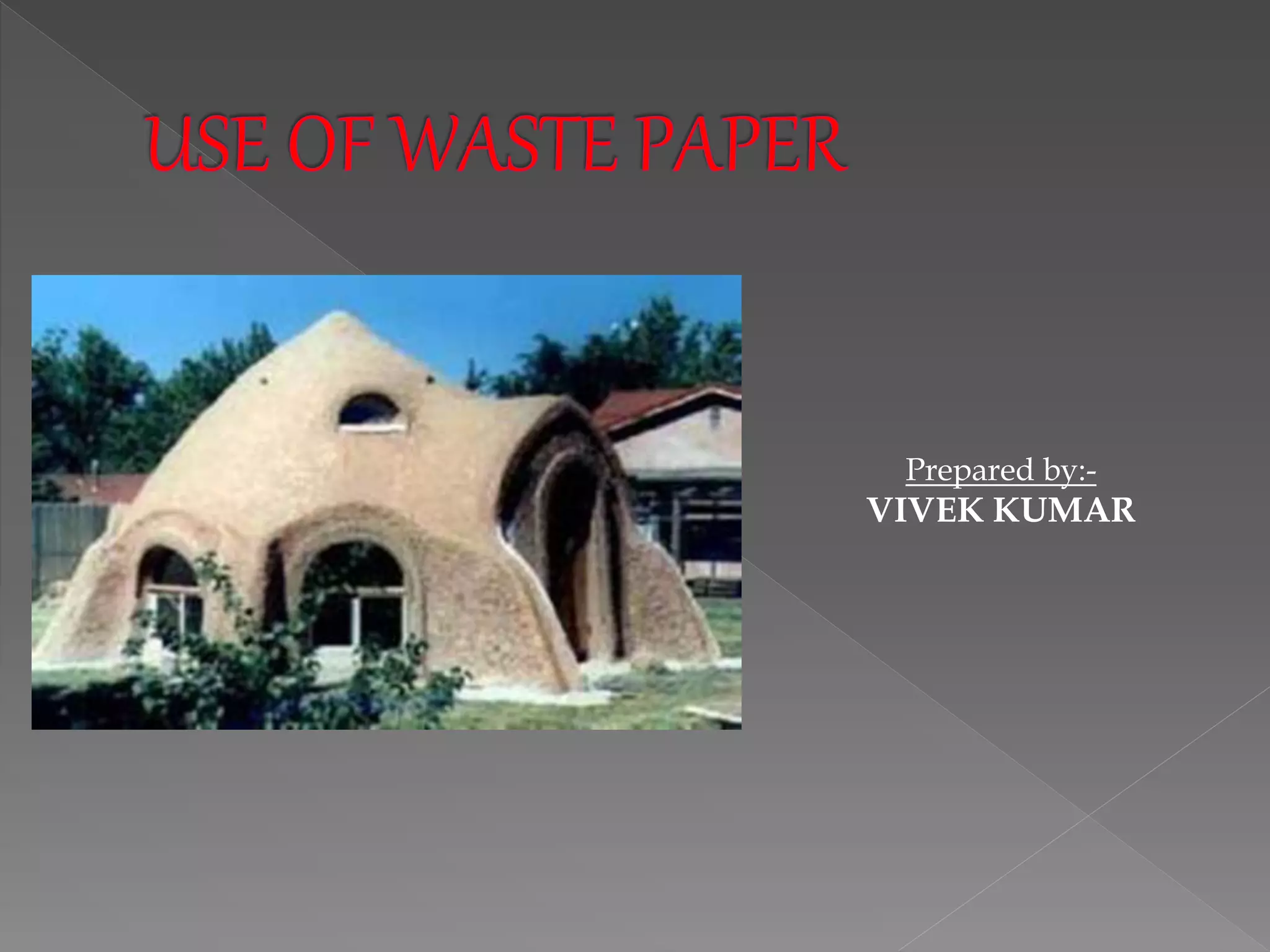
 This is a recently developed material . It is made
with re-pulped paper-fiber with a combination
of Portland cement and or clay.
 This type of material is considered
environmental friendly material.
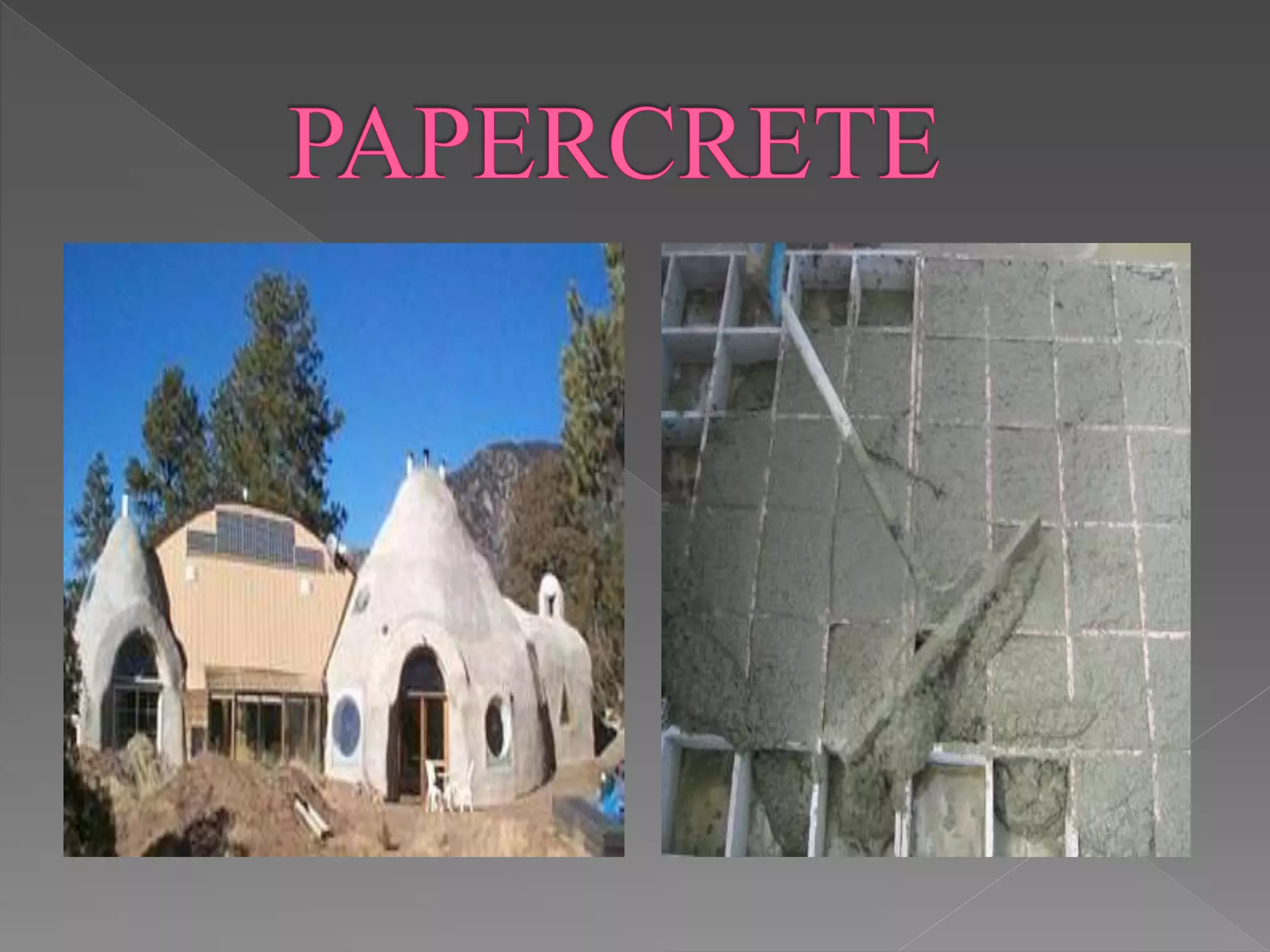
 Paper-Crete is essentially a type of industrial
strength paper Mache made with paper and
cardboard, sand and Portland cement.
 It was discovered by Eric Patterson and Mike
McCain.
 The objective of this project is to design and
build a rigid, cost effective and economical
inner wall of the structure or building.
 As builders and building owners are
pressurized to use sustainable construction
materials, a previously tassel building material
known as paper-Crete has gained a lot of
popularity amidst the recent greening up
efforts.
 Paper-Crete is a recent technology and its use is
limited to experimental and recreation use.
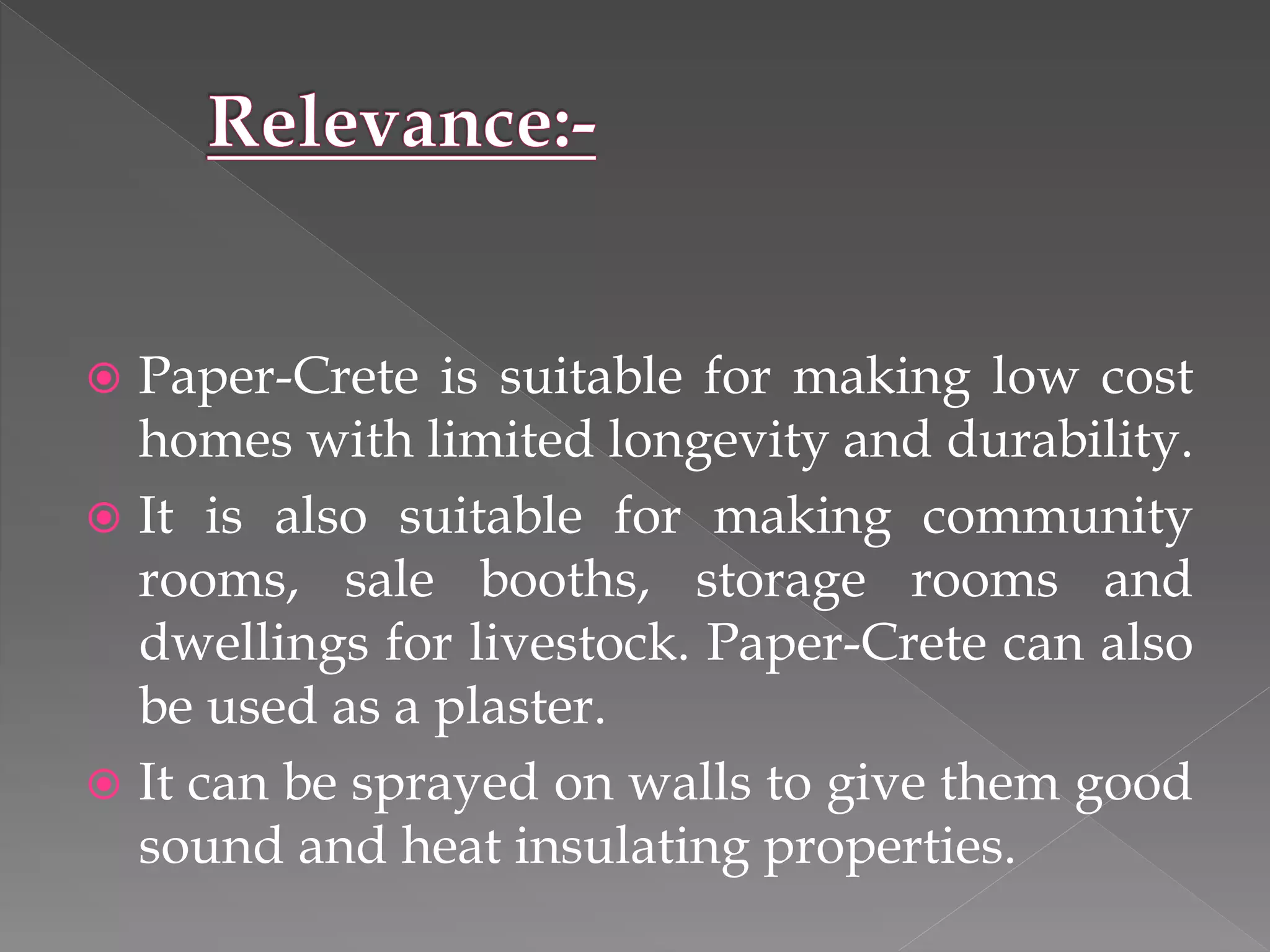
 Paper-Crete is suitable for making low cost
homes with limited longevity and durability.
 It is also suitable for making community
rooms, sale booths, storage rooms and
dwellings for livestock. Paper-Crete can also
be used as a plaster.
 It can be sprayed on walls to give them good
sound and heat insulating properties.
 Raw materials are very inexpensive and freely available.
 Equipment used is relatively low-tech and inexpensive.
 Compressive strength of 0.99-1.12 mpa.
 It has excellent heat and sound insulating properties.
 Paper-Crete is light weight and can be used to make
inexpensive roofing alternatives.
 Paper-Crete is very workable and can be formed into
different shapes such as blocks, panels and sheets with
ease.
 It does not catch fire easily but smolders for hours.
 It is dimensionally very stable.
 The more cement and mineral material is
used the more fire proof it becomes.
 Resist rodent and insect infestation.
 R-value is about 2.0 and 3.0 per inch.
 Literature review.
 Casting of cubes with different material and
with different ratio.
 Curing of cubes. {air dry curing}
 Testing of the compressive strength.
 Permeability test.
 Flame test.
 Conclusion.
 FOLLOWING ARE THE DESIGN
TRAILS:-
 45:35:20 { CEMENT: PULP: SAND }
 35:25:20:20 { CEMENT: SAND: PULP: M1 }
 35:25:20:20 { CEMENT: SAND: PULP: M2 }
 TEST RESULTS FOR 45:35:20 :-
 COMPRESSIVE STRENGTH FOR 7 DAYS
CUBE NO. STRENGT
H
WEIGHT AVG.
STRENGT
H
1 18.63 KN 4.780
0.980 MPA
2 21.57 KN 4.902
3 25.98 KN 4.930
4* 30.4 KN 3.276 1.35 MPA
 TEST RESULTS FOR 35:25:20:20 (METAL 1)
:-
 COMPRESSIVE STRENGTH FOR 7 DAYSCUBE NO. STRENGT
H
WEIGHT
KG
AVG.
STRENGT
H
1 57.3 KN 4.660
1.704 MPA
2 37.56 KN 5.471
3 34.13-
39.13 KN
5.470
4* (28 DAYS) 79.18 KN 5.275 3.52 MPA
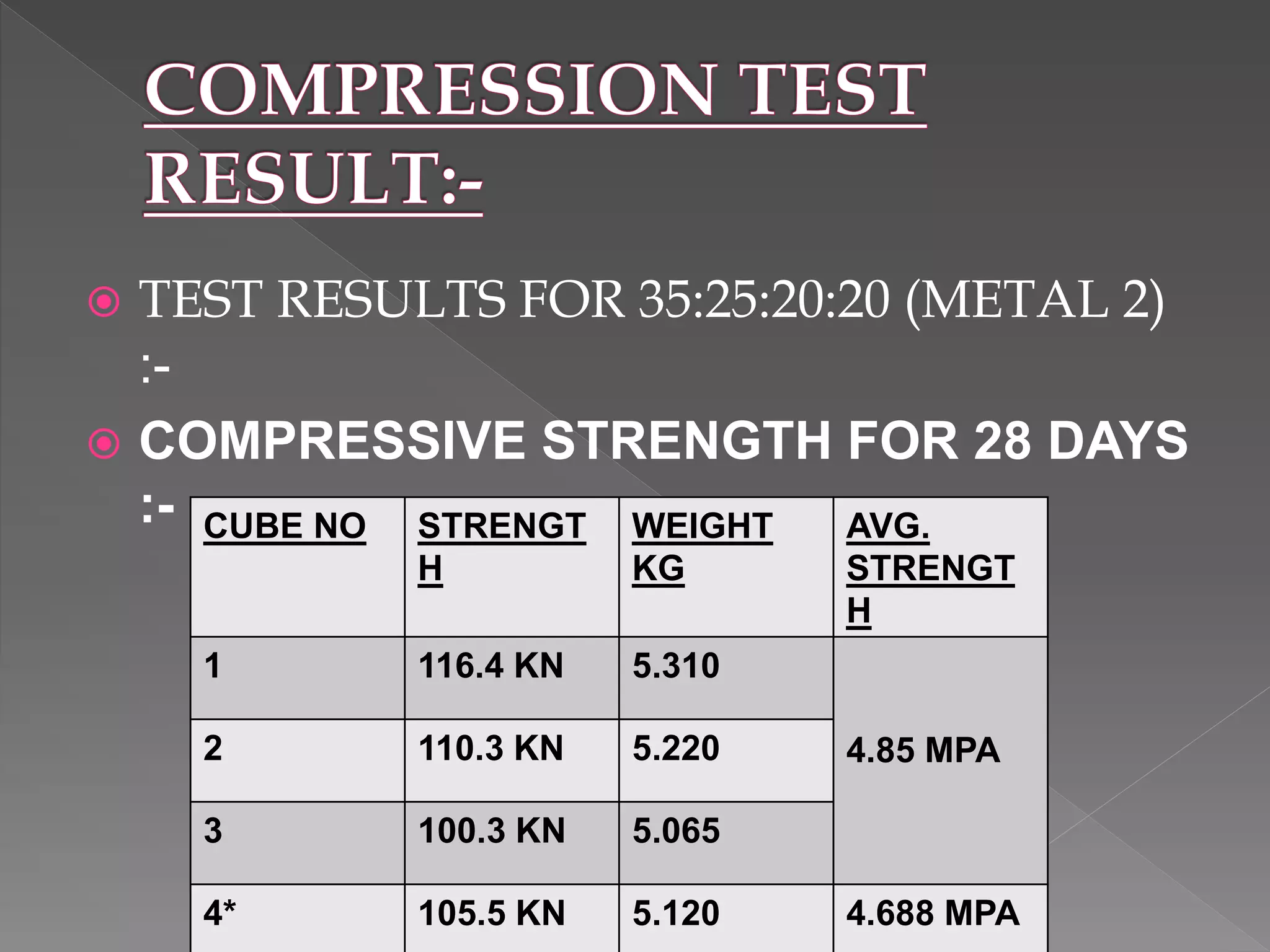
 TEST RESULTS FOR 35:25:20:20 (METAL 2)
:-
 COMPRESSIVE STRENGTH FOR 28 DAYS
:- CUBE NO STRENGT
H
WEIGHT
KG
AVG.
STRENGT
H
1 116.4 KN 5.310
4.85 MPA2 110.3 KN 5.220
3 100.3 KN 5.065
4* 105.5 KN 5.120 4.688 MPA
 During this project we had casted total 12
cubes, i.e. 3 sets. Out of each set 1 cube is
kept for oven drying and remaining cubes for
air drying.
 After casting the cubes we had observed
that compressive strength of the oven dried
cubes is greater than air dried cubes.
 We had also observed that this cube’s fail in
shear only.
 From the above results we conclude that
density of the paper-crete is less than the
ordinary bricks density.
 Thus we can use the paper-crete for inner
wall construction in place of bricks which has
high density, thereby they increase the dead
weight of the structure which is reduced by
using paper-crete.
Vivek

Vivek

  • 1.
  • 3.
    KORIA JAPAN CHINATAIWA N HONG KONG U.S. A CANAD A GERMA NY U.K FRANCE Recycli ngg ratio% 75.4 72 34 68 80 52 68 75 65 64
  • 5.
     This isa recently developed material . It is made with re-pulped paper-fiber with a combination of Portland cement and or clay.  This type of material is considered environmental friendly material.  Paper-Crete is essentially a type of industrial strength paper Mache made with paper and cardboard, sand and Portland cement.  It was discovered by Eric Patterson and Mike McCain.
  • 6.
     The objectiveof this project is to design and build a rigid, cost effective and economical inner wall of the structure or building.  As builders and building owners are pressurized to use sustainable construction materials, a previously tassel building material known as paper-Crete has gained a lot of popularity amidst the recent greening up efforts.  Paper-Crete is a recent technology and its use is limited to experimental and recreation use.
  • 7.
     Paper-Crete issuitable for making low cost homes with limited longevity and durability.  It is also suitable for making community rooms, sale booths, storage rooms and dwellings for livestock. Paper-Crete can also be used as a plaster.  It can be sprayed on walls to give them good sound and heat insulating properties.
  • 8.
     Raw materialsare very inexpensive and freely available.  Equipment used is relatively low-tech and inexpensive.  Compressive strength of 0.99-1.12 mpa.  It has excellent heat and sound insulating properties.  Paper-Crete is light weight and can be used to make inexpensive roofing alternatives.  Paper-Crete is very workable and can be formed into different shapes such as blocks, panels and sheets with ease.  It does not catch fire easily but smolders for hours.
  • 9.
     It isdimensionally very stable.  The more cement and mineral material is used the more fire proof it becomes.  Resist rodent and insect infestation.  R-value is about 2.0 and 3.0 per inch.
  • 10.
     Literature review. Casting of cubes with different material and with different ratio.  Curing of cubes. {air dry curing}  Testing of the compressive strength.  Permeability test.  Flame test.  Conclusion.
  • 12.
     FOLLOWING ARETHE DESIGN TRAILS:-  45:35:20 { CEMENT: PULP: SAND }  35:25:20:20 { CEMENT: SAND: PULP: M1 }  35:25:20:20 { CEMENT: SAND: PULP: M2 }
  • 15.
     TEST RESULTSFOR 45:35:20 :-  COMPRESSIVE STRENGTH FOR 7 DAYS CUBE NO. STRENGT H WEIGHT AVG. STRENGT H 1 18.63 KN 4.780 0.980 MPA 2 21.57 KN 4.902 3 25.98 KN 4.930 4* 30.4 KN 3.276 1.35 MPA
  • 16.
     TEST RESULTSFOR 35:25:20:20 (METAL 1) :-  COMPRESSIVE STRENGTH FOR 7 DAYSCUBE NO. STRENGT H WEIGHT KG AVG. STRENGT H 1 57.3 KN 4.660 1.704 MPA 2 37.56 KN 5.471 3 34.13- 39.13 KN 5.470 4* (28 DAYS) 79.18 KN 5.275 3.52 MPA
  • 17.
     TEST RESULTSFOR 35:25:20:20 (METAL 2) :-  COMPRESSIVE STRENGTH FOR 28 DAYS :- CUBE NO STRENGT H WEIGHT KG AVG. STRENGT H 1 116.4 KN 5.310 4.85 MPA2 110.3 KN 5.220 3 100.3 KN 5.065 4* 105.5 KN 5.120 4.688 MPA
  • 22.
     During thisproject we had casted total 12 cubes, i.e. 3 sets. Out of each set 1 cube is kept for oven drying and remaining cubes for air drying.  After casting the cubes we had observed that compressive strength of the oven dried cubes is greater than air dried cubes.  We had also observed that this cube’s fail in shear only.
  • 23.
     From theabove results we conclude that density of the paper-crete is less than the ordinary bricks density.  Thus we can use the paper-crete for inner wall construction in place of bricks which has high density, thereby they increase the dead weight of the structure which is reduced by using paper-crete.

Editor's Notes

  • #5 The way to recycle waste paper in architural field have been studying as papercrete.