PAPER NO: 8
CULTURAL STUDIES
Marxism:Activity ads &
Consumerism.
Concept of Marxism (19th
century, Marx-Engels)
 Karl Marx was one of the most influential
philosopher of all time and consequently his
work has influenced a lot of films.The
spectator faces Marxist problems such as:
proletariat conditions, bourgeoisie
dominance, the evolving technology and its
connection to society, and revolution.
(Wikipedia)
Continuing…..
 Obviously there were many other
philosophers, influenced by Marx, who
expanded those core elements in many other
directions, some of them contemporaneous
to him including Engels, Kautsky, Bernstein
and others after his death (Rosa Luxemburg,
Gyorgy Lukacs, Antonio Gramsci, Ernst
Bloch). (Wikipedia)
Continuing……
 Every one of them shared a faith in
proletariat justice, where object and subject
finally identify each other. Lower industrial
classes are the “soil” for the revolution and
will bring true values for all humanity but
doing this demands the fall of the dominant
industrialized class: the bourgeoisie.
(Wikipedia)
Continuing…..
 Marx has never described a “communist”
society but he gave some advice in his
Critique of the Gotha Program. He said that
capitalism is the world where slave-masses
serve the few dehumanized bourgeoisies. It
should reflect the horribleness of bourgeois
society and the honorable values brought
about by the proletarian class. (Wikipedia)
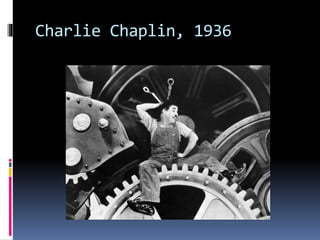
Charlie Chaplin, 1936
 A classic movie by Charlie Chaplin is a Marxist
film? Chaplin was always sensitive to social
problems. England has always been the land
of socialist battles. High gate cemetery is a
sufficient proof of how deeply related
England is to Marx’s life.
 This film could be seen as a social accusation
toward industrialization . If one wants to
better understand what proletariat alienation
is, this is the film to see.This movie is based
on a simple concept which it explains well
through stereotypical and ironic characters.
 A society that works in a crazy context cannot
be fit for man, who continuously searches to
be free. If it is only a critical film more than
constructive one, it reflects a particular
aspect of industrial proletariat problems, a
very old problem that is a socialist vindication
but at the same time, is the basis of Marx’s
philosophy.
Feminist and Marxist
perspective on advertisement
‘Burger King’
Analysis of Advertisement.
(Women bodies in consumerism)
 Based on the picture, one can say that
females are more dominant than males.
There are some reasons why one can say like
that. Why must the woman appear on that
advertisement?
 The first thing is a Beautiful woman. Beauty is
a promise of happiness. one can describe the
beauty as a thing that makes the costumer
happy.
 As one can see from the picture, a woman
who has beautiful face is attractive,
seductive, and teasing.
 Beauty is the most important instrument to
attract customers. Exploring woman’s beauty
and show it on advertisement means
promising happiness to customers and giving
customers’ satisfactions.
 Other things are red lips.They support the
beauty of a woman.They’re not just a normal
lips, but lips covered by red color of lipstick.
They support the sense of beauty and play as
the symbol of beauty.
 Then, the wide-open mouth means that she
hunger. She’s ready to eat something and full
of desire. It can be interpreted as she’s in
wonder, surprise, or eagerness.
 Next, Open wide-eyes describe the act of
seriousness about something faced by. In this
case, the open wide-eyes relate to the
character of the woman. Food offered in
front of her eyes is seductive. She has desire
to want more.
 Burger (in this case hot-dog) has materialist
interpretation. It describes the costumer’s
meal from the high class/ high status. Only
middle and upper class can buy this kind of
food.There’s also the hegemony that
creating system where one group is
dominated by another.
Well-known figures in Advertisement.
Unnecessarily body
exploitation.
Conclusion:-
 Thus, the Marx-Engels analysis of
society and the conditions of
production spilled over into an
analysis of culture.
Resources..
www.wikipedia.com
Prepared By:
Jayti Thakar.
Nupur Vyas.
Disha Trivedi.
Hezal Trivedi.
Paper no 8- Marxism

Paper no 8- Marxism

  • 1.
    PAPER NO: 8 CULTURALSTUDIES Marxism:Activity ads & Consumerism.
  • 2.
    Concept of Marxism(19th century, Marx-Engels)  Karl Marx was one of the most influential philosopher of all time and consequently his work has influenced a lot of films.The spectator faces Marxist problems such as: proletariat conditions, bourgeoisie dominance, the evolving technology and its connection to society, and revolution. (Wikipedia)
  • 3.
    Continuing…..  Obviously therewere many other philosophers, influenced by Marx, who expanded those core elements in many other directions, some of them contemporaneous to him including Engels, Kautsky, Bernstein and others after his death (Rosa Luxemburg, Gyorgy Lukacs, Antonio Gramsci, Ernst Bloch). (Wikipedia)
  • 4.
    Continuing……  Every oneof them shared a faith in proletariat justice, where object and subject finally identify each other. Lower industrial classes are the “soil” for the revolution and will bring true values for all humanity but doing this demands the fall of the dominant industrialized class: the bourgeoisie. (Wikipedia)
  • 5.
    Continuing…..  Marx hasnever described a “communist” society but he gave some advice in his Critique of the Gotha Program. He said that capitalism is the world where slave-masses serve the few dehumanized bourgeoisies. It should reflect the horribleness of bourgeois society and the honorable values brought about by the proletarian class. (Wikipedia)
  • 6.
  • 7.
     A classicmovie by Charlie Chaplin is a Marxist film? Chaplin was always sensitive to social problems. England has always been the land of socialist battles. High gate cemetery is a sufficient proof of how deeply related England is to Marx’s life.
  • 8.
     This filmcould be seen as a social accusation toward industrialization . If one wants to better understand what proletariat alienation is, this is the film to see.This movie is based on a simple concept which it explains well through stereotypical and ironic characters.
  • 9.
     A societythat works in a crazy context cannot be fit for man, who continuously searches to be free. If it is only a critical film more than constructive one, it reflects a particular aspect of industrial proletariat problems, a very old problem that is a socialist vindication but at the same time, is the basis of Marx’s philosophy.
  • 10.
    Feminist and Marxist perspectiveon advertisement ‘Burger King’
  • 11.
    Analysis of Advertisement. (Womenbodies in consumerism)  Based on the picture, one can say that females are more dominant than males. There are some reasons why one can say like that. Why must the woman appear on that advertisement?  The first thing is a Beautiful woman. Beauty is a promise of happiness. one can describe the beauty as a thing that makes the costumer happy.
  • 12.
     As onecan see from the picture, a woman who has beautiful face is attractive, seductive, and teasing.  Beauty is the most important instrument to attract customers. Exploring woman’s beauty and show it on advertisement means promising happiness to customers and giving customers’ satisfactions.
  • 13.
     Other thingsare red lips.They support the beauty of a woman.They’re not just a normal lips, but lips covered by red color of lipstick. They support the sense of beauty and play as the symbol of beauty.  Then, the wide-open mouth means that she hunger. She’s ready to eat something and full of desire. It can be interpreted as she’s in wonder, surprise, or eagerness.
  • 14.
     Next, Openwide-eyes describe the act of seriousness about something faced by. In this case, the open wide-eyes relate to the character of the woman. Food offered in front of her eyes is seductive. She has desire to want more.
  • 15.
     Burger (inthis case hot-dog) has materialist interpretation. It describes the costumer’s meal from the high class/ high status. Only middle and upper class can buy this kind of food.There’s also the hegemony that creating system where one group is dominated by another.
  • 17.
    Well-known figures inAdvertisement.
  • 18.
  • 20.
    Conclusion:-  Thus, theMarx-Engels analysis of society and the conditions of production spilled over into an analysis of culture.
  • 21.
  • 22.
    Prepared By: Jayti Thakar. NupurVyas. Disha Trivedi. Hezal Trivedi.