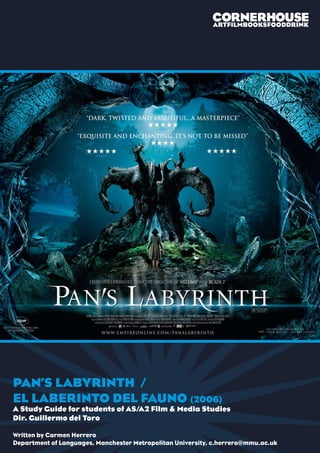
PAN’S LABYRINTH /
EL LABERINTO DEL FAUNO (2006)
A Study Guide for students of AS/A2 Film & Media Studies
Dir. Guillermo del Toro

Written by Carmen Herrero
Department of Languages, Manchester Metropolitan University, c.herrero@mmu.ac.uk
PAN’S LABYRINTH (2006)
STUDY GUIDE


PAN’S LABYRINTH /
EL LABERINTO DEL FAUNO (2006)
Dir. Guillermo del Toro
Study Guide
Written by Carmen Herrero Department of Languages,
Manchester Metropolitan University, c.herrero@mmu.ac.uk

Curriculum links: Contemporary Spanish Cinema; Latin
America Cinema; Spanish civil war and post-war; the role of
women in society.

AS/A2 Media Studies: Pan’s Labyrinth is a contemporary
film suitable for discussion in relation to media language,
narrative and genre or as the focus for critical research/
independent study.

WJEC A2 Film Studies: Pan’s Labyrinth can be studied
in relation to the research project in FS4, Film: Making
Meaning 2 and in FS5, World Cinema. In FS6, Critical
Studies, it could be a focus for work on ‘Genre and
Authorship’.

Introduction
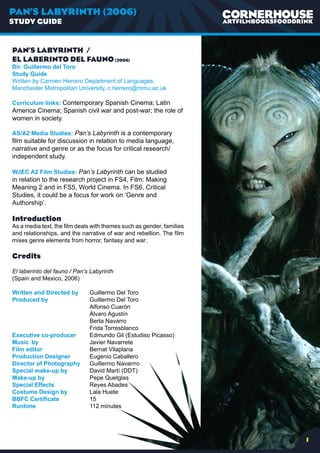
As a media text, the film deals with themes such as gender, families
and relationships, and the narrative of war and rebellion. The film
mixes genre elements from horror, fantasy and war.

Credits
El laberinto del fauno / Pan’s Labyrinth
(Spain and Mexico, 2006)

Written and Directed by       Guillermo Del Toro
Produced by                   Guillermo Del Toro
                              Alfonso Cuarón
                              Álvaro Agustín
                              Berta Navarro
                              Frida Torresblanco
Executive co-producer         Edmundo Gil (Estudiso Picasso)
Music by                      Javier Navarrete
Film editor                   Bernat Vilaplana
Production Designer           Eugenio Caballero
Director of Photography       Guillermo Navarrro
Special make-up by            David Martí (DDT)
Make-up by                    Pepe Quetglas
Special Effects               Reyes Abades
Costume Design by             Lala Huete
BBFC Certificate              15
Runtime                       112 minutes
PAN’S LABYRINTH (2006)
STUDY GUIDE


  Leading players
  Sergi López -                         Vidal
  Maribel Verdú -                       Mercedes
  Ivana Baquero -                       Ofelia
  Alex Angulo -                         Doctor
  Ariadna Gil -                         Carmen
  Doug Jones -                          Fauno
  César Bea -                           Serrano
  Manuel Solo -                         Garcés
  Roger Casamayor -                     Pedro


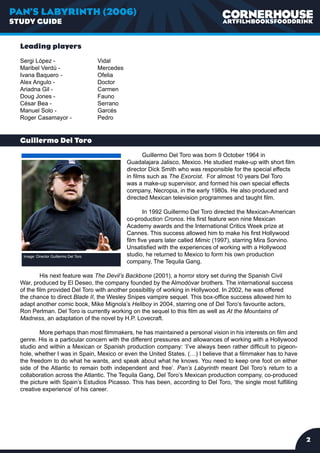
  Guillermo Del Toro
                                                          Guillermo Del Toro was born 9 October 1964 in
                                                   Guadalajara Jalisco, Mexico. He studied make-up with short film
                                                   director Dick Smith who was responsible for the special effects
                                                   in films such as The Exorcist. For almost 10 years Del Toro
                                                   was a make-up supervisor, and formed his own special effects
                                                   company, Necropia, in the early 1980s. He also produced and
                                                   directed Mexican television programmes and taught film.

                                                          In 1992 Guillermo Del Toro directed the Mexican-American
                                                   co-production Cronos. His first feature won nine Mexican
                                                   Academy awards and the International Critics Week prize at
                                                   Cannes. This success allowed him to make his first Hollywood
                                                   film five years later called Mimic (1997), starring Mira Sorvino.
                                                   Unsatisfied with the experiences of working with a Hollywood
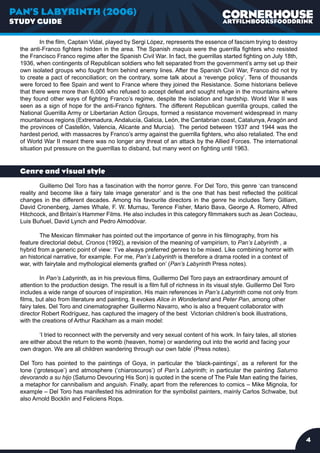
   Image: Director Guillermo Del Toro              studio, he returned to Mexico to form his own production
                                                   company, The Tequila Gang.

           His next feature was The Devil’s Backbone (2001), a horror story set during the Spanish Civil
  War, produced by El Deseo, the company founded by the Almodóvar brothers. The international success
  of the film provided Del Toro with another possibiltiy of working in Hollywood. In 2002, he was offered
  the chance to direct Blade II, the Wesley Snipes vampire sequel. This box-office success allowed him to
  adapt another comic book, Mike Mignola’s Hellboy in 2004, starring one of Del Toro’s favourite actors,
  Ron Perlman. Del Toro is currently working on the sequel to this film as well as At the Mountains of
  Madness, an adaptation of the novel by H.P. Lovecraft.

          More perhaps than most filmmakers, he has maintained a personal vision in his interests on film and
  genre. His is a particular concern with the different pressures and allowances of working with a Hollywood
  studio and within a Mexican or Spanish production company: ‘I’ve always been rather difficult to pigeon-
  hole, whether I was in Spain, Mexico or even the United States. (…) I believe that a filmmaker has to have
  the freedom to do what he wants, and speak about what he knows. You need to keep one foot on either
  side of the Atlantic to remain both independent and free’. Pan’s Labyrinth meant Del Toro’s return to a
  collaboration across the Atlantic. The Tequila Gang, Del Toro’s Mexican production company, co-produced
  the picture with Spain’s Estudios Picasso. This has been, according to Del Toro, ‘the single most fulfilling
  creative experience’ of his career.


                                                                                                                       2
PAN’S LABYRINTH (2006)
STUDY GUIDE


  The Spanish Civil War and Fascism

   ‘The Spanish Civil War, I believe, is one of those wars that never ended. It just kind of wound down very slowly and it still
   to this day haunts the Spanish people. I don’t think it was ever fully resolved. (…) And yet even when the Spanish Civil
   War was essentially a testing ground for most Fascist practices and tactics and weaponries, Europe remained largely
   uninvolved.’
   Source: http://www.reallyscary.com/interviewdeltoro.asp


          Written, directed and produced by Guillermo Del Toro, Pan’s Labyrinth provides a look at the
  horrors of war as seen through the eyes of a young girl who takes refuge in an imaginary world. The
  genesis of the film goes back to the beginning of Del Toro’s career and, like The Devil’s Backbone, takes
  place after the Civil War, during Franco’s dictatorship. Both feature films are related thematically in their
  depiction of war as the destructive force of childhood and through the confrontation between innocence
  and brutality. The Devil’s Backbone is a horror story set in a school orphanage at the end of the Spanish
  Civil War. Although the orphanage lies on a remote and deserted area far away from the frontline, the
  threat of war is omnipresent, especially through the unexploded bomb that sits in the middle of the patio.
  The Devil’s Backbone begins with a childhood rite of passage for ten-year-old Carlos who has to confront
  the bullying Jaime and the school’s intimidating caretaker, Jacinto. Nevertheless the more threatening and
  scary experience for Carlos is seeing the porcelain-like spectre of Santi (Valverde), a fellow orphan who
  was brutally murdered before his arrival. The film presents the concept of ghosts as ‘something pending,
  something incomplete, something left undone’, as defined by the filmmaker. The school is presented as
  a microcosm of the war, with children becoming the ‘new born Spain’ and the adults representing the
  Republican Spain. Guillermo Del Toro considers that The Devil’s Backbone was constructed as a rhyme
  and it shares with Pan’s Labyrinth a brotherhood relationship (‘películas hermanas’) not only thematically
  but also in their ‘mirror structure’.

          Pan’s Labyrinth has links with Hellboy; both are set during 1944, a year of changes in the world,
  and especially in Spain, where the arrival of the allies to end Franco’s dictatorship was expected. While
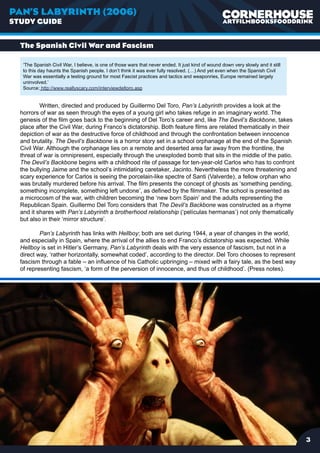
  Hellboy is set in Hitler’s Germany, Pan’s Labyrinth deals with the very essence of fascism, but not in a
  direct way, ‘rather horizontally, somewhat coded’, according to the director. Del Toro chooses to represent
  fascism through a fable – an influence of his Catholic upbringing – mixed with a fairy tale, as the best way
  of representing fascism, ‘a form of the perversion of innocence, and thus of childhood’. (Press notes).
PAN’S LABYRINTH (2006)
STUDY GUIDE

          In the film, Captain Vidal, played by Sergi López, represents the essence of fascism trying to destroy
  the anti-Franco fighters hidden in the area. The Spanish maquis were the guerrilla fighters who resisted
  the Francisco Franco regime after the Spanish Civil War. In fact, the guerrillas started fighting on July 18th,
  1936, when contingents of Republican soldiers who felt separated from the government’s army set up their
  own isolated groups who fought from behind enemy lines. After the Spanish Civil War, Franco did not try
  to create a pact of reconciliation; on the contrary, some talk about a ‘revenge policy’. Tens of thousands
  were forced to flee Spain and went to France where they joined the Resistance. Some historians believe
  that there were more than 6,000 who refused to accept defeat and sought refuge in the mountains where
  they found other ways of fighting Franco’s regime, despite the isolation and hardship. World War II was
  seen as a sign of hope for the anti-Franco fighters. The different Republican guerrilla groups, called the
  National Guerrilla Army or Libertarian Action Groups, formed a resistance movement widespread in many
  mountainous regions (Extremadura, Andalucía, Galicia, León, the Cantabrian coast, Catalunya, Aragón and
  the provinces of Castellón, Valencia, Alicante and Murcia). The period between 1937 and 1944 was the
  hardest period, with massacres by Franco’s army against the guerrilla fighters, who also retaliated. The end
  of World War II meant there was no longer any threat of an attack by the Allied Forces. The international
  situation put pressure on the guerrillas to disband, but many went on fighting until 1963.


  Genre and visual style
          Guillemo Del Toro has a fascination with the horror genre. For Del Toro, this genre ‘can transcend
  reality and become like a fairy tale image generator’ and is the one that has best reflected the political
  changes in the different decades. Among his favourite directors in the genre he includes Terry Gilliam,
  David Cronenberg, James Whale, F. W. Murnau, Terence Fisher, Mario Bava, George A. Romero, Alfred
  Hitchcock, and Britain’s Hammer Films. He also includes in this category filmmakers such as Jean Cocteau,
  Luis Buñuel, David Lynch and Pedro Almodóvar.

          The Mexican filmmaker has pointed out the importance of genre in his filmography, from his
  feature directorial debut, Cronos (1992), a revision of the meaning of vampirism, to Pan’s Labyrinth , a
  hybrid from a generic point of view: ‘I’ve always preferred genres to be mixed. Like combining horror with
  an historical narrative, for example. For me, Pan’s Labyrinth is therefore a drama rooted in a context of
  war, with fairytale and mythological elements grafted on’ (Pan’s Labyrinth Press notes).

           In Pan’s Labyrinth, as in his previous films, Guillermo Del Toro pays an extraordinary amount of
  attention to the production design. The result is a film full of richness in its visual style. Guillermo Del Toro
  includes a wide range of sources of inspiration. His main references in Pan’s Labyrinth come not only from
  films, but also from literature and painting. It evokes Alice in Wonderland and Peter Pan, among other
  fairy tales. Del Toro and cinematographer Guillermo Navarro, who is also a frequent collaborator with
  director Robert Rodríguez, has captured the imagery of the best Victorian children’s book illustrations,
  with the creations of Arthur Rackham as a main model:

          ‘I tried to reconnect with the perversity and very sexual content of his work. In fairy tales, all stories
  are either about the return to the womb (heaven, home) or wandering out into the world and facing your
  own dragon. We are all children wandering through our own fable’ (Press notes).

  Del Toro has pointed to the paintings of Goya, in particular the ‘black-paintings’, as a referent for the
  tone (‘grotesque’) and atmosphere (‘chiaroscuros’) of Pan’s Labyrinth; in particular the painting Saturno
  devorando a su hijo (Saturno Devouring His Son) is quoted in the scene of The Pale Man eating the fairies,
  a metaphor for cannibalism and anguish. Finally, apart from the references to comics – Mike Mignola, for
  example – Del Toro has manifested his admiration for the symbolist painters, mainly Carlos Schwabe, but
  also Arnold Bocklin and Feliciens Rops.
PAN’S LABYRINTH (2006)
STUDY GUIDE


  Suggestion for essay titles, discussions on research projects
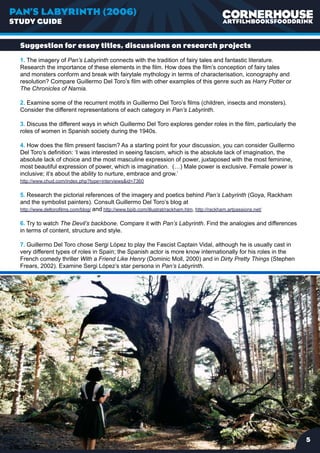
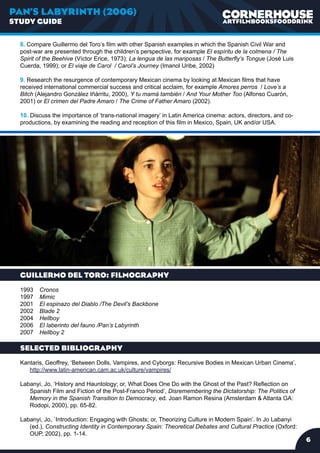
  1. The imagery of Pan’s Labyrinth connects with the tradition of fairy tales and fantastic literature.
  Research the importance of these elements in the film. How does the film’s conception of fairy tales
  and monsters conform and break with fairytale mythology in terms of characterisation, iconography and
  resolution? Compare Guillermo Del Toro’s film with other examples of this genre such as Harry Potter or
  The Chronicles of Narnia.

  2. Examine some of the recurrent motifs in Guillermo Del Toro’s films (children, insects and monsters).
  Consider the different representations of each category in Pan’s Labyrinth.

  3. Discuss the different ways in which Guillermo Del Toro explores gender roles in the film, particularly the
  roles of women in Spanish society during the 1940s.

  4. How does the film present fascism? As a starting point for your discussion, you can consider Guillermo
  Del Toro’s definition: ‘I was interested in seeing fascism, which is the absolute lack of imagination, the
  absolute lack of choice and the most masculine expression of power, juxtaposed with the most feminine,
  most beautiful expression of power, which is imagination. (…) Male power is exclusive. Female power is
  inclusive; it’s about the ability to nurture, embrace and grow.’
  http://www.chud.com/index.php?type=interviewsid=7360

  5. Research the pictorial references of the imagery and poetics behind Pan’s Labyrinth (Goya, Rackham
  and the symbolist painters). Consult Guillermo Del Toro’s blog at
  http://www.deltorofilms.com/blog/ and http://www.bpib.com/illustrat/rackham.htm, http://rackham.artpassions.net/

  6. Try to watch The Devil’s backbone. Compare it with Pan’s Labyrinth. Find the analogies and differences
  in terms of content, structure and style.

  7. Guillermo Del Toro chose Sergi López to play the Fascist Captain Vidal, although he is usually cast in
  very different types of roles in Spain; the Spanish actor is more know internationally for his roles in the
  French comedy thriller With a Friend Like Henry (Dominic Moll, 2000) and in Dirty Pretty Things (Stephen
  Frears, 2002). Examine Sergi López’s star persona in Pan’s Labyrinth.
PAN’S LABYRINTH (2006)
STUDY GUIDE

  8. Compare Guillermo del Toro’s film with other Spanish examples in which the Spanish Civil War and
  post-war are presented through the children’s perspective, for example El espíritu de la colmena / The
  Spirit of the Beehive (Víctor Erice, 1973); La lengua de las mariposas / The Butterfly’s Tongue (José Luis
  Cuerda, 1999); or El viaje de Carol / Carol’s Journey (Imanol Uribe, 2002)

  9. Research the resurgence of contemporary Mexican cinema by looking at Mexican films that have
  received international commercial success and critical acclaim, for example Amores perros / Love’s a
  Bitch (Alejandro González Iñárritu, 2000), Y tu mamá también / And Your Mother Too (Alfonso Cuarón,
  2001) or El crimen del Padre Amaro / The Crime of Father Amaro (2002).

  10. Discuss the importance of ‘trans-national imagery’ in Latin America cinema: actors, directors, and co-
  productions, by examining the reading and reception of this film in Mexico, Spain, UK and/or USA.


  GUILLERMO DEL TORO: FILMOGRAPHY
  1993   Cronos
  1997   Mimic
  2001   El espinazo del Diablo /The Devil’s Backbone
  2002   Blade 2
  2004   Hellboy
  2006   El laberinto del fauno /Pan’s Labyrinth
  2007   Hellboy 2

  SELECTED BIBLIOGRAPHY
  Kantaris, Geoffrey, ‘Between Dolls, Vampires, and Cyborgs: Recursive Bodies in Mexican Urban Cinema’,
     http://www.latin-american.cam.ac.uk/culture/vampires/

  Labanyi, Jo, ‘History and Hauntology; or, What Does One Do with the Ghost of the Past? Reflection on
     Spanish Film and Fiction of the Post-Franco Period’, Disremembering the Dictatorship: The Politics of
     Memory in the Spanish Transition to Democracy, ed. Joan Ramon Resina (Amsterdam  Atlanta GA:
     Rodopi, 2000), pp. 65-82.

  Labanyi, Jo, `Introduction: Engaging with Ghosts; or, Theorizing Culture in Modern Spain’. In Jo Labanyi
     (ed.), Constructing Identity in Contemporary Spain: Theoretical Debates and Cultural Practice (Oxford:
     OUP, 2002), pp. 1-14.
                                                                                                               6
PAN’S LABYRINTH (2006)
STUDY GUIDE

  Savage, Julian, ‘The Object(s) of Interpretation: Guillermo del Toro’s El espinazo del Diablo (The Devil’s
     Backbone)’, Senses of cinema (2002)
     http://www.sensesofcinema.com/contents/02/21/devil_backbone.html

  Smith, Paul Julian, ‘Transatlantic Traffic in Recent Mexican Films’, Journal of Latin American Cultural
     Studies, vol. 12, 3 (December 2003), pp. 389-400.

  Stone, Rob (2002), ‘Spirit and secrets (Four films about childhood)’, Spanish Cinema (Harlow: Longman),
     pp. 85-109.

  Internet References
       » http://www.panslabyrinth.com [Official website]
       » http://www.deltorofilms.com [Guillermo del Toro’s Fansite]

  Interviews with Guillermo del Toro:
        » http://www.darkhorizons.com/news06/deltoro.php
        » http://www.latinoreview.com/news.php?id=861
        » http://www.ifmagazine.com/feature.asp?article=1636
        » http://www.chud.com/index.php?type=interviewsid=7360
        » http://www.einsiders.com/features/interviews/guillermodeltoro.php

  SELECTED BIBLIOGRAPHY ON MEXICAN CINEMA
  Foster, David William, Mexico City in Contemporary Mexican Cinema (University of Texas Press, 2002)

  Hershfield, Joanna / Maciel, David. R, (eds.) Mexico’s Cinema: A Century of Film and Filmmakers
         (Wilmington: Scholarly Resources Inc, 1999)

  Mora, Carl. J, Mexican Cinema: Reflections of a Society, 1896-2003 (London, Jefferson, N.C.: McFarland,
         3rd ed. 2005)

  Noble, Andrea. Mexican National Cinema (London and New York: Routledge, 2005)

  Paranagua, Paulo Antonio (ed.), Mexican Cinema (London: British Film Institute, 1996)

  The Mexican Film Resource Page at http://www.wam.umd.edu/~dwilt/mfb.html

  Wood, Jason, The Faber Book of Mexican Cinema (London: Faber and Faber, 2006)

  Vargas, Juan Carlos. ‘Mexican Post-Industrial Cinema (1990-2002)’, at
         http://www.elojoquepiensa.udg.mx/ingles/revis_03/secciones/codex/artic_02.html
PAN’S LABYRINTH (2006)
STUDY GUIDE


          Study guide written by Carmen Herrero, Department of Languages, Manchester
                           Metropolitan University, c.herrero@mmu.ac.uk

        Cornerhouse is Greater Manchester’s international centre for contemporary visual
          arts and cinema. To find out more about Cornerhouse Education please visit
                                www.cornerhouse.org/education

        Cornerhouse Education projects include Projector an annual programme of events
              for schools and colleges and exposures UK Student Film Festival


        Cornerhouse Funders:


                                                                                                  Cornerhouse
                                                                                               70 Oxford Street
                                                                                                   Manchester
        Study Notes designed by                                                                        M1 5NH
        Robot Monster Design                                            For more info on Cornerhouse Education see
        www.robotmonster.co.uk                                                           www.cornerhouse.org


           Greater Manchester Arts Centre Ltd. Registered Charity No. 514719 Registered Company No.
                                                1681278 England

Pan's Labyrinth study pack

  • 1.
    PAN’S LABYRINTH / ELLABERINTO DEL FAUNO (2006) A Study Guide for students of AS/A2 Film & Media Studies Dir. Guillermo del Toro Written by Carmen Herrero Department of Languages, Manchester Metropolitan University, c.herrero@mmu.ac.uk
  • 2.
    PAN’S LABYRINTH (2006) STUDYGUIDE PAN’S LABYRINTH / EL LABERINTO DEL FAUNO (2006) Dir. Guillermo del Toro Study Guide Written by Carmen Herrero Department of Languages, Manchester Metropolitan University, c.herrero@mmu.ac.uk Curriculum links: Contemporary Spanish Cinema; Latin America Cinema; Spanish civil war and post-war; the role of women in society. AS/A2 Media Studies: Pan’s Labyrinth is a contemporary film suitable for discussion in relation to media language, narrative and genre or as the focus for critical research/ independent study. WJEC A2 Film Studies: Pan’s Labyrinth can be studied in relation to the research project in FS4, Film: Making Meaning 2 and in FS5, World Cinema. In FS6, Critical Studies, it could be a focus for work on ‘Genre and Authorship’. Introduction As a media text, the film deals with themes such as gender, families and relationships, and the narrative of war and rebellion. The film mixes genre elements from horror, fantasy and war. Credits El laberinto del fauno / Pan’s Labyrinth (Spain and Mexico, 2006) Written and Directed by Guillermo Del Toro Produced by Guillermo Del Toro Alfonso Cuarón Álvaro Agustín Berta Navarro Frida Torresblanco Executive co-producer Edmundo Gil (Estudiso Picasso) Music by Javier Navarrete Film editor Bernat Vilaplana Production Designer Eugenio Caballero Director of Photography Guillermo Navarrro Special make-up by David Martí (DDT) Make-up by Pepe Quetglas Special Effects Reyes Abades Costume Design by Lala Huete BBFC Certificate 15 Runtime 112 minutes
  • 3.
    PAN’S LABYRINTH (2006) STUDYGUIDE Leading players Sergi López - Vidal Maribel Verdú - Mercedes Ivana Baquero - Ofelia Alex Angulo - Doctor Ariadna Gil - Carmen Doug Jones - Fauno César Bea - Serrano Manuel Solo - Garcés Roger Casamayor - Pedro Guillermo Del Toro Guillermo Del Toro was born 9 October 1964 in Guadalajara Jalisco, Mexico. He studied make-up with short film director Dick Smith who was responsible for the special effects in films such as The Exorcist. For almost 10 years Del Toro was a make-up supervisor, and formed his own special effects company, Necropia, in the early 1980s. He also produced and directed Mexican television programmes and taught film. In 1992 Guillermo Del Toro directed the Mexican-American co-production Cronos. His first feature won nine Mexican Academy awards and the International Critics Week prize at Cannes. This success allowed him to make his first Hollywood film five years later called Mimic (1997), starring Mira Sorvino. Unsatisfied with the experiences of working with a Hollywood Image: Director Guillermo Del Toro studio, he returned to Mexico to form his own production company, The Tequila Gang. His next feature was The Devil’s Backbone (2001), a horror story set during the Spanish Civil War, produced by El Deseo, the company founded by the Almodóvar brothers. The international success of the film provided Del Toro with another possibiltiy of working in Hollywood. In 2002, he was offered the chance to direct Blade II, the Wesley Snipes vampire sequel. This box-office success allowed him to adapt another comic book, Mike Mignola’s Hellboy in 2004, starring one of Del Toro’s favourite actors, Ron Perlman. Del Toro is currently working on the sequel to this film as well as At the Mountains of Madness, an adaptation of the novel by H.P. Lovecraft. More perhaps than most filmmakers, he has maintained a personal vision in his interests on film and genre. His is a particular concern with the different pressures and allowances of working with a Hollywood studio and within a Mexican or Spanish production company: ‘I’ve always been rather difficult to pigeon- hole, whether I was in Spain, Mexico or even the United States. (…) I believe that a filmmaker has to have the freedom to do what he wants, and speak about what he knows. You need to keep one foot on either side of the Atlantic to remain both independent and free’. Pan’s Labyrinth meant Del Toro’s return to a collaboration across the Atlantic. The Tequila Gang, Del Toro’s Mexican production company, co-produced the picture with Spain’s Estudios Picasso. This has been, according to Del Toro, ‘the single most fulfilling creative experience’ of his career. 2
  • 4.
    PAN’S LABYRINTH (2006) STUDYGUIDE The Spanish Civil War and Fascism ‘The Spanish Civil War, I believe, is one of those wars that never ended. It just kind of wound down very slowly and it still to this day haunts the Spanish people. I don’t think it was ever fully resolved. (…) And yet even when the Spanish Civil War was essentially a testing ground for most Fascist practices and tactics and weaponries, Europe remained largely uninvolved.’ Source: http://www.reallyscary.com/interviewdeltoro.asp Written, directed and produced by Guillermo Del Toro, Pan’s Labyrinth provides a look at the horrors of war as seen through the eyes of a young girl who takes refuge in an imaginary world. The genesis of the film goes back to the beginning of Del Toro’s career and, like The Devil’s Backbone, takes place after the Civil War, during Franco’s dictatorship. Both feature films are related thematically in their depiction of war as the destructive force of childhood and through the confrontation between innocence and brutality. The Devil’s Backbone is a horror story set in a school orphanage at the end of the Spanish Civil War. Although the orphanage lies on a remote and deserted area far away from the frontline, the threat of war is omnipresent, especially through the unexploded bomb that sits in the middle of the patio. The Devil’s Backbone begins with a childhood rite of passage for ten-year-old Carlos who has to confront the bullying Jaime and the school’s intimidating caretaker, Jacinto. Nevertheless the more threatening and scary experience for Carlos is seeing the porcelain-like spectre of Santi (Valverde), a fellow orphan who was brutally murdered before his arrival. The film presents the concept of ghosts as ‘something pending, something incomplete, something left undone’, as defined by the filmmaker. The school is presented as a microcosm of the war, with children becoming the ‘new born Spain’ and the adults representing the Republican Spain. Guillermo Del Toro considers that The Devil’s Backbone was constructed as a rhyme and it shares with Pan’s Labyrinth a brotherhood relationship (‘películas hermanas’) not only thematically but also in their ‘mirror structure’. Pan’s Labyrinth has links with Hellboy; both are set during 1944, a year of changes in the world, and especially in Spain, where the arrival of the allies to end Franco’s dictatorship was expected. While Hellboy is set in Hitler’s Germany, Pan’s Labyrinth deals with the very essence of fascism, but not in a direct way, ‘rather horizontally, somewhat coded’, according to the director. Del Toro chooses to represent fascism through a fable – an influence of his Catholic upbringing – mixed with a fairy tale, as the best way of representing fascism, ‘a form of the perversion of innocence, and thus of childhood’. (Press notes).
  • 5.
    PAN’S LABYRINTH (2006) STUDYGUIDE In the film, Captain Vidal, played by Sergi López, represents the essence of fascism trying to destroy the anti-Franco fighters hidden in the area. The Spanish maquis were the guerrilla fighters who resisted the Francisco Franco regime after the Spanish Civil War. In fact, the guerrillas started fighting on July 18th, 1936, when contingents of Republican soldiers who felt separated from the government’s army set up their own isolated groups who fought from behind enemy lines. After the Spanish Civil War, Franco did not try to create a pact of reconciliation; on the contrary, some talk about a ‘revenge policy’. Tens of thousands were forced to flee Spain and went to France where they joined the Resistance. Some historians believe that there were more than 6,000 who refused to accept defeat and sought refuge in the mountains where they found other ways of fighting Franco’s regime, despite the isolation and hardship. World War II was seen as a sign of hope for the anti-Franco fighters. The different Republican guerrilla groups, called the National Guerrilla Army or Libertarian Action Groups, formed a resistance movement widespread in many mountainous regions (Extremadura, Andalucía, Galicia, León, the Cantabrian coast, Catalunya, Aragón and the provinces of Castellón, Valencia, Alicante and Murcia). The period between 1937 and 1944 was the hardest period, with massacres by Franco’s army against the guerrilla fighters, who also retaliated. The end of World War II meant there was no longer any threat of an attack by the Allied Forces. The international situation put pressure on the guerrillas to disband, but many went on fighting until 1963. Genre and visual style Guillemo Del Toro has a fascination with the horror genre. For Del Toro, this genre ‘can transcend reality and become like a fairy tale image generator’ and is the one that has best reflected the political changes in the different decades. Among his favourite directors in the genre he includes Terry Gilliam, David Cronenberg, James Whale, F. W. Murnau, Terence Fisher, Mario Bava, George A. Romero, Alfred Hitchcock, and Britain’s Hammer Films. He also includes in this category filmmakers such as Jean Cocteau, Luis Buñuel, David Lynch and Pedro Almodóvar. The Mexican filmmaker has pointed out the importance of genre in his filmography, from his feature directorial debut, Cronos (1992), a revision of the meaning of vampirism, to Pan’s Labyrinth , a hybrid from a generic point of view: ‘I’ve always preferred genres to be mixed. Like combining horror with an historical narrative, for example. For me, Pan’s Labyrinth is therefore a drama rooted in a context of war, with fairytale and mythological elements grafted on’ (Pan’s Labyrinth Press notes). In Pan’s Labyrinth, as in his previous films, Guillermo Del Toro pays an extraordinary amount of attention to the production design. The result is a film full of richness in its visual style. Guillermo Del Toro includes a wide range of sources of inspiration. His main references in Pan’s Labyrinth come not only from films, but also from literature and painting. It evokes Alice in Wonderland and Peter Pan, among other fairy tales. Del Toro and cinematographer Guillermo Navarro, who is also a frequent collaborator with director Robert Rodríguez, has captured the imagery of the best Victorian children’s book illustrations, with the creations of Arthur Rackham as a main model: ‘I tried to reconnect with the perversity and very sexual content of his work. In fairy tales, all stories are either about the return to the womb (heaven, home) or wandering out into the world and facing your own dragon. We are all children wandering through our own fable’ (Press notes). Del Toro has pointed to the paintings of Goya, in particular the ‘black-paintings’, as a referent for the tone (‘grotesque’) and atmosphere (‘chiaroscuros’) of Pan’s Labyrinth; in particular the painting Saturno devorando a su hijo (Saturno Devouring His Son) is quoted in the scene of The Pale Man eating the fairies, a metaphor for cannibalism and anguish. Finally, apart from the references to comics – Mike Mignola, for example – Del Toro has manifested his admiration for the symbolist painters, mainly Carlos Schwabe, but also Arnold Bocklin and Feliciens Rops.
  • 6.
    PAN’S LABYRINTH (2006) STUDYGUIDE Suggestion for essay titles, discussions on research projects 1. The imagery of Pan’s Labyrinth connects with the tradition of fairy tales and fantastic literature. Research the importance of these elements in the film. How does the film’s conception of fairy tales and monsters conform and break with fairytale mythology in terms of characterisation, iconography and resolution? Compare Guillermo Del Toro’s film with other examples of this genre such as Harry Potter or The Chronicles of Narnia. 2. Examine some of the recurrent motifs in Guillermo Del Toro’s films (children, insects and monsters). Consider the different representations of each category in Pan’s Labyrinth. 3. Discuss the different ways in which Guillermo Del Toro explores gender roles in the film, particularly the roles of women in Spanish society during the 1940s. 4. How does the film present fascism? As a starting point for your discussion, you can consider Guillermo Del Toro’s definition: ‘I was interested in seeing fascism, which is the absolute lack of imagination, the absolute lack of choice and the most masculine expression of power, juxtaposed with the most feminine, most beautiful expression of power, which is imagination. (…) Male power is exclusive. Female power is inclusive; it’s about the ability to nurture, embrace and grow.’ http://www.chud.com/index.php?type=interviewsid=7360 5. Research the pictorial references of the imagery and poetics behind Pan’s Labyrinth (Goya, Rackham and the symbolist painters). Consult Guillermo Del Toro’s blog at http://www.deltorofilms.com/blog/ and http://www.bpib.com/illustrat/rackham.htm, http://rackham.artpassions.net/ 6. Try to watch The Devil’s backbone. Compare it with Pan’s Labyrinth. Find the analogies and differences in terms of content, structure and style. 7. Guillermo Del Toro chose Sergi López to play the Fascist Captain Vidal, although he is usually cast in very different types of roles in Spain; the Spanish actor is more know internationally for his roles in the French comedy thriller With a Friend Like Henry (Dominic Moll, 2000) and in Dirty Pretty Things (Stephen Frears, 2002). Examine Sergi López’s star persona in Pan’s Labyrinth.
  • 7.
    PAN’S LABYRINTH (2006) STUDYGUIDE 8. Compare Guillermo del Toro’s film with other Spanish examples in which the Spanish Civil War and post-war are presented through the children’s perspective, for example El espíritu de la colmena / The Spirit of the Beehive (Víctor Erice, 1973); La lengua de las mariposas / The Butterfly’s Tongue (José Luis Cuerda, 1999); or El viaje de Carol / Carol’s Journey (Imanol Uribe, 2002) 9. Research the resurgence of contemporary Mexican cinema by looking at Mexican films that have received international commercial success and critical acclaim, for example Amores perros / Love’s a Bitch (Alejandro González Iñárritu, 2000), Y tu mamá también / And Your Mother Too (Alfonso Cuarón, 2001) or El crimen del Padre Amaro / The Crime of Father Amaro (2002). 10. Discuss the importance of ‘trans-national imagery’ in Latin America cinema: actors, directors, and co- productions, by examining the reading and reception of this film in Mexico, Spain, UK and/or USA. GUILLERMO DEL TORO: FILMOGRAPHY 1993 Cronos 1997 Mimic 2001 El espinazo del Diablo /The Devil’s Backbone 2002 Blade 2 2004 Hellboy 2006 El laberinto del fauno /Pan’s Labyrinth 2007 Hellboy 2 SELECTED BIBLIOGRAPHY Kantaris, Geoffrey, ‘Between Dolls, Vampires, and Cyborgs: Recursive Bodies in Mexican Urban Cinema’, http://www.latin-american.cam.ac.uk/culture/vampires/ Labanyi, Jo, ‘History and Hauntology; or, What Does One Do with the Ghost of the Past? Reflection on Spanish Film and Fiction of the Post-Franco Period’, Disremembering the Dictatorship: The Politics of Memory in the Spanish Transition to Democracy, ed. Joan Ramon Resina (Amsterdam Atlanta GA: Rodopi, 2000), pp. 65-82. Labanyi, Jo, `Introduction: Engaging with Ghosts; or, Theorizing Culture in Modern Spain’. In Jo Labanyi (ed.), Constructing Identity in Contemporary Spain: Theoretical Debates and Cultural Practice (Oxford: OUP, 2002), pp. 1-14. 6
  • 8.
    PAN’S LABYRINTH (2006) STUDYGUIDE Savage, Julian, ‘The Object(s) of Interpretation: Guillermo del Toro’s El espinazo del Diablo (The Devil’s Backbone)’, Senses of cinema (2002) http://www.sensesofcinema.com/contents/02/21/devil_backbone.html Smith, Paul Julian, ‘Transatlantic Traffic in Recent Mexican Films’, Journal of Latin American Cultural Studies, vol. 12, 3 (December 2003), pp. 389-400. Stone, Rob (2002), ‘Spirit and secrets (Four films about childhood)’, Spanish Cinema (Harlow: Longman), pp. 85-109. Internet References » http://www.panslabyrinth.com [Official website] » http://www.deltorofilms.com [Guillermo del Toro’s Fansite] Interviews with Guillermo del Toro: » http://www.darkhorizons.com/news06/deltoro.php » http://www.latinoreview.com/news.php?id=861 » http://www.ifmagazine.com/feature.asp?article=1636 » http://www.chud.com/index.php?type=interviewsid=7360 » http://www.einsiders.com/features/interviews/guillermodeltoro.php SELECTED BIBLIOGRAPHY ON MEXICAN CINEMA Foster, David William, Mexico City in Contemporary Mexican Cinema (University of Texas Press, 2002) Hershfield, Joanna / Maciel, David. R, (eds.) Mexico’s Cinema: A Century of Film and Filmmakers (Wilmington: Scholarly Resources Inc, 1999) Mora, Carl. J, Mexican Cinema: Reflections of a Society, 1896-2003 (London, Jefferson, N.C.: McFarland, 3rd ed. 2005) Noble, Andrea. Mexican National Cinema (London and New York: Routledge, 2005) Paranagua, Paulo Antonio (ed.), Mexican Cinema (London: British Film Institute, 1996) The Mexican Film Resource Page at http://www.wam.umd.edu/~dwilt/mfb.html Wood, Jason, The Faber Book of Mexican Cinema (London: Faber and Faber, 2006) Vargas, Juan Carlos. ‘Mexican Post-Industrial Cinema (1990-2002)’, at http://www.elojoquepiensa.udg.mx/ingles/revis_03/secciones/codex/artic_02.html
  • 9.
    PAN’S LABYRINTH (2006) STUDYGUIDE Study guide written by Carmen Herrero, Department of Languages, Manchester Metropolitan University, c.herrero@mmu.ac.uk Cornerhouse is Greater Manchester’s international centre for contemporary visual arts and cinema. To find out more about Cornerhouse Education please visit www.cornerhouse.org/education Cornerhouse Education projects include Projector an annual programme of events for schools and colleges and exposures UK Student Film Festival Cornerhouse Funders: Cornerhouse 70 Oxford Street Manchester Study Notes designed by M1 5NH Robot Monster Design For more info on Cornerhouse Education see www.robotmonster.co.uk www.cornerhouse.org Greater Manchester Arts Centre Ltd. Registered Charity No. 514719 Registered Company No. 1681278 England