Cross-border
Interoperability
“Interoperability is the ability of making systems and
organizations to work together (inter-operate).”
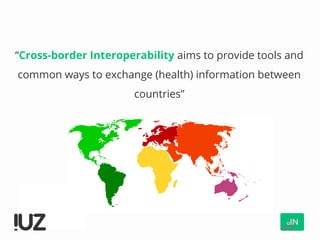
“Cross-border Interoperability aims to provide tools and
common ways to exchange (health) information between
countries”
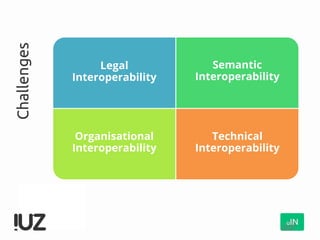
Challenges
Legal
Interoperability
Semantic
Interoperability
Organisational
Interoperability
Technical
Interoperability
! Implementation of legal common grounds for
information exchange;
! Establishment of circles of trust;
! Legal recognition of involved parties, such as HCPs
(including their roles), patients and others;
! Set in place common authentication mechanisms
(e.g. European e-Identification projects);
! Others;
LegalandOrganizational
Interoperability
! Represent as much as possible the information using
clinical code-systems;
! If necessary, define common and agreed value sets
for information exchange;
! Establish formal mappings of existent information to
the agreed value sets;
! Include also the translations to allow multi-language
capabilities (cross-country scenarios);
Semantic
Interoperability
! Implement common interfaces for services;
! Establish agreed format for information exchange;
! If possible, prove and certify the compliance level of
the involved systems;
! Define roadmaps for information integration;
! And others;
Technical
Interoperability
Citizens and patients
! Receive health care abroad (almost) seamlessly;
! Receive medication in a foreign country on existing
prescription;
! Access to his own information in multiple languages
and recognized formats;
Health care providers
! Get quick and easy access to key patient data;
! Improve health care cooperation across borders;
Health care quality
! Reduce medication errors by exchanging data;
! Facilitate the occasional care of foreign patients
Benefits
“So... How can we give response to some of this issues?”
IHE
What is?
IHE is an initiative by healthcare
professionals and industry
Aims to improve the way computer
systems in healthcare share information.
Promotes the coordinated use of
established standards such as DICOM and
HL7 to address specific clinical needs in
support of optimal patient care.
Systems developed in accordance with
IHE communicate with one another
better, are easier to implement, and
enable care providers to use information
more effectively.
Vision
Enable seamless and secure
access to health information
whenever and wherever needed.
Mission
IHE improves healthcare by
providing specifications, tools and
services for interoperability.
IHE engages clinicians, health
authorities, industry, and users to
develop, test, and implement
standards-based solutions to vital
health information needs.
! Anatomic Pathology
! Eye Care
! IT Infrastructure
! Laboratory
! Patient Care Coordination
! Patient Care Devices
! Quality, Research and Public Health
! Radiation Oncology
! Radiology
IHEDomains
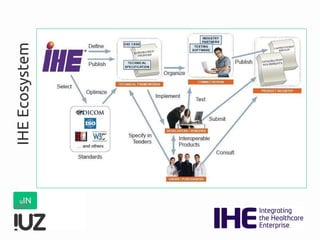
IHEEcosystem
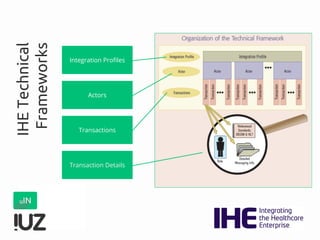
IHETechnical
Frameworks
Integration Profiles
Actors
Transactions
Transaction Details
HL7
What is?
Founded in 1987, Health Level Seven
International (HL7) is a not-for-profit,
ANSI-accredited standards developing
organization.
Its dedicated to providing a
comprehensive framework and related
standards for the exchange, integration,
sharing, and retrieval of electronic health
information
This information that supports clinical
practice and the management, delivery
and evaluation of health services.
Vision
To create the best and most
widely used standards in
healthcare.
Mission
HL7 provides standards for
interoperability that improve care
delivery, optimize workflow,
reduce ambiguity and enhance
knowledge transfer among all of
our stakeholders.
All processes include high
scientific rigor and technical
expertise.
“The 1000 kg Gorilla of
Healthcare Standards”
HL7v2
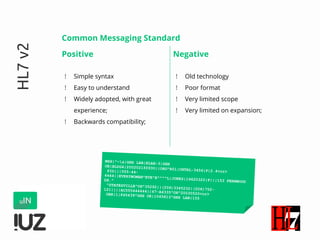
Common Messaging Standard
Positive Negative
! Simple syntax
! Easy to understand
! Widely adopted, with great
experience;
! Backwards compatibility;
! Old technology
! Poor format
! Very limited scope
! Very limited on expansion;
MSH|^~&|GHH LAB|ELAB-3|GHH
OE|BLDG4|200202150930||ORU^R01|CNTRL-3456|P|2.4<cr>PID|||555-44-
4444||EVERYWOMAN^EVE^E^^^^L|JONES|19620320|F|||153 FERNWOODDR.^
^STATESVILLE^OH^35292||(206)3345232|(206)752-121||||AC555444444||67-A4335^OH^20030520<cr>OBR|1|845439^GHH OE|1045813^GHH LAB|155
HL7v3
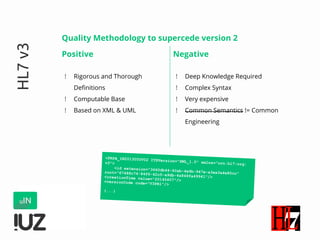
Quality Methodology to supercede version 2
Positive Negative
! Rigorous and Thorough
Definitions
! Computable Base
! Based on XML & UML
! Deep Knowledge Required
! Complex Syntax
! Very expensive
! Common Semantics != Common
Engineering
<PRPA_IN201305UV02 ITSVersion="XML_1.0" xmlns="urn:hl7-org:v3">
<id extension="3660db44-40ab-4e9b-947e-a3ea3a4e80cc"root="67488c74-84f6-42c5-a9db-4a848fa49941"/><creationTime value="20140407"/><versionCode code="V3PR1"/>
(...)
HL7FHIR Fast Health Interoperable Resources
! Small building blocks for health records;
! XML / JSON representation;
! Tailored for REST but useable in other ways;
! Standard Data, Narrative and Extensions
! Best ideas from HL7, DICOM and IHE
! Based on industry best practices, with a focus on
simplicity and implementability;
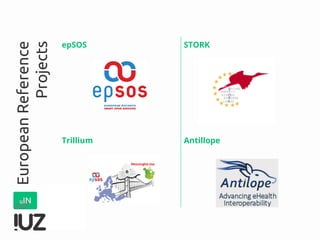
EuropeanReference
Projects epSOS STORK
Trillium Antillope
eHealth Integration
Platform
Topics
1. Description
2. Key-functionalities
3. Business services provided
4. General architecture
5. Application scenarios
6. Demonstration workflows
7. Other supported use-cases
! Provides Technical and Semantic interoperability;
! Was firstly designed with EU Interoperability
Framework as blueprint;
! Boosts the exchange of health-related information
among departments, organisations or geographical
apart clinicians and patients ;
! Was built using well known and cutting edge
eHealth standards, allowing many integration
possibilities;
Description
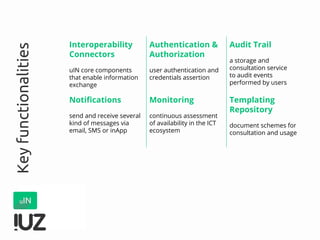
Keyfunctionalities
Interoperability
Connectors
uIN core components
that enable information
exchange
Authentication &
Authorization
user authentication and
credentials assertion
Audit Trail
a storage and
consultation service
to audit events
performed by users
Notifications
send and receive several
kind of messages via
email, SMS or inApp
Monitoring
continuous assessment
of availability in the ICT
ecosystem
Templating
Repository
document schemes for
consultation and usage
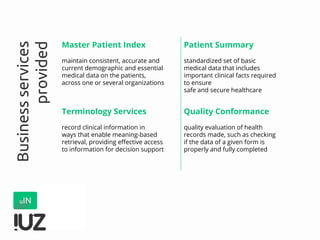
Businessservices
provided Master Patient Index
maintain consistent, accurate and
current demographic and essential
medical data on the patients,
across one or several organizations
Patient Summary
standardized set of basic
medical data that includes
important clinical facts required
to ensure
safe and secure healthcare
Terminology Services
record clinical information in
ways that enable meaning-based
retrieval, providing effective access
to information for decision support
Quality Conformance
quality evaluation of health
records made, such as checking
if the data of a given form is
properly and fully completed
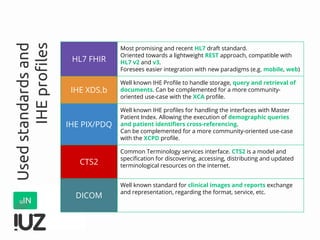
Usedstandardsand
IHEprofiles
HL7 FHIR
Most promising and recent HL7 draft standard.
Oriented towards a lightweight REST approach, compatible with
HL7 v2 and v3.
Foresees easier integration with new paradigms (e.g. mobile, web)
IHE XDS.b
Well known IHE Profile to handle storage, query and retrieval of
documents. Can be complemented for a more community-
oriented use-case with the XCA profile.
IHE PIX/PDQ
Well known IHE profiles for handling the interfaces with Master
Patient Index. Allowing the execution of demographic queries
and patient identifiers cross-referencing.
Can be complemented for a more community-oriented use-case
with the XCPD profile.
CTS2
Common Terminology services interface. CTS2 is a model and
specification for discovering, accessing, distributing and updated
terminological resources on the internet.
DICOM
Well known standard for clinical images and reports exchange
and representation, regarding the format, service, etc.
*
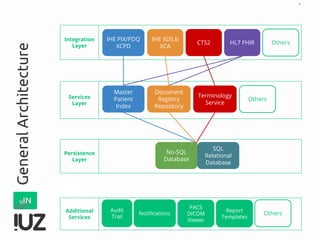
GeneralArchitecture
Integration
Layer
Services
Layer
Persistence
Layer
Additional
Services
IHE PIX/PDQ
XCPD
IHE XDS.b
XCA
CTS2 HL7 FHIR Others
Master
Patient
Index
Document
Registry
Repository
Terminology
Service
Others
No-SQL
Database
SQL
Relational
Database
Audit
Trail
Notifications
PACS
DICOM
Viewer
Report
Templates
Others
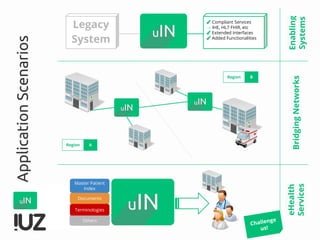
ApplicationScenarios Legacy
System
✓ Compliant Services
→ IHE, HL7 FHIR, etc
✓ Extended Interfaces
✓ Added Functionalities
Region A
Region B
BridgingNetworksEnabling
Systems
eHealth
Services
Challenge
us!
Master Patient
Index
Documents
Terminologies
Others
Master
Patient Index
*
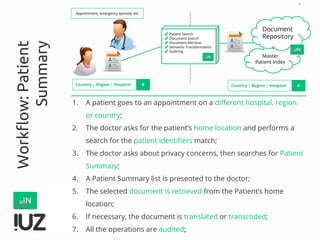
Workflow:Patient
Summary
Appointment, emergency episode, etc
Document
Repository
✓ Patient Search
✓ Document Search
✓ Document Retrieve
✓ Semantic Transformation
✓ Auditing
Country | Region | Hospital ACountry | Region | Hospital B
1. A patient goes to an appointment on a different hospital, region
or country;
2. The doctor asks for the patient’s home location and performs a
search for the patient identifiers match;
3. The doctor asks about privacy concerns, then searches for Patient
Summary;
4. A Patient Summary list is presented to the doctor;
5. The selected document is retrieved from the Patient’s home
location;
6. If necessary, the document is translated or transcoded;
7. All the operations are audited;
Master
Patient Index
*
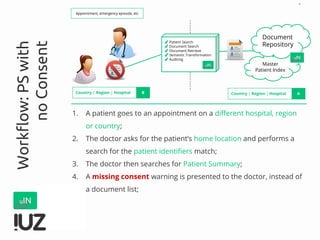
Workflow:PSwith
noConsent
Appointment, emergency episode, etc
Document
Repository
✓ Patient Search
✓ Document Search
✓ Document Retrieve
✓ Semantic Transformation
✓ Auditing
Country | Region | Hospital ACountry | Region | Hospital B
1. A patient goes to an appointment on a different hospital, region
or country;
2. The doctor asks for the patient’s home location and performs a
search for the patient identifiers match;
3. The doctor then searches for Patient Summary;
4. A missing consent warning is presented to the doctor, instead of
a document list;
Master
Patient Index
*
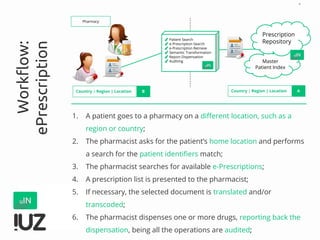
Pharmacy
Prescription
Repository✓ Patient Search
✓ e-Prescription Search
✓ e-Prescription Retrieve
✓ Semantic Transformation
✓ Report Dispensation
✓ Auditing
Country | Region | Location ACountry | Region | Location B
1. A patient goes to a pharmacy on a different location, such as a
region or country;
2. The pharmacist asks for the patient’s home location and performs
a search for the patient identifiers match;
3. The pharmacist searches for available e-Prescriptions;
4. A prescription list is presented to the pharmacist;
5. If necessary, the selected document is translated and/or
transcoded;
6. The pharmacist dispenses one or more drugs, reporting back the
dispensation, being all the operations are audited;
Workflow:
ePrescription
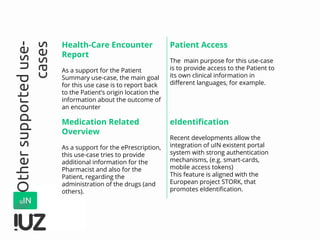
Othersupporteduse-
cases Health-Care Encounter
Report
As a support for the Patient
Summary use-case, the main goal
for this use case is to report back
to the Patient’s origin location the
information about the outcome of
an encounter
Patient Access
The main purpose for this use-case
is to provide access to the Patient to
its own clinical information in
different languages, for example.
Medication Related
Overview
As a support for the ePrescription,
this use-case tries to provide
additional information for the
Pharmacist and also for the
Patient, regarding the
administration of the drugs (and
others).
eIdentification
Recent developments allow the
integration of uIN existent portal
system with strong authentication
mechanisms, (e.g. smart-cards,
mobile access tokens)
This feature is aligned with the
European project STORK, that
promotes eIdentification.
Thank you!
contact@iuz.pt
+351 234 247 381
Rua Calouste Gulbenkian, n. 1
3810-074 Aveiro, Portugal
iuz.pt
iuz-technologies

iUZ.Talk - Cross-border Interoperability

  • 1.
  • 2.
    “Interoperability is theability of making systems and organizations to work together (inter-operate).”
  • 3.
    “Cross-border Interoperability aimsto provide tools and common ways to exchange (health) information between countries”
  • 4.
  • 5.
    ! Implementation oflegal common grounds for information exchange; ! Establishment of circles of trust; ! Legal recognition of involved parties, such as HCPs (including their roles), patients and others; ! Set in place common authentication mechanisms (e.g. European e-Identification projects); ! Others; LegalandOrganizational Interoperability
  • 6.
    ! Represent asmuch as possible the information using clinical code-systems; ! If necessary, define common and agreed value sets for information exchange; ! Establish formal mappings of existent information to the agreed value sets; ! Include also the translations to allow multi-language capabilities (cross-country scenarios); Semantic Interoperability
  • 7.
    ! Implement commoninterfaces for services; ! Establish agreed format for information exchange; ! If possible, prove and certify the compliance level of the involved systems; ! Define roadmaps for information integration; ! And others; Technical Interoperability
  • 8.
    Citizens and patients !Receive health care abroad (almost) seamlessly; ! Receive medication in a foreign country on existing prescription; ! Access to his own information in multiple languages and recognized formats; Health care providers ! Get quick and easy access to key patient data; ! Improve health care cooperation across borders; Health care quality ! Reduce medication errors by exchanging data; ! Facilitate the occasional care of foreign patients Benefits
  • 9.
    “So... How canwe give response to some of this issues?”
  • 10.
    IHE What is? IHE isan initiative by healthcare professionals and industry Aims to improve the way computer systems in healthcare share information. Promotes the coordinated use of established standards such as DICOM and HL7 to address specific clinical needs in support of optimal patient care. Systems developed in accordance with IHE communicate with one another better, are easier to implement, and enable care providers to use information more effectively. Vision Enable seamless and secure access to health information whenever and wherever needed. Mission IHE improves healthcare by providing specifications, tools and services for interoperability. IHE engages clinicians, health authorities, industry, and users to develop, test, and implement standards-based solutions to vital health information needs.
  • 11.
    ! Anatomic Pathology !Eye Care ! IT Infrastructure ! Laboratory ! Patient Care Coordination ! Patient Care Devices ! Quality, Research and Public Health ! Radiation Oncology ! Radiology IHEDomains
  • 12.
  • 13.
  • 14.
    HL7 What is? Founded in1987, Health Level Seven International (HL7) is a not-for-profit, ANSI-accredited standards developing organization. Its dedicated to providing a comprehensive framework and related standards for the exchange, integration, sharing, and retrieval of electronic health information This information that supports clinical practice and the management, delivery and evaluation of health services. Vision To create the best and most widely used standards in healthcare. Mission HL7 provides standards for interoperability that improve care delivery, optimize workflow, reduce ambiguity and enhance knowledge transfer among all of our stakeholders. All processes include high scientific rigor and technical expertise. “The 1000 kg Gorilla of Healthcare Standards”
  • 15.
    HL7v2 Common Messaging Standard PositiveNegative ! Simple syntax ! Easy to understand ! Widely adopted, with great experience; ! Backwards compatibility; ! Old technology ! Poor format ! Very limited scope ! Very limited on expansion; MSH|^~&|GHH LAB|ELAB-3|GHH OE|BLDG4|200202150930||ORU^R01|CNTRL-3456|P|2.4<cr>PID|||555-44- 4444||EVERYWOMAN^EVE^E^^^^L|JONES|19620320|F|||153 FERNWOODDR.^ ^STATESVILLE^OH^35292||(206)3345232|(206)752-121||||AC555444444||67-A4335^OH^20030520<cr>OBR|1|845439^GHH OE|1045813^GHH LAB|155
  • 16.
    HL7v3 Quality Methodology tosupercede version 2 Positive Negative ! Rigorous and Thorough Definitions ! Computable Base ! Based on XML & UML ! Deep Knowledge Required ! Complex Syntax ! Very expensive ! Common Semantics != Common Engineering <PRPA_IN201305UV02 ITSVersion="XML_1.0" xmlns="urn:hl7-org:v3"> <id extension="3660db44-40ab-4e9b-947e-a3ea3a4e80cc"root="67488c74-84f6-42c5-a9db-4a848fa49941"/><creationTime value="20140407"/><versionCode code="V3PR1"/> (...)
  • 17.
    HL7FHIR Fast HealthInteroperable Resources ! Small building blocks for health records; ! XML / JSON representation; ! Tailored for REST but useable in other ways; ! Standard Data, Narrative and Extensions ! Best ideas from HL7, DICOM and IHE ! Based on industry best practices, with a focus on simplicity and implementability;
  • 18.
  • 19.
  • 20.
    Topics 1. Description 2. Key-functionalities 3.Business services provided 4. General architecture 5. Application scenarios 6. Demonstration workflows 7. Other supported use-cases
  • 21.
    ! Provides Technicaland Semantic interoperability; ! Was firstly designed with EU Interoperability Framework as blueprint; ! Boosts the exchange of health-related information among departments, organisations or geographical apart clinicians and patients ; ! Was built using well known and cutting edge eHealth standards, allowing many integration possibilities; Description
  • 22.
    Keyfunctionalities Interoperability Connectors uIN core components thatenable information exchange Authentication & Authorization user authentication and credentials assertion Audit Trail a storage and consultation service to audit events performed by users Notifications send and receive several kind of messages via email, SMS or inApp Monitoring continuous assessment of availability in the ICT ecosystem Templating Repository document schemes for consultation and usage
  • 23.
    Businessservices provided Master PatientIndex maintain consistent, accurate and current demographic and essential medical data on the patients, across one or several organizations Patient Summary standardized set of basic medical data that includes important clinical facts required to ensure safe and secure healthcare Terminology Services record clinical information in ways that enable meaning-based retrieval, providing effective access to information for decision support Quality Conformance quality evaluation of health records made, such as checking if the data of a given form is properly and fully completed
  • 24.
    Usedstandardsand IHEprofiles HL7 FHIR Most promisingand recent HL7 draft standard. Oriented towards a lightweight REST approach, compatible with HL7 v2 and v3. Foresees easier integration with new paradigms (e.g. mobile, web) IHE XDS.b Well known IHE Profile to handle storage, query and retrieval of documents. Can be complemented for a more community- oriented use-case with the XCA profile. IHE PIX/PDQ Well known IHE profiles for handling the interfaces with Master Patient Index. Allowing the execution of demographic queries and patient identifiers cross-referencing. Can be complemented for a more community-oriented use-case with the XCPD profile. CTS2 Common Terminology services interface. CTS2 is a model and specification for discovering, accessing, distributing and updated terminological resources on the internet. DICOM Well known standard for clinical images and reports exchange and representation, regarding the format, service, etc.
  • 25.
    * GeneralArchitecture Integration Layer Services Layer Persistence Layer Additional Services IHE PIX/PDQ XCPD IHE XDS.b XCA CTS2HL7 FHIR Others Master Patient Index Document Registry Repository Terminology Service Others No-SQL Database SQL Relational Database Audit Trail Notifications PACS DICOM Viewer Report Templates Others
  • 26.
    ApplicationScenarios Legacy System ✓ CompliantServices → IHE, HL7 FHIR, etc ✓ Extended Interfaces ✓ Added Functionalities Region A Region B BridgingNetworksEnabling Systems eHealth Services Challenge us! Master Patient Index Documents Terminologies Others
  • 27.
    Master Patient Index * Workflow:Patient Summary Appointment, emergencyepisode, etc Document Repository ✓ Patient Search ✓ Document Search ✓ Document Retrieve ✓ Semantic Transformation ✓ Auditing Country | Region | Hospital ACountry | Region | Hospital B 1. A patient goes to an appointment on a different hospital, region or country; 2. The doctor asks for the patient’s home location and performs a search for the patient identifiers match; 3. The doctor asks about privacy concerns, then searches for Patient Summary; 4. A Patient Summary list is presented to the doctor; 5. The selected document is retrieved from the Patient’s home location; 6. If necessary, the document is translated or transcoded; 7. All the operations are audited;
  • 28.
    Master Patient Index * Workflow:PSwith noConsent Appointment, emergencyepisode, etc Document Repository ✓ Patient Search ✓ Document Search ✓ Document Retrieve ✓ Semantic Transformation ✓ Auditing Country | Region | Hospital ACountry | Region | Hospital B 1. A patient goes to an appointment on a different hospital, region or country; 2. The doctor asks for the patient’s home location and performs a search for the patient identifiers match; 3. The doctor then searches for Patient Summary; 4. A missing consent warning is presented to the doctor, instead of a document list;
  • 29.
    Master Patient Index * Pharmacy Prescription Repository✓ PatientSearch ✓ e-Prescription Search ✓ e-Prescription Retrieve ✓ Semantic Transformation ✓ Report Dispensation ✓ Auditing Country | Region | Location ACountry | Region | Location B 1. A patient goes to a pharmacy on a different location, such as a region or country; 2. The pharmacist asks for the patient’s home location and performs a search for the patient identifiers match; 3. The pharmacist searches for available e-Prescriptions; 4. A prescription list is presented to the pharmacist; 5. If necessary, the selected document is translated and/or transcoded; 6. The pharmacist dispenses one or more drugs, reporting back the dispensation, being all the operations are audited; Workflow: ePrescription
  • 30.
    Othersupporteduse- cases Health-Care Encounter Report Asa support for the Patient Summary use-case, the main goal for this use case is to report back to the Patient’s origin location the information about the outcome of an encounter Patient Access The main purpose for this use-case is to provide access to the Patient to its own clinical information in different languages, for example. Medication Related Overview As a support for the ePrescription, this use-case tries to provide additional information for the Pharmacist and also for the Patient, regarding the administration of the drugs (and others). eIdentification Recent developments allow the integration of uIN existent portal system with strong authentication mechanisms, (e.g. smart-cards, mobile access tokens) This feature is aligned with the European project STORK, that promotes eIdentification.
  • 31.
    Thank you! contact@iuz.pt +351 234247 381 Rua Calouste Gulbenkian, n. 1 3810-074 Aveiro, Portugal iuz.pt iuz-technologies