Presenter
Meha
M.Sc (N)
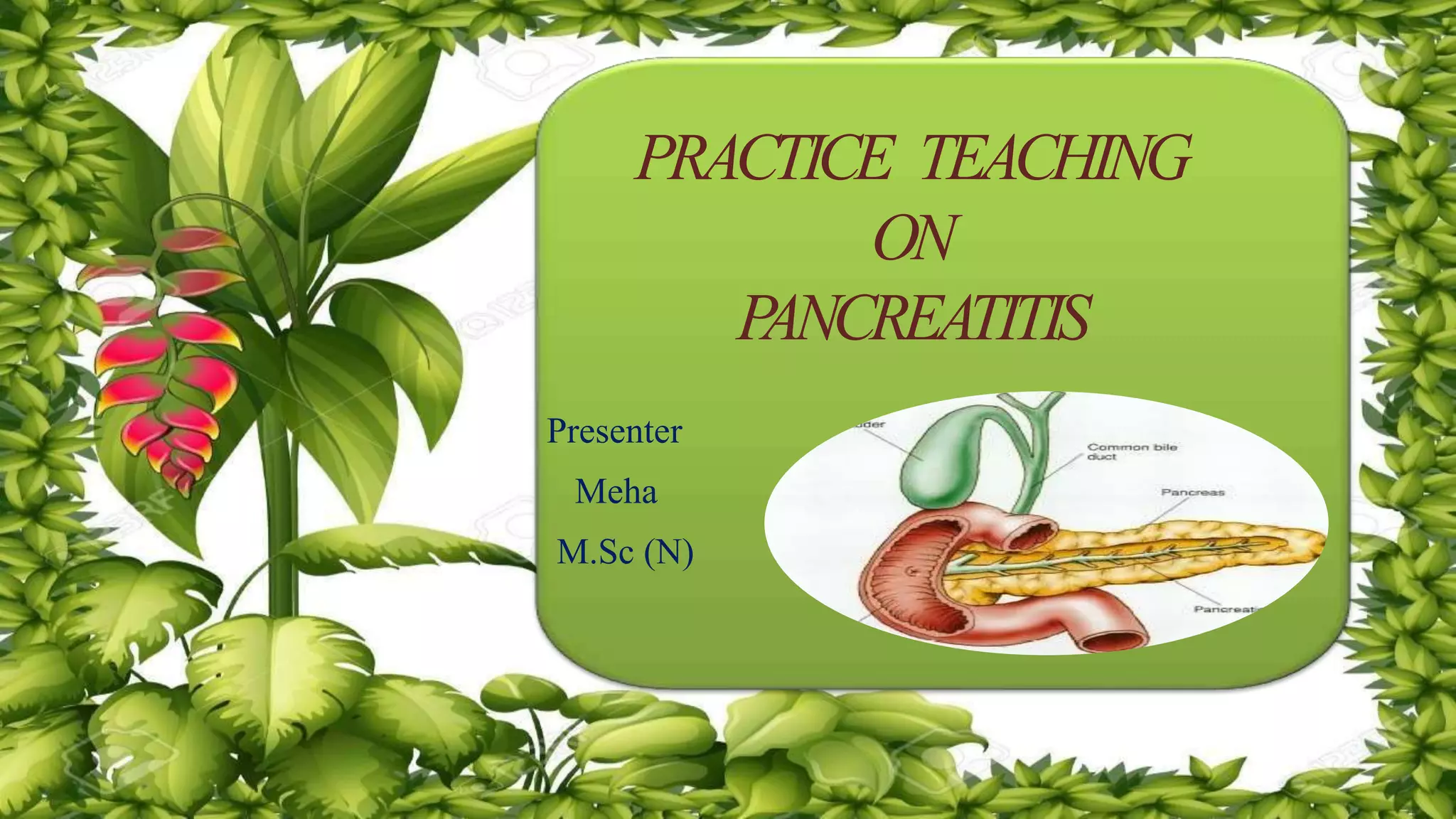
PRACTICE TEACHING
ON
PANCREATITIS
Definition
Anatomy and physiology of pancreas
Types of pancreatitis
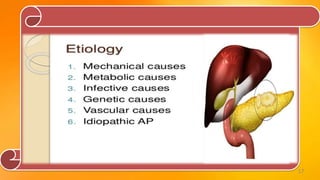
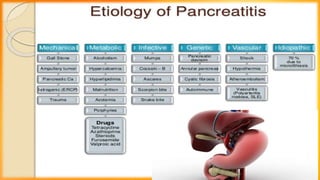
Main causes of pancreatitis
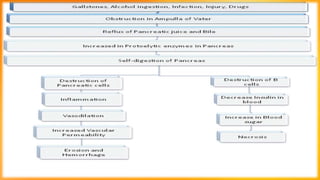
Pathophysiology
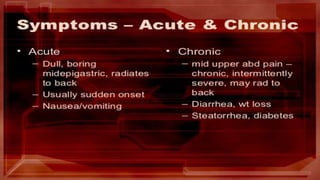
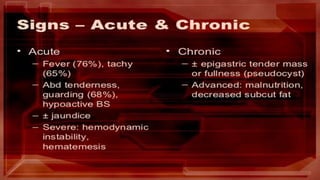
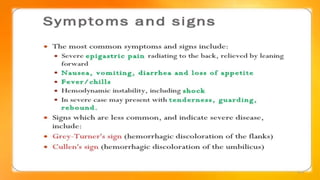
Sign and symptoms
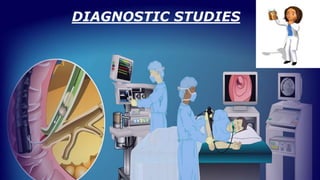
Diagnostic studies
Complications
Medical management
Surgical management
Nursing management
Research abstract 2
Inflammation of the pancreas that can lead to digestion of the
pancreas by its own enzymes and/or irreversible structural damage to
the organ.
Or
Pancreatitis is a painful inflammatory condition in which the
pancreatic enzymes are prematurely activated resulting in auto
digestion of the pancreas.
3
DEFINITION
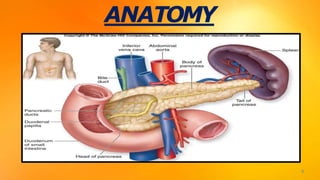
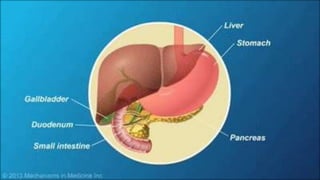
ANATOMY
4
5
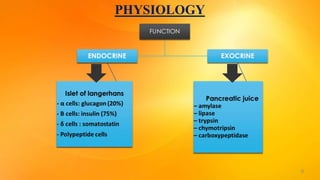
PHYSIOLOGY
6
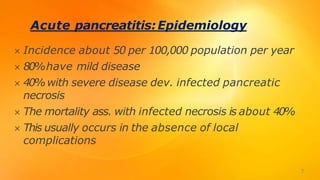
Acute pancreatitis:Epidemiology
 Incidence about 50 per 100,000 population per year
 80%have mild disease
 40%with severe disease dev. infected pancreatic
necrosis
 The mortality ass. with infected necrosis is about 40%
 This usually occurs in the absence of local
complications
7
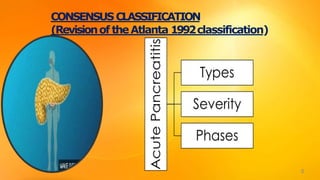
CONSENSUS CLASSIFICATION
(Revisionof theAtlanta 1992classification)
8
Types of
Pancreatitis
• Sudden inflammation of the pancreas due to something
that has triggered the digestive enzymes to become
activated inside the organ (there will be a high amylase
and lipase level in the blood).
• It comes on quickly and if treated promptly it can be
reversed. Typically there is limited structural damage to
the pancreas because it can be reversed with proper
treatment 10
Chronic inflammation of the pancreas (can be from
repeated episodes of acute pancreatitis but most
commonly due to years of alcohol abuse) that has
led to irreversible damage to the structure of
pancreas.
11
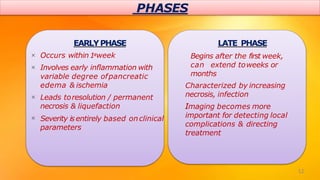
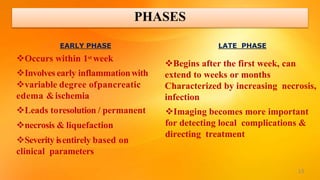
PHASES


EARLYPHASE
Occurs within1stweek
Involves early inflammation with

variable degree ofpancreatic
edema & ischemia
Leads toresolution / permanent

necrosis & liquefaction
Severity isentirely based onclinical
parameters
LATE PHASE
Begins after the first week,
can extend toweeks or
months
Characterized by increasing
necrosis, infection
Imaging becomes moreI
important for detecting local
complications & directing
treatment
12
PHASES
EARLY PHASE
Occurs within 1st week
Involves early inflammationwith
variable degree ofpancreatic
edema &ischemia
Leads toresolution / permanent
necrosis & liquefaction
Severity isentirely based on
clinical parameters
LATE PHASE
Begins after the first week, can
extend to weeks or months
Characterized by increasing necrosis,
infection
Imaging becomes more important
for detecting local complications &
directing treatment
13
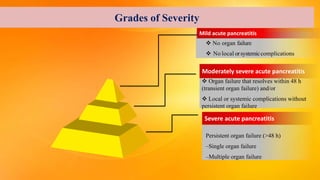
Grades of Severity
Mild acute pancreatitis
Moderately severe acute pancreatitis
Severe acute pancreatitis
 No organ failure
 No local orsystemiccomplications
 Organ failure that resolves within 48 h
(transient organ failure) and/or
 Local or systemic complications without
persistent organ failure
Persistent organ failure (>48 h)
–Single organ failure
–Multiple organ failure
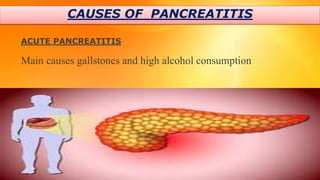
CAUSES OF PANCREATITIS
ACUTE PANCREATITIS
Main causes gallstones and high alcohol consumption
15
CHRONIC PANCREATITIS
Main cause is heavy-long term alcohol
consumption
16
17
18
PATHOPHYSIOLOGY
20
21
22
23
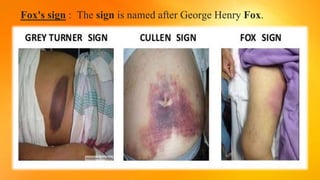
Fox's sign : The sign is named after George Henry Fox.
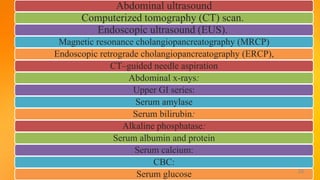
DIAGNOSTIC STUDIES
Abdominal ultrasound
Computerized tomography (CT) scan.
Endoscopic ultrasound (EUS).
Magnetic resonance cholangiopancreatography (MRCP)
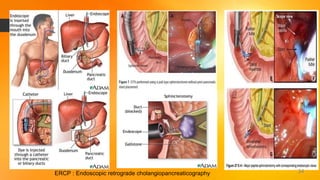
Endoscopic retrograde cholangiopancreatography (ERCP),
CT–guided needle aspiration
Abdominal x-rays:
Upper GI series:
Serum amylase
Serum bilirubin:
Alkaline phosphatase:
Serum albumin and protein
Serum calcium:
CBC:
Serum glucose 26
Baseline CT scanning is indicated in the
following situations:(1) the diagnosis is in
doubt;(2) severe pancreatitis is suspected
because of high fever (higher than 38.8°
C[102°F]), distension and leukocytosis
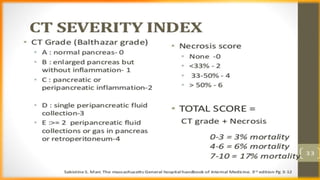
CT Severity Index (Balthazar Score) in Acute
Pancreatitis
Helpful in assessing complications related to
acute pancreatitis or as a follow-up study in
patients who are clinically deteriorating
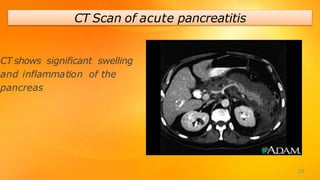
CT Scan of acute pancreatitis
CT shows significant swelling
and inflammation of the
pancreas
29
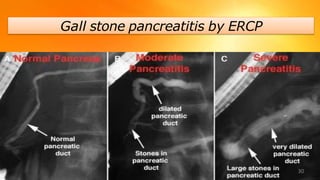
Gall stone pancreatitis by ERCP
30
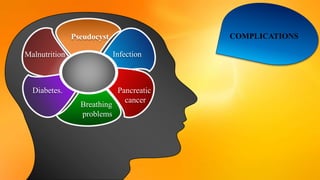
Infection
Pancreatic
cancer
Breathing
problems
Diabetes.
Malnutrition
Pseudocyst COMPLICATIONS
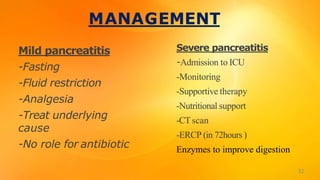
MANAGEMENT
Mild pancreatitis
-Fasting
-Fluid restriction
-Analgesia
-Treat underlying
cause
-No role for antibiotic
Severe pancreatitis
-Admission to ICU
-Monitoring
-Supportive therapy
-Nutritional support
-CTscan
-ERCP (in 72hours )
Enzymes to improve digestion
32
SURGICAL MANAGEMENT
Sphincterotomy. Cholecystectomy Stent placement
Balloon
dilatation
33
ERCP : Endoscopic retrograde cholangiopancreaticography 34
NURSING MANAGEMENT
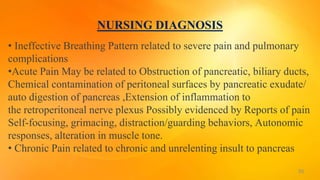
NURSING DIAGNOSIS
• Ineffective Breathing Pattern related to severe pain and pulmonary
complications
•Acute Pain May be related to Obstruction of pancreatic, biliary ducts,
Chemical contamination of peritoneal surfaces by pancreatic exudate/
auto digestion of pancreas ,Extension of inflammation to
the retroperitoneal nerve plexus Possibly evidenced by Reports of pain
Self-focusing, grimacing, distraction/guarding behaviors, Autonomic
responses, alteration in muscle tone.
• Chronic Pain related to chronic and unrelenting insult to pancreas
36
• Deficient Fluid Volume related to vomiting, self-
restricted intake, fever, and fluid shifts
• Imbalanced Nutrition: Less Than Body Requirements
related to fear of eating, mal absorption, and glucose
intolerance
• Impaired skin integrity related to poor nutritional status,
bed rest, and multiple drains and surgical wound
• Anxiety related to surgical intervention
37
RESEARCH ABSTRACT
99 patients with pancreatitis are discussed, 95 of whom had pancreatitis
induced by cane spirits. One quarter of the patients had pancreatic
calcification (more Indians than Africans) and 13% had pancreatic
pseudocysts (32% Indians, 6% Africans). Over 50% of the African patients
were in the lower dietary group, consuming meat less than twice weekly.
Pancreatic function tests (secretin-cholecystokinin) disclosed a low
bicarbonate and amylase secretion in 84 patients and a lowered
concentration associated with a large volume of secretion in 15 patients.
Triple-lumen intestinal perfusion with sucrose or glucose revealed a
diminished absorption of both sugars in pancreatitis with diabetes and
other groups tested. Water and sodium absorption were increased, and
potassium secretion was increased in pancreatitis with diabetes. 38
SUMMARIZATION
39
Definition
Anatomy and physiology of pancreas
Types of pancreatitis
Main causes of pancreatitis
Pathophysiology
Sign and symptoms
Diagnostic studies
Complications
Medical management
Surgical management
Nursing management
Research abstract
41

Pancreatitis

  • 1.
  • 2.
    Definition Anatomy and physiologyof pancreas Types of pancreatitis Main causes of pancreatitis Pathophysiology Sign and symptoms Diagnostic studies Complications Medical management Surgical management Nursing management Research abstract 2
  • 3.
    Inflammation of thepancreas that can lead to digestion of the pancreas by its own enzymes and/or irreversible structural damage to the organ. Or Pancreatitis is a painful inflammatory condition in which the pancreatic enzymes are prematurely activated resulting in auto digestion of the pancreas. 3 DEFINITION
  • 4.
  • 5.
  • 6.
  • 7.
    Acute pancreatitis:Epidemiology  Incidenceabout 50 per 100,000 population per year  80%have mild disease  40%with severe disease dev. infected pancreatic necrosis  The mortality ass. with infected necrosis is about 40%  This usually occurs in the absence of local complications 7
  • 8.
  • 9.
  • 10.
    • Sudden inflammationof the pancreas due to something that has triggered the digestive enzymes to become activated inside the organ (there will be a high amylase and lipase level in the blood). • It comes on quickly and if treated promptly it can be reversed. Typically there is limited structural damage to the pancreas because it can be reversed with proper treatment 10
  • 11.
    Chronic inflammation ofthe pancreas (can be from repeated episodes of acute pancreatitis but most commonly due to years of alcohol abuse) that has led to irreversible damage to the structure of pancreas. 11
  • 12.
    PHASES   EARLYPHASE Occurs within1stweek Involves earlyinflammation with  variable degree ofpancreatic edema & ischemia Leads toresolution / permanent  necrosis & liquefaction Severity isentirely based onclinical parameters LATE PHASE Begins after the first week, can extend toweeks or months Characterized by increasing necrosis, infection Imaging becomes moreI important for detecting local complications & directing treatment 12
  • 13.
    PHASES EARLY PHASE Occurs within1st week Involves early inflammationwith variable degree ofpancreatic edema &ischemia Leads toresolution / permanent necrosis & liquefaction Severity isentirely based on clinical parameters LATE PHASE Begins after the first week, can extend to weeks or months Characterized by increasing necrosis, infection Imaging becomes more important for detecting local complications & directing treatment 13
  • 14.
    Grades of Severity Mildacute pancreatitis Moderately severe acute pancreatitis Severe acute pancreatitis  No organ failure  No local orsystemiccomplications  Organ failure that resolves within 48 h (transient organ failure) and/or  Local or systemic complications without persistent organ failure Persistent organ failure (>48 h) –Single organ failure –Multiple organ failure
  • 15.
    CAUSES OF PANCREATITIS ACUTEPANCREATITIS Main causes gallstones and high alcohol consumption 15
  • 16.
    CHRONIC PANCREATITIS Main causeis heavy-long term alcohol consumption 16
  • 17.
  • 18.
  • 19.
  • 20.
  • 21.
  • 22.
  • 23.
  • 24.
    Fox's sign :The sign is named after George Henry Fox.
  • 25.
  • 26.
    Abdominal ultrasound Computerized tomography(CT) scan. Endoscopic ultrasound (EUS). Magnetic resonance cholangiopancreatography (MRCP) Endoscopic retrograde cholangiopancreatography (ERCP), CT–guided needle aspiration Abdominal x-rays: Upper GI series: Serum amylase Serum bilirubin: Alkaline phosphatase: Serum albumin and protein Serum calcium: CBC: Serum glucose 26
  • 27.
    Baseline CT scanningis indicated in the following situations:(1) the diagnosis is in doubt;(2) severe pancreatitis is suspected because of high fever (higher than 38.8° C[102°F]), distension and leukocytosis CT Severity Index (Balthazar Score) in Acute Pancreatitis Helpful in assessing complications related to acute pancreatitis or as a follow-up study in patients who are clinically deteriorating
  • 29.
    CT Scan ofacute pancreatitis CT shows significant swelling and inflammation of the pancreas 29
  • 30.
  • 31.
  • 32.
    MANAGEMENT Mild pancreatitis -Fasting -Fluid restriction -Analgesia -Treatunderlying cause -No role for antibiotic Severe pancreatitis -Admission to ICU -Monitoring -Supportive therapy -Nutritional support -CTscan -ERCP (in 72hours ) Enzymes to improve digestion 32
  • 33.
    SURGICAL MANAGEMENT Sphincterotomy. CholecystectomyStent placement Balloon dilatation 33
  • 34.
    ERCP : Endoscopicretrograde cholangiopancreaticography 34
  • 35.
  • 36.
    NURSING DIAGNOSIS • IneffectiveBreathing Pattern related to severe pain and pulmonary complications •Acute Pain May be related to Obstruction of pancreatic, biliary ducts, Chemical contamination of peritoneal surfaces by pancreatic exudate/ auto digestion of pancreas ,Extension of inflammation to the retroperitoneal nerve plexus Possibly evidenced by Reports of pain Self-focusing, grimacing, distraction/guarding behaviors, Autonomic responses, alteration in muscle tone. • Chronic Pain related to chronic and unrelenting insult to pancreas 36
  • 37.
    • Deficient FluidVolume related to vomiting, self- restricted intake, fever, and fluid shifts • Imbalanced Nutrition: Less Than Body Requirements related to fear of eating, mal absorption, and glucose intolerance • Impaired skin integrity related to poor nutritional status, bed rest, and multiple drains and surgical wound • Anxiety related to surgical intervention 37
  • 38.
    RESEARCH ABSTRACT 99 patientswith pancreatitis are discussed, 95 of whom had pancreatitis induced by cane spirits. One quarter of the patients had pancreatic calcification (more Indians than Africans) and 13% had pancreatic pseudocysts (32% Indians, 6% Africans). Over 50% of the African patients were in the lower dietary group, consuming meat less than twice weekly. Pancreatic function tests (secretin-cholecystokinin) disclosed a low bicarbonate and amylase secretion in 84 patients and a lowered concentration associated with a large volume of secretion in 15 patients. Triple-lumen intestinal perfusion with sucrose or glucose revealed a diminished absorption of both sugars in pancreatitis with diabetes and other groups tested. Water and sodium absorption were increased, and potassium secretion was increased in pancreatitis with diabetes. 38
  • 39.
    SUMMARIZATION 39 Definition Anatomy and physiologyof pancreas Types of pancreatitis Main causes of pancreatitis Pathophysiology Sign and symptoms Diagnostic studies Complications Medical management Surgical management Nursing management Research abstract
  • 41.