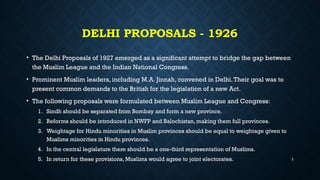
DELHI PROPOSALS -1926
• The Delhi Proposals of 1927 emerged as a significant attempt to bridge the gap between
the Muslim League and the Indian National Congress.
• Prominent Muslim leaders, including M.A. Jinnah, convened in Delhi.Their goal was to
present common demands to the British for the legislation of a new Act.
• The following proposals were formulated between Muslim League and Congress:
1. Sindh should be separated from Bombay and form a new province.
2. Reforms should be introduced in NWFP and Balochistan, making them full provinces.
3. Weightage for Hindu minorities in Muslim provinces should be equal to weightage given to
Muslims minorities in Hindu provinces.
4. In the central legislature there should be a one-third representation of Muslims.
5. In return for these provisions, Muslims would agree to joint electorates. 3
4.
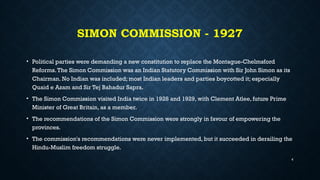
SIMON COMMISSION -1927
• Political parties were demanding a new constitution to replace the Montague-Chelmsford
Reforms.The Simon Commission was an Indian Statutory Commission with Sir John Simon as its
Chairman. No Indian was included; most Indian leaders and parties boycotted it; especially
Quaid e Azam and Sir Tej Bahadur Sapra.
• The Simon Commission visited India twice in 1928 and 1929, with Clement Atlee, future Prime
Minister of Great Britain, as a member.
• The recommendations of the Simon Commission were strongly in favour of empowering the
provinces.
• The commission's recommendations were never implemented, but it succeeded in derailing the
Hindu-Muslim freedom struggle.
4
5.
NEHRU REPORT -1928
• This was the first Indian attempt to frame a constitution. A committee was appointed under
Pandit Motilal Nehru.
• It called for complete independence rather than dominion status. It included:
• Dominion Status: India should be recognized as a sole dominion under British administration.
• Central Government: A central government should be established for the Indian Constitution.
• Joint Electorates: Proposed joint electorates with reservation of seats for minorities in the
legislatures.
• The new central government would control all departments without reserving any for the
British.The King should appoint a Governor General and a Prime Minister.
• The Nehru Report reflected the aspirations of diverse Indian communities and their desire
for self-governance. 5
6.
QUAID E AZAM’S14 POINTS - 1929
• After the publication of Nehru Report, Hindu-Muslim reconciliation became very weak.
The All-India Muslim League which had split over cooperation with the Simon
Commission was reunited.
• Muhammad Ali Jinnah had asked for three amendments to the Nehru Report, all of which
were rejected.They were:
1. One-third representation of Muslims in the Central Assembly.
2. Muslim majority in Bengal and the Punjab be maintained on the actual population ratio for ten
years.
3. The provinces should have residuary powers which meant a federal and not a unitary scheme.
6
continued
7.
QUAID E AZAM’S14 POINTS – 1929
• The reunited Muslim League, under Jinnah’s leadership issued the Fourteen Points as
the basis of any future constitution. In addition to Separate Electorates, the fourteen
points were:
1. Federal Constitution: The future constitution of India should be federal, with residuary
powers vested in the provinces.
2. Autonomy for Provinces: All provinces should have equal autonomy.
3. Muslim Representation: Adequate representation for Muslims in all legislative bodies.
4. Separate Electorates: Continuation of separate electorates for Muslims.
5. Reserved Seats: Reserved seats for Muslims in government services and self-governing
bodies.
6. Religious Freedom: Full religious freedom for all communities. 7
continued
8.
QUAID E AZAM’S14 POINTS – 1929
7. Protection of Minorities: Protection of the rights and interests of religious and other
minorities.
8. Equal Rights: Equal rights for all citizens regardless of religion or caste.
9. One-Third Muslim Representation: One-third representation for Muslims in central
legislative bodies.
10.Sindh’s Autonomy: Full autonomy for Sindh.
11.Baluchistan’s Autonomy: Full autonomy for Baluchistan.
12.Reforms in NWFP: Reforms in the North-West Frontier Province (NWFP) to protect the
rights of Muslims.
13.Bengal’s Reforms: Reforms in Bengal to address the concerns of Muslims.
14.Punjab’s Reforms: Reforms in Punjab to safeguard Muslim interests. 8
9.
ALLAMA IQBAL’S PRESIDENTIALADDRESS
AT ALLAHABAD - 1930
• The Allahabad Address was delivered by Sir Muhammad Iqbal during the 21st annual
session of the All-India Muslim League on December 29, 1930.
• In his address, Iqbal outlined a vision of independent states for the great Muslim-
majority provinces in northwestern India. He became the first politician to articulate
what would later be known as the Two-Nation Theory. According to this theory, Muslims
constituted a distinct nation and deserved political independence from other regions
and communities of India.
He said: “I would like to see the Punjab, North-West Frontier Province, Sindh, and Balochistan
amalgamated into a single state. Self-government within the British Empire, or without the British
Empire, the formation of a consolidated North-West Indian Muslim State appears to me the final
destiny of Muslims, at least of North India.” 9
continued
10.
ALLAMA IQBAL’S PRESIDENTIALADDRESS
AT ALLAHABAD - 1930
• Iqbal defined the Muslims of India as a nation. He emphasized that there could be no
peace in the country unless and until they were recognized as such. Under a federal
system, he advocated for equal privileges for Muslim-majority units, similar to those
given to Hindu-majority units.
He said: “The life of Islam as a cultural force in this country very largely depends on its
centralization in a specified territory.”
10
continued
11.
ALLAMA IQBAL’S PRESIDENTIALADDRESS
AT ALLAHABAD - 1930
• Iqbal stressed not only the need for political unity among Muslim communities but also
the undesirability of blending the Muslim population into a wider society not based on
Islamic principles. He rejected secularism and nationalism, emphasizing that the
construction of a policy on national lines should not displace the Islamic principle of
solidarity.
• In the latter part of his life, Iqbal focused on political activity. In a letter to Muhammad
Ali Jinnah in 1937, he wrote: “A separate federation of Muslim provinces, reformed on
the lines I have suggested above, is the only course by which we can secure a peaceful
India and save Muslims from the domination of Non-Muslims.Why should not the
Muslims of North-West and Bengal be considered as nations entitled to self-
determination, just as other nations in India and outside India are?” 11
12.
FIRST ROUND TABLECONFERENCE - 1930
• The Round Table Conferences were held partially to support the Simon Commission, and
partially to meet the objection that it contained no Indian members.
• The conference was organized by the British government to discuss constitutional reforms in
India.The first session was opened by King George V in London on 10 November, 1930.
• The British Prime Minister made the commitment that British would recognize that the executive
would be responsible to the legislature if the Indian legislature was formed as a federation.
• In India, both the Congress and Muslim League were pushing for their demands. Allama Iqbal
delivered his Allahabad Address, Motilal Nehru demanded full dominion status by 31
December, 1930, and his son Jawaharlal Nehru demanded full independence.
12
13.
SECOND ROUND TABLECONFERENCE -
1931
• Allama Iqbal and Gandhi were included as delegates in this session.
• The communal differences of the first conference could not be solved in this either.
• The Princes withdrew their agreement to join a federation.
• Muslim delegates were not in agreement with one another. Muhammad Ali Jinnah’s
role was described as “unique”. A British Journal wrote “The Hindus thought he was a
Muslim communalist, the Muslims took him to be pro-Hindu, the Princes deemed him
to be too democratic, the British considered him to be a rabid extremist – with the
result that he was everywhere but nowhere. None wanted him.”
13
14.
THIRD ROUND TABLECONFERENCE - 1932
• This session was almost meaningless: except a White Paper embodying
recommendations of all three sessions.
• Lord Willingdon was appointed the new Viceroy for India, who had Gandhi arrested.
The Congress began another Civil Disobedience Movement.
• Jinnah was not invited to the session because he had accused Lord Sankey, Chairman
of the Federal Structure Sub-Committee, of partiality.
• Jinnah believed he was excluded because of his insistence on the Fourteen Points.
14
15.
GOVERNMENT OF INDIAACT - 1935
• Influenced by the Simon Commission Report, recommendations from the Round Table
Conferences, and the White Paper published by the British government, the Government
of India Act, 1935 was enacted by the British Parliament.
• Congress demanded a swift and complete transfer of power, while Britain’s Conservative
Party was opposed to Home rule in India.
• Under the Government of India Act 1935, the British wanted the provinces and princely
states to come together under a federation.
• A Federal Court was to be set up to decide disputes between the Federal and Provincial
Governments.The Indian Council was abolished.
• It was divided into two parts: Federal Part and Provincial Part. 15
continued
16.
GOVERNMENT OF INDIAACT - 1935
• Federal Part:
• The Reserved Federal Executive was to constitute a governor general, and a council of
ministers.
• Defence, foreign affairs, tribal area affairs and ecclesiastical affairs were reserved.
• Transferred affairs were: education, finance, home, law, railways, commerce, industries,
and labor.
• There were to be two legislatures:
• The Council of State was to be the Upper House, with 250 members.
• The House of Assembly was the Lower House, with 375 members.
16
continued
17.
GOVERNMENT OF INDIAACT - 1935
• Provincial Part:
• The Governor was to act on the advice of the elected Chief Minister, except in the case of
“Special Responsibility”.
• Six provinces: Bengal, Bihar, Assam, UP, Bombay, and Madras had two legislatures; Upper
House and Lower House.
• In the remaining five provinces there was only a Lower House.
• Three new provinces were created.
• NWFP was made a full fledged province with a Legislative Assembly and a Governor.
• Sindh was separated from Bombay and organized in the same way as the NWFP.
• Orissa was separated from Bengal.
17
18.
ELECTIONS - 1937
•These were the first broad based elections which tested the representative status of political
parties.
• The tone of the campaign was set by Jawaharlal Nehru, who said that India had two parties: the
British and the Congress. “The others must line up”.
• To this Quaid-e-Azam replied: “I refuse to line up with the Congress.There is a third party in
this country and that is the Muslims.We are not going to be dictated to by any one.”
• The Muslim League lost, when the elections were held, though under separate electorates the
Muslim League faced only Muslim voters.The League won only 104 out of 489 Muslim Seats.The
Congress won 711 out of 1585 general votes. It was able to form the government in 7 out of 11
provinces.
18
19.
CONGRESS GOVERNMENT –1937-39
• In the 1937 Provincial Elections, the Indian National Congress secured significant victories,
forming ministries in several provinces.
• Jawaharlal Nehru assumed office as the Prime Minister of India, leading the Congress
Ministries.
• Congress ministries alienated the Muslims of their provinces and issued policies and actions
which included:
• Declaring Hindi as the national language.
• The Congress flag became the national flag, and Bande Mataram was adopted as the national
anthem.
• A strict prohibition was imposed on cow slaughter.
• Saluting Gandhi’s portrait in schools was forced.
19
continued
20.
CONGRESS GOVERNMENT –1937-39
• Introduced Educational reforms including The Warda Taleemi Scheme which aimed to counter
the Two-Nation Theory by shaping the minds of Muslim children.The Vidya Mandar Scheme
promoted Hindu culture through mandatory Mandar education at the elementary level.
• Muslims faced economic setbacks, exclusion from government offices, and limited career
opportunities.Their trade and agriculture suffered due to discriminatory policies.
• The Congress rule witnessed rising political Hinduism.
• Some Congress leaders seemed to focus solely on Hindu welfare and sought revenge for the
perceived 700-year Muslim rule.
• Construction of new mosques was banned, and Muslims faced harassment during prayers.
• The Congress ministries resigned in 1939 as a protest to British declaration of war with Germany.
• This period left a lasting impact on Hindu-Muslim relations, revealing the Congress’s Hindu-
centric policies and their effects on the Muslim community. 20
21.
DAY OF DELIVERANCE- 1939
• In September 1939, the Second World War broke out.The Viceroy announced that India was
also at War.The Congress protested that they were not consulted, and said India would not
participate unless the British accepted the principle of full and immediate independence for
India.
• The British offered full dominion status at the end of the War. On 22 September 1939, the
Congress resigned from all its ministries.
• Muhammad Ali Jinnah first offered terms to the Congress rather than to the British. He asked
for League-Congress coalitions in the provinces, an end to anti-Muslim moves and acceptance
of the necessity for two thirds Muslim majority voting for the passing of laws affecting Muslims.
The Congress did not respond, so Jinnah declared 22 December 1939 as a 'day deliverance'
from Congress rule.
• Nehru then approached Muhammad Ali Jinnah with conciliatory gestures, but it was too late.
The League was now able to consolidate its political gains.
21
22.
LAHORE RESOLUTION -1940
• The Lahore Resolution, also known as the Pakistan Resolution, was a significant political
statement adopted by the All-India Muslim League during its three-day general session in
Lahore from March 22 to March 24, 1940.
• The resolution called for the creation of independent states based on geographically
contiguous units.
• It emphasized that areas where Muslims were numerically in the majority (such as the North
Western and Eastern Zones of British India) should be grouped to form autonomous and
sovereign states.
• Although the term “Pakistan” had been proposed earlier, it gained widespread usage only after
the resolution.
22
continued
23.
LAHORE RESOLUTION –1940
• The Lahore session is noted for the formal adoption of the Two-Nation theory by the
All-India Muslim League.
• Muhammad Ali Jinnah, once a proponent of Hindu-Muslim unity, transformed himself
into a champion of a separate Muslim homeland called Pakistan during his address at
the Lahore conference. He said:
“The Hindus and Muslims belong to two different religious philosophies, social customs,
literatures.They neither intermarry or interdine, and indeed they belong to two different
civilizations which are based on conflicting ideas and conceptions.”
23



![towards-pakistan-1947 [Autosaved].pp.....tx](https://cdn.slidesharecdn.com/ss_thumbnails/towards-pakistan-1947autosaved-240710175911-c968a700-thumbnail.jpg?width=640&height=640&fit=bounds)
![towards-pakistan-1947 [Autosaved]...pptx](https://cdn.slidesharecdn.com/ss_thumbnails/towards-pakistan-1947autosaved-240710181039-b380499e-thumbnail.jpg?width=640&height=640&fit=bounds)


