Pain Types and Viscerogenic
Pain Patterns
Pain
• Primary symptom in many PT practices
• Recognized as the 5th vital sign
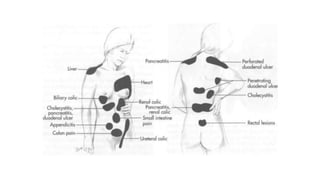
Most common sites of referred pain from a
systemic disease process
• Chest
• Back
• Shoulder
• Scapula
• Pelvis
• Hip
• Groin
• SI joint
Mechanisms of Referred Visceral Pain
• Embryologic Development
• Multisegmental Innvervation
• Direct Pressure and shared pathways
Mechanisms of Referred Visceral Pain
• Embryologic Development
• Pain refers to the organ location during fetal development
• Pain refers to other body part/s coming from the same tissue in the utero
• Chest is part of the gut
• Pneumonia or pleuritis refer pain to the abdomen
• Heart’s pericardium is formed from the gut
• MI or pericarditis can also refer pain to the abdomen
Mechanisms of Referred Visceral Pain
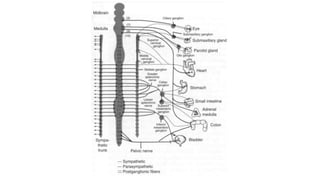
• Multisegmental Innervation
• Viscera have multisegmental innervation
• Heart
• Bronchi
• Stomach
• Kidneys
• Intestines
• Bladder
• Pain may be referred to areas supplied by the corresponding spinal nerves
• cardiac pain can occur in jaw, neck, upper trapezius, shoulder, and arm
(innervated by C3 to T4)
• Shoulder pain - cardiac and diaphragmatic origin
• C5 spinal segment - supplies the heart, respiratory diaphragm, and shoulder
Mechanisms of Referred Visceral Pain
• Direct Pressure and Shared Pathways
• Direct pressure from any inflamed , infected , or obstructed organ in contact
with the respiratory diaphragm can refer pain to the ipsilateral shoulder
• Spleen tucked up under the diaphragm on the left side
• Tail of the pancreas in contact with the diaphragm on the left side
• Head of pancreas in contact with the diaphragm on the right side
• Gallbladder located under the liver on the right side
• Central diaphragm impingement can refer pain to the shoulder
• Peripheral diaphragm impingement can refer pain to the ipsilateral costal
margins and/or lumbar region
Assessment of Pain and Symptoms
• Cultural rules
• Differences in pain perception
• Intensity and responses
Assessment of Pain and Symptoms
• Component of a comprehensive pain assessment
• Health history
• physical exam
• medication history
• including nonprescription drug use and complementary and alternative therapies
• assessment of functional status
• consideration of psychosocial-spiritual factors
Assessment of Pain and Symptoms
• To elicit a complete description of symptoms from the client, use a
term other pain
• Client’s symptoms
• Hurt
• Sore
• Burning
• Tightness
• Heaviness
• Discomfort
• Aching
Pain Assessment in the Older Adult
• Pain is accepted as key feature of the aging process
• Older adults use OTC analgesic medications for pain, aching &
discomfort
• Adults may avoid giving an accurate assessment of their pain
• Some may expect pain with aging
• Fear that talking about pain will lead to expensive tests or medications with
unwanted side effects
• Others underreport pain symptoms due to fear of losing one's independence
Pain Assessment in the Older Adult
• Factors affecting older adults’ reliability in reporting pain
• Sensory impairment
• Cognitive impairment
• Ability to comprehend a scale and communicate a response
• Frail adults
• Dementia (pain report is reliable in the early stages using VAS)
• Alzheimer’s type dementia
• Loses short-term memory
• Cannot always identify the source of recent painful stimuli
Pain Assessment in the Older Adult
• Symptoms of Pain in Clients with Cognitive Impairment
• Verbal comments such as ouch or stop
• Nonverbal vocalizations (e.g., moans, signs, gasps)
• Facial grimacing or frowning
• Audible breathing independent of vocalization (labored, short or long periods of hyperventilation)
• Agitation or increased confusion
• Unable to be consoled or distracted
• Bracing or holding onto furniture
• Decreased mobility
• Lying very still; refusing to move
• Clutching the painful area
• Resisting care provided by others; striking out; pushing others away
• Sleep disturbance
• Weight loss
• Depression
Pain Assessment in the Older Adult
• McGill Melzack Pain Questionnaire
• Verbal Descriptor Scale (VDS)
• Most sensitive and reliable among older adults
• Indicated for those with mild to moderate cognitive impairment
• Alzheimer’s Discomfort Rating Scale
• Helpful for adult who are unable to communicate their pain
• Pain Assessment in Advanced Dementia
• a simple, valid, and reliable instrument for measurement of pain in
noncommunicative clients
Pain Assessment in the young group
• Infants and children with substantial cognitive impairment may be
able to use pain-rating scales when explained carefully
• If using a rating scale is not possible:
• may rely on the parent or caregiver’s report and/or other measures of pain in
children with cognitive or communication impairments and physical
disabilities
• Terms to use
• Hurt rather pain: understood by children as young as 3 years old
• Owie or ouchie
Pain Assessment in the young group
• Look for telltale behavior:
• Lack of cooperation
• Withdrawal
• Acting out
• Distractibility
• Seeking comfort
• Altered sleep patterns
• Vocalizations
• Eating patterns
Pain Assessment in the young group
• Faces Pain Scale – Revised (FPS-R)
• child looks at the faces, the therapist or parent uses the simple words to
describe the expression
• corresponding number is used to record the score
• Child Facial Coding System (CFCS) and the Neonatal Facial Coding
System (NFCS)
• can be used as behavioral measures of pain intensity in very young children
and infants
Characteristics of Pain
• Location
• Description of sensation
• Intensity
• Duration
• Frequency and Duration
• Pattern
• Other additional components:
• Factors that aggravate the pain
• Factors that alleviate/relieve the pain
Location of Pain
• Show me exactly where your pain is located
• Do you have any other pain or symptoms anywhere else?
• If yes, what causes the pain or symptoms to occur in this other area?
Location of Pain
• Superficial lesion (probably not severe)
• client points to a small, localized area and the pain does not spread
• Viscera or deep somatic structure (diffuse, segmental, referred pain)
• client points to a small, localized area but the pain does spread
Description of Pain
• What does it feel like?
• You may want to ask: Is your pain/Are your symptoms:
• Knifelike
• Dull
• Boring
• Burning
• Throbbing
• Prickly
• Deep aching
• Sharp
Description of Pain
• Has the pain changed in quality since it first began?
• Changed in intensity?
• Changed in duration (how long it lasts)?
Description of Pain
• Systemic origin of symptoms
• client describes the pain as…
• knifelike, boring, colicky, coming in waves, or a deep aching feeling
• Aching pain of a muscular lesion
• Pain increases by squeezing or by pressing the muscle overlying the area of
pain
• Resisting motion of the limb may also reproduce aching of muscular origin
that has no connection to deep somatic aching
Intensity of Pain
• Extremely important but difficult component to assess in the overall
pain profile
• Highly subjective
• Careful assessment of the person's nonverbal behavior
• Correlation of the person's personality with his or her perception of
the pain
• May be influenced by psychologic factors (emotions)
• African Americans vs. Caucasians
• Men vs. Women
• Reported less among individuals with some means of social and emotional
support
Intensity of Pain
• Quantify symptoms other than pain such as:
• Stiffness
• Pressure
• Soreness
• Discomfort
• Cramping
• Aching
• Numbness
• Tingling
Intensity of Pain
• Visual Analog Scale
• Numerical Rating Scale
• (+) plus is used for clients who indicate the pain is "off the scale" or
"higher than a 10"
Frequency and Duration of Pain
• Should be asked how often the symptoms occur
• Is the pain constant or intermittent?
• How long do the symptoms last?
• Systemic disease – shown to be constant rather than an intermittent
type of pain experience
• Clients who indicate that the pain is constant should be asked:
• Do you have this pain right now?
• Did you notice these symptoms this morning immediately when you woke up?
Frequency and Duration of Pain
• Pain of musculoskeletal origin
• not actually present consistently
• can be reduced with rest or change in position
Pattern of Pain
• These questions may be helpful in further assessing the pattern of
pain, especially how the symptoms may change with time
• Tell me about the pattern of your pain/ symptoms.
• Alternate question: When does your back/shoulder (name the involved body
part) hurt?
• Alternate question: Describe your pain/ symptoms from first waking up in the
morning to going to bed at night
Pattern of Pain
• Follow-up questions may include:
• Have you ever experienced anything like this before?
• If yes, do these episodes occur more or less often than at first?
• How does your pain/symptom(s) change with time?
• Are your symptoms worse in the morning or evening?
Pattern of Pain
• Pattern of pain associated with
systemic disease
• often a progressive pattern with a cyclical
onset
• the client describes symptoms as being
alternately worse, better, and worse over a
period of months
• If the client is unsure of the pattern of
symptoms/ avoided paying any attention
to this pain description
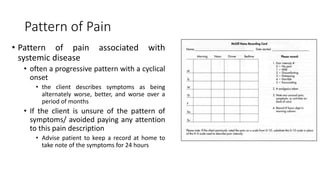
• Advise patient to keep a record at home to
take note of the symptoms for 24 hours
Pattern of Pain
• Record the use of any medications (medications can alter pain pattern
or characteristics)
• Did the current medication reduce, control, or relieve pain?
• Look for side effects or adverse reactions to any drugs or drug
combinations
• Possible peptic ulcer
• Clients taking nonsteroidal anti-inflammatory drugs (NSAIDs) who
experience an increase in shoulder, neck, or back pain several hours after
taking the medication
Pattern of Pain
• Constitutional symptoms affect the whole body and are characteristic
of systemic disease or illness
• Fever
• Diaphoresis (unexplained perspiration)
• Night sweats (can occur during the day)
• Nausea
• Vomiting
• Diarrhea
• Pallor
• Dizziness/syncope (fainting)
• Fatigue
• Weight loss
Aggravating & Relieving Factors
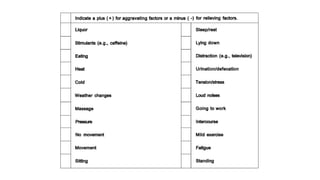
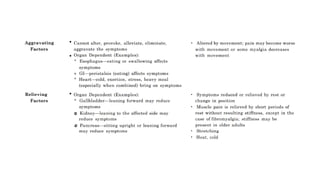
• Aggravating factors:
• What brings your pain (symptoms)
on?
• What kinds of things make your
pain (symptoms) worse?
• Eating
• Exercise
• Rest
• Specific positions
• Excitement
• Stress
• Relieving factors:
• What makes the pain better?
Aggravating & Relieving Factors
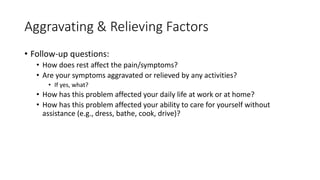
• Follow-up questions:
• How does rest affect the pain/symptoms?
• Are your symptoms aggravated or relieved by any activities?
• If yes, what?
• How has this problem affected your daily life at work or at home?
• How has this problem affected your ability to care for yourself without
assistance (e.g., dress, bathe, cook, drive)?
Aggravating & Relieving Factors
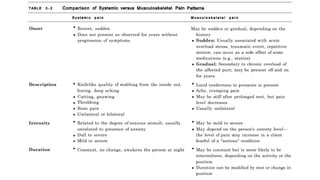
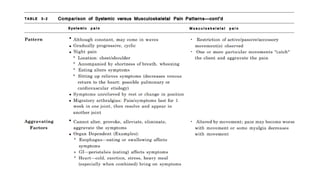
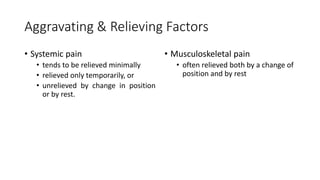
• Systemic pain
• tends to be relieved minimally
• relieved only temporarily, or
• unrelieved by change in position
or by rest.
• Musculoskeletal pain
• often relieved both by a change of
position and by rest
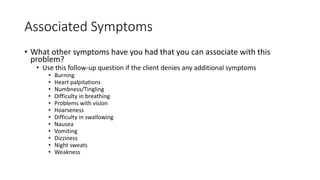
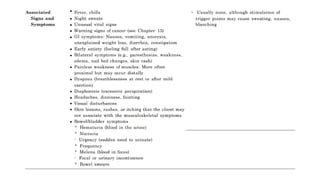
Associated Symptoms
• What other symptoms have you had that you can associate with this
problem?
• Use this follow-up question if the client denies any additional symptoms
• Burning
• Heart palpitations
• Numbness/Tingling
• Difficulty in breathing
• Problems with vision
• Hoarseness
• Difficulty in swallowing
• Nausea
• Vomiting
• Dizziness
• Night sweats
• Weakness
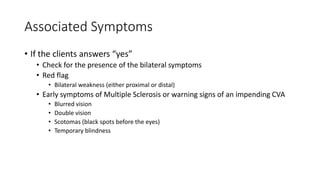
Associated Symptoms
• If the clients answers “yes”
• Check for the presence of the bilateral symptoms
• Red flag
• Bilateral weakness (either proximal or distal)
• Early symptoms of Multiple Sclerosis or warning signs of an impending CVA
• Blurred vision
• Double vision
• Scotomas (black spots before the eyes)
• Temporary blindness
Thank you!

Pain Assessment Pain Types Pain Patternn

  • 1.
    Pain Types andViscerogenic Pain Patterns
  • 2.
    Pain • Primary symptomin many PT practices • Recognized as the 5th vital sign
  • 3.
    Most common sitesof referred pain from a systemic disease process • Chest • Back • Shoulder • Scapula • Pelvis • Hip • Groin • SI joint
  • 4.
    Mechanisms of ReferredVisceral Pain • Embryologic Development • Multisegmental Innvervation • Direct Pressure and shared pathways
  • 5.
    Mechanisms of ReferredVisceral Pain • Embryologic Development • Pain refers to the organ location during fetal development • Pain refers to other body part/s coming from the same tissue in the utero • Chest is part of the gut • Pneumonia or pleuritis refer pain to the abdomen • Heart’s pericardium is formed from the gut • MI or pericarditis can also refer pain to the abdomen
  • 7.
    Mechanisms of ReferredVisceral Pain • Multisegmental Innervation • Viscera have multisegmental innervation • Heart • Bronchi • Stomach • Kidneys • Intestines • Bladder • Pain may be referred to areas supplied by the corresponding spinal nerves • cardiac pain can occur in jaw, neck, upper trapezius, shoulder, and arm (innervated by C3 to T4) • Shoulder pain - cardiac and diaphragmatic origin • C5 spinal segment - supplies the heart, respiratory diaphragm, and shoulder
  • 9.
    Mechanisms of ReferredVisceral Pain • Direct Pressure and Shared Pathways • Direct pressure from any inflamed , infected , or obstructed organ in contact with the respiratory diaphragm can refer pain to the ipsilateral shoulder • Spleen tucked up under the diaphragm on the left side • Tail of the pancreas in contact with the diaphragm on the left side • Head of pancreas in contact with the diaphragm on the right side • Gallbladder located under the liver on the right side • Central diaphragm impingement can refer pain to the shoulder • Peripheral diaphragm impingement can refer pain to the ipsilateral costal margins and/or lumbar region
  • 10.
    Assessment of Painand Symptoms • Cultural rules • Differences in pain perception • Intensity and responses
  • 11.
    Assessment of Painand Symptoms • Component of a comprehensive pain assessment • Health history • physical exam • medication history • including nonprescription drug use and complementary and alternative therapies • assessment of functional status • consideration of psychosocial-spiritual factors
  • 12.
    Assessment of Painand Symptoms • To elicit a complete description of symptoms from the client, use a term other pain • Client’s symptoms • Hurt • Sore • Burning • Tightness • Heaviness • Discomfort • Aching
  • 13.
    Pain Assessment inthe Older Adult • Pain is accepted as key feature of the aging process • Older adults use OTC analgesic medications for pain, aching & discomfort • Adults may avoid giving an accurate assessment of their pain • Some may expect pain with aging • Fear that talking about pain will lead to expensive tests or medications with unwanted side effects • Others underreport pain symptoms due to fear of losing one's independence
  • 14.
    Pain Assessment inthe Older Adult • Factors affecting older adults’ reliability in reporting pain • Sensory impairment • Cognitive impairment • Ability to comprehend a scale and communicate a response • Frail adults • Dementia (pain report is reliable in the early stages using VAS) • Alzheimer’s type dementia • Loses short-term memory • Cannot always identify the source of recent painful stimuli
  • 15.
    Pain Assessment inthe Older Adult • Symptoms of Pain in Clients with Cognitive Impairment • Verbal comments such as ouch or stop • Nonverbal vocalizations (e.g., moans, signs, gasps) • Facial grimacing or frowning • Audible breathing independent of vocalization (labored, short or long periods of hyperventilation) • Agitation or increased confusion • Unable to be consoled or distracted • Bracing or holding onto furniture • Decreased mobility • Lying very still; refusing to move • Clutching the painful area • Resisting care provided by others; striking out; pushing others away • Sleep disturbance • Weight loss • Depression
  • 16.
    Pain Assessment inthe Older Adult • McGill Melzack Pain Questionnaire • Verbal Descriptor Scale (VDS) • Most sensitive and reliable among older adults • Indicated for those with mild to moderate cognitive impairment • Alzheimer’s Discomfort Rating Scale • Helpful for adult who are unable to communicate their pain • Pain Assessment in Advanced Dementia • a simple, valid, and reliable instrument for measurement of pain in noncommunicative clients
  • 17.
    Pain Assessment inthe young group • Infants and children with substantial cognitive impairment may be able to use pain-rating scales when explained carefully • If using a rating scale is not possible: • may rely on the parent or caregiver’s report and/or other measures of pain in children with cognitive or communication impairments and physical disabilities • Terms to use • Hurt rather pain: understood by children as young as 3 years old • Owie or ouchie
  • 18.
    Pain Assessment inthe young group • Look for telltale behavior: • Lack of cooperation • Withdrawal • Acting out • Distractibility • Seeking comfort • Altered sleep patterns • Vocalizations • Eating patterns
  • 19.
    Pain Assessment inthe young group • Faces Pain Scale – Revised (FPS-R) • child looks at the faces, the therapist or parent uses the simple words to describe the expression • corresponding number is used to record the score • Child Facial Coding System (CFCS) and the Neonatal Facial Coding System (NFCS) • can be used as behavioral measures of pain intensity in very young children and infants
  • 20.
    Characteristics of Pain •Location • Description of sensation • Intensity • Duration • Frequency and Duration • Pattern • Other additional components: • Factors that aggravate the pain • Factors that alleviate/relieve the pain
  • 21.
    Location of Pain •Show me exactly where your pain is located • Do you have any other pain or symptoms anywhere else? • If yes, what causes the pain or symptoms to occur in this other area?
  • 22.
    Location of Pain •Superficial lesion (probably not severe) • client points to a small, localized area and the pain does not spread • Viscera or deep somatic structure (diffuse, segmental, referred pain) • client points to a small, localized area but the pain does spread
  • 23.
    Description of Pain •What does it feel like? • You may want to ask: Is your pain/Are your symptoms: • Knifelike • Dull • Boring • Burning • Throbbing • Prickly • Deep aching • Sharp
  • 24.
    Description of Pain •Has the pain changed in quality since it first began? • Changed in intensity? • Changed in duration (how long it lasts)?
  • 25.
    Description of Pain •Systemic origin of symptoms • client describes the pain as… • knifelike, boring, colicky, coming in waves, or a deep aching feeling • Aching pain of a muscular lesion • Pain increases by squeezing or by pressing the muscle overlying the area of pain • Resisting motion of the limb may also reproduce aching of muscular origin that has no connection to deep somatic aching
  • 26.
    Intensity of Pain •Extremely important but difficult component to assess in the overall pain profile • Highly subjective • Careful assessment of the person's nonverbal behavior • Correlation of the person's personality with his or her perception of the pain • May be influenced by psychologic factors (emotions) • African Americans vs. Caucasians • Men vs. Women • Reported less among individuals with some means of social and emotional support
  • 27.
    Intensity of Pain •Quantify symptoms other than pain such as: • Stiffness • Pressure • Soreness • Discomfort • Cramping • Aching • Numbness • Tingling
  • 28.
    Intensity of Pain •Visual Analog Scale • Numerical Rating Scale • (+) plus is used for clients who indicate the pain is "off the scale" or "higher than a 10"
  • 29.
    Frequency and Durationof Pain • Should be asked how often the symptoms occur • Is the pain constant or intermittent? • How long do the symptoms last? • Systemic disease – shown to be constant rather than an intermittent type of pain experience • Clients who indicate that the pain is constant should be asked: • Do you have this pain right now? • Did you notice these symptoms this morning immediately when you woke up?
  • 30.
    Frequency and Durationof Pain • Pain of musculoskeletal origin • not actually present consistently • can be reduced with rest or change in position
  • 31.
    Pattern of Pain •These questions may be helpful in further assessing the pattern of pain, especially how the symptoms may change with time • Tell me about the pattern of your pain/ symptoms. • Alternate question: When does your back/shoulder (name the involved body part) hurt? • Alternate question: Describe your pain/ symptoms from first waking up in the morning to going to bed at night
  • 32.
    Pattern of Pain •Follow-up questions may include: • Have you ever experienced anything like this before? • If yes, do these episodes occur more or less often than at first? • How does your pain/symptom(s) change with time? • Are your symptoms worse in the morning or evening?
  • 33.
    Pattern of Pain •Pattern of pain associated with systemic disease • often a progressive pattern with a cyclical onset • the client describes symptoms as being alternately worse, better, and worse over a period of months • If the client is unsure of the pattern of symptoms/ avoided paying any attention to this pain description • Advise patient to keep a record at home to take note of the symptoms for 24 hours
  • 34.
    Pattern of Pain •Record the use of any medications (medications can alter pain pattern or characteristics) • Did the current medication reduce, control, or relieve pain? • Look for side effects or adverse reactions to any drugs or drug combinations • Possible peptic ulcer • Clients taking nonsteroidal anti-inflammatory drugs (NSAIDs) who experience an increase in shoulder, neck, or back pain several hours after taking the medication
  • 35.
    Pattern of Pain •Constitutional symptoms affect the whole body and are characteristic of systemic disease or illness • Fever • Diaphoresis (unexplained perspiration) • Night sweats (can occur during the day) • Nausea • Vomiting • Diarrhea • Pallor • Dizziness/syncope (fainting) • Fatigue • Weight loss
  • 36.
    Aggravating & RelievingFactors • Aggravating factors: • What brings your pain (symptoms) on? • What kinds of things make your pain (symptoms) worse? • Eating • Exercise • Rest • Specific positions • Excitement • Stress • Relieving factors: • What makes the pain better?
  • 37.
    Aggravating & RelievingFactors • Follow-up questions: • How does rest affect the pain/symptoms? • Are your symptoms aggravated or relieved by any activities? • If yes, what? • How has this problem affected your daily life at work or at home? • How has this problem affected your ability to care for yourself without assistance (e.g., dress, bathe, cook, drive)?
  • 38.
    Aggravating & RelievingFactors • Systemic pain • tends to be relieved minimally • relieved only temporarily, or • unrelieved by change in position or by rest. • Musculoskeletal pain • often relieved both by a change of position and by rest
  • 40.
    Associated Symptoms • Whatother symptoms have you had that you can associate with this problem? • Use this follow-up question if the client denies any additional symptoms • Burning • Heart palpitations • Numbness/Tingling • Difficulty in breathing • Problems with vision • Hoarseness • Difficulty in swallowing • Nausea • Vomiting • Dizziness • Night sweats • Weakness
  • 41.
    Associated Symptoms • Ifthe clients answers “yes” • Check for the presence of the bilateral symptoms • Red flag • Bilateral weakness (either proximal or distal) • Early symptoms of Multiple Sclerosis or warning signs of an impending CVA • Blurred vision • Double vision • Scotomas (black spots before the eyes) • Temporary blindness
  • 46.