PRESENTED BY,
     LALITHADEVI.P
         BDS - CRRI
             VDCW
INTRODUCTION

• Pain is one of the most common reasons for
  patients to seek medical attention and one of the
  most prevalent medical complaints
• 9 out of 10 Americans aged 18 or older suffer
  pain at least once a month, and 42% experience
  it every day.
• Consequently, physicians and other practitioners
  need education to assist in developing the skills
  needed to evaluate and manage patients with
  pain.
PAIN - DEFINITION

• The International Association for the Study
  of Pain (IASP) defines pain as “an
  unpleasant sensory and emotional
  experience which we primarily associate
  with tissue damage or describe in terms of
  such damage, or both.”
• Father of pain - Bonica
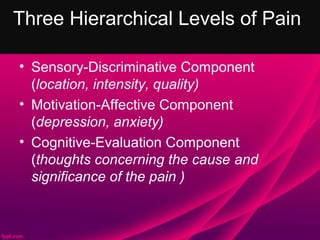
Three Hierarchical Levels of Pain

• Sensory-Discriminative Component
  (location, intensity, quality)
• Motivation-Affective Component
  (depression, anxiety)
• Cognitive-Evaluation Component
  (thoughts concerning the cause and
  significance of the pain )
Types of pain

•   Nociceptive,
•   Neuropathic,
•   Psychogenic,
•   Mixed, or idiopathic.
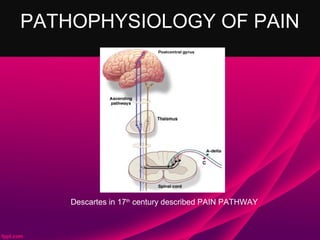
PATHOPHYSIOLOGY OF PAIN


    Descartes in 17th century described PAIN PATHWAY
Pain messages are two-way traffic. Inhibitory effects are
achieved through the descending pathways, which reach from
the conscious brain down to the gates in the subconscious
brain and the spinal cord.

The reason for this is that the gates are places where the flow
of pain messages can be controlled or influenced (Wells &
Nown 1998).

By sending responses back to the periphery, the brain can
ordered the release of chemicals that have analgesic effects,
which can reduces or inhibit pain sensation.


Pain generally starts with a physical event; a cut, burn, tear, or
bump (Catalano, 1987).
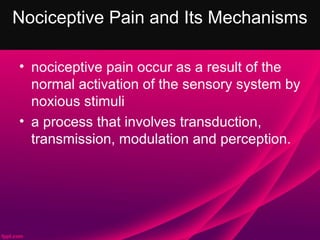
Nociceptive Pain and Its Mechanisms

• nociceptive pain occur as a result of the
  normal activation of the sensory system by
  noxious stimuli
• a process that involves transduction,
  transmission, modulation and perception.
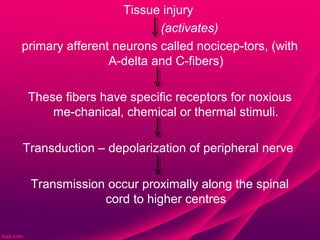
Tissue injury
                         (activates)
primary afferent neurons called nocicep-tors, (with
                A-delta and C-fibers)

 These fibers have specific receptors for noxious
     me-chanical, chemical or thermal stimuli.

Transduction – depolarization of peripheral nerve

 Transmission occur proximally along the spinal
             cord to higher centres
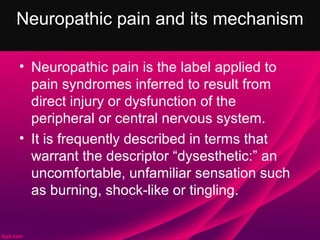
Neuropathic pain and its mechanism

• Neuropathic pain is the label applied to
  pain syndromes inferred to result from
  direct injury or dysfunction of the
  peripheral or central nervous system.
• It is frequently described in terms that
  warrant the descriptor “dysesthetic:” an
  uncomfortable, unfamiliar sensation such
  as burning, shock-like or tingling.
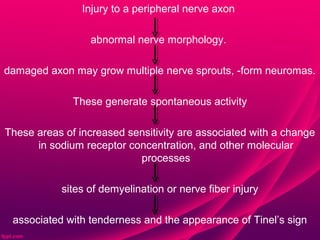
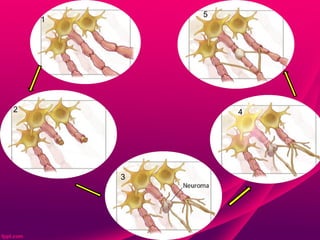
Injury to a peripheral nerve axon

                 abnormal nerve morphology.

damaged axon may grow multiple nerve sprouts, -form neuromas.

              These generate spontaneous activity

These areas of increased sensitivity are associated with a change
      in sodium receptor concentration, and other molecular
                           processes

           sites of demyelination or nerve fiber injury

 associated with tenderness and the appearance of Tinel’s sign
5
    1


2               4


        3
Psychological and “Idiopathic” Pain
          Mechanisms
• When reasonable inferences about the
  sustaining pathophysiology of a pain syndrome
  cannot be made, and there is no positive
  evidence that the
• etiology is psychiatric, it is best to label the pain
  as “idiopathic.”
• The experience of persistent pain appears to
  induce disturbances in mood ,impaired coping,
  and other processes, which in turn, appear to
  worsen pain and pain-related distress.
• Other patients have premorbid or
  comorbid psychosocial concerns or
  psychiatric disorders that are best
  understood as evolving in parallel to the
  pain.
• patients with personality disorders,
  substance use disorders, or mood
  disorders often are best served by primary
  treatment for the psychiatric problem
Initial Pain Assessment
             Guidelines
• Obtain a detailed history, including
• an assessment of the pain characteristics,
• impact of the pain on multiple domains (physical,
  psychosocial, role functioning, work, etc.),
• related concerns and comorbidities (other
  symptoms, psychiatric disorders including
  substance use disorder, etc.),
• prior work-up and working diagnosis,
• prior therapies
• Conduct a physical examination, emphasizing
  the neurological and musculoskeletal
  examination
• Obtain and review past medical records and
  diagnostic studies
• Develop a formulation including 1) working
  diagnoses for the pain etiology, pain syndrome
  and inferred pathophysiology, and 2) plan of
  care including need for additional diagnostic
  studies and initial treatments for the pain and
  related concerns
TYPES OF PAIN BY NATURE

Pain perception
Pain reaction


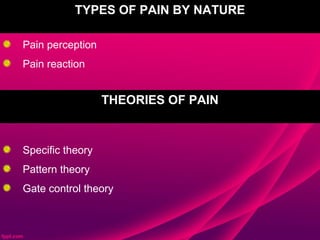
                  THEORIES OF PAIN


Specific theory
Pattern theory
Gate control theory
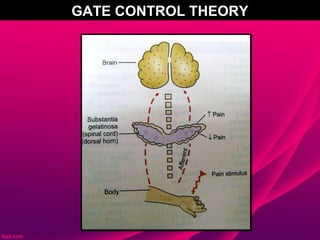
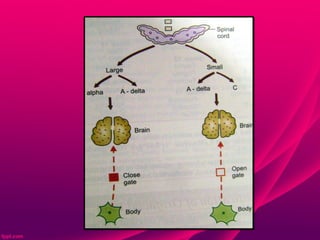
GATE CONTROL THEORY
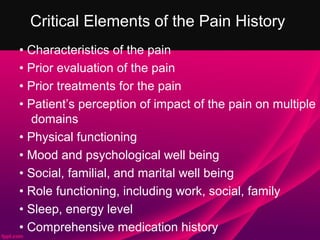
Critical Elements of the Pain History
• Characteristics of the pain
• Prior evaluation of the pain
• Prior treatments for the pain
• Patient’s perception of impact of the pain on multiple
   domains
• Physical functioning
• Mood and psychological well being
• Social, familial, and marital well being
• Role functioning, including work, social, family
• Sleep, energy level
• Comprehensive medication history
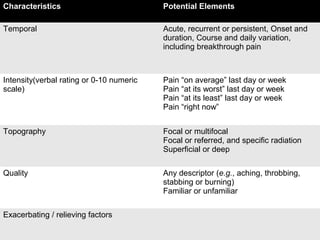
PAIN CHARACTERISTICS
Characteristics                           Potential Elements

Temporal                                  Acute, recurrent or persistent, Onset and
                                          duration, Course and daily variation,
                                          including breakthrough pain


Intensity(verbal rating or 0-10 numeric   Pain “on average” last day or week
scale)                                    Pain “at its worst” last day or week
                                          Pain “at its least” last day or week
                                          Pain “right now”


Topography                                Focal or multifocal
                                          Focal or referred, and specific radiation
                                          Superficial or deep

Quality                                   Any descriptor (e.g., aching, throbbing,
                                          stabbing or burning)
                                          Familiar or unfamiliar

Exacerbating / relieving factors
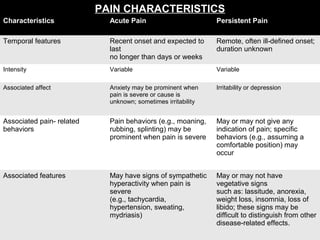
PAIN CHARACTERISTICS
Characteristics                           Acute Pain                             Persistent Pain

Temporal features                                 Recent onset and expected to   Remote, often ill-defined onset;
                                                  last                           duration unknown
      •
                                                  no longer than days or weeks
            Differences Between Acute and Persistent Pain

Intensity                                 Variable                               Variable

Associated affect                         Anxiety may be prominent when          Irritability or depression
                                          pain is severe or cause is
                                          unknown; sometimes irritability


Associated pain- related                  Pain behaviors (e.g., moaning,         May or may not give any
behaviors                                 rubbing, splinting) may be             indication of pain; specific
                                          prominent when pain is severe          behaviors (e.g., assuming a
                                                                                 comfortable position) may
                                                                                 occur


Associated features                       May have signs of sympathetic          May or may not have
                                          hyperactivity when pain is             vegetative signs
                                          severe                                 such as: lassitude, anorexia,
                                          (e.g., tachycardia,                    weight loss, insomnia, loss of
                                          hypertension, sweating,                libido; these signs may be
                                          mydriasis)                             difficult to distinguish from other
                                                                                 disease-related effects.
PAIN MANAGEMENT
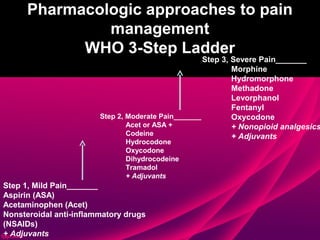
Pharmacologic approaches to pain
               management
            WHO 3-Step Ladder
                                                     Step 3, Severe Pain_______
                                                             Morphine
                                                             Hydromorphone
                                                             Methadone
                                                             Levorphanol
                                                             Fentanyl
                        Step 2, Moderate Pain_______         Oxycodone
                                Acet or ASA +                + Nonopioid analgesics
                                Codeine                      + Adjuvants
                              Hydrocodone
                              Oxycodone
                              Dihydrocodeine
                              Tramadol
                              + Adjuvants
Step 1, Mild Pain_______
Aspirin (ASA)
Acetaminophen (Acet)
Nonsteroidal anti-inflammatory drugs
(NSAIDs)
+ Adjuvants
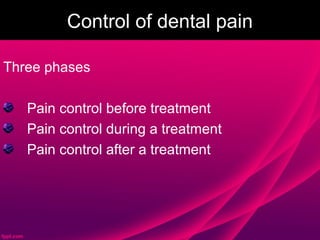
Control of dental pain

Three phases

   Pain control before treatment
   Pain control during a treatment
   Pain control after a treatment
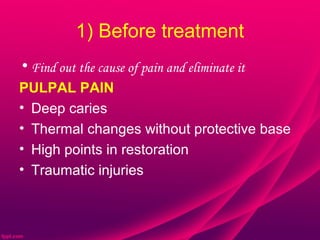
1) Before treatment
• Find out the cause of pain and eliminate it
PULPAL PAIN
• Deep caries
• Thermal changes without protective base
• High points in restoration
• Traumatic injuries
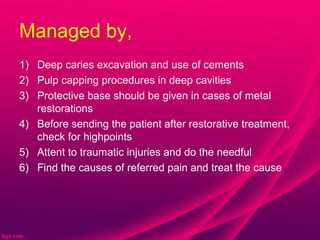
Managed by,
1) Deep caries excavation and use of cements
2) Pulp capping procedures in deep cavities
3) Protective base should be given in cases of metal
   restorations
4) Before sending the patient after restorative treatment,
   check for highpoints
5) Attent to traumatic injuries and do the needful
6) Find the causes of referred pain and treat the cause
2)During the treatment
Use high speed instruments with
• H2O coolants witch will reduce heat and pain
• Small bur size, as the size of bur increases, heat
  dissipation increases
• Continuous cutting- increased heat generation
• Minimal pressure while cutting or with sharp instruments
• Condensation pressure, 4-5 pounds
• Burnishing and carving to be done after initial setting of
  material
• Polishing should be done in wet medium
Causes of pain after 24 hours of
          treatment
• High speed cutting without coolant
 Remove restoration and place temporarily sedative
  dressing and wait till the pain stops and then proceed for
  permanent restoration
• High points
 Reduce them
• Deep cavity restored with amalgam without a base
 Remove the restoration and place base, varnish
• **If pain persist then do pharmacological treatment
Methods of pain control

A.   Local or regional anaesthesia
1.   Topical anaesthesia
2.   Local infiltration
3.   Field block anaesthesia
4.   Nerve block
5.   Intraligamentary
6.   Crestal anaesthetic technique(CAT)
B. Electronic anaesthesia
• Trans cutaneous electronic nerve
   stimulation (TENS)
• Based upon gate control theory
C. Audio analgesia
• White noise
• Principle- stimulus distraction
D. Inhalational anaesthesia
• Conscious sedation
• N2O + O2
E. Hypnosis


F. Accupuncture
• “Adjuvants” refers either to medications
  that are coadministered to manage an
  adverse
• effect of an opioid, or to so-called adjuvant
  analgesics that are added to enhance
• analgesia.
REFERENCES

• EPEC Project, 1999 Module 4: Pain
  Management,
• MJA - Volume 185 Number 2 -17 July 2006
• ARTICLE – AMA :Module 1 Pain Management :
• Pathophysiology of Pain and Pain Assessment
• mja.com.au | The Medical Journal of Australia
• Operative Endodontics – Neeraj Gupta
Pain

Pain

  • 1.
    PRESENTED BY, LALITHADEVI.P BDS - CRRI VDCW
  • 2.
    INTRODUCTION • Pain isone of the most common reasons for patients to seek medical attention and one of the most prevalent medical complaints • 9 out of 10 Americans aged 18 or older suffer pain at least once a month, and 42% experience it every day. • Consequently, physicians and other practitioners need education to assist in developing the skills needed to evaluate and manage patients with pain.
  • 3.
    PAIN - DEFINITION •The International Association for the Study of Pain (IASP) defines pain as “an unpleasant sensory and emotional experience which we primarily associate with tissue damage or describe in terms of such damage, or both.” • Father of pain - Bonica
  • 4.
    Three Hierarchical Levelsof Pain • Sensory-Discriminative Component (location, intensity, quality) • Motivation-Affective Component (depression, anxiety) • Cognitive-Evaluation Component (thoughts concerning the cause and significance of the pain )
  • 5.
    Types of pain • Nociceptive, • Neuropathic, • Psychogenic, • Mixed, or idiopathic.
  • 6.
    PATHOPHYSIOLOGY OF PAIN Descartes in 17th century described PAIN PATHWAY
  • 7.
    Pain messages aretwo-way traffic. Inhibitory effects are achieved through the descending pathways, which reach from the conscious brain down to the gates in the subconscious brain and the spinal cord. The reason for this is that the gates are places where the flow of pain messages can be controlled or influenced (Wells & Nown 1998). By sending responses back to the periphery, the brain can ordered the release of chemicals that have analgesic effects, which can reduces or inhibit pain sensation. Pain generally starts with a physical event; a cut, burn, tear, or bump (Catalano, 1987).
  • 8.
    Nociceptive Pain andIts Mechanisms • nociceptive pain occur as a result of the normal activation of the sensory system by noxious stimuli • a process that involves transduction, transmission, modulation and perception.
  • 9.
    Tissue injury (activates) primary afferent neurons called nocicep-tors, (with A-delta and C-fibers) These fibers have specific receptors for noxious me-chanical, chemical or thermal stimuli. Transduction – depolarization of peripheral nerve Transmission occur proximally along the spinal cord to higher centres
  • 10.
    Neuropathic pain andits mechanism • Neuropathic pain is the label applied to pain syndromes inferred to result from direct injury or dysfunction of the peripheral or central nervous system. • It is frequently described in terms that warrant the descriptor “dysesthetic:” an uncomfortable, unfamiliar sensation such as burning, shock-like or tingling.
  • 11.
    Injury to aperipheral nerve axon abnormal nerve morphology. damaged axon may grow multiple nerve sprouts, -form neuromas. These generate spontaneous activity These areas of increased sensitivity are associated with a change in sodium receptor concentration, and other molecular processes sites of demyelination or nerve fiber injury associated with tenderness and the appearance of Tinel’s sign
  • 12.
    5 1 2 4 3
  • 13.
    Psychological and “Idiopathic”Pain Mechanisms • When reasonable inferences about the sustaining pathophysiology of a pain syndrome cannot be made, and there is no positive evidence that the • etiology is psychiatric, it is best to label the pain as “idiopathic.” • The experience of persistent pain appears to induce disturbances in mood ,impaired coping, and other processes, which in turn, appear to worsen pain and pain-related distress.
  • 14.
    • Other patientshave premorbid or comorbid psychosocial concerns or psychiatric disorders that are best understood as evolving in parallel to the pain. • patients with personality disorders, substance use disorders, or mood disorders often are best served by primary treatment for the psychiatric problem
  • 15.

    Initial Pain Assessment Guidelines • Obtain a detailed history, including • an assessment of the pain characteristics, • impact of the pain on multiple domains (physical, psychosocial, role functioning, work, etc.), • related concerns and comorbidities (other symptoms, psychiatric disorders including substance use disorder, etc.), • prior work-up and working diagnosis, • prior therapies
  • 16.
    • Conduct aphysical examination, emphasizing the neurological and musculoskeletal examination • Obtain and review past medical records and diagnostic studies • Develop a formulation including 1) working diagnoses for the pain etiology, pain syndrome and inferred pathophysiology, and 2) plan of care including need for additional diagnostic studies and initial treatments for the pain and related concerns
  • 17.
    TYPES OF PAINBY NATURE Pain perception Pain reaction THEORIES OF PAIN Specific theory Pattern theory Gate control theory
  • 18.
  • 20.
    Critical Elements ofthe Pain History • Characteristics of the pain • Prior evaluation of the pain • Prior treatments for the pain • Patient’s perception of impact of the pain on multiple domains • Physical functioning • Mood and psychological well being • Social, familial, and marital well being • Role functioning, including work, social, family • Sleep, energy level • Comprehensive medication history
  • 21.
  • 22.
    Characteristics Potential Elements Temporal Acute, recurrent or persistent, Onset and duration, Course and daily variation, including breakthrough pain Intensity(verbal rating or 0-10 numeric Pain “on average” last day or week scale) Pain “at its worst” last day or week Pain “at its least” last day or week Pain “right now” Topography Focal or multifocal Focal or referred, and specific radiation Superficial or deep Quality Any descriptor (e.g., aching, throbbing, stabbing or burning) Familiar or unfamiliar Exacerbating / relieving factors
  • 23.
    PAIN CHARACTERISTICS Characteristics Acute Pain Persistent Pain Temporal features Recent onset and expected to Remote, often ill-defined onset; last duration unknown • no longer than days or weeks Differences Between Acute and Persistent Pain Intensity Variable Variable Associated affect Anxiety may be prominent when Irritability or depression pain is severe or cause is unknown; sometimes irritability Associated pain- related Pain behaviors (e.g., moaning, May or may not give any behaviors rubbing, splinting) may be indication of pain; specific prominent when pain is severe behaviors (e.g., assuming a comfortable position) may occur Associated features May have signs of sympathetic May or may not have hyperactivity when pain is vegetative signs severe such as: lassitude, anorexia, (e.g., tachycardia, weight loss, insomnia, loss of hypertension, sweating, libido; these signs may be mydriasis) difficult to distinguish from other disease-related effects.
  • 24.
  • 25.
    Pharmacologic approaches topain management WHO 3-Step Ladder Step 3, Severe Pain_______ Morphine Hydromorphone Methadone Levorphanol Fentanyl Step 2, Moderate Pain_______ Oxycodone Acet or ASA + + Nonopioid analgesics Codeine + Adjuvants Hydrocodone Oxycodone Dihydrocodeine Tramadol + Adjuvants Step 1, Mild Pain_______ Aspirin (ASA) Acetaminophen (Acet) Nonsteroidal anti-inflammatory drugs (NSAIDs) + Adjuvants
  • 26.
    Control of dentalpain Three phases Pain control before treatment Pain control during a treatment Pain control after a treatment
  • 27.
    1) Before treatment •Find out the cause of pain and eliminate it PULPAL PAIN • Deep caries • Thermal changes without protective base • High points in restoration • Traumatic injuries
  • 28.
    Managed by, 1) Deepcaries excavation and use of cements 2) Pulp capping procedures in deep cavities 3) Protective base should be given in cases of metal restorations 4) Before sending the patient after restorative treatment, check for highpoints 5) Attent to traumatic injuries and do the needful 6) Find the causes of referred pain and treat the cause
  • 29.
    2)During the treatment Usehigh speed instruments with • H2O coolants witch will reduce heat and pain • Small bur size, as the size of bur increases, heat dissipation increases • Continuous cutting- increased heat generation • Minimal pressure while cutting or with sharp instruments • Condensation pressure, 4-5 pounds • Burnishing and carving to be done after initial setting of material • Polishing should be done in wet medium
  • 30.
    Causes of painafter 24 hours of treatment • High speed cutting without coolant  Remove restoration and place temporarily sedative dressing and wait till the pain stops and then proceed for permanent restoration • High points  Reduce them • Deep cavity restored with amalgam without a base  Remove the restoration and place base, varnish • **If pain persist then do pharmacological treatment
  • 31.
    Methods of paincontrol A. Local or regional anaesthesia 1. Topical anaesthesia 2. Local infiltration 3. Field block anaesthesia 4. Nerve block 5. Intraligamentary 6. Crestal anaesthetic technique(CAT)
  • 32.
    B. Electronic anaesthesia •Trans cutaneous electronic nerve stimulation (TENS) • Based upon gate control theory
  • 33.
    C. Audio analgesia •White noise • Principle- stimulus distraction
  • 34.
    D. Inhalational anaesthesia •Conscious sedation • N2O + O2
  • 35.
  • 36.
    • “Adjuvants” referseither to medications that are coadministered to manage an adverse • effect of an opioid, or to so-called adjuvant analgesics that are added to enhance • analgesia.
  • 37.
    REFERENCES • EPEC Project,1999 Module 4: Pain Management, • MJA - Volume 185 Number 2 -17 July 2006 • ARTICLE – AMA :Module 1 Pain Management : • Pathophysiology of Pain and Pain Assessment • mja.com.au | The Medical Journal of Australia • Operative Endodontics – Neeraj Gupta