Unit 50
LO4
Assignment 1
Presentation
Introduction
 This  presentation is going to explore
  journalistic obligations within print media.
 I will cover key areas of print media, and
  certain responsibilities that a journalist
  must adhere to when creating any work.
 There are a number of topics within this
  piece that are sensitive, thus care must be
  taken by journalists when dealing with
  such activities.
Social and Cultural Awareness
   It is important for journalists to be socially and
    culturally aware of those involved with stories.
   Such awareness can help prevent situations
    where ones customs and traditions are broken
    or dismayed somewhat.
   Journalists are also responsible for being
    understanding and aware when it comes to
    peoples privacy, preferences and rights.
   People have to be aware not to affront
    people of other cultures by being
    discourteous to their culture.
Examples
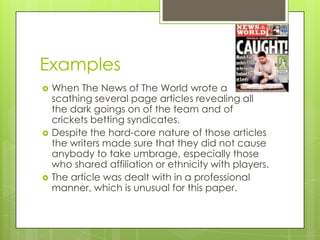
   When The News of The World wrote a
    scathing several page articles revealing all
    the dark goings on of the team and of
    crickets betting syndicates.
   Despite the hard-core nature of those articles
    the writers made sure that they did not cause
    anybody to take umbrage, especially those
    who shared affiliation or ethnicity with players.
   The article was dealt with in a professional
    manner, which is unusual for this paper.
Representation
   It is necessary to represent groups of people
    accurately and it is also necessary not to
    misrepresent anybody in any fashion.
   Whether it is cultural, social or even
    demographical representation, there are
    steps taken to ensured groups of people
    aren't mistakenly misrepresented.
   To ensure this writers must avoid any
    rumours, stereotypes and misnomers.
Examples
 There  is an online article on Slideshare
  which points out the various
  misrepresentations and stereotypes we
  find within the media.
 http://www.slideshare.net/reigatemedia/
  media-representations
Race
   Over the more recent decades there has been a
    shift in public speaking and thinking, even in the
    media when it comes to race.
   The birth of regulation and the rise of politically
    correct vocabularies have almost killed
    misrepresentation of race.
   At what cost one may ask, respected figures within
    media and authority now tread carefully when it
    comes to race remarks.
   Comedians and TV/Filmmakers have all had to
    alter stories and censor scripts to avoid this
    conjunction.
Examples
   Big Brother is a show that has succumbed to
much criticism, thanks to its many questionable
housemates.
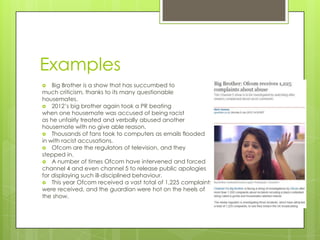
 2012’s big brother again took a PR beating
when one housemate was accused of being racist
as he unfairly treated and verbally abused another
housemate with no give able reason.
 Thousands of fans took to computers as emails flooded
in with racist accusations.
 Ofcom are the regulators of television, and they
stepped in.
 A number of times Ofcom have intervened and forced
channel 4 and even channel 5 to release public apologies
for displaying such ill-disciplined behaviour.
 This year Ofcom received a vast total of 1,225 complaints
were received, and the guardian were hot on the heels of
the show.
Gender
   This is our basic category for sorting between
    human beings and even today there exists
    that age old stereotype about men and
    women.
   Men are seen to be Tough, Hard and Sweaty.
   Women are seen to be Fragile, Soft and
    Fragrant.
   Though today there exists many examples of
    people who go against this
    stereotype, people still have this belief.
Examples
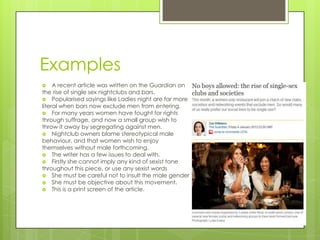
    A recent article was written on the Guardian on
the rise of single sex nightclubs and bars.
 Popularised sayings like Ladies night are far more
literal when bars now exclude men from entering.
 For many years women have fought for rights
through suffrage, and now a small group wish to
throw it away by segregating against men.
 Nightclub owners blame stereotypical male
behaviour, and that women wish to enjoy
themselves without male forthcoming.
 The writer has a few issues to deal with.
 Firstly she cannot imply any kind of sexist tone
throughout this piece, or use any sexist words
 She must be careful not to insult the male gender
 She must be objective about this movement.
 This is a print screen of the article.
Sexuality
   A pattern of emotional, romantic and sexual
    attractions to men and women.
   Within the media, sexuality is seen as a hot
    topic for many reasons.
   The saying ‘sex sells’ is now a trademark
    phrase within the darker sects of media as
    advertisers, film makers and television
    producers have all sold out to this craze and
    now objectify men and women for the
    gratification of audiences.
Examples
   Another Slideshare articles shows the stereotypes of various groups of people:
   Gay men die of Aids, Bisexuals are confused, Heterosexuals are normal
   Stereotyping is used to make television interesting, it does this by playing on
    stereotypes and captivating audiences through this.
   In Family Guy, the main Character Peter undergoes medical experimentation
    for money, he is implanted with something called the ‘Gay Gene’ and is
    subsequently homosexual for a number of weeks. The show follows the family
    and friends reaction and adjustment to this.
   Various attitudes are explored, for instance, Peter’s son is totally against
    homosexuals, quoting the bible on several occasions to dismay his father. The
    family dog, whom has the ability to speak takes a very liberal stance and says
    nothing about it. This explores the harsh reality of many families who are
    affected by a homosexual parent.
   If a journalist was to write about such a topic there are a few issues.
   Firstly privacy of the family must be respected, especially that of the children.
   Journalists must also remember that they cannot under any circumstance
    intrude of the family to gain information.
   Finally because there are children involved, journalists must be careful not to
    photograph them without consent or at their place of education.
Denotations
 The literal meaning of a word, i.e. what is
  placed and what it means.
 Though the message may carry another
  meaning, the denotation simply looks at
  the first meaning or preferred reading of
  that text.
 Denotations are instrumental when it
  comes to advertising as it is the quickest
  way to get the message across.
Examples
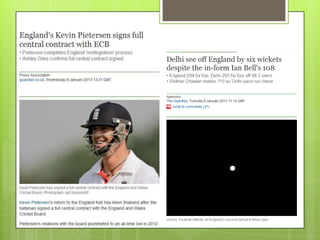
 On  the Guardian there is an article about
  Kevin Pietersen signing a full ECB contract.
 Kevin was disgraced and dropped from
  the team when it was found out he sent
  provocative texts to the other team.
 The article and denotation is all about this
  re-intergration process he went through.
Connotations
 The  hidden or dual meaning of a word or
  phrase.
 It looks specifically at what is behind the
  line, not the line itself.
 There can often be a double entendre
  which can be deciphered.
Examples
 The  entire article talks about the fault of
  Kevin.
 Pietersen is one of the greatest batsmen
  for the English team and has the record
  and fan support to prove it.
 I feel the negativity in this article may
  portray the hidden message that Kevin
  has lost all that recognition and support
  just because of one incident.
Credibility
 How   believable or reliable a source
  is, such as EWT, statistics and press
  releases.
 More than one source is explored in
  search of credibility.
 Having credibility is important for any
  journalist as they want their work trusted
  and respected.
 Objectivity and accuracy is key for
  journalist looking to become credible.
Examples
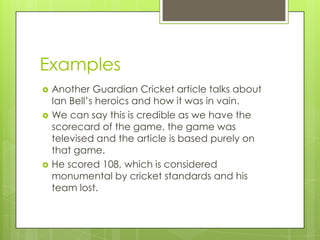
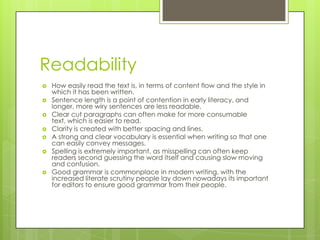
   Another Guardian Cricket article talks about
    Ian Bell’s heroics and how it was in vain.
   We can say this is credible as we have the
    scorecard of the game, the game was
    televised and the article is based purely on
    that game.
   He scored 108, which is considered
    monumental by cricket standards and his
    team lost.
Readability
   How easily read the text is, in terms of content flow and the style in
    which it has been written.
   Sentence length is a point of contention in early literacy, and
    longer, more wiry sentences are less readable.
   Clear cut paragraphs can often make for more consumable
    text, which is easier to read.
   Clarity is created with better spacing and lines.
   A strong and clear vocabulary is essential when writing so that one
    can easily convey messages.
   Spelling is extremely important, as misspelling can often keep
    readers second guessing the word itself and causing slow moving
    and confusion.
   Good grammar is commonplace in modern writing, with the
    increased literate scrutiny people lay down nowadays its important
    for editors to ensure good grammar from their people.
Examples

Style flows very well.


Sentences are easily read and
are of a reasonable length.


Paragraphs are spaced
and distributed evenly


Clarity means my words
are easily read.


Strong and Clear Vocabulary     Spelling has been thoroughly checked   Grammar has been thoroughly checked
Alternate Readings
   Stuart Hall created a theory;
   There are 3 types of alternate readings.
   Preferred Reading, the reading of which is
    intended by the creator, what he wants you to
    think.
   Negotiated reading is where the viewer follows the
    initial meaning but may be swayed by
    independent views, or may be seen to take a
    neutral stance.
   Oppositional reading is where the reader chooses
    to oppose or simply does not recognise the
    meaning. If he opposes he may pose his own
    theory of this show.
Examples


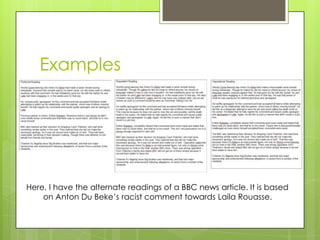
Here, I have the alternate readings of a BBC news article. It is based
    on Anton Du Beke’s racist comment towards Laila Rouasse.
The End!

Page 7

  • 1.
  • 2.
    Introduction  This presentation is going to explore journalistic obligations within print media.  I will cover key areas of print media, and certain responsibilities that a journalist must adhere to when creating any work.  There are a number of topics within this piece that are sensitive, thus care must be taken by journalists when dealing with such activities.
  • 3.
    Social and CulturalAwareness  It is important for journalists to be socially and culturally aware of those involved with stories.  Such awareness can help prevent situations where ones customs and traditions are broken or dismayed somewhat.  Journalists are also responsible for being understanding and aware when it comes to peoples privacy, preferences and rights.  People have to be aware not to affront people of other cultures by being discourteous to their culture.
  • 4.
    Examples  When The News of The World wrote a scathing several page articles revealing all the dark goings on of the team and of crickets betting syndicates.  Despite the hard-core nature of those articles the writers made sure that they did not cause anybody to take umbrage, especially those who shared affiliation or ethnicity with players.  The article was dealt with in a professional manner, which is unusual for this paper.
  • 5.
    Representation  It is necessary to represent groups of people accurately and it is also necessary not to misrepresent anybody in any fashion.  Whether it is cultural, social or even demographical representation, there are steps taken to ensured groups of people aren't mistakenly misrepresented.  To ensure this writers must avoid any rumours, stereotypes and misnomers.
  • 6.
    Examples  There is an online article on Slideshare which points out the various misrepresentations and stereotypes we find within the media.  http://www.slideshare.net/reigatemedia/ media-representations
  • 7.
    Race  Over the more recent decades there has been a shift in public speaking and thinking, even in the media when it comes to race.  The birth of regulation and the rise of politically correct vocabularies have almost killed misrepresentation of race.  At what cost one may ask, respected figures within media and authority now tread carefully when it comes to race remarks.  Comedians and TV/Filmmakers have all had to alter stories and censor scripts to avoid this conjunction.
  • 8.
    Examples  Big Brother is a show that has succumbed to much criticism, thanks to its many questionable housemates.  2012’s big brother again took a PR beating when one housemate was accused of being racist as he unfairly treated and verbally abused another housemate with no give able reason.  Thousands of fans took to computers as emails flooded in with racist accusations.  Ofcom are the regulators of television, and they stepped in.  A number of times Ofcom have intervened and forced channel 4 and even channel 5 to release public apologies for displaying such ill-disciplined behaviour.  This year Ofcom received a vast total of 1,225 complaints were received, and the guardian were hot on the heels of the show.
  • 9.
    Gender  This is our basic category for sorting between human beings and even today there exists that age old stereotype about men and women.  Men are seen to be Tough, Hard and Sweaty.  Women are seen to be Fragile, Soft and Fragrant.  Though today there exists many examples of people who go against this stereotype, people still have this belief.
  • 10.
    Examples  A recent article was written on the Guardian on the rise of single sex nightclubs and bars.  Popularised sayings like Ladies night are far more literal when bars now exclude men from entering.  For many years women have fought for rights through suffrage, and now a small group wish to throw it away by segregating against men.  Nightclub owners blame stereotypical male behaviour, and that women wish to enjoy themselves without male forthcoming.  The writer has a few issues to deal with.  Firstly she cannot imply any kind of sexist tone throughout this piece, or use any sexist words  She must be careful not to insult the male gender  She must be objective about this movement.  This is a print screen of the article.
  • 11.
    Sexuality  A pattern of emotional, romantic and sexual attractions to men and women.  Within the media, sexuality is seen as a hot topic for many reasons.  The saying ‘sex sells’ is now a trademark phrase within the darker sects of media as advertisers, film makers and television producers have all sold out to this craze and now objectify men and women for the gratification of audiences.
  • 12.
    Examples  Another Slideshare articles shows the stereotypes of various groups of people:  Gay men die of Aids, Bisexuals are confused, Heterosexuals are normal  Stereotyping is used to make television interesting, it does this by playing on stereotypes and captivating audiences through this.  In Family Guy, the main Character Peter undergoes medical experimentation for money, he is implanted with something called the ‘Gay Gene’ and is subsequently homosexual for a number of weeks. The show follows the family and friends reaction and adjustment to this.  Various attitudes are explored, for instance, Peter’s son is totally against homosexuals, quoting the bible on several occasions to dismay his father. The family dog, whom has the ability to speak takes a very liberal stance and says nothing about it. This explores the harsh reality of many families who are affected by a homosexual parent.  If a journalist was to write about such a topic there are a few issues.  Firstly privacy of the family must be respected, especially that of the children.  Journalists must also remember that they cannot under any circumstance intrude of the family to gain information.  Finally because there are children involved, journalists must be careful not to photograph them without consent or at their place of education.
  • 13.
    Denotations  The literalmeaning of a word, i.e. what is placed and what it means.  Though the message may carry another meaning, the denotation simply looks at the first meaning or preferred reading of that text.  Denotations are instrumental when it comes to advertising as it is the quickest way to get the message across.
  • 14.
    Examples  On the Guardian there is an article about Kevin Pietersen signing a full ECB contract.  Kevin was disgraced and dropped from the team when it was found out he sent provocative texts to the other team.  The article and denotation is all about this re-intergration process he went through.
  • 15.
    Connotations  The hidden or dual meaning of a word or phrase.  It looks specifically at what is behind the line, not the line itself.  There can often be a double entendre which can be deciphered.
  • 16.
    Examples  The entire article talks about the fault of Kevin.  Pietersen is one of the greatest batsmen for the English team and has the record and fan support to prove it.  I feel the negativity in this article may portray the hidden message that Kevin has lost all that recognition and support just because of one incident.
  • 17.
    Credibility  How believable or reliable a source is, such as EWT, statistics and press releases.  More than one source is explored in search of credibility.  Having credibility is important for any journalist as they want their work trusted and respected.  Objectivity and accuracy is key for journalist looking to become credible.
  • 18.
    Examples  Another Guardian Cricket article talks about Ian Bell’s heroics and how it was in vain.  We can say this is credible as we have the scorecard of the game, the game was televised and the article is based purely on that game.  He scored 108, which is considered monumental by cricket standards and his team lost.
  • 20.
    Readability  How easily read the text is, in terms of content flow and the style in which it has been written.  Sentence length is a point of contention in early literacy, and longer, more wiry sentences are less readable.  Clear cut paragraphs can often make for more consumable text, which is easier to read.  Clarity is created with better spacing and lines.  A strong and clear vocabulary is essential when writing so that one can easily convey messages.  Spelling is extremely important, as misspelling can often keep readers second guessing the word itself and causing slow moving and confusion.  Good grammar is commonplace in modern writing, with the increased literate scrutiny people lay down nowadays its important for editors to ensure good grammar from their people.
  • 21.
    Examples Style flows verywell. Sentences are easily read and are of a reasonable length. Paragraphs are spaced and distributed evenly Clarity means my words are easily read. Strong and Clear Vocabulary Spelling has been thoroughly checked Grammar has been thoroughly checked
  • 22.
    Alternate Readings  Stuart Hall created a theory;  There are 3 types of alternate readings.  Preferred Reading, the reading of which is intended by the creator, what he wants you to think.  Negotiated reading is where the viewer follows the initial meaning but may be swayed by independent views, or may be seen to take a neutral stance.  Oppositional reading is where the reader chooses to oppose or simply does not recognise the meaning. If he opposes he may pose his own theory of this show.
  • 23.
    Examples Here, I havethe alternate readings of a BBC news article. It is based on Anton Du Beke’s racist comment towards Laila Rouasse.
  • 24.