Nov 30th, 2001
Copyright © 2001, Andrew W. Moore
PAC-learning
Andrew W. Moore
Associate Professor
School of Computer Science
Carnegie Mellon University
www.cs.cmu.edu/~awm
awm@cs.cmu.edu
412-268-7599
Note to other teachers and users of these slides. Andrew would
be delighted if you found this source material useful in giving
your own lectures. Feel free to use these slides verbatim, or to
modify them to fit your own needs. PowerPoint originals are
available. If you make use of a significant portion of these slides
in your own lecture, please include this message, or the
following link to the source repository of Andrew’s tutorials:
http://www.cs.cmu.edu/~awm/tutorials . Comments and
corrections gratefully received.
PAC-learning: Slide 2
Copyright © 2001, Andrew W. Moore
Probably Approximately Correct
(PAC) Learning
• Imagine we’re doing classification with categorical
inputs.
• All inputs and outputs are binary.
• Data is noiseless.
• There’s a machine f(x,h) which has H possible
settings (a.k.a. hypotheses), called h1, h2 .. hH.
PAC-learning: Slide 3
Copyright © 2001, Andrew W. Moore
Example of a machine
• f(x,h) consists of all logical sentences about X1, X2
.. Xm that contain only logical ands.
• Example hypotheses:
• X1 ^ X3 ^ X19
• X3 ^ X18
• X7
• X1 ^ X2 ^ X2 ^ x4 … ^ Xm
• Question: if there are 3 attributes, what is the
complete set of hypotheses in f?
PAC-learning: Slide 4
Copyright © 2001, Andrew W. Moore
Example of a machine
• f(x,h) consists of all logical sentences about X1, X2
.. Xm that contain only logical ands.
• Example hypotheses:
• X1 ^ X3 ^ X19
• X3 ^ X18
• X7
• X1 ^ X2 ^ X2 ^ x4 … ^ Xm
• Question: if there are 3 attributes, what is the
complete set of hypotheses in f? (H = 8)
True X2 X3 X2 ^ X3
X1 X1 ^ X2 X1 ^ X3 X1 ^ X2 ^ X3
PAC-learning: Slide 5
Copyright © 2001, Andrew W. Moore
And-Positive-Literals Machine
• f(x,h) consists of all logical sentences about X1, X2
.. Xm that contain only logical ands.
• Example hypotheses:
• X1 ^ X3 ^ X19
• X3 ^ X18
• X7
• X1 ^ X2 ^ X2 ^ x4 … ^ Xm
• Question: if there are m attributes, how many
hypotheses in f?
PAC-learning: Slide 6
Copyright © 2001, Andrew W. Moore
And-Positive-Literals Machine
• f(x,h) consists of all logical sentences about X1, X2
.. Xm that contain only logical ands.
• Example hypotheses:
• X1 ^ X3 ^ X19
• X3 ^ X18
• X7
• X1 ^ X2 ^ X2 ^ x4 … ^ Xm
• Question: if there are m attributes, how many
hypotheses in f? (H = 2m)
PAC-learning: Slide 7
Copyright © 2001, Andrew W. Moore
And-Literals Machine
• f(x,h) consists of all logical
sentences about X1, X2 ..
Xm or their negations that
contain only logical ands.
• Example hypotheses:
• X1 ^ ~X3 ^ X19
• X3 ^ ~X18
• ~X7
• X1 ^ X2 ^ ~X3 ^ … ^ Xm
• Question: if there are 2
attributes, what is the
complete set of hypotheses
in f?
PAC-learning: Slide 8
Copyright © 2001, Andrew W. Moore
And-Literals Machine
• f(x,h) consists of all logical
sentences about X1, X2 ..
Xm or their negations that
contain only logical ands.
• Example hypotheses:
• X1 ^ ~X3 ^ X19
• X3 ^ ~X18
• ~X7
• X1 ^ X2 ^ ~X3 ^ … ^ Xm
• Question: if there are 2
attributes, what is the
complete set of hypotheses
in f? (H = 9)
True True
True X2
True ~X2
X1 True
X1 ^ X2
X1 ^ ~X2
~X1 True
~X1 ^ X2
~X1 ^ ~X2
PAC-learning: Slide 9
Copyright © 2001, Andrew W. Moore
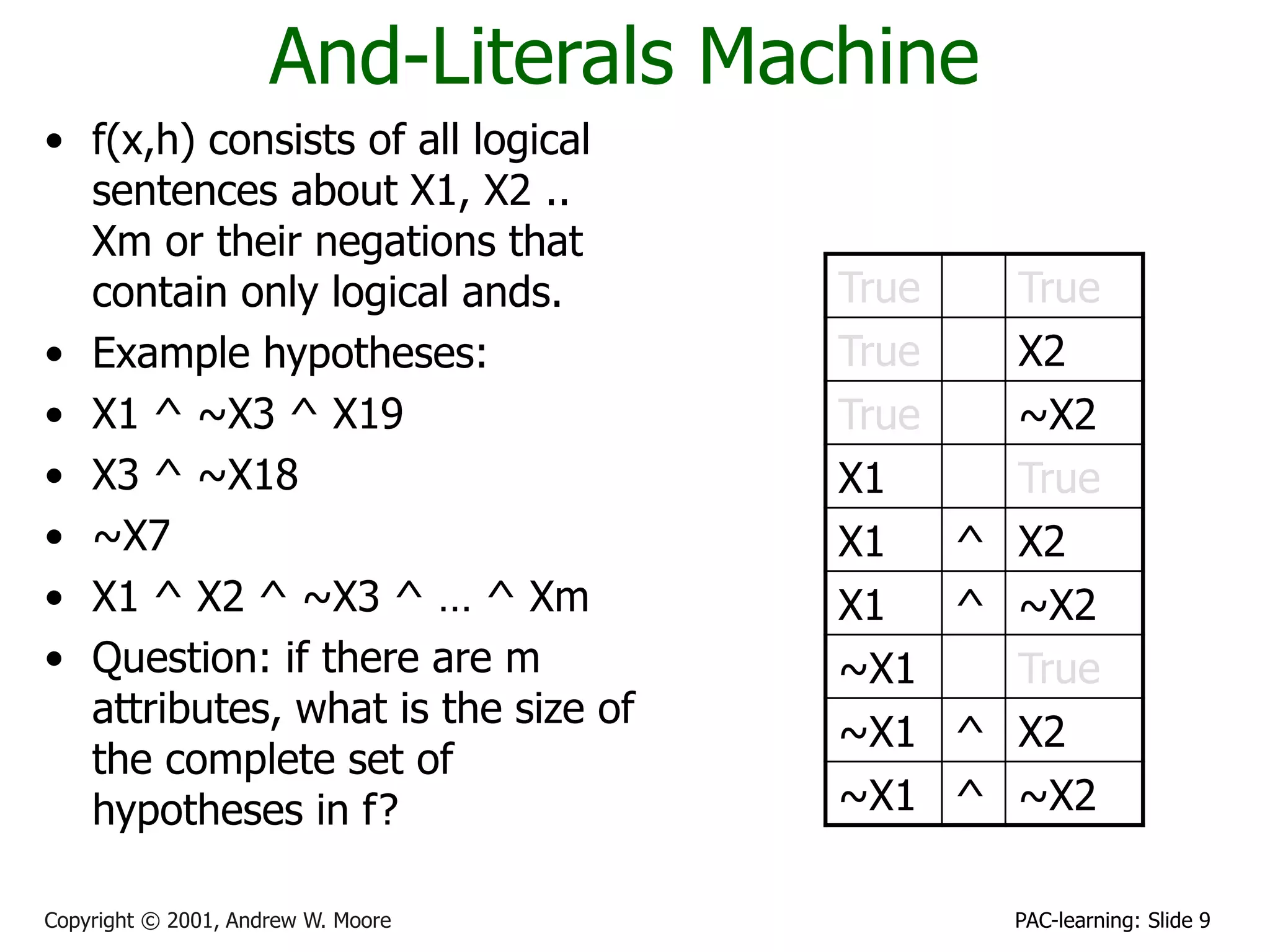
And-Literals Machine
• f(x,h) consists of all logical
sentences about X1, X2 ..
Xm or their negations that
contain only logical ands.
• Example hypotheses:
• X1 ^ ~X3 ^ X19
• X3 ^ ~X18
• ~X7
• X1 ^ X2 ^ ~X3 ^ … ^ Xm
• Question: if there are m
attributes, what is the size of
the complete set of
hypotheses in f?
True True
True X2
True ~X2
X1 True
X1 ^ X2
X1 ^ ~X2
~X1 True
~X1 ^ X2
~X1 ^ ~X2
PAC-learning: Slide 10
Copyright © 2001, Andrew W. Moore
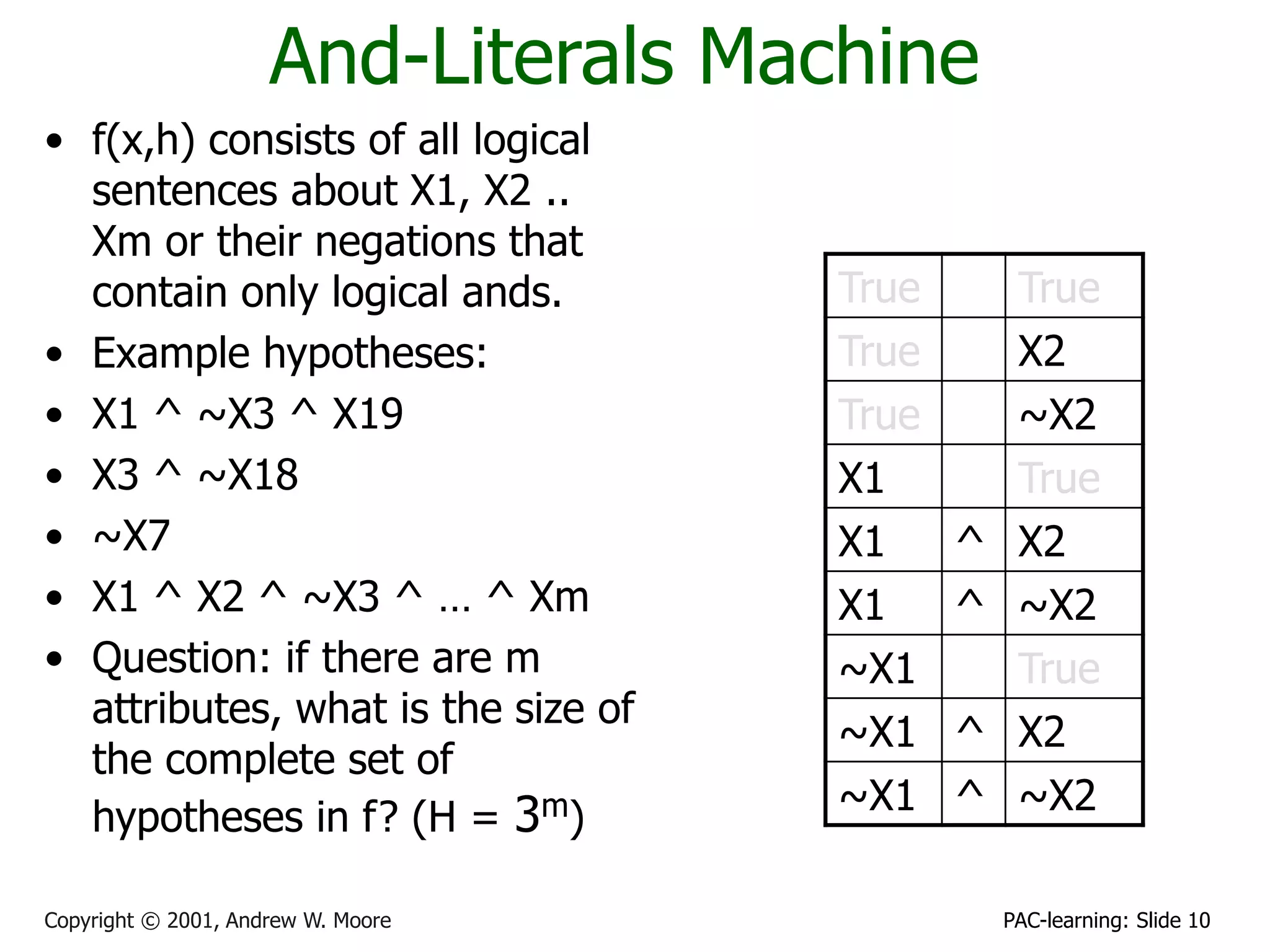
And-Literals Machine
• f(x,h) consists of all logical
sentences about X1, X2 ..
Xm or their negations that
contain only logical ands.
• Example hypotheses:
• X1 ^ ~X3 ^ X19
• X3 ^ ~X18
• ~X7
• X1 ^ X2 ^ ~X3 ^ … ^ Xm
• Question: if there are m
attributes, what is the size of
the complete set of
hypotheses in f? (H = 3m)
True True
True X2
True ~X2
X1 True
X1 ^ X2
X1 ^ ~X2
~X1 True
~X1 ^ X2
~X1 ^ ~X2
PAC-learning: Slide 11
Copyright © 2001, Andrew W. Moore
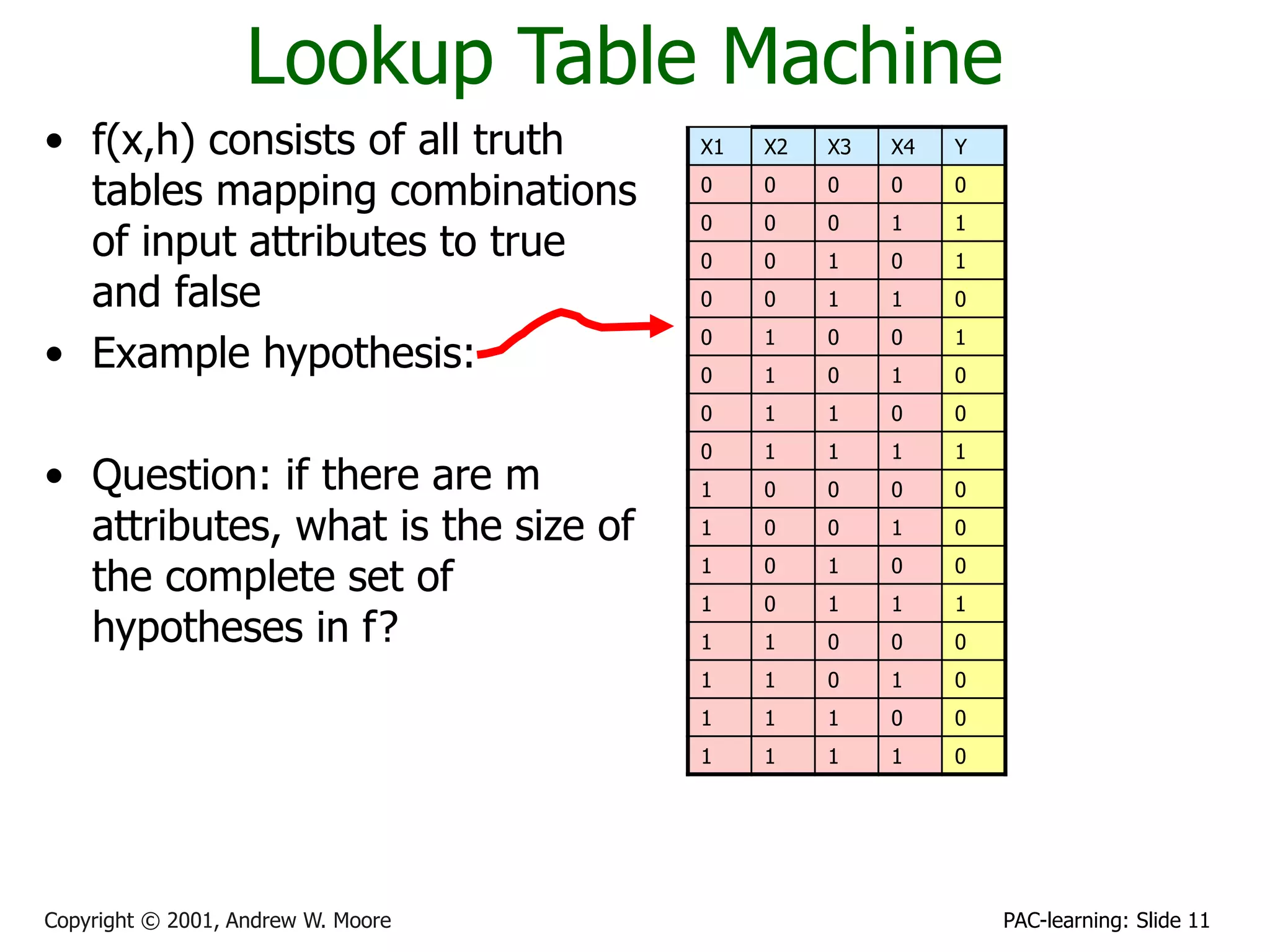
Lookup Table Machine
• f(x,h) consists of all truth
tables mapping combinations
of input attributes to true
and false
• Example hypothesis:
• Question: if there are m
attributes, what is the size of
the complete set of
hypotheses in f?
X1 X2 X3 X4 Y
0 0 0 0 0
0 0 0 1 1
0 0 1 0 1
0 0 1 1 0
0 1 0 0 1
0 1 0 1 0
0 1 1 0 0
0 1 1 1 1
1 0 0 0 0
1 0 0 1 0
1 0 1 0 0
1 0 1 1 1
1 1 0 0 0
1 1 0 1 0
1 1 1 0 0
1 1 1 1 0
PAC-learning: Slide 12
Copyright © 2001, Andrew W. Moore
Lookup Table Machine
• f(x,h) consists of all truth
tables mapping combinations
of input attributes to true
and false
• Example hypothesis:
• Question: if there are m
attributes, what is the size of
the complete set of
hypotheses in f?
X1 X2 X3 X4 Y
0 0 0 0 0
0 0 0 1 1
0 0 1 0 1
0 0 1 1 0
0 1 0 0 1
0 1 0 1 0
0 1 1 0 0
0 1 1 1 1
1 0 0 0 0
1 0 0 1 0
1 0 1 0 0
1 0 1 1 1
1 1 0 0 0
1 1 0 1 0
1 1 1 0 0
1 1 1 1 0
m
H 2
2

PAC-learning: Slide 13
Copyright © 2001, Andrew W. Moore
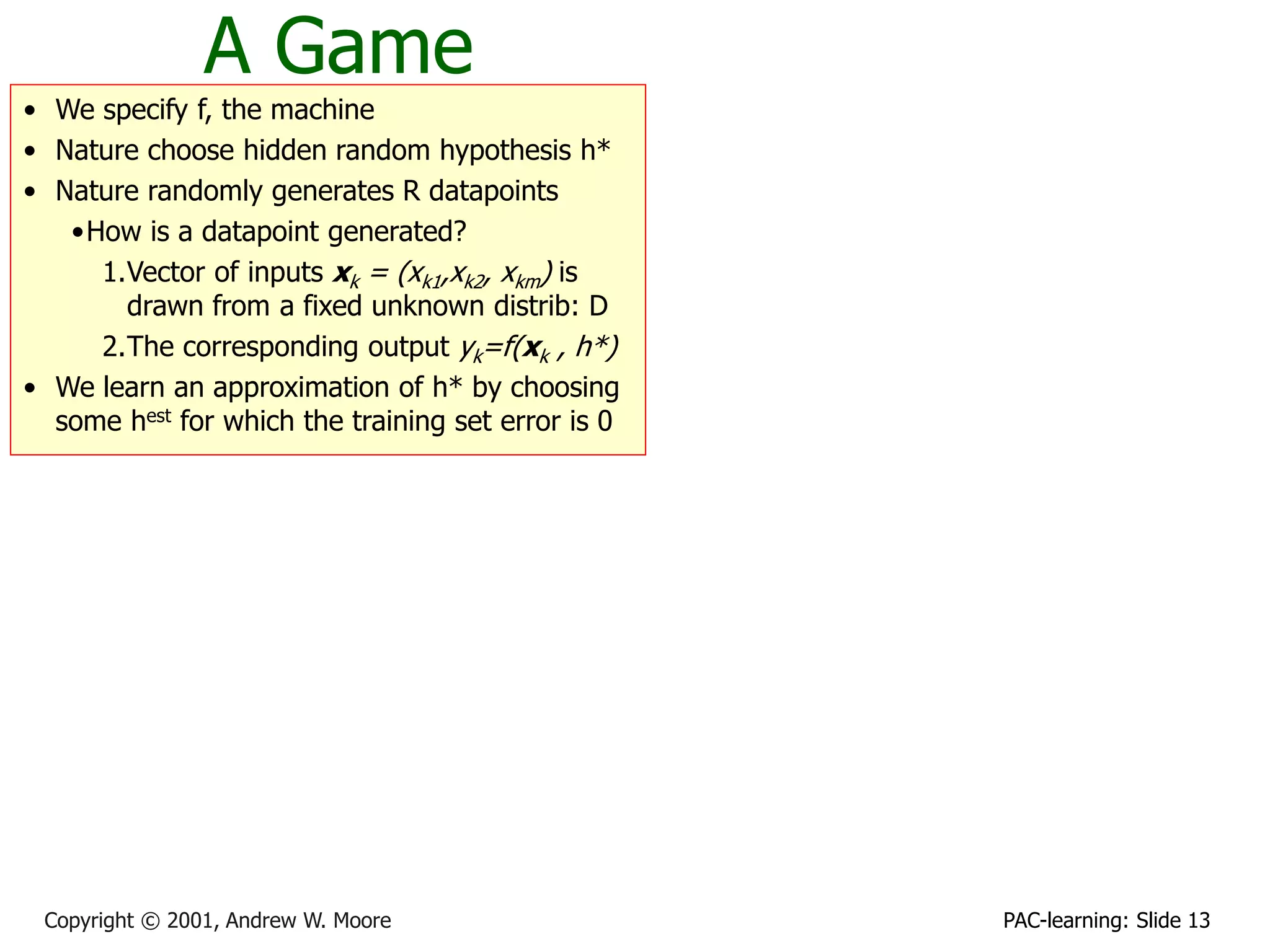
A Game
• We specify f, the machine
• Nature choose hidden random hypothesis h*
• Nature randomly generates R datapoints
•How is a datapoint generated?
1.Vector of inputs xk = (xk1,xk2, xkm) is
drawn from a fixed unknown distrib: D
2.The corresponding output yk=f(xk , h*)
• We learn an approximation of h* by choosing
some hest for which the training set error is 0
PAC-learning: Slide 14
Copyright © 2001, Andrew W. Moore
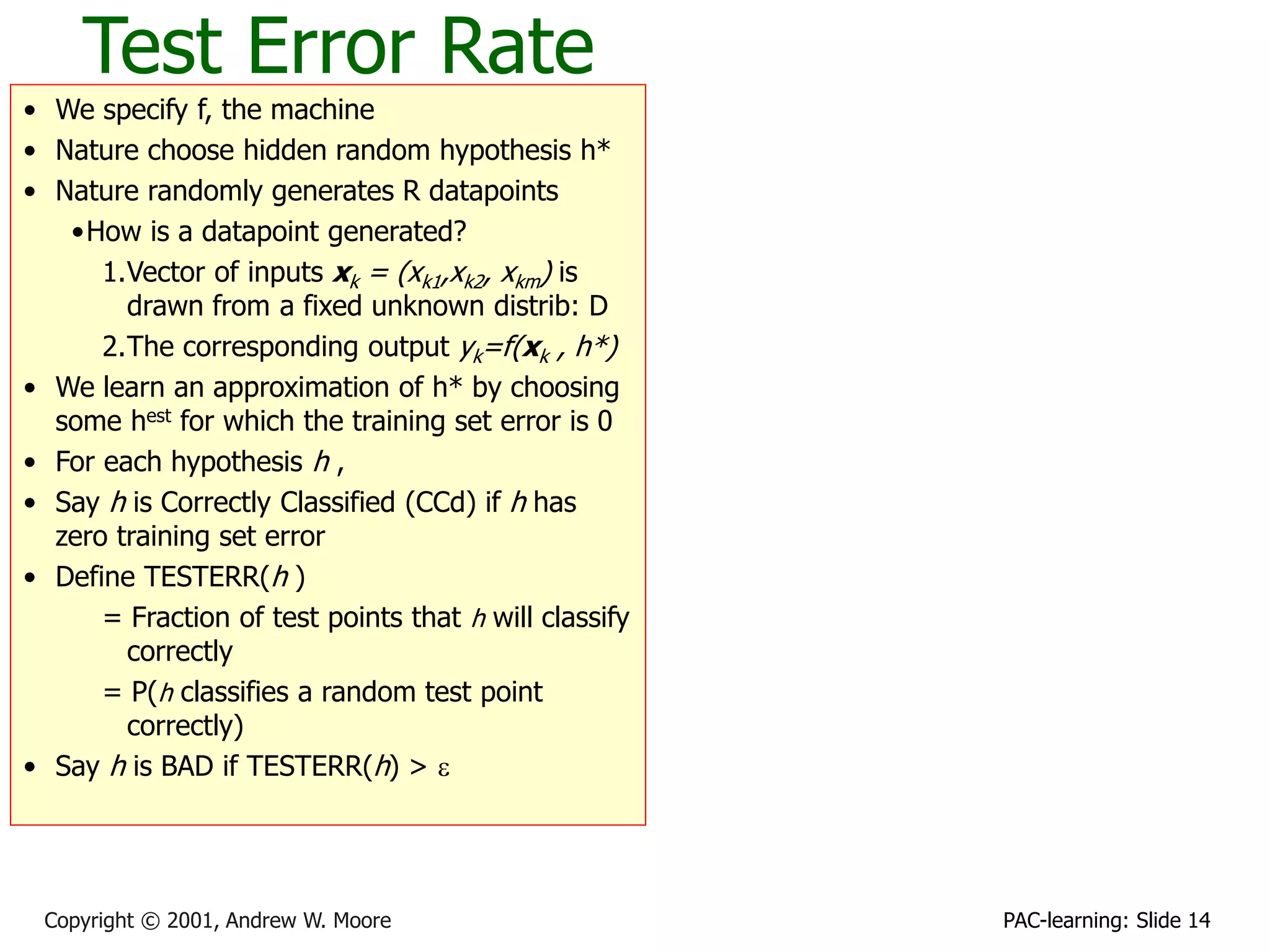
Test Error Rate
• We specify f, the machine
• Nature choose hidden random hypothesis h*
• Nature randomly generates R datapoints
•How is a datapoint generated?
1.Vector of inputs xk = (xk1,xk2, xkm) is
drawn from a fixed unknown distrib: D
2.The corresponding output yk=f(xk , h*)
• We learn an approximation of h* by choosing
some hest for which the training set error is 0
• For each hypothesis h ,
• Say h is Correctly Classified (CCd) if h has
zero training set error
• Define TESTERR(h )
= Fraction of test points that h will classify
correctly
= P(h classifies a random test point
correctly)
• Say h is BAD if TESTERR(h) > e
PAC-learning: Slide 15
Copyright © 2001, Andrew W. Moore
Test Error Rate
• We specify f, the machine
• Nature choose hidden random hypothesis h*
• Nature randomly generates R datapoints
•How is a datapoint generated?
1.Vector of inputs xk = (xk1,xk2, xkm) is
drawn from a fixed unknown distrib: D
2.The corresponding output yk=f(xk , h*)
• We learn an approximation of h* by choosing
some hest for which the training set error is 0
• For each hypothesis h ,
• Say h is Correctly Classified (CCd) if h has
zero training set error
• Define TESTERR(h )
= Fraction of test points that i will classify
correctly
= P(h classifies a random test point
correctly)
• Say h is BAD if TESTERR(h) > e
)
bad
is
|
)
,
(
Set,
Training
(
)
bad
is
|
CCd
is
(
h
y
h
x
f
k
P
h
h
P
k
k 



R
)
1
( e


PAC-learning: Slide 16
Copyright © 2001, Andrew W. Moore
Test Error Rate
• We specify f, the machine
• Nature choose hidden random hypothesis h*
• Nature randomly generates R datapoints
•How is a datapoint generated?
1.Vector of inputs xk = (xk1,xk2, xkm) is
drawn from a fixed unknown distrib: D
2.The corresponding output yk=f(xk , h*)
• We learn an approximation of h* by choosing
some hest for which the training set error is 0
• For each hypothesis h ,
• Say h is Correctly Classified (CCd) if h has
zero training set error
• Define TESTERR(h )
= Fraction of test points that i will classify
correctly
= P(h classifies a random test point
correctly)
• Say h is BAD if TESTERR(h) > e
)
bad
is
|
)
,
(
Set,
Training
(
)
bad
is
|
CCd
is
(
h
y
h
x
f
k
P
h
h
P
k
k 



R
)
1
( e



)
bad
a
learn
we
( h
P









h
h
P
bad
a
contains
s
'
CCd
of
set
the
 
 bad
is
^
CCd
is
. h
h
h
P

















bad)
is
^
CCd
is
(
:
bad)
is
^
CCd
is
(
bad)
is
^
CCd
is
(
2
2
1
1
H
H h
h
h
h
h
h
P
 


H
i
i
i h
h
P
1
bad
is
^
CCd
is
 


H
i
i
i h
h
P
1
bad
is
|
CCd
is
  R
i
i H
h
h
P
H )
1
(
bad
is
|
CCd
is e



PAC-learning: Slide 17
Copyright © 2001, Andrew W. Moore
PAC Learning
• Chose R such that with probability less than d we’ll
select a bad hest (i.e. an hest which makes mistakes
more than fraction e of the time)
• Probably Approximately Correct
• As we just saw, this can be achieved by choosing
R such that
• i.e. R such that
R
H
h
P )
1
(
)
bad
a
learn
we
( e
d 










d
e
1
log
log
69
.
0
2
2 H
R
PAC-learning: Slide 18
Copyright © 2001, Andrew W. Moore
PAC in action
Machine Example
Hypothesis
H R required to PAC-
learn
And-positive-
literals
X3 ^ X7 ^ X8 2m
And-literals X3 ^ ~X7 3m
Lookup Table
And-lits or
And-lits
(X1 ^ X5) v
(X2 ^ ~X7 ^ X8)
X1 X2 X3 X4 Y
0 0 0 0 0
0 0 0 1 1
0 0 1 0 1
0 0 1 1 0
0 1 0 0 1
0 1 0 1 0
0 1 1 0 0
0 1 1 1 1
1 0 0 0 0
1 0 0 1 0
1 0 1 0 0
1 0 1 1 1
1 1 0 0 0
1 1 0 1 0
1 1 1 0 0
1 1 1 1 0
m
2
2
m
m 2
2
3
)
3
( 







d
e
1
log
69
.
0
2
m







d
e
1
log
)
3
(log
69
.
0
2
2 m







d
e
1
log
2
69
.
0
2
m







d
e
1
log
)
3
log
2
(
69
.
0
2
2 m
PAC-learning: Slide 19
Copyright © 2001, Andrew W. Moore
PAC for decision trees of depth k
• Assume m attributes
• Hk = Number of decision trees of depth k
• H0 =2
• Hk+1 = (#choices of root attribute) *
(# possible left subtrees) *
(# possible right subtrees)
= m * Hk * Hk
• Write Lk = log2 Hk
• L0 = 1
• Lk+1 = log2 m + 2Lk
• So Lk = (2 k-1)(1+log2 m) +1
• So to PAC-learn, need











d
e
1
log
1
)
log
1
)(
1
2
(
69
.
0
2
2 m
R k
PAC-learning: Slide 20
Copyright © 2001, Andrew W. Moore
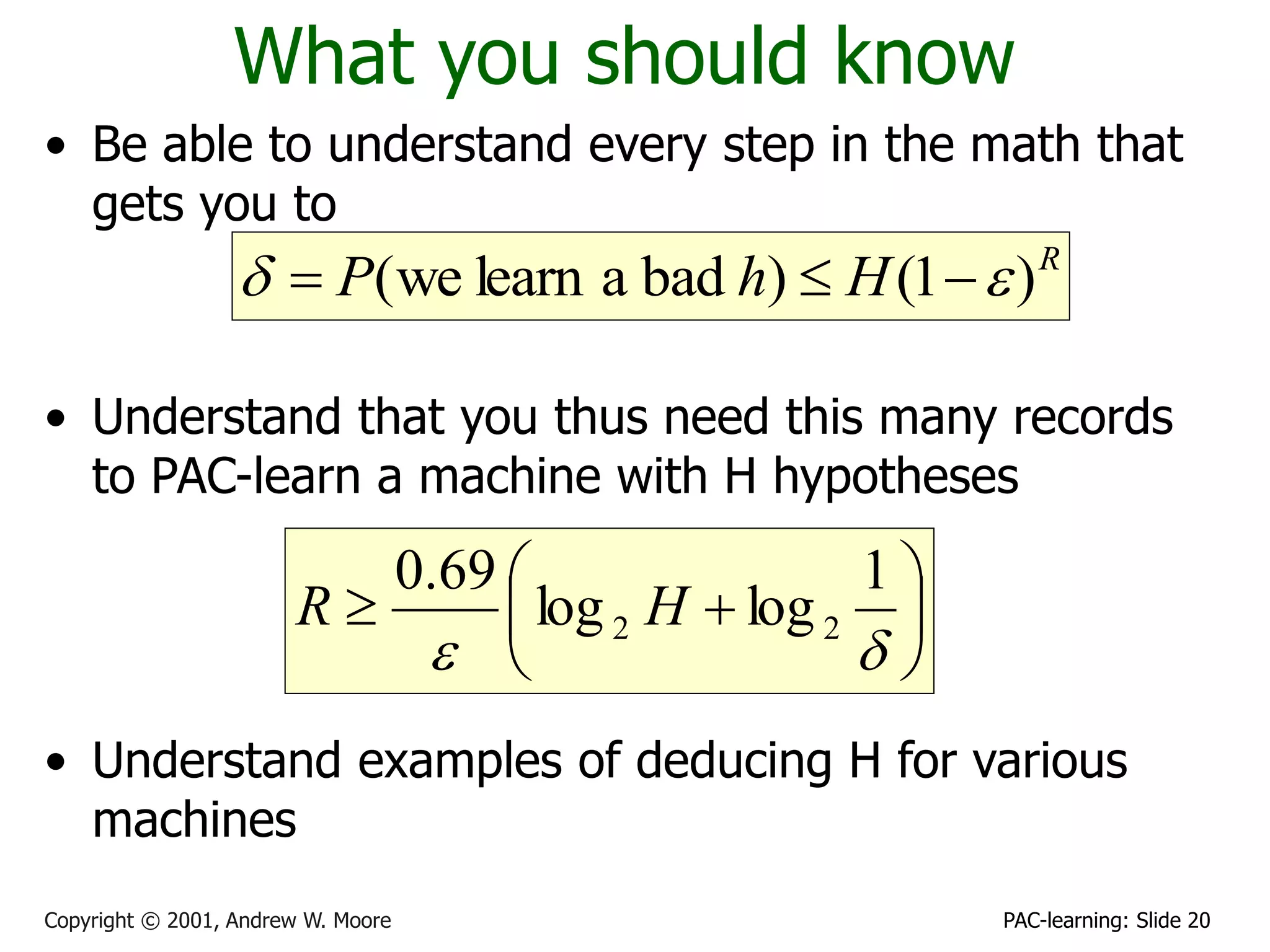
What you should know
• Be able to understand every step in the math that
gets you to
• Understand that you thus need this many records
to PAC-learn a machine with H hypotheses
• Understand examples of deducing H for various
machines
R
H
h
P )
1
(
)
bad
a
learn
we
( e
d 










d
e
1
log
log
69
.
0
2
2 H
R

pac.ppt

  • 1.
    Nov 30th, 2001 Copyright© 2001, Andrew W. Moore PAC-learning Andrew W. Moore Associate Professor School of Computer Science Carnegie Mellon University www.cs.cmu.edu/~awm awm@cs.cmu.edu 412-268-7599 Note to other teachers and users of these slides. Andrew would be delighted if you found this source material useful in giving your own lectures. Feel free to use these slides verbatim, or to modify them to fit your own needs. PowerPoint originals are available. If you make use of a significant portion of these slides in your own lecture, please include this message, or the following link to the source repository of Andrew’s tutorials: http://www.cs.cmu.edu/~awm/tutorials . Comments and corrections gratefully received.
  • 2.
    PAC-learning: Slide 2 Copyright© 2001, Andrew W. Moore Probably Approximately Correct (PAC) Learning • Imagine we’re doing classification with categorical inputs. • All inputs and outputs are binary. • Data is noiseless. • There’s a machine f(x,h) which has H possible settings (a.k.a. hypotheses), called h1, h2 .. hH.
  • 3.
    PAC-learning: Slide 3 Copyright© 2001, Andrew W. Moore Example of a machine • f(x,h) consists of all logical sentences about X1, X2 .. Xm that contain only logical ands. • Example hypotheses: • X1 ^ X3 ^ X19 • X3 ^ X18 • X7 • X1 ^ X2 ^ X2 ^ x4 … ^ Xm • Question: if there are 3 attributes, what is the complete set of hypotheses in f?
  • 4.
    PAC-learning: Slide 4 Copyright© 2001, Andrew W. Moore Example of a machine • f(x,h) consists of all logical sentences about X1, X2 .. Xm that contain only logical ands. • Example hypotheses: • X1 ^ X3 ^ X19 • X3 ^ X18 • X7 • X1 ^ X2 ^ X2 ^ x4 … ^ Xm • Question: if there are 3 attributes, what is the complete set of hypotheses in f? (H = 8) True X2 X3 X2 ^ X3 X1 X1 ^ X2 X1 ^ X3 X1 ^ X2 ^ X3
  • 5.
    PAC-learning: Slide 5 Copyright© 2001, Andrew W. Moore And-Positive-Literals Machine • f(x,h) consists of all logical sentences about X1, X2 .. Xm that contain only logical ands. • Example hypotheses: • X1 ^ X3 ^ X19 • X3 ^ X18 • X7 • X1 ^ X2 ^ X2 ^ x4 … ^ Xm • Question: if there are m attributes, how many hypotheses in f?
  • 6.
    PAC-learning: Slide 6 Copyright© 2001, Andrew W. Moore And-Positive-Literals Machine • f(x,h) consists of all logical sentences about X1, X2 .. Xm that contain only logical ands. • Example hypotheses: • X1 ^ X3 ^ X19 • X3 ^ X18 • X7 • X1 ^ X2 ^ X2 ^ x4 … ^ Xm • Question: if there are m attributes, how many hypotheses in f? (H = 2m)
  • 7.
    PAC-learning: Slide 7 Copyright© 2001, Andrew W. Moore And-Literals Machine • f(x,h) consists of all logical sentences about X1, X2 .. Xm or their negations that contain only logical ands. • Example hypotheses: • X1 ^ ~X3 ^ X19 • X3 ^ ~X18 • ~X7 • X1 ^ X2 ^ ~X3 ^ … ^ Xm • Question: if there are 2 attributes, what is the complete set of hypotheses in f?
  • 8.
    PAC-learning: Slide 8 Copyright© 2001, Andrew W. Moore And-Literals Machine • f(x,h) consists of all logical sentences about X1, X2 .. Xm or their negations that contain only logical ands. • Example hypotheses: • X1 ^ ~X3 ^ X19 • X3 ^ ~X18 • ~X7 • X1 ^ X2 ^ ~X3 ^ … ^ Xm • Question: if there are 2 attributes, what is the complete set of hypotheses in f? (H = 9) True True True X2 True ~X2 X1 True X1 ^ X2 X1 ^ ~X2 ~X1 True ~X1 ^ X2 ~X1 ^ ~X2
  • 9.
    PAC-learning: Slide 9 Copyright© 2001, Andrew W. Moore And-Literals Machine • f(x,h) consists of all logical sentences about X1, X2 .. Xm or their negations that contain only logical ands. • Example hypotheses: • X1 ^ ~X3 ^ X19 • X3 ^ ~X18 • ~X7 • X1 ^ X2 ^ ~X3 ^ … ^ Xm • Question: if there are m attributes, what is the size of the complete set of hypotheses in f? True True True X2 True ~X2 X1 True X1 ^ X2 X1 ^ ~X2 ~X1 True ~X1 ^ X2 ~X1 ^ ~X2
  • 10.
    PAC-learning: Slide 10 Copyright© 2001, Andrew W. Moore And-Literals Machine • f(x,h) consists of all logical sentences about X1, X2 .. Xm or their negations that contain only logical ands. • Example hypotheses: • X1 ^ ~X3 ^ X19 • X3 ^ ~X18 • ~X7 • X1 ^ X2 ^ ~X3 ^ … ^ Xm • Question: if there are m attributes, what is the size of the complete set of hypotheses in f? (H = 3m) True True True X2 True ~X2 X1 True X1 ^ X2 X1 ^ ~X2 ~X1 True ~X1 ^ X2 ~X1 ^ ~X2
  • 11.
    PAC-learning: Slide 11 Copyright© 2001, Andrew W. Moore Lookup Table Machine • f(x,h) consists of all truth tables mapping combinations of input attributes to true and false • Example hypothesis: • Question: if there are m attributes, what is the size of the complete set of hypotheses in f? X1 X2 X3 X4 Y 0 0 0 0 0 0 0 0 1 1 0 0 1 0 1 0 0 1 1 0 0 1 0 0 1 0 1 0 1 0 0 1 1 0 0 0 1 1 1 1 1 0 0 0 0 1 0 0 1 0 1 0 1 0 0 1 0 1 1 1 1 1 0 0 0 1 1 0 1 0 1 1 1 0 0 1 1 1 1 0
  • 12.
    PAC-learning: Slide 12 Copyright© 2001, Andrew W. Moore Lookup Table Machine • f(x,h) consists of all truth tables mapping combinations of input attributes to true and false • Example hypothesis: • Question: if there are m attributes, what is the size of the complete set of hypotheses in f? X1 X2 X3 X4 Y 0 0 0 0 0 0 0 0 1 1 0 0 1 0 1 0 0 1 1 0 0 1 0 0 1 0 1 0 1 0 0 1 1 0 0 0 1 1 1 1 1 0 0 0 0 1 0 0 1 0 1 0 1 0 0 1 0 1 1 1 1 1 0 0 0 1 1 0 1 0 1 1 1 0 0 1 1 1 1 0 m H 2 2 
  • 13.
    PAC-learning: Slide 13 Copyright© 2001, Andrew W. Moore A Game • We specify f, the machine • Nature choose hidden random hypothesis h* • Nature randomly generates R datapoints •How is a datapoint generated? 1.Vector of inputs xk = (xk1,xk2, xkm) is drawn from a fixed unknown distrib: D 2.The corresponding output yk=f(xk , h*) • We learn an approximation of h* by choosing some hest for which the training set error is 0
  • 14.
    PAC-learning: Slide 14 Copyright© 2001, Andrew W. Moore Test Error Rate • We specify f, the machine • Nature choose hidden random hypothesis h* • Nature randomly generates R datapoints •How is a datapoint generated? 1.Vector of inputs xk = (xk1,xk2, xkm) is drawn from a fixed unknown distrib: D 2.The corresponding output yk=f(xk , h*) • We learn an approximation of h* by choosing some hest for which the training set error is 0 • For each hypothesis h , • Say h is Correctly Classified (CCd) if h has zero training set error • Define TESTERR(h ) = Fraction of test points that h will classify correctly = P(h classifies a random test point correctly) • Say h is BAD if TESTERR(h) > e
  • 15.
    PAC-learning: Slide 15 Copyright© 2001, Andrew W. Moore Test Error Rate • We specify f, the machine • Nature choose hidden random hypothesis h* • Nature randomly generates R datapoints •How is a datapoint generated? 1.Vector of inputs xk = (xk1,xk2, xkm) is drawn from a fixed unknown distrib: D 2.The corresponding output yk=f(xk , h*) • We learn an approximation of h* by choosing some hest for which the training set error is 0 • For each hypothesis h , • Say h is Correctly Classified (CCd) if h has zero training set error • Define TESTERR(h ) = Fraction of test points that i will classify correctly = P(h classifies a random test point correctly) • Say h is BAD if TESTERR(h) > e ) bad is | ) , ( Set, Training ( ) bad is | CCd is ( h y h x f k P h h P k k     R ) 1 ( e  
  • 16.
    PAC-learning: Slide 16 Copyright© 2001, Andrew W. Moore Test Error Rate • We specify f, the machine • Nature choose hidden random hypothesis h* • Nature randomly generates R datapoints •How is a datapoint generated? 1.Vector of inputs xk = (xk1,xk2, xkm) is drawn from a fixed unknown distrib: D 2.The corresponding output yk=f(xk , h*) • We learn an approximation of h* by choosing some hest for which the training set error is 0 • For each hypothesis h , • Say h is Correctly Classified (CCd) if h has zero training set error • Define TESTERR(h ) = Fraction of test points that i will classify correctly = P(h classifies a random test point correctly) • Say h is BAD if TESTERR(h) > e ) bad is | ) , ( Set, Training ( ) bad is | CCd is ( h y h x f k P h h P k k     R ) 1 ( e    ) bad a learn we ( h P          h h P bad a contains s ' CCd of set the    bad is ^ CCd is . h h h P                  bad) is ^ CCd is ( : bad) is ^ CCd is ( bad) is ^ CCd is ( 2 2 1 1 H H h h h h h h P     H i i i h h P 1 bad is ^ CCd is     H i i i h h P 1 bad is | CCd is   R i i H h h P H ) 1 ( bad is | CCd is e   
  • 17.
    PAC-learning: Slide 17 Copyright© 2001, Andrew W. Moore PAC Learning • Chose R such that with probability less than d we’ll select a bad hest (i.e. an hest which makes mistakes more than fraction e of the time) • Probably Approximately Correct • As we just saw, this can be achieved by choosing R such that • i.e. R such that R H h P ) 1 ( ) bad a learn we ( e d            d e 1 log log 69 . 0 2 2 H R
  • 18.
    PAC-learning: Slide 18 Copyright© 2001, Andrew W. Moore PAC in action Machine Example Hypothesis H R required to PAC- learn And-positive- literals X3 ^ X7 ^ X8 2m And-literals X3 ^ ~X7 3m Lookup Table And-lits or And-lits (X1 ^ X5) v (X2 ^ ~X7 ^ X8) X1 X2 X3 X4 Y 0 0 0 0 0 0 0 0 1 1 0 0 1 0 1 0 0 1 1 0 0 1 0 0 1 0 1 0 1 0 0 1 1 0 0 0 1 1 1 1 1 0 0 0 0 1 0 0 1 0 1 0 1 0 0 1 0 1 1 1 1 1 0 0 0 1 1 0 1 0 1 1 1 0 0 1 1 1 1 0 m 2 2 m m 2 2 3 ) 3 (         d e 1 log 69 . 0 2 m        d e 1 log ) 3 (log 69 . 0 2 2 m        d e 1 log 2 69 . 0 2 m        d e 1 log ) 3 log 2 ( 69 . 0 2 2 m
  • 19.
    PAC-learning: Slide 19 Copyright© 2001, Andrew W. Moore PAC for decision trees of depth k • Assume m attributes • Hk = Number of decision trees of depth k • H0 =2 • Hk+1 = (#choices of root attribute) * (# possible left subtrees) * (# possible right subtrees) = m * Hk * Hk • Write Lk = log2 Hk • L0 = 1 • Lk+1 = log2 m + 2Lk • So Lk = (2 k-1)(1+log2 m) +1 • So to PAC-learn, need            d e 1 log 1 ) log 1 )( 1 2 ( 69 . 0 2 2 m R k
  • 20.
    PAC-learning: Slide 20 Copyright© 2001, Andrew W. Moore What you should know • Be able to understand every step in the math that gets you to • Understand that you thus need this many records to PAC-learn a machine with H hypotheses • Understand examples of deducing H for various machines R H h P ) 1 ( ) bad a learn we ( e d            d e 1 log log 69 . 0 2 2 H R