Packer Genetics: The Selfish Code Ero Carrera, Jose Duart (ero.carrera, jose.duart)@zynamics.com
Pythonized Bochs Compiler blood ties The selfish code Unpacking automation for fun and profit
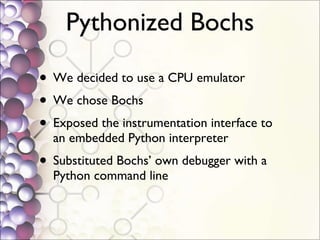
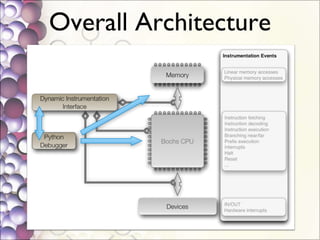
Pythonized Bochs We decided to use a CPU emulator We chose Bochs Exposed the instrumentation interface to an embedded Python interpreter Substituted Bochs’ own debugger with a Python command line
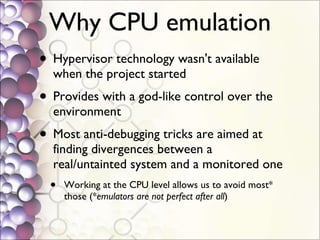
Why CPU emulation Hypervisor technology wasn't available when the project started Provides with a god-like control over the environment Most anti-debugging tricks are aimed at finding divergences between a real/untainted system and a monitored one Working at the CPU level allows us to avoid most* those (* emulators are not perfect after all )
Why CPU emulation Sandboxes lead to the endless problems Need to asymptotically approach the OS feature-set to provide a veritable environment We didn't want to redevelop an existing OS
Bochs Why Bochs? The instrumentation interface is powerful and fine-grained Snapshots are neat! Why to embedded Python into Bochs? Faster development & research cycle 
Overall Architecture
Drawbacks Speed, but entirely depends on the use case. It is not a big issue for us Some effort is needed in order to remove all the useless noise (other processes, kernel code, etc) as we see it all
Our approach to unpacking  As generic as possible, the least we need to know about packers the better Try to algorithmically capture the generic "concept" behind unpacking In short: try to capture as closely as possible the: Run -> Wait for unpacking done -> Dump These steps capture a vast majority of all packers if implemented with care We are very aware that it has limitations with packers employing runtime, on-demand unpacking/decoding techniques 
Keep it simple, Stupid!  We tried a set of different heuristics that in the end proved more problematic than helpful Tracking execution flow into dirty memory Multi-stage, multi-layer packing a PITA Attempting to capture "long" jumps Same problems as above and false positives EIP jump patterns False positives
Keep it simple, Stupid!  Monitoring specific APIs that might signal end-of-unpacking Packers get to use really crazy APIs, because they need them or simply to annoy sandboxes Looking for typical entrypoint patterns Easy to fake and being actively done Therefore, those attempts that might otherwise look insightful lead to an over-specification of what we wanted to actually capture. In the end we had to go even more generic to really be universal 
Issues to solve QoU metric (Quality of Unpacking) Optimize emulation time (don’t keep running if it’s useless) Filter out data/junk-code/rubbish
Pythonized Bochs Compiler blood ties The selfish code Unpacking automation for fun and profit
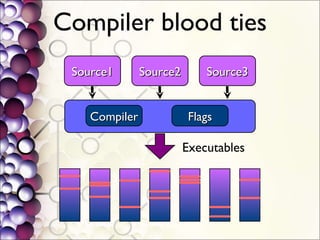
Compiler blood ties Source1 Source2 Source3 Compiler Flags Executables
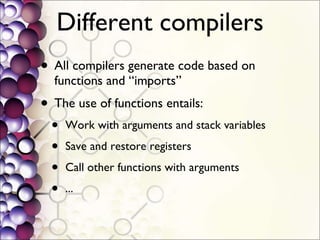
Different compilers All compilers generate code based on functions and “imports” The use of functions entails: Work with arguments and stack variables Save and restore registers Call other functions with arguments ...
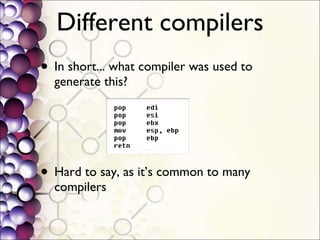
Different compilers In short... what compiler was used to generate this? Hard to say, as it’s common to many compilers
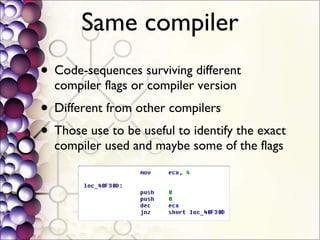
Same compiler Code-sequences surviving different compiler flags or compiler version Different from other compilers Those use to be useful to identify the exact compiler used and maybe some of the flags
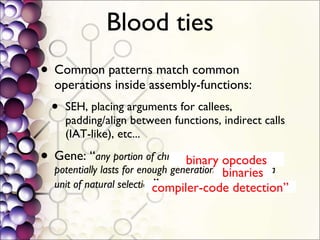
Blood ties Common patterns match common operations inside assembly-functions: SEH, placing arguments for callees, padding/align between functions, indirect calls (IAT-like), etc... Gene: “ any portion of chromosomal material that potentially lasts for enough generations to serve as a unit of natural selection ” compiler-code detection” binaries binary opcodes
Pythonized Bochs Compiler blood ties The selfish code Unpacking automation for fun and profit
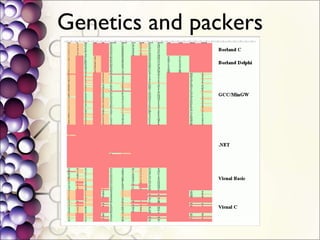
Genetics and packers Most packed samples contain no compiler-generated code but obfuscated-code Search for compiler-genes produces zero or few results
Genetics and packers
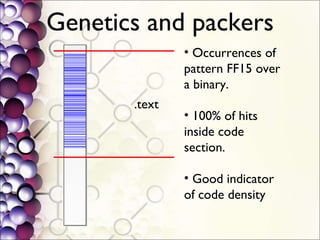
Genetics and packers .text Occurrences of pattern FF15 over a binary. 100% of hits inside code section. Good indicator of code density
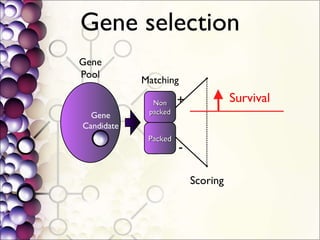
Gene selection Non packed Packed Gene Candidate Gene Pool Matching Scoring Survival + -
Pythonized Bochs Compiler blood ties The selfish code Unpacking automation for fun and profit
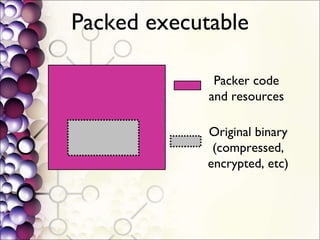
Packed executable Packer code and resources Original binary (compressed, encrypted, etc)
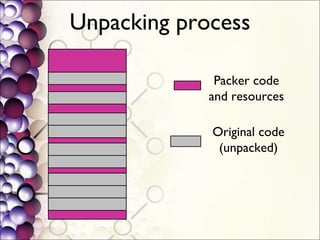
Unpacking process Packer code and resources Original code (unpacked)
Gene[tr]ic unpacker
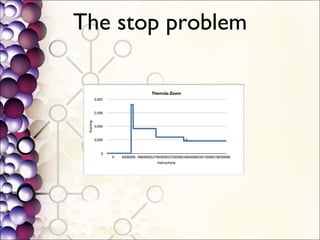
The stop problem
DEMO
Unpacking stats Test machine: VMware (1 core, 2Gb ram) running on a i7 2.8Ghz Minimum unpacking time: 5 seconds Maximum unpacking time: relative to MaxTicks (user configured) Average: 10.8 secs Test performed over 580 packers (includes different versions and protection options)
Problems... ... that are not a problem: Packers with compiler-code (Armadillo and Visual-C/WinMain) N-packed samples
Problems... ... to solve: Virtualization: the process works with really low scorings but we do nothing to analyze the VM Obfuscation: similar issue with VMs Not affected by anti-disasm tricks as we do pattern-matching Decryption on demand: Code that changes after stabilization
Work in progress Gene[tr]ic unpacker as an online tool Plugins (optional post-processing): Deobfuscator VM analysis (as described in [1] to obtain more accurate callgraphs) Support for other CPUs, OSs and VMs [1]  Rotalume: A Tool for Automatic Reverse Engineering of Malware Emulators. http://bit.ly/9XtAeb
Questions?

Packer Genetics: The selfish code

  • 1.
    Packer Genetics: TheSelfish Code Ero Carrera, Jose Duart (ero.carrera, jose.duart)@zynamics.com
  • 2.
    Pythonized Bochs Compilerblood ties The selfish code Unpacking automation for fun and profit
  • 3.
    Pythonized Bochs Compilerblood ties The selfish code Unpacking automation for fun and profit
  • 4.
    Pythonized Bochs Wedecided to use a CPU emulator We chose Bochs Exposed the instrumentation interface to an embedded Python interpreter Substituted Bochs’ own debugger with a Python command line
  • 5.
    Why CPU emulationHypervisor technology wasn't available when the project started Provides with a god-like control over the environment Most anti-debugging tricks are aimed at finding divergences between a real/untainted system and a monitored one Working at the CPU level allows us to avoid most* those (* emulators are not perfect after all )
  • 6.
    Why CPU emulationSandboxes lead to the endless problems Need to asymptotically approach the OS feature-set to provide a veritable environment We didn't want to redevelop an existing OS
  • 7.
    Bochs Why Bochs?The instrumentation interface is powerful and fine-grained Snapshots are neat! Why to embedded Python into Bochs? Faster development & research cycle 
  • 8.
  • 9.
    Drawbacks Speed, butentirely depends on the use case. It is not a big issue for us Some effort is needed in order to remove all the useless noise (other processes, kernel code, etc) as we see it all
  • 10.
    Our approach tounpacking  As generic as possible, the least we need to know about packers the better Try to algorithmically capture the generic "concept" behind unpacking In short: try to capture as closely as possible the: Run -> Wait for unpacking done -> Dump These steps capture a vast majority of all packers if implemented with care We are very aware that it has limitations with packers employing runtime, on-demand unpacking/decoding techniques 
  • 11.
    Keep it simple,Stupid!  We tried a set of different heuristics that in the end proved more problematic than helpful Tracking execution flow into dirty memory Multi-stage, multi-layer packing a PITA Attempting to capture "long" jumps Same problems as above and false positives EIP jump patterns False positives
  • 12.
    Keep it simple,Stupid!  Monitoring specific APIs that might signal end-of-unpacking Packers get to use really crazy APIs, because they need them or simply to annoy sandboxes Looking for typical entrypoint patterns Easy to fake and being actively done Therefore, those attempts that might otherwise look insightful lead to an over-specification of what we wanted to actually capture. In the end we had to go even more generic to really be universal 
  • 13.
    Issues to solveQoU metric (Quality of Unpacking) Optimize emulation time (don’t keep running if it’s useless) Filter out data/junk-code/rubbish
  • 14.
    Pythonized Bochs Compilerblood ties The selfish code Unpacking automation for fun and profit
  • 15.
    Compiler blood tiesSource1 Source2 Source3 Compiler Flags Executables
  • 16.
    Different compilers Allcompilers generate code based on functions and “imports” The use of functions entails: Work with arguments and stack variables Save and restore registers Call other functions with arguments ...
  • 17.
    Different compilers Inshort... what compiler was used to generate this? Hard to say, as it’s common to many compilers
  • 18.
    Same compiler Code-sequencessurviving different compiler flags or compiler version Different from other compilers Those use to be useful to identify the exact compiler used and maybe some of the flags
  • 19.
    Blood ties Commonpatterns match common operations inside assembly-functions: SEH, placing arguments for callees, padding/align between functions, indirect calls (IAT-like), etc... Gene: “ any portion of chromosomal material that potentially lasts for enough generations to serve as a unit of natural selection ” compiler-code detection” binaries binary opcodes
  • 20.
    Pythonized Bochs Compilerblood ties The selfish code Unpacking automation for fun and profit
  • 21.
    Genetics and packersMost packed samples contain no compiler-generated code but obfuscated-code Search for compiler-genes produces zero or few results
  • 22.
  • 23.
    Genetics and packers.text Occurrences of pattern FF15 over a binary. 100% of hits inside code section. Good indicator of code density
  • 24.
    Gene selection Nonpacked Packed Gene Candidate Gene Pool Matching Scoring Survival + -
  • 25.
    Pythonized Bochs Compilerblood ties The selfish code Unpacking automation for fun and profit
  • 26.
    Packed executable Packercode and resources Original binary (compressed, encrypted, etc)
  • 27.
    Unpacking process Packercode and resources Original code (unpacked)
  • 28.
  • 29.
  • 30.
  • 31.
    Unpacking stats Testmachine: VMware (1 core, 2Gb ram) running on a i7 2.8Ghz Minimum unpacking time: 5 seconds Maximum unpacking time: relative to MaxTicks (user configured) Average: 10.8 secs Test performed over 580 packers (includes different versions and protection options)
  • 32.
    Problems... ... thatare not a problem: Packers with compiler-code (Armadillo and Visual-C/WinMain) N-packed samples
  • 33.
    Problems... ... tosolve: Virtualization: the process works with really low scorings but we do nothing to analyze the VM Obfuscation: similar issue with VMs Not affected by anti-disasm tricks as we do pattern-matching Decryption on demand: Code that changes after stabilization
  • 34.
    Work in progressGene[tr]ic unpacker as an online tool Plugins (optional post-processing): Deobfuscator VM analysis (as described in [1] to obtain more accurate callgraphs) Support for other CPUs, OSs and VMs [1] Rotalume: A Tool for Automatic Reverse Engineering of Malware Emulators. http://bit.ly/9XtAeb
  • 35.