Understanding PyPy 
Francisco Fernandez Castano 
Rushmore.fm 
francisco.fernandez.castano@gmail.com @fcofdezc 
November 8, 2014 
Francisco Fernandez Castano (@fcofdezc) PyPy November 8, 2014 1 / 51
Overview 
1 Introduction 
My Personal history with PyPy 
What is PyPy? 
Why is Python slow? 
Motivation 
2 RPython 
Overview 
De
nition 
Goals 
Hello World in RPython 
Translation process 
Building Flow Graphs 
Annotation phase 
RTyper 
Backend Optimizations 
Preparation for source generation 
Overview 
3 JIT 
PyPy strategy 
4 Garbage Collection Francisco Fernandez Castano (@fcofdezc) PyPy November 8, 2014 2 / 51
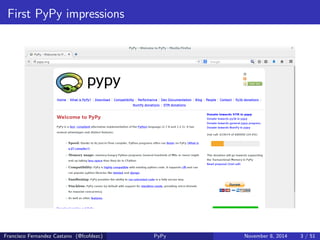
First PyPy impressions 
Francisco Fernandez Castano (@fcofdezc) PyPy November 8, 2014 3 / 51
First PyPy impressions 
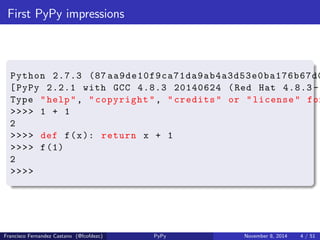
Python 2.7.3 (87 aa9de10f9ca71da9ab4a3d53e0ba176b67d086 [ PyPy 2.2.1 with GCC 4.8.3 20140624 (Red Hat 4.8.3 -1)] Type " help ", " copyright ", " credits " or " license " for >>>> 1 + 1 
2 
>>>> def f(x): return x + 1 
>>>> f(1) 
2 
>>>> 
Francisco Fernandez Castano (@fcofdezc) PyPy November 8, 2014 4 / 51
First PyPy impressions 
Ok... just Python... 
Francisco Fernandez Castano (@fcofdezc) PyPy November 8, 2014 5 / 51
Second PyPy impressions 
Francisco Fernandez Castano (@fcofdezc) PyPy November 8, 2014 6 / 51
What is PyPy? 
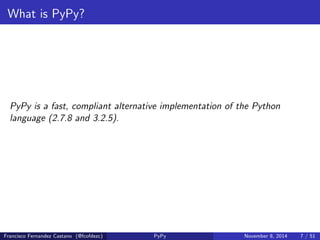
PyPy is a fast, compliant alternative implementation of the Python 
language (2.7.8 and 3.2.5). 
Francisco Fernandez Castano (@fcofdezc) PyPy November 8, 2014 7 / 51
Why is Python slow? 
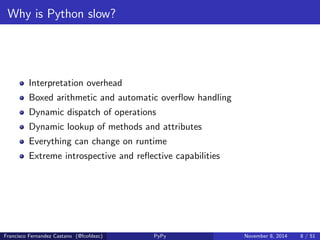
Interpretation overhead 
Boxed arithmetic and automatic over
ow handling 
Dynamic dispatch of operations 
Dynamic lookup of methods and attributes 
Everything can change on runtime 
Extreme introspective and re
ective capabilities 
Francisco Fernandez Castano (@fcofdezc) PyPy November 8, 2014 8 / 51
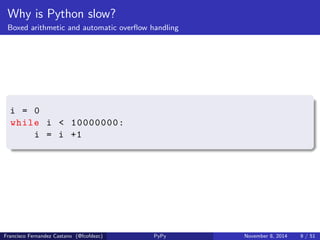
Why is Python slow? 
Boxed arithmetic and automatic over
ow handling 
i = 0 
while i < 10000000: 
i = i +1 
Francisco Fernandez Castano (@fcofdezc) PyPy November 8, 2014 9 / 51
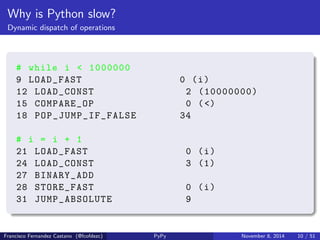
Why is Python slow? 
Dynamic dispatch of operations 
# while i < 1000000 
9 LOAD_FAST 0 (i) 
12 LOAD_CONST 2 (10000000) 
15 COMPARE_OP 0 (<) 
18 POP_JUMP_IF_FALSE 34 
# i = i + 1 
21 LOAD_FAST 0 (i) 
24 LOAD_CONST 3 (1) 
27 BINARY_ADD 
28 STORE_FAST 0 (i) 
31 JUMP_ABSOLUTE 9 
Francisco Fernandez Castano (@fcofdezc) PyPy November 8, 2014 10 / 51
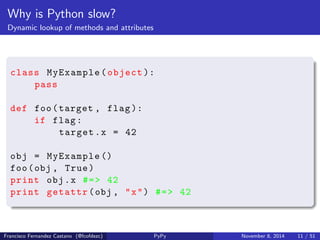
Why is Python slow? 
Dynamic lookup of methods and attributes 
class MyExample ( object ): 
pass 
def foo(target , flag ): 
if flag : 
target .x = 42 
obj = MyExample () 
foo(obj , True ) 
print obj.x #=> 42 
print getattr (obj , "x") #=> 42 
Francisco Fernandez Castano (@fcofdezc) PyPy November 8, 2014 11 / 51
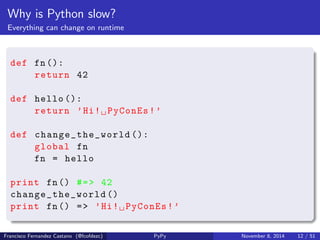
Why is Python slow? 
Everything can change on runtime 
def fn (): 
return 42 
def hello (): 
return 'Hi!  PyConEs !' 
def change_the_world (): 
global fn 
fn = hello 
print fn () #=> 42 
change_the_world () 
print fn () => 'Hi!  PyConEs !' 
Francisco Fernandez Castano (@fcofdezc) PyPy November 8, 2014 12 / 51
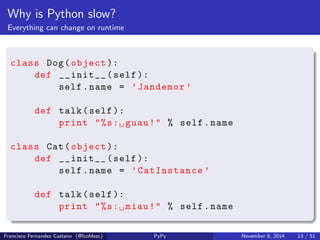
Why is Python slow? 
Everything can change on runtime 
class Dog( object ): 
def __init__ ( self ): 
self . name = 'Jandemor ' 
def talk ( self ): 
print "%s:  guau !" % self . name 
class Cat( object ): 
def __init__ ( self ): 
self . name = 'CatInstance ' 
def talk ( self ): 
print "%s:  miau !" % self . name 
Francisco Fernandez Castano (@fcofdezc) PyPy November 8, 2014 13 / 51
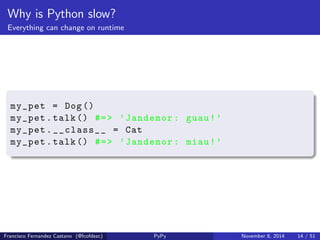
Why is Python slow? 
Everything can change on runtime 
my_pet = Dog () 
my_pet . talk () #=> 'Jandemor : guau !' 
my_pet . __class__ = Cat 
my_pet . talk () #=> 'Jandemor : miau !' 
Francisco Fernandez Castano (@fcofdezc) PyPy November 8, 2014 14 / 51
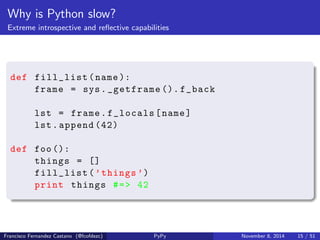
Why is Python slow? 
Extreme introspective and re
ective capabilities 
def fill_list ( name ): 
frame = sys. _getframe (). f_back 
lst = frame . f_locals [ name ] 
lst. append (42) 
def foo (): 
things = [] 
fill_list ('things ') 
print things #=> 42 
Francisco Fernandez Castano (@fcofdezc) PyPy November 8, 2014 15 / 51
Why is Python slow? 
CPython is a clean and maintainable software. 
Francisco Fernandez Castano (@fcofdezc) PyPy November 8, 2014 16 / 51
Why is Python slow? 
Show me the numbers 
Francisco Fernandez Castano (@fcofdezc) PyPy November 8, 2014 17 / 51
Why is Python slow? 
Show me the numbers 
speed.pypy.org 
Video processing example 
Francisco Fernandez Castano (@fcofdezc) PyPy November 8, 2014 18 / 51
What is PyPy? 
PyPy is a python interpreter written in Python. 
Francisco Fernandez Castano (@fcofdezc) PyPy November 8, 2014 19 / 51
What is PyPy? 
Francisco Fernandez Castano (@fcofdezc) PyPy November 8, 2014 20 / 51
What is PyPy? 
PyPy is a python interpreter written in RPython. 
Francisco Fernandez Castano (@fcofdezc) PyPy November 8, 2014 21 / 51
Motivation 
The Pareto princpile: the 20% of the program will account for the 
80% of the runtime. 
The Fast path principle. 
Francisco Fernandez Castano (@fcofdezc) PyPy November 8, 2014 22 / 51
De
nition 
RPython is a restricted subset of Python that is amenable to static 
analysis. 
Francisco Fernandez Castano (@fcofdezc) PyPy November 8, 2014 23 / 51
Goals 
Abstract as much as possible creating Interpreters for DL. 
l * o * p 
l - language to analyze. 
o - optimize and tweak depending on dierent factors. (GC ie) 
p - being able to produce interpreter for dierent platforms. 
Francisco Fernandez Castano (@fcofdezc) PyPy November 8, 2014 24 / 51
Hello World 
Mandatory Hello World. 
Francisco Fernandez Castano (@fcofdezc) PyPy November 8, 2014 25 / 51
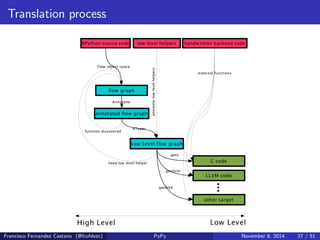
Translation process 
Complete program is imported generating control 
ow graph. 
The Annotator does type inference. 
The Rtyper uses high level types to transform into low level ones. 
Some optimizations are applied. 
Next step is prepare graphs to be translated. 
The C backend generates source
les. 
Francisco Fernandez Castano (@fcofdezc) PyPy November 8, 2014 26 / 51
Translation process 
RPython source code 
Flow object space 
flow graph 
Annotator 
low level helpers 
annotated flow graph 
RTyper 
annotate low level helpers 
Low Level flow graph 
handwritten backend code 
external functions 
C code 
LLVM code 
genc 
other target 
function discovered 
need low level helper 
genllvm 
High Level Low Level 
handwritten code 
genXXX 
Francisco Fernandez Castano (@fcofdezc) PyPy November 8, 2014 27 / 51
Building Flow Graphs 
Code is NOT parsed. 
Uses code objects that de
ne the behaviour. 
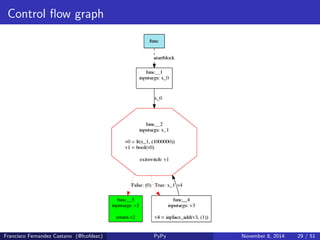
Flow Graph builder using an abstract interpretation producing control 

ow graph. 
Francisco Fernandez Castano (@fcofdezc) PyPy November 8, 2014 28 / 51
Control 
ow graph 
Francisco Fernandez Castano (@fcofdezc) PyPy November 8, 2014 29 / 51
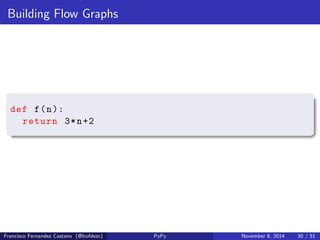
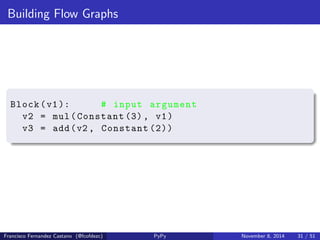
Building Flow Graphs 
def f(n): 
return 3*n+2 
Francisco Fernandez Castano (@fcofdezc) PyPy November 8, 2014 30 / 51
Building Flow Graphs 
Block (v1 ): # input argument 
v2 = mul ( Constant (3) , v1) 
v3 = add (v2 , Constant (2)) 
Francisco Fernandez Castano (@fcofdezc) PyPy November 8, 2014 31 / 51
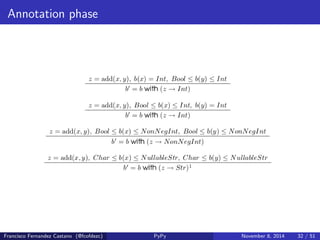
Annotation phase 
Francisco Fernandez Castano (@fcofdezc) PyPy November 8, 2014 32 / 51
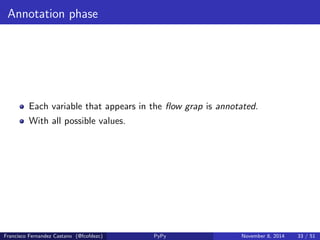
Annotation phase 
Each variable that appears in the 
ow grap is annotated. 
With all possible values. 
Francisco Fernandez Castano (@fcofdezc) PyPy November 8, 2014 33 / 51
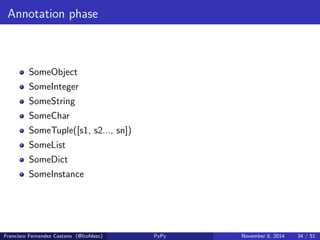
Annotation phase 
SomeObject 
SomeInteger 
SomeString 
SomeChar 
SomeTuple([s1, s2..., sn]) 
SomeList 
SomeDict 
SomeInstance 
Francisco Fernandez Castano (@fcofdezc) PyPy November 8, 2014 34 / 51
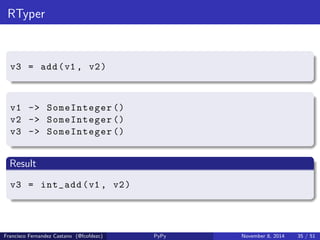
RTyper 
v3 = add(v1 , v2) 
v1 - SomeInteger () 
v2 - SomeInteger () 
v3 - SomeInteger () 
Result 
v3 = int_add (v1 , v2) 
Francisco Fernandez Castano (@fcofdezc) PyPy November 8, 2014 35 / 51
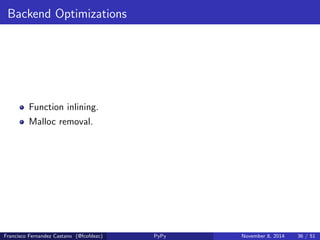
Backend Optimizations 
Function inlining. 
Malloc removal. 
Francisco Fernandez Castano (@fcofdezc) PyPy November 8, 2014 36 / 51
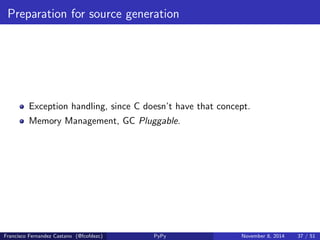
Preparation for source generation 
Exception handling, since C doesn't have that concept. 
Memory Management, GC Pluggable. 
Francisco Fernandez Castano (@fcofdezc) PyPy November 8, 2014 37 / 51
Overview 
Francisco Fernandez Castano (@fcofdezc) PyPy November 8, 2014 38 / 51
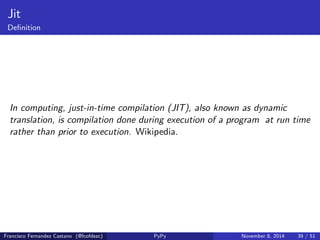
Jit 
De
nition 
In computing, just-in-time compilation (JIT), also known as dynamic 
translation, is compilation done during execution of a program at run time 
rather than prior to execution. Wikipedia. 
Francisco Fernandez Castano (@fcofdezc) PyPy November 8, 2014 39 / 51
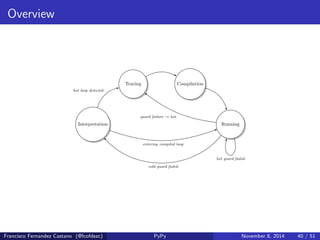
Overview 
Francisco Fernandez Castano (@fcofdezc) PyPy November 8, 2014 40 / 51
PyPy strategy 
RPython generates a tracing JIT. 
Instead of user code is interpreter code who launch compiled code. 
It comes mostly for free to language implementators. 
Francisco Fernandez Castano (@fcofdezc) PyPy November 8, 2014 41 / 51
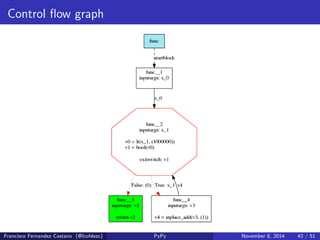
Control 
ow graph 
Francisco Fernandez Castano (@fcofdezc) PyPy November 8, 2014 42 / 51
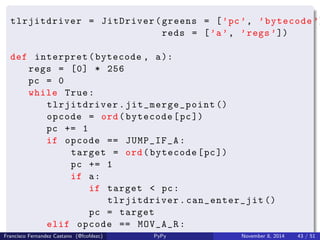
tlrjitdriver = JitDriver ( greens = ['pc ', 'bytecode '], 
reds = ['a', 'regs ']) 
def interpret ( bytecode , a): 
regs = [0] * 256 
pc = 0 
while True : 
tlrjitdriver . jit_merge_point () 
opcode = ord ( bytecode [pc ]) 
pc += 1 
if opcode == JUMP_IF_A : 
target = ord ( bytecode [pc ]) 
pc += 1 
if a: 
if target  pc: 
tlrjitdriver . can_enter_jit () 
pc = target 
elif opcode == MOV_A_R : 
Francisco Fernandez Castano.(.@f.cofde#zc)rest unmoPdyPiy fied November 8, 2014 43 / 51
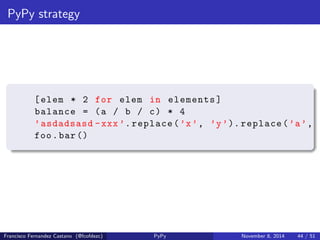
PyPy strategy 
[ elem * 2 for elem in elements ] 
balance = (a / b / c) * 4 
'asdadsasd - xxx '. replace ('x', 'y'). replace ('a', 'b') 
foo.bar () 
Francisco Fernandez Castano (@fcofdezc) PyPy November 8, 2014 44 / 51
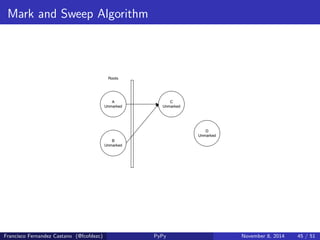
Mark and Sweep Algorithm 
Francisco Fernandez Castano (@fcofdezc) PyPy November 8, 2014 45 / 51
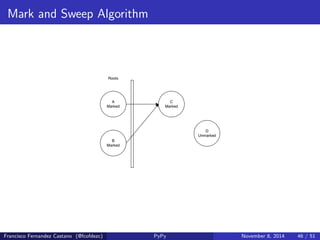
Mark and Sweep Algorithm 
Francisco Fernandez Castano (@fcofdezc) PyPy November 8, 2014 46 / 51

Understanding PyPy - PyConEs 14

  • 1.
    Understanding PyPy FranciscoFernandez Castano Rushmore.fm francisco.fernandez.castano@gmail.com @fcofdezc November 8, 2014 Francisco Fernandez Castano (@fcofdezc) PyPy November 8, 2014 1 / 51
  • 2.
    Overview 1 Introduction My Personal history with PyPy What is PyPy? Why is Python slow? Motivation 2 RPython Overview De
  • 3.
    nition Goals HelloWorld in RPython Translation process Building Flow Graphs Annotation phase RTyper Backend Optimizations Preparation for source generation Overview 3 JIT PyPy strategy 4 Garbage Collection Francisco Fernandez Castano (@fcofdezc) PyPy November 8, 2014 2 / 51
  • 4.
    First PyPy impressions Francisco Fernandez Castano (@fcofdezc) PyPy November 8, 2014 3 / 51
  • 5.
    First PyPy impressions Python 2.7.3 (87 aa9de10f9ca71da9ab4a3d53e0ba176b67d086 [ PyPy 2.2.1 with GCC 4.8.3 20140624 (Red Hat 4.8.3 -1)] Type " help ", " copyright ", " credits " or " license " for >>>> 1 + 1 2 >>>> def f(x): return x + 1 >>>> f(1) 2 >>>> Francisco Fernandez Castano (@fcofdezc) PyPy November 8, 2014 4 / 51
  • 6.
    First PyPy impressions Ok... just Python... Francisco Fernandez Castano (@fcofdezc) PyPy November 8, 2014 5 / 51
  • 7.
    Second PyPy impressions Francisco Fernandez Castano (@fcofdezc) PyPy November 8, 2014 6 / 51
  • 8.
    What is PyPy? PyPy is a fast, compliant alternative implementation of the Python language (2.7.8 and 3.2.5). Francisco Fernandez Castano (@fcofdezc) PyPy November 8, 2014 7 / 51
  • 9.
    Why is Pythonslow? Interpretation overhead Boxed arithmetic and automatic over ow handling Dynamic dispatch of operations Dynamic lookup of methods and attributes Everything can change on runtime Extreme introspective and re ective capabilities Francisco Fernandez Castano (@fcofdezc) PyPy November 8, 2014 8 / 51
  • 10.
    Why is Pythonslow? Boxed arithmetic and automatic over ow handling i = 0 while i < 10000000: i = i +1 Francisco Fernandez Castano (@fcofdezc) PyPy November 8, 2014 9 / 51
  • 11.
    Why is Pythonslow? Dynamic dispatch of operations # while i < 1000000 9 LOAD_FAST 0 (i) 12 LOAD_CONST 2 (10000000) 15 COMPARE_OP 0 (<) 18 POP_JUMP_IF_FALSE 34 # i = i + 1 21 LOAD_FAST 0 (i) 24 LOAD_CONST 3 (1) 27 BINARY_ADD 28 STORE_FAST 0 (i) 31 JUMP_ABSOLUTE 9 Francisco Fernandez Castano (@fcofdezc) PyPy November 8, 2014 10 / 51
  • 12.
    Why is Pythonslow? Dynamic lookup of methods and attributes class MyExample ( object ): pass def foo(target , flag ): if flag : target .x = 42 obj = MyExample () foo(obj , True ) print obj.x #=> 42 print getattr (obj , "x") #=> 42 Francisco Fernandez Castano (@fcofdezc) PyPy November 8, 2014 11 / 51
  • 13.
    Why is Pythonslow? Everything can change on runtime def fn (): return 42 def hello (): return 'Hi! PyConEs !' def change_the_world (): global fn fn = hello print fn () #=> 42 change_the_world () print fn () => 'Hi! PyConEs !' Francisco Fernandez Castano (@fcofdezc) PyPy November 8, 2014 12 / 51
  • 14.
    Why is Pythonslow? Everything can change on runtime class Dog( object ): def __init__ ( self ): self . name = 'Jandemor ' def talk ( self ): print "%s: guau !" % self . name class Cat( object ): def __init__ ( self ): self . name = 'CatInstance ' def talk ( self ): print "%s: miau !" % self . name Francisco Fernandez Castano (@fcofdezc) PyPy November 8, 2014 13 / 51
  • 15.
    Why is Pythonslow? Everything can change on runtime my_pet = Dog () my_pet . talk () #=> 'Jandemor : guau !' my_pet . __class__ = Cat my_pet . talk () #=> 'Jandemor : miau !' Francisco Fernandez Castano (@fcofdezc) PyPy November 8, 2014 14 / 51
  • 16.
    Why is Pythonslow? Extreme introspective and re ective capabilities def fill_list ( name ): frame = sys. _getframe (). f_back lst = frame . f_locals [ name ] lst. append (42) def foo (): things = [] fill_list ('things ') print things #=> 42 Francisco Fernandez Castano (@fcofdezc) PyPy November 8, 2014 15 / 51
  • 17.
    Why is Pythonslow? CPython is a clean and maintainable software. Francisco Fernandez Castano (@fcofdezc) PyPy November 8, 2014 16 / 51
  • 18.
    Why is Pythonslow? Show me the numbers Francisco Fernandez Castano (@fcofdezc) PyPy November 8, 2014 17 / 51
  • 19.
    Why is Pythonslow? Show me the numbers speed.pypy.org Video processing example Francisco Fernandez Castano (@fcofdezc) PyPy November 8, 2014 18 / 51
  • 20.
    What is PyPy? PyPy is a python interpreter written in Python. Francisco Fernandez Castano (@fcofdezc) PyPy November 8, 2014 19 / 51
  • 21.
    What is PyPy? Francisco Fernandez Castano (@fcofdezc) PyPy November 8, 2014 20 / 51
  • 22.
    What is PyPy? PyPy is a python interpreter written in RPython. Francisco Fernandez Castano (@fcofdezc) PyPy November 8, 2014 21 / 51
  • 23.
    Motivation The Paretoprincpile: the 20% of the program will account for the 80% of the runtime. The Fast path principle. Francisco Fernandez Castano (@fcofdezc) PyPy November 8, 2014 22 / 51
  • 24.
  • 25.
    nition RPython isa restricted subset of Python that is amenable to static analysis. Francisco Fernandez Castano (@fcofdezc) PyPy November 8, 2014 23 / 51
  • 26.
    Goals Abstract asmuch as possible creating Interpreters for DL. l * o * p l - language to analyze. o - optimize and tweak depending on dierent factors. (GC ie) p - being able to produce interpreter for dierent platforms. Francisco Fernandez Castano (@fcofdezc) PyPy November 8, 2014 24 / 51
  • 27.
    Hello World MandatoryHello World. Francisco Fernandez Castano (@fcofdezc) PyPy November 8, 2014 25 / 51
  • 28.
    Translation process Completeprogram is imported generating control ow graph. The Annotator does type inference. The Rtyper uses high level types to transform into low level ones. Some optimizations are applied. Next step is prepare graphs to be translated. The C backend generates source
  • 29.
    les. Francisco FernandezCastano (@fcofdezc) PyPy November 8, 2014 26 / 51
  • 30.
    Translation process RPythonsource code Flow object space flow graph Annotator low level helpers annotated flow graph RTyper annotate low level helpers Low Level flow graph handwritten backend code external functions C code LLVM code genc other target function discovered need low level helper genllvm High Level Low Level handwritten code genXXX Francisco Fernandez Castano (@fcofdezc) PyPy November 8, 2014 27 / 51
  • 31.
    Building Flow Graphs Code is NOT parsed. Uses code objects that de
  • 32.
    ne the behaviour. Flow Graph builder using an abstract interpretation producing control ow graph. Francisco Fernandez Castano (@fcofdezc) PyPy November 8, 2014 28 / 51
  • 33.
    Control ow graph Francisco Fernandez Castano (@fcofdezc) PyPy November 8, 2014 29 / 51
  • 34.
    Building Flow Graphs def f(n): return 3*n+2 Francisco Fernandez Castano (@fcofdezc) PyPy November 8, 2014 30 / 51
  • 35.
    Building Flow Graphs Block (v1 ): # input argument v2 = mul ( Constant (3) , v1) v3 = add (v2 , Constant (2)) Francisco Fernandez Castano (@fcofdezc) PyPy November 8, 2014 31 / 51
  • 36.
    Annotation phase FranciscoFernandez Castano (@fcofdezc) PyPy November 8, 2014 32 / 51
  • 37.
    Annotation phase Eachvariable that appears in the ow grap is annotated. With all possible values. Francisco Fernandez Castano (@fcofdezc) PyPy November 8, 2014 33 / 51
  • 38.
    Annotation phase SomeObject SomeInteger SomeString SomeChar SomeTuple([s1, s2..., sn]) SomeList SomeDict SomeInstance Francisco Fernandez Castano (@fcofdezc) PyPy November 8, 2014 34 / 51
  • 39.
    RTyper v3 =add(v1 , v2) v1 - SomeInteger () v2 - SomeInteger () v3 - SomeInteger () Result v3 = int_add (v1 , v2) Francisco Fernandez Castano (@fcofdezc) PyPy November 8, 2014 35 / 51
  • 40.
    Backend Optimizations Functioninlining. Malloc removal. Francisco Fernandez Castano (@fcofdezc) PyPy November 8, 2014 36 / 51
  • 41.
    Preparation for sourcegeneration Exception handling, since C doesn't have that concept. Memory Management, GC Pluggable. Francisco Fernandez Castano (@fcofdezc) PyPy November 8, 2014 37 / 51
  • 42.
    Overview Francisco FernandezCastano (@fcofdezc) PyPy November 8, 2014 38 / 51
  • 43.
  • 44.
    nition In computing,just-in-time compilation (JIT), also known as dynamic translation, is compilation done during execution of a program at run time rather than prior to execution. Wikipedia. Francisco Fernandez Castano (@fcofdezc) PyPy November 8, 2014 39 / 51
  • 45.
    Overview Francisco FernandezCastano (@fcofdezc) PyPy November 8, 2014 40 / 51
  • 46.
    PyPy strategy RPythongenerates a tracing JIT. Instead of user code is interpreter code who launch compiled code. It comes mostly for free to language implementators. Francisco Fernandez Castano (@fcofdezc) PyPy November 8, 2014 41 / 51
  • 47.
    Control ow graph Francisco Fernandez Castano (@fcofdezc) PyPy November 8, 2014 42 / 51
  • 48.
    tlrjitdriver = JitDriver( greens = ['pc ', 'bytecode '], reds = ['a', 'regs ']) def interpret ( bytecode , a): regs = [0] * 256 pc = 0 while True : tlrjitdriver . jit_merge_point () opcode = ord ( bytecode [pc ]) pc += 1 if opcode == JUMP_IF_A : target = ord ( bytecode [pc ]) pc += 1 if a: if target pc: tlrjitdriver . can_enter_jit () pc = target elif opcode == MOV_A_R : Francisco Fernandez Castano.(.@f.cofde#zc)rest unmoPdyPiy fied November 8, 2014 43 / 51
  • 49.
    PyPy strategy [elem * 2 for elem in elements ] balance = (a / b / c) * 4 'asdadsasd - xxx '. replace ('x', 'y'). replace ('a', 'b') foo.bar () Francisco Fernandez Castano (@fcofdezc) PyPy November 8, 2014 44 / 51
  • 50.
    Mark and SweepAlgorithm Francisco Fernandez Castano (@fcofdezc) PyPy November 8, 2014 45 / 51
  • 51.
    Mark and SweepAlgorithm Francisco Fernandez Castano (@fcofdezc) PyPy November 8, 2014 46 / 51