Packaging tool options
Len Bass
Deployment pipeline
2
Pre-commit
tests
X
promote
to normal
production
Build Image
and Perform
Integration
tests
UAT /
staging /
performance
tests
Deploy to
production
Commit
...
...
Pre-commit
tests
Commit
Developers
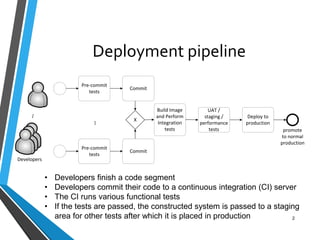
• Developers finish a code segment
• Developers commit their code to a continuous integration (CI) server
• The CI runs various functional tests
• If the tests are passed, the constructed system is passed to a staging
area for other tests after which it is placed in production
This talk
3
Pre-commit
tests
X
promote
to normal
production
Build Image
and Perform
Integration
tests
UAT /
staging /
performance
tests
Deploy to
production
Commit
...
...
Pre-commit
tests
Commit
Developers
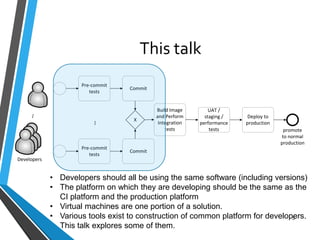
• Developers should all be using the same software (including versions)
• The platform on which they are developing should be the same as the
CI platform and the production platform
• Virtual machines are one portion of a solution.
• Various tools exist to construction of common platform for developers.
This talk explores some of them.
Virtual machine at execution time
© Len Bass 2015 4
Messages
through IP
address
Virtual Machine
including
machine image
Environment
Configuration
parameters
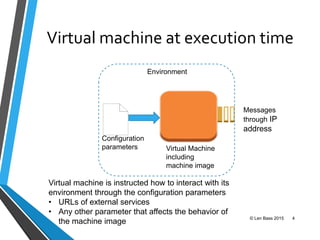
Virtual machine is instructed how to interact with its
environment through the configuration parameters
• URLs of external services
• Any other parameter that affects the behavior of
the machine image
The build process produces this
virtual machine
• The goals of the build process are
• Repeatable
• Invokable by different members of a development team
• Efficient both in human terms and in machine terms
© Len Bass 2015 5
Four issues:
1. How is the virtual machine created?
2. How is the configuration parameter file specified?
3. How is the machine image created?
4. How is the machine image loaded into the virtual
machine?
• Different tools provide different solutions to these
questions.
© Len Bass 2015 6
Creating a virtual machine
• The virtual machine exists on a platform –VirtualBox or
AWS in our case
• The virtual machine is created within the platform
through an API call to the platform.
• The API call specifies
• Hardware specifications' of virtual machine
• Initial software contents
• AWS requires many more parameters thanVirtualBox –
credentials, security settings.
© Len Bass 2015 7
Tools with respect to creating
virtual machine
• Vagrant has a concept of back end provider that includes
VirtualBox and AWS. It creates the necessaryVMs.
• Chef, Puppet, Ansible assume that theVM already exists.
• Docker assumes a virtual machine exists on which a
portion of it runs but has a library with some pre-supplied
VMs.
© Len Bass 2015 8
How is the configuration parameter
file specified?
• All of the tools have mechanisms for specifying
configuration parameters in their specification file.
• Vagrant has a “Vagrantfile”
• Docker has a “Dockerfile”
• Other tools have things called “cookbooks” or “playbooks”
• How these parameters are presented to the executable
image depends on the executable image. A common
means is through command line parameters.
© Len Bass 2015 9
Layered system as an example
© Len Bass 2015 10
Building the layered system
• System is compiled, linked together and an executable
image is created.
• In Chef, Puppet and Ansible, this executable image is stored on a
disk in a directory.
• Vagrant builds its image inside of theVM
• Docker we will discuss in a minute © Len Bass 2015 11
Instantiating aVirtual Machine
© Len Bass 2015 12
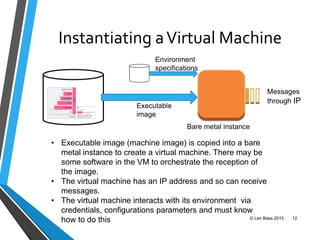
• Executable image (machine image) is copied into a bare
metal instance to create a virtual machine. There may be
some software in the VM to orchestrate the reception of
the image.
• The virtual machine has an IP address and so can receive
messages.
• The virtual machine interacts with its environment via
credentials, configurations parameters and must know
how to do this
Bare metal instance
Messages
through IP
Environment
specifications
Executable
image
How long does this take?
• Sending 1K bytes over 1 Gbps network takes .01 ms
• A machine image may be 8GB or more.
• Transferring 8GB over 1Gbps network takes at least 64
seconds (bits in Gbps, bytes in GB)
• This number will vary based on speed of network and size
of machine image but we are talking about multiple
minutes to instantiate a virtual machine with a fully
loaded system.
© Len Bass 2015 13
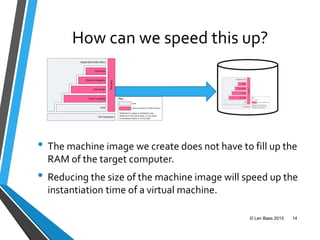
How can we speed this up?
• The machine image we create does not have to fill up the
RAM of the target computer.
• Reducing the size of the machine image will speed up the
instantiation time of a virtual machine.
© Len Bass 2015 14
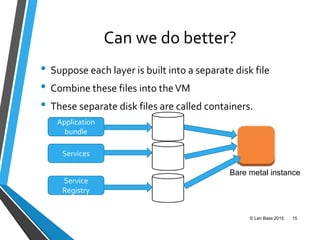
Can we do better?
• Suppose each layer is built into a separate disk file
• Combine these files into theVM
• These separate disk files are called containers.
© Len Bass 2015 15
Application
bundle
Services
Service
Registry
Bare metal instance
Containers
• Combining these files in theVM requires special software.
• On theVM is a container manager
• On the build side is a container builder
• Now the instantiation process consists of loading
multiple containers.
• Suppose further that some software (such as the OS and
the service registry) is shared across multiple
applications.
• Then once aVM is loaded with one application, loading
other applications becomes much faster since only the
app container must be loaded.
© Len Bass 2015 16
Docker
• Docker is the most common container system today.
• The Linux version is built on LXC which was the original
container system.
• Docker maintains a repository with common containers
such as Linux.
© Len Bass 2015 17
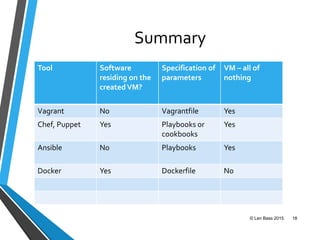
Summary
Tool Software
residing on the
createdVM?
Specification of
parameters
VM – all of
nothing
Vagrant No Vagrantfile Yes
Chef, Puppet Yes Playbooks or
cookbooks
Yes
Ansible No Playbooks Yes
Docker Yes Dockerfile No
© Len Bass 2015 18

Packaging tool options

  • 1.
  • 2.
    Deployment pipeline 2 Pre-commit tests X promote to normal production BuildImage and Perform Integration tests UAT / staging / performance tests Deploy to production Commit ... ... Pre-commit tests Commit Developers • Developers finish a code segment • Developers commit their code to a continuous integration (CI) server • The CI runs various functional tests • If the tests are passed, the constructed system is passed to a staging area for other tests after which it is placed in production
  • 3.
    This talk 3 Pre-commit tests X promote to normal production BuildImage and Perform Integration tests UAT / staging / performance tests Deploy to production Commit ... ... Pre-commit tests Commit Developers • Developers should all be using the same software (including versions) • The platform on which they are developing should be the same as the CI platform and the production platform • Virtual machines are one portion of a solution. • Various tools exist to construction of common platform for developers. This talk explores some of them.
  • 4.
    Virtual machine atexecution time © Len Bass 2015 4 Messages through IP address Virtual Machine including machine image Environment Configuration parameters Virtual machine is instructed how to interact with its environment through the configuration parameters • URLs of external services • Any other parameter that affects the behavior of the machine image
  • 5.
    The build processproduces this virtual machine • The goals of the build process are • Repeatable • Invokable by different members of a development team • Efficient both in human terms and in machine terms © Len Bass 2015 5
  • 6.
    Four issues: 1. Howis the virtual machine created? 2. How is the configuration parameter file specified? 3. How is the machine image created? 4. How is the machine image loaded into the virtual machine? • Different tools provide different solutions to these questions. © Len Bass 2015 6
  • 7.
    Creating a virtualmachine • The virtual machine exists on a platform –VirtualBox or AWS in our case • The virtual machine is created within the platform through an API call to the platform. • The API call specifies • Hardware specifications' of virtual machine • Initial software contents • AWS requires many more parameters thanVirtualBox – credentials, security settings. © Len Bass 2015 7
  • 8.
    Tools with respectto creating virtual machine • Vagrant has a concept of back end provider that includes VirtualBox and AWS. It creates the necessaryVMs. • Chef, Puppet, Ansible assume that theVM already exists. • Docker assumes a virtual machine exists on which a portion of it runs but has a library with some pre-supplied VMs. © Len Bass 2015 8
  • 9.
    How is theconfiguration parameter file specified? • All of the tools have mechanisms for specifying configuration parameters in their specification file. • Vagrant has a “Vagrantfile” • Docker has a “Dockerfile” • Other tools have things called “cookbooks” or “playbooks” • How these parameters are presented to the executable image depends on the executable image. A common means is through command line parameters. © Len Bass 2015 9
  • 10.
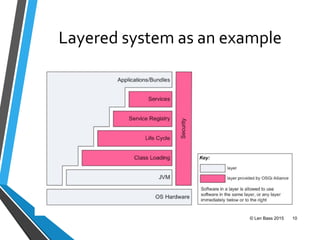
    Layered system asan example © Len Bass 2015 10
  • 11.
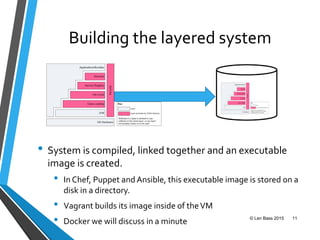
    Building the layeredsystem • System is compiled, linked together and an executable image is created. • In Chef, Puppet and Ansible, this executable image is stored on a disk in a directory. • Vagrant builds its image inside of theVM • Docker we will discuss in a minute © Len Bass 2015 11
  • 12.
    Instantiating aVirtual Machine ©Len Bass 2015 12 • Executable image (machine image) is copied into a bare metal instance to create a virtual machine. There may be some software in the VM to orchestrate the reception of the image. • The virtual machine has an IP address and so can receive messages. • The virtual machine interacts with its environment via credentials, configurations parameters and must know how to do this Bare metal instance Messages through IP Environment specifications Executable image
  • 13.
    How long doesthis take? • Sending 1K bytes over 1 Gbps network takes .01 ms • A machine image may be 8GB or more. • Transferring 8GB over 1Gbps network takes at least 64 seconds (bits in Gbps, bytes in GB) • This number will vary based on speed of network and size of machine image but we are talking about multiple minutes to instantiate a virtual machine with a fully loaded system. © Len Bass 2015 13
  • 14.
    How can wespeed this up? • The machine image we create does not have to fill up the RAM of the target computer. • Reducing the size of the machine image will speed up the instantiation time of a virtual machine. © Len Bass 2015 14
  • 15.
    Can we dobetter? • Suppose each layer is built into a separate disk file • Combine these files into theVM • These separate disk files are called containers. © Len Bass 2015 15 Application bundle Services Service Registry Bare metal instance
  • 16.
    Containers • Combining thesefiles in theVM requires special software. • On theVM is a container manager • On the build side is a container builder • Now the instantiation process consists of loading multiple containers. • Suppose further that some software (such as the OS and the service registry) is shared across multiple applications. • Then once aVM is loaded with one application, loading other applications becomes much faster since only the app container must be loaded. © Len Bass 2015 16
  • 17.
    Docker • Docker isthe most common container system today. • The Linux version is built on LXC which was the original container system. • Docker maintains a repository with common containers such as Linux. © Len Bass 2015 17
  • 18.
    Summary Tool Software residing onthe createdVM? Specification of parameters VM – all of nothing Vagrant No Vagrantfile Yes Chef, Puppet Yes Playbooks or cookbooks Yes Ansible No Playbooks Yes Docker Yes Dockerfile No © Len Bass 2015 18