Experience in teaching
DevOps
Len Bass
Topics
• What is DevOps
• Class offering
• Student knowledge shortcomings
© Len Bass 2015 2
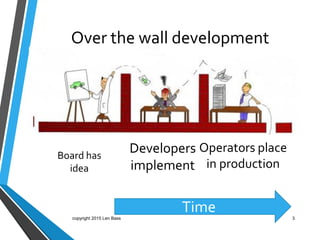
Over the wall development
copyright 2015 Len Bass 3
Board has
idea
Developers
implement
Operators place
in production
Time
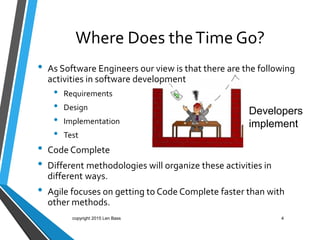
Where Does theTime Go?
• As Software Engineers our view is that there are the following
activities in software development
• Requirements
• Design
• Implementation
• Test
• Code Complete
• Different methodologies will organize these activities in
different ways.
• Agile focuses on getting to Code Complete faster than with
other methods.
4
Developers
implement
copyright 2015 Len Bass
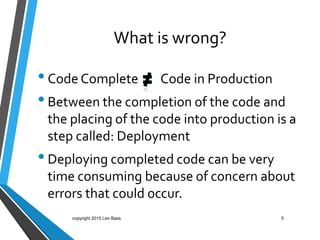
What is wrong?
•Code Complete Code in Production
•Between the completion of the code and
the placing of the code into production is a
step called: Deployment
•Deploying completed code can be very
time consuming because of concern about
errors that could occur.
5copyright 2015 Len Bass
What is the work flow for code from a
multiteam development effort
• You develop and test your code in isolation
• Your code is integrated with code developed by other
teams to see if an executable can be constructed.
• The built system is tested for correctness
• The built system is tested for performance and other
qualities (staging)
• The built system is placed into production
copyright 2015 Len Bass 6
Errors can occur at every stage
• Every error must either be corrected or prevented.
• Preventing errors can be done through some
combination of
• Process
• Architecture
• Tooling
• Coordination among teams.
• Coordination takes time.
• Correcting errors takes time
© Len Bass 2015 7
How much time?
• Historically, releases are scheduled for once a quarter or
once a year to give time to coordinate and adequately
test.
• This means there may be months delay before a new
concept or feature is added to a system.
• This delay has become more and more unacceptable.
• Weekly or daily releases are becoming the norm.
copyright 2015 Len Bass 8
Goal of DevOps
• The goal of DevOps is to reduce the time to market
without compromising quality by
• Reducing errors during deployment
• Speeding up incident handling after deployment
• Speeding up deployment
copyright 2015 Len Bass 9
Example for reducing errors during
deployment
• Use microservice architecture
• Each team makes its own choices of technology for the service it
is developing
• Avoids inconsistencies in versions and technology choices that
are discovered during deployment process
© Len Bass 2015 10
Example for speeding up incident
handling
• Developers carry pagers and are the first respondents to
an incident
• When an incident occurs developers do not need to wait
for the incident to be escalated through a ticketing
system
• Gives developers cradle to grave responsibility for a
service
© Len Bass 2015 11
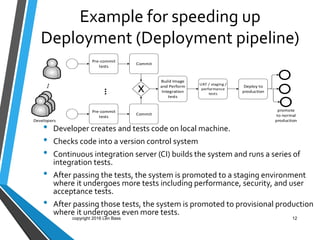
Example for speeding up
Deployment (Deployment pipeline)
• Developer creates and tests code on local machine.
• Checks code into a version control system
• Continuous integration server (CI) builds the system and runs a series of
integration tests.
• After passing the tests, the system is promoted to a staging environment
where it undergoes more tests including performance, security, and user
acceptance tests.
• After passing those tests, the system is promoted to provisional production
where it undergoes even more tests.
copyright 2016 Len Bass 12
Pre-commit
tests
X
Build Image
and Perform
Integration
tests
UAT / staging /
performance
tests
Deploy to
production
Commit
...
Pre-commit
tests
Commit
Developers
promote
to normal
production
Just to summarize
• Placing a system into production can be error prone and
time consuming
• Supporting a system after it gets into production can be
time consuming and error prone
• DevOps is a set of practices intended to speed up placing
a robust system into production
© Len Bass 2015 13
Topics
• What is DevOps
• Class offering
• Student knowledge shortcomings
© Len Bass 2015 14
Context for DevOps course
• I teach a DevOps course as a portion of the CMU MSE
professional master’s program
• Students are graduate students at CMU. Some have
industrial experience, some right out of undergraduate
school
• Currently in the fourth offering of the course
© Len Bass 2015
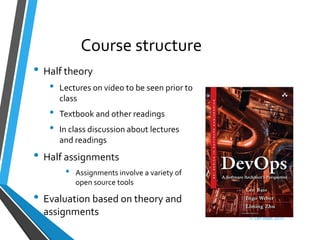
Course structure
• Half theory
• Lectures on video to be seen prior to
class
• Textbook and other readings
• In class discussion about lectures
and readings
• Half assignments
• Assignments involve a variety of
open source tools
• Evaluation based on theory and
assignments © Len Bass 2015
Discussion examples
• What was your takeaway from the videos and readings?
• Each student is called on
• Generate a design of a relevant tool, e.g. Continuous
Integration server
• Done in groups
• Time in discussion matches time in video
• Balances out of class reading/video with inclass time spent
discussing
© Len Bass 2015
Assignment
• Sample assignment:
• Create two virtual machines
• Install SSH so that one machine can securely connect to another
without being prompted for a password
• One page discussion: Discuss the pluses and minuses of having
“known hosts” in SSH
• Each assignment takes roughly half a day
© Len Bass 2015 18
Syllabus
• You can retrieve the syllabus from
https://github.com/devopseducator/2016workshop
© Len Bass 2015
Major topics
• DevOps overview
• Networking
• Cloud
• Deployment pipeline
• Architecture
• Deployment
• Security
• Monitoring
© Len Bass 2015 20
Elaborating on the syllabus - networking
• it is amazing what Masters students in CS at CMU do not
know. A reflection of their undergraduate curriculum.
• Virtualization
• Virtual machines
• Virtual machine images
• Networks
• IP addresses
• DNS servers andTTL (time to live)
• Ports
• Load Balancers
© Len Bass 2015
Elaborating on the syllabus –
cloud
• Failures in the cloud
• Distributed coordination – Zookeeper, Consul
• Scalability
© Len Bass 2015
Deployment pipeline
• Introduction to a deployment pipeline
• What are the roles and responsibilities of various
teams with respect to the pipeline
• Case study in business continuity
• Environments of the pipeline in more detail with types
of tests
• Development
• Build
• Staging
• Production
• Case study of company that sets up continuous
deployment pipelines
© Len Bass 2015
Elaborating on the syllabus –
architecture and advanced
packaging
• Microservice architecture
• Case study in migrating to a microservice architecture
• Containers
© Len Bass 2015
Elaborating on the syllabus –
deployment
• Designing for deployment
• Use of feature toggles
• Backward and forward compatability
• Managing schemas
© Len Bass 2015
Elaborating on the syllabus –
security
• Basic security
• Credential management
• Securing the network
• Securing the pipeline
• Securing an app
© Len Bass 2015
Elaborating on the syllabus –
monitoring
• What to monitor
• How to monitor
• Interpreting monitoring data
© Len Bass 2015
Assignments – all open source
except AWS
• VirtualBox - virtualization
• SSH – secure connection betweenVMs
• Vagrant – tool for creating and provisioning a singleVM
• Jenkins – continuous integration server
• Chef – configuration management
• Docker - containers
• AWS EC2 Container Service
• ChefVault – secure configuration management
• Nagios - monitoring
© Len Bass 2015
Topics
• What is DevOps
• Class offering
• Student knowledge shortcomings
© Len Bass 2015 29
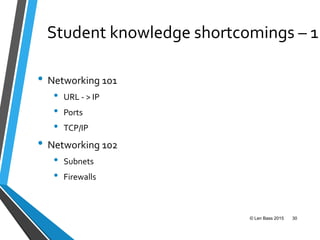
Student knowledge shortcomings – 1
• Networking 101
• URL - > IP
• Ports
• TCP/IP
• Networking 102
• Subnets
• Firewalls
© Len Bass 2015 30
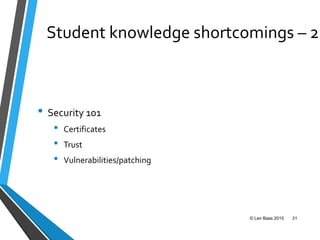
Student knowledge shortcomings – 2
• Security 101
• Certificates
• Trust
• Vulnerabilities/patching
© Len Bass 2015 31
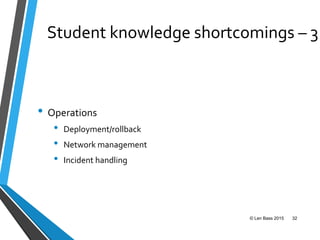
Student knowledge shortcomings – 3
• Operations
• Deployment/rollback
• Network management
• Incident handling
© Len Bass 2015 32
Proposal
• Establish an “infrastructure” minor to the Software
Engineering degree. It could have the following courses:
• Operating systems
• Networking
• Operations/Security
• The cloud
• DevOps
© Len Bass 2015 33
Summary
• DevOps is a set of practices to
• Shorten time to deployment
• Reduce errors during deployment process
• Shorten time to respond to incidents
• A course on DevOps is attractive to students
• There are gaps in knowledge from standard
undergraduate CS or SE curricula
© Len Bass 2015 34
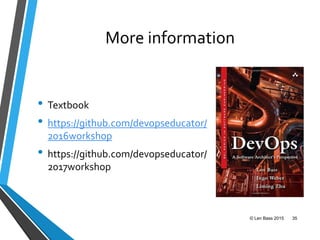
More information
• Textbook
• https://github.com/devopseducator/
2016workshop
• https://github.com/devopseducator/
2017workshop
© Len Bass 2015 35

Experience in teaching devops

  • 1.
  • 2.
    Topics • What isDevOps • Class offering • Student knowledge shortcomings © Len Bass 2015 2
  • 3.
    Over the walldevelopment copyright 2015 Len Bass 3 Board has idea Developers implement Operators place in production Time
  • 4.
    Where Does theTimeGo? • As Software Engineers our view is that there are the following activities in software development • Requirements • Design • Implementation • Test • Code Complete • Different methodologies will organize these activities in different ways. • Agile focuses on getting to Code Complete faster than with other methods. 4 Developers implement copyright 2015 Len Bass
  • 5.
    What is wrong? •CodeComplete Code in Production •Between the completion of the code and the placing of the code into production is a step called: Deployment •Deploying completed code can be very time consuming because of concern about errors that could occur. 5copyright 2015 Len Bass
  • 6.
    What is thework flow for code from a multiteam development effort • You develop and test your code in isolation • Your code is integrated with code developed by other teams to see if an executable can be constructed. • The built system is tested for correctness • The built system is tested for performance and other qualities (staging) • The built system is placed into production copyright 2015 Len Bass 6
  • 7.
    Errors can occurat every stage • Every error must either be corrected or prevented. • Preventing errors can be done through some combination of • Process • Architecture • Tooling • Coordination among teams. • Coordination takes time. • Correcting errors takes time © Len Bass 2015 7
  • 8.
    How much time? •Historically, releases are scheduled for once a quarter or once a year to give time to coordinate and adequately test. • This means there may be months delay before a new concept or feature is added to a system. • This delay has become more and more unacceptable. • Weekly or daily releases are becoming the norm. copyright 2015 Len Bass 8
  • 9.
    Goal of DevOps •The goal of DevOps is to reduce the time to market without compromising quality by • Reducing errors during deployment • Speeding up incident handling after deployment • Speeding up deployment copyright 2015 Len Bass 9
  • 10.
    Example for reducingerrors during deployment • Use microservice architecture • Each team makes its own choices of technology for the service it is developing • Avoids inconsistencies in versions and technology choices that are discovered during deployment process © Len Bass 2015 10
  • 11.
    Example for speedingup incident handling • Developers carry pagers and are the first respondents to an incident • When an incident occurs developers do not need to wait for the incident to be escalated through a ticketing system • Gives developers cradle to grave responsibility for a service © Len Bass 2015 11
  • 12.
    Example for speedingup Deployment (Deployment pipeline) • Developer creates and tests code on local machine. • Checks code into a version control system • Continuous integration server (CI) builds the system and runs a series of integration tests. • After passing the tests, the system is promoted to a staging environment where it undergoes more tests including performance, security, and user acceptance tests. • After passing those tests, the system is promoted to provisional production where it undergoes even more tests. copyright 2016 Len Bass 12 Pre-commit tests X Build Image and Perform Integration tests UAT / staging / performance tests Deploy to production Commit ... Pre-commit tests Commit Developers promote to normal production
  • 13.
    Just to summarize •Placing a system into production can be error prone and time consuming • Supporting a system after it gets into production can be time consuming and error prone • DevOps is a set of practices intended to speed up placing a robust system into production © Len Bass 2015 13
  • 14.
    Topics • What isDevOps • Class offering • Student knowledge shortcomings © Len Bass 2015 14
  • 15.
    Context for DevOpscourse • I teach a DevOps course as a portion of the CMU MSE professional master’s program • Students are graduate students at CMU. Some have industrial experience, some right out of undergraduate school • Currently in the fourth offering of the course © Len Bass 2015
  • 16.
    Course structure • Halftheory • Lectures on video to be seen prior to class • Textbook and other readings • In class discussion about lectures and readings • Half assignments • Assignments involve a variety of open source tools • Evaluation based on theory and assignments © Len Bass 2015
  • 17.
    Discussion examples • Whatwas your takeaway from the videos and readings? • Each student is called on • Generate a design of a relevant tool, e.g. Continuous Integration server • Done in groups • Time in discussion matches time in video • Balances out of class reading/video with inclass time spent discussing © Len Bass 2015
  • 18.
    Assignment • Sample assignment: •Create two virtual machines • Install SSH so that one machine can securely connect to another without being prompted for a password • One page discussion: Discuss the pluses and minuses of having “known hosts” in SSH • Each assignment takes roughly half a day © Len Bass 2015 18
  • 19.
    Syllabus • You canretrieve the syllabus from https://github.com/devopseducator/2016workshop © Len Bass 2015
  • 20.
    Major topics • DevOpsoverview • Networking • Cloud • Deployment pipeline • Architecture • Deployment • Security • Monitoring © Len Bass 2015 20
  • 21.
    Elaborating on thesyllabus - networking • it is amazing what Masters students in CS at CMU do not know. A reflection of their undergraduate curriculum. • Virtualization • Virtual machines • Virtual machine images • Networks • IP addresses • DNS servers andTTL (time to live) • Ports • Load Balancers © Len Bass 2015
  • 22.
    Elaborating on thesyllabus – cloud • Failures in the cloud • Distributed coordination – Zookeeper, Consul • Scalability © Len Bass 2015
  • 23.
    Deployment pipeline • Introductionto a deployment pipeline • What are the roles and responsibilities of various teams with respect to the pipeline • Case study in business continuity • Environments of the pipeline in more detail with types of tests • Development • Build • Staging • Production • Case study of company that sets up continuous deployment pipelines © Len Bass 2015
  • 24.
    Elaborating on thesyllabus – architecture and advanced packaging • Microservice architecture • Case study in migrating to a microservice architecture • Containers © Len Bass 2015
  • 25.
    Elaborating on thesyllabus – deployment • Designing for deployment • Use of feature toggles • Backward and forward compatability • Managing schemas © Len Bass 2015
  • 26.
    Elaborating on thesyllabus – security • Basic security • Credential management • Securing the network • Securing the pipeline • Securing an app © Len Bass 2015
  • 27.
    Elaborating on thesyllabus – monitoring • What to monitor • How to monitor • Interpreting monitoring data © Len Bass 2015
  • 28.
    Assignments – allopen source except AWS • VirtualBox - virtualization • SSH – secure connection betweenVMs • Vagrant – tool for creating and provisioning a singleVM • Jenkins – continuous integration server • Chef – configuration management • Docker - containers • AWS EC2 Container Service • ChefVault – secure configuration management • Nagios - monitoring © Len Bass 2015
  • 29.
    Topics • What isDevOps • Class offering • Student knowledge shortcomings © Len Bass 2015 29
  • 30.
    Student knowledge shortcomings– 1 • Networking 101 • URL - > IP • Ports • TCP/IP • Networking 102 • Subnets • Firewalls © Len Bass 2015 30
  • 31.
    Student knowledge shortcomings– 2 • Security 101 • Certificates • Trust • Vulnerabilities/patching © Len Bass 2015 31
  • 32.
    Student knowledge shortcomings– 3 • Operations • Deployment/rollback • Network management • Incident handling © Len Bass 2015 32
  • 33.
    Proposal • Establish an“infrastructure” minor to the Software Engineering degree. It could have the following courses: • Operating systems • Networking • Operations/Security • The cloud • DevOps © Len Bass 2015 33
  • 34.
    Summary • DevOps isa set of practices to • Shorten time to deployment • Reduce errors during deployment process • Shorten time to respond to incidents • A course on DevOps is attractive to students • There are gaps in knowledge from standard undergraduate CS or SE curricula © Len Bass 2015 34
  • 35.
    More information • Textbook •https://github.com/devopseducator/ 2016workshop • https://github.com/devopseducator/ 2017workshop © Len Bass 2015 35