“Why aren’t you rich?
You're in the resources industry
after all…
7 reasons..
Grant Musgrove
ACOR CEO
E-mail: grantm@acor.org.au
Reason 1: We are creating positive
“Externalities” and NOT being paid for it!
• E.g. Carbon abatement, finite resouce
recycling
• The ERF may bring hope following ACOR
representations, (but unless you’re
organisation is an ACOR member I’m not
going to tell you how :)
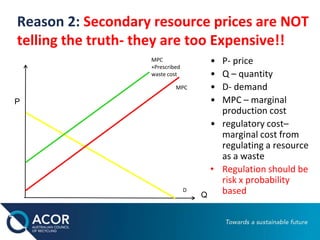
Reason 2: Secondary resource prices are NOT
telling the truth- they are too Expensive!!
• P- price
• Q – quantity
• D- demand
• MPC – marginal
production cost
• regulatory cost–
marginal cost from
regulating a resource
as a waste
• Regulation should be
risk x probability
basedD
MPC
MPC
+Prescribed
waste cost
P
Q
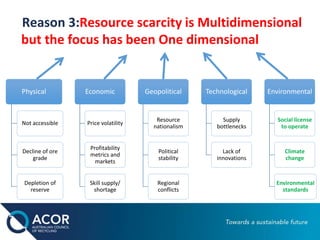
Reason 3:Resource scarcity is Multidimensional
but the focus has been One dimensional
Physical
Not accessible
Decline of ore
grade
Depletion of
reserve
Economic
Price volatility
Profitability
metrics and
markets
Skill supply/
shortage
Geopolitical
Resource
nationalism
Political
stability
Regional
conflicts
Technological
Supply
bottlenecks
Lack of
innovations
Environmental
Social license
to operate
Climate
change
Environmental
standards
Reason 4: “Imperfect information” is
pervasive
• Focus of government strategies has been on
increasing the quantity of Recyclate VS Landfill
• Need to refocus on profitability through quality
recyclate (e.g. ACOR’s material specifications in
packaging across other streams)
• Markets “fail” through lower prices/profitability
for fear/risk of receiving contaminated/ variable
feedstock
• Two thirds of manufacturing costs are
materials.
• The productivity debate has been
dominated by labour productivity
• Lets take the agenda back to
business, not ideology
Reason 5: Need to focus on “total factor
productivity”
Reason 6: Governments are not
focussing on sector profitability and
industry development
• Levy revenue that does not go back to industry
development is a tax on the resource recovery
industry via residuals to landfill
• Commonwealth Product Stewardship schemes
have been policy and commercial failures
because they are not focused on industry
sustainability (eg TVs and Computers)
Reason 7: Waste Crime is costing governments
and the community up to $1 billion per year
through:
• Levy avoidance
– waste “disappears”
– high value recyclables waste re- classified as low value waste  exported or gets
dumped
– waste sent out of jurisdiction
– illegal dumping & stockpiling
• Tax avoidance
– Cash transactions, GST avoidance
• Market distortion
– E.g. lower prices, jobs lost
• Money laundering
– Metal theft and metal being traded in cash in black market
• Illegal exports
– Breach Basel Convention, e.g. e- waste, used oil, used batteries
• Environmental degradation
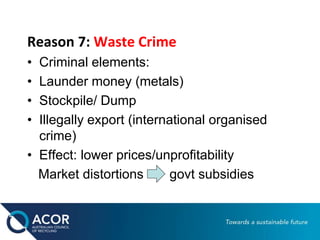
Reason 7: Waste Crime
• Criminal elements:
• Launder money (metals)
• Stockpile/ Dump
• Illegally export (international organised
crime)
• Effect: lower prices/unprofitability
Market distortions govt subsidies

Why are't you rich? You are in the resources industry after all...

  • 1.
    “Why aren’t yourich? You're in the resources industry after all… 7 reasons.. Grant Musgrove ACOR CEO E-mail: grantm@acor.org.au
  • 2.
    Reason 1: Weare creating positive “Externalities” and NOT being paid for it! • E.g. Carbon abatement, finite resouce recycling • The ERF may bring hope following ACOR representations, (but unless you’re organisation is an ACOR member I’m not going to tell you how :)
  • 3.
    Reason 2: Secondaryresource prices are NOT telling the truth- they are too Expensive!! • P- price • Q – quantity • D- demand • MPC – marginal production cost • regulatory cost– marginal cost from regulating a resource as a waste • Regulation should be risk x probability basedD MPC MPC +Prescribed waste cost P Q
  • 4.
    Reason 3:Resource scarcityis Multidimensional but the focus has been One dimensional Physical Not accessible Decline of ore grade Depletion of reserve Economic Price volatility Profitability metrics and markets Skill supply/ shortage Geopolitical Resource nationalism Political stability Regional conflicts Technological Supply bottlenecks Lack of innovations Environmental Social license to operate Climate change Environmental standards
  • 5.
    Reason 4: “Imperfectinformation” is pervasive • Focus of government strategies has been on increasing the quantity of Recyclate VS Landfill • Need to refocus on profitability through quality recyclate (e.g. ACOR’s material specifications in packaging across other streams) • Markets “fail” through lower prices/profitability for fear/risk of receiving contaminated/ variable feedstock
  • 6.
    • Two thirdsof manufacturing costs are materials. • The productivity debate has been dominated by labour productivity • Lets take the agenda back to business, not ideology Reason 5: Need to focus on “total factor productivity”
  • 7.
    Reason 6: Governmentsare not focussing on sector profitability and industry development • Levy revenue that does not go back to industry development is a tax on the resource recovery industry via residuals to landfill • Commonwealth Product Stewardship schemes have been policy and commercial failures because they are not focused on industry sustainability (eg TVs and Computers)
  • 8.
    Reason 7: WasteCrime is costing governments and the community up to $1 billion per year through: • Levy avoidance – waste “disappears” – high value recyclables waste re- classified as low value waste  exported or gets dumped – waste sent out of jurisdiction – illegal dumping & stockpiling • Tax avoidance – Cash transactions, GST avoidance • Market distortion – E.g. lower prices, jobs lost • Money laundering – Metal theft and metal being traded in cash in black market • Illegal exports – Breach Basel Convention, e.g. e- waste, used oil, used batteries • Environmental degradation
  • 9.
    Reason 7: WasteCrime • Criminal elements: • Launder money (metals) • Stockpile/ Dump • Illegally export (international organised crime) • Effect: lower prices/unprofitability Market distortions govt subsidies

Editor's Notes

  • #4 Market failure which does not take into consideration marginal social costs of packaging in order to internalise this market failure price needs to contain marginal social , economic and environmental cost including the cost of recovery and recycling
  • #5 Declining ore grades– zinc, lead and particularly copper and nickel will be affected, as will precious metals such as gold and platinum, rare metals already running out Low hanging fruit — the high quality large deposits have already been found, lower economic attractiveness of new projects, cost inflation Price and currency volatility Market restrictions - a number of emerging economies such as Indonesia have either imposed or are considering new export restrictions on a variety of metals High risk – greenfield projects located outside traditional mining countries face multiple challenges. Citigroup suggests that a quarter of these may not be developed before 2020, with a further 40% at risk. Increasing interdependence of resource systems - closely interlinked on the local level and increasingly on the global level Access -Supply bottlenecks for much needed and scarce equipment Lack of innovation and technological advancements Environmental group and labor risks, mining unrest — lack of a social license to operate, incredibly difficult and lengthy permitting processes Climate change, accidents and natural disasters