A call for an International definition of
‘Environmentally Sustainable Industrial
Packaging’
A proposal to the 15th International
Conference on Industrial Packaging in
Vancouver, Canada on 4th June 2015
Phil Pease C.Env
A call for an International definition of
‘Environmentally Sustainable Industrial Packaging’
• What is “sustainable”?
• Why do we need this?
• What have we got already?
• The Future…
What is ‘sustainable’ ?...
The term, “sustainable development”, was popularised in
‘Our Common Future’, a report published by the World
Commission on Environment and Development in 1987. Also
known as ‘The Brundtland Report’, it included the “classic”
definition of sustainable development:
“development which meets the needs of the present without
compromising the ability of future generations to meet their
own needs.”
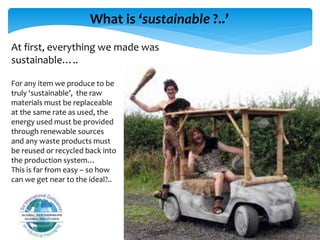
At first, everything we made was
sustainable…..
What is ‘sustainable ?..’
For any item we produce to be
truly ‘sustainable’, the raw
materials must be replaceable
at the same rate as used, the
energy used must be provided
through renewable sources
and any waste products must
be reused or recycled back into
the production system…
This is far from easy – so how
can we get near to the ideal?..
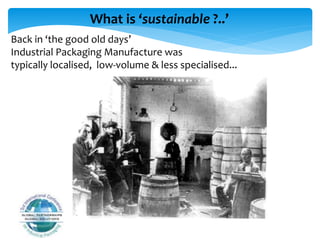
Back in ‘the good old days’
Industrial Packaging Manufacture was
typically localised, low-volume & less specialised...
What is ‘sustainable ?..’
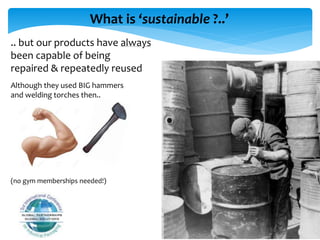
.. but our products have always
been capable of being
repaired & repeatedly reused
What is ‘sustainable ?..’
Although they used BIG hammers
and welding torches then..
(no gym memberships needed!)
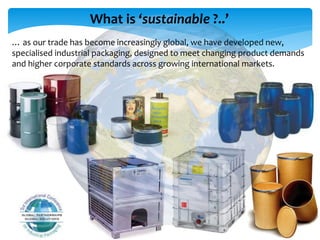
… as our trade has become increasingly global, we have developed new,
specialised industrial packaging, designed to meet changing product demands
and higher corporate standards across growing international markets.
What is ‘sustainable ?..’
Naturally..
as a global population, have recognised that we must take
care of how we use energy & natural resources
simply to ensure we do not deplete or pollute our planet
and leave a legacy of problems for our own future
generations.
Why do we need this?
“Yada
Yada…Protect
the Planet…
We’ve heard this all
before….”
Why do we need this?
Obviously we all acknowledge our ethical & moral duty to our planet and future generations,
but let’s take a hard-edged, commercial look at it…
Our customers:
Want to be seen as responsible - sourcing safe, responsible raw materials,
with global coverage, maximum safety, zero wastage and minimal costs !
Our regulators:
Want to apply more stringent rules - to minimise energy use, reduce pollution, cut wastage
(and increase government revenues !)… making life more difficult for the manufacturing
industry… who are tasked to comply with it all, whilst still trying to make some profit of
course.
Why do we need this?
Understood - but we CAN turn this to our advantage...
Industrial Packaging has maintained its proven environmental
benefits, compared to retail packaging, for many years:
 Internationally standardised design-types & materials
 Established global / UN model rules covering manufacture, test & reuse
 Multi-Modal frameworks for all transport systems & product types
 Ability to repeatedly recover, reuse, remanufacture, recondition, recycle
 Widest range of use: Food to Pharmaceutical, Chemicals to Cosmetics
 Worldwide infrastructure for collection, reconditioning, remanufacture & reuse
BUT!..... We need to shout about these real-world
benefits to both Customers & Regulators
Industrial
Packaging
is GREAT !!!
Why do we need this?
Establishing clearly defined ISO standards, to demonstrate that Industrial
Packaging IS Sustainable, will provide powerful assistance when lobbying to
prove how our packaging is different to retail - with benefits for transport safety
AND protection of our environment & resources.
Our packaging should be given every opportunity to be understood as having very
different dynamics to other packaging types, presenting real environmentally
benefits. We need to argue that industrial packaging should remain, wherever
possible, outside any retail & waste stream definitions – and associated costs.
Our work on ISO Packaging & Environment is already proving to have real benefit –
we should strive to add to this with clear definitions of sustainability.
✓
What have we got already?
The EU Packaging & Packaging Waste Regulations establish legally binding
targets on amount of packaging to be recycled / scrapped.
These rules are widely accepted as critically flawed in that their definitions are all
based on WASTE, RECYCLING and RETAIL Packaging
(despite the best efforts of our industry).
‘Reuse’ is only now just starting to be
properly considered as outside the boundary
of ‘waste’ and typically only if ‘designed for reuse’….
This is a case that needs to be argued, as our packaging
Dynamics are very different from retail packaging.
NOT THE SAME !
What have we got already?
NOT THE SAME !
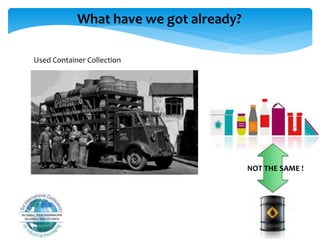
Used Container Collection
What have we got already?
NOT THE SAME !
Used Container Collection
What have we got already?
NOT THE SAME !
Container Cleaning
What have we got already?
NOT THE SAME !
Container Cleaning
What have we got already?
NOT THE SAME !
Materials Recycling
What have we got already?
NOT THE SAME !
Materials Recycling
What have we got already?
NOT THE SAME !
Materials separation
What have we got already?
Our work on the ISO Packaging & Environment Standards included amending the
definition of ‘reuse’ to read:
“packaging or packaging component which has been designed to accomplish or
prove its ability to accomplish a minimum number of trips or rotations in a system
for reuse.”
This change immediately enables our industry to argue that used industrial
packaging is reusable and has an established reuse infrastructure. Therefore it
should not be classed as waste until it becomes no longer fit for purpose.
- This argument has already helped to achieve huge cost savings in the UK for
transporting empty, uncleaned drums & IBCs within the hazardous waste rules.
What have we got already?
ISO 14040 ‘Life Cycle Assessment’
“consecutive and interlinked stages of a product system, from raw material
acquisition or generation from natural resources to final disposal.”
Our products can achieve incredible efficiencies throughout their life cycle, from
first use of the raw material during manufacture, through reuse, reconditioning,
remanufacture, and final disposal / recycling– which is most likely simply the start
of another new cycle for the raw materials.
Adding clear definitions of Industrial Packaging Sustainability can enhance our
products’ standing, especially when considered alongside existing international
standards such as this.
What have we got already?
In a publication entitled
“The Global Protocol on Packaging and Sustainability”.
The Consumer Goods Forum reviewed the retail supply
chain and, although not specific to industrial packaging,
it did reference the CEN and ISO Packaging & Environment
suite of standards – which are intended for all packaging
types.
This can be downloaded from:
http://www.theconsumergoodsforum.com/
download-global-protocol-on-packaging-sustainability-gpps
What have we got already?
A British Standards publication BS8905: 2011 entitled
“Framework for the assessment of the sustainable use of materials. Guidance”
contains useful information on what the standard
terms a “sustainability assessment”.
Whilst not written with Packaging specifically in-mind,
it does contain some useful, up-to-date information
on what is considered “sustainable”.
There is also a published report by
PEC Partnership Ltd:
“Assessing how BS 8905 can be applied in the packaging sector”
What have we got already?
There are a great deal more articles & publications relating to sustainability:
Such as EUROPEN’s (European Packaging Organization) - metrics for
measuring the sustainability of packaging.
Despite the generations of work across our industry - all the focus on the
environmental impact of packaging, has been carried out for retail packaging,
there is still no definition of ‘sustainable’
in relation to Industrial Packaging.
The future…
Ideally, we should make a proposal to ISO for a new set of standards, to establish
definitions for “Sustainable Industrial Packaging”.
Even if we decide to not try for an ISO Standard – we should try to establish,
within our own industry, a set of definitions that we can reference when
discussing how our industrial packaging is beneficial to international trade and
environmental care.
With so many considerations, such a definition may never be perfect…but then,
for any manufactured product to be truly sustainable, it would require renewable
energy sources, replenishable process machinery, and natural, continually
replenishable raw materials -ie; back to wooden barrels made with stone
mallets!...
The future…
A couple of ideas to start:
RIPA definition of sustainable steel drum and plastic drum
A sustainable steel or plastic 220 L drum has the following physical attributes:
(a) Constructed in accordance with a recognized international standard
(e.g. ANSI – MH 2; JIS Z-1601; ISO 20848 – 2, etc.)
(b) Capable of withstanding the reconditioning process and accomplishing more than one
use-rotation after the initial rotation (i.e. filled and refilled) for the same purpose for which
it was produced.
(c) Designed to be capable of transporting both hazardous and non-hazardous materials
initially and in each reuse rotation.
(d) Capable of withstanding anticipated global storage and handling processes.
(e) Capable of being cleaned and safely recycled after its useful life.
The future…
Proposed draft to define a sustainable fibre drum
A sustainable fibreboard drum has the following physical attributes:
(a) Constructed in accordance with a recognised international standard
(e.g. BS EN 12710: 2006 / BS EN 14768: 2005 / EN 14053: 2003)
(b) Manufactured from natural or recycled raw materials, such as Kraft Fibre, obtained
from either managed forests, capable of being replenished without displacement of
naturally occurring hardwoods, or as recycled material from approved reprocessors.
(c) Designed to ensure optimal environmental performance as defined by ISO 18602: 2013
(d) Capable of withstanding anticipated global storage and handling processes.
(e) Capable of being cleaned and safely reused or recycled after its useful life.
and finally…
For those of you that may still be under the illusion that our political leaders and
regulators, holding positions of ‘expertise’ for environmental care, actually know their
craft… and think they can be trusted to ensure the correct regulations are in place for us..
During the recent UK General Elections for our new Government, a leading head of a key
Environmental Department was heard to ask:
“So – what happens
when the renewable
energy runs out?......”
Proposals to ISO ? - I’ll look into it!
Phil Pease
Boval Consulting Ltd. UK
Tel: +44 (0) 7770 633320
philpease@bovalgroup.co.uk

Presentation Mr. Pease

  • 1.
    A call foran International definition of ‘Environmentally Sustainable Industrial Packaging’ A proposal to the 15th International Conference on Industrial Packaging in Vancouver, Canada on 4th June 2015 Phil Pease C.Env
  • 2.
    A call foran International definition of ‘Environmentally Sustainable Industrial Packaging’ • What is “sustainable”? • Why do we need this? • What have we got already? • The Future…
  • 3.
    What is ‘sustainable’?... The term, “sustainable development”, was popularised in ‘Our Common Future’, a report published by the World Commission on Environment and Development in 1987. Also known as ‘The Brundtland Report’, it included the “classic” definition of sustainable development: “development which meets the needs of the present without compromising the ability of future generations to meet their own needs.”
  • 4.
    At first, everythingwe made was sustainable….. What is ‘sustainable ?..’ For any item we produce to be truly ‘sustainable’, the raw materials must be replaceable at the same rate as used, the energy used must be provided through renewable sources and any waste products must be reused or recycled back into the production system… This is far from easy – so how can we get near to the ideal?..
  • 5.
    Back in ‘thegood old days’ Industrial Packaging Manufacture was typically localised, low-volume & less specialised... What is ‘sustainable ?..’
  • 6.
    .. but ourproducts have always been capable of being repaired & repeatedly reused What is ‘sustainable ?..’ Although they used BIG hammers and welding torches then.. (no gym memberships needed!)
  • 7.
    … as ourtrade has become increasingly global, we have developed new, specialised industrial packaging, designed to meet changing product demands and higher corporate standards across growing international markets. What is ‘sustainable ?..’
  • 8.
    Naturally.. as a globalpopulation, have recognised that we must take care of how we use energy & natural resources simply to ensure we do not deplete or pollute our planet and leave a legacy of problems for our own future generations. Why do we need this?
  • 9.
    “Yada Yada…Protect the Planet… We’ve heardthis all before….” Why do we need this?
  • 10.
    Why do weneed this? Obviously we all acknowledge our ethical & moral duty to our planet and future generations, but let’s take a hard-edged, commercial look at it… Our customers: Want to be seen as responsible - sourcing safe, responsible raw materials, with global coverage, maximum safety, zero wastage and minimal costs ! Our regulators: Want to apply more stringent rules - to minimise energy use, reduce pollution, cut wastage (and increase government revenues !)… making life more difficult for the manufacturing industry… who are tasked to comply with it all, whilst still trying to make some profit of course.
  • 11.
    Why do weneed this? Understood - but we CAN turn this to our advantage... Industrial Packaging has maintained its proven environmental benefits, compared to retail packaging, for many years:  Internationally standardised design-types & materials  Established global / UN model rules covering manufacture, test & reuse  Multi-Modal frameworks for all transport systems & product types  Ability to repeatedly recover, reuse, remanufacture, recondition, recycle  Widest range of use: Food to Pharmaceutical, Chemicals to Cosmetics  Worldwide infrastructure for collection, reconditioning, remanufacture & reuse BUT!..... We need to shout about these real-world benefits to both Customers & Regulators Industrial Packaging is GREAT !!!
  • 12.
    Why do weneed this? Establishing clearly defined ISO standards, to demonstrate that Industrial Packaging IS Sustainable, will provide powerful assistance when lobbying to prove how our packaging is different to retail - with benefits for transport safety AND protection of our environment & resources. Our packaging should be given every opportunity to be understood as having very different dynamics to other packaging types, presenting real environmentally benefits. We need to argue that industrial packaging should remain, wherever possible, outside any retail & waste stream definitions – and associated costs. Our work on ISO Packaging & Environment is already proving to have real benefit – we should strive to add to this with clear definitions of sustainability. ✓
  • 13.
    What have wegot already? The EU Packaging & Packaging Waste Regulations establish legally binding targets on amount of packaging to be recycled / scrapped. These rules are widely accepted as critically flawed in that their definitions are all based on WASTE, RECYCLING and RETAIL Packaging (despite the best efforts of our industry). ‘Reuse’ is only now just starting to be properly considered as outside the boundary of ‘waste’ and typically only if ‘designed for reuse’…. This is a case that needs to be argued, as our packaging Dynamics are very different from retail packaging. NOT THE SAME !
  • 14.
    What have wegot already? NOT THE SAME ! Used Container Collection
  • 15.
    What have wegot already? NOT THE SAME ! Used Container Collection
  • 16.
    What have wegot already? NOT THE SAME ! Container Cleaning
  • 17.
    What have wegot already? NOT THE SAME ! Container Cleaning
  • 18.
    What have wegot already? NOT THE SAME ! Materials Recycling
  • 19.
    What have wegot already? NOT THE SAME ! Materials Recycling
  • 20.
    What have wegot already? NOT THE SAME ! Materials separation
  • 21.
    What have wegot already? Our work on the ISO Packaging & Environment Standards included amending the definition of ‘reuse’ to read: “packaging or packaging component which has been designed to accomplish or prove its ability to accomplish a minimum number of trips or rotations in a system for reuse.” This change immediately enables our industry to argue that used industrial packaging is reusable and has an established reuse infrastructure. Therefore it should not be classed as waste until it becomes no longer fit for purpose. - This argument has already helped to achieve huge cost savings in the UK for transporting empty, uncleaned drums & IBCs within the hazardous waste rules.
  • 22.
    What have wegot already? ISO 14040 ‘Life Cycle Assessment’ “consecutive and interlinked stages of a product system, from raw material acquisition or generation from natural resources to final disposal.” Our products can achieve incredible efficiencies throughout their life cycle, from first use of the raw material during manufacture, through reuse, reconditioning, remanufacture, and final disposal / recycling– which is most likely simply the start of another new cycle for the raw materials. Adding clear definitions of Industrial Packaging Sustainability can enhance our products’ standing, especially when considered alongside existing international standards such as this.
  • 23.
    What have wegot already? In a publication entitled “The Global Protocol on Packaging and Sustainability”. The Consumer Goods Forum reviewed the retail supply chain and, although not specific to industrial packaging, it did reference the CEN and ISO Packaging & Environment suite of standards – which are intended for all packaging types. This can be downloaded from: http://www.theconsumergoodsforum.com/ download-global-protocol-on-packaging-sustainability-gpps
  • 24.
    What have wegot already? A British Standards publication BS8905: 2011 entitled “Framework for the assessment of the sustainable use of materials. Guidance” contains useful information on what the standard terms a “sustainability assessment”. Whilst not written with Packaging specifically in-mind, it does contain some useful, up-to-date information on what is considered “sustainable”. There is also a published report by PEC Partnership Ltd: “Assessing how BS 8905 can be applied in the packaging sector”
  • 25.
    What have wegot already? There are a great deal more articles & publications relating to sustainability: Such as EUROPEN’s (European Packaging Organization) - metrics for measuring the sustainability of packaging. Despite the generations of work across our industry - all the focus on the environmental impact of packaging, has been carried out for retail packaging, there is still no definition of ‘sustainable’ in relation to Industrial Packaging.
  • 26.
    The future… Ideally, weshould make a proposal to ISO for a new set of standards, to establish definitions for “Sustainable Industrial Packaging”. Even if we decide to not try for an ISO Standard – we should try to establish, within our own industry, a set of definitions that we can reference when discussing how our industrial packaging is beneficial to international trade and environmental care. With so many considerations, such a definition may never be perfect…but then, for any manufactured product to be truly sustainable, it would require renewable energy sources, replenishable process machinery, and natural, continually replenishable raw materials -ie; back to wooden barrels made with stone mallets!...
  • 27.
    The future… A coupleof ideas to start: RIPA definition of sustainable steel drum and plastic drum A sustainable steel or plastic 220 L drum has the following physical attributes: (a) Constructed in accordance with a recognized international standard (e.g. ANSI – MH 2; JIS Z-1601; ISO 20848 – 2, etc.) (b) Capable of withstanding the reconditioning process and accomplishing more than one use-rotation after the initial rotation (i.e. filled and refilled) for the same purpose for which it was produced. (c) Designed to be capable of transporting both hazardous and non-hazardous materials initially and in each reuse rotation. (d) Capable of withstanding anticipated global storage and handling processes. (e) Capable of being cleaned and safely recycled after its useful life.
  • 28.
    The future… Proposed draftto define a sustainable fibre drum A sustainable fibreboard drum has the following physical attributes: (a) Constructed in accordance with a recognised international standard (e.g. BS EN 12710: 2006 / BS EN 14768: 2005 / EN 14053: 2003) (b) Manufactured from natural or recycled raw materials, such as Kraft Fibre, obtained from either managed forests, capable of being replenished without displacement of naturally occurring hardwoods, or as recycled material from approved reprocessors. (c) Designed to ensure optimal environmental performance as defined by ISO 18602: 2013 (d) Capable of withstanding anticipated global storage and handling processes. (e) Capable of being cleaned and safely reused or recycled after its useful life.
  • 29.
    and finally… For thoseof you that may still be under the illusion that our political leaders and regulators, holding positions of ‘expertise’ for environmental care, actually know their craft… and think they can be trusted to ensure the correct regulations are in place for us.. During the recent UK General Elections for our new Government, a leading head of a key Environmental Department was heard to ask: “So – what happens when the renewable energy runs out?......”
  • 30.
    Proposals to ISO? - I’ll look into it! Phil Pease Boval Consulting Ltd. UK Tel: +44 (0) 7770 633320 philpease@bovalgroup.co.uk