Evan G. Buchanan and David F. Plusquellic
Professional Research Experience Program
Chirped Pulse THz Spectroscopy: Instrument and Source
Development
Motivation
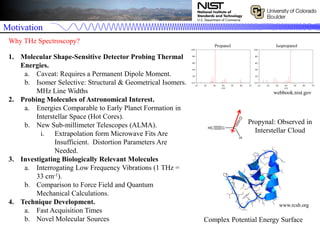
1. Molecular Shape-Sensitive Detector Probing Thermal
Energies.
a. Caveat: Requires a Permanent Dipole Moment.
b. Isomer Selective: Structural & Geometrical Isomers.
MHz Line Widths
2. Probing Molecules of Astronomical Interest.
a. Energies Comparable to Early Planet Formation in
Interstellar Space (Hot Cores).
b. New Sub-millimeter Telescopes (ALMA).
i. Extrapolation form Microwave Fits Are
Insufficient. Distortion Parameters Are
Needed.
3. Investigating Biologically Relevant Molecules
a. Interrogating Low Frequency Vibrations (1 THz =
33 cm-1).
b. Comparison to Force Field and Quantum
Mechanical Calculations.
4. Technique Development.
a. Fast Acquisition Times
b. Novel Molecular Sources
Why THz Spectroscopy?
+
Propanol
webbook.nist.gov
Isopropanol
Complex Potential Energy Surface
Propynal: Observed in
Interstellar Cloud
www.rcsb.org
Motivation
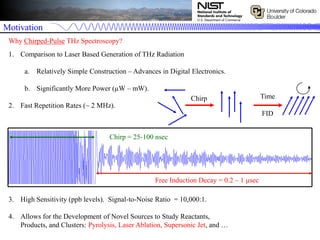
Why Chirped-Pulse THz Spectroscopy?
1. Comparison to Laser Based Generation of THz Radiation
a. Relatively Simple Construction – Advances in Digital Electronics.
b. Significantly More Power (µW – mW).
2. Fast Repetition Rates (~ 2 MHz).
3. High Sensitivity (ppb levels). Signal-to-Noise Ratio = 10,000:1.
4. Allows for the Development of Novel Sources to Study Reactants,
Products, and Clusters: Pyrolysis, Laser Ablation, Supersonic Jet, and …
Chirp = 25-100 nsec
Free Induction Decay = 0.2 – 1 µsec
Chirp Time
FID
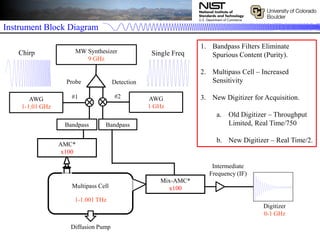
Instrument Block Diagram
Multipass Cell
Intermediate
Frequency (IF)
Digitizer
0-1 GHz
AMC*
x100
MW Synthesizer
9 GHz
AWG
1-1.01 GHz
Bandpass
Mix-AMC*
x100
Bandpass
Detection
#1 #2
Probe
1-1.001 THz
Diffusion Pump
Single FreqChirp
AWG
1 GHz
1. Bandpass Filters Eliminate
Spurious Content (Purity).
2. Multipass Cell – Increased
Sensitivity
3. New Digitizer for Acquisition.
a. Old Digitizer – Throughput
Limited, Real Time/750
b. New Digitizer – Real Time/2.
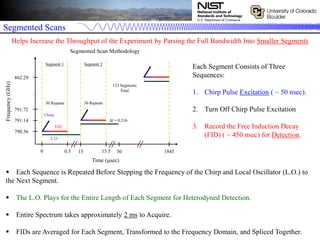
Segmented Scans
Chirp
FID
L.O.
0 15 1845
790.56
791.14
791.72
862.29
Segmented Scan Methodology
Time (μsec)
Frequency(GHz)
123 Segments
Total
Δf = 0.216
30 Repeats 30 Repeats
15.50.5
Segment 1 Segment 2
30
Helps Increase the Throughput of the Experiment by Parsing the Full Bandwidth Into Smaller Segments
Each Segment Consists of Three
Sequences:
1. Chirp Pulse Excitation ( ~ 50 nsec).
2. Turn Off Chirp Pulse Excitation
3. Record the Free Induction Decay
(FID) ( ~ 450 nsec) for Detection.
 Each Sequence is Repeated Before Stepping the Frequency of the Chirp and Local Oscillator (L.O.) to
the Next Segment.
 The L.O. Plays for the Entire Length of Each Segment for Heterodyned Detection.
 Entire Spectrum takes approximately 2 ms to Acquire.
 FIDs are Averaged for Each Segment, Transformed to the Frequency Domain, and Spliced Together.
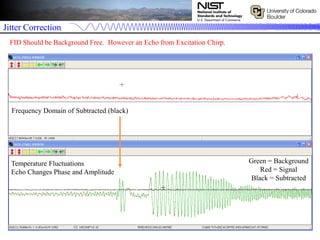
Jitter Correction
FID Should be Background Free. However an Echo from Excitation Chirp.
Temperature Fluctuations
Echo Changes Phase and Amplitude
Frequency Domain of Subtracted (black)
Green = Background
Red = Signal
Black = Subtracted
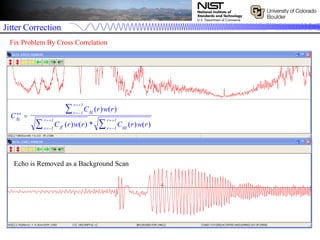
Jitter Correction
Fix Problem By Cross Correlation
Echo is Removed as a Background Scan
C
C r w r
C r w r C r w r
fg
ws fgr l
r l
ffr l
r l
ggr l
r l
 






 
( ) ( )
( ) ( ) * ( ) ( )
Pyrolysis
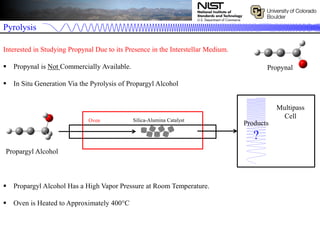
Interested in Studying Propynal Due to its Presence in the Interstellar Medium.
 Propynal is Not Commercially Available.
 In Situ Generation Via the Pyrolysis of Propargyl Alcohol
 Propargyl Alcohol Has a High Vapor Pressure at Room Temperature.
 Oven is Heated to Approximately 400°C
Propynal
Silica-Alumina CatalystOven
Products
?
Propargyl Alcohol
Multipass
Cell
Pyrolysis of Propargyl Alcohol
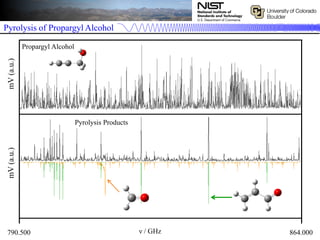
ν / GHz790.500 864.000
Propargyl Alcohol
Pyrolysis Products
Pyrolysis of Propargyl Alcohol
+
Propargyl Ether Methylacetylene
Propargyl Alcohol
+
Propynal
Propenal
Hydrogen
Acetylene Formaldehyde
+
No RXN
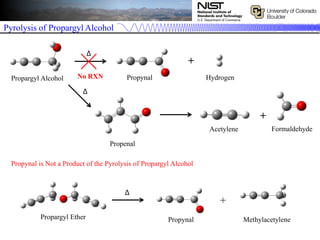
Propynal is Not a Product of the Pyrolysis of Propargyl Alcohol
Propynal
Δ
Δ
Δ
Pyrolysis Overview
ν / GHz
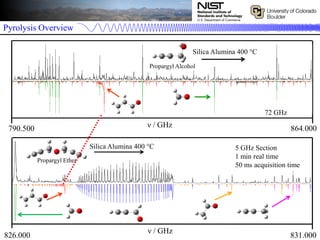
Silica Alumina 400 °C 5 GHz Section
1 min real time
50 ms acquisition time
Silica Alumina 400 °C
790.500 864.000ν / GHz
72 GHz
Propargyl Ether
Propargyl Alcohol
826.000 831.000
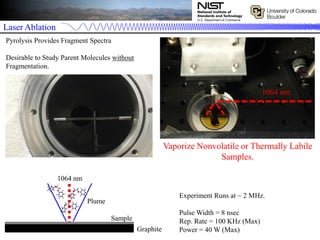
Laser Ablation
Graphite
Sample
1064 nm
Plume
Vaporize Nonvolatile or Thermally Labile
Samples.
1064 nm
Pyrolysis Provides Fragment Spectra
Desirable to Study Parent Molecules without
Fragmentation.
Experiment Runs at ~ 2 MHz.
Pulse Width = 8 nsec
Rep. Rate = 100 KHz (Max)
Power = 40 W (Max)
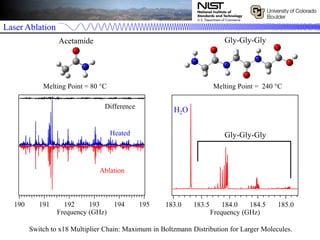
Laser Ablation
Acetamide
Melting Point = 80 °C
Gly-Gly-Gly
Melting Point = 240 °C
H2O
Gly-Gly-GlyHeated
Ablation
Difference
Switch to x18 Multiplier Chain: Maximum in Boltzmann Distribution for Larger Molecules.
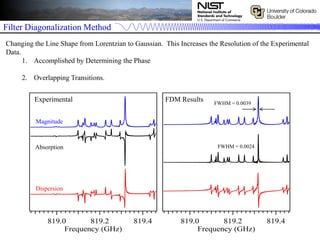
Filter Diagonalization Method
FDM ResultsExperimental
Magnitude
Absorption
Dispersion
FWHM = 0.0039
FWHM = 0.0024
Changing the Line Shape from Lorentzian to Gaussian. This Increases the Resolution of the Experimental
Data.
1. Accomplished by Determining the Phase
2. Overlapping Transitions.
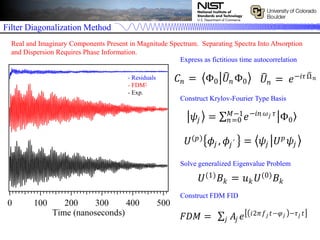
Filter Diagonalization Method
Real and Imaginary Components Present in Magnitude Spectrum. Separating Spectra Into Absorption
and Dispersion Requires Phase Information.
𝐶𝑛 = Φ0 𝑈𝑛 Φ0 𝑈𝑛 = 𝑒−𝑖𝜏Ω 𝑛
𝜓𝑗 = 𝑒−𝑖𝑛 𝜔 𝑗 𝜏
Φ0
𝑀−1
𝑛=0
𝑈(𝑝)
𝜙𝑗 , 𝜙𝑗 ′ = 𝜓𝑗 𝑈 𝑝
𝜓𝑗
𝑈(1)
𝐵 𝑘 = 𝑢 𝑘 𝑈(0)
𝐵 𝑘
Express as fictitious time autocorrelation
Construct Krylov-Fourier Type Basis
Solve generalized Eigenvalue Problem
𝐹𝐷𝑀 = 𝐴𝑗 𝑒 𝑖2𝜋𝑓 𝑗 𝑡−𝜑 𝑗 −𝜏 𝑗 𝑡
𝑗
Construct FDM FID
- Residuals
- FDM‡
- Exp.
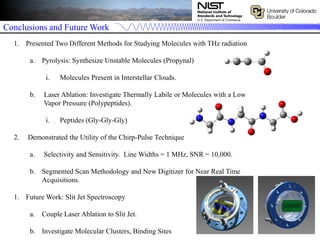
Conclusions and Future Work
1. Presented Two Different Methods for Studying Molecules with THz radiation
a. Pyrolysis: Synthesize Unstable Molecules (Propynal)
i. Molecules Present in Interstellar Clouds.
b. Laser Ablation: Investigate Thermally Labile or Molecules with a Low
Vapor Pressure (Polypeptides).
i. Peptides (Gly-Gly-Gly)
2. Demonstrated the Utility of the Chirp-Pulse Technique
a. Selectivity and Sensitivity. Line Widths = 1 MHz, SNR = 10,000.
b. Segmented Scan Methodology and New Digitizer for Near Real Time
Acquisitions.
1. Future Work: Slit Jet Spectroscopy
a. Couple Laser Ablation to Slit Jet.
b. Investigate Molecular Clusters, Binding Sites

Pacifichem

  • 1.
    Evan G. Buchananand David F. Plusquellic Professional Research Experience Program Chirped Pulse THz Spectroscopy: Instrument and Source Development
  • 2.
    Motivation 1. Molecular Shape-SensitiveDetector Probing Thermal Energies. a. Caveat: Requires a Permanent Dipole Moment. b. Isomer Selective: Structural & Geometrical Isomers. MHz Line Widths 2. Probing Molecules of Astronomical Interest. a. Energies Comparable to Early Planet Formation in Interstellar Space (Hot Cores). b. New Sub-millimeter Telescopes (ALMA). i. Extrapolation form Microwave Fits Are Insufficient. Distortion Parameters Are Needed. 3. Investigating Biologically Relevant Molecules a. Interrogating Low Frequency Vibrations (1 THz = 33 cm-1). b. Comparison to Force Field and Quantum Mechanical Calculations. 4. Technique Development. a. Fast Acquisition Times b. Novel Molecular Sources Why THz Spectroscopy? + Propanol webbook.nist.gov Isopropanol Complex Potential Energy Surface Propynal: Observed in Interstellar Cloud www.rcsb.org
  • 3.
    Motivation Why Chirped-Pulse THzSpectroscopy? 1. Comparison to Laser Based Generation of THz Radiation a. Relatively Simple Construction – Advances in Digital Electronics. b. Significantly More Power (µW – mW). 2. Fast Repetition Rates (~ 2 MHz). 3. High Sensitivity (ppb levels). Signal-to-Noise Ratio = 10,000:1. 4. Allows for the Development of Novel Sources to Study Reactants, Products, and Clusters: Pyrolysis, Laser Ablation, Supersonic Jet, and … Chirp = 25-100 nsec Free Induction Decay = 0.2 – 1 µsec Chirp Time FID
  • 4.
    Instrument Block Diagram MultipassCell Intermediate Frequency (IF) Digitizer 0-1 GHz AMC* x100 MW Synthesizer 9 GHz AWG 1-1.01 GHz Bandpass Mix-AMC* x100 Bandpass Detection #1 #2 Probe 1-1.001 THz Diffusion Pump Single FreqChirp AWG 1 GHz 1. Bandpass Filters Eliminate Spurious Content (Purity). 2. Multipass Cell – Increased Sensitivity 3. New Digitizer for Acquisition. a. Old Digitizer – Throughput Limited, Real Time/750 b. New Digitizer – Real Time/2.
  • 5.
    Segmented Scans Chirp FID L.O. 0 151845 790.56 791.14 791.72 862.29 Segmented Scan Methodology Time (μsec) Frequency(GHz) 123 Segments Total Δf = 0.216 30 Repeats 30 Repeats 15.50.5 Segment 1 Segment 2 30 Helps Increase the Throughput of the Experiment by Parsing the Full Bandwidth Into Smaller Segments Each Segment Consists of Three Sequences: 1. Chirp Pulse Excitation ( ~ 50 nsec). 2. Turn Off Chirp Pulse Excitation 3. Record the Free Induction Decay (FID) ( ~ 450 nsec) for Detection.  Each Sequence is Repeated Before Stepping the Frequency of the Chirp and Local Oscillator (L.O.) to the Next Segment.  The L.O. Plays for the Entire Length of Each Segment for Heterodyned Detection.  Entire Spectrum takes approximately 2 ms to Acquire.  FIDs are Averaged for Each Segment, Transformed to the Frequency Domain, and Spliced Together.
  • 6.
    Jitter Correction FID Shouldbe Background Free. However an Echo from Excitation Chirp. Temperature Fluctuations Echo Changes Phase and Amplitude Frequency Domain of Subtracted (black) Green = Background Red = Signal Black = Subtracted
  • 7.
    Jitter Correction Fix ProblemBy Cross Correlation Echo is Removed as a Background Scan C C r w r C r w r C r w r fg ws fgr l r l ffr l r l ggr l r l           ( ) ( ) ( ) ( ) * ( ) ( )
  • 8.
    Pyrolysis Interested in StudyingPropynal Due to its Presence in the Interstellar Medium.  Propynal is Not Commercially Available.  In Situ Generation Via the Pyrolysis of Propargyl Alcohol  Propargyl Alcohol Has a High Vapor Pressure at Room Temperature.  Oven is Heated to Approximately 400°C Propynal Silica-Alumina CatalystOven Products ? Propargyl Alcohol Multipass Cell
  • 9.
    Pyrolysis of PropargylAlcohol ν / GHz790.500 864.000 Propargyl Alcohol Pyrolysis Products
  • 10.
    Pyrolysis of PropargylAlcohol + Propargyl Ether Methylacetylene Propargyl Alcohol + Propynal Propenal Hydrogen Acetylene Formaldehyde + No RXN Propynal is Not a Product of the Pyrolysis of Propargyl Alcohol Propynal Δ Δ Δ
  • 11.
    Pyrolysis Overview ν /GHz Silica Alumina 400 °C 5 GHz Section 1 min real time 50 ms acquisition time Silica Alumina 400 °C 790.500 864.000ν / GHz 72 GHz Propargyl Ether Propargyl Alcohol 826.000 831.000
  • 12.
    Laser Ablation Graphite Sample 1064 nm Plume VaporizeNonvolatile or Thermally Labile Samples. 1064 nm Pyrolysis Provides Fragment Spectra Desirable to Study Parent Molecules without Fragmentation. Experiment Runs at ~ 2 MHz. Pulse Width = 8 nsec Rep. Rate = 100 KHz (Max) Power = 40 W (Max)
  • 13.
    Laser Ablation Acetamide Melting Point= 80 °C Gly-Gly-Gly Melting Point = 240 °C H2O Gly-Gly-GlyHeated Ablation Difference Switch to x18 Multiplier Chain: Maximum in Boltzmann Distribution for Larger Molecules.
  • 14.
    Filter Diagonalization Method FDMResultsExperimental Magnitude Absorption Dispersion FWHM = 0.0039 FWHM = 0.0024 Changing the Line Shape from Lorentzian to Gaussian. This Increases the Resolution of the Experimental Data. 1. Accomplished by Determining the Phase 2. Overlapping Transitions.
  • 15.
    Filter Diagonalization Method Realand Imaginary Components Present in Magnitude Spectrum. Separating Spectra Into Absorption and Dispersion Requires Phase Information. 𝐶𝑛 = Φ0 𝑈𝑛 Φ0 𝑈𝑛 = 𝑒−𝑖𝜏Ω 𝑛 𝜓𝑗 = 𝑒−𝑖𝑛 𝜔 𝑗 𝜏 Φ0 𝑀−1 𝑛=0 𝑈(𝑝) 𝜙𝑗 , 𝜙𝑗 ′ = 𝜓𝑗 𝑈 𝑝 𝜓𝑗 𝑈(1) 𝐵 𝑘 = 𝑢 𝑘 𝑈(0) 𝐵 𝑘 Express as fictitious time autocorrelation Construct Krylov-Fourier Type Basis Solve generalized Eigenvalue Problem 𝐹𝐷𝑀 = 𝐴𝑗 𝑒 𝑖2𝜋𝑓 𝑗 𝑡−𝜑 𝑗 −𝜏 𝑗 𝑡 𝑗 Construct FDM FID - Residuals - FDM‡ - Exp.
  • 16.
    Conclusions and FutureWork 1. Presented Two Different Methods for Studying Molecules with THz radiation a. Pyrolysis: Synthesize Unstable Molecules (Propynal) i. Molecules Present in Interstellar Clouds. b. Laser Ablation: Investigate Thermally Labile or Molecules with a Low Vapor Pressure (Polypeptides). i. Peptides (Gly-Gly-Gly) 2. Demonstrated the Utility of the Chirp-Pulse Technique a. Selectivity and Sensitivity. Line Widths = 1 MHz, SNR = 10,000. b. Segmented Scan Methodology and New Digitizer for Near Real Time Acquisitions. 1. Future Work: Slit Jet Spectroscopy a. Couple Laser Ablation to Slit Jet. b. Investigate Molecular Clusters, Binding Sites