PACE:  A Collaborative Process Elsa Chi Abruzzo President, ARAC, LLC (20 min)
Changing Landscape Regulatory, Compliance and Legal Expanding breadth and depth of regulations and guidelines Increasing FDA, DOJ and SEC (FCPA) enforcement Sales and Marketing More decision makers More sites of service Less time and fewer resources
Learn from GMP and DHR Response to quality issues Inefficient processes    Efficient Central aspects of GxP are: Traceability: the ability to reconstruct history Accountability: the ability to resolve who has done what and when PACE Process + Implement = CHR
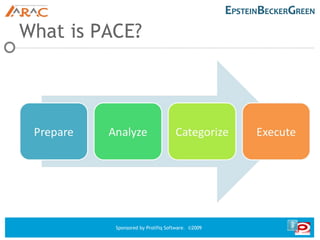
What is PACE?
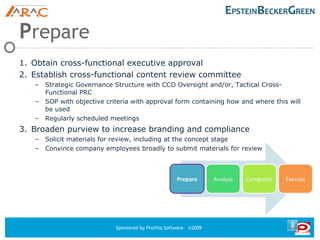
P repare Obtain cross-functional executive approval Establish cross-functional content review committee Strategic Governance Structure with CCO Oversight and/or, Tactical Cross-Functional PRC SOP with objective criteria with approval form containing how and where this will be used Regularly scheduled meetings Broaden purview to increase branding and compliance Solicit materials for review, including at the concept stage Convince company employees broadly to submit materials for review
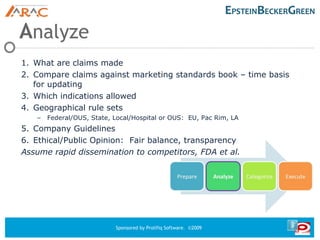
A nalyze What are claims made Compare claims against marketing standards book – time basis for updating Which indications allowed Geographical rule sets Federal/OUS, State, Local/Hospital or OUS:  EU, Pac Rim, LA Company Guidelines Ethical/Public Opinion:  Fair balance, transparency Assume rapid dissemination to competitors, FDA et al.
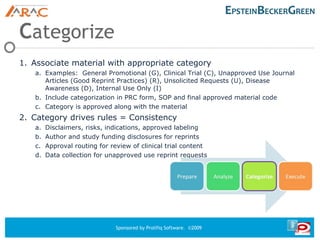
C ategorize Associate material with appropriate category Examples:  General Promotional (G), Clinical Trial (C), Unapproved Use Journal Articles (Good Reprint Practices) (R), Unsolicited Requests (U), Disease Awareness (D), Internal Use Only (I) Include categorization in PRC form, SOP and final approved material code Category is approved along with the material Category drives rules = Consistency Disclaimers, risks, indications, approved labeling Author and study funding disclosures for reprints Approval routing for review of clinical trial content Data collection for unapproved use reprint requests
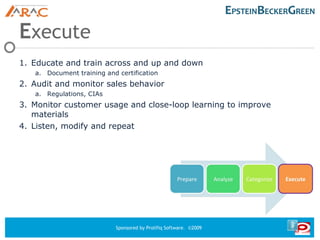
E xecute Educate and train across and up and down Document training and certification Audit and monitor sales behavior Regulations, CIAs Monitor customer usage and close-loop learning to improve materials Listen, modify and repeat
Controlled Dissemination Manual fulfillment – frequent updates? Annual training – will they remember? Medical Affairs – low on resources? Intranet – how often do reps log in? Digital CMS Make the complex simple with technology Efficiency and cost-savings with processes Two choices Modify non industry-specific with compliance rules Choose industry-specific with compliance rules
Questions & Answers Elsa Chi Abruzzo, President, ARAC [email_address] Steven Skwara, Partner, EBG [email_address] Sponsored by: Maureen Shaffer, VP Life Sciences, Prolifiq [email_address]
Takeaways Downloadable presentation with audio available next week www.advamed.org www.prolifiq.net/lifesciences

PACE: A Collaborative Process, Elsa Chi Abruzzo, President, ARAC, LLC

  • 1.
    PACE: ACollaborative Process Elsa Chi Abruzzo President, ARAC, LLC (20 min)
  • 2.
    Changing Landscape Regulatory,Compliance and Legal Expanding breadth and depth of regulations and guidelines Increasing FDA, DOJ and SEC (FCPA) enforcement Sales and Marketing More decision makers More sites of service Less time and fewer resources
  • 3.
    Learn from GMPand DHR Response to quality issues Inefficient processes  Efficient Central aspects of GxP are: Traceability: the ability to reconstruct history Accountability: the ability to resolve who has done what and when PACE Process + Implement = CHR
  • 4.
  • 5.
    P repare Obtaincross-functional executive approval Establish cross-functional content review committee Strategic Governance Structure with CCO Oversight and/or, Tactical Cross-Functional PRC SOP with objective criteria with approval form containing how and where this will be used Regularly scheduled meetings Broaden purview to increase branding and compliance Solicit materials for review, including at the concept stage Convince company employees broadly to submit materials for review
  • 6.
    A nalyze Whatare claims made Compare claims against marketing standards book – time basis for updating Which indications allowed Geographical rule sets Federal/OUS, State, Local/Hospital or OUS: EU, Pac Rim, LA Company Guidelines Ethical/Public Opinion: Fair balance, transparency Assume rapid dissemination to competitors, FDA et al.
  • 7.
    C ategorize Associatematerial with appropriate category Examples: General Promotional (G), Clinical Trial (C), Unapproved Use Journal Articles (Good Reprint Practices) (R), Unsolicited Requests (U), Disease Awareness (D), Internal Use Only (I) Include categorization in PRC form, SOP and final approved material code Category is approved along with the material Category drives rules = Consistency Disclaimers, risks, indications, approved labeling Author and study funding disclosures for reprints Approval routing for review of clinical trial content Data collection for unapproved use reprint requests
  • 8.
    E xecute Educateand train across and up and down Document training and certification Audit and monitor sales behavior Regulations, CIAs Monitor customer usage and close-loop learning to improve materials Listen, modify and repeat
  • 9.
    Controlled Dissemination Manualfulfillment – frequent updates? Annual training – will they remember? Medical Affairs – low on resources? Intranet – how often do reps log in? Digital CMS Make the complex simple with technology Efficiency and cost-savings with processes Two choices Modify non industry-specific with compliance rules Choose industry-specific with compliance rules
  • 10.
    Questions & AnswersElsa Chi Abruzzo, President, ARAC [email_address] Steven Skwara, Partner, EBG [email_address] Sponsored by: Maureen Shaffer, VP Life Sciences, Prolifiq [email_address]
  • 11.
    Takeaways Downloadable presentationwith audio available next week www.advamed.org www.prolifiq.net/lifesciences

Editor's Notes

  • #2 Elsa: Thank you Andrew. Good afternoon everyone, my name is Elsa Abruzzo. Thank you very much for taking the time to listen in today. We will be covering a process that we developed in part at a former company of mine where we were dealing in a complex regulatory landscape. This process has been further developed with time and collaboration with my legal and marketing colleagues. Today, we will be addressing the dissemination of tangible and digital materials with a nod to oral dissemination, but the former will be our focus. Next slide.
  • #3 Elsa: We are all aware of the increasingly difficult landscape which we are all navigating daily. It is becoming more complex for the regulatory, legal and compliance functions as well as for our teammates in the sales and marketing functions. Combine that with more demands on our time and fewer resources with which to accomplish them, and increasingly we are finding that the processes that interconnect us, such as review and approval of new content , are breaking down. Next slide.
  • #4 Elsa: GMP was established in 1938 in response to quality issues with food, drugs and cosmetics. In the subsequent years, GMP processes have morphed to proactively build quality in vs. inspecting it out. I would propose that we are currently facing numerous “quality” issues with promotional and non-promotional materials and that the DOJ, FDA and other regulatory bodies are currently “inspecting it out” through their enforcement efforts. In order to protect our companies and our sales staff, I believe that we should consider the development of proactive, consistent processes surrounding the dissemination of promotional and non-promotional materials . For the purpose of today, we are going to discuss the four-step PACE process which when combined with a system for implementation, results in a Communications History Record, or CHR. Steve Skwara will speak later about the overwhelming data compelling medical device companies to develop CHRs. Next slide.
  • #5 Elsa: First, let me introduce PACE. PACE is a straightforward four-step process for collaborative review and dissemination of tangible and digital content. Prepare, Analyze, Categorize, Execute. Think of PACE as a vaccine protecting your company against risk. Steve will speak later about what happens when preventative measures fail to vaccinate your company fully against liability. PACE is simple and provides transparency and consistency. Additionally, it provides the opportunity to bring key stakeholders, including regulatory, legal, and marketing, together to collaborate. Lastly, these systematic development and approval processes are the building blocks for a CHR which will help you and your company in a worse-case scenario. And , I’ve used it at a previous company in a very complicated regulatory situation and it works. Today, we will introduce the PACE process and in subsequent webinars, we will address different types of materials in greater detail. Next slide.
  • #6 Elsa: The first step in PACE is Prepare . There are three key steps to Prepare. First, this approach will only work if you have approval at the appropriate management or executive level. This is an important initiative and it is cross-functional – spanning, for example, regulatory, clinical, legal and marketing. What this means is that it will take longer to set up initially but that PACE will have staying power within your organization. Secondly, you will need to establish a cross-functional content review committee. In the beginning, there will be much to consider during the initial implementation and much like product design, the better the input and involvement at the concept stage, the more efficient and effective the outcome. Consider involving the personnel at the level required for SOP signoff. At larger organizations, it may be initiated within the governance structure with a CCO’s backing and then moved into the different business units or divisions. At smaller organizations, it will depend on available personnel and company structure. My experience is that a key to success is regularly scheduled meetings. If your company is releasing new products, conducting clinical trials, releasing new indications – once a week is ideal on a set day at a set time. Consistency in personnel breeds consistency in decision-making and outcomes. Comprehensiveness in approval mitigates risk. You will find that over time the SOP with the integrated approval form will become more detailed and you will reach a point when the approvals can be handed down the organization. Over time, we broadened our purview to include concept review of marketing materials – some companies may refer to this as the project or marketing brief. We found that though this increased review at the front end, that marketing did not pursue paths and discover near the end that the content was not approvable. So, in fact, they embraced PACE over time. This is something that will initially require education and encouragement. Next slide.
  • #7 Elsa: The second step in PACE is Analyze since there is a broad range of rules to consider. First, identify the claims being made. Then, compare the claims against a internal marketing standards book which includes “yes” and “no” words and terminology and set time basis for updating of key numbers in documents and citations. This will ensure consistency and communication of brand and claims standards over time both across functions and up and down your organization. Compare the claims against the approved or cleared indications as well as geographical rule sets checked on the form. And, increasingly you may wish to consider public opinion in the review of the content. Even though fair balance does not YET apply to medical devices, you may wish to consider it as public opinion increasingly has equal expectations of medical devices, which they mentally group up with pharma. Lastly, with the proliferation of the internet, email and social media, we liked to presume that every document will be in hands of competitors, FDA, patients and lawyers within days of approval. And, we balanced this with assuming that if it is extremely important, we need to consider if there is a compliant way to give them what they need in a compliant fashion to prevent any desire to circumvent the system. Remember, people are resourceful – so try to be helpful within the appropriate boundaries. Next slide.
  • #8 Elsa: We have reviewed the first two steps of PACE – Prepare and Analyze. Step Three is Categorize. First, back in the prepare stage we talked about setting up an SOP and approval form for material approval and dissemination. You will want to review the types of content within your company and categorize or code in a way that fits your company. We found that quarterly review of disclaimers, associated rules and the categories was helpful. In the first year of implementation, we found that we expanded categories, refined the SOP and approval form. After a year, the categories and disclaimers largely stabilized. Some examples of categories that would stimulate a different rule set may include general promotional, disease awareness, journal reprints containing unapproved product uses and internal use only materials. Categorizing your content systematizes the application of rules and is crucial to consistency. Categories do not apply here to type of media but to the rules, disclaimers and dissemination associated. There may also be situations such as in dissemination of clinical trial materials where an approval routing is needed or in the case of unapproved use journal reprints where data collection, such as hospital name, HCP status and city state are collected. Next slide.
  • #9 Elsa: Step Four of PACE: Prepare, Analyze, Categorize and now Execute. Execution is critical to success. Internal training is important, but so is sales training. Ideally the rollout of the new system and categories would occur at a pre-scheduled sales meeting(s) where marketing and regulatory can be on hand to answer questions and potential concerns. Always remember to frame the system in the context of what’s in it for them – this will gain their interest. Some systems which will talk about in a minute will offer more benefits for them than others. They will also need to understand that this helps protect them and the company. I recommend setting up regular proactive monitoring and auditing and incorporating this in the SOP as well. Systems that gather this information and provide reporting will make this easier for you and your company. Perhaps most importantly, listen listen and listen. Make change to the procedure collaboratively and set expectations at the outset that this is a continuous learning process – adaptive to legislative changes and internal needs. Most importantly, since you have a consistent system, the changes that are made are incorporated into SOP and training, ensuring ongoing consistency. [Real-life:  Mention FDA inspection, process and result (BIMO and ???) When Your Competitors Create Roadblocks: Responding to Inquiries – Elsa, you need to script this section] Next slide.
  • #10 Elsa: So, you have gone to a great deal of effort to approve the content and provide guidance for content usage. The question remains as how to control dissemination of the materials. Here is where sales adoption is paramount. Sales needs to see what is in it for them. There are a number of options to control dissemination. We have all used and many may still use manual fulfillment houses whether internal or external to the company. My experience has been that they are expensive and updating content within marketing is slow and costly which also impedes rapid response to changing market conditions. And, it relies on sales remembering not only how to sell but to be mini regulatory experts. Your company may chose to route certain requests through medical affairs or medical information to control dissemination – but resources are an issue and there is still no traceability to the end customer. Pushing content out to an intranet is a great start, but you will need to assess how often sales will be online with their laptops to ensure success with this strategy. This however accommodates rapid response to changing conditions as much of the content is digital and easily updated and reposted. And, it is a low cost strategy for smaller companies with simple rule sets. Digital CMS, or content management systems, moves the control in dissemination one step further. Marketing can respond rapidly to changes and upload them quickly. Finance appreciates the cost savings. And, there is reduced concern about old materials in circulation being used. However some systems can allow sales to download content – thereby taking it immediately out of the digital control loop. What you will need to consider here is whether the CMS is robust or industry-specific enough to accommodate the myriad rule sets while testing for high sales and marketing adoption. Highly adoptable AND compliant systems creates the environment that allows sales to be compliant. The system I am f amiliar with is Prolifiq but you will want to determine which approach is ideal for your company’s needs based on volume of activity and level of risk. Next slide.
  • #11 Andrew: Thank you Maureen. We would now like to hear from you about which webinar topic you would most like to see offered next. [Lisa, show poll.] You should now see the polling buttons available on your screen. We will leave the poll open during the Q&A and report the results during our closing remarks. Now, the operator will now explain how we will conduct our Q&A. [operator to explain] Elsa and Steve: Elsa, Thank you Andrew. Steve and I will now answer questions. [With 5 minutes to go, Andrew will end question period.] Andrew: Let’s show the poll results. [Lisa to show poll results] Great, it appears that the next webinar to be offered in this series is, “XXX”! Thank you for voting. Last slide please.
  • #12 Andrew: Thank you Elsa, Steve and all the participants on the call for your time today. Please look for an email from AdvaMed to all webinar attendees containing a link to this presentation. And, EBG has graciously provided access to a white paper on the recent CIAs -- a link for downloading will also be included. Thank you again and have a great day. [Lisa, save transcript, audio, q&a and anything else that can be saved and close presentation.]