C. Monisha et al Int. Journal of Engineering Research and Applications www.ijera.com
ISSN : 2248-9622, Vol. 4, Issue 3( Version 1), March 2014, pp.86-91
www.ijera.com 86 | P a g e
Packet Reordering Using Congestion Control Algorithm Based on
Data frame Weightage
S. Balaji#1
, C. Monisha#2
1
AssociateProfessor
2
PG Scholor,
#
Department of ComputerScience and Engineering, Anna University-Chennai,SCAD College of Engineering
and Technology, cheranmahadevi, Tamilnadu, India.
ABSTRACT
In network application the data frame is transferred as sub-divided packets which are interdependent. Because of
this inter-packet dependencies problems like buffer overflow, degradation of packets may occur in existing
application. In this paper packet reordering has been done through Round Trip Delay Time(RTT) technology
based on congestion control algorithm & weight based priority algorithm. It has been observed this technology
has achieved considerable success to reduce the time delay and also to avoid degradation of packets. It also
addressed the problem of buffer management of multiple data streams traffic.
Key Words: Interpacket dependencies, RTT, reordering.
I. INTRODUCTION
In majority network application the data
frames are splitted into a small sized packets erfore
transmission. The data is useful only after receiving
of all packets. Degradation of some packets leads to
wastage of whole data. From this is understood that
the multistreams has interdependent packet structure.
This dependency structure depends on encoding used.
Normally re-transmission of losed data packets
found in higher level protocol. But dependency
structure in MPEG video is so strong that delay of
retransmitted packets affects real time traffic.Because
of these inter-packet dependency problems, like
buffer overflow, loss and degradation of packet
usually occurs in existing applications. An usual
approach to deal the packet loss problem is to empty
encoding schemes which provide considerable
improvement in the performance. However this
common approach has its own limitations in same
network application.
The prime causes for the packet loss is due
to congestion.we consider the problem of buffer
management of multiple data streams traffic. In this
paper packet re-ordering has been done through
Round Trip Delay Time (RTT. This technology
based on congestion control algorithm and weightage
based priority algorithm. These algorithms are
guaranteed to give good output, in any traffic pattern.
In this paper we studied packet discard policies in
depth. Our model is suitable to various traffic
encoding schemes that has more inter dependency
structure.
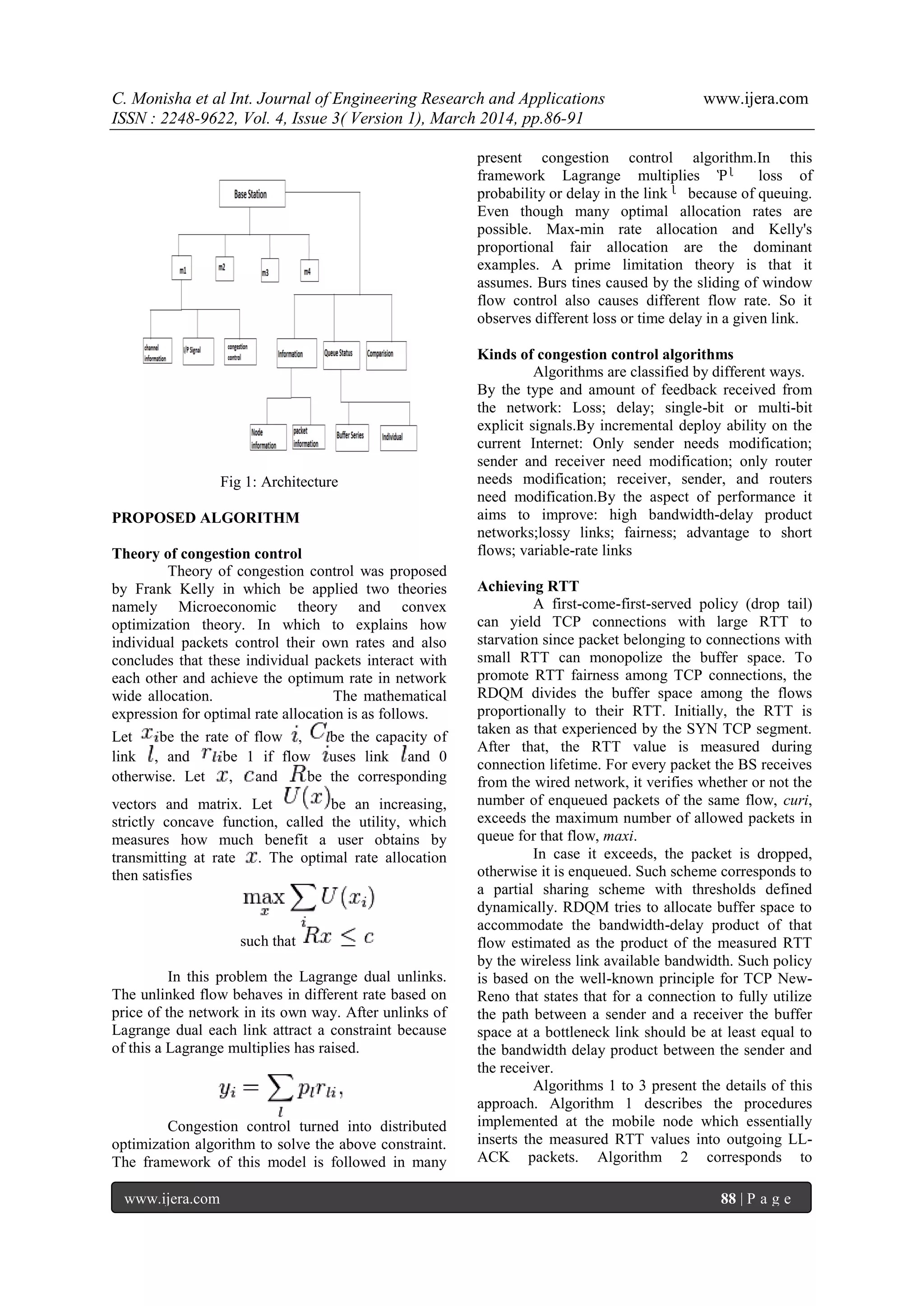
BASE STATION:
A base station is what links mobile phones
to a wireless carrier’s network. Base station provides
local coverage for a wireless network.
1. WSN Info: A wireless sensor network(WSN)
consists of spatially distributed autonomous
sensors to monitor physical or environmental
conditions such as temperature, pressure, sounds,
etc. And to cooperatively pass their data through
the network to a main location.
2. Packet Node: It is a important part in a packet
switching network. The main function of packet
node are transmitting and receiving of data
packets. Data switches and equipment's are
integral part of packet node.
3. Queue Buffer perform
4. Individual Queue Perform
5. Transmission Comparison
MOBILE NODE:
Mobile node is any device having internet
connection and having the character of changing
location frequently. Usually Mobile phones, handheld
and laptop computer are belongs to this kind. Router
also comes in this category. As mobile node moves
from one place to another place, it changes from one
network to another network. Maintaining continuous
internet connection needs special support mechanism.
In traditional routing procedures each mobile node
havesame IP Address. But in standard routing
procedure, each and every time a mobile user have to
change the IP Address whenever the node changes
from one network to another. Mobile Node has three
important parts.
RESEARCH ARTICLE OPEN ACCESS
C. Monisha et al Int. Journal of Engineering Research and Applications www.ijera.com
ISSN : 2248-9622, Vol. 4, Issue 3( Version 1), March 2014, pp.86-91
www.ijera.com 87 | P a g e
1. Mobile Channel
2. Mobile Signal
3. transcoding
Among these, transcoding plays important
role in conversion of one encoding to other encoding.
It convert analog to analog and digital to digital
directly. Transcoding is useful to convert the
unsupported file format to supported one.
II. EXISTING SYSTEM
In this work most related to the problems of
buffer management in video traffic has been
studied.Like MPEG video streaming, most of these
data streams has high dependency structure and
specific encoding schemes. Due to congestion in data
streaming buffer overflow occurs. Because of this
overflow existing encoding scheme dropped some
data packets in the receiving end. So most of the
previous works analyzed on which data packets
should be dropped to receive less damage on the
output.
Because of loss of some packets, whole data
set become unusefull. In the buffer management
policy of Ramanathanetalthe frame is dropped when
many packets are dropped. In that they suggest latest
frame first rule for discard the packets.In many other
works priority based discard policies have been
studied. In that the packets are discriminated based
on importance. Normally less important packets are
dropped which would not affect the good put. The
model proposed by kesselmanetal has no stream
structure which underlies the arrival traffic. In this
work they considered restricted arrival pattern. Buffer
management in FIFO scheduling regime follows
Queuing discipline. Time delay and re-ordering
constrained environment happened due to congestion
in this method.
III. III.PROBLEM DEFINITION
In a network application, the problem of
ensuring the arrival of entire frame at receiving end is
crucial. Because of congestion, buffer overflow and
degradation of packets occurred. An usual approach
to handle the packet loss problems in to empty
encoding schemes. In the existing encoding schemes
even though it achieved some performance
improvement, it has some limitations. It is more
costly due to increased traffic. In the regime of FIFO,
also more time delay and re-ordering constrained
environment have occurred.
The main problem of existing buffer
management is low level of good put to the
throughput. Throughput is defined as amount of data
transmitted as data packets. Good put is defined as
amount of data received as data packets in receiving
end. In a good buffer management practices good put
is almost equal to the throughput. But due to the over
congestion loss of data packets reduces the effective
good put.In account of all issues discussed the
proposed system considered packet re-ordering based
on congestion control algorithm and weightage
priority algorithm.
In network application the data frame is
transferred as sub-divided packets which are
interdependent. Because of this inter-packet
dependencies problems like buffer overflow,
degradation of packets may occur in existing
application. In this paper packet reordering has been
done through Round Trip Delay Time(RTT)
technology based on congestion control algorithm &
weight based priority algorithm . It has been
observed that technology has achieved success to
reduce the time delay and also to avoid degradation
of packets. Addressed the problem of managing
buffer overflows for traffic consisting of multiple
streams, with interpacket dependencies. And
provided guidelines for thedesign of such algorithms,
and analyzed. Provided guarantees on its
performance under any traffic conditions by proving
it has a bounded competitive ratio.
IV. PRPOSED SYSTEM
In the existing methodology, only one
packet has been sent at a time. Once the packet got
received next packet starts to retransmit. But this
proposed system randomly initial frame from every
packet started too sent at a time.This will reduce the
overall delay.The main objective of this paper is to
reduce the overflow in the buffer.The input video has
been splitted into framesOnce the frames has been
delivered to receiver it can be reordered.
Congestion control:
Congestion control controls the traffic by
regulating the entry into the telecommunication
network. To avoid congestion collapse congestion
control algorithm attempts to prevent the over usage
of intermediates node and networks process and link
capabilities. It also avoids to take resource reducing
steps like reducing the packet sending rate.In this
framework Lagrange multiplies Ῥᶩ loss of
probability or delay in the link ᶩ because of
queuing.A prime limitation theory is that it assumes.
C. Monisha et al Int. Journal of Engineering Research and Applications www.ijera.com
ISSN : 2248-9622, Vol. 4, Issue 3( Version 1), March 2014, pp.86-91
www.ijera.com 88 | P a g e
Fig 1: Architecture
PROPOSED ALGORITHM
Theory of congestion control
Theory of congestion control was proposed
by Frank Kelly in which be applied two theories
namely Microeconomic theory and convex
optimization theory. In which to explains how
individual packets control their own rates and also
concludes that these individual packets interact with
each other and achieve the optimum rate in network
wide allocation. The mathematical
expression for optimal rate allocation is as follows.
Let be the rate of flow , be the capacity of
link , and be 1 if flow uses link and 0
otherwise. Let , and be the corresponding
vectors and matrix. Let be an increasing,
strictly concave function, called the utility, which
measures how much benefit a user obtains by
transmitting at rate . The optimal rate allocation
then satisfies
such that
In this problem the Lagrange dual unlinks.
The unlinked flow behaves in different rate based on
price of the network in its own way. After unlinks of
Lagrange dual each link attract a constraint because
of this a Lagrange multiplies has raised.
Congestion control turned into distributed
optimization algorithm to solve the above constraint.
The framework of this model is followed in many
present congestion control algorithm.In this
framework Lagrange multiplies Ῥᶩ loss of
probability or delay in the link ᶩ because of queuing.
Even though many optimal allocation rates are
possible. Max-min rate allocation and Kelly's
proportional fair allocation are the dominant
examples. A prime limitation theory is that it
assumes. Burs tines caused by the sliding of window
flow control also causes different flow rate. So it
observes different loss or time delay in a given link.
Kinds of congestion control algorithms
Algorithms are classified by different ways.
By the type and amount of feedback received from
the network: Loss; delay; single-bit or multi-bit
explicit signals.By incremental deploy ability on the
current Internet: Only sender needs modification;
sender and receiver need modification; only router
needs modification; receiver, sender, and routers
need modification.By the aspect of performance it
aims to improve: high bandwidth-delay product
networks;lossy links; fairness; advantage to short
flows; variable-rate links
Achieving RTT
A first-come-first-served policy (drop tail)
can yield TCP connections with large RTT to
starvation since packet belonging to connections with
small RTT can monopolize the buffer space. To
promote RTT fairness among TCP connections, the
RDQM divides the buffer space among the flows
proportionally to their RTT. Initially, the RTT is
taken as that experienced by the SYN TCP segment.
After that, the RTT value is measured during
connection lifetime. For every packet the BS receives
from the wired network, it verifies whether or not the
number of enqueued packets of the same flow, curi,
exceeds the maximum number of allowed packets in
queue for that flow, maxi.
In case it exceeds, the packet is dropped,
otherwise it is enqueued. Such scheme corresponds to
a partial sharing scheme with thresholds defined
dynamically. RDQM tries to allocate buffer space to
accommodate the bandwidth-delay product of that
flow estimated as the product of the measured RTT
by the wireless link available bandwidth. Such policy
is based on the well-known principle for TCP New-
Reno that states that for a connection to fully utilize
the path between a sender and a receiver the buffer
space at a bottleneck link should be at least equal to
the bandwidth delay product between the sender and
the receiver.
Algorithms 1 to 3 present the details of this
approach. Algorithm 1 describes the procedures
implemented at the mobile node which essentially
inserts the measured RTT values into outgoing LL-
ACK packets. Algorithm 2 corresponds to
C. Monisha et al Int. Journal of Engineering Research and Applications www.ijera.com
ISSN : 2248-9622, Vol. 4, Issue 3( Version 1), March 2014, pp.86-91
www.ijera.com 89 | P a g e
implemented at the BS which either accepts or
discards incoming packets. Algorithm 3 updates the
queue thresholds, i.e., curi, andmaxi. Algorithm 2 is
triggered by the arrival of TCP data packet
Algorithm 1: On LL-ACK packet transmission
at MN
1. If TCP data packet received
2. Encapsulate feedback info into outgoing LL-ACK
3. Send LL-ACK
4. Endif
Algorithm 2: On TCP DATA packet arrival at BS
1. Get Flow ID
2. If packet belongs to a new flow Then
3. Create new entry for incoming flow
4. Set Flow Packet Limit equal to MAXdef
5. Set Flow Packet Count equal to zero
6. Set Flow RTT equal to RTTdef
7. Else
8. If Flow Packet Count is greater than Flow Packet
Limit Then
9. Drop incoming packet
10. Else
11. Increase Flow Packet Count by one
12. Accept packet
13. Endif
14. Endif
Algorithm 3: On LL-ACK packet arrival at BS
1.Get Flow ID
2. If Flow RTT is greater that zero Then
3. Set RTT Sum equal to zero
4. ForEach Flow Do
5. Increase RTT Sum by Flow RTT
6. Endfor
7. ForEach Flow Do
8. Set Flow Weight to Flow RTT / RTT Sum
9. Set Flow Packet Limit to max between Flow
Weight andbuffersize
10. Endfor
11. Endif
V. PERFORMANCE EVALUVATIONS
In this section, it is concentrated on
describing about MRTT values. wegenerated
maximum number of RTT valuesfor every
transmissions. It reports about the packet
transmission time for every RTT values.
Fig 2:Comparision of MRTT Value
The packets containing video is transmitted
from source to destination.Fore every packet RTT
values and MRTT values are compared for every
number of packet transmissions.
Fig 3: Comparison of RTT Vs MRTT
VI. CONCLUSION AND FUTURE
WORK:
The main function of the network layer is
routing packets from source to destination. The
traffic traversing the network has inter-packet
dependencies due to application-level encoding
schemes. The proposed scheme has addressed the
problem of managing buffer overflows for traffic
consisting of multiple streams, with inter-packet
dependencies. The algorithms proposed in this paper
derives the guidelines to increase the performance of
Buffer management.
To increase the merits of the work, it is
planned to investigate the following issues in our
future research:
In future work encryption and compression
method will be applied this will lead to reduce the
packet size. Main intention of this method is to avoid
the congestion and flooding.
0
1
2
3
4
1 4 7 10 13 16 19 22 25 28 31
MRTTValue
No Of Transmission
Comparison Of MRTT Value
MRTT1
MRTT2
MRTT3
0
0.5
1
1.5
2
2.5
3
1 4 7 10 13 16 19 22 25 28 31
RTT/MRTTValue
No of Transmission
Comparision Of RTT Vs MRTT
C. Monisha et al Int. Journal of Engineering Research and Applications www.ijera.com
ISSN : 2248-9622, Vol. 4, Issue 3( Version 1), March 2014, pp.86-91
www.ijera.com 90 | P a g e
REFERENCES
[1] Gabrielscalosub, peter marbach, jorg
Liebeherrr, IEEE trans’ Buffer management
for Aggregated streaming data with packet
dependencies” IEEE trans. Parallel and
distributed system vol.24.
[2] A. Albanese, J. Blo¨mer, J. Edmonds, M.
Luby, and M. Sudan, “Priority Encoding
Transmission,” IEEE Trans. Information
Theory, vol. 42, no. 6, pp. 1737-1744, 1996.
[3] A. Borodin and R. El-Yaniv, Online
Computation and Competitive
Analysis.Cambridge Univ. Press, 1998.
[4] A. Fiat, Y. Mansour, and U. Nadav,
“Competitive Queue Management for
Latency Sensitive Packets,” Proc. 19th Ann.
ACM-SIAM Symp.Discrete Algorithms
(SODA), pp. 228-237, 2009.
[5] A. Kesselman and Y. Mansour, “QoS-
Competitive Video Buffering,”Computing
and Informatics, vol. 21, no. 6, pp. 1001-
1018, 2002.
[6] A. Kesselman, B. Patt-Shamir, and G.
Scalosub, “Competitive Buffer Management
with Packet Dependencies,” Proc. IEEE 23rd
Int’l Symp. Parallel and Distributed
Processing (IPDPS), 2009.
[7] A. Mehaoua, R. Boutaba, Y. Rasheed, and
A. Leon-Garcia, “An Integrated Framework
for Efficient Transport of Real-Time MPEG
Video over ATM Best Effort Service,” Real-
Time Imaging, vol. 7, no. 3, pp. 287-300,
2001.
[8] A. Romanow and S. Floyd, “Dynamics of
TCP Traffic over ATM Networks,” IEEE J.
Selected Areas in Comm., vol. 13, no. 4, pp.
633- 641, 1995.
[9] A. Ziviani, J.F. de Rezende, O.C.M.B.
Duarte, and S. Fdida, “Improving the
Delivery Quality of MPEG Video Streams
by Using Differentiated Services,” Proc.
Second European Conf. Universal
Multiservice Networks (ECUMN), pp. 107-
115, 2002.
[10] B. Girod, M. Kalman, Y.J. Liang, and R.
Zhang, “Advances in Channel-Adaptive
Video Streaming,” Wireless Comm. and
Mobile Computing, vol. 2, no. 6, pp. 573-
584, 2002
[11] B.L. Nelson and I. Gerhardt, “On Capturing
Dependence in Point Processes: Matching
Moments and Other Techniques,” 2010.
[12] D.E. Wrege, E.W. Knightly, H. Zhang, and
J. Liebeherr, “Deterministic Delay Bounds
for VBR Video in Packet-Switching
Networks: Fundamental Limits and Practical
Trade-Offs,” IEEE/ ACM Trans.
Networking, vol. 4, no. 3, pp. 352-362,
1996.
[13] D.D. Sleator and R.E. Tarjan, “Amortized
Efficiency of List Update and Paging
Rules,” Comm. the ACM, vol. 28, no. 2, pp.
202-208, 1985.
[14] E. Gu¨ rses, G.B. Akar, and N. Akar, “A
Simple and Effective Mechanism for Stored
Video Streaming with TCP Transport and
Server-Side Adaptive Frame Discard,”
Computer Networks, vol. 48, no. 4, pp. 489-
501, 2005.
[15] E.W. Knightly and N.B. Shroff, “Admission
Control for Statistical QoS: Theory and
Practice,” IEEE Network, vol. 13, no. 2, pp.
20-29, 1999.
[16] F. Li and Z. Zhang, “Scheduling Weighted
Packets with Deadlines over a Fading
Channel,” Proc. IEEE 43rd Ann. Conf.
Information Sciences and Systems (CISS),
pp. 717-712, 2009.448 IEEE
TRANSACTIONS ON PARALLEL AND
DISTRIBUTED SYSTEMS, VOL. 24, NO.
3, MARCH 2013
[17] iSuppli Market Intelligence,
http://www.isuppli.com/, 2009.
[18] I.F. Akyildiz, T. Melodiaa, and K.R.
Chowdhurya, “A Survey on Wireless
Multimedia Sensor Networks,” Computer
Networks, vol. 51, no. 4, pp. 921-960, 2007.
[19] J.M. Boyce and R.D. Gaglianello, “Packet
Loss Effects on MPEG Video Sent over the
Public Internet,” Proc. ACM Sixth Int’l
Conf. Multimedia, pp. 181-190, 1998.
[20] K.-H. Liu, X. Ling, X.S. Shen, and J.W.
Mark, “Performance Analysis of Prioritized
MAC in UWB WPAN with Bursty
Multimedia Traffic,” IEEE Trans. Vehicular
Technology, vol. 56,no. 4, pp. 2462-2473,
2008.
[21] M.H. Goldwasser, “A Survey of Buffer
Management Policies for Packet Switches,”
ACM SIGACT News, vol. 41, no. 1, pp.
100-128, 2010.
C. Monisha et al Int. Journal of Engineering Research and Applications www.ijera.com
ISSN : 2248-9622, Vol. 4, Issue 3( Version 1), March 2014, pp.86-91
www.ijera.com 91 | P a g e
S. Balaji, M.E, (Phd), MISTE is currently
working as a Head of The Department,dept of CSE in
SCAD College of engineering and Technology,
Tirunelveli His research interests are Wireless
networks Mobile Computing, Network Security,
Wireless Sensor Networks, Cloud Computing .He has
presented many papers in National and International
conferences in Network security, Mobile Computing,
wireless network security, and Cloud Computing.
And also his methodology of teaching about TCP &
UDP is hosted on Wipro Mission 10x portal. He is a
life time member of ISTE.
C. Monisha. Currently doing ME
Computer science in SCAD College of engineeringng
and technology, Cheranmahadevivi, Tirunelveli
district. She has completed her undergraduate B.Tech
Information on Technology in Infant jesus college of
engineering, Tuticorin in 2012.

P43018691

  • 1.
    C. Monisha etal Int. Journal of Engineering Research and Applications www.ijera.com ISSN : 2248-9622, Vol. 4, Issue 3( Version 1), March 2014, pp.86-91 www.ijera.com 86 | P a g e Packet Reordering Using Congestion Control Algorithm Based on Data frame Weightage S. Balaji#1 , C. Monisha#2 1 AssociateProfessor 2 PG Scholor, # Department of ComputerScience and Engineering, Anna University-Chennai,SCAD College of Engineering and Technology, cheranmahadevi, Tamilnadu, India. ABSTRACT In network application the data frame is transferred as sub-divided packets which are interdependent. Because of this inter-packet dependencies problems like buffer overflow, degradation of packets may occur in existing application. In this paper packet reordering has been done through Round Trip Delay Time(RTT) technology based on congestion control algorithm & weight based priority algorithm. It has been observed this technology has achieved considerable success to reduce the time delay and also to avoid degradation of packets. It also addressed the problem of buffer management of multiple data streams traffic. Key Words: Interpacket dependencies, RTT, reordering. I. INTRODUCTION In majority network application the data frames are splitted into a small sized packets erfore transmission. The data is useful only after receiving of all packets. Degradation of some packets leads to wastage of whole data. From this is understood that the multistreams has interdependent packet structure. This dependency structure depends on encoding used. Normally re-transmission of losed data packets found in higher level protocol. But dependency structure in MPEG video is so strong that delay of retransmitted packets affects real time traffic.Because of these inter-packet dependency problems, like buffer overflow, loss and degradation of packet usually occurs in existing applications. An usual approach to deal the packet loss problem is to empty encoding schemes which provide considerable improvement in the performance. However this common approach has its own limitations in same network application. The prime causes for the packet loss is due to congestion.we consider the problem of buffer management of multiple data streams traffic. In this paper packet re-ordering has been done through Round Trip Delay Time (RTT. This technology based on congestion control algorithm and weightage based priority algorithm. These algorithms are guaranteed to give good output, in any traffic pattern. In this paper we studied packet discard policies in depth. Our model is suitable to various traffic encoding schemes that has more inter dependency structure. BASE STATION: A base station is what links mobile phones to a wireless carrier’s network. Base station provides local coverage for a wireless network. 1. WSN Info: A wireless sensor network(WSN) consists of spatially distributed autonomous sensors to monitor physical or environmental conditions such as temperature, pressure, sounds, etc. And to cooperatively pass their data through the network to a main location. 2. Packet Node: It is a important part in a packet switching network. The main function of packet node are transmitting and receiving of data packets. Data switches and equipment's are integral part of packet node. 3. Queue Buffer perform 4. Individual Queue Perform 5. Transmission Comparison MOBILE NODE: Mobile node is any device having internet connection and having the character of changing location frequently. Usually Mobile phones, handheld and laptop computer are belongs to this kind. Router also comes in this category. As mobile node moves from one place to another place, it changes from one network to another network. Maintaining continuous internet connection needs special support mechanism. In traditional routing procedures each mobile node havesame IP Address. But in standard routing procedure, each and every time a mobile user have to change the IP Address whenever the node changes from one network to another. Mobile Node has three important parts. RESEARCH ARTICLE OPEN ACCESS
  • 2.
    C. Monisha etal Int. Journal of Engineering Research and Applications www.ijera.com ISSN : 2248-9622, Vol. 4, Issue 3( Version 1), March 2014, pp.86-91 www.ijera.com 87 | P a g e 1. Mobile Channel 2. Mobile Signal 3. transcoding Among these, transcoding plays important role in conversion of one encoding to other encoding. It convert analog to analog and digital to digital directly. Transcoding is useful to convert the unsupported file format to supported one. II. EXISTING SYSTEM In this work most related to the problems of buffer management in video traffic has been studied.Like MPEG video streaming, most of these data streams has high dependency structure and specific encoding schemes. Due to congestion in data streaming buffer overflow occurs. Because of this overflow existing encoding scheme dropped some data packets in the receiving end. So most of the previous works analyzed on which data packets should be dropped to receive less damage on the output. Because of loss of some packets, whole data set become unusefull. In the buffer management policy of Ramanathanetalthe frame is dropped when many packets are dropped. In that they suggest latest frame first rule for discard the packets.In many other works priority based discard policies have been studied. In that the packets are discriminated based on importance. Normally less important packets are dropped which would not affect the good put. The model proposed by kesselmanetal has no stream structure which underlies the arrival traffic. In this work they considered restricted arrival pattern. Buffer management in FIFO scheduling regime follows Queuing discipline. Time delay and re-ordering constrained environment happened due to congestion in this method. III. III.PROBLEM DEFINITION In a network application, the problem of ensuring the arrival of entire frame at receiving end is crucial. Because of congestion, buffer overflow and degradation of packets occurred. An usual approach to handle the packet loss problems in to empty encoding schemes. In the existing encoding schemes even though it achieved some performance improvement, it has some limitations. It is more costly due to increased traffic. In the regime of FIFO, also more time delay and re-ordering constrained environment have occurred. The main problem of existing buffer management is low level of good put to the throughput. Throughput is defined as amount of data transmitted as data packets. Good put is defined as amount of data received as data packets in receiving end. In a good buffer management practices good put is almost equal to the throughput. But due to the over congestion loss of data packets reduces the effective good put.In account of all issues discussed the proposed system considered packet re-ordering based on congestion control algorithm and weightage priority algorithm. In network application the data frame is transferred as sub-divided packets which are interdependent. Because of this inter-packet dependencies problems like buffer overflow, degradation of packets may occur in existing application. In this paper packet reordering has been done through Round Trip Delay Time(RTT) technology based on congestion control algorithm & weight based priority algorithm . It has been observed that technology has achieved success to reduce the time delay and also to avoid degradation of packets. Addressed the problem of managing buffer overflows for traffic consisting of multiple streams, with interpacket dependencies. And provided guidelines for thedesign of such algorithms, and analyzed. Provided guarantees on its performance under any traffic conditions by proving it has a bounded competitive ratio. IV. PRPOSED SYSTEM In the existing methodology, only one packet has been sent at a time. Once the packet got received next packet starts to retransmit. But this proposed system randomly initial frame from every packet started too sent at a time.This will reduce the overall delay.The main objective of this paper is to reduce the overflow in the buffer.The input video has been splitted into framesOnce the frames has been delivered to receiver it can be reordered. Congestion control: Congestion control controls the traffic by regulating the entry into the telecommunication network. To avoid congestion collapse congestion control algorithm attempts to prevent the over usage of intermediates node and networks process and link capabilities. It also avoids to take resource reducing steps like reducing the packet sending rate.In this framework Lagrange multiplies Ῥᶩ loss of probability or delay in the link ᶩ because of queuing.A prime limitation theory is that it assumes.
  • 3.
    C. Monisha etal Int. Journal of Engineering Research and Applications www.ijera.com ISSN : 2248-9622, Vol. 4, Issue 3( Version 1), March 2014, pp.86-91 www.ijera.com 88 | P a g e Fig 1: Architecture PROPOSED ALGORITHM Theory of congestion control Theory of congestion control was proposed by Frank Kelly in which be applied two theories namely Microeconomic theory and convex optimization theory. In which to explains how individual packets control their own rates and also concludes that these individual packets interact with each other and achieve the optimum rate in network wide allocation. The mathematical expression for optimal rate allocation is as follows. Let be the rate of flow , be the capacity of link , and be 1 if flow uses link and 0 otherwise. Let , and be the corresponding vectors and matrix. Let be an increasing, strictly concave function, called the utility, which measures how much benefit a user obtains by transmitting at rate . The optimal rate allocation then satisfies such that In this problem the Lagrange dual unlinks. The unlinked flow behaves in different rate based on price of the network in its own way. After unlinks of Lagrange dual each link attract a constraint because of this a Lagrange multiplies has raised. Congestion control turned into distributed optimization algorithm to solve the above constraint. The framework of this model is followed in many present congestion control algorithm.In this framework Lagrange multiplies Ῥᶩ loss of probability or delay in the link ᶩ because of queuing. Even though many optimal allocation rates are possible. Max-min rate allocation and Kelly's proportional fair allocation are the dominant examples. A prime limitation theory is that it assumes. Burs tines caused by the sliding of window flow control also causes different flow rate. So it observes different loss or time delay in a given link. Kinds of congestion control algorithms Algorithms are classified by different ways. By the type and amount of feedback received from the network: Loss; delay; single-bit or multi-bit explicit signals.By incremental deploy ability on the current Internet: Only sender needs modification; sender and receiver need modification; only router needs modification; receiver, sender, and routers need modification.By the aspect of performance it aims to improve: high bandwidth-delay product networks;lossy links; fairness; advantage to short flows; variable-rate links Achieving RTT A first-come-first-served policy (drop tail) can yield TCP connections with large RTT to starvation since packet belonging to connections with small RTT can monopolize the buffer space. To promote RTT fairness among TCP connections, the RDQM divides the buffer space among the flows proportionally to their RTT. Initially, the RTT is taken as that experienced by the SYN TCP segment. After that, the RTT value is measured during connection lifetime. For every packet the BS receives from the wired network, it verifies whether or not the number of enqueued packets of the same flow, curi, exceeds the maximum number of allowed packets in queue for that flow, maxi. In case it exceeds, the packet is dropped, otherwise it is enqueued. Such scheme corresponds to a partial sharing scheme with thresholds defined dynamically. RDQM tries to allocate buffer space to accommodate the bandwidth-delay product of that flow estimated as the product of the measured RTT by the wireless link available bandwidth. Such policy is based on the well-known principle for TCP New- Reno that states that for a connection to fully utilize the path between a sender and a receiver the buffer space at a bottleneck link should be at least equal to the bandwidth delay product between the sender and the receiver. Algorithms 1 to 3 present the details of this approach. Algorithm 1 describes the procedures implemented at the mobile node which essentially inserts the measured RTT values into outgoing LL- ACK packets. Algorithm 2 corresponds to
  • 4.
    C. Monisha etal Int. Journal of Engineering Research and Applications www.ijera.com ISSN : 2248-9622, Vol. 4, Issue 3( Version 1), March 2014, pp.86-91 www.ijera.com 89 | P a g e implemented at the BS which either accepts or discards incoming packets. Algorithm 3 updates the queue thresholds, i.e., curi, andmaxi. Algorithm 2 is triggered by the arrival of TCP data packet Algorithm 1: On LL-ACK packet transmission at MN 1. If TCP data packet received 2. Encapsulate feedback info into outgoing LL-ACK 3. Send LL-ACK 4. Endif Algorithm 2: On TCP DATA packet arrival at BS 1. Get Flow ID 2. If packet belongs to a new flow Then 3. Create new entry for incoming flow 4. Set Flow Packet Limit equal to MAXdef 5. Set Flow Packet Count equal to zero 6. Set Flow RTT equal to RTTdef 7. Else 8. If Flow Packet Count is greater than Flow Packet Limit Then 9. Drop incoming packet 10. Else 11. Increase Flow Packet Count by one 12. Accept packet 13. Endif 14. Endif Algorithm 3: On LL-ACK packet arrival at BS 1.Get Flow ID 2. If Flow RTT is greater that zero Then 3. Set RTT Sum equal to zero 4. ForEach Flow Do 5. Increase RTT Sum by Flow RTT 6. Endfor 7. ForEach Flow Do 8. Set Flow Weight to Flow RTT / RTT Sum 9. Set Flow Packet Limit to max between Flow Weight andbuffersize 10. Endfor 11. Endif V. PERFORMANCE EVALUVATIONS In this section, it is concentrated on describing about MRTT values. wegenerated maximum number of RTT valuesfor every transmissions. It reports about the packet transmission time for every RTT values. Fig 2:Comparision of MRTT Value The packets containing video is transmitted from source to destination.Fore every packet RTT values and MRTT values are compared for every number of packet transmissions. Fig 3: Comparison of RTT Vs MRTT VI. CONCLUSION AND FUTURE WORK: The main function of the network layer is routing packets from source to destination. The traffic traversing the network has inter-packet dependencies due to application-level encoding schemes. The proposed scheme has addressed the problem of managing buffer overflows for traffic consisting of multiple streams, with inter-packet dependencies. The algorithms proposed in this paper derives the guidelines to increase the performance of Buffer management. To increase the merits of the work, it is planned to investigate the following issues in our future research: In future work encryption and compression method will be applied this will lead to reduce the packet size. Main intention of this method is to avoid the congestion and flooding. 0 1 2 3 4 1 4 7 10 13 16 19 22 25 28 31 MRTTValue No Of Transmission Comparison Of MRTT Value MRTT1 MRTT2 MRTT3 0 0.5 1 1.5 2 2.5 3 1 4 7 10 13 16 19 22 25 28 31 RTT/MRTTValue No of Transmission Comparision Of RTT Vs MRTT
  • 5.
    C. Monisha etal Int. Journal of Engineering Research and Applications www.ijera.com ISSN : 2248-9622, Vol. 4, Issue 3( Version 1), March 2014, pp.86-91 www.ijera.com 90 | P a g e REFERENCES [1] Gabrielscalosub, peter marbach, jorg Liebeherrr, IEEE trans’ Buffer management for Aggregated streaming data with packet dependencies” IEEE trans. Parallel and distributed system vol.24. [2] A. Albanese, J. Blo¨mer, J. Edmonds, M. Luby, and M. Sudan, “Priority Encoding Transmission,” IEEE Trans. Information Theory, vol. 42, no. 6, pp. 1737-1744, 1996. [3] A. Borodin and R. El-Yaniv, Online Computation and Competitive Analysis.Cambridge Univ. Press, 1998. [4] A. Fiat, Y. Mansour, and U. Nadav, “Competitive Queue Management for Latency Sensitive Packets,” Proc. 19th Ann. ACM-SIAM Symp.Discrete Algorithms (SODA), pp. 228-237, 2009. [5] A. Kesselman and Y. Mansour, “QoS- Competitive Video Buffering,”Computing and Informatics, vol. 21, no. 6, pp. 1001- 1018, 2002. [6] A. Kesselman, B. Patt-Shamir, and G. Scalosub, “Competitive Buffer Management with Packet Dependencies,” Proc. IEEE 23rd Int’l Symp. Parallel and Distributed Processing (IPDPS), 2009. [7] A. Mehaoua, R. Boutaba, Y. Rasheed, and A. Leon-Garcia, “An Integrated Framework for Efficient Transport of Real-Time MPEG Video over ATM Best Effort Service,” Real- Time Imaging, vol. 7, no. 3, pp. 287-300, 2001. [8] A. Romanow and S. Floyd, “Dynamics of TCP Traffic over ATM Networks,” IEEE J. Selected Areas in Comm., vol. 13, no. 4, pp. 633- 641, 1995. [9] A. Ziviani, J.F. de Rezende, O.C.M.B. Duarte, and S. Fdida, “Improving the Delivery Quality of MPEG Video Streams by Using Differentiated Services,” Proc. Second European Conf. Universal Multiservice Networks (ECUMN), pp. 107- 115, 2002. [10] B. Girod, M. Kalman, Y.J. Liang, and R. Zhang, “Advances in Channel-Adaptive Video Streaming,” Wireless Comm. and Mobile Computing, vol. 2, no. 6, pp. 573- 584, 2002 [11] B.L. Nelson and I. Gerhardt, “On Capturing Dependence in Point Processes: Matching Moments and Other Techniques,” 2010. [12] D.E. Wrege, E.W. Knightly, H. Zhang, and J. Liebeherr, “Deterministic Delay Bounds for VBR Video in Packet-Switching Networks: Fundamental Limits and Practical Trade-Offs,” IEEE/ ACM Trans. Networking, vol. 4, no. 3, pp. 352-362, 1996. [13] D.D. Sleator and R.E. Tarjan, “Amortized Efficiency of List Update and Paging Rules,” Comm. the ACM, vol. 28, no. 2, pp. 202-208, 1985. [14] E. Gu¨ rses, G.B. Akar, and N. Akar, “A Simple and Effective Mechanism for Stored Video Streaming with TCP Transport and Server-Side Adaptive Frame Discard,” Computer Networks, vol. 48, no. 4, pp. 489- 501, 2005. [15] E.W. Knightly and N.B. Shroff, “Admission Control for Statistical QoS: Theory and Practice,” IEEE Network, vol. 13, no. 2, pp. 20-29, 1999. [16] F. Li and Z. Zhang, “Scheduling Weighted Packets with Deadlines over a Fading Channel,” Proc. IEEE 43rd Ann. Conf. Information Sciences and Systems (CISS), pp. 717-712, 2009.448 IEEE TRANSACTIONS ON PARALLEL AND DISTRIBUTED SYSTEMS, VOL. 24, NO. 3, MARCH 2013 [17] iSuppli Market Intelligence, http://www.isuppli.com/, 2009. [18] I.F. Akyildiz, T. Melodiaa, and K.R. Chowdhurya, “A Survey on Wireless Multimedia Sensor Networks,” Computer Networks, vol. 51, no. 4, pp. 921-960, 2007. [19] J.M. Boyce and R.D. Gaglianello, “Packet Loss Effects on MPEG Video Sent over the Public Internet,” Proc. ACM Sixth Int’l Conf. Multimedia, pp. 181-190, 1998. [20] K.-H. Liu, X. Ling, X.S. Shen, and J.W. Mark, “Performance Analysis of Prioritized MAC in UWB WPAN with Bursty Multimedia Traffic,” IEEE Trans. Vehicular Technology, vol. 56,no. 4, pp. 2462-2473, 2008. [21] M.H. Goldwasser, “A Survey of Buffer Management Policies for Packet Switches,” ACM SIGACT News, vol. 41, no. 1, pp. 100-128, 2010.
  • 6.
    C. Monisha etal Int. Journal of Engineering Research and Applications www.ijera.com ISSN : 2248-9622, Vol. 4, Issue 3( Version 1), March 2014, pp.86-91 www.ijera.com 91 | P a g e S. Balaji, M.E, (Phd), MISTE is currently working as a Head of The Department,dept of CSE in SCAD College of engineering and Technology, Tirunelveli His research interests are Wireless networks Mobile Computing, Network Security, Wireless Sensor Networks, Cloud Computing .He has presented many papers in National and International conferences in Network security, Mobile Computing, wireless network security, and Cloud Computing. And also his methodology of teaching about TCP & UDP is hosted on Wipro Mission 10x portal. He is a life time member of ISTE. C. Monisha. Currently doing ME Computer science in SCAD College of engineeringng and technology, Cheranmahadevivi, Tirunelveli district. She has completed her undergraduate B.Tech Information on Technology in Infant jesus college of engineering, Tuticorin in 2012.