Kingdom Of Saudi Arabia
                         Al-Imam Muhammad Ibn Saud Islamic University
                          College of Computer and Information Sciences
                                 Information System Department
                                IS 332: Decision Support System


    Simplex Method and Sensitivity
              Analysis
            From “Operations Research: An Introduction” Book


                                     Chapter 3


1   Done by: T.Alkhansaa Abuhashim
Sensitivity Analysis
     In LP, the parameters (input data) of the model can
       change within certain limits without causing the
       optimum solution to change. This is referred to as
       sensitivity analysis.

    Graphical Sensitivity Analysis:
     Two cases will be considered:
        Sensitivity of the optimum solution to changes in the
         availability of the resources (right-hand side of the
         constraints)
        Sensitivity of the optimum solution to changes in unit
         profit or unit cost (coefficients of the objective function)

2   Done by: T.Alkhansaa Abuhashim
Changes in the Right-Hand Side
     JOBCO produces two products on two machines.
       A unit of product 1 requires 2 hours on machine 1
       and 1 hour on machine 2. For product 2, a unit
       requires 1 hour on machine 1 and 3 hours on
       machine 2. The revenues per unit of products 1
       and 2 are $30 and $20, respectively. The total
       daily processing time available for each machine
       is 8 hours.


3   Done by: T.Alkhansaa Abuhashim
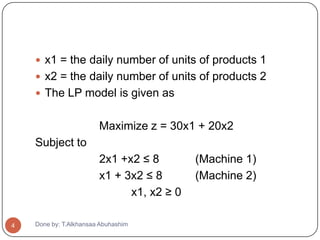
 x1 = the daily number of units of products 1
     x2 = the daily number of units of products 2
     The LP model is given as


                        Maximize z = 30x1 + 20x2
    Subject to
                        2x1 +x2 ≤ 8        (Machine 1)
                        x1 + 3x2 ≤ 8       (Machine 2)
                              x1, x2 ≥ 0

4   Done by: T.Alkhansaa Abuhashim
First: change in resources
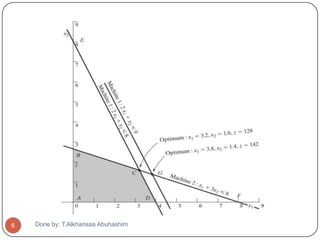
     If the daily capacity is increased from 8 hours to 9
       hours, the new optimum will occur at point G. The
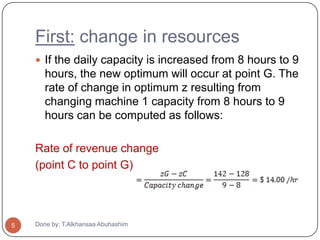
       rate of change in optimum z resulting from
       changing machine 1 capacity from 8 hours to 9
       hours can be computed as follows:

    Rate of revenue change
    (point C to point G)


5   Done by: T.Alkhansaa Abuhashim
6   Done by: T.Alkhansaa Abuhashim
Shadow Price
     Dual or Shadow price/unit worth of resource: is
      the change in the optimal objective value per unit
      change in the availability of the resource.
     e.g. a unit increase (decrease) in machine l
      capacity will increase (decrease) revenue by
      $14.00


7   Done by: T.Alkhansaa Abuhashim
Feasibility Range
     We can see that the dual price of $14.00/hr remains
        valid for changes (increases or decreases) in machine
        1 capacity that move its constraint parallel to itself to
        any point on the line segment BF.
       Minimum machine 1 capacity [at B = (0, 2.67)] =
                                         2×0+1×2.67 =2.67 hr
       Maximum machine 1 capacity [at F = (8,0)] =
                                         2×8+1×0=16 hr
       The dual price of $14.001hr will remain valid for the
        range
                    2.67 hr ≤ Machine 1 capacity ≤ 16 hr
       Changes outside this range will produce a different
        dual price.

8   Done by: T.Alkhansaa Abuhashim
 You can verify that the dual price for machine 2
      capacity is $2.00/hr and it remains valid for changes
      (increases or decreases) that move its Constraint
      parallel to itself to any point on the line segment DE.
     Minimum machine 2 capacity [at D = (4, 0)] =
                                          1×4+3×0 =4 hr
     Maximum machine 2 capacity [at E = (0,8)] =
                                          1×0+3×8=24 hr
     The dual price of $2.00/hr for machine 2 will remain
      applicable for the range
                    4 hr ≤ Machine 2 capacity ≤ 24 hr

9   Done by: T.Alkhansaa Abuhashim
Second: Changes in the Objective
     Coefficients
      Changes in revenue units (i.e., objective-function
       coefficients) will change the slope of z.
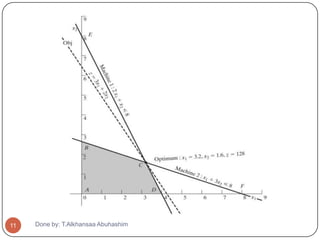
      The optimum solution will remain at point C so
       long as the objective function lies between lines
       BF and DE, the two constraints that define the
       optimum point.


10   Done by: T.Alkhansaa Abuhashim
11   Done by: T.Alkhansaa Abuhashim
 We can write the objective function in the general
        format
                 Maximize z = c1x1 + c2x2
      The optimum solution will remain at point C so
       long as z=c1x1 + c2x2 lies between the two lines
         x1+3x2 = 8
         2x1+x2 = 8
      This means that the ratio c1/c2 can vary between
        1/3 and 2/1, which yields the following condition:
            (1/3) ≤ (c1/c2) ≤ (2/1)   or
            .333 ≤ (c1/c2) ≤ 2

12   Done by: T.Alkhansaa Abuhashim
Optimality Range
      The unit revenue of product 2 is fixed at its
       current value of                     c2 = $20.00.
       The associated range for c1:
                    [remember: (1/3) ≤ (c1/c2) ≤ (2/1)]
           (1/3) × 20 ≤ c1 ≤ 2 × 20        or
           6.67 ≤ c1 ≤ 40
      Similarly, if we fix the value of c1 at $30.00
           c2 ≤ 30×3 and c2 ≥ (30/2)             or
           15 ≤ c2 ≤ 90


13   Done by: T.Alkhansaa Abuhashim
 Suppose that the unit revenues for products 1
        and 2 are changed to $35 and $25, respectively.
              Will the optimum remain the same?

      The new objective function is
              Maximize z = 35x1 + 25x2

      The solution will remain optimal :
      c1/c2 = 35/ 25= 1.4  within the optimality range
       (.333,2)

14   Done by: T.Alkhansaa Abuhashim

P2 ch03 2

  • 1.
    Kingdom Of SaudiArabia Al-Imam Muhammad Ibn Saud Islamic University College of Computer and Information Sciences Information System Department IS 332: Decision Support System Simplex Method and Sensitivity Analysis From “Operations Research: An Introduction” Book Chapter 3 1 Done by: T.Alkhansaa Abuhashim
  • 2.
    Sensitivity Analysis  In LP, the parameters (input data) of the model can change within certain limits without causing the optimum solution to change. This is referred to as sensitivity analysis. Graphical Sensitivity Analysis:  Two cases will be considered:  Sensitivity of the optimum solution to changes in the availability of the resources (right-hand side of the constraints)  Sensitivity of the optimum solution to changes in unit profit or unit cost (coefficients of the objective function) 2 Done by: T.Alkhansaa Abuhashim
  • 3.
    Changes in theRight-Hand Side  JOBCO produces two products on two machines. A unit of product 1 requires 2 hours on machine 1 and 1 hour on machine 2. For product 2, a unit requires 1 hour on machine 1 and 3 hours on machine 2. The revenues per unit of products 1 and 2 are $30 and $20, respectively. The total daily processing time available for each machine is 8 hours. 3 Done by: T.Alkhansaa Abuhashim
  • 4.
     x1 =the daily number of units of products 1  x2 = the daily number of units of products 2  The LP model is given as Maximize z = 30x1 + 20x2 Subject to 2x1 +x2 ≤ 8 (Machine 1) x1 + 3x2 ≤ 8 (Machine 2) x1, x2 ≥ 0 4 Done by: T.Alkhansaa Abuhashim
  • 5.
    First: change inresources  If the daily capacity is increased from 8 hours to 9 hours, the new optimum will occur at point G. The rate of change in optimum z resulting from changing machine 1 capacity from 8 hours to 9 hours can be computed as follows: Rate of revenue change (point C to point G) 5 Done by: T.Alkhansaa Abuhashim
  • 6.
    6 Done by: T.Alkhansaa Abuhashim
  • 7.
    Shadow Price  Dual or Shadow price/unit worth of resource: is the change in the optimal objective value per unit change in the availability of the resource.  e.g. a unit increase (decrease) in machine l capacity will increase (decrease) revenue by $14.00 7 Done by: T.Alkhansaa Abuhashim
  • 8.
    Feasibility Range  We can see that the dual price of $14.00/hr remains valid for changes (increases or decreases) in machine 1 capacity that move its constraint parallel to itself to any point on the line segment BF.  Minimum machine 1 capacity [at B = (0, 2.67)] = 2×0+1×2.67 =2.67 hr  Maximum machine 1 capacity [at F = (8,0)] = 2×8+1×0=16 hr  The dual price of $14.001hr will remain valid for the range 2.67 hr ≤ Machine 1 capacity ≤ 16 hr  Changes outside this range will produce a different dual price. 8 Done by: T.Alkhansaa Abuhashim
  • 9.
     You canverify that the dual price for machine 2 capacity is $2.00/hr and it remains valid for changes (increases or decreases) that move its Constraint parallel to itself to any point on the line segment DE.  Minimum machine 2 capacity [at D = (4, 0)] = 1×4+3×0 =4 hr  Maximum machine 2 capacity [at E = (0,8)] = 1×0+3×8=24 hr  The dual price of $2.00/hr for machine 2 will remain applicable for the range 4 hr ≤ Machine 2 capacity ≤ 24 hr 9 Done by: T.Alkhansaa Abuhashim
  • 10.
    Second: Changes inthe Objective Coefficients  Changes in revenue units (i.e., objective-function coefficients) will change the slope of z.  The optimum solution will remain at point C so long as the objective function lies between lines BF and DE, the two constraints that define the optimum point. 10 Done by: T.Alkhansaa Abuhashim
  • 11.
    11 Done by: T.Alkhansaa Abuhashim
  • 12.
     We canwrite the objective function in the general format Maximize z = c1x1 + c2x2  The optimum solution will remain at point C so long as z=c1x1 + c2x2 lies between the two lines  x1+3x2 = 8  2x1+x2 = 8  This means that the ratio c1/c2 can vary between 1/3 and 2/1, which yields the following condition: (1/3) ≤ (c1/c2) ≤ (2/1) or .333 ≤ (c1/c2) ≤ 2 12 Done by: T.Alkhansaa Abuhashim
  • 13.
    Optimality Range  The unit revenue of product 2 is fixed at its current value of c2 = $20.00. The associated range for c1: [remember: (1/3) ≤ (c1/c2) ≤ (2/1)] (1/3) × 20 ≤ c1 ≤ 2 × 20 or 6.67 ≤ c1 ≤ 40  Similarly, if we fix the value of c1 at $30.00 c2 ≤ 30×3 and c2 ≥ (30/2) or 15 ≤ c2 ≤ 90 13 Done by: T.Alkhansaa Abuhashim
  • 14.
     Suppose thatthe unit revenues for products 1 and 2 are changed to $35 and $25, respectively. Will the optimum remain the same?  The new objective function is Maximize z = 35x1 + 25x2  The solution will remain optimal : c1/c2 = 35/ 25= 1.4  within the optimality range (.333,2) 14 Done by: T.Alkhansaa Abuhashim