Preparative HPLC
PreparativeHPLC (P-HPLC) –a technique used to isolate and purify relatively large
quantities of a target compound from a sample.
The prep. HPLC is mainly used to isolate the maximum amount of analyte of interest at a
desired purity in a short period.
Preparative HPLC generally operates with high sample concentrations and volumes necessary
for analytical applications, making detector selectivity and sensitivity less critical factors.
3.
It is themethod employed to separate, identify, and measure components in a liquid
mixture, primarily aimed at analyzing small sample quantities for qualitative and
quantitative assessment.
Analytical HPLC
4.
Principle - Adsorption.
InP-HPLC, the analyte of interest is collected in a fraction collector after the detection by the detector.
Comparison between HPLC and P- HPLC
Solvent reservoir:
PreparativeHPLC utilizes large-capacity reservoirs (up to several gallons).
These reservoirs are typically constructed from glass or stainless steel.
The choice of material depends on the nature of the sample.
For biologically sensitive compounds, biocompatible materials are preferred.
7.
Pump:
Preparative HPLCoperates at a high eluent flow rate, requiring columns with a larger
internal diameter.
The typical flow rate ranges from 10 to 100 ml/min, while larger columns may
necessitate flow rates of 500 ml to 1 liter per minute.
To accommodate these high flow rates and large volumes, analytical pumps are
modified accordingly.
The key adaptation involves using a larger piston head and an expanded liquid-filled
chamber to facilitate the increased pumping capacity.
8.
Preparative injector:
ARheodyne injector, also known as a rotary sampling valve, is designed to introduce
sample volumes ranging from 0.1 to 100 ml under high-pressure conditions,
reaching up to 4000 psi.
Its operation consists of four distinct steps.
9.
Preparative column:
Thecolumn plays a crucial role in establishing a
reproducible preparative HPLC method.
It must withstand the high inlet pressure required
to achieve the necessary flow rate. The
performance of a preparative column is influenced
by the particle size of the packing material.
Due to the wider design of preparative columns, a
sample distribution plate is incorporated to ensure
even sample dispersion across the column.
This plate consists of a disc featuring radial slots for
effective distribution.
10.
Preparative columnpacking:
The selection of a packing technique for preparative columns depends on factors such
as the particle size of the packing material, the scale of preparation, and the nature of
the substances being separated.
Preparative columns can be packed using either dry packing or slurry packing methods.
To prevent the packed bed from resettling, the packing pressure must be at least twice
the working pressure.
For effective packing of preparative HPLC columns, pressures of up to 650 bar (9500
psi) are required.
2 methods- dry packing & Slurry packing.
11.
Dry packing:
Drypacking is used when the particle size of the packing
material is more than 20 µm.
It can be packed with tapping or with sonic vibrations.
Slurry packing:
When the packing material has a particle size of less than 20
µm, liquid chromatographic columns are packed using a slurry
method.
The slurry is prepared by dispersing 2.2 g of silica in an
appropriate solvent, such as dibromomethane,
tetrachloroethylene, carbon tetrachloride, or diiodomethane.
12.
Preparative HPLCcolumns packed with slurry must not be operated at pressures
exceeding the bursting strength of the column tube.
Once prepared, the slurry is transferred to the packing reservoir.
The reservoir is then connected to a pump, where flow rate and pressure settings are
adjusted based on the column’s diameter and length.
The column is detached once it is tightly packed, and the packing is secured with proper
sealing.
.
13.
Column packing techniques:
Radialcompression packing:
In this method, the column walls must be flexible,
and the packing is done within a tubular polymer
cartridge.
This cartridge is then inserted into a stainless steel
cylindrical column.
The column is filled with a dense slurry of the
packing material and sealed with an appropriate
material.
Pressure, either pneumatic or hydraulic, is applied
externally to the polymer cartridge walls,
compressing the packed bed radially.
The radial compression technique is typically used
for columns with diameters of up to 20 cm.
14.
Longitudinal/axial compression packing:
Axial compression packing is an alternative technique for
column packing, particularly suitable for columns with
larger diameters.
This method is highly efficient for column packing.
In this technique, the column contains a piston that can
move along its entire length.
The mobile phase flows through channels located at the
center, which are connected to the detector and then to
the fraction collector.
15.
Once thepacking process is complete, the piston is withdrawn from the bottom
of the column.
The length of the packed bed is determined by the quantity of packing material
used.
The application of this technique in preparative chromatography has significantly
increased.
It is particularly beneficial for processing expensive substances, such as antibiotics
and other biotechnology-derived products, in kilogram-scale or larger quantities
16.
Detector:
Preparative chromatographicdetectors typically have minimal specifications
since high sensitivity is not required due to the large sample sizes and high
solute concentrations in the eluent.
Analytical detectors can also be utilized for preparative applications.
In preparative HPLC, the sample must be diluted with a substantial volume of
the mobile phase before passing through the detector.
17.
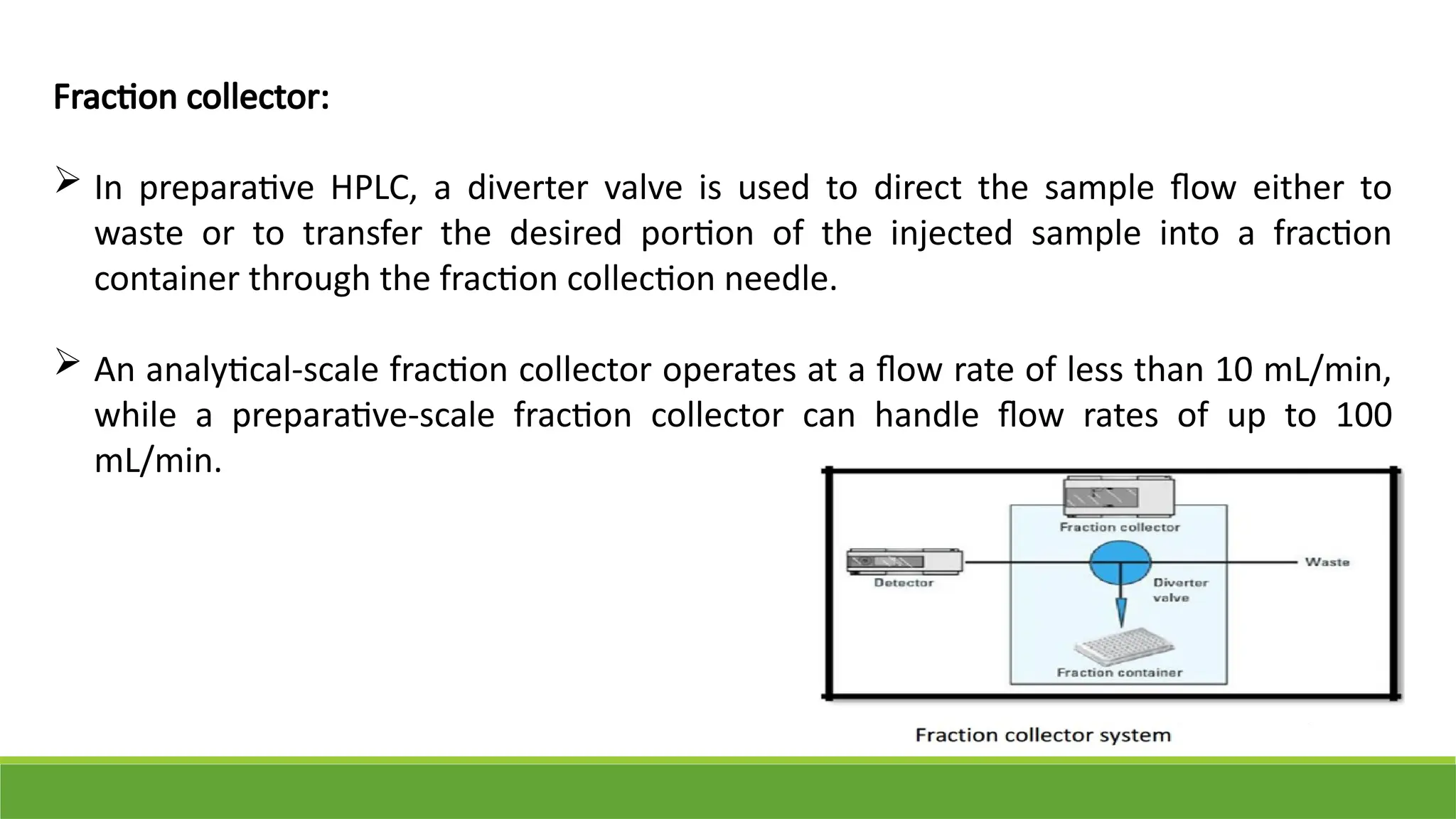
Fraction collector:
Inpreparative HPLC, a diverter valve is used to direct the sample flow either to
waste or to transfer the desired portion of the injected sample into a fraction
container through the fraction collection needle.
An analytical-scale fraction collector operates at a flow rate of less than 10 mL/min,
while a preparative-scale fraction collector can handle flow rates of up to 100
mL/min.
18.
Fraction collection methods
Nameof the method Mechanism involved
Manual fraction collection the diverter valve is switched manually.
Time-based fraction collection It involves the collection of desired analyte at specific time intervals during a
purification process.
Peak-based fraction collection the collection of fraction based on a detector signal.
Mass-based fraction collection It involves collecting fractions based on the target mass set by the user, as
determined by the mass detector.
19.
APPLICATIONS:
Purification in medicinalor high-throughput chemistry:
P-HPLC is widely used for the purification of newly synthesized compounds
before testing for activity. When the structures of the synthesized compounds are
known, mass-based fraction collection is the preferred purification method.
Purification of compounds in natural product chemistry:
The preparative HPLC process is utilized to separate and purify individual
components from a crude extract mixture.
Purification of by-products formed during impurity analysis:
In preparative HPLC, a larger amount of starting material is needed, so
the purification process is optimized to separate impurities clearly from the
main compound.
20.
Recovery collection:
Inpreparative HPLC analysis, it is essential to collect all fractions of a sample at a
specific location, a process known as recovery collection. A diverter valve is employed to
separate the fraction of interest from the waste material. These collected fractions serve
as a safeguard in case of an analytical run failure, making recovery collection highly
valuable for reanalysis.
21.
Miscellaneous applications:
preparativeHPLC is used in the pharmaceutical industry, to study drug stability
and for quality control analysis.
Preparative HPLC is used in the purification of compounds in natural product
chemistry.
Micropurification and purity analysis of several different classes of compounds
can be performed using preparative HPLC and pure compounds can be further
used for advanced studies.
Preparative HPLC is used in the purification of by-products arising from the
analysis of impurities.
Preparative HPLC is used in clinical testing for antibodies, urea and bilirubin.
Preparative HPLC is used to determine contamination and water pollution in
environmental analysis.
Preparative HPLC is used in forensic analysis to quantify drugs and poisons in
body fluids






![Gagandutt sharma(HPLC) [Pharmaceutics].pdf](https://cdn.slidesharecdn.com/ss_thumbnails/gaganduttsharmahplcpharmaceutics-231228113552-2e6d34b5-thumbnail.jpg?width=640&height=640&fit=bounds)


