Choice of Oxygenators and Patient
Outcome
Jinil Raj T S
Fortis Hospital
Mumbai
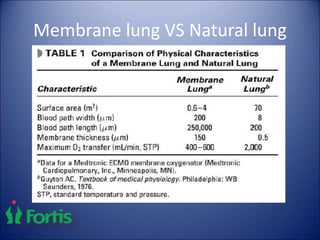
Membrane lung VS Natural lung
What harm an Oxygenator does?
• Hemodilution and allogenic transfusion
• Trauma to blood cells
• SIRS
• GME
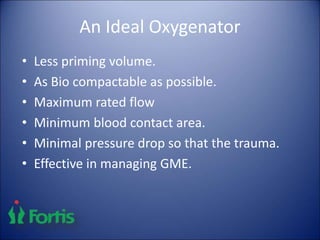
An Ideal Oxygenator
• Less priming volume.
• As Bio compactable as possible.
• Maximum rated flow
• Minimum blood contact area.
• Minimal pressure drop so that the trauma.
• Effective in managing GME.
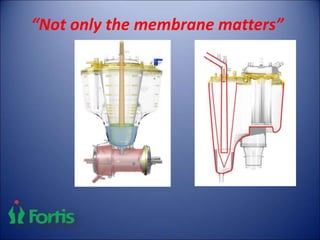
“Not only the membrane matters”
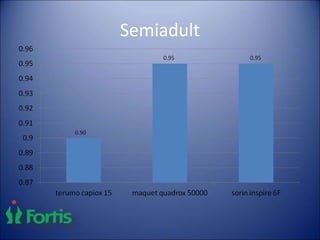
Semi Adult
• Sorin Inspire 6F
• Maquet Quadrox 50000
• Terumo RX15
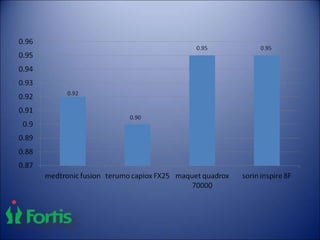
Adult
• Inspire adult 8F
• Maquet Quadrox 70000
• Terumo RX 25
• Medtronic fusion
• Medos Hilite 7000
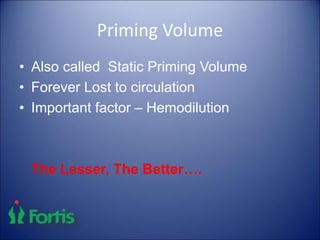
Priming Volume
• Also called Static Priming Volume
• Forever Lost to circulation
• Important factor – Hemodilution
The Lesser, The Better….
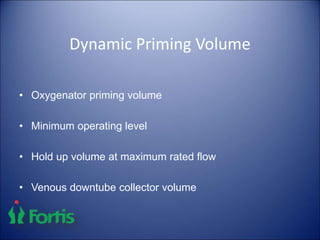
Dynamic Priming Volume
• Oxygenator priming volume
• Minimum operating level
• Hold up volume at maximum rated flow
• Venous downtube collector volume
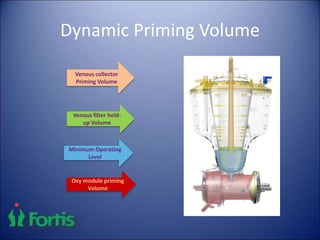
Dynamic Priming Volume
Oxy module priming
Volume
Minimum Operating
Level
Venous filter hold-
up Volume
Venous collector
Priming Volume
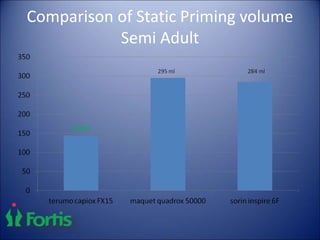
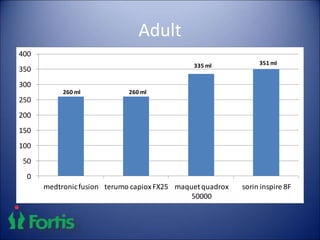
Comparison of Static Priming volume
Semi Adult
Adult
0
50
100
150
200
250
300
350
400
medtronicfusion terumo capioxFX25 maquetquadrox
50000
sorin inspire 8F
260 ml 260 ml
335 ml 351 ml
Membrane Surface Area
• Signifies area available for gas exchange
• Area of contact of blood with oxygenating surface
• Gas Exchange – Diffusion
• Aggregation of formed elements
• Potential source of SIRS
• Physiological Coating in most Oxygenators
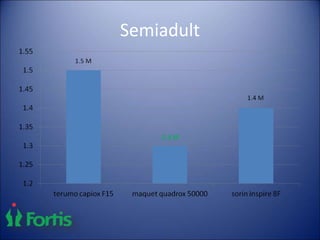
Semiadult
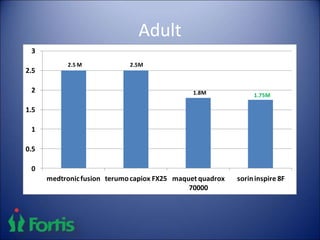
Adult
0
0.5
1
1.5
2
2.5
3
medtronicfusion terumocapiox FX25 maquet quadrox
70000
sorininspire 8F
2.5 M 2.5M
1.8M 1.75M
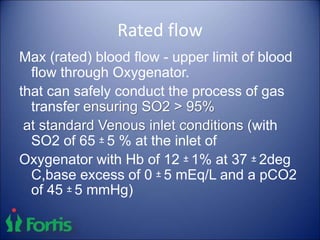
Rated flow
Max (rated) blood flow - upper limit of blood
flow through Oxygenator.
that can safely conduct the process of gas
transfer ensuring SO2 > 95%
at standard Venous inlet conditions (with
SO2 of 65 ± 5 % at the inlet of
Oxygenator with Hb of 12 ± 1% at 37 ± 2deg
C,base excess of 0 ± 5 mEq/L and a pCO2
of 45 ± 5 mmHg)
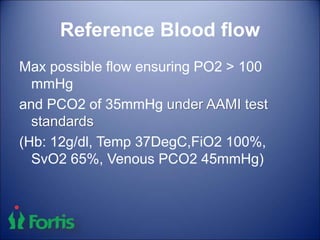
Reference Blood flow
Max possible flow ensuring PO2 > 100
mmHg
and PCO2 of 35mmHg under AAMI test
standards
(Hb: 12g/dl, Temp 37DegC,FiO2 100%,
SvO2 65%, Venous PCO2 45mmHg)
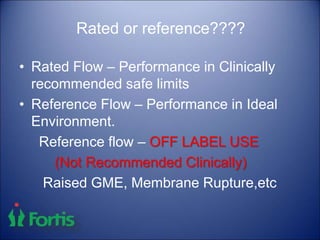
Rated or reference????
• Rated Flow – Performance in Clinically
recommended safe limits
• Reference Flow – Performance in Ideal
Environment.
Reference flow – OFF LABEL USE
(Not Recommended Clinically)
Raised GME, Membrane Rupture,etc
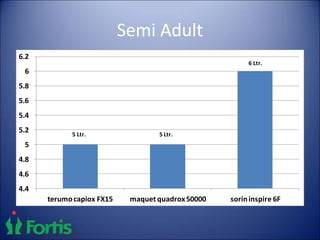
Semi Adult
4.4
4.6
4.8
5
5.2
5.4
5.6
5.8
6
6.2
terumocapiox FX15 maquet quadrox50000 sorininspire 6F
5 Ltr. 5 Ltr.
6 Ltr.
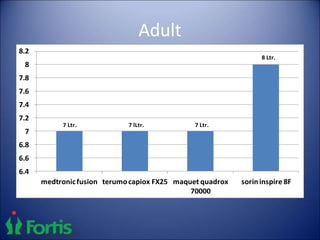
Adult
6.4
6.6
6.8
7
7.2
7.4
7.6
7.8
8
8.2
medtronicfusion terumocapiox FX25 maquet quadrox
70000
sorininspire 8F
7 Ltr. 7 lLtr. 7 Ltr.
8 Ltr.
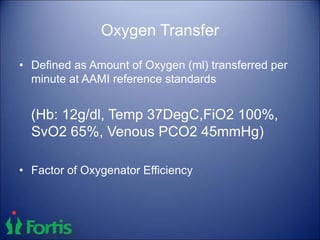
Oxygen Transfer
• Defined as Amount of Oxygen (ml) transferred per
minute at AAMI reference standards
(Hb: 12g/dl, Temp 37DegC,FiO2 100%,
SvO2 65%, Venous PCO2 45mmHg)
• Factor of Oxygenator Efficiency
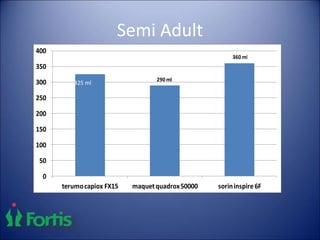
Semi Adult
0
50
100
150
200
250
300
350
400
terumocapiox FX15 maquetquadrox50000 sorininspire6F
290 ml
360 ml
325 ml
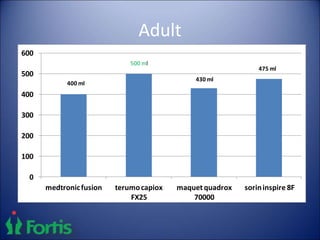
Adult
0
100
200
300
400
500
600
medtronicfusion terumocapiox
FX25
maquet quadrox
70000
sorininspire 8F
400 ml
500 ml
430 ml
475 ml
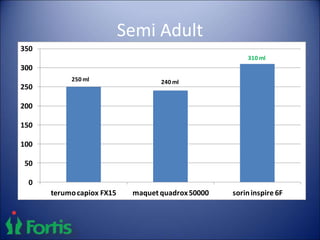
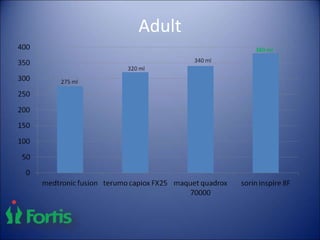
CO2 transfer
• Defined as the amount of CO2 (ml) transferred
per minute of flow under AAMI reference
standards
(Hb: 12g/dl, Temp 37DegC,FiO2 100%, SvO2 65%, Venous
PCO2 45mmHg)
• Another marker of Oxygenator efficiency
Semi Adult
0
50
100
150
200
250
300
350
terumocapiox FX15 maquet quadrox50000 sorininspire 6F
250 ml 240 ml
310 ml
Adult
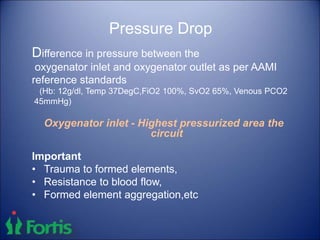
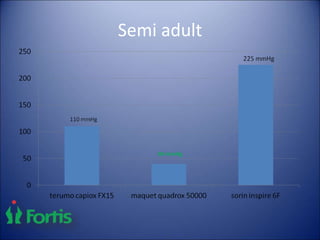
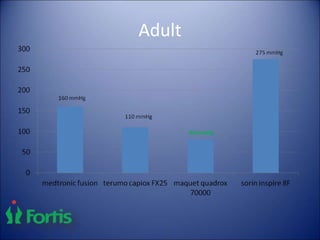
Pressure Drop
Difference in pressure between the
oxygenator inlet and oxygenator outlet as per AAMI
reference standards
(Hb: 12g/dl, Temp 37DegC,FiO2 100%, SvO2 65%, Venous PCO2
45mmHg)
Oxygenator inlet - Highest pressurized area the
circuit
Important
• Trauma to formed elements,
• Resistance to blood flow,
• Formed element aggregation,etc
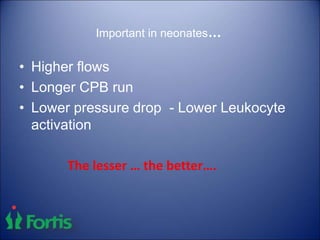
Important in neonates…
• Higher flows
• Longer CPB run
• Lower pressure drop - Lower Leukocyte
activation
The lesser … the better….
Semi adult
Adult
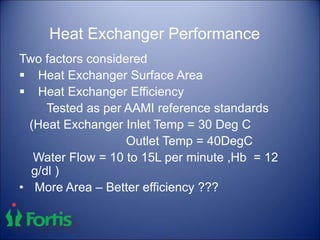
Heat Exchanger Performance
Two factors considered
 Heat Exchanger Surface Area
 Heat Exchanger Efficiency
Tested as per AAMI reference standards
(Heat Exchanger Inlet Temp = 30 Deg C
Outlet Temp = 40DegC
Water Flow = 10 to 15L per minute ,Hb = 12
g/dl )
• More Area – Better efficiency ???
Semiadult
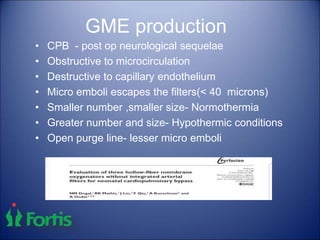
GME production
• CPB - post op neurological sequelae
• Obstructive to microcirculation
• Destructive to capillary endothelium
• Micro emboli escapes the filters(< 40 microns)
• Smaller number ,smaller size- Normothermia
• Greater number and size- Hypothermic conditions
• Open purge line- lesser micro emboli
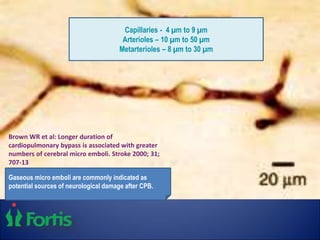
Capillaries - 4 µm to 9 µm
Arterioles – 10 µm to 50 µm
Metarterioles – 8 µm to 30 µm
Gaseous micro emboli are commonly indicated as
potential sources of neurological damage after CPB.
Brown WR et al: Longer duration of
cardiopulmonary bypass is associated with greater
numbers of cerebral micro emboli. Stroke 2000; 31;
707-13
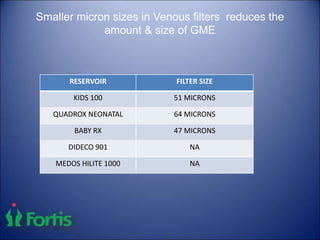
Smaller micron sizes in Venous filters reduces the
amount & size of GME
RESERVOIR FILTER SIZE
KIDS 100 51 MICRONS
QUADROX NEONATAL 64 MICRONS
BABY RX 47 MICRONS
DIDECO 901 NA
MEDOS HILITE 1000 NA
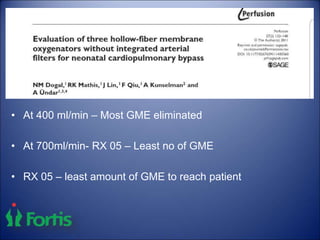
• At 400 ml/min – Most GME eliminated
• At 700ml/min- RX 05 – Least no of GME
• RX 05 – least amount of GME to reach patient
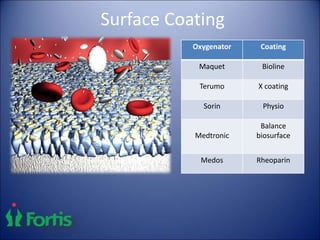
Surface Coating
Oxygenator Coating
Maquet Bioline
Terumo X coating
Sorin Physio
Medtronic
Balance
biosurface
Medos Rheoparin
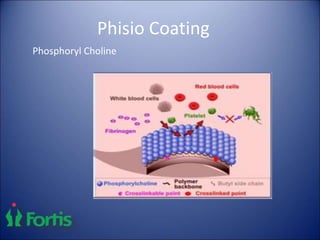
Phisio Coating
Phosphoryl Choline
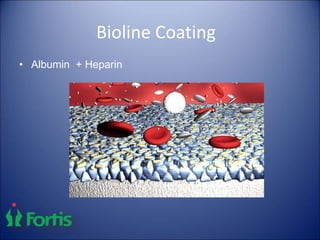
Bioline Coating
• Albumin + Heparin
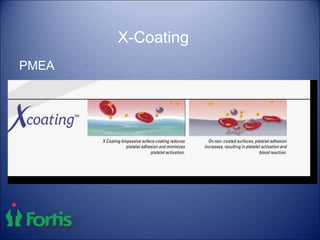
X-Coating
PMEA
Balance Biosurface
An Ideal oxygenator
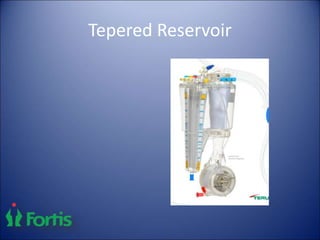
• Tepered reservoir
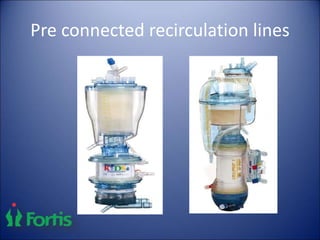
• Preconnected recirculation lines
• Orientation of holder
• Rotatable oxygenator and suction ports.
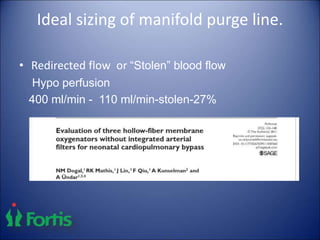
• Ideal sizing of manifold purge line.
Tepered Reservoir
Pre connected recirculation lines
Rotatable Oxygenator and suction ports
Reduce the tubing length thus
the contact surface area
Ideal sizing of manifold purge line.
• Redirected flow or “Stolen” blood flow
Hypo perfusion
400 ml/min - 110 ml/min-stolen-27%
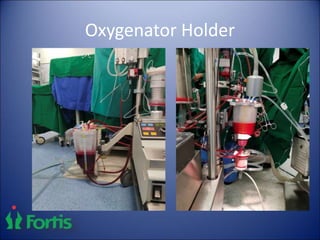
Oxygenator Holder
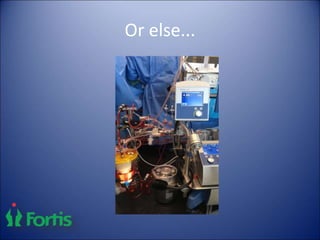
Or else...
To conclude...
“An ideal oxygenator is like an
ideal spouse”
Cannot have all qualities together

oxygenators.ppt