OXIDATION STATE
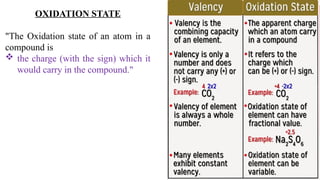
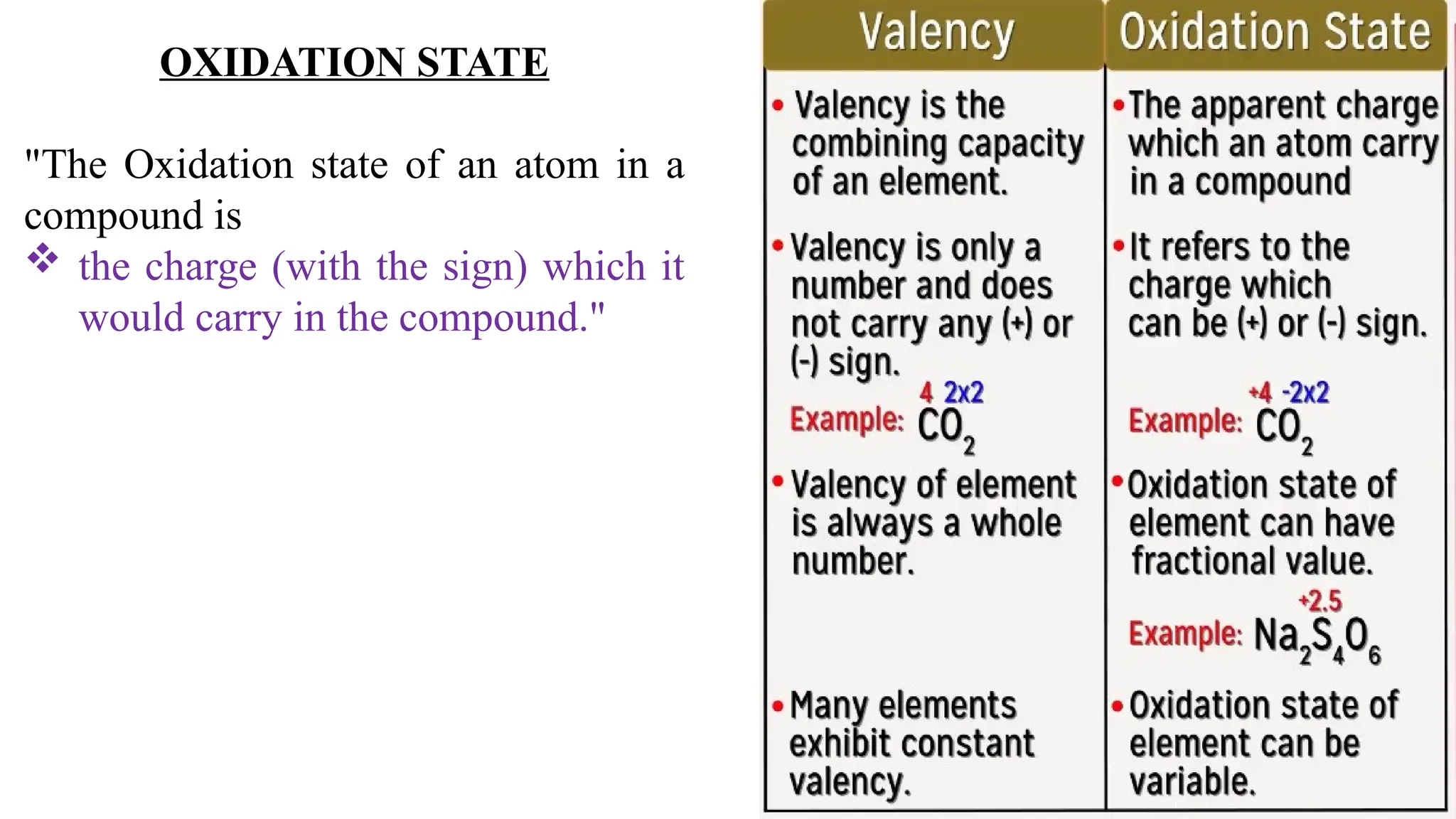
"The Oxidation state of an atom in a
compound is
 the charge (with the sign) which it
would carry in the compound."
Oxidation State
and
Nature of Species
Oxidation State and Nature of Species
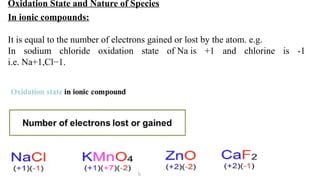
In ionic compounds:
It is equal to the number of electrons gained or lost by the atom. e.g.
In sodium chloride oxidation state of Na is +1 and chlorine is -1
i.e. Na+1,Cl−1.
Oxidation State and Nature of Species
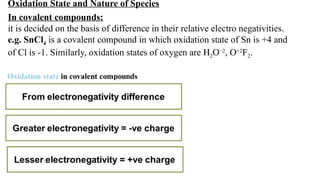
In covalent compounds:
it is decided on the basis of difference in their relative electro negativities.
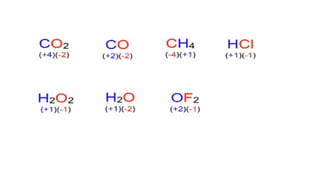
e.g. SnCl4 is a covalent compound in which oxidation state of Sn is +4 and
of Cl is -1. Similarly, oxidation states of oxygen are H2O−2
, O+2
F2.
Oxidation State and Nature of Species
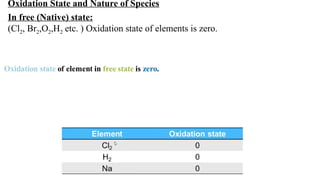
In free (Native) state:
(Cl2, Br2,O2,H2 etc. ) Oxidation state of elements is zero.
Periodic Trend
(a) Across the Period
Typical elements (Subgroup A)
The oxidation state of a typical element is directly or indirectly related to
the group number to which the element belongs in the periodic table.
The element which
belongs to s-block but
has zero oxidation state is
He
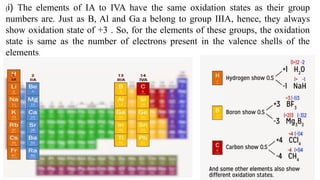
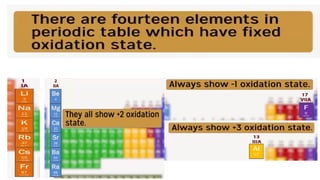
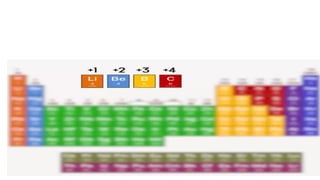
(i) The elements of IA to IVA have the same oxidation states as their group
numbers are. Just as B, Al and Ga a belong to group IIIA, hence, they always
show oxidation state of +3 . So, for the elements of these groups, the oxidation
state is same as the number of electrons present in the valence shells of the
elements.
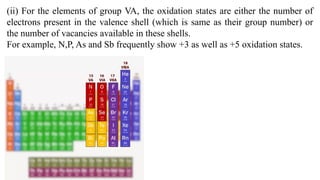
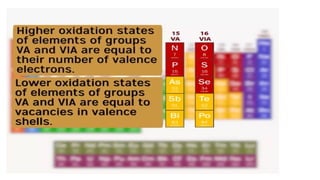
(ii) For the elements of group VA, the oxidation states are either the number of
electrons present in the valence shell (which is same as their group number) or
the number of vacancies available in these shells.
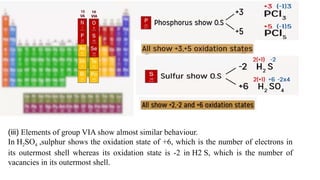
For example, N,P, As and Sb frequently show +3 as well as +5 oxidation states.
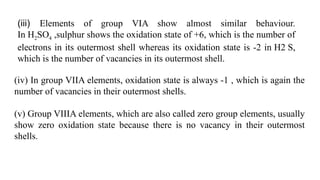
(iii) Elements of group VIA show almost similar behaviour.
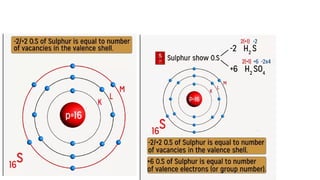
In H2SO4 ,sulphur shows the oxidation state of +6, which is the number of electrons in
its outermost shell whereas its oxidation state is -2 in H2 S, which is the number of
vacancies in its outermost shell.
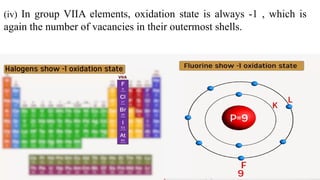
(iv) In group VIIA elements, oxidation state is always -1 , which is
again the number of vacancies in their outermost shells.
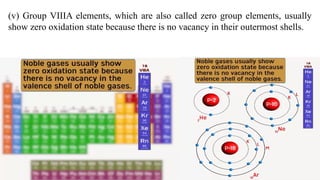
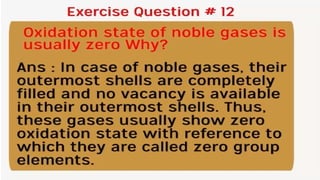
(v) Group VIIIA elements, which are also called zero group elements, usually
show zero oxidation state because there is no vacancy in their outermost shells.
(iii) Elements of group VIA show almost similar behaviour.
In H2SO4 ,sulphur shows the oxidation state of +6, which is the number of
electrons in its outermost shell whereas its oxidation state is -2 in H2 S,
which is the number of vacancies in its outermost shell.
(iv) In group VIIA elements, oxidation state is always -1 , which is again the
number of vacancies in their outermost shells.
(v) Group VIIIA elements, which are also called zero group elements, usually
show zero oxidation state because there is no vacancy in their outermost
shells.
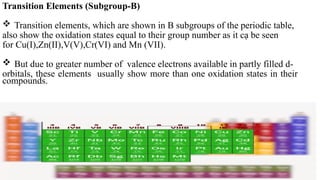
Transition Elements (Subgroup-B)
 Transition elements, which are shown in B subgroups of the periodic table,
also show the oxidation states equal to their group number as it cạ be seen
for Cu(I),Zn(II),V(V),Cr(VI) and Mn (VII).
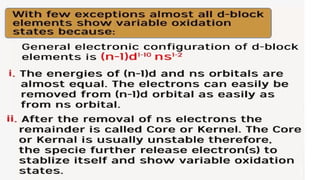
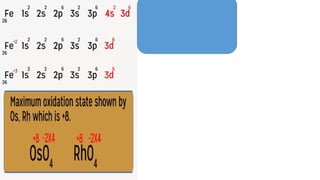
 But due to greater number of valence electrons available in partly filled d-
orbitals, these elements usually show more than one oxidation states in their
compounds.
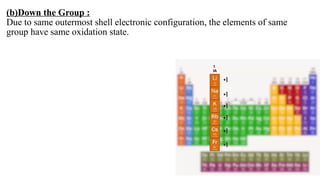
(b)Down the Group :
Due to same outermost shell electronic configuration, the elements of same
group have same oxidation state.
Oxidation state, Valency and Oxidation Number

Oxidation state, Valency and Oxidation Number

  • 1.
    OXIDATION STATE "The Oxidationstate of an atom in a compound is  the charge (with the sign) which it would carry in the compound."
  • 5.
  • 6.
    Oxidation State andNature of Species In ionic compounds: It is equal to the number of electrons gained or lost by the atom. e.g. In sodium chloride oxidation state of Na is +1 and chlorine is -1 i.e. Na+1,Cl−1.
  • 7.
    Oxidation State andNature of Species In covalent compounds: it is decided on the basis of difference in their relative electro negativities. e.g. SnCl4 is a covalent compound in which oxidation state of Sn is +4 and of Cl is -1. Similarly, oxidation states of oxygen are H2O−2 , O+2 F2.
  • 9.
    Oxidation State andNature of Species In free (Native) state: (Cl2, Br2,O2,H2 etc. ) Oxidation state of elements is zero.
  • 10.
    Periodic Trend (a) Acrossthe Period Typical elements (Subgroup A) The oxidation state of a typical element is directly or indirectly related to the group number to which the element belongs in the periodic table. The element which belongs to s-block but has zero oxidation state is He
  • 11.
    (i) The elementsof IA to IVA have the same oxidation states as their group numbers are. Just as B, Al and Ga a belong to group IIIA, hence, they always show oxidation state of +3 . So, for the elements of these groups, the oxidation state is same as the number of electrons present in the valence shells of the elements.
  • 12.
    (ii) For theelements of group VA, the oxidation states are either the number of electrons present in the valence shell (which is same as their group number) or the number of vacancies available in these shells. For example, N,P, As and Sb frequently show +3 as well as +5 oxidation states.
  • 13.
    (iii) Elements ofgroup VIA show almost similar behaviour. In H2SO4 ,sulphur shows the oxidation state of +6, which is the number of electrons in its outermost shell whereas its oxidation state is -2 in H2 S, which is the number of vacancies in its outermost shell.
  • 16.
    (iv) In groupVIIA elements, oxidation state is always -1 , which is again the number of vacancies in their outermost shells.
  • 17.
    (v) Group VIIIAelements, which are also called zero group elements, usually show zero oxidation state because there is no vacancy in their outermost shells.
  • 19.
    (iii) Elements ofgroup VIA show almost similar behaviour. In H2SO4 ,sulphur shows the oxidation state of +6, which is the number of electrons in its outermost shell whereas its oxidation state is -2 in H2 S, which is the number of vacancies in its outermost shell. (iv) In group VIIA elements, oxidation state is always -1 , which is again the number of vacancies in their outermost shells. (v) Group VIIIA elements, which are also called zero group elements, usually show zero oxidation state because there is no vacancy in their outermost shells.
  • 20.
    Transition Elements (Subgroup-B) Transition elements, which are shown in B subgroups of the periodic table, also show the oxidation states equal to their group number as it cạ be seen for Cu(I),Zn(II),V(V),Cr(VI) and Mn (VII).  But due to greater number of valence electrons available in partly filled d- orbitals, these elements usually show more than one oxidation states in their compounds.
  • 25.
    (b)Down the Group: Due to same outermost shell electronic configuration, the elements of same group have same oxidation state.